Primary Options for Acute Care - Information Manual 2018 - Central PHO
←
→
Page content transcription
If your browser does not render page correctly, please read the page content below
Primary
Options for
Acute Care
Information Manual

2018
1

                                  TABLE OF CONTENTS

                                                                                     Page
ACUTE DEMAND TEAM CONTACT DETAILS…………………………………………………………………                            2
ABOUT THE POAC PROGRAMME ……………………………………………………………………………….                              3
ELIGIBILITY…………………………………………………………………………………………………………………                                4
ACC FUNDING AND POAC…………………………………………………………………………………………..                              4
COLLABORATIVE CLINICAL PATHWAYS (CCP)……………………………………………………………..                        4
POAC SERVICES………………………………………………………………………………………………………….                                5
              Practice-Based Services……………………………………………………………………….                     5
              Observation of POAC patients in practice – Guide……………………………..           5
              Diagnostic Services (Plain Film X-Ray/ DVT Ultrasound)……………………….        5
              Referrals to other POAC sites (including After Hours Care)………………….      7
              Acute Nursing Support………………………………………………………………………..                      7
              Home-based Support………………………………………………………………………….                         8
POAC SERVICE PROCESS…………………………………………………………………………………………….                              9
CLAIMING GUIDE………………………………………………………………………………………………………                                 10
ST JOHN AMBULANCE REDIRECTION PATHWAY GUIDELINES…………………………………….                       14

CLINICAL GOVERNANCE…………………………………………………………………………………………….                               17
POAC FREQUENTLY ASKED QUESTIONS…………………………………………………………………….                            18
PATIENT INFORMATION……………………………………………………………………………………………                                20
POAC BUSINESS RULES……………………………………………………………………………………………..                              21

Approved by: Acute Demand Team Date of Issue: Updated March 2018                   Version: 4
2
ACUTE DEMAND TEAM CONTACT DETAILS
Mobile: 027 274 8106
Email: POAC@midcentraldhb.govt.nz
Key Contacts
Clinical Director Acute Care
Dr. Paul Cooper
Paul.Cooper@centralpho.org.nz
Ph. (06) 354 9107
Clinical Nurse Specialist Lead - Acute Care
Beth McPherson
beth.mcpherson@midcentraldhb.govt.nz
Ph. (06) 350 4557
Project Support Officer Collaborative Clinical Pathways
Kim Vardon
kim.vardon@centralpho.org.nz
Ph. (06) 560 3367
Approved by: Acute Demand Team Date of Issue: Updated March 2018 Version: 43
ABOUT POAC
Primary Options for Acute Care (POAC) is a patient centred service which enables General Practice
Teams (GPT) to safely manage acute illness, by accessing an increased range of specified services in the
community. This service provides an alternative to referring patients to hospital who would otherwise
be sent to the Emergency Department (ED). The aim of POAC is to simplify arrangements for acute care
in the community by providing funded care options which are aligned, wherever possible with
Collaborative Clinical Pathways (CCP).
The service has been specifically designed to:
increase management of acute illness in the community thereby decreasing numbers presenting
acutely to hospital
enable primary care providers to maximise the management of patients in the community
make the best use of available resources within the current workforce
integration of primary and secondary services
link with other community services that support the overall purpose
improve patient experience by providing care closer to home
A range of services are accessible through POAC, these include:
Diagnostic procedures, e.g. DVT Ultrasound, Plain Film X-Ray, Urgent Bloods
Extended services within the GP surgery (GP/NP/nurse consults, procedures e.g. incision and
drainage, intravenous therapy)
GP/ NP or nurse home visits
Referral to Accident and Medical Centre
Home-based Support (Personal Care)
Acute Registered Nurse assessment and management (Recovery at Home service)
Patient observation
POAC funding is obtainable by completing the electronic a POAC claim form within 30 days of
completing the episode of care.
While the Doctor or Nurse Practitioner takes full clinical responsibility of their patients who enter into
the POAC service, the POAC team will be undertaking regular retrospective clinical audit and case review
on specified POAC cases as triggered through the Continuous Quality Improvement (CQI) process.
Through this process, feedback will be provided to sites in order to ensure consistency, eligibility criteria
are adhered to and that the case was appropriate for POAC.
General Criteria
Patient is safely maintained
Patient ≥ 16 years of age. Only exception is when specified POAC pathways for children are used
Patient would otherwise have been referred acutely to hospital in the MidCentral DHB region
Services are not funded through another funding stream
Patient is resident in NZ, UK or Australia or has a working visa with a continuous stay of two
years or more
Approved by: Acute Demand Team Date of Issue: Updated March 2018 Version: 44
ELIGIBILITY
To be eligible for POAC services, the following criterion applies:
Patient ≥ 16 years of age. Only exception is when specified POAC pathways for children are used
The patient is acutely unwell and has been assessed as clinically safe and appropriate to be
managed in the community
The patient has given his/ her consent to the recommended treatment
The patient has given his/ her consent to their clinical consultation notes being used for auditing
and evaluation purposes as part of the data collection process for the POAC
The patient is eligible to access funded New Zealand health care services
The clinician is able to take responsibility for the patients care, or have handed over the patient
to another clinician
The clinician can confirm that in their opinion the patient would otherwise have been referred
acutely to hospital
Considerations when initiating a POAC episode include:
* Other applicable funding streams (e.g. ACC, maternity, private insurance) should be used in the
first instance
* If referring for Recovery at Home services (R@H), the patient must be >16 years old
ACC FUNDING AND POAC
ACC cases should be treated and claimed through ACC as per normal processes. POAC funding applies
only under the following circumstances:
If there is a history of injury then all investigations and treatment should be claimed under ACC in
the first instance e.g. DVT, Head injury requiring observation
Surcharges for medical treatment or diagnostic services will be funded as covered in the claiming
guide
All cases claimed under POAC will need to be identified as ACC and the case number must be
documented on the POAC electronic advanced claiming form and submitted within 30 days
COLLABORATIVE CLINICAL PATHWAYS (CCP)
Pathways have been developed for key conditions to support GPTs to manage patient care in the
community, and additional pathways continue to be developed in collaboration with local clinicians
based on the most up to date evidenced based practice.
The CCPs are published to Map of Medicine. Map of Medicine is a web-based application, and is
accessible via http://app.mapofmedicine.com. Alternatively, Map of Medicine can be launched within
Medtech via the Connected Care tab. A username and password is required for Map of Medicine.
Contact the CCP Team at clincalpathways@midcentraldhb.govt.nz to register.
Currently there are seven specific pathways which pertain to POAC. They are Cellulitis, DVT, COPD,
Acute Rehydration in Adults, Gastroenteritis in Children, Acute Heart Failure and Iron Infusion. Please
see claiming guide for specific services covered by POAC within these pathways.
Approved by: Acute Demand Team Date of Issue: Updated March 2018 Version: 45
POAC SERVICES
Practice-Based Services
Practice based services can be claimed under POAC by the initiating Doctor or Nurse Practitioner taking
clinical responsibility for the patient.
Services may include IV therapy (antibiotics/fluids), extended GP/ NP consultation, observation time,
nurse consult, incision and drainage of abscesses, and other services as required.
No prior approval is required where all other eligibility criteria are met.
Observation of POAC patients in practice - Guide
One of the key goals of the POAC service is to deliver timely, flexible and co-ordinated care which meets
the health needs of the individual needs of patients in the community setting. Under the POAC service, a
period of observation within the clinical practice setting can be claimed where it is identified that this
service can safely prevent an acute hospital attendance.
Pre-requisites
Adequate clinical space and staff resourcing available to provide patient observation of up to 3
hours
The Medical or Nurse Practitioner providing clinical oversight is on-site during the period of
observation
The Registered Nurse is present during the monitoring/ observation period
Documentation Requirements for POAC Claims
Regular observations recorded, Early Warning System (EWS) scored and actioned on appropriate
form
Evidence supplied in clinical notes showing improvement and review prior to patient discharge
If the patient is under active observation, and is likely to exceed 3 hours, a phone call to the
Emergency Department (ED) Consultant or relevant hospital-based specialty is required and
the clinical documentation must reflect the outcome of discussion
Observation not suitable under POAC:
ACC injuries except minor head injuries or observations of an older person after a fall
Adults with high or intermediate risk of coronary syndromes
Children < 16 years of age. Only exception is when specified POAC pathways for children are
used
Diagnostic Services (Plain Film X-Ray/ DVT Ultrasound)
Routine investigations should be ordered through the normal process. For POAC initiated laboratory
investigations, please ensure to annotate “POAC” on the radiology request form to indicate urgency of
turnaround.
Approved by: Acute Demand Team Date of Issue: Updated March 2018 Version: 46
The following diagnostic services are accessible under POAC. Please see table below for providers and
hours available:
Radiology Service POAC Providers
Provider Service Type Coverage Specific Area
Broadway Radiology Plain Film X-Ray PNTH, Feilding, Horowhenua
Tel: (06) 357-9079 Residents
Fax:(06) 357-9094
Website:www.broadwayradiology.co.nz
Ultrasound DVT All MDHB Residents
Radiologist hotline
(if delay in report or urgent enquires)
Cell: 021 344 922
The Palms X-ray
Tel: (06) 354 7737 Palmerston North and
Plain Film X-Ray
Fax: (06) 354 7757 Feilding Residents
Website: www.radiusmedical.co.nz
Tararua Health Group
Radiology Plain Film X-Ray and Tararua Residents
Tel: (06) 374 8497 Ultrasound DVT
www.thg.org.nz
Horowhenua Radiology
Tel: (06) 357 9079 Plain film X-Ray: Horowhenua Residents
Fax: (06) 357 9094
www.broadwayradiology.co.nz
Manawatu Ultrasound at The
Palms Palmerston North and
Tel: (06) 354 9800 Ultrasound DVT
Feilding Residents
Website:
www.manawatuultrasound.co.nz
Pacific Radiology
Tel: 06-954 2040 Palmerston North and
Ultrasound DVT
Website: Feilding Residents
www.pacificradiology.com
Referral Forms Required:
Plain Film X-Ray – General Radiology Form
Ultrasound DVT- USS form located on the Map of Medicine
*Clearly annotate ‘POAC’ on forms so provider does not charge the patient*
Approved by: Acute Demand Team Date of Issue: Updated March 2018 Version: 47
Referrals to other POAC sites (including After Hours Care)
Process for handover between sites
There may be occasions where your patient requires care from another POAC provider. In all instances,
you will need to provide a clinical handover to the receiving site. The Doctor or Nurse Practitioner who
initially refers the patient carries clinical responsibility, unless that clinician has specifically handed over
care to another Doctor or Nurse Practitioner.
The following points should be undertaken when handing over between sites while the patient is
receiving services under POAC:
The referring GP/ NP will need to make a verbal clinical handover to the provider and have the
patient accepted for treatment
Complete a POAC ‘Transfer of Care/ Handover Form’ and send a copy to the receiving site
Give a copy to the patient to take with them including any other relevant notes to the nominated
POAC provider
This process also applies when handing the patient back to their health home.
POAC Referral Centres
POAC Referral Centres are POAC sites which are accredited by the POAC programme as fulfilling the
requirements to provide more complex care. The Referral Centres will receive POAC referrals potentially
from GPTs, St John and Secondary Services (Iron Infusions only). This will enable the patient to receive
POAC services as an alternative to hospital. All POAC related care will be funded under POAC.
The POAC Referral Centres are:
- City Doctors
- The Palms Medical
- Kauri HealthCare
- Feilding Health Care (Enrolled patients only)
Acute Nursing Support in the Home
The District Nursing Service (DNS) supports (GPTs) to manage clients with acute episodes of unwellness
in the community to prevent avoidable hospital admissions. The nursing team will work in partnership
with the GPTS to enable their acutely unwell client to remain safely at home.
The DNS can provide:
Rapid response
Intensive short term support
Home based care
Close physical state monitoring
Patient education and reinforcement of GPT plan
Additional referrals to appropriate services as assessed
Criteria for referral for acute nursing support in the home includes:
Can clinical oversight be provided by GP/NP
The patient has been assessed in the last three days by a GP/NP
Approved by: Acute Demand Team Date of Issue: Updated March 2018 Version: 48
GP/NP has discussed with patient the need for further medical assessment if required
The patient is clinically stable to be managed at home (baseline observations required)
Has the patient consented to referral
Is the patient ≥ 16 years of age
For all new referrals:
1. Please call (06) 3508100 or 0800 001491
2. Fax through the relevant clinical information to the District Nursing Service on Fax. (06) 3508102
*All referrals must meet above clinical criteria and be accepted by phone prior to actioning*
Home - Base Support
For those that have an acute health event in the community and require up to four weeks of short-term
personal care service. Existing long-term packages can be topped up.
Support can include showering, dressing, medication checking/prompting (not administering),
nutritional oversight for cognitively impaired client e.g. heating up meals, guidance, prompting and
direction due to cognitive impairment and someone not initiating same, night settling for safety check
(client wellbeing, checking appliances, security etc).
Personal care can be provided from three visits per week up to three visits a day based on need.
Home-based Support (Personal Care): for patients’ ≥ 65 years
(If under 65years, please discuss with Supportlinks 0800 221 411)
Supportlinks Community Packages of Temporary Support (CPOTs):
Includes four specific packages of personal care* which are primarily morning support and cover
up to a maximum of 4 weeks:
Package No. Visits Days per week covered
A 3 visits per week Monday - Sunday
B 5 visits per week Monday - Sunday
C 7 visits per week Monday - Sunday
D 2 - 3 visits per day Monday - Sunday
*Personal care = Hygiene cares/ Medication prompts/ Nutritional oversight
Referral Process: To refer a patient, please use a Supportlinks referral form stating a request for this
support. For any patient referral enquiries please phone Supportlinks on ph. 0800 221 411
Or for any other enquiries please contact: Pauline Holland (Team Leader Supportlinks)
pauline.holland@midcentraldhb.govt.nz
Ph. (06) 3506683
Approved by: Acute Demand Team Date of Issue: Updated March 2018 Version: 49
POAC SERVICE PROCESS
NB. If your site cannot take clinical responsibility for the POAC episode, and community based treatment
could safely be provided at another POAC provider, follow handover process as outlined on page 7.
Please note:
The patient will pay for the first POAC interaction in all instances i.e. Initial consultation at
General Practice or St. John assessment including transport to General Practice
* Subsequent consultations are covered by POAC
Approved by: Acute Demand Team Date of Issue: Updated March 2018 Version: 410
CLAIMING GUIDE
Cellulitis Package of Care
(Is funded by POAC where the Adult Cellulitis Pathway has been followed - Please note all prices exclude GST unless otherwise stated)
Initial GP/NP Consultation Patient pays initial consult
(Unless transported in by ambulance)
Administration of IV Cefazolin as per Cellulitis pathway (fixed fee) $100.00/dose
Maximum of four days IV antibiotics (additional can be funded where endorsed by
Infectious Diseases Physician)
Includes GP/NP/RN time and consumables
Wound care and/or incision & drainage can be charged in addition to this fee (on-
going care once IV treatment is completed is not covered by POAC)
IV Cefazolin is not funded by POAC for any other condition
GP/NP review of cellulitis $40.00
GP/NP follow-up review and discharge (end of episode of care) $40.00
GP after hours fee (fixed fee) $20.00
An additional fee may be claimed if the patient is seen after hours
DVT Package of Care
(Is funded by POAC where the DVT Pathway has been followed - Please note all prices exclude GST unless otherwise stated)
Initial GP/NP Consultation Patient pays initial consult
(Unless transported in by ambulance)
DVT ultrasound
Please indicate on the advance form that patient has been referred for a DVT Funded via community radiology contract
ultrasound
GP/NP review post Ultrasound – Standard GP/NP consultation rate
Standard consultation rate is able to be claimed (claimed at 15 minute intervals) Incl. GST
Administration of single dose of Clexane (fixed fee)
$50.00
Includes each time administered (Maximum up to 5 doses)
Clexane Self Administration Teaching Standard RN consultation rate
Standard nurse consultation
(claimed at 15 minute intervals) Incl. GST
COPD Package of Care
(Is funded by POAC where the COPD Pathway has been followed - Please note all prices exclude GST unless otherwise stated)
Initial GP/NP Consultation Patient pays initial consult
(Unless transported in by ambulance)
GP/NP Consultation (this includes extended consults and reviews)
Charged pro-rata at clinic standard patient rate
Claim should be clearly supported with detailed clinical notes Standard GP/NP consultation
(claimed at 15 min intervals) Incl. GST
Standard consultation rate is able to be claimed
ACC Surcharges will be covered by POAC
Nurse Consult +/- Observation Time
Please calculate the total number of minutes spent $1/minute
Max 3 Hours for observation (see POAC manual for guidance if likely to exceed this)
GP Team review at 3-5 days Standard GP/NP/RN consultation rate or A&M
Standard consultation rate is able to be claimed fee (claimed at 15 minute intervals) Incl. GST
Chest x-ray Please indicate on advanced form that you referred the patient for a CXR Funded via community radiology contract
Approved by: Acute Demand Team Date of Issue: Updated March 2018 Version: 411
Acute Rehydration in Adults Package of Care
(Is funded by POAC where the Acute HF Pathway has been followed - Please note all prices exclude GST unless otherwise stated)
Initial GP/NP Consultation Patient pays initial consult
Nurse Consult +/- Observation Time $1/minute
Please calculate the total number of minutes
Max 3 Hours of observation (see POAC manual for guidance if likely to exceed this)
GP/NP Consultation (this includes extended consults and reviews)
Charged pro-rata at clinic standard patient rate
Claim should be clearly supported with detailed clinical notes Standard GP/NP consultation
(claimed at 15 min intervals)
Standard consultation rate is able to be claimed
Incl. GST
ACC Surcharges will be covered by POAC
IV Normal Saline Infusion Consumables including Cannulation procedure (fixed fee) $25
Saline is available under MPSO
Gastroenteritis in Children Package of Care
(Is funded by POAC where the Child Gastroenteritis Pathway has been followed- Please note all prices exclude GST unless otherwise stated)
Initial GP/NP Consultation Patient pays initial consult
Nurse Consult +/- Observation Time $1/minute
Please calculate the total number of minutes
Max 1 Hour of Observation (see POAC manual for guidance if likely to exceed this)
GP/NP Consultation (this includes extended consults and reviews)
Charged pro-rata at clinic standard patient rate Standard GP/NP consultation
Claim should be clearly supported with detailed clinical notes (claimed at 15 min intervals)
Standard consultation rate is able to be claimed Incl. GST
ACC Surcharges will be covered by POAC
Please note:
If patient has their first POAC contact with St. John ambulance or ED - POAC will fund initial consult at
receiving site
The POAC electronic advanced claiming form is to be used in conjunction with the POAC claiming guide
Reminder that POAC will cover the acute episode of care only (usually up to 3 – 5 days)
Approved by: Acute Demand Team Date of Issue: Updated March 2018 Version: 412
Acute Heart Failure Package of Care - *for approved POAC practices only*
(Is funded by POAC where the Acute HF Pathway has been followed - Please note all prices exclude GST unless otherwise stated)
Patient pays initial consult
Initial GP/NP Consultation
(Unless transported in by
ambulance
Nurse Consult +/- Observation Time
Please calculate the total number of minutes $1/minute
Max 3 Hours of Observation (see POAC manual for guidance if likely to exceed this)
GP/NP Consultation (this includes extended consults and reviews)
Charged pro-rata at clinic standard patient rate Standard GP/NP consultation
Claim should be clearly supported with detailed clinical notes (claimed at 15 min intervals)
Standard consultation rate is able to be claimed Incl. GST
ACC Surcharges will be covered by POAC
ECG (fixed fee) $35
For acute events only. Document history and clearly identify need for acute ECG. (Includes nurse time)
Price inclusive of nurse time
POAC does not fund routine ECGs
Standard GP/NP/RN
GP Team review at 3-5 days consultation rate
Standard consultation rate is able to be claimed (claimed at 15 minute intervals)
Incl. GST
Iron Infusion Package of Care - *for POAC Referral Centres only*
(Is funded by POAC where the Iron Infusion Pathway has been followed - Please note all prices exclude GST unless otherwise stated)
Initial GP/NP Consultation Patient pays initial consult
Clinical Care
This includes NP/RN time (10min set up, 30 min infusion, 30 min observation) $70
GP/NP Extended Consultation $80
To review referral, criteria, consent patient, prescribe and review post infusion (includes follow-up
bloods at one and four weeks)
IV Infusion Consumables including Cannulation Procedure (fixed fee) $25
IV Cannula, extension set and 100ml Normal Saline
Total Cost $175 per infusion
Approved by: Acute Demand Team Date of Issue: Updated March 2018 Version: 413
Other Presentation +/- Procedures
(Please note all prices exclude GST unless otherwise stated)
Patient pays initial consult
Initial GP/NP Consultation
(Unless transported in by
ambulance)
GP/NP Consultation (this includes extended consults and reviews) Standard GP/NP consultation
Charged pro-rata at clinic standard patient rate (claimed at 15 min intervals)
Claim should be clearly supported with detailed clinical notes Incl. GST
Standard consultation rate is able to be claimed
ACC Surcharges will be covered by POAC
GP/NP Home Visit
Standard consultation rate is able to be claimed at 15 minute intervals – please specify this on the Standard GP/NP consultation
advance form rate. Incl. GST
Standard GP/NP consultation
GP/NP review at 3-5 days rate
Standard consultation rate is able to be claimed (claimed at 15 minute intervals)
Incl. GST
GP/NP/RN Telephone consultation/co-ordination Standard GP/NP/RN telephone
Standard consultation rate is able to be claimed at 15 minute intervals- this is only able to be consultation rate
claimed for significant input or contribution to the coordination of care- please specify this on (claimed at 15 min intervals)
advance form Incl. GST
Nurse Home Visit (fixed fee)
Please calculate the total number of minutes spent and specify this on advance form $1/minute
Nurse Consult +/- Observation Time
Max 3 Hours of Observation (see POAC manual for guidance if likely to exceed this) $1/minute
EWS recordings evident pre, during and post treatment
Consumables/Procedures e.g. catheterisation
Please itemise in advanced form Please itemise in advanced
MPSO funded drugs not claimable from POAC form
Other IV antibiotic therapy may be funded only where endorsed by hospital specialist.
Incision and Drainage (fixed fee) $80
Moderately severe abscess requiring local anaesthetic Inclusive of GP/NP/Nurse
Includes GP/Nurse time and consumables consultation and consumables
Simple boil/abscess management is standard primary care work and NOT funded by POAC
IV antibiotics should not be routinely given for abscess- discuss with ID or surgical consultant if IV
antibiotics are being considered
ECG (fixed fee) $35
For acute events only. POAC does not fund routine ECGs Fixed fee- includes nurse
Document history and clearly identify need for acute ECG. time
Price inclusive of nurse time
If suspected cardiac events refer to hospital via ambulance(not POAC funded)
IV Cannulation Procedure (fixed fee) $15
Saline flush available under MPSO, GP and nurse time can be charged in addition
IV Normal Saline Infusion consumables including Cannulation Procedure (fixed fee) $25
Saline is available under MPSO
Wound Care/Other Consumables (fixed fee) $10
2x visits max will be funded for wound management (only two visits are funded max
On-going wound care will be payable by patient(ACC wounds refer to Health Care NZ ) for simple dressings only)
Approved by: Acute Demand Team Date of Issue: Updated March 2018 Version: 414
ST JOHN AMBULANCE REDIRECTION PATHWAY GUIDELINES
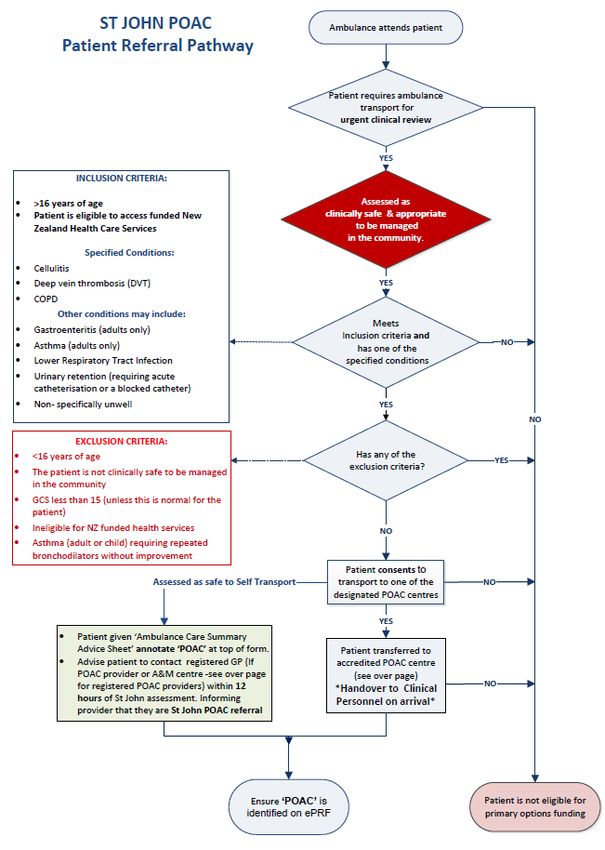
St John staff will have direct access to Primary Options pathways in the Manawatu and Horowhenua
Districts. These pathways provide a non-ED option for patients who require transport to a medical
facility, but can be managed in a POAC Accident & Medical Centre or at nominated General Practice
Teams (GPTs) facilities. Provided patients meet the specific criteria, their visit is free to POAC Centre’s.
Ambulance officers can redirect their patients to these POAC Centre’s if POAC criteria are met.
AMBULANCE REDIRECTION PROCESS
The aim is to ensure that ‘the right patients are treated in the right place, by the right person, at the
right time’. POAC will support St John to redirect patients to primary care as an alternative to a hospital
emergency department by providing funding consult at the nominated POAC Centre.
The ambulance officer will identify appropriate POAC cases based upon referral criteria and
will discuss referral options with the patient.
Following consent from the patient the ambulance officer will transport the patient to the
nominated POAC Centre.
As agreed upon by the POAC Centre’s the ambulance personnel will not need to ring prior
to transfer but present themselves to clinical personnel on arrival.
A POAC Centre can only decline to accept patient based on safety or capacity issues. In these cases
ambulance will continue to Palmerston North ED.
Please ensure your reception staff is made aware that St John may present and will need to speak
with the acute practice nurse on arrival.
The POAC team will be auditing all redirected cases to ensure appropriateness and will encourage
feedback as roll out this process. We will be evaluating the process constantly and will be providing
information to St John POAC champions and POAC site champions as required.
Referral Criteria for ambulance transport
The types of patients, who potentially may be transported to a nominated POAC Centre, must have
all of the following inclusion criteria met:
Low acuity
Patient ≥16 years of age
Patient is eligible to access funded New Zealand Health Care Services
Patient has consented to transfer
Patient is clinically stable and unlikely to be referred to hospital
Transport time to the POAC Centre is such that it is reasonable to transport the patient there
The clinical problem that the patient has must be able to be safely managed in an POAC Centre
- this requires clinical judgment
The clinic staff have the right to ask ambulance personnel to immediately transport the patient to
ED if they do not think it is appropriate or safe for the patient to be treated at the clinic
Approved by: Acute Demand Team Date of Issue: Updated March 2018 Version: 415
POAC claiming Process
The patient will pay for the initial transport as per St John protocol. On presentation to primary site
POAC will fund all aspects of care related to that episode including the initial consultation, ACC
surcharges and subsequent ambulance transport to hospital if required.
Referral criteria for patient self-transport
Where the patient has been assessed as requiring urgent review defined as within same day of
presentation and patient has own transport, they can self-transport to a medical facility. The ambulance
crew should indicate on the patient record form that POAC has been initiated; document the time
patient was left. The patient must be advised to ring provider as soon as possible to make a same day
review, advising receptionist they are deemed a ‘POAC patient referred by St John’. They must take the
form with them and attend within 12 hours (12 hours if overnight contact) of the time documented on
the form. POAC funding will only apply if the patient presents within this time period of the time
documented.
POAC St. JOHN REDIRECTION PROCESS
Patient requires Assessed as clinically
Patient is assessed by transport for safe &apprpopriate
St John urgent clinical to be managed in
reveiw the community
If the patient has own transport
and can safely make their own Patient consents to
way, they may be advised to self transport to one of Patient meets all
transport. The patient s record the designated POAC inclusion criteria's
form is left with patient centres
,documenting time they were
left and annotated 'POAC'
POAC WILL FULLY FUND ALL COSTS NORMALLY CHARGED
The patient MUST attend within TO THE PATIENT FOR THIS VISIT.
12 hours (12 hours if overnight
contact) in order for visits to be INCLUDING:
funded by POAC
ACC SURCHARGES
CONSULT FEES
AMBULANCE FEE FOR PATIENTS TRANSPORTED
ON TO HOSPITAL (IF CLINICALLY REQUIRED
NO COSTS SHOULD BE INCURRED BY THE PATIENT
Approved by: Acute Demand Team Date of Issue: Updated March 2018 Version: 416
POAC Redirection Sites
City Doctors
The Palms Medical
Feilding Health Care
Pahiatua Medical Centre
Barraud Street Medical Centre
Kauri HealthCare
Approved by: Acute Demand Team Date of Issue: Updated March 2018 Version: 417
CLINICAL GOVERNANCE
The POAC Clinical Governance Group Membership includes representatives from:
Emergency Department
Accident & Medical Centres
Pharmacy
District Nursing
St. John
MDHB specialist services – Medicine/ Infectious Diseases/ Haematology
MDHB Funding Division
POAC Team
Consumer
Maori Health
The group provides clinical oversight of the POAC service and looks at processes for continuous quality
improvement and safety.
Key responsibilities include:
Clinical effectiveness and safety
Monitor performance of the POAC service against agreed clinical targets and ensure the POAC
service is safe
Quality assurance
Develop a robust monitoring process to ensure appropriate and safe utilisation of the POAC
service;
Develop strategies to identify, manage and support outlier clinicians or practices
Provider education and development
Provide clinical input into development of clinical guidelines and policies
Clinical audit that leads to continuing quality improvement
Initiate and analyse audits of the POAC care provided
It is expected that all POAC sites will have a robust significant event management system and
clinical governance process. The role of the POAC clinical governance group is to support this
process
Risk management
Identify areas of clinical risk and advise on strategies to mitigate these
Research and development
Provide clinical input into development of new or enhanced services
Approved by: Acute Demand Team Date of Issue: Updated March 2018 Version: 418 POAC FREQUENTLY ASKED QUESTIONS Which patients are eligible to receive POAC services? Patients (≥16 years of age) who would otherwise require an acute hospital referral within the MidCentral DHB region, and are able to have their health needs met safely in the community. (Only exception in age range is when specified POAC pathways for children are used) UK or Australian citizens visiting New Zealand, or other visitors residing in New Zealand on a working visa with a continuous stay of two years or more. Refer to the Ministry Of Health eligibility criteria for publicly funded health services online for further information. Patients whose treatment is not covered by another funding stream e.g. ACC (see exclusions in ACC section of manual), maternity services, and private insurance. Who takes clinical responsibility for my patient when under the POAC service? The Doctor or Nurse Practitioner who initially assesses the patient carries clinical responsibility, unless that clinician has specifically handed over care to another Doctor or Nurse Practitioner. What if the patient is registered with another GP? When the initiating Doctor is not the patient’s GP, he/she agrees to advise and handover care to the patient’s GP at the earliest practical opportunity e.g. the next working day. The initiating doctor carries clinical responsibility for managing the patient’s acute illness until the responsibility has been accepted by the patient’s GP. Does the patient need to be enrolled? No, patients do not need to be enrolled with you or any other practice to receive treatment under this service. How can services be accessed for patients? Services within the clinic can be provided as clinically assessed, no approval is required. X-ray services can also be accessed without prior approval being required. What if the services required cost more than budgeted amount? If the cost of the episode of care is not covered in the claiming guide or you are likely to exceed the maximum observation limit of 3 hours, please phone the POAC team for advice on eligibility to proceed with the claim Does the patient have to pay for any services? The initial standard GP/ NP consultation incurs the usual charge and thereafter all services are provided at no cost to the patient. This is on the proviso that the patient/ condition meets the eligibility criteria and those items claimed are covered in the claiming guide. What is the claiming procedure for POAC services? At the completion of care ‐ submit claim including all relevant clinical notes for the completed episode of care. Claims should be submitted within 30 days of completing the POAC episode. Approved by: Acute Demand Team Date of Issue: Updated March 2018 Version: 4
19

What conditions can be claimed under POAC?
We encourage the consideration of POAC services for any situation where an acute referral to hospital
can be avoided. This decision is based on clinical assessment where the patient can be safely cared for in
the community. Localised collaborative clinical pathways are available on Map of Medicine to support
management of some of the more common conditions.

Will POAC pay for after hours follow-up or home visits if needed?
Yes. Either the GP/ NP, the deputised after hour’s service or a local A&M can provide after hours care to
your patient.

What hours is the POAC service support team available?
Monday – Friday: 0800 – 1630hrs
Mobile: 027 274 8106

What if my patient eventually needs to be admitted?
It is expected that some POAC cases may require referral to hospital for further management. Should
this be required, refer to hospital services in the usual way. POAC will pay for services provided up to
referral to hospital. It is essential that patients be admitted when necessary, risks should never be taken
to avoid admission.

Can services be accessed for the same patient, for more than one episode?
Yes, funding is allocated per patient, per episode.

Who can help with medical management advice?
The local hospital Emergency Department (ED) Consultant or relevant hospital-based specialty Medical
Practitioner may be contacted for medical advice.

How much should I charge?
For the initial standard GP/ NP consultation, charge the usual standard consultation rate. The only
exception to this is if the patient is brought to you via St. John Ambulance as a POAC case – in this
instance the patient pays the St. John fee and the other ongoing visits are covered by POAC. We have set
fees for some services (packages of care) which are detailed in the claiming guide in this POAC
information manual

When should an episode of care end?
POAC will fund for the acute episode only. The patient should be discharged when they are no longer
acutely unwell and needing the increased level of care that POAC funds. This is usually within 3‐5 days
but may be longer under some circumstances e.g. extension of IV antibiotic cover for cellulitis following
discussion with Infectious Diseases Physician as indicated in the collaborative clinical pathway.

Does POAC fund ongoing dressing changes?
No, once the patient is well enough to be discharged from POAC (usually within 24 hours of last IV
Antibiotic dose). Ongoing dressings should be referred to District Nursing service, or the patient would
pay in the usual way.

Approved by: Acute Demand Team Date of Issue: Updated March 2018                                Version: 4
20
PATIENT INFORMATION
1. What is POAC?
POAC is a new service in the MidCentral DHB region. It assists your General Practice Team to safely
manage your acute/urgent illness by funding an increased range of specified services in the
community, as an alternative to referring you to hospital. These services can include radiology
investigations, extended services at your GPs surgery and home support
2. Who are the POAC team?
The POAC team is a small team made up of an acute care doctor and specialist nurses. They support
your General Practice Team to deliver an increased range of acute/urgent services so you can be
treated at your General Practice instead of going to hospital
3. What are the benefits?
It allows your General Practice Team to refer you to services within your community
It allows you to be directly involved in decision making regarding your care
It enables you to remain in a familiar environment, and with your family during an illness
4. Will it cost me anything?
You will pay for your first visit with your General Practice Team as you normally do. Once you have
been placed with POAC, specific services related to your care will not cost you anything. The
acute/urgent phase is covered, however when this is over or you enter into long term management,
costs will no longer be covered by POAC
5. How long will I be with the POAC service?
You will remain with POAC until you are no longer acutely unwell. This is assessed by your General
Practitioner (GP) or Nurse Practitioner (NP) and generally will be no longer than 3-7 days, after which
you will be discharged from the POAC service
6. What happens if I need to go to hospital?
If for any reason your condition worsens, you may be advised to go to hospital.
In most cases POAC will pay for specified services to support your transition to hospital
7. Who should I call if I have a problem?
Call your General Practice Team immediately if you have any concerns about your wellbeing or that
of a family or friend who is with the POAC service
In a Medical Emergency, call 111
8. How do I provide feedback on my experience of POAC?
We value all feedback as it helps us with ongoing service improvement, and helps future patients
receiving care under POAC. If you would like to tell us about your POAC experience, please contact us
either by Phone: 027 274 8106 or Email: POAC@midcentraldhb.govt.nz
9. What happens to my health information?
Health information directly relating to your care will be sent to POAC and any sub-contracted
healthcare providers. It may be used for audit and review purposes. The POAC service has processes
and procedures to ensure health information is stored securely and remains confidential. Unless
advised, we will only use your information to provide you with the most appropriate care and
treatment, or for reasons directly related to the provision of your health service
Approved by: Acute Demand Team Date of Issue: Updated March 2018 Version: 421
POAC BUSINESS RULES
Definitions: In these terms and conditions, unless context otherwise requires:
‘We’ and ‘us’ means the contract holders, Central Primary Health Organisation (CPHO)
The service’ means the Primary Options for Acute Care (POAC) service
Background: this document represents a contract between us and the practices wishing to utilise the
POAC service. The service is operated by us under contract to MidCentral District Health Board (MDHB).
The range of acute alternative services includes, but is not limited to, the range of services listed in the
POAC information manual
Objective: The overall outcome of the service is to have an immediate and significant impact on health
outcomes for patients and the growth in acute hospital referrals by empowering primary care providers
to provide more flexible and responsive alternatives to an acute hospital referral
Outcomes: The overall outcome of the service is to demonstrate primary care responsibility to
contribute to reducing hospital acute demand, and decreasing escalation of care by providing a higher
level of care in the community
Definition of the service: The service and its procedures are defined in the POAC information manual.
The POAC service may be modified from time to time
Qualifying patients: All patients’ ≥16 years of age (exception gastroenteritis in children pathway) of
qualifying GP/NP who are normally resident in the MDHB region are eligible. Any patient who, following
a normal consultation, the GP/NP would normally refer acutely to hospital, but who they consider could
be safely managed in the community with extra support or diagnostic services can be provided care
under the service
Qualifying Doctors: any Registered Medical Practitioner who holds a current Annual Practicing
Certificate (APC) and has not been found guilty of disgraceful conduct under the Medical Practitioners
Act 1995
Qualifying Nurse Practitioners: any Registered Nurse Practitioner who holds a current APC and has not
been found guilty of professional misconduct under as per the Nursing Council of New Zealand Code of
Conduct 2012
POAC Champions: Site must have identified POAC Champions which must include medical and nursing
representatives.
POAC Champion Role:
To promote and support the implementation and integration of the POAC programme into site
work activities
To disseminate POAC programme information including updates to staff
To be available for case review feedback quarterly with POAC Team or at short notice if required
Medical and Nursing Staff: All medical and nursing staff employed by the participating practice will be
registered with their appropriate statutory body and hold a current APC
Approved by: Acute Demand Team Date of Issue: Updated March 2018 Version: 422
Clinical Responsibility: when a GP/NP who is not the patients GP/NP provides care under the service
(the initiating clinician ), he/she agrees to advise and handover care to the patients GP/NP at the earliest
practical opportunity e.g. next working day or at the end of the acute episode of care. The initiating
clinician carries clinical responsibility for managing the patient’s acute illness until responsibility has
been accepted by the patients GP/NP.
Quality standards: Doctors/Nurse Practitioners providing the service will apply sound clinical judgment
to ensure that patient safety is not compromised
Records: GPs/NPs providing services covered by POAC are required to submit all relevant clinical records
related to the episode of care being provided via the Medtech advanced form.
Indemnity: When using the service the GP/NP agrees to take full clinical responsibility for managing the
treatment and ongoing care in the community.
The GP/NP indemnifies us against any loss, damage or expense incurred by us as a result of any action or
poor performance by the GP/NP.
Continuous Quality Improvement:
The GP/NP agrees to co-operate with the POAC team in its audit responsibilities under the
contract between the participating parties
The GP/NP agrees to allow the POAC team reasonable access to premises, all relevant
information, and POAC referred patients as required for audit and case review purposes
For the purposes of carrying out any audit, access to clinical information will only be made
available to a suitably qualified registered medical/ nursing practitioner
The GP/NP/Team agrees to a quarterly case review feedback. Where patient safety concerns or
immediate concerns with POAC programme are identified, it is expected the sites will be
available for discussion/feedback in a more urgent manner
Claiming: the GP/ NP agree to adhere to the claiming instructions as defined in the information manual
and as modified from time to time by us. The GP/ NP agrees to submit all relevant information along
with the claim within 30 days of completion of the episode of care
Payment for the service: CPHO agree to fund all appropriate claims made by the GP/ NP to the POAC
service
Doctor/ Nurse Practitioner acknowledgement: In completing the funding form, the GP/NP
acknowledges that he/she has read, understood, and agrees to be bound by these terms and conditions
when claiming POAC services
Approved by: Acute Demand Team Date of Issue: Updated March 2018 Version: 423
Transfer of Care
The ‘New Zealand Medical Council’ clearly directs the required standards for transfer of care between
clinicians.1 Transfer of care involves transferring some or all of the responsibility for the patient’s
ongoing care. When you transfer care of a patient to another practitioner, you must ensure that the
patient remains under the care of one of you at all times. You should also ensure:
- Relevant clinical information/documentation about the patient history, present condition and
prescribed treatment is handed over to receiving clinician
- The chain of responsibility is clear throughout the transfer
- Where the transfer is for acute care, you should provide this information in a face-to-face or
telephone discussion with the receiving doctor
- The patient is aware of how information about them is being shared and who is responsible for
providing treatment over what period of time
Please use the POAC Transfer of Care/ Handover Form for all transfers of care between POAC sites
We reserve the right to modify or limit the availability to the service without further notice
1
‘Good Medical Practice’ Medical Council of New Zealand, April 2013
Approved by: Acute Demand Team Date of Issue: Updated March 2018 Version: 4You can also read


