PROGRESS REPORT ON THE INTERNATIONAL RESEARCH CRUISE INFORMATION DATABASE AND WEB-SITE - A JOINT POGO-COML-NOAA INITIATIVE - A ...
←
→
Page content transcription
If your browser does not render page correctly, please read the page content below
Progress report on the International Research Cruise Information Database
and web-site - a joint POGO-CoML-NOAA initiative
Status: July 2010
PROJECT OVERVIEW
To develop, update and maintain an international cruise information database to facilitate
resource sharing and information exchange related to past and planned research cruises.
ACCOMPLISHMENTS/PROGRESS/STATUS
The POGO Cruise Information Database (www.pogo-oceancruises.org) was launched in May
2007 and is coordinated by the British Oceanographic Data Centre (BODC). The website
focuses on vessels greater than 60m in length and incorporates three major databases, including
a research vessel directory, a cruise programme database and a database of Cruise Summary
Reports.
The current priorities are:
Continue requesting and enter into database 2010 (and 2011) cruise programmes
Continue to work with operators to improve timeliness and content of cruise programme
information, making special effort to contact and obtain information from Brazil, Canada,
India, Korea, Russia and South Africa.
Adapt Cruise Programme CMS to allow input from CCHDO, IOCCP and GO-SHIP
Allow input to be displayed where only preliminary information is available (useful for
cruises at an early stage of planning).
Routine maintenance of the system - including ensuring the research vessels database is kept
up to date.
Synergy from working with EU EUROFLEETS project, including:
(1) Develop more automatic input of cruise programme information by using and extending
software developed by SeaDataNet (Mikado). The SeaDataNet Mikado software allows
one to map the fields of a database into the agreed standard fields. When this has been
done once, it is a simple matter of running the software to generate the information in the
required format, including using the standard codes/dictionaries. Checks can also be
incorporated (e.g. checking that the end of the cruise is after the start). This will be
developed and initially tested it out with EUROFLEETS and then adapted to POGO
contributors. This should improve efficiency and remove the need for most of the manual
checking and editing.
(2) New initial browse facility (Browse-step) – see mock-up web page for EUROFLEETS
below. This also shows how the Cruise Programme database is now taking a more
prominent position, and the research vessel and cruise summary report being subsidiary,
rather than the equal importance implied by the current arrangement for POGO. This
arrangement will be transferred across to the POGO system.
(3) Inclusion of NASA Blue Marble WMS Maps for the Cruise Programme database.
(4) Primary importance of the Cruise Programme database emphasised by allowing access to
research vessel and cruise summary report information directly from the cruise
programme search results.
1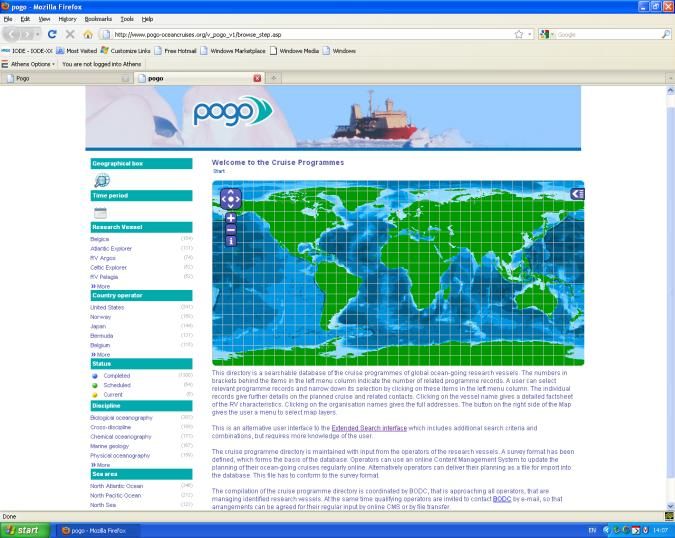
1. Cruise Programme Database
At the end of 2007 the cruise planning database included details of 573 cruise programmes by
18 ship operators, covering 24 research vessels from 10 countries. For 2008 cruises,
information has been received for over 450 cruises from the following countries: Australia,
Belgium, China, France, Germany, Japan, Netherlands, Norway, Sweden, UK and USA
(UNOLS including Bermuda). For 2009, cruise programme information has been received for
over 580 cruises from the following countries: Australia, Belgium, China, France, Germany,
Japan, Netherlands, Norway, Sweden, UK and USA (UNOLS including Bermuda). So far for
2010 information has also been supplied for 413 cruises from Australia (4), Belgium (40),
France (29), Germany (11), Ireland (42), Netherlands (6), Romania (5), Sweden (19), UK (34)
and USA including Bermuda (223).

The current content of the database is summarised in Table 1 below.

    Country     Information Provider        Research Vessels          No. of 2010   Total No.
                                                                       cruises      of cruises
  Australia     CSIRO                   RV Southern Surveyor                    4           30
  Belgium       MUMM                    RV Belgica                             40          115
  China         IOCAS                   RV Ke Xue San Hao                                    9
                                        RV Ke Xue Yi Hao
  Finland       FIMR                    Aranda                                             17
  France        IFREMER                 L'Atalante                            29           87
                                        Pourquoi pas?
                                        Le Suroit
                                        Thalassa
  Germany       BSH/DOD                 FS Meteor                             11           85
                                        FS Maria S. Merian
                                        FS Polarstern
                                        FS Poseidon
                                        FS Sonne
                                        Walther Herwig III
  Iceland       MRI                     Arni Fridriksson                                   18
                                        Bjarni Saemundsson
  Ireland       MI                      Celtic Explorer                       42           77
                                        Celtic Voyager
  Japan         JAMSTEC                 RV Natsushima                                     350
                                        Kaiyo
                                        RV Yokosuka
                                        Kairei
                                        Mirai
                                        RV Hakuho Maru
                                        Kaiyo
                                        Tansei Maru
  Netherlands   NIOZ                    RV Pelagia                             6           52
  Norway        IMR                     RV Jan Mayen                                      158
                                        Lance
                                        RV Johan Hjort
                                        RV G.O. Sars
                                        Dr. Fridtjof Nansen
  Romania       National Institute of   Mare Nigrum                            5            5
                Marine Geology and
                Geoecology -
                GEOECOMAR

                                              2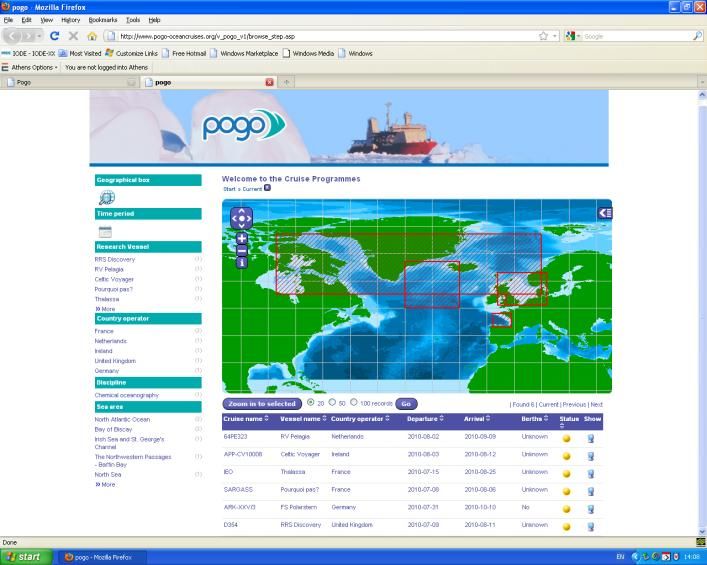
Country      Information Provider          Research Vessels         No. of 2010     Total No.
                                                                         cruises        of cruises
  Sweden         SMHI                     RV Argos                               19             74
  UK             NERC NMF                 RRS Discovery                          34             80
                                          RRS Ernest Shackleton
                                          RRS James Cook
                                          RRS James Clark Ross
  USA            UNOLS                    Melville                               223          848
                 (including Bermuda)      Roger Revelle
                                          Kilo Moana
                                          Thomas G. Thompson
                                          Atlantis
                                          Knorr
                                          Marcus Langseth
                                          Seward Johnson
                                          NOAA Ronald H. Brown
                                          Atlantic Explorer
      Table 1: Summary of information in Cruise Programme Database (2007-2010)

Ship operators are provided with a blank spreadsheet and guidance notes to assist in completion
of the spreadsheet. Wherever possible they are encouraged to extract from their own databases
rather than re-type information. The ship operators who have replied are cooperative but, in
general, do not have a lot of time to spend on this or have other more pressing priorities. On a
number of occasions we have been directed to their web sites, which often contain sparse
information – and as Adobe Acrobat (pdf) files – which means cut and paste or re-typing. We
request that the SeaDataNet vocabularies are used in the spreadsheet, but even when the BODC
vocabularies are listed, these are not often used. This means that work has to be done at BODC
translating the information into the appropriate codes. Information continues to be requested for
2010 cruises (and 2011 if available).

The website was refreshed (including adding the new POGO logo) at the end of 2009 and the
layout resulting from searches was improved. A new field has been added to show whether the
cruise is planned, currently taking place, or has been completed. There is also an option to show
if the cruise has been cancelled. This is indicated by coloured dots – green=planned;
yellow=currently in progress; blue=completed; black=cancelled: this is updated automatically
for the in progress and completed cruises. This shows the cruise status at a glance.

Also added is the opportunity to link in an image of the planned cruise track if this is available.

A further improvement has been to use the Ports Gazetteer developed by SeaDataNet. This is a
list of ports together with their geographic coordinates, and other supporting information. Using
this ensures that there is consistency in naming the departure and arrival ports.

One of the continuing problems encountered is the lack of geographic information – most
operators will provide some general description of the area to be visited, but do not have
latitude-longitude ranges available in their own systems. BODC add these in, but this is a time
consuming exercise. Some cases are reasonably straightforward, e.g. the USA (UNOLS)
contribution usually has US Navy Squares which can be converted fairly easily. Others may
only have a text description (e.g. Porcupine Abyssal Plain, Off Omaezaki, Sagami Bay). The

                                                 3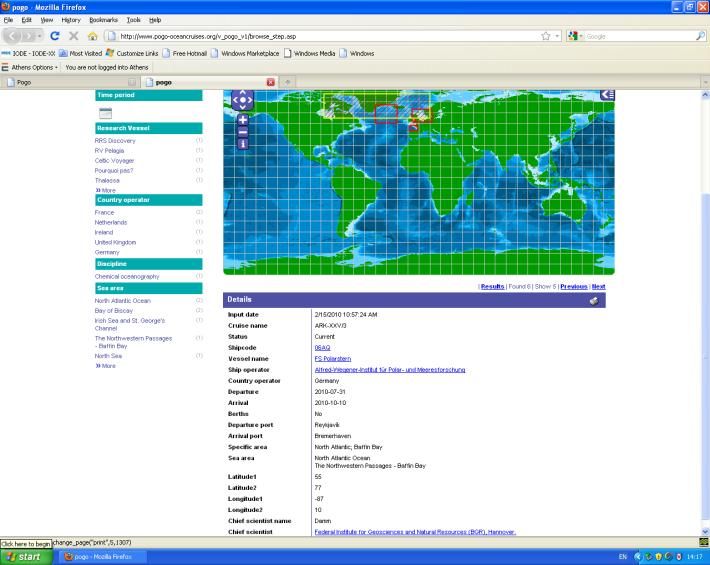
latitude/longitude range is important to the cruise programme database as it is the basis for the
geographic searching, and this information is viewed on a map.
The online Content Management System (CMS) for the cruise programme information
established in 2008 has been tested and has been in regular use during 2009 and 2010 by NIOZ
for RV Pelagia cruises, and occasionally by Germany for FS Polarstern and FS Meteor. The
CMS can be reached at the POGO International Cruise Information Database web-site
(www.pogo-oceancruises.org) and selecting “Planned Cruise Programmes” and “Updating
Cruise plans via the online Content Management System” or directly at:
www.pogo-oceancruises.org/vu_cruises/welcome.asp
The system has been designed so that:
Each operator can only manage its own records AND for a fixed set of vessels
Where a vessel is shared and thus operated by two (or more) operators, each operator
manages and sees only its own records (see e.g. Argos in Sweden)
The CMS works on the basis that the account holder is also the operator - thus they can not
change the operator.
Account holders can generate new entries and make modifications to existing entries and save
these. This is indicated by an ORANGE dot in the “active” column, which means that the
records are forwarded for final acceptance by the Administrator. The account holder can also
change this orange to red, perhaps because the entry is not finalised yet.
Offers have been received from the International Ocean Carbon Coordination Project (IOCCP)
and the Climate Variability and Predictability Program (CLIVAR) to enter cruise programme
information when it becomes available to them. As the CMS is designed to allow updates and
new entries by ship operators for their own vessels only, further security needs to be added to
the CMS needs to be adjusted to allow IOCCP (Maria Hood) and CLIVAR (Steve Diggs) to add
new records for vessels owned by a number of different operators. This is under discussion and
development. The CMS has been upgraded to allow preliminary information only to be included
and for the entry to be labelled as such (this allows for information whoich would otherwise be
mandatory to be omitted).
2. Global Directory of Ocean-going Research Vessels
The Global Directory of Ocean-going Research Vessels has been operational since early July
2007. It has been developed by EurOcean with support of MARIS and it contains
characteristics, owners and operators’ information for ocean-going research vessels. The content
format conforms to the Oceanic database, operated by the University of Delaware. This global
directory has been developed as a special version online research vessel directory for all
European vessels previously developed by EurOcean, which can be found at the EurOcean
portal (www.eurocean.org). It contains up-to-date information on ocean-going Research
Vessels, operated worldwide, and is accessible from the www.pogo-oceancruises.org website.
The Directory software was upgraded to enable research vessel operators to maintain the vessel
information themselves by an online Content Management System. During the second half of
2007 European operators were invited by EurOcean to validate and improve the entries for their
vessels. Subsequently the identified operators of these non-European vessels have been invited
to validate and update their entries, using the online Content Management System.
4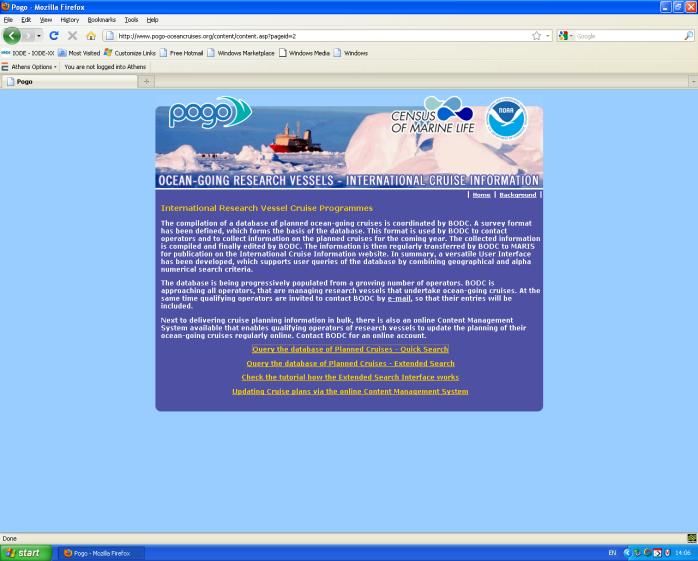
The Research Vessel Directory now contains facts and figures of 174 Research Vessels. The
Research Vessels are provided with a ship code, identifying a unique hull, through cooperation
with ICES, US NODC and BODC. These ICES ship codes are used in each of the 3 databases in
the full POGO system as linking pin. There are nine vessels in the database which are less than
60m in length of which Belgica is the shortest at 50.90m. Cruise programmes for vessels less
than 60m unless have not been specifically requested unless it was deemed useful to do so (e.g.
Bermuda with Atlantic Explorer at 51m), or the operator requested it (e.g. Finland, with Aranda
at 59.80m, Belgium with Belgica).

3. Cruise Summary Reports (CSR) database and Content Management System (CMS)
The Cruise Summary Report (CSR) database has been developed by BSH/DOD, Germany. It
focuses on details of completed cruises and provides a first level inventory of oceanographic
measurements made and samples taken. The ROSCOP (Report of Observations/ Samples
Collected by Oceanographic Programmes) was conceived by IOC/IODE in the late 1960s in
order to provide an inventory for tracking oceanographic data collected on Research Vessels.
The ROSCOP form was extensively revised in 1990, and was re-named the Cruise Summary
Report (CSR). Most marine disciplines are represented in the CSR, including physical,
chemical, and biological oceanography, fisheries, marine geology/geophysics, marine
contamination/pollution, and marine meteorology. Traditionally, it is the Chief Scientist's
obligation to submit a CSR to his/her National Oceanographic Data Centre (NODC) not later
than two weeks after the cruise. In the past these have been periodically transmitted to the World
Data Centres for Oceanography and to ICES.

The CSR activity gained new momentum in Europe during EU-funded marine data management
projects EURONODIM and Sea-Search under the lead of BSH/DOD, Germany. The combined
ICES and Sea-Search/SeaDataNet CSR database now comprises details of over 37000
oceanographic research cruises primarily from Europe and North America, some information
extending back over the last 40 years. This ongoing CSR database can be found via the POGO
research cruises website at www.sea-search.net/roscop.

As part of the POGO-CoML-NOAA initiative BSH/DOD has developed a special version of the
CSR database, that gives access to Cruise Summary Reports of all ocean-going vessels
worldwide larger than 60 metres. It is directly accessible from the www.pogo-oceancruises.org
website.

In 2008, BSH/DOD developed an online Content Management System (CMS) to allow Chief
Scientists and NODCs of countries outside Europe to prepare and deliver their Cruise Summary
Reports. This is now available and linked into the International Research Cruise Information
system. Retrieval software has also been developed in line with that used for SeaDataNet, but
with the POGO “look and feel” and limited to POGO ships. This allows searching of all cruise
summary reports provided to BSH, including those supplied before the POGO system was
developed, but restricted to the larger research vessels.

HIGHLIGHTS
The Cruise Programme Database continues to be operational and 580 new entries from 10
countries have been added during 2008. Requests for 2010 cruises are continuing and requests
for 2011 cruises will be issued soon.

                                                5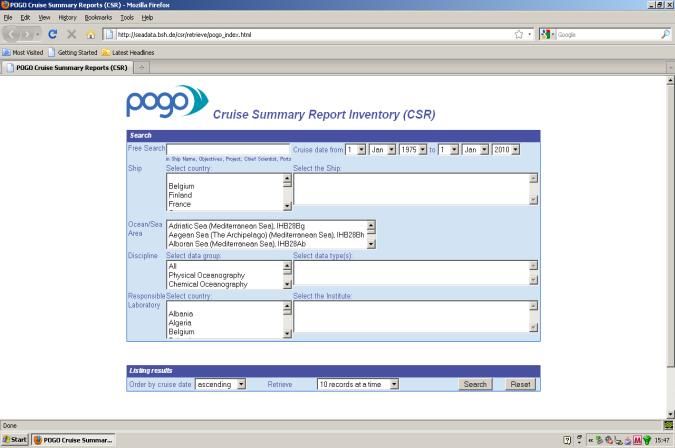
The Research Vessels Database continues to be operational and updates and amendments have
been made during the year. Vessel operators have access to the database and are able to update
details of their own vessels.
The Cruise Summary Report (CSR) database is operational for input of new CSRs and searching
of existing ones. It is linked into the POGO Cruise Information site.
Within Europe, the new EU-funded EUROFLEETS project (started September 2009) is
beginning to improve information provision from the project partners. EUROFLEETS aims to
bring together the existing European Research Fleet owners to enhance their coordination and
promote the cost-effective use of their facilities in order to support the efficient provision of
essential research services for monitoring and sustainable management of the regional seas and
the oceans and allow access to all European scientists. The system will utilise and build on the
developments carried out for POGO, and POGO in turn will benefit from an enhanced system.
In particular the EUROFLEETS project will develop more automatic harvesting from the
operator databases and refresh the information at regular intervals.
SOCIETAL BENEFITS
The project was undertaken to enhance resource sharing and information exchange related to
past and planned research cruises. Benefits include:
Helping scientists from different countries coordinate future funded research through
information about research vessels of opportunity;
Aiding in retrospective ability to find data in regions of interest;
Making it possible for projects to conduct joint work and to fill empty berths;
Creating capacity-building and training opportunities;
Aiding in tracking and distributing data;
Allowing cost sharing among institutions, projects, and nations;
Making possible intercomparisons, intercalibrations, and validation among different data
types (e.g. CTD vs. Argo, in situ vs. remote sensing)
EDUCATION AND OUTREACH ACHIEVEMENTS
List any related activities including conference presentations.
POGO Research Cruise Information System - presentation given at POGO-11 Meeting,
Shirshov Institute of Oceanology, Moscow, Russia, 26-28 January 2010 (see below under
FIGURES/PHOTOGRAPHS/ILLUSTRATIONS)
Rickards, L.J., Schaap, D., Nast, F., Che‐Bohnenstengel, A., Carvalho, T. & Costa, C. 2010
POGO International Research Cruise Information System. Abstract and poster for the
International Conference on Marine Data and Information Systems (IMDIS). March 2010, Paris,
France. (see below under FIGURES/PHOTOGRAPHS/ILLUSTRATIONS)
PUBLICATIONS
List only current year publications (in review, in press, and published) and separate by category
with full citation Note: Please include presentations under Outreach.
6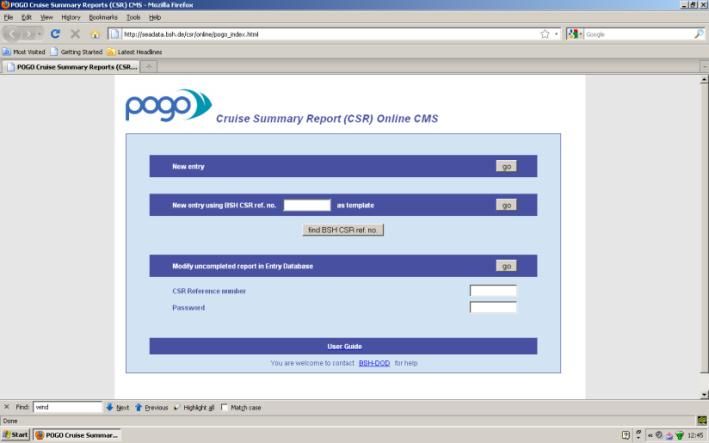
Rickards, L.J., Schaap, D., Nast, F., Che‐Bohnenstengel, A., Carvalho, T. & Costa, C. 2010
POGO International Research Cruise Information System. Abstract and poster for the
International Conference on Marine Data and Information Systems (IMDIS). March 2010, Paris,
France.

FIGURES/PHOTOGRAPHS/ILLUSTRATIONS – (preferably jpegs) – that help explain the
results and or depict the highlights – please include captions.
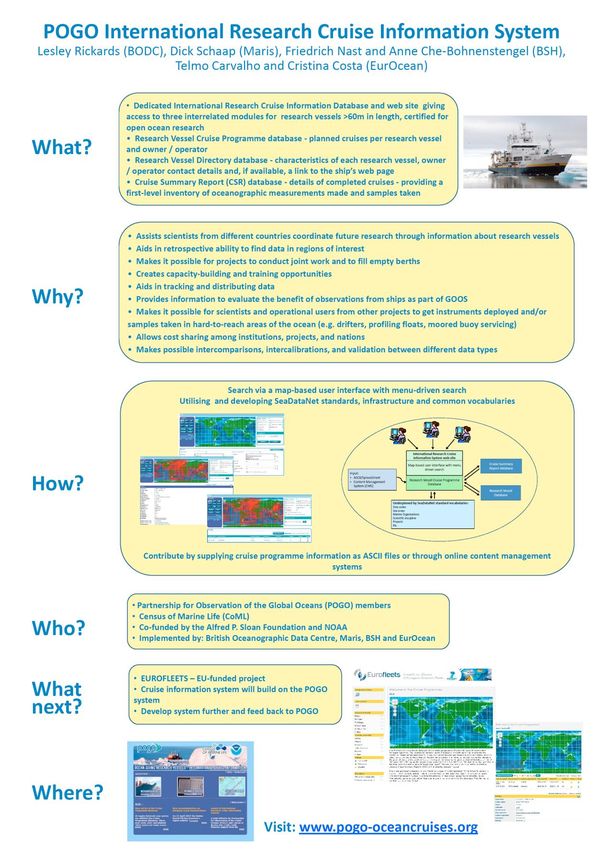
Screen shots illustrating components of the POGO International Cruise Information System

Input screen for Cruise Summary Report           Screen for searching Cruise Summary Report database

Home page for Cruise Programme Information       Quick search page for cruise programme information

Current cruises in the Northern Atlantic         Detail information of cruise

                                             7
Outline of presentation given at POGO 11 meeting, Moscow, January 2010
POGO Research Cruise Information System
POGO Research Cruise
• Tool for ocean scientists to become more
Information System efficient in cruise planning, utilise spare
berths, instrument deployment, and servicing
of moorings
• For ocean-going research vessels (>60m)
• Implementation carried out by a SeaDataNet
subgroup (BODC, Maris, BSH, EurOcean)
• Initially developed in 2007
• Funding from POGO, CoML and NOAA
POGO Research Cruise Information System Cruise Programme Status
Research Cruise Information System is in 3 parts: Number of cruises:
• Cruise Programmes • 2007 – 573 cruises
• Research Vessel Directory • 2008 – 455 cruises
• Cruise Summary Reports • 2009 – 586 cruises
Australia 10 Japan 120
Belgium 39 Netherlands 15
China 6 Norway 45
France 24 Sweden 19
Germany 6 UK 27
Ireland 20 USA (incl. Bermuda) 255
• 2010 cruise programmes beginning to arrive
Technical Developments in 2009 Technical Developments in 2009
• Cruise Programme • Cruise programme database upgraded
Content Management • Cruise status added (planned, current,
System (CMS) completed), automatically updated
operational • Planned cruise track option
• Use of ports gazetteer (from SeaDataNet)
• Cruise Summary Reports
CMS and search linked
to International
Research Cruise
Information System
8Outreach Issues
• Some organisations supply information
• Contribution to EOS article rapidly, but some are slow
• Abstract for poster submitted to IMDIS • Some organisations do not reply
Conference • Incomplete information supplied
• Dissemination of information to EU • Lack of geographic information provided
EUROFLEETS project • Manual work necessary => time consuming
Towards an alliance of
Future activities European research fleets
• Continue requesting 2010 and 2011 cruise programmes The EUROFLEETS proposal covers 3 areas:
• Including input from CCHDO, IOCCP and GO-SHIP Networking Activity: working groups (specification, training and information) to
• Allowing input where only preliminary information is available strengthen coordination within research fleets:
• Shared strategic vision (future investments)
• Develop more automatic input of cruise programme information • Eco-responsibility (guidelines of good practices) & environment friendly research vessels
• Using/extending software developed by SeaDataNet (Mikado) • Interoperability and operational progress
• Synergy from working with EU EUROFLEETS project • European peer review of cruise projects and harmonization proposals
• Training and education
• New dynamic user interface (initial “browse” facility)
• Dissemination and exploitation
• Inclusion of NASA Blue Marble WMS Maps for the Cruise Trans-National Access: access offered to the vessels below will be implemented
Programme database through a call for proposals
• 5 Ocean large vessels with underwater vehicles and embarked equipment of
• Primary importance of the Cruise Programme database international class (seismics or long coring)
emphasised by allowing access to research vessel and cruise • 14 Regional vessels, carrying out cruises in 6 European eco-regions.
summary report information directly from the cruise programme Joint Research Activity to modernize infrastructure or service regarding:
search results • innovating software, and on board data processing
• interoperable sensors to equip European underwater vehicles.
9POGO International Cruise Information System poster for International Conference on Marine
Data and Information Systems (IMDIS2010) Conference, March 2010, Paris, France
10You can also read


