Proof-of-Review: A Review based Consensus Protocol for Blockchain Application
←
→
Page content transcription
If your browser does not render page correctly, please read the page content below
(IJACSA) International Journal of Advanced Computer Science and Applications,
                                                                                                                    Vol. 12, No. 3, 2021

          Proof-of-Review: A Review based Consensus
              Protocol for Blockchain Application
                                 Dodo Khan1, Low Tang Jung2, Manzoor Ahmed Hashmani3
                                          Department of Computer and Information Science
                                            UniversitiTeknologi Petronas, Seri Iskandar
                                               32610 Perak DarulRidzuan, Malaysia

    Abstract—Blockchain is considered one of the most disruptive      in insurance[4], healthcare[5-7], economics [8-10], IoT [11-
technologies of our time and in the last 2 decades andhas drawn       13], supply chain, software engineering [14-16], transport,
attention from research and industrial communities. Blockchain        government agencies, distributed video coding [58] and
is basically a distributed ledger with immutable records, mostly      finance. As per the survey conducted by World Economic
utilized to perform the transactions across various nodes after       Forum [17], Blockchain will be soaring to 10% of global GDP
achieving the mutual consensus between all the associated nodes.      by 2027.
The consensus protocol is a core component of Blockchain
technology, playing a vital role in Blockchain’s success, global          The primary properties of this technology are
emergence, and disruption capability.Many consensus protocols         decentralization, resiliency, integrity, anonymity which are the
such as PoW, PoS, PoET, etc. have been proposed to make               driving force for industries to adopt Blockchain.Along with
Blockchain more efficient to meet real-time application               various technical components, the consensus protocol is the
requirements. However, these protocols have their respective          main component in which Blockchain relies on. Consensus
limitations of low throughput and high latency and sacrifice on       protocol plays a vital role in blockchain’s success, global
scalability.These limitations have motivated this research team to    emergence, and disruption.It serves to achieve the consensus
introduce a novel review-based consensus protocol called Proof-       of information sharing, replicating state, and broadcast the
of-Review, which is aimed to establish an efficient, reliable, and    transaction amongst the Blockchain network participants
scalable Blockchain. The “review” in the proposed protocol is         without any controlled 3rd party or authority. The success of
referring to the community trust on a node, which is entirely
                                                                      Blockchain isheavily dependent onan efficient consensus
depending on the node’s previous behavior within the network
which includes the previous transactions and interaction with
                                                                      mechanism forits great impactson the overall performance
other nodes. Those reviews eventually become the trust value          which shall include transaction throughput, latency,
gained by the node. The more positive the reviews the more            scalability, and fault tolerance.
trustworthyis the nodeto be considered in the network and vice            There are many comprehensive definitions of consensus
versa. The most trustworthy node is selected to become the round      protocol available in the literature. However, in this study
leader and allows to publish a new block. The architecture of the     "The agreement on the commonstate of ledger in between the
proposed protocol is based on two parallel chains i.e. Transaction
                                                                      group of nodes in Blockchain application” is adopted as the
Chain and Review Chain. Both chains are linked to each other.
                                                                      definition.There are ranges of consensus protocols
The transaction chain stores the transaction whereas the review
chain will store the reviews and be analyzed with an NLP
                                                                      availablefor Blockchain implementations. Nakamoto proposed
algorithm to find the round leader for the next round.                PoW[2]with Bitcoin to address double spending issue in
                                                                      digital cryptocurrency system in a trustless environment. Since
    Keywords—Blockchain; consensus protocol; transaction chain;       the day Bitcoin is launched, it is continuously growing in
review chain; prove-of-review; PoW; PoS                               terms of the number of transactions and the nodes. Due to the
                                                                      exponential growth,it encounters several performance issues.
                        I.   INTRODUCTION                             The most highlighted are the huge amount of energy
    Blockchain technology is oneof the most hyped                     consumption, low transaction throughput, high latency,and
decentralized innovation these days with an enlightening              poor scalability.Currently, the Bitcoin network consists of
future. Initially, Blockchain was introduced by Haber and             around 10 thousand nodes [18] while it can only process 7
Stornetta [1] and latergainedintense attention because of the         transactions per second (TPS) with a latency of 10 min.
Bitcoin byNamakoto in 2008 [2]. Bitcoin earns intense                 Moreover, the transaction throughput can possibly be raised to
success in the cryptocurrencyarena. Many similar currencies           25 TPS after fine tuningof the key parameters without
have seen been launched in the following years. There are             compromising the security [19] and it also consumes huge
2017crypto currencies available on the internet by 2019 [3]           amount of energy [20].
with the different business models. Besides global                       There are centralized applications performing better than
cryptocurrency hype, Bitcoin holds the highest market                 Bitcoin. For example,VISAnetwork is comprising of around
capitalization of up to 53%. Blockchain is serving as the             50 millionusers and at maximum, it can process up to 65000
fundamental       technology    behind    Bitcoin.    Besides         TPS [1]. Researchers tried to address the blockchain
cryptocurrency, Blockchain gain lots of attraction from a             limitations with new consensus mechanisms/approachesto
diverse range of fields and has shown a noticeable growthlike         reduce     energy-intensive  mining     and    the   energy

                                                                                                                          290 | P a g e
                                                        www.ijacsa.thesai.org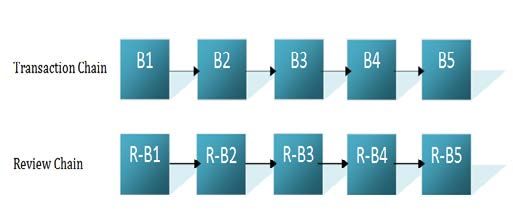
(IJACSA) International Journal of Advanced Computer Science and Applications,
                                                                                                                   Vol. 12, No. 3, 2021

consumptionwhile increasing throughput. For example,Proof            transaction by many nodes anonymously without control of
of luck [21], Proof of Authority (PoA), Proof of space [22],         any central party [24]. A decentralized database with the
Proof of Elapsed time (PoET) [23], and Proof of Stake (PoS).         capacity to work in the decentralized environment without
Every available protocol comes with its own advantages and           trustingthe intermediaries [24]. A shared, distributed,
disadvantages but mostly lacking in real-time transaction            immutable replicated, and tamper-evident ledger letting every
processing. Besides, there is no universal generic consensus         participant to access read, and verify the legitimacy [25]. A
protocol so far which can possibly be implemented in every           type of distributed ledger maintaining the information
domain with diverse set application requirements.                    regarding the transaction which are shared between all the
                                                                     participants in the network[26].Transparency, Immutability,
    This research utilizes an emerging area of Blockchain            distributed database, ledger, auditability, and intermediary are
consensus protocol but least investigated, the review-based          the common terminologies used in every definition.
approach. This approach intends to make every node
accountable for every transaction and allowing all the nodes as          Fig. 1 illustrates that in the Blockchain, the first Block is
a whole to decide which node will generate the next Block.           referred as Genesis Block. The previous hash in the genesis
The “reviews” is referring to the community trust on a node,         block would be equal to Zero. The Block in the Blockchain
which entirely depends on the node’s previous behavior within        containsan organized set of records and every block is
the network which shall include the previous transactions and        cryptographically coupled with the next block. Since
interaction with other nodes. Every node will share its              Blockchain works in distributed and decentralized fashion, it
experience with other nodes in the reviews form and those            maintains a long list of Block and every Block contains many
reviews will eventually become the trust value of the node           transactions depending on its size. Moreover, Blocks are
after the analysis through an NLP algorithm. The more                divided into two sections: Block header and transaction. Block
positive the reviews the more trustworthy a node shall be            header compromised of Version, Prev_Hash, Merke root,
considered in the network and vice versa. Securing good and          timestamp, nonce Hash (the unique identity of each Block)
positive reviews is not easy and not a one-day job. It needs         which is entirely different for every block like figure prints.
consistently good behavior to earn others’ trust. It cannot be
spent and bought therefore theonly way to increase trust is to
behave honestly. Blockchain and reviews would be a good
combinationwhere reviews serve as an incentive and
blockchain is responsible to keep reviews record safe.
    In this study, we propose a new proof-of-review
consensusprotocol to establish a reliable and scalable
Blockchain.This protocol intends to address the shortcoming
of the previous model in terms of throughput, latency,
scalability, and energy consumption. The architecture of the                          Fig. 1. Bitcoin Blockchain Structure.
proposed protocolis based on 2 parallel chains, the transaction
chain, and the review chain. Both chains are linked to each             Every Block carries the hash of prior block therefore every
other. The transaction chain, as usual, stores the transactions      block is connected to one another through the hash. Any
whereas the review chain will store the reviews and those that       manipulation in the information of the block alters the hash
will be analyzed by an NLP algorithm to determine a round            number and that block will be unrecognizable for the next
leader to generate a new Block while other nodes will be             block [27]. Fig. 1 shows the Bitcoin blockchain structure.
involved in the block verification process. The proposed
protocol is also tolerant to some of the major attacks such as           In general, Blockchain is classified into three different
Sybil attack, bad-mouthing, on-off, etc.                             categories. Namely, Public Blockchain, consortium
                                                                     Blockchain, and Private Blockchain [28]. The major
    The rest of the paper isstructured as follows. In Section 2,     differencesin these categories are based on who can participate
we discuss the Background of Blockchain and the consensus            in the Blockchain consensus process [29]. For example, in
model. Section 3 discusses the related work in consensus             Public Blockchain all nodes are welcome to participate in the
model. Section 4 describes the proposed proof-of-review              consensus process whereas in Consortium and Private
(PoRv) consensus protocol with details. Section 5 discusses          Blockchain only selected and validated set of nodes can
the block structure. Section 6 is about thesecurity analysis of      participate.
PoRvwhich includes the potential attacks and strategies to
address the attacks. Section 7 discuss the preliminary results           • Public Blockchain: The Public Blockchain network is
and Sections 8 and 9 discuss the conclusion and future work                entirely opened for everyone to freely join and leave at
respectively.                                                              any timeas they please.Therefore, it works in between
                                                                           completely anonymous and entrusted nodes. In Public
                II. BLOCKCHAIN BACKGROUND                                  Blockchain, information is accessible and shared to all
                                                                           network participants. It comes under the umbrella of as
A. Blockchain Characteristics                                              permissionless Blockchain. Moreover, every node
     There are several definitions of Blockchain available in the          iswelcome to participate in the consensus processto
literature. Most of themdefine the context itis supposed to be             ensure the validity and integrity of data. Bitcoin and
used. For example, apublicly shared ledger for maintaining the             Ethereum are classic examples of Public Blockchain.

                                                                                                                              291 | P a g e
                                                        www.ijacsa.thesai.org
(IJACSA) International Journal of Advanced Computer Science and Applications,
Vol. 12, No. 3, 2021
• Federated Blockchain: Federated Blockchains are also C. Consensus Characterization
referred as Consortium Blockchain. In which every In Blockchain the key tasks are the block validation and
node can access data. However, only a predetermined the continuous maintaining of the security which can be
group of nodes would be able to change and take part in achieved by a well-structured mechanism called consensus
the consensus process. Most of theconsortium protocol. Since Blockchain is a distributed and a shared ledger
Blockchain are implemented in banking sector [30]. so there is no need for a centralized authority to ensure the
Because in the banking settings, the idea is to share the legitimacy of all the transactions. Therefore, it is challenging
power between the authorities rather than one to achieve consensus among the nodes on the transaction in a
controlled authority who can possibly make biased block without compromising on the security [26]. Therefore,
decisions. Here are some well-known examples of the consensus protocol is considered asthe heart of any
Consortium Blockchain, R3 (Bank), EWF (Energy), Blockchain application. In the distributed environment,
B3i (Insurance). achieving consensus is not a trivial task to getall network
• Private Blockchain:Federated Private Blockchain is participants (Nodes) to agree on accepting or rejecting a
kind of centralized blockchain in which central potential block.Once a new Block is accepted, all node
authority or predefined group of nodes canread and members are supposed to append this block into their
write or participate in the blockchain. Only pre- respective chain.
validated nodes would be able to join the network. The consensus protocol is an active research area in the
Furthermore, the known and authorized nodes take last two decades. It has been and being deep studiesfor its
responsibility to maintain the consensusprocess.Private resilient for a node failure, message delay, portioning of the
Blockchain are considered as Permissioned Blockchain network, message out of order or missing.In Blockchain
where data is accessible to authorized groups of nodes. network, the consensus protocolis supposed to deal with the
These groups can change acceptance by consensus malicious, selfish, faulty nodes and make sure that all nodes
procedure. Private Blockchain is designed for settings have reached consensus among themon the global state of the
where all nodes are known and authorized. ledger. In the context of Blockchain, the three key properties
B. Key Properties of Blockchain of consensus mechanismnamely Safety, Liveness, and Fault
Toleranceshall determine the applicability and efficiency of
Some of the key properties of blockchain are described in any consensus protocol [31].
this section,
• Safety: This property is the responsible for ensuring that
• Persistency: Blockchain transactions are maintained in nothing malicious will ever take place in the
shared ledger which are considered as persistent Blockchain. It refers to the properties of validity and
because the ledger is shared across the distributed agreement in the conventional consensus set out in the
network, where every node is made accountable and on distributed systems. Validity is defined as “A correct
control of its record and maintains the integrity by the mechanism proposed a value X then another correct
consensus protocol. So,persistency can only be retained mechanismshould also produce the same the value X".
if majority of the nodes acts honestly. Several Whereas the Agreement property made responsible to
Blockchain properties are derived from persistency, i.e., ensure that two correct processes should not provide
transparency, immutability which makes Blockchain different output. Generally, consensus protocol is
auditable [31]. considered safe when uponone honest node produces
• Validity: Unlike several distributed system, Blockchain valid output and subsequentlyevery other node in the
does not need every node to perform validation. Blocks network obtain the same output. The produced output
and transaction are broadcasted across distributed should be valid and be the same as all other nodes,
network and their legitimacy will be validated by all referring to consistency of the share state [33].
other nodes that process is referred as consensus • Liveness: This property ensures that eventually,
mechanism. Therefore, any illegitimate action would something good will take place. Liveness of consensus
easily be identified with the source node. There are 3 mechanism can only be ensured if all honest nodes
major roles for this process. (1) Proposer: the one who participate in the consensus process and ultimately
proposes the value (2) Acceptor: The one who verify generate a value and all right/correct requests will
the value and take a decision and (3) Learner who eventually be processed. There is no time limit to
accepts on the chose value [24]. decide on a value, it is not necessary for all nodes to
• Anonymity and Identity: Anonymity is one of the have a same state at a given point of time.
primaryproperties of Public Blockchain. Node • Fault Tolerance: A consensus protocol is considered
identification could be linked with the real-life identity. fault tolerant when it is resilient to failure of nodes
A single user can acquire multiple identitiesfor which are participating in the consensus process. The
avoidingidentity exposure [32]. There is no central node failure can be planned in two types.
entity is required to maintain the private data such as
identity. On the other hand, in private Blockchain
identities are required to operate and governed by
known entities and authorized group of nodes.
292 | P a g e
www.ijacsa.thesai.org(IJACSA) International Journal of Advanced Computer Science and Applications,
Vol. 12, No. 3, 2021
Fail-Stop - It deals with all nodes who discontinue complexity it doesn'tsupport large network and restricted to
processing temporarily or permanently. And those also stop small network.
producing, receiving messages, or taking part in consensus
Bitcoin uses Proof of work consensus protocol. Therefore,
process.
it has attracted wide research interest in last two decades. Due
Byzantine failure – It deals with faulty and malicious to the complex block mining process, it consumes huge
nodes specially designed to crash consensus mechanism amount energy and require other specialized equipment do
properties. Leslie Lamport [34] identified and characterized as intensive mathematical computation. Therefore, it is also
the Byzantine General's Problem. referred as resource hungry and energy inefficient and
eventually, it offers low throughput and high latency.
Considering the importance of consensus mechanism in Moreover, most important concern of research community in
Blockchain implementations, all the three properties are PoW is limited scalability, it only supports seven transaction
essential for any consensus protocol. However, it is agreed by per second (TPS) which is entirely not acceptable in business
many researchers [35] that all three properties can’t be real world application. Firstly, Proof of stake(PoS) was
achieved at one time. A deterministic asynchronous consensus presented at Bitcoin community forum later Ethereum adopted
mechanism can possiblyachieve at most of two out of three it. It was proposed to provide ease in block mining and reduce
properties and compromise onat leastone of them. Itis not high wastage of energy in PoW and referred as energy
random task to select two properties and compromise on efficient variant of PoW. This new idea changed entire Block
one,but it entirely depends on application requirements. Fault mining concept, so theexpensive and extremely powerful
tolerance can’t be comprised because it is the most important equipment’sare no longer needed for block mining. However,
property [33] for any blockchain implementation. Therefore, miners (nodes) are required to hold and show stake in the form
the nature of application is to decide which property to let go of certain number of coins. The node holding high stake has
of,either on liveness or safety. For instance, Raft [36], Paxos more chances to become block producer and earn the reward.
[37], view-stamped replication used consensus protocol that Apparently, it certainly saves more energy as comparison to
take fault tolerance and safety and let go the liveness. Bitcoin PoW but there are different attacks arises such as nothing at
[2], Ethereum [38], Ripple [39], stellar [40] and other stake problem. Ethereum only support 15 transaction per
cryptocurrencieschose fault tolerance and liveness and second (TPS) which is also very low in comparison with other
sacrifice on the safety. mainstream application. There is another proposed alternate,
III. RELATED WORK proof of space it strives to utilize physical storage resources as
a substitute of computational power in PoW [45] [22].
Nakamoto launched Bitcoin in 2008 [2] with its secured
intense success in the field of cryptocurrency. Therefore, Proof of Coin Age [46] support the same mechanism as
many similar currencies have been launched in the following proof of stake. Where nodes are needed to show the ownership
years. There are 2017cryptocurrencies available on internet by of certain amount currency for performing the virtual mining.
2019 [3] with different business models.Besides global Proof of activity [47] create the mining lottery of every node
cryptocurrency hype, Bitcoin holds the highest market own the number of coins. The lottery winner will produce the
capitalization of up to 53%. Blockchain is serving as block and claim its reward by signing message within interval
fundamental technology behind Bitcoin. It aims to influence of time. Intel proposed proof of elapsed time [48] and which
almost every industry. Its applicationis not restricted to only has been implemented in HyperLedger project. Proof of
financial eco-system [3] but it is set to revolutionize the elapsed time are required to use the Intel SGX supported
politics, healthcare, and society science arena [41]. CPUs for performing the online voting via random sleeping
time. Researcher tried to address above discussed limitations
The consensus protocol is the main and core component of with various new consensus mechanism and approaches,
Blockchain technology, and it plays a vital role in Blockchain which do not require energy intensive mining, and reduce the
for its success as global emergence and disruptive technology. energy consumption and increase throughput, For example
Nguyen and kin [42][43] recommend in their respective proof of space [49], Proof of Authority (PoA), Proof of luck
research to categorize the Blockchain consensus mechanism [21].
into two major groups. Proof Based and Voting
Basedconsensus mechanism. Proof-based consensus Besides all the approaches, there is another emerging
mechanisms are mostly used in permissionless Blockchain in areafor Blockchain consensus model but unfortunately least
which anyone is free to join and leave at any time they want. investigated. Reputation based consensus mechanism. This
They are supported by the several cryptographic techniques area intended to make every node accountable on every
and the incentive-based design. Moreover, this group of transaction and return power to the nodes as whole.
consensus mechanism, offer comparatively better support for A recent published study proposed the Proof of Reputation
nodes scalability but the on the cost of performance which (PoR) [50] in which reputation would be served as the
includes the throughput and latency. In proof based consensus incentive for nodes positive behavior, time, utilized energy as
model performance of Blockchain compromised with well as block publication rather thanthecoins. Therefore,
increasing size of network.Whereas, voting based consensus mining node are no longer required in this technique. The lab-
model mostly utilized in permissioned Blockchain. It offers based simulation proved that it can be scaled up to the
quick consensus finality which eventually bring high number thousand nodes with processing capacity ofmore than
throughput [44]. In the voting based consensus model nodes hundreds of transactions (TPS). Reputation scheme [51]
communicate with each other, due to high communication
293 | P a g e
www.ijacsa.thesai.org(IJACSA) International Journal of Advanced Computer Science and Applications,
Vol. 12, No. 3, 2021
designed on the similar concept of PoR. It involves both IV. PROTOCOL DESCRIPTION
honest nodes as well as malicious nodes together in the
positive manner. It rewards the good behavior as reputation A. Important Definition
and, alsoproposed the punishment factor in the revenue • Block: A block is the main data structure of Blockchain.
payment function of reputation. Therefore, the cooperative It consists of Block header and list of transaction, Block
behavior would be rewarded, and non-cooperative behavior header containing metadata i.e., timestamp, Prev_Hash,
would be punished.The implementation of this reputation- Merkle tree etc. Like figure print, Hash is the unique
based incentive module on state-of-the-art PoX protocol can identity of every block and it is identified the with its
achieve better results than usual. Another protocol Proof of hash. The prev_Hash in the metadata of every block is
QoS [52] designed on the similar idea of reputation, where to connect the prior block and this series of
good quality of service would be encouraged. Mostly it has chronologically connected blocks forms chain.
been used in permissionless Blockchain. In this protocol, the
whole network would be categorized into small group and • Genesis Block:The first Block in the Blockchain is
each group will nominate a node based on its quality of referred as Genesis Block. Therefore, the previous hash
service, then the consensus would be achieved in between the must be equivalent to zero because there is no block
nominated nodes with Byzantine Fault Tolerance (BFT). The before it. If you start from any block and following the
architecture of Proof of QoS has entirely based a hybrid chronologically chain backward you will reach at
protocol, where it utilizes Proof-of-QoS to select nodes for genesis block.
running BFT-style consensus. • Round: The round is a set of five steps to achieve
Proof of X-repute protocol designed for Blockchain consensus. At the end of round, a block supposed to be
enabled - IoT systems[53] it introduced new module of repute added intoboth chains i.e., transaction chain as well as
method and to illustrate the potential of repute that it can be reviewchain.
utilized to manage the integrity of consensus protocol. The • Nominated Round leader (NRL): Nominated Round
reward and punishment in the repute method sets the nodes leaders are the nodes selected based on their behavior in
repute values; the nodes behavior would either be rewarded or the network and sentiment analysis of the review with
punished which certainly impact the security and integrity of NLP algorithm. In every round top three nodes with
consensus protocol. Another study proposed Blockchain highest positive reviews will be selected as NRL.
Reputation based consensus (BRBC) [54] protocol for private Initially every node strives to become NRL and get a
blockchain networks. In this protocol network setsa trust chance to become round leader. To become an NRL it
threshold level and all nodes are supposed to secure higher is required to meet minimum criteria which is the node
reputation score than trust threshold for getting a chance to should not be currently blacklisted and minimum
append a new block in the chain. Moreover, miner (nodes) positive reviews.
activities are monitored by randomly selected judges and they
sign their reputation score based on their behavior. Judges will • Round Leader: Round Leader is node with highest
reward good and cooperative behavior whereas punishment positive reviews selected from NRLor the most
factor also included on the malicious and non-cooperative trustworthy node selected from NRL. RL will only be
behavior. selected from list NRL. A new RL will selected for
every round to propose a block, and the selection
In one study reputation integrated as moduleReCon [55] in process are independently done through an NLP
which external reputation system has been integrated with algorithm. To become RL it is required to meet
Blockchain consensus protocol to achieve scalable minimum criteria which is node should not be
permissionless consensus protocol. Where it utilizesexternal blacklisted and minimum positive reviews.
reputation ranking mechanism as input to ranks the nodes.
Node ranking would be done based on the result of consensus • Step verifier (SV): Step verifiers are the set of nodes
rounds performed by small committee. Therefore, current independently selected on the basis on their behavior
reputation would be used to select the committee. Delegated and availability in the network. A new set of SVs are
Proof of Reputation [56] designed to replace coin-based stake selected for every step in the consensus process and
with the reputation ranking system. The reputation system each SV are tasked to perform different activities to
developed on design of famous raking theories (PageRank, contribute toeach step in the round.Each step verifier is
NCDawareRank and HodgeRank). RepuCoin [57], uses miner required to meet a minimum review and not currently
reputation as its strength as key function of its work and blacklisted.
energy integrated over the time of complete Blockchain rather
than immediate computational power with possibility of B. Overview
borrowing, temporarily and rapidly. Whereas the reputation The core idea behind the proposed Proof-of-Review
would be earning with the span of time. RepuCoin claims that consensus protocol is toallow and therefore to givepower to
it will tolerant 51% attack and put limits on the rate of voting each node to post reviewsand rating in the form of stars for
power growth of the entire system. every other node. Nodes are required to maintain their good
and positive behavior consistently to secure positive reviews
from other nodes, and those reviews will eventually become
their trust value in the network. The trust value cannot be
bought, spent, or sharedbut it can only be earned with good
294 | P a g e
www.ijacsa.thesai.org(IJACSA) International Journal of Advanced Computer Science and Applications,
Vol. 12, No. 3, 2021
and positive behavior. The node with more positive reviews behavior consistently. Nodes with highest positive
will be considered more trustworthy in the network.The most reviewsreflects the high trust value and comparatively offer
trustworthy node will get higher chance to publish a new better services as well as not likely to attack the system. In
block. every round only one node with highest trust value will be
selected as Round Leader and publish the block. Publishing a
• If node maintain a good and positive behavior, it will block will certainly help to get more positivereviews from
receive a good and encouraging feedback/review and other nodes which eventually increase the trust value.
which eventually increase their trust value in the
network. In each round the PoRv execute the following task. A
around starts with a transaction and ends with new Block
• If node act maliciously, selfishly, it will get negative being added to Ledger.
feedback/review, and which decrease the trust value in
the network. • Step # 1. Select Nominated Round Leader (NRL)
The proposed model works on a 2-chain architecture. All online nodes appear to be Potential Round Leader
There would be 2 parallel chains – the first chain as usual will (PRL) and get a chance to become Nominated Round Leader
store the transactions and referred as transaction chain (NRL). The restriction of minimum trust value and not to be
whereas the other chain is designed to store the reviews given blacklisted will be applied to all nodes in the network. Each
by nodes and referred as Review Chain. PRL will evaluate their own reviews (text format).
To achieve the proposed protocol, we will answer The evaluation calls on the Natural Language processing
following questions: (NLP) to evaluate the text to determine a trust value. Then, the
trust value will be compared against their rating. The PRL's
C. Question 1: In this Model, How to keep Ledger and trustand rating should be identical with negligible difference
Review Consensus? otherwise the node will be blacklisted with status involved in
As Bitcoin uses the PoW consensus protocol, which strives "Malicious Activity" for current round.
to allowentire network of nodes to agree on every single block
Top 3 nodes with highest positive Reviews/trust value out
in the chain. The first node that has solved the
computationally intensive puzzle securethe right to publish the of all PRL will be selected as Nominated Round Leader
block, while remaining nodes will be allowed to take part in (NRL). NRL will propagated a message using GOSSIP
Block verification. Similarly, in Proof-of-Review (PoRv), the protocol to all other nodes in the network which includes their
node with most positive reviews will get a chance to publish (NRL) trust value and their hashed credentials.
the Block. Positive reviewsfrom other nodes will eventually • Step # 2. Select Round Leader
become their trust value, which means the most positive
reviews means more trustworthy and vice versa. And the All nodes in the network will listen message a from NRL
block verification is open for all other nodes. Since from Step 1.
PoRvprotocol work on the 2-chainarchitecture, a Transaction Nodes with highest online time will be identified and
chain and Review chain, therefore every node is required to selected as "Step Verifier". (Other nodes which are not
agree on both the transaction and the review block. selected as Step Verifier, they need stay online for next step to
D. Question 2: How to Produce Block through PoRv be selected as Step Verifier). The restriction of minimum trust
value and not to be blacklisted will be applied to each "Step
The response of this concern will be likeBitcoin, it utilized Verifier".
the proof of work consensus protocol, in which the node
solves the mathematical puzzle before all other nodes will get Each SV will wait certain amount to time (System defined
a chance to publish the next Block in the Blockchain while duration) to receive the messages from 3 NRL (from Step
other nodes will verify the block. In PoRv protocol, the node 1).NRL are selected with condition to be online, there are less
with most positive review (which eventually becomes the trust changes of no message.
value), will generate and publish a new blockwhile other
SV will re-evaluate reviews of each NRL. If results are
nodes can verify the block. Every node is required to maintain
identical with received, the minor difference is negligible. The
the good behavior consistently because any bad review will
node with highest trust value will become a Round Leader
cause a reduction in the trust value.
(RL) and other 2 nodes will remain Nominated Round Leader
E. Question 3: How to Encourage other Nodes to Publish (NRL)and stay in a queue.
Block If re-evaluation results are not identical for node with a
There is no reward or incentive in this model for highest trust value,then that particular node will be blacklisted
publishing new block as comparing to cryptocurrencies like with status involved in "Malicious Activity" and re-evaluation
Bitcoin and Ethereum. In this model we are giving power back will be done for next node from NRL and process goes until
to every node in the network. This is to empower every node the RL is selected.
to rate and to post reviews on others’ behavior in the network.
Those reviews will become trust value or trustworthiness of a SV will propagate a message using GOSSIP protocol to all
node which cannot be bought, spent, and transferred but the nodes in the network which includes the RL recommendation
only way to earn trust value is to stay honest and with good and its trust value.
295 | P a g e
www.ijacsa.thesai.org(IJACSA) International Journal of Advanced Computer Science and Applications,
Vol. 12, No. 3, 2021
• Step # 3. Propose a Block • Step # 5. Block Decision
All nodes will listen message from SV from Step 2. All nodes will listen message from SV from Step 4.
Nodes with highest online time will be identified and Nodes with highest online time will be identified and
selected as "Step Verifier". The restriction of minimum trust selected as "Step Verifier". The restriction of minimum trust
value and not to be blacklisted will be applied to each "Step value and not to be blacklisted will be applied to each "Step
Verifier". SV will wait maximum amount of time (System Verifier". SV will wait maximum amount of time (System
defined duration) to receive the minimum number of messages defined duration) to receive the minimum number of messages
(from Step 2) for RL recommendation and its review number (from Step 4)for Verify value YES. (SV are selected with
(SV are selected with condition to be online, there are less condition to be online, there are less changes of no message.).
chances of no message.).
SV will re-evaluate reviews of RL and compare with the
SV will re-evaluate the reviews of RL and compare it with one received in the message from Step 4. If result is identical
the one received in the message from Step 2. If result is the process will move on, otherwise RL will be blacklisted,
identical only then the process will move on otherwise RL will and it goes back to Step 2 and select a new RL from NRL.
be blacklisted and it goes back to Step 2 and select a new RL
Each SV will come to a final decision on the Block.SV are
from the remaining NRL.
listening to messages that includes a signed value Yes or No
If all go well, the RL will assemble a block and add in addition to the vote of confidence to Round Leader and a
transaction from its transaction poll until the block size hit. RL Block. If they receive the maximum number
will technically verify the Transaction (e-signature) and sign a messagescontaining Yes along of the vote of confidence to RL
Block. and a Block, SV will approve the Block and the same block is
supposed to be broadcasted to all other nodes.
RL will prorogate a message which includes its RL trust
value as a Signed Block. V. BLOCK STRUCTURE
• Step # 4. Block Verification This consensus protocol is entirely dependent on the
community (other nodes) reviews. It is essential to store the
All nodes will listen message from SV from Step 3. reviews whose legitimacy is verified by all other nodes.
Nodes with highest online time will be identified and Therefore, in the proposed protocol, there would be 2 parallel
selected as "Step Verifier". The restriction of minimum chains. First chain will store the transactions and referred as
Review Number and not to be blacklisted will be applied to Transaction chain whereas the other chain is designed to store
each "Step Verifier". SV will wait maximum amount of time the reviews given by step verifiers and it is referred to as
(System defined duration) to receive the message From (from Review Chain shown in Fig. 2.
Step 3) the Signed Block and its trust value. The block structure of the first chain would be as usual as
SV will re-evaluate reviews of RL and compare with the in conventional Blockchain, which is separated into 2 parts.
one received in the message from Step 3. If result is identical Block header and list of transaction. Block header contains the
the process will move on otherwise RL will be blacklisted and version, prev_hash, timestamp, nonce, Merkle root,
it goes back to Step 2 and select a new RL from remaining transaction parts contain the transaction only. The structure is
NRL. illustrated in Fig. 3.
Each SV seeks to verify and validate the block and its Whereas the Block structure for review chain is a bit
associated transactions. Each SV will iterate over transactions different. It is also divided into two parts, Block header and
in the block. With each transaction, every SV will evaluate the Review Transaction. Blockheader contains the version,
transaction by processing it into its VERIFY () function. The previous hash, timestamp, merkel root, hash of thetransaction
verify function will either return a Yes or No. "YES" means Block. Therefore, both the chains are linked with each other
Transaction is good and "NO" means Transaction is bad. If it but carrying different information. The review transaction part
returned Yes, and remaining technical checks are good (e.g e- contains the list of reviews and public keys of the node that
signature), SV will move to next transaction. Once all the have written the review. The structure is illustrated in Fig. 4.
transaction are verified and validated as good and no
disagreement found, each SV will propagate a message with
vote in continuance of this RL and Block and its trust value.
Verify – Another parameter will also be part of message,
YES/NO depending on the number of votes in confidence.
YES, when the number of votes in confidence meets minimum
threshold value and vote is still in agreement for a leader.
Otherwise,ifit is Nofor any transaction, it is considered a bad
transaction. This disagreement will allow verifier to conclude
the RL evaluation is bad and consequently the RL is acting
Fig. 2. 2 Parallel Chain Architecture.
maliciously and Blacklisted and it goes back to Step 2 and
select a new RL.
296 | P a g e
www.ijacsa.thesai.org(IJACSA) International Journal of Advanced Computer Science and Applications,
Vol. 12, No. 3, 2021
VI. SECURITY ANALYSIS
Block Header
Version We presume the communication between the nodes in the
Prev_Hash network are set up through a reliable peer-to-peer network but
Merkel root there are chances it can still be damaged by selfish behavior,
Timestamp malicious attack, or node failure. This section will discuss
some potential attacks in peer-to-peer networks and specially
Transaction in trust-based protocols and strategies to address them
Tx1 efficiently without damaging the network.
TX2 Following are several potential attacks [20] and strategy to
….. address them.
• Bad-mouthing attack: In this attack, malicious nodes
Fig. 3. The Block Structure of Transaction Chain. want negatively to influence other node's trust value.
Therefore, they deliberately and continuously give
bad/negative reviews to one or all nodes to undermine
Block Header their trust value or defame the good nodes. which
Version eventually help them level up their trust level.
Prev_blk_Hash
Tran_blk_Hash In our model, reviews are associated with the step
Merkel root verifiers, andnew step verifiers are selected on every step in
the consensus process. Moreover, the reviews will be analyzed
Timestamp
with strong NLP algorithm which confirm the date and time of
Review Transaction the reviews and the sentiments. TheNLP algorithm will not
R - Tx1 count any malicious review or any review with malicious
doubt therefore it would not affect the system.
R - TX2
….. • Camouflage attack: In this attack, malicious nodes show
of the honest and good behavior to secure positive
reviews which increase its trust value. Once they got
Fig. 4. The Block Structure of Review Chain. required trust value, they randomly attack the system.
The prefix “non” is not a word; it should be joined to
The Fig. 5 explains the complete workflow of the proposed the word it modifies, usually without a hyphen.
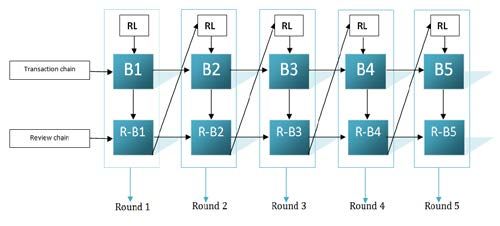
protocol system. Basically, thereare two parallel chains. This
system works in round structure, where in each round a new In our model, there are two chain architecture, it stores
Round Leader will be selected. The Round Leader willbe reviews of every node in the separate chain. A NLP algorithm
responsible to generate two blocks in one round, the measure the trust level and ensures the legitimacy of every
transaction Block, and the Review Block and both blocks review on every step of consensus process. Therefore, any
would be linked to each other. Initially, RL generates the random malicious act will be easily detected, and malicious
transaction Block after successfully achieving the consensus node will be blacklisted right away.
then Step verifier will be allowedto posttheir reviews and • Sybil Attack: This attack has been discussed in almost
ratings.Consensus will also be achieved on the reviews. Then all consensus Model. In this attack, malicious node
the RL generates the Review Block which will hold the hash creates multiple account. if one account gets defame by
of transaction Block. For the next round, the new RL will be getting negative review and acting maliciously, it
selected from the latest Review Block, and Block generation quickly switches to other account and start.
process will continue.
In our model, every node needs to earn positives review
consistently, if a malicious node switches new account, so it
wouldn't be able to hurt because it needs a minimum trust
valueto participate in consensus process which make it to act
honestly, and it wouldn’t cost effect to create a new account
every now and then.
• On-off attack: In this attack, the attacker shows mix of
behaviors, good as well as bad alternatively. In order to
get mix reviews therefore remain undetectable and
occasionally cause damage.
Fig. 5. The Complete Workflow of PoR Consensus Protocol.
297 | P a g e
www.ijacsa.thesai.org(IJACSA) International Journal of Advanced Computer Science and Applications,
Vol. 12, No. 3, 2021
In our protocol, there are two chains architecture, a 3000
separate chain is recording the reviews of every node in the
network and NLP algorithm measure the overall trust level 2500
and analyze the legitimacy of every node in the step verifiers 2000
on every step in the consensus process. Therefore, any On-off
attack can be easily reported. 1500
The reason for attackers to attack the system is 2-fold, they 1000
want to downgrade other nodes’ trustvalue to push up their 500
trust in the network to get more chances to perform malicious
0
actions.Other reason could be they want to damage the
system. Our model discourages any kind of malicious activity
and provide equal opportunities to all nodes to earn more
positive reviews and increase their trust value in the network.
It entirely works on the other node’s reviews and the nodes
trust value to make every node act and behave honestly and Negative Positive
consistently.
Fig. 6. Sentimental Analysis of Tweet for 6 US based Airlines.
VII. PRELIMINARY RESULTS
This section will discuss the Proof of concept (PoC) for VIII. CONCLUSION
evaluating reviews which is done on by performing the
To conclude, we propose a new PoRv consensus protocol
sentiment analysis of reviews (Text) through NLP. Therefore,
to make blockchain more efficient, reliable, and scalable. In
we used freely available on the standard Kaggle dataset. It
this protocol, we are utilizing the trustworthiness of node by
consists of reviews (tweets) for six US based airlines. The
empowering every node to post reviews for every other node
tweet is the mix of positives, negative and neutral. However,
on their previous behavior within the network. The trust may
our focus was on the positives and negative. The analysis was
include the previous transactions and interaction with other
done on those tweets to find the most trustworthiness of
nodes. An NLP algorithmis used to analyze the reviews and to
airlines and exactly sample idea would be replicated in the
calculate the trust value of every node. The trust value will be
proposed system.
linked to every node to efficiently select the round leader node
Sentiment analysis is performed to analyze the feeling and and that will increase the throughput with less latency.Node
opinion about anything i.e., Text or image. Basically, it is used with most positive reviews will be selected as the round leader
for decision making when you have multiple choices and you and canpublish new block to earn more positive reviews. The
need to select the most reliable. proposed protocol is designed on a 2-chain architecture that
both chains are cryptographically linked to each other. The
A simple program has been written in python first chain is utilized to store the transaction whereas the
programming language using multiple NLP libraries and all second chain is used to store the reviews. The proposed
the coding work has been done on Jupyter Notebook. system is found to be tolerant to some major attacks such as
The Fig. 6 illustrates the sentimental analysis of tweet for Sybil attack, bad-mouthing, and on-off attack.
six US based airlines those are United, US airways,
Southwest, Delta, Virgin America. The analysis is measured IX. FUTURE WORK
either positive and negative and the neutral category is The in-depth/detailed investigation and experiments of the
discarded for this evaluation. In the figure x-axis presents the proposed protocol is ongoing.The separate blockchainsare in
number of reviews (tweets) and y-axis shows the airlines. The the development phase based on the PoRv consensus protocol.
figure illustratescomparatively their high number of negative Experiment/simulation are to be used to validate and verify
and less positive for all the airlines. the proposed protocol. The implementation and experiments
on the proposed PoRv shall be published in the future papers.
However, our focus is on the positives, and the southwest
got the highest number of positive tweets and followed by the ACKNOWLEDGMENT
Delta andtheUnited.
This study is conducted in UniversitiTeknologi
PETRONAS (UTP) as "Generic Consensus Model for
Improving Nodes Syndicating Performance in Blockchain"
under the Fundamental Research Grant Scheme (FRGS) from
the Ministry of Higher Education (MOHE) Malaysia.
298 | P a g e
www.ijacsa.thesai.org(IJACSA) International Journal of Advanced Computer Science and Applications,
Vol. 12, No. 3, 2021
REFERENCES [23] B. Curran, "What is Proof of Elapsed Time Consensus?(PoET)
[1] S. Haber and W. S. Stornetta, "How to time-stamp a digital document," Complete Beginner’s Guide," ed: Accessed: Mar, 2019.
in Conference on the Theory and Application of Cryptography, 1990: [24] M. Correia, G. S. Veronese, N. F. Neves, and P. Verissimo, "Byzantine
Springer, pp. 437-455. consensus in asynchronous message-passing systems: a survey,"
[2] S. Nakamoto, "Bitcoin: A peer-to-peer electronic cash system," International Journal of Critical Computer-Based Systems, vol. 2, no. 2,
Manubot, 2019. pp. 141-161, 2011.
[3] A. Tapscott and D. Tapscott, "How blockchain is changing finance," [25] X. Li, P. Jiang, T. Chen, X. Luo, and Q. Wen, "A survey on the security
Harvard Business Review, vol. 1, no. 9, pp. 2-5, 2017. of blockchain systems," Future Generation Computer Systems, vol. 107,
pp. 841-853, 2020.
[4] Z. Hess, Y. Malahov, and J. Pettersson, "Æternity blockchain," Online].
Available: https://aeternity. com/aeternity-blockchainwhitepaper. pdf, [26] Z. Zheng, S. Xie, H. Dai, X. Chen, and H. Wang, "An overview of
2017. blockchain technology: Architecture, consensus, and future trends," in
2017 IEEE international congress on big data (BigData congress), 2017:
[5] A. Ekblaw, A. Azaria, J. D. Halamka, and A. Lippman, "A Case Study IEEE, pp. 557-564.
for Blockchain in Healthcare:“MedRec” prototype for electronic health
records and medical research data," in Proceedings of IEEE open & big [27] K. Korpela, J. Hallikas, and T. Dahlberg, "Digital supply chain
data conference, 2016, vol. 13, p. 13. transformation toward blockchain integration," in proceedings of the
50th Hawaii international conference on system sciences, 2017.
[6] A. Azaria, A. Ekblaw, T. Vieira, and A. Lippman, "Medrec: Using
blockchain for medical data access and permission management," in [28] V. Buterin, "A next-generation smart contract and decentralized
2016 2nd International Conference on Open and Big Data (OBD), 2016: application platform," white paper, vol. 3, no. 37, 2014.
IEEE, pp. 25-30. [29] O. Dib, K.-L. Brousmiche, A. Durand, E. Thea, and E. B. Hamida,
[7] X. Yue, H. Wang, D. Jin, M. Li, and W. Jiang, "Healthcare data "Consortium blockchains: Overview, applications and challenges,"
gateways: found healthcare intelligence on blockchain with novel International Journal On Advances in Telecommunications, vol. 11, no.
privacy risk control," Journal of medical systems, vol. 40, no. 10, pp. 1- 1&2, pp. 51-64, 2018.
8, 2016. [30] T. T. A. Dinh, J. Wang, G. Chen, R. Liu, B. C. Ooi, and K.-L. Tan,
[8] S. Huckle, R. Bhattacharya, M. White, and N. Beloff, "Internet of "Blockbench: A framework for analyzing private blockchains," in
things, blockchain and shared economy applications," Procedia Proceedings of the 2017 ACM International Conference on Management
computer science, vol. 98, pp. 461-466, 2016. of Data, 2017, pp. 1085-1100.
[9] P. Bylica, L. Glen, P. Janiuk, A. Skrzypcaz, and A. Zawlocki, "A [31] C. Hammerschmidt, "Consensus in blockchain systems," URL
Probabilistic Nanopayment Scheme for Golem," ed, 2015. https://medium. com/@ chrshmmmr/consensus-in-blockchain-systems-
in-short-691fc7d1fefe, 2017.
[10] P. Hurich, "The virtual is real: An argument for characterizing bitcoins
as private property," Banking & Finance Law Review, vol. 31, no. 3, p. [32] K. Yeow, A. Gani, R. W. Ahmad, J. J. Rodrigues, and K. Ko,
573, 2016. "Decentralized consensus for edge-centric internet of things: A review,
taxonomy, and research issues," IEEE Access, vol. 6, pp. 1513-1524,
[11] A. Dorri, S. S. Kanhere, R. Jurdak, and P. Gauravaram, "Blockchain for 2017.
IoT security and privacy: The case study of a smart home," in 2017
IEEE international conference on pervasive computing and [33] A. Baliga, "Understanding blockchain consensus models," Persistent,
communications workshops (PerCom workshops), 2017: IEEE, pp. 618- vol. 4, pp. 1-14, 2017.
623. [34] L. Lamport, R. Shostak, and M. Pease, "The Byzantine generals
[12] Y. Zhang and J. Wen, "The IoT electric business model: Using problem," in Concurrency: the Works of Leslie Lamport, 2019, pp. 203-
blockchain technology for the internet of things," Peer-to-Peer 226.
Networking and Applications, vol. 10, no. 4, pp. 983-994, 2017. [35] N. A. Lynch, M. J. Fischer, and R. Fowler, "A Simple and Efficient
[13] J. Sun, J. Yan, and K. Z. Zhang, "Blockchain-based sharing services: Byzantine Generals Algorithm," Georgia Inst of Tech Atlanta School of
What blockchain technology can contribute to smart cities," Financial Information And Computer Science, 1982.
Innovation, vol. 2, no. 1, pp. 1-9, 2016. [36] D. Middleton, "Hyperledger’s Sawtooth Lake Aims at a Thousand
[14] X. Xu et al., "The blockchain as a software connector," in 2016 13th Transactions per Second," ed, 2017.
Working IEEE/IFIP Conference on Software Architecture (WICSA), [37] C. Gutierrez, "Hyperledger’s Sawtooth Lake Aims at a Thousand
2016: IEEE, pp. 182-191. Transactions per Second," ed: March, 2017.
[15] E. Nordström, "Personal clouds: Concedo," ed, 2015. [38] V. Buterin, "What is Ethereum?," Ethereum Official webpage.
[16] J. S. Czepluch, N. Z. Lollike, and S. O. Malone, "The use of block chain Available: http://www. ethdocs. org/en/latest/introduction/what-is-
technology in different application domains," The IT University of ethereum. html, 2016.
Copenhagen, Copenhagen, 2015. [39] A. Harðarson, "Can Ripple disrupt the global payments market?," 2018.
[17] D. Shift, "Technology tipping points and societal impact," in World [40] D. Mazieres, "The Stellar Consensus Protocol," A Federated Model for
Economic Forum Survey Report, available at: http://www3. weforum. Internet-level Consensus. Version July, vol. 14, 2015.
org/docs/WEF_GAC15_Technological_Tipping_Points_report_2015. [41] F. Tschorsch and B. Scheuermann, "Bitcoin and beyond: A technical
pdf (last accessed 20.08. 2018), 2015. survey on decentralized digital currencies," IEEE Communications
[18] A. Yeow, "Global Bitcoin Nodes Distribution," URL: https://bitnodes. Surveys & Tutorials, vol. 18, no. 3, pp. 2084-2123, 2016.
earn. com/(accessed 08 November 2018), 2015. [42] G.-T. Nguyen and K. Kim, "A survey about consensus algorithms used
[19] K. Croman et al., "On scaling decentralized blockchains," in in blockchain," Journal of Information processing systems, vol. 14, no.
International conference on financial cryptography and data security, 1, pp. 101-128, 2018.
2016: Springer, pp. 106-125. [43] J. Bou Abdo, R. El Sibai, K. Kambhampaty, and J. Demerjian,
[20] B. Obama, "The White House: Office of the Press Secretary," "Permissionless reputation‐based consensus algorithm for blockchain,"
Presidential Studies Quarterly, vol. 39, no. 3, p. 429, 2009. Internet Technology Letters, vol. 3, no. 3, p. e151, 2020.
[21] M. Milutinovic, W. He, H. Wu, and M. Kanwal, "Proof of luck: An [44] M. Vukolić, "The quest for scalable blockchain fabric: Proof-of-work
efficient blockchain consensus protocol," in proceedings of the 1st vs. BFT replication," in International workshop on open problems in
Workshop on System Software for Trusted Execution, 2016, pp. 1-6. network security, 2015: Springer, pp. 112-125.
[22] S. Park, A. Kwon, G. Fuchsbauer, P. Gaži, J. Alwen, and K. Pietrzak, [45] A. Miller, A. Juels, E. Shi, B. Parno, and J. Katz, "Permacoin:
"Spacemint: A cryptocurrency based on proofs of space," in Repurposing bitcoin work for data preservation," in 2014 IEEE
International Conference on Financial Cryptography and Data Security, Symposium on Security and Privacy, 2014: IEEE, pp. 475-490.
2018: Springer, pp. 480-499.
299 | P a g e
www.ijacsa.thesai.orgYou can also read


