Pubs GUIDELINES FOR RE-OPENING
←
→
Page content transcription
If your browser does not render page correctly, please read the page content below
GUIDELINES FOR RE-OPENING PUBS

                                 GUIDELINES FOR RE-OPENING

                                            Pubs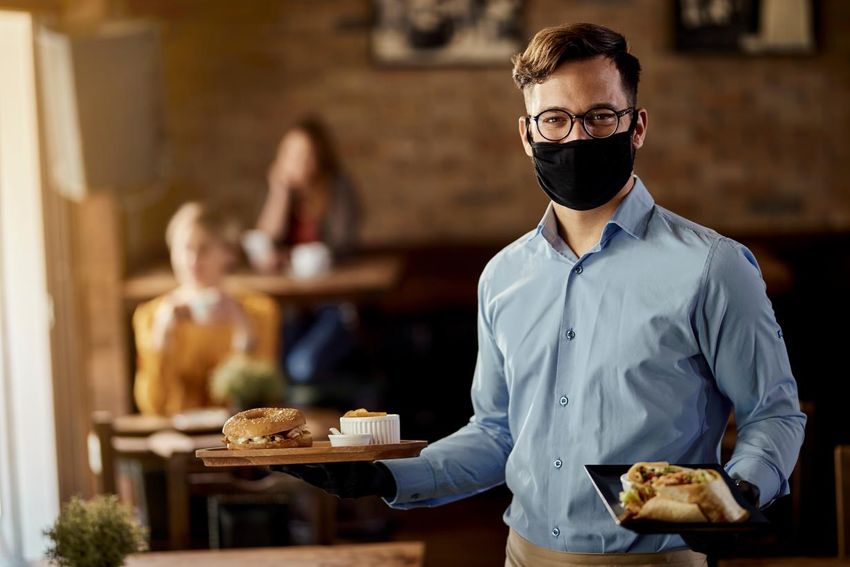
GUIDELINES FOR RE-OPENING PUBS

     Note:
     This is a living document which means as Government Public Health guidelines evolve, this
     document will also evolve to reflect new Government advice and changes to protocols when they
     emerge. All sectoral guidelines have been developed in line with the Government’s Roadmap for
     Reopening Society and Business, the Work Safely Protocol and the updated Reframing the Challenge,
     Continuing our Recovery & Reconnecting, and based on the latest health guidance available from the
     Department of Health and the HSE. The links to latest guidelines will be included throughout the
     document.

     The Tourism and Hospitality sectoral guidelines, aligned with the Work Safely Protocol, have been
     developed collaboratively to assist businesses to apply guidance to their operations. The guidelines
     are informed by the latest Government public health advice and related regulations.

     Disclaimer
     The information contained within these operational re-opening guidelines can change from time to time. It must
     not by itself be relied upon in determining obligations or other decisions. Users of this document must
     independently verify any information on which they wish to rely. It is expected that all business owners and
     management will have familiarised themselves with the Work Safely Protocol prior to re-opening and
     implemented all relevant requirements.
     Fáilte Ireland, their servants or agents, do not assume legal or other liability for any inaccuracy, mistake,
     misstatement, or any other error of whatsoever nature contained herein. Fáilte Ireland hereby formally disclaim
     liability in respect of such aforesaid matters.
     The information accessible in this document has been compiled from many sources that are not controlled by
     Fáilte Ireland. While all reasonable care has been taken in the compilation and publication of the contents of this
     document, Fáilte Ireland makes no representations or warranties, whether express or implied, as to the accuracy
     or suitability of the information or materials contained in this document. Due to the evolving nature of the COVID-
     19 pandemic, this document will be subject to change.
     Access to and use of the information herein is entirely at the risk of the user. Fáilte Ireland shall not be liable,
     directly, or indirectly, to the user or any other third party for any damage resulting from the use of the information
     contained or implied in this document.
     Fáilte Ireland has endeavoured to attribute copyright or other intellectual rights to the rightful owners where such
     course has been appropriate. Where any attribution has been missed or overlooked Fáilte Ireland, on being
     informed, will correct this omission. By proceeding to use this Fáilte Ireland document you are accepting this
     disclaimer.

     Fáilte Ireland Overview Guidelines to Re-opening
     It is recommended that businesses also view the Fáilte Ireland Overview Guidelines to Re-opening in
     addition to this sector specific guideline document, as further information relating to COVID-19
     control measures, Health & Safety measures, hygiene measures, etc. are outlined.

 2                                                BACK TO CONTENTS PAGE
GUIDELINES FOR RE-OPENING PUBS

Revision History:
Version       Date Changes              Changes from previous version

            Guidelines for Re-Opening Pubs Effective 21 September 2020 is now combined with this document to encompass Pubs that Serve Food and Wet Pubs

  9.0     10/09/2021         Update of guidelines in line with Reframing the Challenge, Continuing our Recovery & Reconnecting
  8.3     06/08/2021         Updated Government Guidance for Outdoor Events (Section 11)
  8.2      29/07/2021        Update to table on Page 4 and Indoor Hospitality Food Counter Service

  8.1      25/07/2021        Information update on contact tracing
  8.0      23/07/2021        Updated to reflect the Health (Amendment) (No. 2) Act 2021
                             Minor updates to the COVID-19 Resilience & Recovery 2021 (Table on page 4) relating to the recent announcements
  7.2      01/07/2021
                             from Government.

  7.1      02/06/2021        Further minor updates to the COVID-19 Resilience & Recovery 2021 (Table on page 4) & links to Work Safely Protocol.

  7.0      26/05/2021        Update of information in line with Work Safely Protocol, Ventilation and other general guidance.

  6.0      11/05/2021        Update of information in line with Government Public Health advice

  5.4      01/03/2021        Update to the COVID-19 Resilience & Recovery 2021 – The Path Ahead.

  5.3      25/01/2021        Update of information in line with Government Health advice and Ventilation (Appendix 2).
                             Update of Resilience and Recovery 2020-2021: Plan for Living with COVID-19 for Level 5 and Guidance on
  5.2      08/01/2021
                             International Travel
  5.1      04/01/2021        Update of Resilience and Recovery 2020-2021: Plan for Living with COVID-19 for Level 5.

  5.0      22/12/2020        Update of Resilience and Recovery 2020-2021: Plan for Living with COVID-19.
                             Update in line with S.I 571 of 2020 (Face Coverings In Certain Premises And Businesses) and updates to Government
  4.3      17/12/2020
                             Public Health and Safety advice.
  4.2      02/12/2020        Updates to Summary of Level 3 – Page 6

  4.1      02/12/2020        Updated links
                             Updates in line with Work Safely Protocol.
  4.0      01/12/2020        Update of Resilience and Recovery 2020-2021: Plan for Living with COVID-19 for Level 3 and update in line with S.I.
                             560 of 2020
                  Guidelines for Re-Opening Pubs Effective 21 September 2020 published in addition to first issue as Wet Pubs in Dublin remained closed.

  3.2      16/11/2020        Update of information relating to International Travel.

  3.1      09/11/2020        Update of information relating to Face Covering (HPSC).

  3.0      22/10/2020         Update of Resilience and Recovery 2020-2021: Plan for Living with COVID-19 for Level 5.

  2.0      06/10/2020         Update of Resilience and Recovery 2020-2021: Plan for Living with COVID-19
                              Update of Resilience and Recovery 2020-2021: Plan for Living with COVID-19 – clarification on restrictions for county
  1.3      25/09/2020
                              Donegal
  1.2      18/09/2020         Updated in line with Resilience and Recovery 2020-2021: Plan for Living with COVID-19.

  1.1      14/09/2020         Document Published. These guidelines do not come into effect until 21st September 2020.
                                        Guidelines for Re-Opening Pubs that Serve Food published as Wet Pubs remained closed

   1.5     02/09/2020         Addition of Regulation S.I. No. 326 of 2020

   1.4     27/08/2020         Updated in line with Government Public Health advice.
   1.3     06/07/2020         Updates to Appendix 1 of COVID-19: Guidance for Food Service Businesses (HPSC) V1.1.
   1.2     23/0692020         Clarification on inclusion of service personnel in NPHET guidance.
   1.1     17/06/2020         Document Published

    3                                                           BACK TO CONTENTS PAGE
Reframing the Challenge
Continuing our Recovery and Reconnecting

                                                        New Public Health Measures
                             Subject to the public health situation at the time & continued protective factors.
                                     Current Measures                                        From 20th September

Weddings           The maximum number of guests permitted to attend a wedding is 100 (current protective measures apply).

Paid Tourist
                   Accommodation services including hotels, B&Bs, self-catering, caravan & camping and hostels are open.
Accommodation

Gyms, Pools &
Leisure            Open for individual training only.                          Indoor classes are permitted with reduced capacity.
Facilities

                   Public transport returns to 100% capacity.
Transport
                   Face coverings must be worn

                   Coach Tours are permitted with 75% capacity with protective measures
                   Face coverings must be worn
Coach Tours        Multiple table bookings can be accommodated in food and beverage businesses when catering for tour groups
                   subject to the application of other existing Infection Prevention Control measures in place for safe operation of
                   service.

Domestic Travel    No Restrictions

                   Indoor hospitality can open subject to the Guidance on Indoor Hospitality. Government regulations in relation
Cafés,             to evidence of COVID-19 vaccination or immunity following recovery should be implemented.
Restaurants &
Pubs               Outdoor Hospitality can continue to operate for customers who are unable to provide evidence of COVID-19
(including Hotel   vaccination or immunity following recovery.
Restaurants
and Bars)
                   A maximum of 6 adults and up to 9 minors (under 18) may be seated at a table.

Closing Time       Food & Beverage facility must be clear of all patrons by 11:30pm.

Nightclubs         Closed.

Outdoor Parks
                   Open with protective measures.
& Play Areas

                   Business events/conferences can take place at up to 60% seated capacity once all participants show proof of
                   immunity.

                   Small non-social meetings, training and educational programmes may take place when it is considered essential,
Meetings           for the operation of the business, that they must take place face-to-face and as a matter of urgency (in advance
                   of the expected move from a restrictions regime on 22 October).

                   For food and beverage service associated with essential on-site business meetings/training/education, there will
                   need to be a requirement to ensure that the numbers permitted equate to 60% of the seated capacity.
Reframing the Challenge
Continuing our Recovery and Reconnecting

                                                         New Public Health Measures
                                Subject to the public health situation at the time & continued protective factors.
                                      Current Measures                                           From 20th September
                     Open with protective measures (for example, a
                     maximum capacity to allow 2m distancing, one-way
                     traffic within the venue). Maximum numbers linked
                     to the capacity, taking account of Public Health             Guided tours within indoor attractions are permitted
Attractions
                     Advice.                                                      in pods of 6.

                     Outdoor amusements/theme parks/funfairs are
                     permitted.

                                                                                  Organised indoor group activities (sports, arts,
                                                                                  culture, dance classes) can take place with capacity
                                                                                  limits of 100 people (with appropriate protective
                                                                                  measures) where all patrons are immune (fully
                                                                                  vaccinated or recovered from COVID-19 within
                                                                                  previous 6 months), or accompanied minors (under
                                                                                  18).

                     Outdoor Activities Open with protective measures.            Where patrons have mixed immunity status, pods of
Activities           Outdoor amusements/theme parks/funfairs are                  up to 6 participants will be permitted (excluding adult
                     permitted                                                    leaders/teachers).

                                                                                  Indoor guided tours are permitted in pods of 6.

                                                                                  Restrictions on Organised outdoor group activities
                                                                                  are removed.

                                                                                  Note: where applicable, spectator attendance will
                                                                                  remain in line with regulations for events.

                     Organised indoor events & mass gatherings* are permitted with capacity limits of 60% of seated capacity where
                     all patrons are immune (fully vaccinated or recovered from COVID-19 within previous 6 months), or
                     accompanied minors (under 18)

Organised            Where patrons have mixed immunity status, organised indoor events / mass gatherings are not permitted.
Indoor Events /
Mass                 Easing of capacity limit restrictions does not apply to large privately organised social events.
Gatherings
                     For Food & Beverage services associated Events/Gatherings there will be a requirement to ensure that the
                     numbers permitted equate to 60% of the seated capacity. Multiple table bookings are allowed subject to the
                     application of other existing Infection Prevention Control measures for the safe operation of food and beverage
                     service.

                     Organised outdoor events & mass gatherings are permitted with capacity limits of 75% of venue capacity where
                     all patrons are immune (fully vaccinated or recovered from COVID-19 within previous 6 months), or
Organised
                     accompanied minors (under 18).
Outdoor Events
/ Gatherings
                     Where patrons have mixed immunity status, the capacity limit will be 50%, subject to appropriate protective
                     measures including physical distancing between groups & face masks.

*Indoor events and mass gatherings includes conferences, trade fairs and exhibitions and large-scale business events involving external
audiences, and bingo venues.
GUIDELINES FOR RE-OPENING PUBS
Table of Contents
1. Introduction: Meeting & Overcoming                     10. Food and / or Beverage Service                      20
the COVID-19 Challenge                               6    Guidance for Food & Beverage Service                    20
                                                          Outdoor Hospitality                                     20
2. Business Response/Action Plan                     8    Definition of an Outdoor Space                          20
Monitoring & Supporting                              8    Cleaning & Disinfection Protocol                        21
Policies & Processes                                 9    Capacity Management                                     21
Communication                                        9    Physical Distancing Protocol                            21
Training                                             10   COVID-19 Contact Tracing                                22
Cleaning & Frequency                                 10   Measures to Control Noise Levels                        22
Ventilation/ Air Conditioning                        10   Bar(s)                                                  22
Staffing Resources                                   10   Table Service                                           22
                                                          Order Taking                                            23
3. Employee & Customer Health                        11   Glassware                                               23
Face Coverings/Masks                                 11   Food Counter Service – Self-Service Carvery/Buffet      24
Physical Distancing                                  12   Employee Service Stations                               26
Employee Physical Distancing                         12   Ice Machines                                            26
Measures to Control Noise Levels                     12   Payment Facilities                                      26
Providing Hand Sanitisers                            12   Customer & Service Elevators                            26
Information Signage                                  12   Toilet Facilities                                       26
Employee & Customer Health Concerns                  13   Smoking Areas                                           26
Isolation Area                                       13
                                                          11. Outdoor Events                                      27
4. Employee Responsibilities                         13   Outdoor Event Area                                      27
Hand Hygiene                                         13   Definition of an Outdoor Space                          27
COVID-19 Training                                    14   Cleaning & Disinfection Protocol                        27
Personal Protective Equipment (PPE)                  14   Capacity Management                                     27
Employee Welfare Facilities & Timekeeping            14   Physical Distancing Protocol                            27
First Aid Kit                                        14   COVID-19 Contact Tracing                                28
                                                          Food & Beverage Service at an Outdoor Event             28
5. Physical Distancing                               15   Food Counter Service – Self-Service Carvery/Buffet      28
Capacity Management                                  15   Employee Service Stations                               29
Queuing                                              15   Smoking Areas                                           29
Meet & Greet                                         15
Seating                                              15   12. Kitchen                                             30
Food Counter Service – Self-Service Carvery/Buffet   16   Food Preparation Area                                   30
Smoking Areas                                        16   Cleaning & Disinfection Protocol                        30
Back of House                                        16   Physical Distancing Protocol                            30
Timekeeping Facilities                               16   Kitchen & Food Handling Personnel                       30
                                                          Wash-Up                                                 30
6. Locations for Distribution of PPE                 17
Customer Facing Areas                                17   13. Back of House                                       31
Back of House                                        17   Cleaning & Disinfection Protocol                        31
                                                          Physical Distancing Protocol                            31
7. Employee Uniforms                                 17   Employee Toilet Facilities                              31
Cleaning & Disinfection Protocol                     17   Cellars, Cold Rooms & Store Rooms                       31
Physical Distancing Protocol                         17
                                                          14. Suppliers of Goods and Services                     32
8. Cleaning Products & Protocols                     18   Deliveries                                              32
Public Spaces & Communal Areas                       18   Dealing with Drivers                                    32
Back of House & Staff Areas                          18   Entering the Premises                                   32
Equipment Shared by Employees                        18   Accepting Deliveries                                    32
Control of Waterborne Hazards                        18
                                                          Appendix 1                                              33
9. Technical & Maintenance Services                  19   Controlled and Uncontrolled Environments                33
Water Disinfection                                   19
                                                          Appendix 2                                              34
Dishwashing & Laundry Equipment                      19   Ventilation                                             34
Dispensers                                           19
                                                          Manual (Natural) Requirements                           34
Additional Recommendations                           19
                                                          Mechanical Requirements                                 34

                                                            NOTE: These guidelines have been developed for all types
                                                            of bars, public houses and gastropubs of all sizes. For
                                                            example, terms such as ‘Back of House’ generally apply to
                                                            employee facilities. Not all references will relate to
                                                            individual properties. These guidelines should be applied
                                                            as appropriate to your business.

                                                            These guidelines are designed to support the operations
                                                            of food and beverage service within tourism businesses
                                                            which include, but are not limited to restaurants, cafés,
                                                            pubs, paid accommodation and attractions.
GUIDELINES FOR RE-OPENING PUBS

1. Introduction: Meeting & Overcoming
the COVID-19 Challenge
COVID-19 is an unprecedented challenge for the tourism                                               ▪    Putting dedicated resources in place
sector.                                                                                                   Tourism businesses should ensure that they have
                                                                                                          dedicated personnel to implement and operate a robust
Pubs, bars and gastropubs will need to review how they work                                               system that prevents the spread of COVID-19. Equally
and introduce new practices and procedures to ensure                                                      importantly, they need to put processes in place that can
everyone stays safe. As a result, Fáilte Ireland has developed                                            deal with individual and multiple cases of the disease that
operational guidelines in line with the Health Service                                                    may occur.
Executive (HSE), Health Protection Surveillance Centre
(HPSC) and the Food Safety Authority of Ireland (FSAI).                                              ▪    Adapting and enhancing hygiene practices
                                                                                                          Tourism businesses must adapt and implement enhanced
As part of this, Fáilte Ireland has created this set of specific                                          procedures in general cleaning, storage and cleaning of
guidelines to help you re-open your bar or pub. You can be                                                equipment. In particular, they should introduce and
reassured that these recommendations are underpinned by                                                   implement touchless solutions where possible.
advice made available from the HSA, HSE, HPSC, FSAI, World                                                References to HACCP in this guidance are for the
Health Organisation (WHO) and other relevant bodies.                                                      purposes of food safety and not the prevention of COVID-
                                                                                                          19.
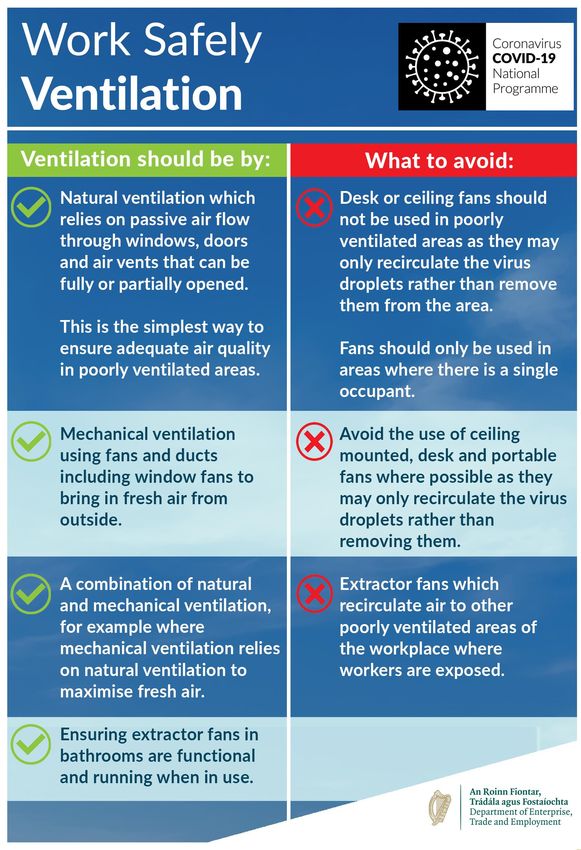
Businesses should follow the Work Safely Protocol which has                                          ▪ Ventilation
been developed under the aegis of the Safety Health and                                                The proven importance of ensuring adequate fresh
Welfare Act 2005. Businesses are now required to review                                                outside air circulation should be factored into operational
their existing advice, guidance and protocols to ensure they                                           practices. Consider a ventilation assessment of the
are in line with these updates. The Health and Safety                                                  business and the use of CO₂ monitors as per the Work
Authority (HSA) is the compliance body and has full powers                                             Safely Protocol and the WSP Employer Checklist No. 8 -
as set out in this legislation designated in relation to the                                           Ventilation. Further information regarding air
implementation of the Work Safely Protocol. Non-                                                       conditioning and ventilation can be found in Section 5.D
compliance can result in the closure of a business.                                                    of the Work Safely Protocol as well as Appendix 2.

Businesses must keep a record of the time and date of arrival                                             The spread of the virus is most likely when infected
at the premises of a group/sole customer and the name and                                                 people are in close contact so the risk of getting COVID-19
telephone number of the lead person in a group/sole                                                       is higher in crowded and poorly ventilated spaces where
customer for COVID-19 contact tracing. Details must be                                                    infected people spend long periods of time together in
securely retained for 28 days and be compliant with GDPR.                                                 close proximity. It is important to maximise ventilation in
                                                                                                          areas where people are in close contact. While large
Personal Responsibility                                                                                   droplets containing the virus will settle onto the
All individuals will need to continue to monitor the ongoing                                              surrounding surfaces within seconds, smaller particles
risk from the disease and take personal responsibility as they                                            containing the virus can stay suspended for longer
take steps individually and collectively in their everyday lives                                          periods of time. Dilution of indoor air by opening
to keep this risk under control.                                                                          windows and doors or using mechanical ventilation
                                                                                                          (HVAC) systems can lower the airborne concentration
                                                                                                           and remove these smaller particles from the air.
The guidelines were developed based on the following
considerations:
                                                                                                     ▪    Focusing on best practice in food and beverage service
▪     Restructuring operations                                                                            Tourism businesses must follow HACCP, best practice in
      Tourism businesses of all types need to adapt their                                                 service, and physical distancing requirements to promote
      operations, review employee practices and consider the                                              the health of employees and customers.
      design of their business to ensure physical distancing and
      the prevention of the spread of COVID-19. Further
      information on reviewing employee practices can be
      found in the Work Safely Protocol e.g. consider any new
      additional measures for employees who are deemed high
      risk.

    * Current physical distancing guidance is in line with Public Health advice. This document will evolve to reflect new Public Health advice and changes to protocols as and when they emerge

 7                                                                           BACK TO CONTENTS PAGE
GUIDELINES FOR RE-OPENING PUBS

▪     Food and beverage service businesses as ‘controlled’                                               to achieve this. A Health and Safety statement was
      environments                                                                                       already required, and is still a requirement. The COVID-19
      Public and private venues or workplaces are considered                                             Response plan is also a requirement of the Work Safely
      controlled environments. This includes food and                                                    Protocol.
      beverage businesses such as restaurants, cafés and pubs
      and bars.                                                                                          In addition, food and beverage business operators will be
                                                                                                         required to introduce COVID-19 safety management
      Uncontrolled environments are settings where people                                                systems in the form of enhanced hygiene, cleaning and
      have open access to the premises and generally don’t                                               disinfection, staff training and health checks, as well as
      know each other and are unlikely to be in close contact                                            physical distancing. This is to protect against the
      with each other for an extended period of time. Examples                                           transmission of the virus to or between staff, customers
      include supermarkets, retail stores, shopping malls and                                            and other people who enter their premises. Any COVID-
      takeaway-only food outlets.                                                                        19 precautions must not compromise food safety.

      Additional details on controlled and uncontrolled                                                  For advice and information on food safety during COVID-
      environments can be found in Appendix 1.                                                           19 and for food businesses re-opening, the Food Safety
                                                                                                         Authority of Ireland (FSAI) website is a useful resource
                                                                                                         which is regularly updated HERE.

▪     Food Preparation Area                                                                         ▪ Guidance on International Travel
      Current legislation states a “food preparation area”                                            A range of new measures and requirements, including
      means an indoor part of such premises which is                                                  mandatory quarantine for travel from certain countries,
      structurally adapted and used for the purpose of                                                for those travelling to Ireland is available HERE. It is
      preparing food for consumption by members of the                                                important for employers to keep up to-date on travel
      public on or off the premises concerned and, for the                                            restrictions and requirements into the country as these
      avoidance of doubt, does not include a tent, caravan,                                           may be subject to change on a regular basis.
      vehicle, storage container or other temporary structure.
                                                                                                         Current Government advice is available HERE.
      If your business serves food, you are required to have a
      designated food preparation area as outlined above.

▪     Food safety and COVID-19 safety
      There are no reports of transmission of COVID-19 via
      food. The main mode of transmission is from person to
      person. Food business operators must continue to apply
      their food safety management systems, based on the
      principles of HACCP.

      The requirement in legislation is to have a Food Safety
      Management System in place based on the principles of
      HACCP.ISO 340:2007 is one of the available approaches

    * Current physical distancing guidance is in line with Public Health advice. This document will evolve to reflect new Public Health advice and changes to protocols as and when they emerge.

 8                                                                           BACK TO CONTENTS PAGE
GUIDELINES FOR RE-OPENING PUBS
2. Business Response/Action Plan
Creating an Action Plan will help to clarify what is required to overcome the threat of COVID-19 and give your employees
and customers confidence that they are safe.
In developing an Action Plan, the first step that the Your Action Plan needs strong commitment from both
management team of a bar or pub should take is to familiarise management and employees. Consultation with employees,
themselves with the latest guidelines from the following effective supervision, clear direction and information for your
sources: customers are key to ensuring compliance with Government
Public Health advice and the success of your Action Plan.
▪ Health Services Executive (HSE)
▪ Health and Safety Authority (HSA)
For further information on the development of your Action
Plan see HERE.
▪ Health Protection Surveillance Centre (HPSC)
▪ Food Safety Authority of Ireland (FSAI) Monitoring & Supporting
▪ Irish Government Departments A COVID-19 Response Team/Lead Worker Representative
▪ World Health Organisation (WHO). (LWR) must be appointed to ensure new procedures are
adhered to. Adherence to this protocol will only be achieved if
Information from these sources should help to shape your employers and workers have a shared responsibility to
plan of action. You should also: implement the measures contained in this protocol in their
place of work. A collaborative approach to the
▪ Complete a risk assessment to identify what operational,
implementation of the protocol is essential to achieve success
changes you need to make in your business, this should
include an occupational health and safety risk as well as and maximum buy in.
considering a ventilation assessment. Further information
can be found HERE for risk assessments and Appendix 2 for Each workplace should appoint at least one lead worker
Ventilation. representative charged with ensuring that COVID-19 measures
are strictly adhered to in their workplace. The person(s)
▪ Review of all standard operating procedures (SOPs) to undertaking the role must receive the necessary training and
define and note what you are changing. have a structured framework to follow within the organisation
to be effective in preventing the spread of the virus. Further
▪ Create a communication plan to inform employees and information and a short online course on the role of Lead
customers of what you are changing, what you need them Worker Representative can be found on the HSA website.
to do and how you expect everyone to act and behave.
Employers should have regular and meaningful engagement
▪ Visit the HSA website for templates, checklists and advice with their worker representative, workers and/or their
on the returning to work Protocols. Please see HERE for recognised Trade Union or other representative (including
more information. health and safety committee where it exists) about the
measures being put in place to address the
A number of activities will require review e.g. workflows, occupational exposure to COVID-19 in the workplace.
operations, etc. For advice on re-opening, visit the FSAI Employers should provide COVID-19 induction training for all
website. Please see HERE for more information. workers on their return.
The plan should reassure employees and customers that The number of worker representatives for COVID-19
safeguarding their health and safety is of the utmost appointed should, ideally, be proportionate to the number of
importance. It should also ensure that your operations workers in the workplace and this person(s) should be clearly
continue to run in an appropriate manner. identifiable in the workplace. Employers and worker
representatives will work together to ensure that all the
You should review the plan regularly and amend it as new actions in this protocol are fully adhered to in order to ensure
regulations, guidelines and procedures come into place. the suppression of COVID-19 in the workplace.
Experience and feedback will inform how appropriate and
effective the action plan is.
Strict management controls should be in place to ensure
compliance with Public Health advice at all times.
* Current physical distancing guidance is in line with Public Health advice. This document will evolve to reflect new Public Health advice and changes to protocols as and when they emerge.
9 BACK TO CONTENTS PAGEGUIDELINES FOR RE-OPENING PUBS
Section 3 of the Work Safely Protocol sets out the steps for ▪ Reviewing and updating cancellation and refund policies in
employers and workers to reduce the risk of exposure to line with business requirements, e.g. events.
COVID-19.
▪ Developing and updating policy relating to the standards
These provisions include: of behaviour expected from employees and customers to
prevent the spread of COVID-19. Strict management
▪ Consulting with the workplace representatives in the controls should be in place to ensure compliance with
development of a COVID-19 response plan. Public Health advice at all times.
▪ Developing/Amending policies and procedures for prompt ▪ If adopting the use of Rapid Antigen Diagnostic Tests
identification and isolation of workers who may have (RADT) in the workplace, amend the COVID-19 Business
symptoms of COVID-19. Response / Action plan to take account of the agreed
testing policy and approach taken and communicate to all
▪ Developing, consulting, communicating and implementing employees. For more information see section D13 of the
workplace changes or policies. Specific reference is made Work Safely Protocol
to agreeing with workers any temporary restructuring of
work patterns that may be required to implement the
COVID-19 prevention measures in the workplace. There is
also provision for the lead worker representative to be Communication
involved in communicating the health advice around
COVID-19 in the workplace. You should share the plan with all employees, as well as
changes to other policies, e.g. sick leave policies, prior to
▪ The HSA has introduced interim guidance to assist them returning to work. If it’s updated at any time, you
employers and workers to manage a return to work should make sure everyone knows what has changed.
following COVID-19 testing or infection. The Fitness for
Work interim guidance and related checklists are available Giving guidelines to employees on how they should
here. communicate the Action Plan to customers will ensure
everyone gives the same message and there is no
inconsistency.
Policies & Processes Make sure an up-to-date list of the contact information of all
employees, including emergency telephone numbers, is
Management should review all business policies and standard always readily available across all departments in the
operating procedures across each department to reflect business.
operational changes. In particular, this means:
Regularly review all COVID-19 related signage and notices
▪ Defining and documenting a clear plan of action in the throughout the premises to ensure they display the latest
event of a suspected case of COVID-19 among customers Public Health advice from Government. Signs should be
and/or employees. placed in prominent and relevant positions, be legible and,
where appropriate, be offered in multiple languages.
▪ Develop a policy and process in line with the Work safely
Protocol to prepare your business for management of a Downloading and using the HSE COVID-19 tracker app is also
case or cases (outbreak) of COVID-19 in the workplace. an important measure that can be adopted. Employers
Ref. section 9 of the Work Safely Protocol. should provide advice on the tracker and encourage workers
to download. Workers should download as it can be used for
An outbreak of COVID-19 is when two or more cases of contact tracing purposes in and out of the workplace.
the disease are linked by time, place or person. The
management of an outbreak is managed by the local
Departments of Public Health to enable the outbreak to
be brought under control as quickly as possible. It also
requires close engagement and cooperation between the
employer, the LWR, the staff, representatives and in
particular with the worker(s) affected. Outbreaks in a
single workplace, which are not managed and brought
under control quickly, can rapidly spread to other
workplaces and/or the wider community. Continuous and
effective communication between all parties is essential.
Refer to HPSC guidance on management of outbreaks
HERE.
▪ Defining and documenting the correct and appropriate
use of Personal Protective Equipment (PPE) where
required. This should be in line with the Government’s
Public Health advice.
▪ Developing and updating current policy for the care of
employee uniforms to ensure they are appropriately
maintained.
* Current physical distancing guidance is in line with Public Health advice. This document will evolve to reflect new Public Health advice and changes to protocols as and when they emerge.
10 BACK TO CONTENTS PAGEGUIDELINES FOR RE-OPENING PUBS
Training Ventilation /Air Conditioning
Management should inform all employees of the measures Where possible, windows and doors should be opened to
being adopted to manage the threat of COVID-19. Use the
most appropriate training channels to do this and ensure all allow for a flow of air throughout the property. When rooms
employees remain at home and seek medical attention if are being cleaned, windows and/or doors where
they have key symptoms such as a high temperature, appropriate, should be opened. Care needs to be taken at all
coughing or shortness of breath. times to ensure security and safety measures.
There is an obligation on employers to ensure that The spread of the virus is most likely when infected people
employees are aware that they must not attend work if they
have symptoms. This is essential to ensure that the virus are in close contact so the risk of getting COVID-19 is higher
does not spread. in crowded and poorly ventilated spaces where infected
people spend long periods of time together in close
You should organise information briefings that cover all the proximity. It is important to maximise ventilation in areas
basic protective measures against COVID-19 and the signs where people are in close contact. While large droplets
and symptoms of the disease. In particular, make sure you
cover: containing the virus will settle onto the surrounding surfaces
within seconds, smaller particles containing the virus can
▪ Hand and respiratory hygiene and physical distancing stay suspended for longer periods of time. Dilution of indoor
measures
air by opening windows and doors or using mechanical
▪ Correct use of PPE ventilation (HVAC) systems can lower the airborne
▪ Cleaning and disinfecting regimes (incorporating front concentration and remove these smaller particles from the
and back office areas if relevant) air.
▪ Employee health and what to do if feeling unwell
Further information regarding air conditioning and
▪ Unwell customer/dealing with suspected cases/liaising ventilation can be found in Section 5.d of the Work Safely
with authorities.
Protocol, in the WSP Employer Checklist No. 8 – Ventilation,
▪ If training is needed for specific procedures or if your as well as Appendix 2.
property has specific requirements, it should be included
in the training programme.
First Aid Responders may require further training in light of Staffing Resources
COVID-19.
For a more comprehensive list of symptoms of COVID-19, Property owners/management should review rotas in line
please click HERE. If you do not have symptoms, you can get with The Work Safely Protocol, subsection 3 which provides
a free COVID-19 (coronavirus) test at a COVID-19 walk-in test that full consultation on these matters is required to ensure
centre. sufficient employees are available to maintain physical
distancing while completing the tasks to the required
standards. Employee scheduling should ensure more time is
Cleaning & Frequency allocated for cleaning and encourage employees to work
alone if possible. Further information can be found HERE
Cleaning and disinfection should be carried out with
increased frequency, at least twice a day, but more To achieve this, you should:
frequently depending on the through-put of customers at a ▪ Implement phased shifts.
given time and whenever facilities are visibly dirty. ▪ Schedule small teams.
▪ Keep the same team combinations where possible to
Ensure contact/touch surfaces such as table tops, work limit employee interaction. This will assist should contact
equipment, door handles and handrails are visibly clean at all tracing be required.
times and are cleaned and disinfected at least twice daily.
You will also need to plan for the impact of employee
Implement modified cleaning intervals for rooms and work absences; this may involve reallocating employees from non-
areas. This applies especially for toilet facilities and essential tasks. Where appropriate, cross-training employees
communal spaces. Cleaning of work areas should be will help maintain staffing levels on your premises.
conducted at regular intervals. Employees who have not had close contact with a confirmed
case should continue taking the usual precautions and
Further information on cleaning in non-healthcare settings is attend work as usual.
available from the ECDC HERE and from the Government
website HERE. Further information on close contacts, casual contacts and
testing is available from the HSE website.
As far as reasonably possible, a distance of 2 metres* and a
minimum of 1 metre* should be maintained between
employees. Where 2 metres* is not possible all other
measures to protect employees should be in place. You
should apply the Work Safely Protocol.
* Current physical distancing guidance is in line with Public Health advice. This document will evolve to reflect new Public Health advice and changes to protocols as and when they emerge.
11 BACK TO CONTENTS PAGEGUIDELINES FOR RE-OPENING PUBS
3. Employee & Customer Health
All individuals will need to continue to monitor the ongoing risk from the disease and take personal responsibility as they
take steps individually and collectively in their everyday lives to keep this risk under control.
The health and safety of employees and customers is the number one priority for management. Strict management
controls should be in place to ensure compliance with Public Health advice at all times. The following steps will help
ensure everyone remains fit and well:
Face Coverings/Masks Following the HPSC Evidence Summary on the “Efficacy of
visors compared with masks in the prevention of
Wearing a face covering/mask helps to prevent the spread of transmission of COVID-19 in non-healthcare settings”,
COVID-19. It is strongly recommended to wear a face Tourism and Hospitality businesses should consider the
covering/mask in situations where physical distancing is following recommendations:
difficult. Face masks are always in addition to, and never a
substitute for, other Public Health measures including ▪ In public settings, expert opinion and international
physical distancing, hand hygiene and practising appropriate guidance generally favours cloth face coverings over
respiratory etiquette. visors or shields.
Under current legislation, management and employees in ▪ There is a rationale and laboratory evidence favouring
customer facing roles, who engage in or carry out work cloth face coverings over visors where the wearer is at a
relating to the preparation of, or service of, food or higher level (standing) than those potentially exposed at
beverages for consumption on the premises must wear a a lower level (sitting). This is extremely important for
face covering. Management must ensure that employees food and beverage service businesses.
comply with this regulation.
There are cases where people may be unable to wear a face
▪ Visors reduce exposure to a certain extent when
compared to no face covering and may be considered an
covering and this is deemed as a reasonable excuse. For alternative in certain circumstances where an individual
details on what constitutes a reasonable excuse see HERE. is unable to wear a face covering/mask. Click HERE for
Businesses must ensure that they are familiar with the more information.
various reasons why an employee or customer may not be
required to wear a face covering/mask, further details can
be found HERE.
▪ If visors are used, they should cover the entire face
(above the eyes to below the chin and wrap around from
ear to ear) and be correctly applied.
The Work Safely Protocol states that face coverings/masks
are recommended in public areas in buildings, including
receptions/foyers and also when moving throughout
▪ Further information on the handling and care of visors
can be found HERE
buildings.
Government Public Health advice states that face covering/
masks must be worn by customers when arriving to and
leaving their table in the bar. Please see HERE.
As part of your business risk assessment, you should
determine the requirement for face coverings/masks in all
individual business activities. The Work Safely Protocol states
that in settings where 2 metre employee separation cannot
be ensured then face coverings/masks should be made
available to employees in line with Public Health advice.
Ensure that customers are clearly informed of your own
business policy and government regulations regarding face
coverings/masks in advance of arrival. Employers and
employees must keep up to date with the latest Public
Health advice issued regarding face coverings/masks.
A face covering should cover your nose and mouth, go under
your chin, fit snugly against the side of the face with no
visible gaps and be secured with ties or ear loops. For more
information on the safe use, storage and disposal of face
coverings/masks, please click HERE.
* Current physical distancing guidance is in line with Public Health advice. This document will evolve to reflect new Public Health advice and changes to protocols as and when they emerge.
12 BACK TO CONTENTS PAGEGUIDELINES FOR RE-OPENING PUBS
Physical Distancing Measures to Control Noise Levels
Physical distancing guidelines in line with the Government’s Employees and customers should be aware of the increased
Public Health advice should be incorporated into the Action risk of transmission from speaking loudly, shouting and
Plan for each department within a business. Specific areas singing etc. and should ensure that they take the necessary
should also comply with mandatory capacity limits. precautions to avoid any increased risk.
Following updated Government Public Health measures, According to the WHO, transmission of COVID-19 can occur
businesses should ensure that they implement the required through direct, indirect, or close contact with infected
measures, subject to the current Public Health advice, in people through infected secretions such as saliva and
relation to maximum capacity at a table. These measures are respiratory secretions or droplets, which are expelled when
applicable to pre-bookings and walk-in customers. an infected person coughs, sneezes, talks, etc.
In a controlled environment, such as pubs, bars and High noise levels within a premises can impact conversation
gastropubs, physical distancing of at least 2 metres* is negatively and encourage customers to raise their voice to
considered best practice unless the requirements outlined in communicate thus encouraging possible transmission of the
Appendix 1 have been met. virus.
Physical distancing is considered to be the distance between Straining to hear others due to high volumes can cause
people seated at separate tables i.e. back of chair to back of people to move closer to each other and not adhere to social
chair. distancing. To avoid this, businesses should put in place a
plan and take appropriate measures to control noise levels,
Careful consideration needs to be given when using to ensure volumes do not rise to a level where people are
communal areas, while queuing, using elevators, stairs or
moving around the premises. Ensure there are systems in required to take such measures to hear others.
place to prevent intermingling in communal areas (e.g.
entrances, exits and toilet facilities). See Appendix 1. Given the strong evidence from the WHO and other public
health bodies, noise levels should be maintained at levels
Tables, seating and couches in public areas and other where it is not necessary to speak loudly or shout.
physical layouts should be rearranged to ensure physical Consideration should also be given to the HPSC's guidance
distancing. on musical performance.
Signage relating to these COVID-19 preventative measures
Employee Physical Distancing should be displayed in visible locations to inform customers.
Where possible, on arrival and departure from work, Pub owners and management are responsible for keeping
employees should be able to enter and exit through noise at an appropriate level to help prevent the spread of
separate doors. COVID-19.
As far as reasonably possible, a distance of 2 metres* and a
minimum of 1 metre* should be maintained between
employees. Where 2 metres* is not possible all other Providing Hand Sanitisers
measures to protect employees should be in place. Where Hand sanitisers (including touchless dispensers where
the working environment makes it difficult to physically possible) should be readily available and accessible to all, at
distance, employers need to consider what measures to put each access point. Hand sanitisers for use against COVID-19
in place to protect employees. may be alcohol or non-alcohol based.
Minimise any direct employee contact and provide hand When choosing a hand sanitiser, it is important to ensure
washing facilities, and other hand hygiene aids such as hand that it is effective against COVID-19. Further information on
sanitisers, wipes etc. Ensure these are readily accessible so hand sanitisers is available in the Work Safely Protocol,
employees can perform hand hygiene as soon as a task is found HERE.
complete.
Make face masks/coverings available to employees in line
with Public Health advice. You should note that wearing Information Signage
masks is not a substitute for the other measures outlined
above. You should display appropriate COVID-19 signage relating to
hand and respiratory hygiene and physical distancing
measures throughout the premises. Where feasible, screens
and monitors can communicate these messages effectively.
* Current physical distancing guidance is in line with Public Health advice. This document will evolve to reflect new Public Health advice and changes to protocols as and when they emerge.
13 BACK TO CONTENTS PAGEGUIDELINES FOR RE-OPENING PUBS
Employee & Customer Health Concerns Employers must ensure all employees submit their pre-
return to work form before they return to work. For further
Employees should be trained on what to do if they or a details relating to what information should be obtained,
customer becomes unwell. Employers and employees should please refer to Section 3.D4 of the Work Safely Protocol.
follow the Work Safely Protocol.
Advice is available to business owners/management and
When dealing with a suspected or confirmed case of COVID- employees on how to support your wellbeing during the
19 among employees, follow the Work Safely Protocol. COVID-19 crisis. Wellbeing supports can be viewed on the
Fáilte Ireland COVID-19 Support Hub HERE
If management is alerted to a suspected case of COVID-19 on
their premises, a clinician from a local medical centre should
be contacted. The clinician will advise on the next steps.
Further information is available on the HSE website and also Isolation Area
page 5 of the Work Safely Protocol.
Identify an area/room on the premises where any customer
Please see HERE for more information. or employee showing possible COVID-19 symptoms can be
isolated from other people. From there, the individual can
Note: Your reception desk needs to have the telephone travel home to seek medical attention elsewhere. It is
numbers of the health authorities, medical centres plus essential to clean and disinfect this isolation area thoroughly
public and private hospitals readily available in case a guest after it has been used.
or employee falls ill. For a full list of Dept of Public Health
contact details, please see HERE. Further information on the public health measures for this
stage of reopening are available at www.gov.ie
4. Employee Responsibilities
At its meeting of 31 August, Government decided to move from a model of regulatory restrictions to a system based on
personal responsibility. As such, it is essential that each employee, take every opportunity to adhere to the recommended
infection prevention control measures and to minimise the transmission of the virus.
The effective delivery of the Action Plan depends on how management and employees act. Paying attention to the
following issues is especially important:
Hand Hygiene ▪ When arriving and leaving the workplace/other sites,
Correct hand hygiene practices are vital to help minimise the ▪ After drinking or smoking
spread of infections including COVID-19. Food and beverage ▪ After handling waste,
businesses should ensure that adequate sanitary facilities
are provided and that employees thoroughly and frequently ▪ After cleaning duties including sweeping/mopping etc.
wash their hands. ▪ After using the toilet,
This involves hand washing with soap and water, for a ▪ After handling money and
minimum of 20 seconds, or the use of hand sanitiser (if ▪ When hands are dirty. If visibly dirty, wash hands with
hands are visibly clean), as required and frequently. soap and water.
Hands should be washed as often as necessary and always: This list is not exhaustive where a more comprehensive list is
available from the Work Safely Protocol.
▪ After coughing and sneezing or blowing nose,
▪ Before and after preparing food, For additional COVID-19 hand hygiene measures, hands
should be washed before putting on or after removing PPE.
▪ Before and after eating,
▪ Before and after handing their face covering, Please see HERE for more information from the HSE.
▪ If in contact with someone who is displaying COVID-19
symptoms,
▪ Before and after being on public transport,
▪ Before and after being in a crowd,
* Current physical distancing guidance is in line with Public Health advice. This document will evolve to reflect new Public Health advice and changes to protocols as and when they emerge.
14 BACK TO CONTENTS PAGEGUIDELINES FOR RE-OPENING PUBS
COVID-19 Training Employee Welfare Facilities & Timekeeping
All employees should to receive training on COVID-19 safety As we move to a system based on personal responsibility
and disinfection protocols. More comprehensive training rather than regulations, employers and employees should
should be given to teams in frequent customer contact make every effort to ensure best practice in infection
including customer facing areas, Operations and Security. prevention control measures is adhered to. In doing so, the
Work Safely Protocol should be adhered to.
Employers must ensure all employees submit their pre-
Personal Protective Equipment (PPE) return to work form before they return for work. Further
details relating to what information should be obtained is
Personal protective equipment (PPE), can be effective in available HERE for more information.
reducing the spread of viruses and disease, but only if used
properly. If required by their roles, appropriate PPE must be It is also essential to display signage relating to hand and
worn by employees. Each section of the business should be respiratory hygiene as well as physical distancing
assessed to decide what is needed. Training on how to prominently at Back of House.
properly use, apply and dispose of all PPE is essential.
Employee welfare facilities (such as employee areas and
In the context of COVID-19 risk, employers should check the locker rooms) need to be re-organised to suit physical
HPSC website regularly for updates regarding use of distancing measures and be frequently cleaned and
recommended PPE. disinfected. Staggered start times and break times can also
be very helpful, also review the use of clocking-in machines.
As part of the business risk assessment, consideration needs
to be given to the level of PPE required for various tasks e.g. Employee meetings should be held online if possible. If
power hosing which can cause an aerosol effect. physical meetings need to take place, physical distancing
measures should be taken.
Handwashing is a greater protective barrier to infection than
wearing disposable gloves. Correct hand hygiene is
extremely important, whether using gloves or not. However
the following should be applied when using disposable First Aid Kit
gloves:
A medical kit should always be available behind the bar in
▪ Gloves may be used by employees for food handling or smaller premises. Multiple kits should be located at various
garnish preparation, according to usual food safety locations around larger premises. Kits should include:
guidance, but they should ensure that the gloves are
changed frequently and that hands are washed before ▪ Germicidal disinfectant/wipes for surface cleaning
putting gloves on, between glove changes and when tissues.
gloves are removed.
▪ Face/eye masks. Note that disposable face masks can
only be used once.
▪ Gloves should be changed after carrying out non-food
related activities such as opening/closing doors by hand, ▪ Gloves (disposable).
emptying bins, handling money, etc. ▪ Protective apron (disposable).
▪ Employees should be aware that wearing gloves can ▪ Biohazard disposable waste bag.
allow bacteria to build up on the surface of the hands, so
hand hygiene is extremely important when gloves are
removed to avoid subsequent contamination of food.
▪ It is acceptable to prepare and handle food with bare
hands provided proper hand washing procedures are in
place. Hand sanitisers can be used as an additional
measure but should not replace handwashing.
Further information on PPE is available HERE
In the context of COVID-19 risk, employers should check the
HPSC website regularly for updates regarding use of
recommended PPE.
* Current physical distancing guidance is in line with Public Health advice. This document will evolve to reflect new Public Health advice and changes to protocols as and when they emerge.
15 BACK TO CONTENTS PAGEGUIDELINES FOR RE-OPENING PUBS
5. Physical Distancing
Physical distancing is very important to help slow the spread of COVID-19. This is achieved by minimising contact between
potentially infected individuals and healthy individuals.
The business owner or management needs to meet Public Health advice on maintaining current physical distancing
guidance between people at all times. Strict management controls should be in place to ensure compliance with Public
Health advice at all times.
Capacity Management As far as reasonably possible, a distance of 2 metres* should
be maintained. Where 2 metres* is not possible all other
The capacity of your business must be reviewed prior to re- measures to protect employees and customers should be in
opening and at all times when your business is operational. place.
Capacity should be determined on the basis of seated
capacity rather than a mixture of standing and seated Face masks must be worn by staff where no other protective
capacity. measures are in place e.g. protective screens and where
physical distancing of 2 metres* is not possible.
Seating layout and table plans need to be reviewed to
ensure the maximum available physical distancing and other
protective measures can be strictly adhered to.
Seating
The employee and customer flow of the business should be
In a controlled environment, it is recommended that physical
carefully managed, particularly at entrances, exits and other
distancing of at least 2 metres* is considered best practice
areas where customers might potentially congregate but are
between tables unless the requirements outlined in
not permitted to do so.
Appendix 1 have been met.
Following updated Government Public Health measures,
businesses should ensure that they implement the required Physical distancing is considered to be the distance between
people seated at separate tables i.e. back of chair to back of
measures, subject to the current Public Health advice, in
chair.
relation to capacity management. Physical distancing
measures required throughout your business are outlined Following updated Government Public Health measures,
below. businesses should ensure that they implement the required
measures, subject to the current Public Health advice, in
relation to maximum capacity at a table. These measures are
Queuing applicable to pre-bookings and walk-in customers.
Any area where customers or employees queue should be Greeting and seating customers should be managed in a way
clearly marked for appropriate physical distancing. This that disperses them correctly throughout the premises.
includes tills, stairs, elevator lobbies, public areas, drop off
areas, etc. A designated employee should be stationed at customer
facing areas to control physical distancing measures.
Use floor markings inside the premises to facilitate
compliance with the physical distancing advice of 2 metres*, It is the responsibility of supervisors and managers to ensure
particularly in the most crowded areas. Use vertical signage that customers do not congregate in groups. Customers
to direct customers to facilitate movement within the should be seated at a table except when using the toilet,
premises while maintaining 2 metre* distance. paying, and departing.
Businesses should ensure that they implement the required
Meet & Greet measures, subject to the current Public Health advice, in
Employees should follow Government Public Health advice relation to formal or informal events within their premises.
during the Meet, Greet and Seat process for customers. A
friendly verbal greeting should replace a physical greeting.
See Queuing section above to ensure peak-period queuing
procedures are implemented if customers can’t be seated
immediately.
* Current physical distancing guidance is in line with Public Health advice. This document will evolve to reflect new Public Health advice and changes to protocols as and when they emerge.
16 BACK TO CONTENTS PAGEGUIDELINES FOR RE-OPENING PUBS
Food Counter Service - Self-Service Physical barriers such as sneeze guards/plexiglass and
Carvery/Buffet partitions can be useful, particularly in areas where it is
Robust physical distancing measures should be implemented difficult for individuals to remain apart, for example in
where a business offers a Food Counter Service such as a kitchens, at cash registers, host stands and food or drink
Self-Service Carvery or Buffet. For detailed guidance on the pickup areas for staff. These physical barriers need to be
requirements to offer this service please click HERE regularly cleaned and disinfected.
Physical distancing should be maintained at all times
between employees except in situations where employees
Smoking Areas are part of the same household. e.g. family members
In these areas, the capacity should be in line with working together.
Government Public Health recommendations at any one
time, while ensuring that the recommended physical
distancing measures are adhered to. Timekeeping Facilities
If queuing takes place at the clocking-in machine, ensure
that physical distancing guidance between employees is
Back of House maintained. See Queuing section above to ensure
appropriate risk mitigation measures are in place. If you use
Physical distancing protocols that follow the Government’s clocking-in machines, a strenuous cleaning and disinfection
Public Health advice should be observed in the shared office regime should be put in place.
spaces, employee locker rooms, store rooms, delivery areas,
stockrooms, IT areas, bar support areas such as cold/keg To view Government Public Health measures currently in
rooms, kitchens and other areas where employees gather place, click HERE.
and work.
As far as reasonably possible, a distance of 2 metres* and a
minimum of 1 metre* should be maintained between
employees. Where 2 metres* is not possible all other
measures to protect employees should be in place.
Where the service environment makes it difficult to
physically distance, employers need to consider what
measures to put in place to protect employees.
Examples of practical measures to adhere to physical
distancing guidance in the service environment are to:
▪ Stagger workstations on either side of service area so
that employees are not facing one another;
▪ Provide PPE if required, such as face masks, disposable
gloves and clean aprons/uniforms. The use of PPE would
be routine in high-risk areas of food premises that
produce ready-to eat and cooked foods. When
employees are dressed in PPE it is possible to reduce
distance between workers;
▪ Limit the number of employees in a food preparation or
service area at any one time;
▪ Organise employees into working groups or teams to
facilitate reduced interaction between groups.
* Current physical distancing guidance is in line with Public Health advice. This document will evolve to reflect new Public Health advice and changes to protocols as and when they emerge.
17 BACK TO CONTENTS PAGEYou can also read


