Quality Account 2018/19 - Leicestershire Partnership NHS Trust
←
→
Page content transcription
If your browser does not render page correctly, please read the page content below

Quality Account 2018/19

Table of Contents

    Part 1 ................................................................................................................................ 4
    Introduction ....................................................................................................................... 4
    Statement on quality from the Chief Executive of Leicestershire Partnership Trust ........... 4
    Statement on quality from the Chief Executive .................................................................. 5

    Part 2 ................................................................................................................................ 6
    Priorities for improvement in 2019/2020 and statements of assurance .............................. 6
    Statement of Directors’ responsibilities in respect of the Quality Account .......................... 7
    Statement of responsible person on behalf of Leicestershire Partnership NHS Trust ........ 8
    Priorities for quality improvement in 2019/2020 ................................................................. 9
    Quality Improvement ....................................................................................................... 12
    Delivering our quality improvement priorities ................................................................... 12

    Part 3 .............................................................................................................................. 13
    Review of quality performance in 2018/19 ....................................................................... 13
    Review of services .......................................................................................................... 14
    How we have reviewed our services in 2018/19 .............................................................. 14
    Participation in clinical audits........................................................................................... 15
    Clinical audit key achievements ...................................................................................... 18
    Quality improvement as a result of clinical audit .............................................................. 18
    Participation in clinical research ...................................................................................... 19
    Quality improvement as a result of research and development ....................................... 23
    Goals agreed with Commissioners - Use of contractual arrangements............................ 24
    Further information on CQUINS ...................................................................................... 26
    Care Quality Commission (CQC) .................................................................................... 27
    Data quality ..................................................................................................................... 29
    Waiting Times ................................................................................................................. 29
    Use of NHS number ........................................................................................................ 29
    Information Governance .................................................................................................. 30
    Clinical coding error rates................................................................................................ 30
    Transformation: Single Electronic Patient Record (EPR) ................................................. 30
    Transformation projects................................................................................................... 31
    What do our staff say? .................................................................................................... 33
    Freedom to speak up ...................................................................................................... 34
    Anti-bullying and harassment service (ABHAS) ............................................................... 35
    Our Quality Performance in 2018/19 ............................................................................... 36
2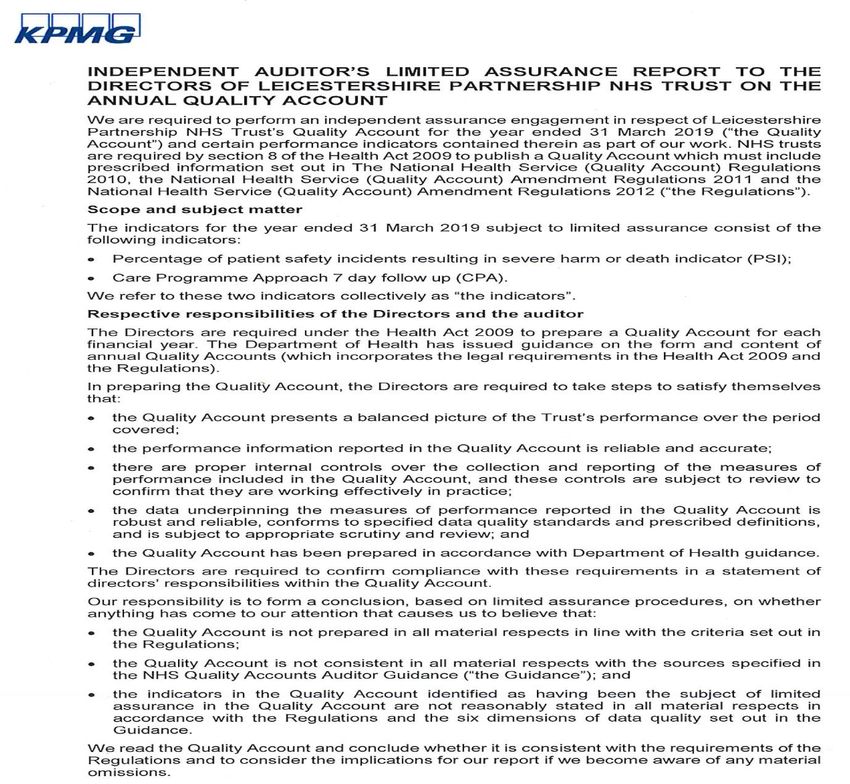
Our local priorities – our achievements in 2018/19 .......................................................... 36
  Mandatory reporting criteria 2018/19 ............................................................................... 37
  External assurance on quality indicator testing ................................................................ 40
  Quality of services ‘Safe Care’ – Supporting our workforce ............................................. 41
  Learning from incidents ................................................................................................... 42
  Learning from mortality reviews ....................................................................................... 43
  Summary of learning from case reviews and investigations ............................................ 44
  Never Events .................................................................................................................. 45
  Duty of Candour .............................................................................................................. 45
  HM Coroner .................................................................................................................... 45
  Infection Prevention and Control/Healthcare Associated Infections (HCAIs) ................... 46
  Safeguarding Children and Vulnerable Adults ................................................................. 47
  Examples of Patient Safety Improvements during 2018/19 ............................................. 49
  Examples of Quality Improvements during 2018/19 ........................................................ 50
  Examples of Patient Experience Improvements during 2018/19 ...................................... 51
  Quality of services ‘Patient Experience’ ........................................................................... 52
  Mandated national survey ............................................................................................... 52
  Friends and Family’ (FFT) Test (patients)........................................................................ 52
  Complaints, PALS and Compliments............................................................................... 53
  Involving patients and carers in the infrastructure of the organisation.............................. 56
  Patient Stories ................................................................................................................. 56
  Always Events® .............................................................................................................. 56
  Volunteers ....................................................................................................................... 57
  Patient Led Assessment of the Care Environment (PLACE) ........................................... 57
  Commentary received from stakeholders ........................................................................ 59
Statement from External Audit

  Appendix 1 List of LPT Services 2018/19 ........................................................................ 70
  Appendix 2 CQC Grid ..................................................................................................... 71
  Appendix 3: Data definitions ............................................................................................ 72

  Glossary .......................................................................................................................... 74

  Feedback your views ...................................................................................................... 77

                                                                                                                                           3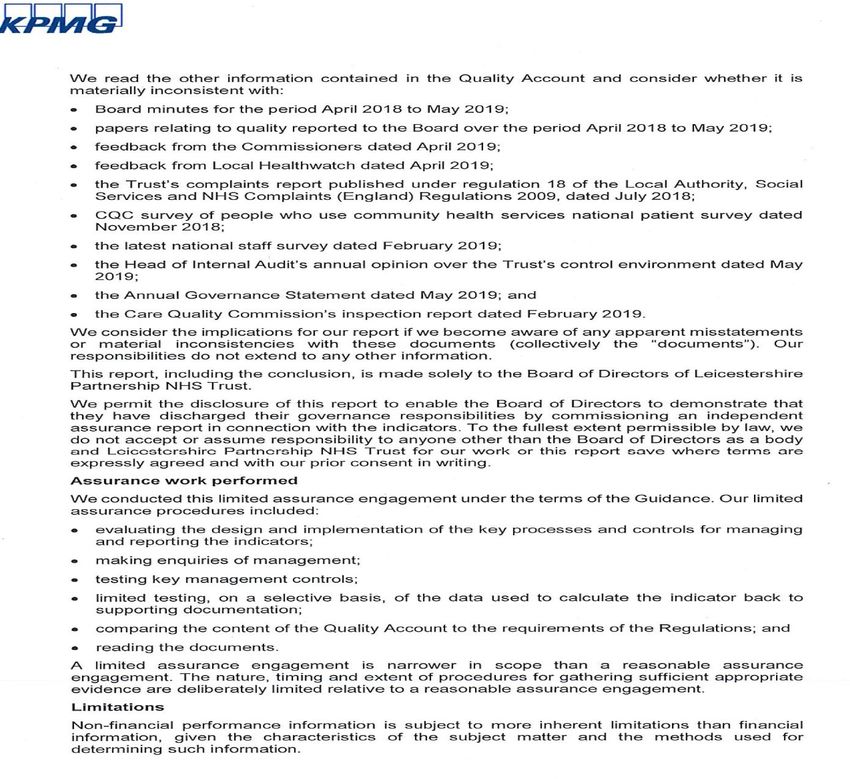
Part 1

    Introduction
    Statement on quality from the Chief
    Executive of Leicestershire Partnership Trust

4
Statement on quality from the Chief Executive

‘On behalf of the Board of LPT I am proud to be able to present our 2018/19 Quality
Account. The report presents the quality of the services that we provide and reflects
the open and transparent culture that we are developing as a Trust. We welcome
external scrutiny of our services and in November 2018 we welcomed CQC
inspectors into the Trust to provide an assessment of five of our services. This
Account presents those findings.

Overall we were rated as ‘requires improvement’. We are pleased that the CQC
recognised improvement in our mental health services for older people, which was
given an improved rating of ‘good’. It was disappointing to see the ratings of
inadequate for our acute adult mental health services and our rehabilitation services.
We acknowledge that there are improvements to be made, in areas including the
quality of our buildings and the environments in which we provide care, to ensure
they are as safe as possible. We also need to improve the quality of our medicines
management. The Board and Executive will continue to focus on this over the
coming year.

It is a priority of the Trust Board to establish a process and commitment to
continuous quality improvement to ensure that all of our staff have the skills to
improve the quality and safety of the care they provide and during this past year we
have worked with all of our services to embed this approach. The quality of our
services is dependent our how well our staff feel supported, and this year we will be
focusing on culture, leadership and inclusion in LPT, ensuring that all our staff feel
empowered and valued.

We are committed to ensuring our services are focused around the needs of people,
families, and local communities. The experience of our patients and their carer’s is
critical in providing patient-centered services. This Account gives details of how we
understand this experience. The Board is proud of our FFT (friends and families
test) scores, with 97% of people who responded over the last year saying they would
recommend our service to friends and family.

As a Trust Board we must ensure the services that we
provide are safe but also ensuring best value.’

Dr Peter Miller,
Chief Executive,
By Order of the Board

                                                                                         5
Part 2

    Priorities for improvement in 2019/2020 and
    statements of assurance

6
Statement of Directors’ responsibilities in respect of the Quality Account
The Directors are required, under the Health Act 2009, National Health Service
(Quality Accounts) Regulations 2010 and National Health Service (Quality Account)
Amendment Regulations 2011 and the National Health Service (Quality Account)
Amendment Regulations 2012 to prepare Quality Accounts for each financial year.
NHS Improvement has issued guidance on the form and content of annual Quality
Accounts (which incorporate the above legal requirements). In preparing the Quality
Account, Directors are required to take steps to satisfy themselves that:
The Quality Account presents a balanced picture of the Trust’s performance over
the period covered.
The performance information reported in the Quality Account is reliable and
accurate; with the exception of a matter raised in Part 3 ‘external assurance on
quality indicator testing’.
There are proper internal controls over the collection and reporting of the measures
of performance included in the Quality Account, and these controls are subject to
review to confirm that they are working effectively in practice.
The data underpinning the measures of performance reported in the Quality
Account is robust and reliable, conforms to specified data quality standards and
prescribed definitions and is subject to appropriate review and scrutiny. The Trust
was pleased to receive a limited assurance opinion on the CPA 7 day follow up data
but recognises that further improvement needs to be made to the data underpinning
the percentage of patient safety incidents resulting in severe harm or death (PSI);
this has impacted on the data reported for 2018/19. The Trust is committed to
improving the robustness of this data in 2019/20.
The Quality Account has been prepared in accordance with NHS Improvement’s
annual reporting manual and supporting guidance (which incorporates the Quality
Account regulations).
The Directors confirm to the best of their knowledge and belief they have complied
with the above requirements in preparing the Quality Account.
By order of the Board
24/06/2019...........Date.................................................Chair
7
.24/06/2019...........Date.............................................Chief Executive

    Statement of responsible person on behalf of Leicestershire Partnership NHS Trust

    To the best of my knowledge the information included in this Quality Account is
    accurate.

    Date: 26/4/19

    Dr Anne Scott
    Interim Chief Nurse (1st January 2019 -1st June 2019)

8
Priorities for quality improvement in 2019/2020
Improving quality is about making healthcare safer, more effective, patient centred,
timely, efficient and equitable. Our central purpose is to provide the highest quality
healthcare and promote recovery and hope to our patients. We are committed to
improving the quality of our care and the services we provide. Our patients value
clinical outcomes together with their overall experience of our services. We want to
provide the very best experience for every person using our services.
Our priorities for 2019/2020 will focus on four key areas:
Engagement Listening and involvement with patients and carers.
Care Planning
Reducing avoidable harm
Discharge and flow
Our quality plan for 2019/2020 is outlined in figure 1.
Based on the feedback from the Executive Team (ET) and the Quality Assurance
Committee (QAC) with regards to the clinical priorities for LPT over 2019/20 there
has been acknowledgment that more work is required to reframe the LPT approach.
This coming year the clinical priorities have resonance across the Trust and
therefore will be viewed as a Trust-wide approach rather than being directorate
specific. Whilst it is acknowledged that each directorate might need to adapt the
improvement ideas to fit the context and resources of their directorate the principles
must remain core and the outcomes the same in order to have standardised
organisational outcomes. The four priorities as highlighted in figure 2 are inextricably
linked therefore some actions pertaining to a specific domain will be similar however
the measures will vary. The outcomes of the four will lead to the delivery of better
patient care which we aspire to deliver. By using a quality improvement collaborative
approach professionals and teams including patients and carers will be motivated to
do something different which will in turn improve the outcomes.
9
Figure 1- Trust Quality Plan 2019/20

Trust Vision: To improve the health and well being of
the people of Leicester, Leicestershire and Rutland by
providing high quality, integrated physical and mental
health care pathways

                   Quality
LPT Values:        Strategy principles:
  Respect
  Integrity        Deliver safe, effective, patient centred
    Trust          care everytime
Compassion

                      Safe           Clinical priorities:

                                     Engagement
   Trust            Effective        listening and              Reducing    Discharge
 Ojectives:                                            Care                 and flow of
                                      involvement               avoidable
                                                     planning                patients
                                     with patients                harm
    Staff                              and carers
 Partnership        Person-
   Safety           Centred
Sustainability       Care

10
Figure 2 - Quality Improvement clinical priorities 2019/20
11Quality Improvement
Leicestershire Partnership NHS Trust continues to strengthen its approach to quality
improvement (QI). The Director of Nursing and Medical Director are working together
collaboratively to provide executive leadership to embed the Trust quality
improvement approach. The Trust is currently in the consultation phase of
developing the approach with clear timescales for each phase. Much quality
improvement work has been undertaken within the organisation already and we are
implementing a consistent approach and framework to support quality improvement
and facilitate shared learning and finally for quality improvement to become business
as usual in all of our functions. There will be a virtual team using an umbrella
approach to provide a single point of access for accessing support. Recovery
principles and service user involvement will be central to this approach which will be
linked with our other key initiatives such as our culture programme and innovation.
Delivering our quality improvement priorities
The Trust Board is committed to achieving excellence and members discuss quality
performance at every Trust Board meeting. We will report and monitor our progress
against delivery of the clinical priorities at the Quality Assurance Committee (QAC),
which is a Trust Board Committee. The QAC provides advice and assurance to the
Board in relation to quality performance.
The QAC shapes, influences and provides overall assurance about the quality of our
services and reports any concerns to the Board.
The clinical priorities identified match the CQC findings and action plan. Rather than
duplicate work this year the action plan will act to serve both pieces of work.
12Part 3
Review of quality performance in
2018/19
13Review of services
During 2018/19 Leicestershire Partnership Trust provided and/or subcontracted 100
relevant health services. Mental Health and Learning Disabilities account for 59
services and Community Health Services make up the remaining 41. See full list in
Appendix 1.
LPT has reviewed all the data available on the quality of care in 100 of these
relevant health services, both for services directly provided and for those services
subcontracted. Robust monitoring both externally with commissioners (via
contractual requirements to monitor clinical quality performance indicators) and
internally (via performance reviews and quality reports) ensures the highest
standards are adhered to in the areas of infection control, patient safety, service user
and carer experience, safeguarding, clinical effectiveness and compliance with
regulatory requirements.
The income generated by the NHS services in 2018/19 represents 100 per cent of
the total income generated from the provision of NHS services by Leicestershire
Partnership Trust for 2018/19
How we have reviewed our services in 2018/19
Board members remain visible in our services. During 2018/19 we had two new
Executive Directors; Medical Director and Director of Finance. We welcomed a new
Non-Executive Director who represented Leicester University. From 1 April 2018
there were new Healthwatch arrangements for Leicestershire and Leicester City, and
a representative for both has contributed to the monthly Trust Board meetings as a
participating observer.
The last year has seen an increasing number of staff observers at the public Board
meetings for staff development. Such initiatives and other leadership programmes
are supported strongly by the Board. Staff and public engagement from the Board is
further strengthened by our Communication Team tweeting news from the public
Board meetings.
We run an established programme of Board Walks every month where Board
Members visit services to see the day to day activities of frontline staff and meet with
patients to hear about their experiences. Board Walks build communication and
engagement between the Board members and staff whilst highlighting areas of good
practice and areas where changes may be required.
During 2018/19, Board members completed 84 visits to our services; FYPC received
18, CHS received 29 AMH/LD received 32 and corporate services received 5 Board
Walks.
Commissioners are visible in our services as they undertake quality visits
During 2018/19 there were four Commissioner-led visits to our services. The visits
were undertaken to gain assurance of the “quality” of our services and reports and
actions are fed back to our commissioning bodies. Other regulatory organisations
14visited including the Nursing and Midwifery Council (NMC) as part of their
accreditation to offer undergraduate nurse training at Leicester University.
Participation in clinical audits
During 2018/19, 8 National Clinical Audits and 1 National Confidential Enquires
covered NHS services that LPT provides. During that period, LPT participated in
100% of National Clinical Audits and 100% of National Confidential Enquiries of the
collective national clinical audits and national confidential enquiries which it was
eligible to participate in.
The national Clinical Audits and National Confidential Enquiries that LPT was eligible
to participate in during 2018/19 are as follows.
Title
EIP Spotlight Audit
Sentinel Stroke National Audit Programme (SSNAP)
Chronic Obstructive Pulmonary Disease (COPD) re-audit
National Clinical Audit of Anxiety and Depression - NCAAD
POMH Topic 6d Assessment of the side effects of depot/ LAI antipsychotics
POMH 16b Rapid tranquilisation
POMH 7f Monitoring of patients prescribed lithium
POMH Topic 18 Use of clozapine
National Confidential Inquiry into Suicide and Homicide for people with Mental Illness
(NCISH)
The national clinical audits and national enquiries that LPT participated in and for
which data collection was completed during 2018/19 are listed below. Alongside this
are the number of cases submitted to each audit or enquiry as a percentage of the
number of registered cases required by the terms of that audit or enquiry.
Title Number of cases submitted as a
percentage of the number of
registered cases required
EIP Spotlight Audit 100%
Sentinel Stroke National Audit Programme 100%
(SSNAP)
Chronic Obstructive Pulmonary Disease 100%
(COPD) re-audit
National Clinical Audit of Anxiety and 32% *unable able to secure enough
Depression - NCAAD submissions by the short deadline
15POMH Topic 6d Assessment of the side 100%
effects of depot/ LAI antipsychotics
POMH 16b Rapid tranquilisation 100%
POMH 7f Monitoring of patients prescribed 100%
lithium
POMH Topic 18 Use of clozapine 100%
National Confidential Inquiry into Suicide 100%
and Homicide for people with Mental Illness
(NCISH)
The reports of three National Clinical Audits were reviewed by LPT in 2018/19 and
the following actions are planned to improve the quality of healthcare provided.
National Audit Title Actions to be taken
Chronic Obstructive Pulmonary Disease Review service provision of rolling verses
(COPD) re-audit block programmes.
Contact patients by phone, offer
alternative venues where appropriate.
Introduce telephone triage for all new
assessments one week prior to
attendance; telephone triage
questionnaire added to SystmOne.
2017 Parkinson's audit Develop group work education sessions
by MDT. Gather PD patient information
leaflets from PUK with local information to
give to patients on contact. Formulation of
PD information packs to be provided on
initial assessment with PD
patients/carers.
Develop group work education sessions
by CINSS MDT (PT, OT, Dietician, SLT,
Psychologist).
POMH Topic 15b Prescribing Valproate for Roll out of the Pregnancy Prevention
Bipolar Programme in LPT.
The reports of 73 local Clinical Audits were reviewed by LPT in 2018/19 and LPT
intends to take the following actions to improve the quality of healthcare provided.
16Audit Title Actions to be taken
Diabetic Foot Screening (Mental Health) Rio form to have a text box to clearly
audit (#1317) state if a patient refuses or is unwell –
Staff can record planned re attempts and
The audit was to assess compliance with further refusals.
the Trust Diabetic Foot Screening policy,
within Mental Health & Learning Disability
inpatient settings.
Key Components of Care within the SLT Include sections or subheadings which
Service for Children with Dysphagia act as prompts to include key information
(#1525) such as hypothesis, level of risk and
aims of intervention within the SystmOne
This Audit aimed to measure quality templates for Dysphagia First
against locally-agreed standards of care Appointment and Report.
within LPT paediatric dysphagia service,
including response to referral, quality of Roll out central booking into clinic-based
assessment and communication of plan to service for children with dysphagia.
others.
Cognitive Assessment of Inpatients on Poster developed and displayed in staff
Organic and Functional wards within areas/ offices. To be included in junior
MHSOP (#1560) doctors induction pack.
This audit was to measure the quality of
the assessment and monitoring of
inpatients on the MHSOP wards.
NICE Spasticity (#1573) Create an Aide Memoire and place this
on SystmOne under the ‘document
The aim of this audit was to identify current library’ for future reference/ reminder to
practices and to develop a local pathway in clinicians.
line with the NICE recommendations.
Quality of Review Health Assessments in Create induction packs for Band 5 staff.
LAC (#1632)
Ensure 1-to-1 supervisions with CTL.
This audit focused on the records and
RHAs written by LPT LAC Nurses and
Public health/ health visitors to ensure the
quality of the RHAs was to the standard
required.
Improving the assessment of wounds SOP and OP to be distributed
CQUIN 4 (#1695 and #1696) electronically to all community staff.
This indicator aimed to increase the Create a quick reference guide (QRG) for
number of wounds, which had failed to downloading clinical photos from phone
heal after 4 weeks, that received a full to patient record, then disseminate the
wound assessment. QRG to staff.
17Clinical audit key achievements
Providing high quality care means making the best clinical decisions to achieve the
best patient outcomes. Undertaking Clinical Audit provides us with an opportunity to
assess the effectiveness of clinical care and also enables continuous quality
improvement.
During 2018/19, the Trust’s Clinical Audit Team supported 194 audits and achieved
a 56% re-audit rate. Nearly 500 audit criteria have been used to re-audit whether
standards have been applied to practice, for the benefit of patients in our care.
Re-auditing after changes have been made enables clinical staff to demonstrate
change and identify those areas where further improvement is required.
Key Achievements in 2018/2019:
• We achieved a 56% re-audit rate
• We supported 194 audits.
• 100% of inpatient falls were clearly documented.
• 100% of looked after children had an Initial Health Assessment that evidenced
that the carer’s and child’s concerns and comments had been sought and
recorded.
Quality improvement as a result of clinical audit
Clinical audit measures compliance against best-practice procedure, for example
NICE guidelines. Following best-practice produces best quality care for our patients
and service users. Below are some examples of high compliance that was achieved
following significant improvement as a result of clinical audits.
• 100% of MHSOP shift-to-shift handover sheets were updated immediately
prior to the handover meeting, which is a 44% improvement
• 99% of CT brain request forms in Memory Services East had an indication of
urgency, which is a 35% improvement. Indicating image request urgency
helps to prioritise patients with acute brain injury. National Dementia
guidelines recognize early diagnosis is associated with better prognosis.
• 100% of looked-after children were offered the opportunity to be seen alone,
which is a 14% improvement
• Audit results are communicated to staff in a variety of ways including team
meetings, staff briefings and communication posters which provide staff with a
snapshot of the key results.
• We deliver a Clinical Audit for Quality Improvement training course twice a
year and are developing a suite of training courses in other quality
improvement techniques.
• We were the host Trust for the POMH UK Regional Workshop in Birmingham
in November 2018, delivering a presentation on Quality Improvement in
Prescribing Practice via LPT’s participation in POMH QIPs
• We regularly attend East Midlands Clinical Audit Support Network meetings.
18Participation in clinical research
LPT continues to provide our service users and carers the opportunity to participate
in research in the knowledge that this enhances care, enables services to deliver
innovative interventions and contributes to the development of staff.
We are committed to developing, hosting and collaborating with local, national and
international research through our partnerships with academic and other NHS
organisations as part of the National Institute of Health Research (NIHR), in
particular with the Clinical Research Network: East Midlands (CRN:EM),
Collaboration for Leadership in Applied Health Research and Care: East Midlands
(CLAHRC:EM) and East Midlands: Academic Health Science Network (EM:AHSN).
Our research profile includes projects adopted across a number of areas including
Children, Dementia and Neurodegenerative Diseases, Diabetes, Cardiovascular
Disease & Stroke Learning Disabilities, and Mental Health.
The number of patients receiving relevant health services provided or sub-contracted
by LPT in 2018/19 that were recruited to participate in portfolio studies approved by
a research ethics committee as of January 31st, Portfolio Recruitment credited to
LPT was 466 (EDGE – local data) and 464 (ODP – national data)
The portfolio studies hosted by the Trust in 2018/19 are listed in the table below:
Title/Acronym Key aim/principle of study
Detecting Susceptibility Genes for late and early onset
AD Genetics
Alzheimer’s disease
Adult Autism
Autism Conditions in Adulthood – Learning about lives of
Spectrum Cohort
adults on the autism spectrum and their relatives
Study
Attitudes, beliefs and understanding of food allergy in
ALLERGENS
children and adolescents
Psychological treatment of anxiety in adolescence: the
ANX-CAMHS
views of CAMHS clinicians
Supporting Memory Services to enable people with
dementia and their families’ timely access to Assistive
ASTEC
Technology
Attachment and Attachment and mentalization as predictors of outcome in
mentalization family therapy for adolescent anorexia nervosa
A qualitative study of potential differences in access to
Bariatric Surgery
bariatric surgery for minority ethnic patients
Better Conversations with Primary Progressive Aphasia
BCPPA (BCPPA): Communication training to keep families
together.
Brains for Dementia – Longitudinal assessment of potential
BDR
brain donors
Implementing NICE Guidelines on bipolar disorder into
BiPOLAR (NICE)
routine health care: integrated managed innovation
19network approach versus other implementation
approaches.
Enhancing Cognition and quality of LIfe in the early
PSychosEs (ECLIPSE) - Study 7: Evaluation of a new
CIRCUITS
online Cognitive Remediation Therapy (CIRCuiTS) training
programme for Mental Health Professionals
A Multinational comparative study to assess what cultural
adaptations are made in clinical interactions by clinicians in
CoACTION
different settings to ensure appropriate communication with
diverse populations
Comparing a reusable learning object with face-to-face
CREATE training for occupational therapists in advising on fitness for
work
Building a culture of openness across the healthcare
system: From transparency through learning to
Cultures of Openness
improvement? Work stream 2: Openness in practice:
actions, experiences and consequences
The psychosocial impact of diabetes and diabetes care
DAWN-SMI provision for people with severe mental illness: a patient,
carer and healthcare staff survey
DEMCOM: National Evaluation of Dementia Friendly
Communities (to identify whether DFCs support people
DEMCOM living with dementia and their carers to maintain their
independence and feel valued members of their local
community)
Developing and evaluating a diabetes self-management
intervention for people with severe mental illness: The
DIAMONDS programme (Diabetes and Mental Illness,
DIAMONDS-QUEST
Improving Outcomes and Self-management): QUEST
(Qualitative Exploration of Self-Management in Severe
Mental Illness and Long-term Conditions)
Detecting Susceptibility Genes for Dementia with Lewy
DLB
Bodies
FEEDS FEEDS: Focus on early eating, drinking and swallowing
A multi-centre cluster randomised controlled trial to
FiNCH evaluate the Guide to Action Care Home fall prevention
programme in care homes for older people.
A multicentre, multinational, randomised, double blind,
placebo controlled, parallel group study to evaluate the
DEME 3728
efficacy and safety of Laquinimod (0.5, 1.0 and 1.5
LEGATO-HD
mg/day) as treatment in patients with Huntington’s Disease
(Participant Identification Centre)
How does variation in assessment and management of
DYSPHAGIA &
dysphagia in acute stroke affect the development of stroke
STROKE
associated pneumonia?
20Optimising the impact of health services research on the
organisation and delivery of health services: a study of
EMBEDDED
embedded models of knowledge co-production in the NHS.
Enroll-HD: A Prospective Registry Study in a Global
ENROLL-HD Huntington's
Disease Cohort
The role of feedback on Adherence to Amblyopia treatment
EUPATCH
version
Passive Enhanced Safety Surveillance (ESS) of
Quadrivalent Live Attenuated Influenza Vaccine (QLAIV)
FLUENZ 2018
Fluenz Tetra in Children and Adolescents during the early
2018/2019 Influenza Season in England
Adapting individual Cognitive Stimulation Therapy (iCST)
iCST
for dementia for delivery by a web-application
A randomised controlled trial of the clinical and cost-
Journeying Through
effectiveness of the Journeying through Dementia
Dementia
intervention compared to usual care
This study is designed to investigate genes underlying
Genetic Research into
childhood onset psychosis. We are recruiting children or
Childhood Onset
adults that have had a diagnosis of a psychotic illness at
Psychosis
age 13 or younger.
The aim of this survey is to provide information about the
health and wellbeing of people with Severe Mental Illness.
The Lifestyle Health and Wellbeing Survey has two main
Lifestyle Health & objectives.
Wellbeing Survey 1. To benchmark current health related behaviours of
people with severe mental ill health
2. To provide a platform for future research with this
population
Managing medicines for patients with serious illness being
Managing Medicines
cared for at home
People with autism detained within hospitals: defining the
mATCH population, understand aetiology and improving care
pathways.
MINDSHINE 3 MindSHINE 3: A definitive randomised controlled trial
investigating two online wellbeing interventions to reduce
NHS staff stress
MOLGEN Molecular genetics of adverse drug reactions: from
candidate genes to genome wide association studies
ORBIT Therapist-guided, parent-assisted remote digital
behavioural intervention for tics in children and adolescents
with Tourette syndrome: an internal pilot study and single-
blind randomised controlled trial
PhISICAL Physical activity Implementation Study In Community-
21dwelling AduLts (PhISICAL) (Participant Identification
Centre)
PPIP2 Prevalence of neuronal cell surface antibodies in patients
with psychotic illness
Describing and specifying pre-appointment written
PRE-APPOINTMENT materials as an intervention: a survey of pre-appointment
materials used by children’s therapy teams in the UK
Measuring and Improving the Health and Quality of
PROBATION & Healthcare for Offenders on Community Sentences:
Health Developing Recommendations for Commissioners and
Practitioners
PROUD Co-Morbid Conditions in ADHD
Post-Traumatic Stress Disorder in Childhood and
PTSD & Childhood Adolescence: A Survey of the Training Needs of Clinicians
and Predictors of Evidence-Based Practice
Optimising medication management in children and young
people with Attention deficit hyperactivity disorder (ADHD)
QUOTA
using an objective measure of attention, impulsivity and
activity (QbTest): a feasibility study
ReCOLLECT Recovery College Characterisation and Testing
RETurn to work After stroKE (RETAKE). Early vocational
rehabilitation compared with usual care for stroke
ReTAKE survivors: an individually randomised controlled multi-
centre pragmatic trial with embedded economic and
process evaluations
This study will investigate brain glutamate in a group of
The effect of cannabis patients with psychosis who use cannabis and compare
use on brain function them to patients who do not and another group of healthy
in early psychosis volunteers. We will undertake a brain scan known as
magnetic resonance spectroscopy for this.
The Oxford Telehealth Qualitative Study (Case 3 in the
SCALS SCALS - Studies in Co-creating Assisted Living Solutions -
study)
Study of Suicide in the Criminal Justice System: Nested
Case-Control (Prof Jenny Shaw (Manchester))
SUICIDE
In-patient suicide whilst under non-routine observation
(Prof Jenny Shaw, Manchester)
TANDEM: Tailored
intervention for A tailored, cognitive behavioural approach intervention for
anxiety and mild to moderate anxiety and/or depression in people with
depression chronic obstructive pulmonary disease (COPD): A
management in randomised controlled trial
COPD
A sham-controlled randomised feasibility study of repetitive
TIARA
transcranial magnetic stimulation (rTMS) as an adjunct to
22treatment as usual (TAU) in adults with severe and
enduring anorexia nervosa (SEED-AN)
A novel patient and carer intervention for Anorexia Nervosa
TRIANGLE
(LPT is the leading recruitment site in the UK)
VASCULAR The design, development and commissioning of patient
PREFERENCES focused vascular services.
Sixteen clinical staff members participated as Principal Investigators in portfolio
research approved by a research ethics committee at LPT during 2018/19. These
staff participated in research covering a range of specialties including old age
psychiatry, adult mental health, children, learning disability, child and adolescent
mental health and public health.
In the last three years we have not had any National Institute of Health Research
(NIHR) funded Chief Investigators within the Trust. However our staff have been
disseminating their research through various publications, showing commitment to
transparency and desire to improve patient outcomes and experience. Thirty five
articles have been published in 2018 in a wide range of journals.
A full list of all research activity is available upon request via email to:
research@leicspart.nhs.uk
Quality improvement as a result of research and development
We utilise research to improve the quality of care for our service users.
There are a number of examples of how research has improved the quality of care
for service users.
FYPC Occupational Therapist explored young people’s views on an occupational
therapy outcome measure when accessing group work in child and mental health
services. The increase in the use of mental health services by children and young
people is recognised but improvement in services is required. There is a need to
build the evidence base to improve the quality of care and use of outcome measures
are key tool to achieving this.
The Canadian Occupational Performance Measure (COPM) is one such
standardised tool and was introduced into occupational therapy group work in a child
and adolescent mental health service. This service evaluation aimed to explore
young people’s views of using COPM.
A qualitative approach was used with purposive sampling technique to recruit five
young service users who had experience of using COPM in group work. Semi
structured interviews were conducted, and their content analysed using thematic
analysis.
Several themes emerged. The participants reported some initial reservations about
using COPM. However, they found having to give themselves a rating before and
23after involvement in group work gave them a sense of purpose and personal
achievement.
COPM has since been introduced with other treatment groups ensuring a systematic
approach to measuring outcomes and goal setting enabling the service to begin to
measure the effectiveness of their interventions.
Senior Dietitian in the Home Enteral Nutrition Service (HENS) carried out a
qualitative research study to explore the experiences of patients and carers of those
using blended diet via gastrostomy tube. Standard practice is the use of commercial
prescription formula whilst blended diet is the use of home prepared foods liquidised
to a puree consistency and given via a gastrostomy. Blended diet is not currently
recommended due to the lack of evidence for its use; however, there are growing
numbers of patients choosing to feed in this way and reporting the benefits of doing
so.
The HENS caseload was screened for patients who are currently using blended diet
via gastrostomy or have done so in the past. Patients and their carers were invited to
take part in a one off semi structured interview based on their experience of using
blended diet. 6 of 15 participants invited took part in the study; the interviews were
recorded and transcribed before being analysed for common themes. Results were
largely positive with multiple reported benefits in both physical health and social
inclusion; advantages were reported in the absence of or outweighing any
disadvantages. Care-givers were focused on using family foods which was felt to
provide social benefits to both patients and their carers in normalising enteral
feeding. There remains limited evidence to allow health professionals to recommend
blended diet as an alternative to standard practice. However, this study suggests
that there may be benefits to others within this patient group which warrants
investigation.
Goals agreed with Commissioners - Use of contractual arrangements
Local authorities, West Leicestershire Clinical Commissioning Group, East
Leicestershire and Rutland Clinical Commissioning Group and Leicester City Clinical
Commissioning Group (CCGs) commission services on behalf of people living in
Leicester, Leicestershire and Rutland. As part of our relationship with the three
Clinical Commissioning Groups we have agreed quality targets and goals and these
are translated into a Quality Schedule and a Commissioning for Quality and
Innovation (CQUIN) payment framework. Progress against delivery has been
monitored by our Commissioners on a monthly basis through formal meetings and
visits to review our services in 2018/19. Commissioners assess multiple local and
national quality requirements against agreed thresholds. Any thresholds not met are
discussed and actions identified to improve services. The Trust’s Quality schedule
for 2019/20 is being finalised with our commissioners. Further details of the Quality
Schedule for 2018/19 can be requested via email to: feedback@leicspart.nhs.uk
24CQUIN Outcomes
A proportion of LPTs income in 2018/19 was conditional on achieving quality
improvement and innovation (CQUIN) goals between West Leicestershire Clinical
Commissioning Group, East Leicestershire and Rutland Clinical Commissioning
Group and Leicester City Clinical Commissioning Group for the provision of NHS
services, through the commissioning for Quality and Innovation payment framework.
CQUINS for 2018/19 were a continuation of 2017/18 projects. The Trust agreed ten
national CQUIN goals with our Commissioners. At the time of publishing the Quality
Account, the overall achievement for the 2 years projects are in the process of being
agreed and finalised with Commissioners.
CQUIN DESCRIPTION OF OUTCOMES (*awaiting final sign
GOAL off)
1 1a Staff health & The National NHS Target not met - Unable to
well-being staff survey will maintain the high levels achieved
provide evidence that in 2016/17. LPT is committed to
the mental health, maximising the health and
physical activity and wellbeing of its staff with a focus
MSK schemes have on culture, leadership, intervention
had a positive impact and prevention and promoting
on staff wellbeing healthy lifestyles.
1b Healthy food To reduce the Fully achieved-LPT has banned
for NHS staff, availability of sugary the promotion and availability of
visitors and drinks and foods high drinks and foods high in sugar, salt
patients in fat, sugar and salt and fat in vending machines and
hospital based outlets.
1c Improving the To immunize 70% of Partially achieved- 54% of front
uptake of flu front line staff line health care workers were
vaccinations for vaccinated against flu (target
front line clinical 70%). A programme of work is
staff being devised to achieve the
80% target for 2019/20
2 2a To improve To improve the cardio Fully achieved -100% of
physical metabolic mental health in patients and
healthcare to assessment and over 75% of community mental
reduce premature treatment for patients health patients received cardio
mortality in people with psychosis metabolic assessment and
with serious treatment.
mental illness
2b To improve To improve discharge Fully achieved- A SMI Physical
communication to summaries for Health Check Shared Care
General patients on CPA Protocol between LPT and primary
Practitioners in care has been agreed and there
patients with has been 5% improvement
serious mental compliance from 92% to 97%
illness(SMI) Good communication improves
outcomes for patients.
253 Improving To reduce by 20% the Fully achieved – There has been
services for number of a 58% reduction in A&E
people with attendances to A&E attendances of patients within a
mental health for those within a selected cohort of frequent
needs who selected cohort of attenders from 2016/17 baseline
present at A&E frequent attenders who would benefit from mental
who would benefit health and psychological
4 Transition out of To
fromimprove the
psychosocial Partially achieved – A system
interventions
Children’s and experience
intervention.and has been set up to facilitate all
Young People’s outcomes of young
interventions young people having a transition
Mental Health people as they plan and joint meeting prior to
Services transition out of transition into adult mental health
Children’s and Young services. Ongoing work with the all
People’s Mental age transformation project and
Health Services continued monitoring in 2019/20
6 Preventing ill To improve alcohol Fully achieved- Targets have
health from and tobacco been met relating to tobacco and
alcohol and screening, advice and alcohol screening and brief
tobacco use referral intervention and advice for
smoking. Partially achieved-
alcohol intervention and advice.
benefit from
Promoting smoking cessation and
reducing alcohol consumption can
improve patients overall health
and well-being.
7 Improving the To increase the Fully achieved – The clinical audit
assessment of number of wounds demonstrates an improvement in
wounds that have failed to the number patients with chronic
heal after 4 weeks wounds who have received a full
that receive a full wound assessment. This ensures
wound assessment appropriate treatment and can
reduce wound healing times.
8 Personalised care To introduce Fully achieved – All relevant staff
and support personalised care and have undertaken training in
planning support planning personalized care and support
conversations for planning 97.5%of patients
patients undergoing undergoing pulmonary
pulmonary rehabilitation had care and support
rehabilitation planning conversations with staff.
Further information on CQUINS
CQUIN guidance for 2019/20 was published in March. For 2019/20 there are five
national CQUINs which have been agreed with commissioners as part of the
2019/20 contract.
Further details of the CQUIN programme for 2017/19 can be requested via email to:
feedback@leicspart.nhs.uk
26Care Quality Commission (CQC)
Leicestershire Partnership NHS Trust is required to register with the Care Quality
Commission and it is currently registered to provide the following conditions on
registration:
Accommodation for persons who require nursing or personal care
Assessment or medical treatment for persons detained under the Mental
Health Act 1983
Diagnostic and screening procedures
Family planning
Surgical procedures
Treatment of disease, disorder or injury
Leicestershire Partnership NHS Trust has not had any conditions placed on its
registration over 2018 / 19.
The Care Quality Commission (CQC) report published in February 2019 relates to
the inspection dated 19th November 2018 to 13th December 2018. The report
describes the CQC’s judgement of the quality of care provided with respect to the
Trust’s well led framework and the following five core services;
• Acute wards for adults of working age and psychiatric intensive care units
• Community-based mental health services for older people
• Specialist community mental health services for children and young
people
• Long stay / rehabilitation mental health wards for working age adults
• Wards for people with a learning disability or autism.
Overall, the rating stayed the same as Requires Improvement and for Caring the
rating was good however the majority of services inspected the ratings were
Requires Improvement and there was a decline in the rating for Well-Led from
Requires Improvement to Inadequate. In 2019/20 the Trust is implementing ‘Step up
to Great’ which includes improving leadership.
There were a number of positives included within the report, such as the community
based mental health service for older people which achieved a Good rating for all 5
CQC domains; the report also highlights areas that exhibited examples of
outstanding practice. However, the Trust received a number of enforcement actions
within the inspection report and warning notice published on the 30th January 2019.
The Trust continues to liaise with the CQC to make sustained improvements across
the key areas identified.
There are nine areas where systems and processes are not operated effectively
across the Trust to ensure that the risk to patients is assessed, monitored, mitigated
and the quality of healthcare improved. These relate to;
27• Access to treatment for specialist community mental health services for
children and young people.
• Maintaining the privacy and dignity of patients and concordance with
mixed sex accommodation.
• Environmental Issues
• Fire safety issues
• Medicines Management
• Seclusion environments and seclusion paperwork
• Risk assessment of patients
• Physical healthcare
• Governance and learning from incidents
The Trust has responded to all of the concerns identified with an immediate
improvement plan and has adopted a long-term quality improvement programme to
address each of the areas highlighted above and ensure sustainability. This has
been compiled in consultation with the services and key stakeholders.
CQC inspection reports can be accessed at http://www.cqc.org.uk/provider/RT5
CQC Ratings Posters
A summary of all CQC ratings is shown as Appendix 2. A comprehensive action
plan has been drawn up and improvement actions are being implemented. Our
progress is monitored monthly through our Trust Board and Quality Assurance
Committee.
CQC Mental Health Act Commissioner visits in 2018/19
By law, the Care Quality Commission (CQC) is required to monitor the use of the
Mental Health Act 1983 (MHA) to provide a safeguard for individual patients whose
rights are restricted under the Act.
During every visit the expected standards of practice as defined by the MHA Code of
Practice (2015) are considered.
In 2018/19 the CQC MHA Reviewer completed the following visits:
LOCATION: DATE OF VISIT:
Griffin Ward 05/04/18
Kirby Ward 19/04/18
CAMHS – Ward 3 26/04/18
Langley Ward 12/07/18
Phoenix Ward 25/09/18
Maple Ward 04/10/18
Agnes Unit 29/10/18
Gwendolen Ward 24/01/19
Coleman Ward 04/02/19
Welford Ward 28/02/19
Acacia Ward 05/03/19
Sycamore Ward 15/03/19
Cedar Ward 25/03/19
28The top 4 themes that can be drawn from the MHA reviews are as follows:
Patients have not been given a copy of their Section 17 Leave form.
Patients need to be involved in writing and reviewing their care plans.
Dormitories do not afford patients privacy and dignity.
Patients should be given information regarding Section 132.
The Trust’s CQC action plan includes actions to improve services based on the
findings of the MHA visits.
Data quality
Leicestershire Partnership Trust is taking action to continually improve data quality
through a significant programme of work which commenced in 2016/17 to review and
improve all aspects of the information lifecycle. This solution incorporates clinical
systems training, system configurations, data entry improvement and a review of
how staff use their performance data to inform improvements to patient care. This
programme is supported by the Chief Clinical Information Officer (CCIO) who has a
specific remit for improving data quality.
The Trust continues to build self-service on-line web-based reporting of core
indicators to support staff to deliver high quality care; and continually reviews its
Information Management and Technology Strategy to ensure it underpins the Trust’s
objectives and service development plans.
The data quality policy – supported by the record keeping and care planning policy -
provides clear responsibilities pertaining to data quality for all staff across the Trust.
Waiting Times
The Trust is focused on improving waiting times for our services and monitors this
through the Integrated Quality and Performance Reports (IQPR) and a specific
reporting to Trust Board. Directorates continue to prioritise the roll-out of best
practice weekly monitoring which enable us to focus on reducing waiting times. A
wait times review group has been established to focus support on services with long
waits to support the Trusts endeavor to reduce wait times for patient.
Use of NHS number
Leicestershire Partnership NHS Trust submitted records during April 2018 to March
2019 the Secondary Uses Service (SUS) for inclusion in the Hospital Episode
Statistics which are included in the latest published data.
March 2019 data to be submitted in April/ May 2019 in line with national submission
deadlines
The percentage of records in the published data which included the patient’s
valid NHS number for the Trust was:
· 100 % for outpatient care (as of February 2019)
· 100 % for inpatient care (as of February 2019)
29The percentage of records in the published data which included the patient’s valid
General Medical Practice Code was:
· 100% for admitted patient care (as of February 2019)
· 99.9% for outpatient care (as of February 2019)
Information Governance
The Trust has developed its Data Security and Protection Framework in line with the
new Data Security and Protection Toolkit which replaced the Information
Governance Toolkit on 1 April 2018. The Toolkit is based on the National Data
Guardian Standards and assesses the organisations against these standards as well
as embedding aspects of the EU General Data Protection Regulation and Data
Protection Act 2018.
Leicestershire Partnerships Data Security and Protection Toolkit Assessment
Reports overall as Standards not fully met (Plan Agreed).
Clinical coding error rates
With the move to a single electronic patient record, the Trust continues to explore
how it will transition to SNOMED CT.
Leicestershire Partnership NHS Trust was not subject to the Payment by Results
clinical coding audit during 2018/19 by the Audit Commission.
Transformation: Single Electronic Patient Record (EPR)
The Trust currently uses a number of systems for the longitudinal collection of
patient demographic information, test results, care plans, contemporaneous
professional summaries and clinical outcomes. The Trust took the decision in May
2018 to migrate to having a single electronic patient record by March 2020, to
undertake e-prescribing within that system by March 2021 and to maximise paper-
free at the point of care by March 2021. The Trust has allocated a £2.1 million
budget for the work and a multi-disciplinary project team has been recruited to lead
and support the change. The main milestones expected in 2019/20 are the rolling out
of e-observations across all inpatient areas, the migration of mental health services
onto the single record, digitising care plans in community hospitals, removing fax
machines from clinical areas and using SNOMED as the primary clinical coding tool.
30You can also read


