Enhancing adult bereavement care across Ireland: A study - Irish Hospice ...
←
→
Page content transcription
If your browser does not render page correctly, please read the page content below

Enhancing adult
bereavement care
across Ireland:
A study

Commissioned by: The Irish Hospice Foundation
Author: Dr. Kathleen McLoughlin
May 2018
“Whether death is
sudden or prolonged,
whether young or old,
it is the time when
life ends forever or is
altered forever.”
Marie Louise O’Donnell, Finite Lives 2017

ISBN 978-0-9956718-9-8

Citation: Mc Loughlin, K. (2018) Enhancing adult bereavement care across Ireland: A study.
Dublin: The Irish Hospice Foundation.
Enhancing adult bereavement care across Ireland: A study                                                                                                                                                                                        1

Table of Contents
Foreword from the Irish Hospice Foundation...........................................................................................................................................................................................................................3

Acknowledgments................................................................................................................................................................................................................................................................................................................................................................8

Steering Committee Membership. ...................................................................................................................................................................................................................................................................................9

Executive Summary...................................................................................................................................................................................................................................................................................................................................................10

1.0 Introduction.........................................................................................................................................................................................................................................................................................................................................................................11

              1.1 Background to the feasibility study...................................................................................................................................................................................................................................................................11

              1.2 Study objectives..................................................................................................................................................................................................................................................................................................................................................11

2.0 Methodology....................................................................................................................................................................................................................................................................................................................................................................12

3.0 Bereavement Care – Why does Ireland need structure?....................................................................................................................................................13

              3.1 The experience of bereaved people.................................................................................................................................................................................................................................................................13

              3.2 Policy.................................................................................................................................................................................................................................................................................................................................................................................................14

                             3.2.1 Mental health strategy.............................................................................................................................................................................................................................................................................................15

                             3.2.2 Palliative care strategy and frameworks....................................................................................................................................................................................................................15

                             3.2.3 National cancer strategy.....................................................................................................................................................................................................................................................................................16

              3.3 National standards......................................................................................................................................................................................................................................................................................................................................16

              3.4 Current bereavement care in Ireland............................................................................................................................................................................................................................................................18

              3.5 Stakeholders’ perceptions of bereavement care..........................................................................................................................................................................................................19

                             3.5.1 Bereavement support in changing communities..................................................................................................................................................................................19

                             3.5.2 National structures, services and developments...............................................................................................................................................................................20

                             3.5.3 C
                                    ommunity based, person centered, bereavement support based on
                                   shared experience...............................................................................................................................................................................................................................................................................................................21

                             3.5.4 Public awareness and education...................................................................................................................................................................................................................................................22

                             3.5.5 Guidance and supports for those working in bereavement care...............................................................................................................23

                             3.5.6 Need for a national adult bereavement network..................................................................................................................................................................................23
2 Enhancing adult bereavement care across Ireland: A study
4.0 Bereavement support structures – The international context...................................................................................................................24
4.1 Literature reviewed and experts identified.....................................................................................................................................................................................................................................24
4.2 The economics of bereavement.................................................................................................................................................................................................................................................................................24
4.3 National bereavement support structures outside of Ireland......................................................................................................................................................25
4.4 Public health approaches to bereavement....................................................................................................................................................................................................................................27
4.5 Standards and guidance...............................................................................................................................................................................................................................................................................................................29
4.6 International alliances.........................................................................................................................................................................................................................................................................................................................29
5.0 Should there be a national structure?. ..........................................................................................................................................................................................................................................31
5.1 An alliance or network and who will lead it?.............................................................................................................................................................................................................................31
5.2 How will it be funded?.........................................................................................................................................................................................................................................................................................................................32
5.3 What should the priorities of the network / alliance be in the first 3-5 years?............................................................................33
5.4 Potential risks...........................................................................................................................................................................................................................................................................................................................................................34
5.5 Benefits of working together...............................................................................................................................................................................................................................................................................................34
6.0 Points for the committee to consider...............................................................................................................................................................................................................................................35
References. ................................................................................................................................................................................................................................................................................................................................................................................................37
Appendix A: Summary Reports from 2016 / 2017 Bereavement Meetings.............................................................................................................41
Appendix B: Terms of Reference for Project Advisory Committee............................................................................................................................................................49
Appendix C: Systematic Review Methodology..............................................................................................................................................................................................................................................50
Appendix D: Telephone Interview Topic Guide..............................................................................................................................................................................................................................................51
Appendix E: Focus Groups...............................................................................................................................................................................................................................................................................................................................52
Appendix F: All Studies Reviewed................................................................................................................................................................................................................................................................................................54Enhancing adult bereavement care across Ireland: A study 3
Foreword from the Irish
Hospice Foundation
For the past thirty years, the Irish Hospice Foundation (IHF) working in partnership with others has
sought to keep a focus on the centrality of loss in each of our lives.
Bereavement is the most human and predictable experience, it teaches us about our strengths as much as
our pain, yet it is also the most isolating and, for some debilitating experience. For many of us, the decisions
we make, the people we become, the help we give as carers, the help we receive from others and the lives
we live each day are all carried out in the context of our own personal bereavements and loss.
Within the Irish Hospice Foundation, we are committed to working collaboratively to make excellence in
bereavement and end-of-life care a national priority. The core issues that we believe must be addressed are:
yy Inconsistency in end-of-life and palliative care services
yy Inconsistency in bereavement services
yy Inadequate staff training and lack of quality improvement in bereavement and end-of-life care
yy Dying, death and bereavement are difficult topics and require greater public knowledge &
awareness.
Through our work in public engagement, in awareness-raising, in training and education up to
postgraduate level, and most importantly, in collaborative working, we are seeking to address some
of these issues. Further, we work to build capacity and build shared commitment and consensus in
delivering new models of bereavement care (e.g. complicated grief therapy, group support programmes,
grief pyramid for children). Over the past years, we have joined with our partners to develop dynamic
networks to generate shared visions and resources to serve bereaved families (e.g. the Irish Childhood
Bereavement Network) and create and provide bereavement information (e.g. leaflets, website).
In 2017 IHF commissioned the ‘Enhancing Adult Bereavement Care Across Ireland’ report to set out the
views of bereavement care providers and consider the options for clarifying and building bereavement
care in Ireland through collaboration. The project was overseen by a Project Advisory Committee (PAC)
whose members were stakeholders involved in bereavement care in Ireland.
The experience of bereavement
The ‘Enhancing Adult Bereavement Care’ report reiterated that each year 30,000 people die in Ireland,
equating to 80 deaths each day. Each deceased person is a family member, a parent or a friend, so it is
reasonable to say that estimates of newly bereaved people are a significant multiple of the number of
deaths in the country. The Irish Hospice Foundation estimates that approximately four to ten people are
significantly impacted by each death, thus 300,000 people are newly bereaved each year, 800 each day –
these very recently bereaved people represent up to 6% of our population1,2. It is clear, bereavement and
loss affect large numbers of people in Ireland, in many ways, over many years.
1.
Scottish Government Health Directorate (2011) Shaping bereavement care. A framework for action for Bereavement Care in
NHS Scotland. Available online: http://www.sehd.scot.nhs.uk/mels/CEL2011_09.pdf
2.
Nucleus Group. (2004). Final report: Review of specific grief and bereavement services. Melbourne, Victoria, Australia:
Metropolitan Health and Aged Care Services Division, Department of Human Services4 Enhancing adult bereavement care across Ireland: A study
People die, and others are bereaved, at all ages; in infancy through to old age and from a variety of
causes. Each of these circumstances suggests a different pattern of care prior to death which may
impact grief and therefore it highlights the need to have a variety of bereavement supports available.
Bereavement and grief are legitimate fields of study and we now understand more about how people
grieve i.e. uniquely in their own way, yet with recognisable common features. We know that bereavement
is a normal, if painful life experience. The overall pattern in bereavement and grief is one of adjusting, of
accommodating the memory and influence of the person who died into life, of living a different life and
creating a ‘new normal’.
Finally, although bereavement is an individual experience, it is firmly set in a collective and societal
context and that context is changing e.g. an ageing demographic, changing family structure and a more
multicultural society. Most people rely heavily on social support during and after bereavement and
sometimes we look outside our circle for additional support. We therefore need to support communities
to respond better to grief and loss and work with those who are directly reaching communities.
We believe that sensitive bereavement care needs to be planned to meet life-stage and individual
circumstances and other changing needs, as well as ensuring additional supports are available on a
needs basis.
The impact of bereavement
The impact of bereavement is well documented, we know from studies and our experience that it
includes intense psychological, physical and emotional disturbance and pain in the early days, weeks
and months.
We also know that bereavement can impact on health and there is increased awareness of the long-
term consequences of bereavement for families and individuals. Low income and socioeconomic
disadvantage are known indicators of higher levels of grief related symptoms, psychological distress
and increased likelihood of experiencing mental and physical health problems3,4 and can compound
their grief during an already difficult time.
We know that there are a number of factors which influence the grief journey and can add to
vulnerabilities, e.g.;
yy The relationship a grieving person had with the person who died (e.g. parent of a child, young
widows/ers)
yy The cause and nature of the death (e.g. unexpected or traumatic deaths)
yy The support available from friends and family
yy The bereaved person’s age, personality, outlook, beliefs, resilience and their previous experience
of loss.
yy Other circumstances, such as financial strain, carer’s responsibilities, access to social support.
We have a growing consensus about when grief becomes a more serious problem. Prolonged Grief is
when grief becomes stuck and people experience disabling and persistent symptoms that don’t improve.
Its impact if unresolved means strong feelings of yearning and distress continue to be experienced, often
coupled with feelings of anger, guilt, bitterness, and an inability to reengage with life.
3.
Burke, L.A. & Neimeyer, R.A. (2013) 11 prospective risk factors for complicated grief. In M. Stroebe, H. Schut & J. van den
Bout (Eds.), Complicated Grief: Scientific foundations for healthcare professionals (pp. 145-161). London: Routledge.
4.
Garratt, E.A., Chandola, T., Purdam, K., & Wood, A.M. (2016) The interactive role of income (material position) and income
rank (psychosocial position) in psychological distress: A 9-longitudinal study of 30,000 UK parents. Social Psychiatry and
Psychiatric Epidemiology, 51 (10), 1361-1372.Enhancing adult bereavement care across Ireland: A study 5
Of interest, there are now proven therapies for the minority (10%) that develop Prolonged Grief 5,6,7, one of
which has recently been introduced in Ireland through the Complicated Grief programme at IHF.
In summary, it is clear that grief matters, if neglected it can have far-reaching implications8. We believe
that with a coordinated, informed and considered approach much can be done to meet needs.
Bereavement services
We know that bereavement support in Ireland is generally provided by a wide range of services and
individuals operating from different structures, ethos and codes of practice. This provision is generally
provided by voluntary & community support or self-help groups, by the health system (primary care
teams/counsellors, hospitals, hospices and mental health services) and by the private sector which
includes private counsellors and psychotherapists. As noted in the ‘Enhancing Adult Bereavement Care
Across Ireland’ report these services are not co-ordinated through an agreed approach and can be
relatively fragmented and patchy in their geographical coverage.
We also know that bereavement services in Ireland rely heavily on the voluntary sector and these
services are under pressure to be sustainable due to their high dependency on fundraising. In addition,
these services are becoming increasingly burdened with additional administration due to the recent
Charity Regulations introduced in 2017.
In terms of supply and planning to meet bereavement needs not all services need to be professional
counselling – indeed this goes against accepted models of bereavement care. The pyramid model
outlined in the report9 indicates that approximately a third of those who are bereaved require additional
supports outside family and friends (eg listening, befriending, peer and support services) while up to
10% present with a more complex need requiring a specialist intervention (e.g. mental health services).
Currently, we cannot say that this level of specialised service is accessible to all who need it and this
can only result in continued suffering. In addition, the report highlights the professional and public lack
of awareness of bereavement services as a challenge to service provision.
This further highlights the lack of standardised assessment and means of identifying vulnerable bereaved
people throughout the system. It is increasingly clear that mechanisms for assessing and identifying
a diagnosis of Prolonged Grief is required in Ireland, as are training routes to ensure evidence-based
therapies are applied and available. A recent review of the attitudes, knowledge and skill of a range of
professions concluded there is a likely training gap around Prolonged Grief (and indeed in grief in general).
We believe services that provide any level of bereavement support should have clarity about the people
they seek to help, the means by which they provide that help, and their mechanisms for referral to other
supports if these are more appropriate.
5.
Lundorf, M., Holmgren, H., Zachariae, R., Farver-Vestergaard, I. & O’ Connor, M. (2017) Prevalence of prolonged grief disorder
in adult bereavement: A systematic review and meta-analysis. Journal of Affective Disorders, 212, 138-149
6.
Shear, K., Frank, E., Houck, PR. and Reynolds, C. (2005) Treatment of complicated grief: a randomised controlled trial. Journal
of American Medical Association, 293(21) 2601-2608.
7.
Shear, K., Wang, Y., Skirtskaya, N., Duan, N et al (2014) Treatment of complicated grief in elderly persons: a randomized
clinical trial. JAMA Psychiatry, 71(11): 1287-1295
8.
Stroebe, M., Schut, H. & Stroebe ( 2007). Health outcomes of bereavement. Lancet, 8 370, 1960-73.
9.
Aoun, SM, Breen, LJ, Howting, DA. (2015) Who needs bereavement support? A population based survey of bereavement risk
and support need. PLoS ONE; 10: e0121101.6 Enhancing adult bereavement care across Ireland: A study
Policy and direction in bereavement care
The ‘Enhancing Adult Bereavement Care Across Ireland’ report also highlights the invisibility of
bereavement in formal policies. Bereavement does not feature as an issue in overarching health
strategies / frameworks. Although bereavement is considered within mental health, suicide, cancer care
and palliative care policies/ frameworks, some of these considerations are minimal. Many of these
documents consistently recommend that government departments should work with other agencies to
initiate a process aimed at developing and implementing national guidance for bereavement care. The
implementation of two policies ‘Connecting for Life, Ireland’s National Strategy to Reduce Suicide, 2015-
2020 and ‘Palliative Care Development Framework 2017-2019’ holds some promise10,11.
We believe that bereavement should be present in policies ranging from education to social protection to
health in order to promote healthy and resilient responses and to ensure supports for those most in need.
A way forward: A framework for bereavement care based on the
pyramid
Significantly, the ‘Enhancing Adult Bereavement Care Across Ireland’ literature review brings together
the evidence and public health language underpinning a coherent approach to bereavement care
i.e. one that is both evidence and value driven. It is clear that bereavement is a national issue of
concern affecting many people every year. Some continue to be highly impacted by grief and loss. The
evolving nature of Irish society means that needs and responses to grief and loss are changing and the
presumed family and community support may not in fact be in existence. Current services are not yet
developed significantly to meet need – at community, voluntary and professional specialised levels.
Within the Irish Hospice Foundation we fully endorse the pyramid model and advocate for this
approach to shape bereavement care policy, planning and service delivery. The approach prioritises:
yy public education and awareness about grief and loss to promote natural support (for all)
yy access to appropriate peer and community bereavement services (for some)
yy access to specialised therapeutic services (for few)
This pyramid model also highlights the role of informal support in helping grieving people and that the
majority of individuals cope by accessing this natural support and help offered from those around them.
However, bereaved people do not always receive the quantity or quality of social support that they would
like9,12,13. It could be that the general public may not be prepared, capable or willing to support grieving family,
friends, colleagues or neighbours14. Perhaps with the increasing professionalisation of dying, death and
bereavement communities have become disempowered. It seems clear that more can be done to strengthen
community responses – compassionate communities has shown some promise in this regard. More work
can be done to support the development of compassionate communities as illustrated in the report.
Local and regional networks can also work to strengthen local responses. We support the
development of local networks to streamline and provide up-to-date information on accessing
services locally and of national and local signposting of bereavement information.
10.
Department of Health (2015) Connecting for Life, Ireland’s National Strategy to Reduce Suicide, 2015-2020. Available online:
https://www.healthpromotion.ie/hp-files/docs/HME00945.pdf
11.
Health Service Executive (HSE) (2017) Palliative Care Services Three Year Development Framework (2017 – 2019) Available
online: http://www.lenus.ie/hse/handle/10147/622650
12.
The Irish Hospice Foundation (2016) What is to be bereaved? Experience of bereavement and grief support in the Irish
population (unpublished manuscript)
13.
Aoun, SM., Breeb, LJ., White, I., Rumbold, B. & Kellehear, A. (2018) What sources of bereavement support are perceived
helpful by bereaved people and why? Empirical evidence for the compassionate communities approach. Available online:
http://journals.sagepub.com/doi/full/10.1177/0269216318774995
14.
Logan, E.L., Thornton, J.A., Kane, R.T. & Breen, L.J. (2017) Social support following bereavement: The role of beliefs,
expectations, and support intentions. Death Studies, DOI: 10.1080/07481187.2017.1382610Enhancing adult bereavement care across Ireland: A study 7
In Ireland the suggestion to work to an ascending needs-led model of bereavement care is not new
15,16,17,18
. However, this model is not yet as widely adopted as it should be and we believe a new
framework of bereavement care, building on the pyramid model should be promoted and resourced
in the coming 1-2 years. This will provide a foundation for further collaborative work and in time the
development of a more standardised approach to bereavement care in Ireland.
Bereaved people struggle to find services that meet their level of need and we know that services are
more effective when targeted correctly. We believe that service development, regulation, standards and
making bereavement care available and known about across Ireland can all be progressed if a common
framework is adopted. Therefore we believe it is imperative that the Irish health and social service begin
to recognise the importance of bereavement care in national policy and regulatory processes. These
processes could take place in the short to medium term and represent the collective voice of those
involved in bereavement care.
Finally, more work can be done to strengthen community responses towards bereavement.
Final Recommendation:
It is essential that we develop a framework for bereavement care, based on the pyramid model, that will
incorporate a national agreed statement for bereavement services in Ireland, including mechanisms to;
yy Provide clarity on the type of bereavement support required to meet bereavement at all levels;
yy Assist services to be clear at what level their service sits;
yy Recommend education and skill required to underpin all levels of service provision;
yy Advocate for sufficient supply of services at all levels;
yy Enable professionals and volunteers to identify what level of service provision someone needs,
including pathways for referral;
yy Recommend that each service meets the criteria/standards set out for their level;
yy Promote equity of service provision (e.g. affordability, geographic spread & service provision
regardless of type of death);
As a first step towards progressing some of the priorities identified in the ‘Enhancing Adult Bereavement
Care Across Ireland’ report the Irish Hospice Foundation is committed to facilitating this collective
working to develop and advocate for a framework for bereavement care which we envisage will enhance
the care provided to bereaved people in Ireland.
We would like to thank the wide range of people who shared their views and experience from different
locations in Ireland and those who guided the project to its conclusion. The process of consulting with
those involved in supporting and understanding bereaved people in Ireland has established that there is
a strong appetite for and a belief in working together at a local and national level to make a difference.
We look forward to working together on the next steps.
Orla Keegan
Head of Education and Bereavement, Irish Hospice Foundation
Sharon Foley
CEO, Irish Hospice Foundation
15.
National Advisory Committee on Palliative Care (2001) Report of the National Advisory Committee on Palliative Care. Available
online: http://lenus.ie/hse/handle/10147/42522
16.
Walsh, T., Foreman, M., Curry, P., O’ Driscoll, S. & McCormack, M. (2008) Bereavement Support in an Acute Hospital: An Irish
Model, Death Studies,32:8,768-786 https://www.researchgate.net/publication/23440270_Bereavement_Support_in_an_Acute_
Hospital_An_Irish_Model
17.
Petrus Consulting, Bates, U., Jordan, N., Malone, K., Monaghan, E., O’Connor, S. & Tiernan, E. (2008). Review of General
Bereavement Support and Specific Services Available Following Suicide Bereavement. Dublin: National Office for Suicide Prevention
18.
Jones, A.M., Deane, C. and Keegan, O. (2015) The development of a framework to support bereaved children and young people:
the Irish Childhood Bereavement Care Pyramid, Bereavement Care, Vol. 34 (2) 43-518 Enhancing adult bereavement care across Ireland: A study
Acknowledgements
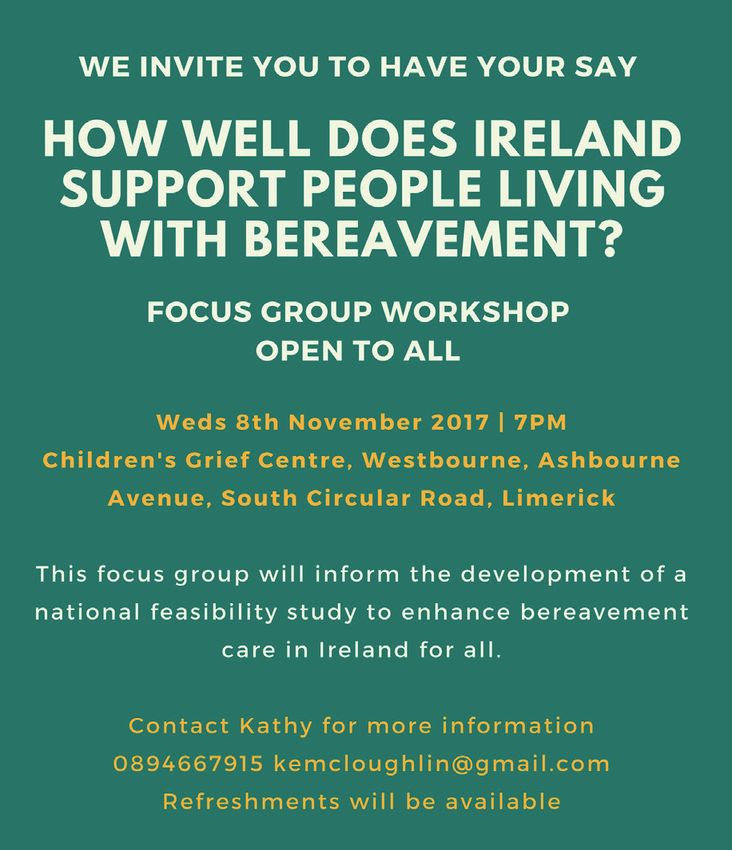
Thank you to the following people who gave their Thank you to all who attended the focus group
time to participate in one-to-one interviews as part discussions in Dublin, Limerick, Cork and Sligo and
of this study: to the following organisations for facilitating us with
a venue for the focus group meetings:
Brid Carroll Chair of the Irish Childhood
Bereavement Network The Children’s Grief Centre, Limerick
Margaret Codd Quality Improvement Facilitator SMA Parish Hall, Wilton, Cork
and Programme Facilitator, Quality Improvement Innovation Centre, Sligo IT, Sligo
Division, Health Service Executive The Irish Hospice Foundation, Dublin
Dr. Susan Delaney Clinical Psychologist and The organisations / professions represented at the
Bereavement Services Manager, Irish Hospice Focus Groups included:
Foundation Anam Cara
Barrettstown
Dr. Philip Dodd National Clinical Adviser and
Bethany Bereavement Support
Clinical Programme Group Lead for Mental Health,
Care Alliance Ireland
Health Service Executive Citizen Information Service
Sharon Foley Chief Executive Officer, Irish Hospice Community Mental Health Nursing, HSE
Foundation, Dublin Embrace Farm
Feileacean
Christopher Hall Chief Executive Officer, Australian Fingal Counselling Service
Centre for Grief and Bereavement GP based in Dublin
Debbie Kerslake Chief Executive Cruse Jigsaw
Bereavement Care, UK Kilkenny bereavement support group
Le Cheile FRC
Josephine Kieran Senior Therapist Bereavement Marymount Hospice
Coordinator, Pieta House, Mater Hospital
Milford Care Centre
Jane McKenna Founder of LauraLynn Children’s
Mount Tabor Care Centre
Hospice and bereaved parent
Pax Counselling
Irene Murphy Director of Bereavement & Family Pieta House
Support Services, Marymount Hospice, Cork and Private Psychotherapist
Board member of the European Association of Rainbows
Palliative Medicine Samaritans
Sligo University Hospital
Alison Penny Co-ordinator Childhood Bereavement St Francis Hospice
Network and National Bereavement Alliance, UK Support After Homicide
Dr. Paulo Pinheiro Consultant Physician, Tallaght Hospital
Cavan General Hospital The Children’s Grief Project
The Hazelton Clinic
Cormac Quinlan Director of Transformation and West Cork Carers Group
Policy, Tusla Wilton Parish Bereavement Group
Sheelagh Reeper-Reynolds HSE National Lead Thank you to the following who assisted in the
for Palliative Care, Primary Care Division, Health coordination and/or facilitation of the focus groups:
Service Executive
Amanda Roberts
Norma Rohan Co-founder, EMBRACE Farm Liz Coogan
Rebecca Lloyd
Dr. Audrey Stephen Research Fellow, School of Margaret Chambers
Nursing and Midwifery, Robert Gordon University, Orla Keegan
Scotland Margaret McGoldrickEnhancing adult bereavement care across Ireland: A study 9
Steering Committee
Membership
The Irish Hospice Foundation commissioned this Margaret McGoldrick Psychotherapist, FirstLight
feasibility study and set up a Project Advisory
Committee (PAC) to oversee and support the study. Ger O’Brien Director of Services, Firstlight
Thank you to the following people (and their Vincent Fox, Social Worker, Mater Hospital,
respective organisations) who have given so Dublin.
freely of both their time and advice during
Josephine Kieran, Senior Therapist Bereavement
2017/8 to enable this study to be completed:
Coordinator, Pieta House,
Orla Keegan Head of Education, Research &
Dr. Amanda Roberts, Bereavement Development
Bereavement, The Irish Hospice Foundation
Officer, Irish Hospice Foundation.
Margaret Chambers Chairperson, Bethany
Bereavement Support
Liz Coogan Principal Social Worker Specialist
Palliative Care, HSE North East
Peter Hanlon Bereavement Therapist /
Clinical Nurse Specialist, A Little Lifetime and
Barretstown10 Enhancing adult bereavement care across Ireland: A study
Executive Summary
This report outlines the key findings of an yy Map all services and supports to
independent feasibility study to enhance inform the development of a directory /
bereavement care in Ireland, commissioned by database of services and support
The Irish Hospice Foundation (IHF) and overseen
yy Facilitate regional and/or national
by an independent project advisory committee
networking meetings / conferences to
representing stakeholders with an interest in
include self-care information
bereavement care and support in Ireland. The
main aims of the study were to establish a vision yy Support small services with policies,
for a national approach to bereavement care procedures and governance issues
in Ireland and to develop an implementation through the development of template and
framework to enhance bereavement care. frameworks
yy Input into the development of job
The methods used to meet the agreed aims
descriptions / training of people working
were diverse and included (1) a rapid systematic
in health and social care, primary care
review of international evidence; (2) one-to-one
and mental health
interviews with 12 national key informants;
(3) telephone interviews with international yy Lobby clinical psychology, psychiatry and
bereavement leads (n=4); (4) a focus group with social work education providers to adopt
the project advisory committee; (5) four focus competency training around grief and
groups with stakeholders (n=41) involved in complicated grief
the provision of bereavement care and support yy Develop and deliver education and
in Ireland; (6) analysis of survey data relevant training
to bereavement collected by the Irish Hospice
yy Establish a national research brief / unit
Foundation and (7) analysis of the records of two
around grief and complicated grief
national bereavement forum meetings held in
2016 and 2017. yy Promote and support the self care of
service providers
From the range of evidence considered, there
is a clear need and desire within the sector Based on this report a phased plan is now
to develop a national structure to enhance required and it may be pertinent to consider an
bereavement care for adults in Ireland. With alliance based around a single project as a first
agreed governance and a solid membership base, step. This minimizes any potential risks and
over time a national network or alliance could: would help develop ways of working collectively.
yy Agree levels of bereavement support and
develop standards / guidance to assist
bereavement support providers
yy Develop, implement and evaluate a public
awareness campaign with a focus on
normal responses to grief and loss and
how the public can support each other
yy Advocate and lobby on bereavement
related issues
yy Develop a signposting and resource
based website for professionals and the
publicEnhancing adult bereavement care across Ireland: A study 11
1.0 Introduction
This report outlines the key findings of an Detailed summary reports from both meetings
independent feasibility study to enhance are included in Appendix A. Participants agreed
bereavement care in Ireland, commissioned by The that a feasibility or scoping study would be
Irish Hospice Foundation (IHF) in July 2017. The useful to examine a broader array of perspectives.
study was overseen by an independent steering A project advisory committee was subsequently
committee representing stakeholders with an interest established to oversee a feasibility study to
in bereavement care and support in Ireland. The explore the development of a pathway toward a
study was funded by The Irish Hospice Foundation. national approach to bereavement care. The terms
of reference for this committee are included in
Appendix B.
1.1 Background to the feasibility
study This document summarises the methodology used
to conduct the national feasibility study, synthesises
In 2016, 70 people representing 33 organisations
the key findings emerging and makes a number of
with a focus or interest in bereavement care
preliminary conclusions for the Steering Committee
and support in Ireland attended the inaugural
to review and reflect upon as they set out to
Bereavement Forum hosted by The Irish Hospice
develop a pathway in 2018.
Foundation. At this forum, participants called for a
nationally coordinated approach to bereavement care
that promotes connection and collaborative working. 1.2 Study objectives
The need for bereavement to become a national
The agreed objectives for the feasibility study were to:
priority at government policy level was emphasized,
together with the need for the development of a
1. Establish the vision for a national approach to
framework, guidance and standards for services
bereavement care in Ireland
offering support. At the forum, a similar approach,
yy Describe current bereavement care in Ireland
developed for childhood bereavement in Ireland (the
ICBN) was examined, together with consideration of yy Identify strengths, weaknesses and
developments in England and Scotland presented by opportunities in current bereavement care
Alison Penny and John Birrell. Furthermore, the need yy Identify relevant policy context for
for a public health approach to bereavement support development of bereavement care aligning to
was also emphasized, whereby social support, mental health and other appropriate areas
community engagement and partnerships with key yy Prioritise needs for action
institutions and organisations (e.g. education and
industry) are promoted and nurtured. 2. Develop an implementation framework for
enhancing bereavement care in Ireland
A second meeting was held in 2017, where 34 yy Based on current situation, literature, and
people from 26 organisations outlined their vision for international models propose:
bereavement care in Ireland. This vision included: o structures/ models for a network or
(1) Broad initiatives to recognise and promote alliance in bereavement care in Ireland
awareness of bereavement in Ireland; o governance and
(2) A national approach to the development of o an outcome driven workplan for a
standards, pathways of support, guidelines network/alliance in bereavement care in
and services; Ireland.
yy Identify key deliverables in a three to five
(3) The need for education for the public,
year timeline
volunteers and professionals;
yy Identify resource requirements, staffing and
(4) The need for organisation, good governance,
potential statutory or non-statutory supports
networking and funding.
yy Conduct a risk analysis12 Enhancing adult bereavement care across Ireland: A study
2.0 Methodology
The study methodology included: (5) Four focus groups with stakeholders
involved in the provision of bereavement
(1) A rapid systematic literature review of care and support in Dublin, Cork,
international evidence to understand Limerick, and Sligo (n=41) (see Appendix
and compare bereavement care, policy, E for topic guide and all supporting
standards, structures, guidance and documentation) to consider the strengths
support in Ireland, UK, Canada, Australia and weaknesses at a more local /
and The Netherlands with consideration to regional level and to enable groups to
both the empirical and grey evidence (see prioritise recommendations collated via
Appendix C for detailed systematic review telephone interviews.
methodology). Studies obtained from the
review have been used to contextualise (6) Analysis of Omnibus research survey
the need for a bereavement structure in data relevant to bereavement collected
Ireland. in 2016 by Amarach for the Irish Hospice
Foundation and data from the Irish
(2) One-to-one telephone interviews with Hospice Foundation’s #haveyoursay 2017
key informants (n=12), nominated by the survey.
Steering Committee, to consider in depth
the structure of bereavement care in (7) Analysis of the records of the two national
Ireland (see Appendix D for topic guide) bereavement forum meetings (2016 &
with a focus on strengths and weaknesses 2017).
and practical consideration for future
developments.
(3) Telephone interviews with bereavement
care leads in England (n=2, Scotland
(n=1) and Australia (n=1) to understand
their experience of the national
development of bereavement care and
associated risks in their countries.
These interviews were unstructured and
conversational based on the person
interviewed and their area of focus.
(4) Focus group discussion with the project
Steering Committee to consider in-depth
the structure of bereavement care in
Ireland (see Appendix D for topic guide)
with a focus on strengths and weaknesses
and practical consideration for future
developments.Enhancing adult bereavement care across Ireland: A study 13
3.0 Bereavement Care –
Why does Ireland need
structure?
3.1 The experience of bereaved interventions show differential efficacy according
to level of need. A comprehensive meta-analysis
people
of 61 controlled studies of psychotherapeutic
Approximately 30,000 people die in Ireland each interventions for bereavement (Currier, Neimeyer,
year. Varying estimates indicate that between 4 to & Berman, 2008) demonstrated greater efficacy
10 people are significantly impacted by each death for interventions targeted to grievers with higher
(Irish Hospice Foundation, 2017; Stephens et al., levels of distress (e.g. clinical symptomatology).
2015; Nucleus Group, 2004). Therefore, at some Grief interventions for individuals with ‘normal’ grief
point in life, bereavement will touch the life of each tend to offer minimal to no efficacy and may even
and every citizen. The impact of bereavement varies result in greater distress (e.g. Schut & Stroebe,
from person to person across time and is influenced 2005). The move to offering support according to
by a number of factors including (a) the nature need is strengthened by recent empirical studies
and circumstances of the person’s death (e.g. that indicate support for targeted interventions for
suddenness or preventability); (b) the relationship people who meet the criteria for complicated grief/
between the person who has died and the bereaved Prolonged Grief Disorder/ disturbed grief (e.g.
person (e.g. strong, secure or ambivalent) and Boelen & Smid, 2017; Shear et al., 2016; Bryant et
(c) individual factors related to the person who is al., 2014; Rosner, Pfoh, Kotoucova & Hagl, 2014).
bereaved (e.g. developmental stage, mental health, Clearly, a blanket approach to bereavement care
social support network) (Strada, 2009). Recent is not appropriate; instead, the focus needs to
studies indicate that the prevalence of those at high shift towards service delivery models predicated
risk of mental ill health post bereavement is 6.4% upon individual need. Modern approaches to
with another 32.5% requiring some degree of formal bereavement care consider such statistics and
bereavement support (HSE, 2017 quoting Aoun evidence, recognising that most people who
(2015)). The Petrus (2008) review of bereavement experience bereavement do not require counselling
support services available in Ireland highlighted or intervention from specialist services but will
that, in a typical year, bereavement care can be benefit from support.
provided to up to 19,000 people. All bereaved
people require information about loss, social “...from the outset it is important that we caution
support and understanding and to know about the ourselves not to become too prescriptive about grief
existence of local services. For the vast majority reactions and their effect on bereavement and to
(60%) this is all the bereavement support required remember that bereavement as a process is affected
(HSE 2017). Where a death is not sudden or tragic by religious and cultural beliefs and by a range of
in nature, bereavement care may involve both pre mediators. The meaning of the loss to the person,
and post death. the combination of risk and protective factors and
the level of internal resilience and coping skills
Not all bereaved people suffer a significant and are important aspects. Moreover, grief is mediated
long-term grief reaction following the death of a by social factors such as the age of the bereaved
loved one (Bonanno, Boerner, & Wortman, 2008); person, the circumstances of the death, the social
however, some bereaved caregivers do exhibit background of those who have been bereaved and
elevated levels of distress and for most this the extent to which mourning, as the public face of
distress is often short lived. However, a significant grief, takes place” (Scottish Framework 2011, p. 11)
minority (about 10-20%) experience persistent
psychiatric difficulties (Kersting et al, 2011; The three levels of intervention for bereavement
Prigerson, Vanderwerker, & Maciejwski, 2008) and care (Schut, Stroebe, van den Bout, & Terheggen,
would benefit from professional intervention. Grief 2001) are: primary – targeting all bereaved14 Enhancing adult bereavement care across Ireland: A study
people; secondary – targeting people at-risk of The 2016 Omnibus survey conducted by
complications of bereavement; and tertiary – Amarach for the IHF (n=908) indicates that 1 in 5
targeting people with complicated bereavement1. respondents had experienced the bereavement of
These levels of intervention align with Neimeyer’s someone close in the previous year with more than
(2008) differentiation of grief support (informal 8 in 10 people experiencing the loss of someone
compassion and information from people who do close within their lifetime. A quarter of respondents
not have professional bereavement training), grief (24%) say their physical health has deteriorated
counselling (provided by trained professionals), since the loss of someone close, with 3 in 10 (29%)
and grief therapy (provided by trained professionals stating that their mental health has deteriorated
to people with mental health concerns). Whilst and 1 in 5 (20%) reporting that their financial
grief is considered to be a normal process, there situation has deteriorated since the loss of a loved
is a growing consensus that bereavement should one. Males were less likely than females to say
be considered a public health priority issue for their physical or mental health has deteriorated
all governments (Kellehear, 2008; Higginson and since the loss of a loved one, but more likely to
Koffman, 2005; Rao et al., 2002). say their finances have deteriorated. Respondents
reported that friends and family are the most useful
Two recent surveys of the public commissioned by sources of support and there was generally a low
The Irish Hospice Foundation provide an insight into use of mental health support services. However,
the general public’s perception of bereavement care more than 1 in 3 respondents stated that they
and support in Ireland. did not get all the help they required during the
bereavement. Respondents were open to using
The #haveyoursay survey informed the development external support sources, with 1 in 5 (19%) stating
of a Charter for Death, Dying and Bereavement in that professional supports (e.g. counsellors and
Ireland. 2,224 people responded to a question psychologists) would have helped them during their
regarding how their community could support bereavement. Younger people were more likely to
the bereaved better. The most important theme feel that counsellors or therapists could help them
emerging from the findings is the need for people during bereavement.
to support each other through bereavement. Other
suggestions included the need to: We now examine why, based on the literature,
policy gaps and experience both nationally
yy Raise awareness to supports and and internationally a structured approach to
information available bereavement care in Ireland is considered
yy Improve access to low cost non- necessary.
denominational support and counselling
yy Hold a media campaign to enable people 3.2 Policy
to understand more about bereavement,
Ireland does not have a national bereavement
supports available and how to access them
strategy or any overarching structure coordinating
yy Hold community gatherings to facilitate bereavement services, support and information.
open conversation and remembrance rituals Bereavement does not feature as an issue in any of
the following current overarching health strategies /
yy Plant memorial gardens
frameworks:
yy Have access to 24/7 support
yy Slaintecare (May 2017)
The findings informed the development of the
People’s Charter on Dying, Death and Bereavement in
yy Healthy Ireland – A Framework for Improved
Health and Wellbeing (2013 – 2025)
Ireland. Specific to bereavement, the Charter states
yy The Department of Health’s Statement of
“For the people who matter to me, I want Ireland to Strategy (2016 – 2019)
be a country where:
yy Health Service People Strategy (2015 –
yy People understand grief and do not avoid 2018)
thinking or talking about it.
yy Family and friends are supported during
a loved one’s illness and after their death. 1.
While Schut et al use ‘primary’, ‘secondary’ and ‘tertiary’
People get space and time to grieve, talk and the terminology ‘universal, selective and indicated’ has
remember.” been used by Currier, Neimeyer, Aoun and the EAPC.Enhancing adult bereavement care across Ireland: A study 15
However, within mental health, suicide, cancer In Connecting for Life – Ireland’s National Strategy to
care and palliative care strategy / frameworks Reduce Suicide (2015-2020) it is noted that increased
bereavement is considered as follows: provision of bereavement counselling is a key success
of the previous strategic document ‘Reach Out’. Action
3.2.1 Mental health strategy 4.3.1 states that enhanced bereavement support
will be offered to people and their families known
Following the publication of Reach Out – the to mental health services and affected by suicide
National Strategy for Action on Suicide Prevention and in 4.3.2 it states that a national evaluation of
(2005-2014) the National Office for Suicide bereavement services will be commissioned.
Prevention (NOSP) selected Petrus Consulting
to examine and report on general bereavement
3.2.2 Palliative care strategy and
support services and specific services available
frameworks
following suicide bereavement. The 2008 report
made a number of recommendations regarding the More focused consideration is offered to
information provided to those bereaved by suicide, bereavement in the HSE Palliative Care Services
the role of self-help groups, models of service Three Year Development Framework (2017-2019)
provision, training, qualification and standards for where in Section 2.3, a population needs approach
those involved in suicide bereavement support to bereavement is recommended. The framework
and discussed future service delivery including advocates for the development of national guidance
associated costings. The Petrus report’s final and standards for bereavement care at all levels
conclusion calls for investment in core generic and more explicitly recommends that:
support:
“The HSE, in conjunction with other
“A bereavement support service should agencies, should initiate a process aimed
not necessarily put an emphasis on the at developing and implementing national
type of death, but rather concentrate guidance for bereavement care at all
on the bereaved person and the levels of provision, based on a population
consequences of their loss, and screen needs approach. The guidance should
for complicated grief.” Petrus Report (2008) explicitly look to develop national
and local coordinated networks, and
More recently, there are passing references to standards for bereavement care, with a
bereavement in Mental Health – a Vision for reach beyond palliative care services.”
Change where bereavement is first mentioned as p.14 HSE Palliative Care Services Three Year
a life course issue that can result in mental health Development Framework (2017-2019)
issues or distress that usually resolves over time
and can benefit from the provision of community
The Palliative Care Competence Framework
based support, including that from friends and
(Ryan et al. 2014) indicates that all health care
family (p21). Later in the document bereavement
professionals require a level of bereavement care
is used as an example of a situation whereby an
competence and this up-skilling will require allocation
individual could deal with the distress by drawing
of appropriate resources and access to education.
on their own interpersonal resources and illustrates
The framework specifies that all health care
that for some people the outcome will be referral
professionals should:
to a GP or mental health services with prescription
for anti-depressants (p45). The document notes yy Understand that grief is a normal and
that GPs often deal with bereavement issues (p63), appropriate response to loss which has
that social support, self-help and volunteering can physical, psychological, spiritual, emotional and
be protective factors against poor mental health for social aspects that affect how it is experienced
older people when faced with bereavement (p117)
yy Recognise the range of individual physical,
and is also an issue for people with intellectual
psychological, spiritual, emotional and social
disabilities as they age (p132). The document
responses to loss and grief
outlines that bereavement support is a key priority
area in The National Strategy for Action on Suicide yy Recognise the factors which may put a
Prevention and also refers to counselling as a brief person at risk of encountering difficulties in
intervention for those presenting with mental health their grief, whilst also remaining aware of the
difficulties due to an underlying life events such as resources and resiliencies that are particular
sudden bereavement (p246). to each person and familyYou can also read


