Quantum electronic coherences by attosecond transient absorption spectroscopy: ab initio B-spline RCS-ADC study - RSC Publishing
←
→
Page content transcription
If your browser does not render page correctly, please read the page content below
Faraday Discussions
         This article is licensed under a Creative Commons Attribution-NonCommercial 3.0 Unported Licence.

                                                                                                             Cite this: Faraday Discuss., 2021, 228, 286

                                                                                                                                                                                View Article Online
                                                                                                               PAPER                                                            View Journal | View Issue

                                                                                                             Quantum electronic coherences by
                                                                                                             attosecond transient absorption
                                                                                                             spectroscopy: ab initio B-spline RCS-ADC
Open Access Article. Published on 08 2020. Downloaded on 2021/9/15 9:17:10.

                                                                                                             study
                                                                                                             M. Ruberti         *

                                                                                                             Received 11th September 2020, Accepted 30th November 2020
                                                                                                             DOI: 10.1039/d0fd00104j

                                                                                                             Here I present a fully ab initio time-resolved study of X-ray attosecond transient
                                                                                                             absorption spectroscopy (ATAS) in a prototypical polyatomic molecule, pyrazine, and
                                                                                                             demonstrate the possibility of retrieving the many-electron quantum ionic coherences
                                                                                                             arising in attosecond molecular photoionisation and pre-determining the subsequent
                                                                                                             charge-directed photochemical reactivity. Advanced first-principles many-electron
                                                                                                             simulations are performed, within a hybrid XUV pump/X-ray probe setup, to describe
                                                                                                             the interaction of pyrazine with both XUV pump and X-ray probe pulses, and study the
                                                                                                             triggered correlated many-electron dynamics. The calculations are carried out by
                                                                                                             means of the recently-developed ab initio method for many-electron dynamics in
                                                                                                             polyatomic molecules, the time-dependent (TD) B-spline Restricted Correlation Space-
                                                                                                             Algebraic Diagrammatic Construction (RCS-ADC). RCS-ADC simulates molecular
                                                                                                             ionisation from first principles, combining the accurate description of electron
                                                                                                             correlation of quantum chemistry with the full account of the continuum dynamics of
                                                                                                             the photoelectron. Complete theoretical characterisation of the atto-ionised many-
                                                                                                             electron state and photo-induced attosecond charge dynamics is achieved by
                                                                                                             calculating the reduced ionic density matrix (R-IDM) of the bipartite ion–photoelectron
                                                                                                             system, with full inclusion of the correlated shakeup states. Deviations from the sudden
                                                                                                             approximation picture of photoionisation, in the low-photon-energy limit, are
                                                                                                             presented. The effect of the multi-channel interaction between the parent-ion and the
                                                                                                             emitted photoelectron on the onset of the quantum electronic coherences is analysed.
                                                                                                             Moreover, I show how the Schmidt decomposition of the R-IDM unravels the many-
                                                                                                             electron dynamics triggered by the pump, allowing for the identification of the key
                                                                                                             channels involved. Finally, I calculate the X-ray attosecond transient absorption spectra
                                                                                                             of XUV-ionised pyrazine. The results unveil the mapping of the ATAS measurement
                                                                                                             onto the quantum electronic coherences, and related non-zero R-IDM matrix elements,
                                                                                                             produced upon ionisation by the XUV pump laser pulse.

                                                                                                             Department of Physics, Imperial College London, Prince Consort Road, London SW7 2AZ, UK. E-mail: m.
                                                                                                             ruberti11@imperial.ac.uk; Tel: +44 (0)20 7589 47728

                                                                                                             286 | Faraday Discuss., 2021, 228, 286–311    This journal is © The Royal Society of Chemistry 2021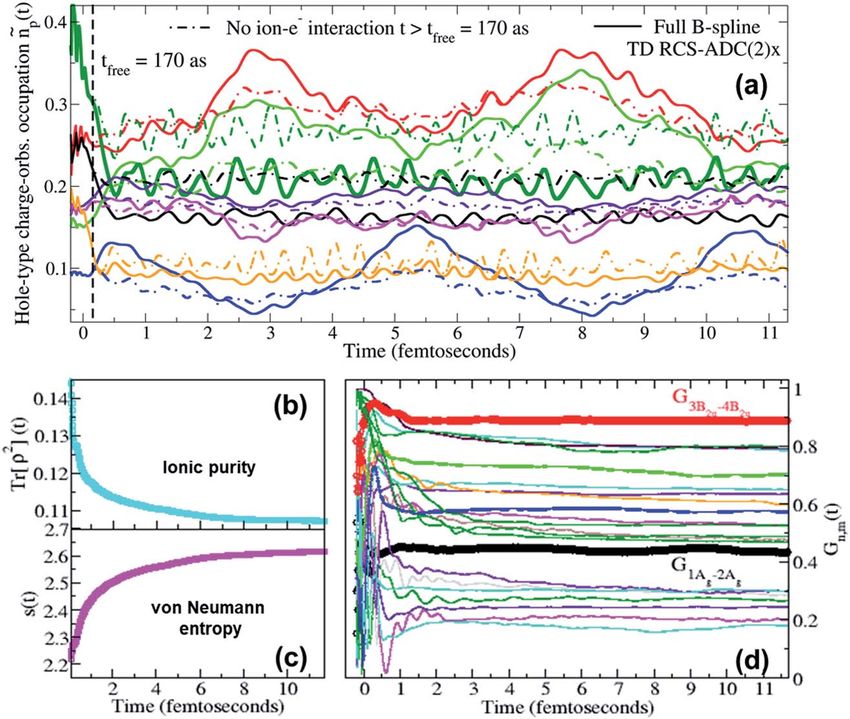
View Article Online
Paper Faraday Discussions
1 Introduction
This article is licensed under a Creative Commons Attribution-NonCommercial 3.0 Unported Licence.
Triggering, imaging and ultimately achieving control of many-electron dynamics
on its intrinsic time-scale in molecular systems are at the heart of modern atto-
second science, with the fundamental important goal of unveiling the role played
by quantum-coherent electronic motion in driving and determining the photo-
induced physical and chemical change of matter. In particular, as a result of
the interaction with a pulse of ionising laser radiation, the molecular many-
electron quantum system breaks up as the emitted photoelectron dris away
Open Access Article. Published on 08 2020. Downloaded on 2021/9/15 9:17:10.
from the parent-ion. In a traditional synchrotron photoionisation experiment, the
resulting population of the series of ionised states occurs incoherently. Indeed,
the application of narrow-bandwidth synchrotron radiation to an atom or
a molecule, for the best resolution of the cationic eigenstates (e.g. through
photoelectron spectra), results in each given ionised eigenstate being coupled to
its own outgoing photoelectron wave of corresponding energy. The total N-elec-
tron wavefunction of the neutral (ion + photoelectron) system is thus completely
entangled and cannot be represented as a separable product of ionic and free-
electron states. Creation of ionic state coherence requires, on the contrary,
short-pulse, broadband sources, e.g. in the XUV to X-ray range, of the kind that
have only become available in the last two decades with the advent of high-order
harmonic generation (HHG)-based attosecond lasers,1 as well as X-ray free elec-
tron lasers (XFELs).2 Ionisation of nite many-electron systems by these new
generation attosecond laser sources creates a partially-entangled state of the
ionised electron and parent-ion sub-systems, where the emerging ionic system is
characterised by a density matrix and a partially-coherent superposition of ionic
eigenstates is populated. This drives an ultrafast charge dynamics in the molec-
ular ion, where (in several biomolecules) the positive charge is predicted to
migrate (hole-migration) across the molecular backbone on a time-scale from
a few femtoseconds (fs) down to hundreds of attoseconds (as).3–6 On longer time
scales, this purely electronic coherent dynamics eventually undergoes decoher-
ence due to the coupling to the nuclear motion (environment) degree of
freedom,7–11 which leads to its nal localisation.
The study of the coherent many-electron dynamics upon photoionisation is
a central topic in attosecond science. Since molecular bonds are more likely to
break where the hole is localised, direct access to the ultrafast charge redistri-
bution underpinned by electronic coherence in the ion could be ultimately
exploited to control photoionisation-induced charge-directed reactivity on
unprecedented ultrafast (attosecond) time-scales, steering the reaction dynamics
at a very early stage of its quantum evolution by acting only on the electronic
degrees of freedom, i.e. before the nuclei start to move and the de-phasing of
electronic coherences occurs. This represents a unique opportunity, which was
previously unavailable on the much longer (femto/pico-second) time-scales
intrinsic to nuclear dynamics, to nd new ways of controlling photochemical
reactions by acting on the quantum electronic coherences, rather than just on the
populations. Moreover, since the ultrafast charge redistribution underpinned by
electronic coherences in the ion initiates all photochemical change,12,13 and as
a result also pre-determines radiation damage, the study of quantum electronic
coherence and entanglement in photoionisation deepens our understanding of
This journal is © The Royal Society of Chemistry 2021 Faraday Discuss., 2021, 228, 286–311 | 287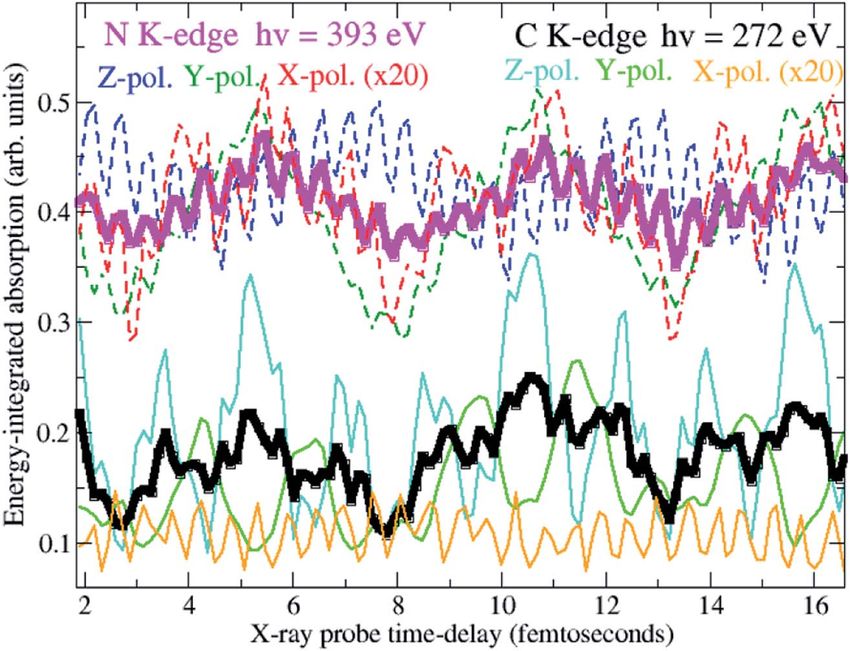
View Article Online
Faraday Discussions Paper
the basic processes leading to photosynthesis, radiation damage, mutation and,
This article is licensed under a Creative Commons Attribution-NonCommercial 3.0 Unported Licence.
more generally, the alteration of molecular biological functions.
To this end, the goal should be to develop quantum protocols, based on
attosecond measurement techniques, for the tomographic reconstruction of the
attosecond ionised quantum states. Indeed, the existence of long-enough lived
quantum electronic coherences would not only make their experimental obser-
vation possible, but could also enable quantum state tomography of the ionic
density matrix emerging from a molecular attosecond ionisation event. In this
direction, the recent spectacular advances in ultrafast light-source technology
Open Access Article. Published on 08 2020. Downloaded on 2021/9/15 9:17:10.
have opened up the possibility of unprecedented direct experimental access to
electronic quantum coherences through cutting-edge attosecond pump–probe
spectroscopy techniques.14,15
However, in order to reach these goals, a crucial role is played by the devel-
opment of a comprehensive theoretical understanding, based on an accurate
theoretical modelling of the ultrafast molecular ionisation process and the role of
the measurement, which can strongly support and guide attosecond experiments
and their interpretation. The present theoretical picture lacks a full under-
standing of the level of entanglement produced in the photoionisation process
and the consequent role of measurement in the observation of the ensuing
dynamics. Moreover, in spite of the fact that predicting the quantum ionic
coherences arising in photoionisation is essential for modelling attosecond hole
migration,14 until very recently the density matrix characterising the ionic state
emerging from attosecond ionisation could not be predicted theoretically or
characterised experimentally, except for 2-level atomic cases.16 This is because
predicting the ionic coherence in attosecond molecular ionisation represents
a major theoretical challenge, where the multi-channel and multi-centre many-
electron problem, in the presence of a laser eld, must be solved with an accu-
rate description of the photoelectron and parent-ion.
With the availability of the new B-spline restricted correlation space (RCS)-ADC
many-body theoretical approach,17,18 complete theoretical characterisation of the
attosecond ionised states in molecular systems has become possible.18 This has
opened up the possibility of calculating, in a fully ab initio fashion and including
the correlated ionic shakeup states, the reduced ionic density matrix (R-IDM) of
the bipartite ion–photoelectron system produced by molecular attosecond ion-
isation. It also allows us to fully capture the onset of the quantum electronic
coherences in the ionic system, generated during the laser-induced dynamics, as
well as the ion–photoelectron entanglement. The B-spline restricted correlation
space (RCS)-ADC method for many-electron dynamics allows one to model ion-
isation of much larger molecular systems than previously possible within the
standard B-spline ADC method,25–28 at the same or higher level of accuracy. It
successfully combines the full description of the photoelectron continuum states
(described in terms of a multi-centre B-spline basis set) with a realistic quantum
chemistry approach to the modelling of electron correlation. Moreover, the new
method goes beyond the previous theoretical studies where the ionisation step
(and the photoelectron degree of freedom) was either completely neglec-
ted,3–5,8–11,19,20 or modelled without taking into account important electron corre-
lation effects such as interchannel couplings and ionic shakeup.14,21–24 RCS-ADC is
based on the separation of the orbital space into correlation and ionisation spaces
and naturally bridges the gap between standard ADC multi-congurational ab
288 | Faraday Discuss., 2021, 228, 286–311 This journal is © The Royal Society of Chemistry 2021
View Article Online
Paper Faraday Discussions
initio techniques and closed-coupling schemes based on the limited number of
This article is licensed under a Creative Commons Attribution-NonCommercial 3.0 Unported Licence.
essential, physically relevant, ionic states, combining the key advantages of both.
In this article, I apply the B-spline RCS-ADC method to describe, in a fully ab
initio fashion, a complete attosecond pump–attosecond probe experiment in
a prototypical polyatomic molecule, i.e. pyrazine. In particular, I present a time-
resolved study of X-ray attosecond transient absorption spectroscopy (ATAS) in
pyrazine and demonstrate the possibility of retrieving the many-electron
quantum ionic coherences arising in attosecond photoionisation and pre-
determining the subsequent charge-directed reactivity. Advanced rst-principles
Open Access Article. Published on 08 2020. Downloaded on 2021/9/15 9:17:10.
many-electron simulations are performed, within a hybrid XUV/X-ray pump–
probe setup, to describe the interaction of pyrazine with both the XUV pump and
X-ray probe pulses. First, during the pump step, I calculate the density matrix of
the bipartite ion–photoelectron system, from which I extract a R-IDM fully
including the correlated shakeup ionic states. I perform a Schmidt decomposition
of the R-IDM in order to analyse the coherent ionic states emerging from the
ionisation event. As a result, the pump-triggered charge dynamics and predom-
inant timescales for many-electron motion are identied and mapped onto the
quantum coherences between the populated ionic eigenstates. In addition, I
analyse the effects of the residual interaction between the emitted photoelectron
and the parent-ion on the quantum coherent many-electron dynamics, as well as
its deviations from the predictions of the sudden approximation, in the low-
photon-energy regime, i.e. close to the ionisation thresholds of the many-body
system. In this way, this work provides a complete theoretical characterisation
of the atto-ionised many-electron state and photo-induced charge dynamics.
Second, I study how this dynamics is reected in the actual pump–probe
signal by calculating the X-ray transient absorption spectra of XUV-ionised
pyrazine. The ab initio simulation of the ATAS measurement is performed
by solving the von Neumann equations for the characterised R-IDM prepared
by the pump interacting with the X-ray probe eld. The results of the
simulation show how the ATAS measurement observables can be mapped
onto the quantum electronic coherences corresponding to the non-zero R-
IDM matrix elements, and related charge dynamics, produced upon ionisa-
tion by the pump laser pulse. The chemically site-specic information is
obtained by using X-ray photon energies able to resonantly excite the ionic
system to the nitrogen and carbon K-edges. The results presented here
extend the work reported in a recent theoretical study on the simulation of
pump–probe experiments in CO2 28 to a larger molecular system and, at the
same time, at a higher level of accuracy in the description of electron
correlation. Furthermore, it represents an important step further with
respect to previous reports where the calculations were restricted to
describing the electron dynamics following the ionisation induced by the
pump pulse, but ignored the effect of the probe pulse and the role of the
attosecond measurement. 18,29 The calculations are performed within the
frozen-nuclei approximation and focus only on the electronic degree of
freedom, which is a valid approach for the rst few femtoseconds aer
ionisation. 7,11,13 On longer time-scales, these calculations provide a frozen-
nuclei benchmark to which the experimental results can be compared, in
order to identify the effects of nuclear motion.
This journal is © The Royal Society of Chemistry 2021 Faraday Discuss., 2021, 228, 286–311 | 289
View Article Online
Faraday Discussions Paper
2 Theoretical methods
This article is licensed under a Creative Commons Attribution-NonCommercial 3.0 Unported Licence.
In this section, I summarise the main features of the B-spline RCS-ADC method
and its time-dependent implementation, and briey describe the basic equations
that allow one to extract the reduced ionic density matrix from the full N-electron
wavefunction as well as the key quantities employed to describe the evolution of
quantum electronic coherences and the hole-density in the molecular cation.
Finally, I discuss the modelling of the interaction between the ionised system,
created in the pump step, and the X-ray probe pulse.
Open Access Article. Published on 08 2020. Downloaded on 2021/9/15 9:17:10.
2.1 Description of the pump step: time-dependent B-spline RCS-ADC
Within B-spline RCS-ADC, the single-electron orbitals are expanded in a multi-
centre B-spline basis set,17,33 designed to accurately describe both bound and
ionised states of the neutral molecule. The resulting Hartree–Fock (HF) virtual
orbital space (VS)17 (fa) is subsequently partitioned into two orthonormal
subspaces: the (restricted) correlation space (RCS) (ca), designed to accurately
describe the localised short-range correlation of the system, and its orthonormal
complement, the ionisation space (IS) (jm), which describes the long-range part of
the photoelectron wavefunction and complements the RCS in order to represent
the electronic wavefunction over the entire spatial region. Here and in what
follows, the a, b, . and m, n. indices refer to the virtual space (unoccupied) RCS
and IS orbitals, respectively, whereas i, j, k, ., indicate the occupied HF orbitals.
Within the time-dependent (TD) B-spline restricted correlation space (RCS)-
ADC(n) approach to molecular ionisation dynamics, the 3D time-dependent
Schrödinger equation (TDSE) for an N-electron polyatomic molecule interacting
with an ultrashort laser pulse,
vJN ðtÞ
iħ ¼H ^ N ðtÞJN ðtÞ ; (1)
vt
is solved by expanding the TD many-electron wavefunction on the basis of the
ground and excited RCS-ADC(n) states18
( )
N X X ðN1;RCSÞ ½n X N E½n ½n
J ðtÞ ¼ ~
c J
cmm ðtÞ^†
m m þ cI ðtÞJ RCS
þ c0 ðtÞJRCS : 0
IRCS
m m IRCS
(2)
N ½n
Here 0 i
|JRCS [n]
is the n-th order RCS correlated ground state, and J ~ i indi-
IRCS
cates the excited intermediate states of the nth-order ADC(n) scheme, built using
the single-particle RCS. The ansatz of eqn (2) includes a full description of elec-
tron correlation effects, such as shakeup processes, breakdown of the molecular
orbital picture and doubly-excited autoionising resonances, as well as inter-
channel couplings in the continuum, which play an essential role both during
the ionisation event and in the post-ionisation charge dynamics. Within the
method of the ADC(n) hierarchy used in this work, i.e. ADC(2)-extended (ADC(2)
x),17 the excited N-electron intermediate states span the conguration space
consisting of 1h1p (|J̃Niai ) and 2h2p (|J̃abiji ) excitation classes built on top of
[n] N [n]
the RCS correlated ground state |J0 i . The rst term on the le-hand side of
RCS [n] 17
eqn (2) describes the IS conguration states of B-spline RCS-ADC, which take the
form of ionisation-channel-specic product-states and read as17
290 | Faraday Discuss., 2021, 228, 286–311 This journal is © The Royal Society of Chemistry 2021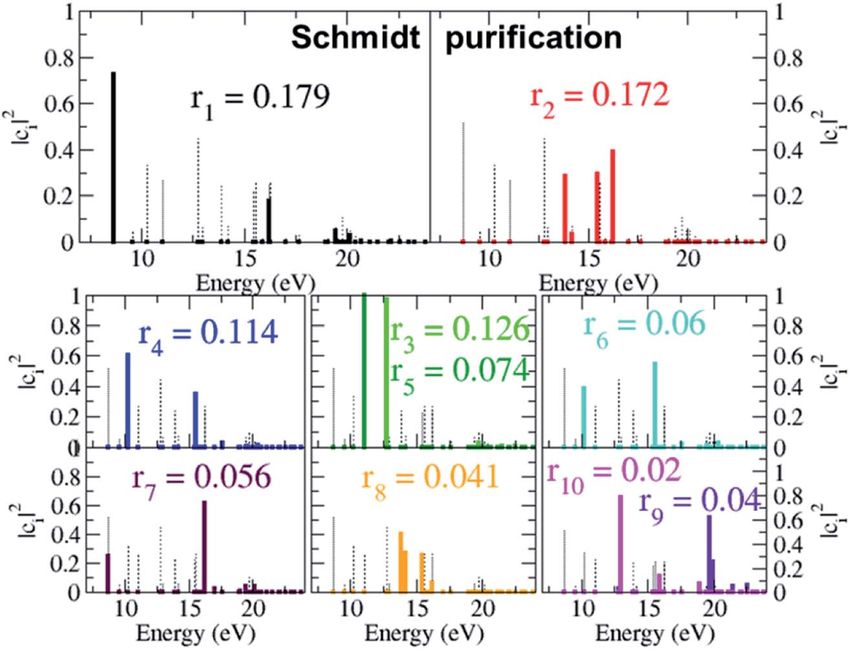
View Article Online
Paper Faraday Discussions
|J̃ N ^†m|JN1,RCS
m,ni ¼ c i, (3)
This article is licensed under a Creative Commons Attribution-NonCommercial 3.0 Unported Licence.
n
where ĉ†m is the creation operator of an electron in the IS molecular orbital jm(r),
and |JN1,RCS
n i denotes the RCS-ADC ionic eigenstates. These are obtained by
diagonalizing the ionic ADC Hamiltonian Ĥ N1 RCS-ADC(n) computed using the single-
particle RCS
Ĥ N1 N1,RCS
RCS-ADC(n)|Jn i ¼ Inp|JN1,RCS
n i, (4)
where the ionisation energy is given by Inp ¼ EN1
n ERCS
0 , and E0
RCS
is the energy of
Open Access Article. Published on 08 2020. Downloaded on 2021/9/15 9:17:10.
the RCS ground state. Within the RCS-ADC(2)x scheme, the eigenstates of the
parent-ion, |JN1,RCS
n i, are expanded into 1h (|J̃N1 i i) and 2h1p
(|J̃aij i) congurations derived from the RCS perturbation theoretically corrected
N1
HF ground state of the neutral molecule17
N1;RCS X Ion N1 X Ion N1 E
J ¼ Vi;n J
~ þ ~
Vaij;n J : (5)
n i aij
i aij
Among the |JN1,RCS
n i,
the 1h-like valence- and core-ionised states are described
up to second order in the many-body perturbation theory, while the states with
2h1p character are described up to rst order.
A complex absorbing potential (CAP) of the form Ŵ ¼ h(r rCAP)2, r $ rCAP is
used to eliminate wave packet reection effects from the radial grid boundaries.
With the addition of the CAP term, the total time-dependent Hamiltonian of eqn
(1) reads as
Ĥ N(t) ¼ Ĥ N ^N
RCS-ADC(n) + DRCS-ADC(n)EPump(t) iŴ , (6)
where the (EPump(t)) laser–molecule interaction is described in length form within
the dipole approximation, and Ĥ N ^N
RCS-ADC(n) and DRCS-ADC(n) are the representation
of the shied eld-free RCS-ADC Hamiltonian H b
~ ¼H ^ E0RCS and the dipole
operator D ^ , respectively, in the space of RCS-ADC intermediate states (see eqn (2)).
These matrices contain the conventional ADC(n) matrices computed within the
RCS-based excitation space and augmented with the blocks corresponding to the
ĉ†m|JN1,RCS
n i product-states, which describe ionisation and interaction in the
continuum.17,18 The time propagation of the unknown coefficients of the neutral
many-electron wavefunction (see eqn (2)) is performed by means of the Arnoldi/
Lanczos algorithm.18 During the simulation of the pump step, I have included
in the expansion of the many-electron wavefunction (eqn (2)) only the open ion-
n,Pump-ionisedi, i.e. the ones that are energetically accessible by
isation channels |JN1,RCS
the pump-pulse ionisation, which are characterised by an (ionisation) spectral
intensity value (see ref. 17 and 18) greater than 1%. All the remaining ionic
channels have been kept frozen. Doing so guarantees that all the ADC(2)x ionic
states that can be effectively populated in the (mainly single-photon) ionisation of
pyrazine by the broadband XUV pulse used in this work, and consequently play
the main role in the ensuing many-electron dynamics taking place in the
molecular cation, are accounted for.18 The contribution of ionic states with
a smaller spectral-intensity value, as well as of deeper core-ionisation channels,
was found to be negligible.
This journal is © The Royal Society of Chemistry 2021 Faraday Discuss., 2021, 228, 286–311 | 291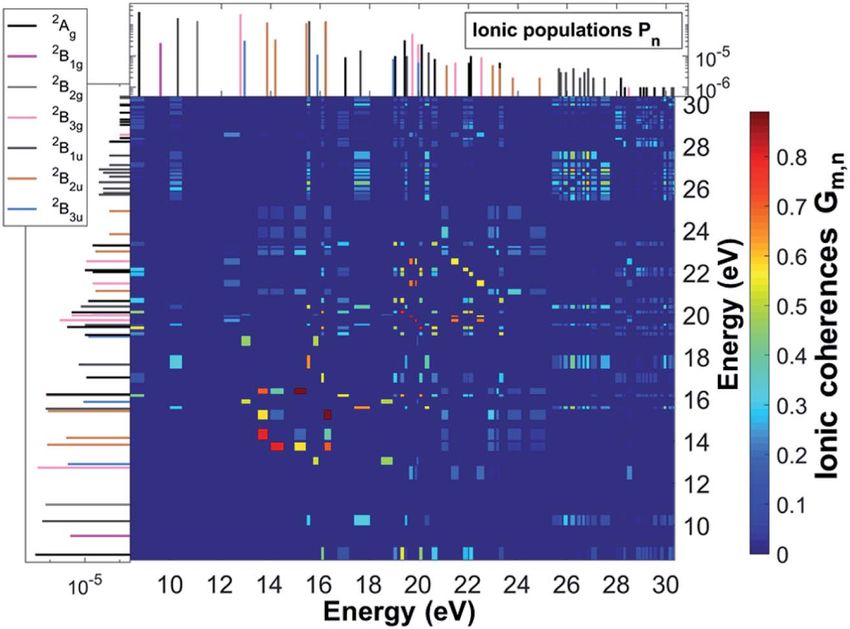
View Article Online
Faraday Discussions Paper
2.2 Pump-triggered ionic density matrix and charge dynamics
This article is licensed under a Creative Commons Attribution-NonCommercial 3.0 Unported Licence.
The pump-triggered coherent electron dynamics is obtained by calculating the
time-dependent R-IDM rR-IDM(t) of the molecular ion emerging from the atto-
second pump-ionisation step. This is achieved by tracing out the unobserved
photoelectron degree of freedom from the total time-dependent density matrix of
the N-electron system r^R-IDM(t) ¼ Trm[|JN(t)ihJN(t)|]. Doing so, and using the
many-electron states of eqn (3) within the TD RCS-ADC(n) frameworks, yields the
following expression in the basis of ADC(n) ionic eigenstates
rR-IDM ðtÞ ¼
Open Access Article. Published on 08 2020. Downloaded on 2021/9/15 9:17:10.
m;n
X ðt X
0
cmm ðtÞ½cnm ðtÞ* þ 2eiðIP IP Þt wn;m cmm t ½cnn ðt0 Þ eiðIP IP Þt dt ;
n m * n m 0 0
¼
m N m;n
(7)
where the latter term corrects for the loss of norm introduced by the CAP,17 Im P is
the ionisation potential of the ionic state m and wn,m is the CAP matrix element
between photoelectron IS orbitals m and n. From now on I shall omit the R-IDM
superscript and denote the reduced ionic density matrix as rm,n.
The R-IDM fully describes the ionic state prepared by attosecond molecular
ionisation; its diagonal elements correspond to the TD population of the different
ionic eigenstates, Pn(t) ¼ |rn,n(t)|, while the off-diagonal ones, rm,n, are related to
the degrees of coherence, 0 # Gm,n # 1, between any pair of populated ionic
channels m and n
rm;n ðtÞ
Gm;n ðtÞ ¼ pffiffiffiffiffiffiffiffiffiffiffiffiffiffiffiffiffiffiffiffiffiffiffiffiffiffiffiffi : (8)
Pm ðtÞ Pn ðtÞ
Diagonalization of the ionic density matrix yields the so-called Schmidt decom-
position. This is a powerful tool to analyse the produced state of the ionic system,
in which the latter is expressed as a fully-incoherent sum of several pure states,
populated with weight ri and represented by the projection operators P ^ i:
X
b
~r ðtÞ ¼ ri ðtÞP^i ðtÞ (9)
i¼1;N
This operation is called purication of the density matrix. Finally, two more quantities
that are used to quantify the ionic coherence and measure the ion–photoelectron
entanglement are the ionic purity, Tr[r2](t), and the von Neumann entropy of entan-
P
glement sIon ðtÞ ¼ ri ðtÞ lnðri ðtÞÞ, respectively. Indeed, a pure ionic state yields
i¼1;N
Tr[r2] ¼ Tr[r] and S(r) ¼ 0, while, for mixed states, the higher the rank of the density
matrix, i.e. the number of pure states involved in the purication of the density matrix
for which ri s 0, the greater the value of the entropy and Tr[r2] # Tr[r]. Moreover, both
quantities have the advantage of being representation-independent and they are
especially convenient when several cationic states are considered.
The time evolution of the hole-density Q(r,t) ~ created upon removal of one
electron by the pump pulse is calculated in the RCS as
PP *
~ tÞ ¼
Qðr; ~ pq ðtÞ, where the hole-density matrix Ñ pq(t)17 depends on
fp ðrÞfq ðrÞN
p q
the R-IDM and reads as
292 | Faraday Discuss., 2021, 228, 286–311 This journal is © The Royal Society of Chemistry 2021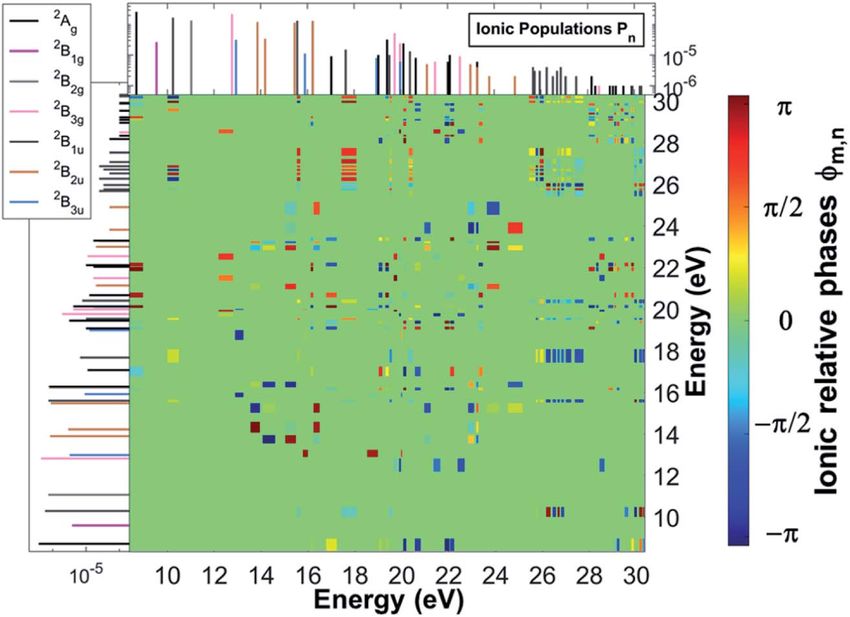
View Article Online
Paper Faraday Discussions
h i
N~ pq ðtÞ ¼ Tr Qb~ b ~pq ¼ a^† a^q :
pq ~
r ðtÞ ; Q
This article is licensed under a Creative Commons Attribution-NonCommercial 3.0 Unported Licence.
p (10)
Diagonalization of the hole-density matrix,
X 2
~ tÞ ¼
Qðr; fp ðrÞ n~p ðtÞ;
~ (11)
p
yields the time-dependent natural charge orbitals, f ~ p ðrÞ, and their respective
hole-occupation numbers, ñp(t). The latter describe what fraction of the created
hole-charge is, at each instant of time t, in the natural charge orbitals f~ p(r), which
are themselves time-dependent linear combinations of the RCS orbital basis fp(r).
Open Access Article. Published on 08 2020. Downloaded on 2021/9/15 9:17:10.
2.3 Description of the probe step: solving the RCS-ADC von Neumann
equations
In this work, I explicitly simulate the interaction of the pump-ionised system with
the probe pulse. This is achieved by calculating the time-delay dependence of the
probe-induced absorption spectra of the pump-ionised pyrazine cation, and
allows one to obtain a realistic description of the attosecond observables. The
simulated pump–probe scheme assumes non-overlapping pump and probe pul-
ses, with the X-ray probe following the XUV pump. This choice does not limit the
use of the scheme proposed in the present work, nor does it affect the results of
the simulations, since both the XUV pump and X-ray probe pulses considered
here are of ultrashort (almost instantaneous) duration. The case of overlapping
pump and probe, more relevant for longer pulses, would simply require one to
treat equally the simultaneous interaction of the molecular system with both the
pump and probe pulses, by means of eqn (1) and (2). The latter scheme, more
demanding from the computational point of view but equally tackleable by the
presented TD RCS-ADC machinery, will be considered in future work. The time-
dependent description of the cation–probe interaction is performed by solving
the time-dependent von Neumann equations for the characterised ionic density
matrix interacting with the probe laser eld
db i h ^ Ion i
~r Probe ðtÞ ¼ H ðtÞ; b
~
r Probe ðtÞ : (12)
dt ħ
The time-dependent ionic Hamiltonian Ĥ Ion(t) in the dipole approximation is
given by
Ĥ Ion(t) ¼ Ĥ N1 ^N1
RCS-ADC(n) + DRCS-ADC(n)EX(t), (13)
^ N1
RCS-ADC(n) and DRCS-ADC(n) are the representation of the shied eld-free
where Ĥ N1
ionic Hamiltonian H b
~ ¼H ^ E0RCS and the dipole operator D ^ , respectively, in the
(N 1)-electron conguration space spanned by all the ionic states of eqn (5),
|JN1,RCS
n i, built within the single-particle RCS. The ionic density matrix b ~
r Probe ðtÞ
is thus constructed on the full electronic spectrum of the ionic subsystem,
including both its low-energy bound excitations, i.e. the valence-ionised states
populated by the pump pulse |JN1 n,Pump-ionisedi, as well as the initially unoccupied
C(1s) and N(1s) core-ionised states |JN1n,Corei, which were kept frozen in the pump
step simulation. The continuum of the valence-doubly-ionised states is not
included in the simulation. This approximation assumes the direct photo-
ionisation contribution to the cross-section, where the X-ray probe pulse directly
This journal is © The Royal Society of Chemistry 2021 Faraday Discuss., 2021, 228, 286–311 | 293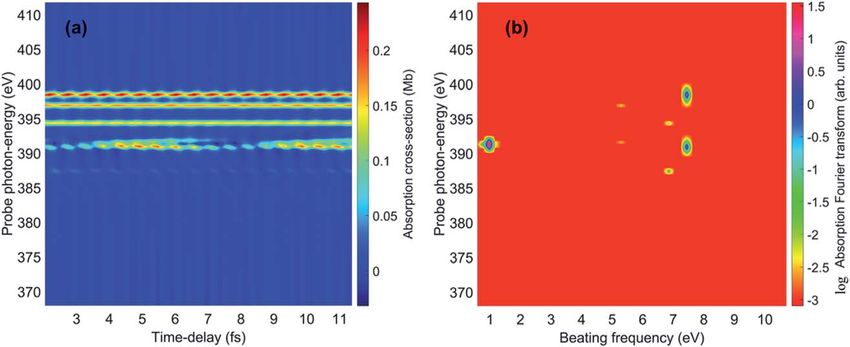
View Article Online
Faraday Discussions Paper
populates the continuum of the valence-doubly-ionised states of the molecular
This article is licensed under a Creative Commons Attribution-NonCommercial 3.0 Unported Licence.
dication, to be negligible with respect to the contribution of the excitation to the
metastable core-singly-ionised resonances. The natural Auger decay of the C(1s)
and N(1s) core-ionised states (labelled by index m) is modelled (semi-empirically)
in the solution of the TD von Neumann equations for the R-IDM (eqn (12)) by
adding the extra non-Hermitian diagonal terms
Auger
Gm t
~ N1 ¼ ei
H 2 (14)
m;m
to the ionic ADC Hamiltonian Ĥ N1 RCS-ADC(n). In this work, the value of the Auger
Open Access Article. Published on 08 2020. Downloaded on 2021/9/15 9:17:10.
decay lifetime31 for both the C(1s) and N(1s) core-ionised states has been assumed
to be of the order of the atomic lifetime, i.e. 6 fs.32
The initial condition used to solve eqn (12) is
b T T
, where b
Probe Probe
~r Probe t ¼ sd ¼b r t ¼ sd ~
r ðtÞ is the R-IDM as calcu-
2 2
lated in eqn (7), sd > 0 is the pump–probe time-delay and TProbe is the time-
duration of the X-ray probe pulse. Note that, prior to the arrival of the probe
TProbe
pulse t # sd , the time-dependence of the R-IDM is given by b ~
r ðtÞ, which
2
is in general different from the free-evolution solution of eqn (12) in the
^ i N1
same time interval b
~r Probe ðtÞ ¼ exp ħH RCS-ADCðnÞ ðtt0 Þ b
~
r Probe
i ^ N1
ðt0 Þexpþ ħH RCS-ADCðnÞ ðtt0 Þ because of the residual interaction between the parent-ion
sub-system and the photoelectron “bath” aer the pump ionisation event. On
TProbe
the contrary, this interaction is neglected at later times t . sd , where
2
the time evolution of the R-IDM interacting with the X-ray probe pulse is given by
TProbe
the solution of eqn (12) b ~r Probe t . sd . The validity of this approxima-
2
tion requires the effect of the interaction with the X-ray probe pulse to dominate
over the residual interaction with the emitted photoelectron and to mainly govern
the many-electron dynamics of interest in the cation. This is conrmed, for values
of the pump–probe time-delay sd approximately >1 fs, by the results presented in
Section 3. The frequency-dependent absorption cross-section s(u;sd)30 is calcu-
lated from the expectation value of the molecular electric dipole moment,
^i
hD ðtÞ ¼ TrðD
Ionic
^b ~r ðtÞÞ, and the incident X-ray probe eld EX(t) as
4puaSðu; sd Þ *
sðu; sd Þ ¼ * 2 ; Sðu; sd Þ ¼ Im E~X ðtÞ Dðu;
~ sd Þ Ionic
ðtÞ (15)
E~
X
where a is the ne structure constant, the tilde denotes the Fourier-transform
from the time domain to the X-ray frequency u, * denotes complex conjuga-
tion, and sd is the pump–probe time-delay. This quantity is then Fourier-
transformed with respect to sd to the pump-induced beating-frequency u1.
3 Results and discussion
In this section, the general formalism of Section 2 is applied to describe
a complete attosecond pump–attosecond probe experiment in the C4H4N2
294 | Faraday Discuss., 2021, 228, 286–311 This journal is © The Royal Society of Chemistry 2021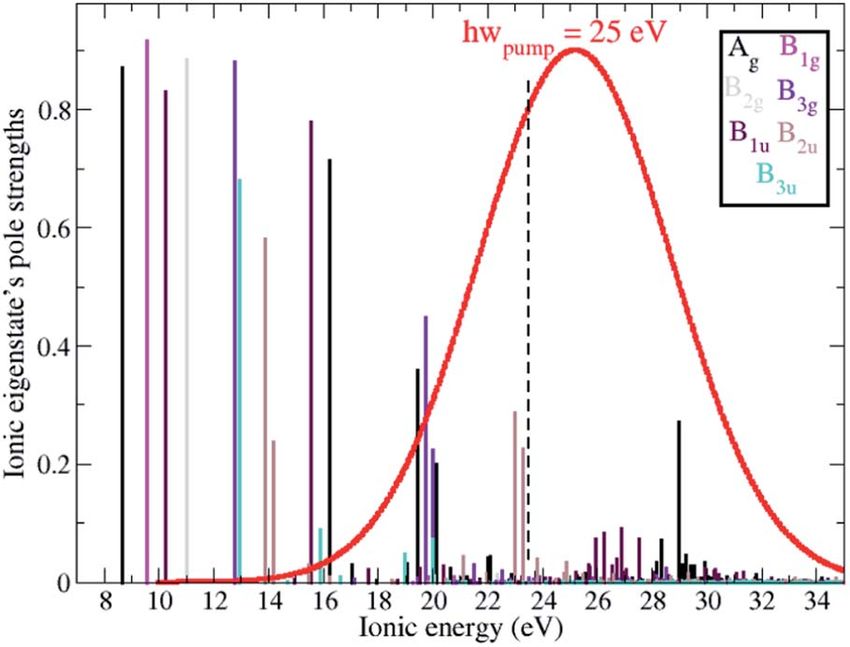
View Article Online
Paper Faraday Discussions
molecule. Pump ionisation is described by directly propagating the initial ground
This article is licensed under a Creative Commons Attribution-NonCommercial 3.0 Unported Licence.
state of the neutral molecule with the full many-body B-spline RCS-ADC(2)x
Hamiltonian. The electronic state of the emerging ionic system is fully charac-
terised by computing the R-IDM. The multicentre B-spline basis17,33 used here is
max ¼ 120 a.u., and a linear grid in the centre-
characterised by a radial box radius rOCE
of-mass expansion,17 with step size h ¼ 0.8 a.u. and maximum value of the orbital
angular momentum lmax ¼ 12. The RCS is built from the virtual orbitals of an HF
calculation performed in the cc-pVDZ GTO basis set. The number of open ionic
channels included in the TD B-spline RCS-ADC(2)x calculation (see eqn (2)) and
Open Access Article. Published on 08 2020. Downloaded on 2021/9/15 9:17:10.
the highest value (among the different symmetry spaces) of the Hamiltonian
matrix dimension are NIonic ¼ 56 and HRCS-ADC(2)x
MaxDim ¼ 169 700, respectively. The
values of the CAP parameters used in this calculation are h ¼ 4 103 and rCAP ¼
70 a.u.
The ab initio simulation of the pump step has been performed using a linearly
polarised low-photon-energy XUV pulse, characterised by a Gaussian temporal
envelope, a central frequency ħuPump ¼ 25 eV, a peak intensity IPump ¼ 6 1011 W
cm2 and a time duration TPump 500 as at full width at half maximum (fwhm).
The latter value corresponds to a few-cycle pulse with a broad, e.g. z7.5 eV fwhm,
spectral-energy bandwidth. Results for the pump-triggered dynamics are pre-
sented for one specic orientation of the laser polarisation direction with respect
to the molecular frame, namely the one parallel to the C–C bonds (and the N–N
axis, z-direction). Convergence of the results has been achieved by using a Dt ¼ 5
time-step and a K ¼ 40 Krylov-space dimension in the Arnoldi/Lanczos time
propagation.
3.1 Simulation of the XUV pump ionisation step
Ionisation of a molecular system by an ultrashort laser pulse such as the one used
in the present work, whose spectral intensity envelope prole is shown in Fig. 1,
can in principle simultaneously populate, either coherently or incoherently,
a high number of ionisation channels in both the outer-valence and inner-valence
energy regions of the ionic electronic spectrum. This can be seen in Fig. 1, which
shows the relative spectral-intensities of all the energetically-accessible ADC(2)x
ionic states of the C4H4N2 molecule, calculated using the cc-pVDZ basis set. The
ADC(2)x valence shell spectrum of photoionized pyrazine shown in Fig. 1 is in very
good agreement with previously reported experimental results obtained by means
of photoelectron spectroscopy and using synchrotron radiation (see ref. 34 and
references therein). In this previous work,34 where the photoionized spectrum of
pyrazine has been studied both experimentally and theoretically, the structure
observed in the experimental photoelectron spectra (recorded at photon energies
ranging from 20 to 90 eV), was interpreted with the aid of vertical ionization
energies, and partial cross-sections, calculated with various theoretical methods
ranging from TDDFT to conguration interaction. In particular, the results of ref.
34 have enabled the identication and characterisation of the principal bands
due to single-hole states as well as the realisation that the inner-valence ioniza-
tion region is strongly affected by many-body effects, such as electron correlation,
and formation of numerous satellite states. This is conrmed and quantied here
in the calculated spectrum in Fig. 1, where each line represents an ionic eigen-
state and is located at the corresponding ionisation energy. The values of the
This journal is © The Royal Society of Chemistry 2021 Faraday Discuss., 2021, 228, 286–311 | 295View Article Online
This article is licensed under a Creative Commons Attribution-NonCommercial 3.0 Unported Licence. Faraday Discussions Paper
Open Access Article. Published on 08 2020. Downloaded on 2021/9/15 9:17:10.
Fig. 1 RCS-ADC(2)x relative spectral intensities, calculated using the cc-pVDZ basis set, of
the ionic states of the C4H4N2 molecule. Different stick colours correspond to ionic states
of different molecular point group symmetry, 2Ag (black), 2B1g (magenta), 2B2g (grey), 2B3g
(purple), 2B1u (dark purple), 2B2u (brown), 2B3u (turquoise). The envelope of the spectral
intensity profile of the pump laser pulse used in this work is also shown in red.
spectral intensities reect the contribution of the 1h congurations to the ionic
states. The complete neglect of electron correlation, such as that characterising
the Koopmans approximation level,35 would give a series of lines with a height of 1
for each occupied molecular orbital. On the contrary, within the second order
ADC(2)x scheme of the ionic ADC(n) hierarchy, the description of the cation
includes all the ionic 2h1p congurations, which allow one to describe the
shakeup process, where the removal of an electron from a particular orbital is
accompanied by the excitation of another electron to an initially unoccupied
orbital. Thus, electron correlation in the description of the ionic system manifests
itself as a decrease in the spectral-intensity line height in individual ionic states
(with the “missing” part reecting the contribution of 2h1p congurations) and
the appearance of additional (satellite) lines in the spectrum. As can be seen in
Fig. 1, the ADC(2)x spectrum of the pyrazine cation can be divided approximately
into three regions. In what follows, the standard D2h symmetry notation is used.
The outer-valence region, which in the case of pyrazine extends up to z13 eV,
contains Koopmans mainly-1h states, namely, as the ionisation potential (IP)
increases, 12Ag, 12B1g, 12B1u, 12B2g, 12B3g and 12B3u, corresponding to the removal
of one electron from the HOMO down to the HOMO5 molecular orbital. As we
go to higher energies, ionic states with strong shakeup character and satellite
structures start to appear, where the 1h content for the 4ag, 5ag, 2b3g, 3b2u and
4b2u molecular orbitals is more equally shared between two or a few more ionic
states. In this region two principal (mainly-1h) lines are also present, corre-
sponding to the 22B1u and 22Ag ionic excited states with IP equal to 15.6 eV and
16.25 eV, respectively. Finally, for larger ionic energies up to the double ionisation
potential (DIP) (z30 eV), the molecular orbital picture of ionisation starts to
break down,36 as it is here that ionisation from the inner-valence 3ag, 3b1u and
2b2u orbitals occurs, which is characterised by the population of many ionic
eigenstates with relatively low 1h weight.
296 | Faraday Discuss., 2021, 228, 286–311 This journal is © The Royal Society of Chemistry 2021View Article Online
This article is licensed under a Creative Commons Attribution-NonCommercial 3.0 Unported Licence. Paper Faraday Discussions
Open Access Article. Published on 08 2020. Downloaded on 2021/9/15 9:17:10.
Fig. 2 Final degrees of coherence Gm,n between the cc-pVDZ RCS-ADC(2)x ionic states
of the C4H4N2 molecule, resulting from the TD B-spline RCS-ADC(2)x simulation of
attosecond pump ionisation of pyrazine by a XUV pulse linearly polarised along the N–N
axis on the molecular plane. The final populations of the ionic states are also shown in the
vertical and horizontal side panels; different stick colours correspond to ionic states of
different molecular point group symmetry, 2Ag (black), 2B1g (magenta), 2B2g (grey), 2B3g
(pink), 2B1u (dark grey), 2B2u (brown), 2B3u (blue).
As a result of this rich electronic structure and the high density of states in the
electronic spectrum of the molecular cation, the broad bandwidth of the laser
pulse can, in principle, create quantum coherence between multiple pairs of ionic
many-electron states. Fig. 2 shows the TD RCS-ADC(2)x calculated nal (at about
40 fs aer ionisation) degree of coherence Gm,n between each pair of ionic
eigenstates populated by the XUV pump pulse. The nal stationary populations
Pn(N) of the RCS-ADC(2)x states of the pyrazine cation are also shown in the
vertical and horizontal side panels of Fig. 2. In the calculations presented here, all
the ionic time-dependent populations Pn(t) have converged to their nal
stationary value at 2 fs aer ionisation. The relative phases Fm,n between the
partially coherently populated eigenstates of energies Em and En are shown in
Fig. 3. The Fm,n relative phases are extracted from the phases of the off-diagonal
matrix elements of the R-IDM and read as Fm,n ¼ arg|rm,n(t)e+i(EmEn)t|. Note that
the hermiticity of the density matrix rn;m ¼ r*m;n implies that Fm,n ¼ Fn,m. The
Pn, Gm,n and Fm,n quantities represent a complete set of information for the
description of the ionic state, which is fully characterised by its density matrix,
prepared by ionisation in the pump step. In Fig. 2, it is possible to identify islands
of strong coherence close to the diagonal (the highest degree of generated
coherence being 0.9), mainly for ionic states with ionisation potential up to 23 eV.
In general, a robust degree of coherence is produced between pairs of states with
This journal is © The Royal Society of Chemistry 2021 Faraday Discuss., 2021, 228, 286–311 | 297View Article Online
This article is licensed under a Creative Commons Attribution-NonCommercial 3.0 Unported Licence. Faraday Discussions Paper
Open Access Article. Published on 08 2020. Downloaded on 2021/9/15 9:17:10.
Fig. 3 Final relative phases Fm,n between the cc-pVDZ RCS-ADC(2)x ionic states of the
C4H4N2 molecule, resulting from the TD B-spline RCS-ADC(2)x simulation of attosecond
pump ionisation of pyrazine by a XUV pulse linearly polarised along the N–N axis on the
molecular plane. The final populations of the ionic states are also shown in the vertical and
horizontal side panels; different stick colours correspond to ionic states of different
molecular point group symmetry, 2Ag (black), 2B1g (magenta), 2B2g (grey), 2B3g (pink), 2B1u
(dark grey), 2B2u (brown), 2B3u (blue).
an energy gap up to approximately the value of the pump–pulse bandwidth, while
for larger energy separations, the coherence rapidly decays to very low (View Article Online
This article is licensed under a Creative Commons Attribution-NonCommercial 3.0 Unported Licence. Paper Faraday Discussions
Open Access Article. Published on 08 2020. Downloaded on 2021/9/15 9:17:10.
Fig. 4 (a) Time-dependent hole-occupation numbers ñp(t) (eqn (11)) of the hole-type
natural charge orbitals most contributing to the ultrafast charge dynamics emerging from
the pump step ionisation of the C4H4N2 molecule, calculated using the full TD B-spline
RCS-ADC(2)x theoretical method (full lines) and the sudden approximation ansatz (dashed
lines). The natural charge orbitals with positive occupation number correspond to the
removal of one electron from one of the occupied orbitals in the HF ground state, with
different coloured lines describing the fraction of the removed bound electron from the
HOMO (1b1g) (green curve), HOMO1 (6ag) (red curve), HOMO2 (1b2g) (dark green
curve), HOMO3 (5b1u) (black curve), HOMO5 (1b3u) (orange curve), HOMO6 (4b2u)
(magenta curve), HOMO8 (3b2u) (blue curve) and HOMO10 (3b3g) (purple curve)
occupied HF orbitals. (b) Fourier-transform of the TD B-spline RCS-ADC(2)x results in (a);
the dominant frequencies are highlighted with circles. (c) Charge density representing the
difference between the pyrazine hole-densities at times t2 and t1 as indicated in (a); the red
and green isosurfaces enclose negative and positive charge densities, respectively.
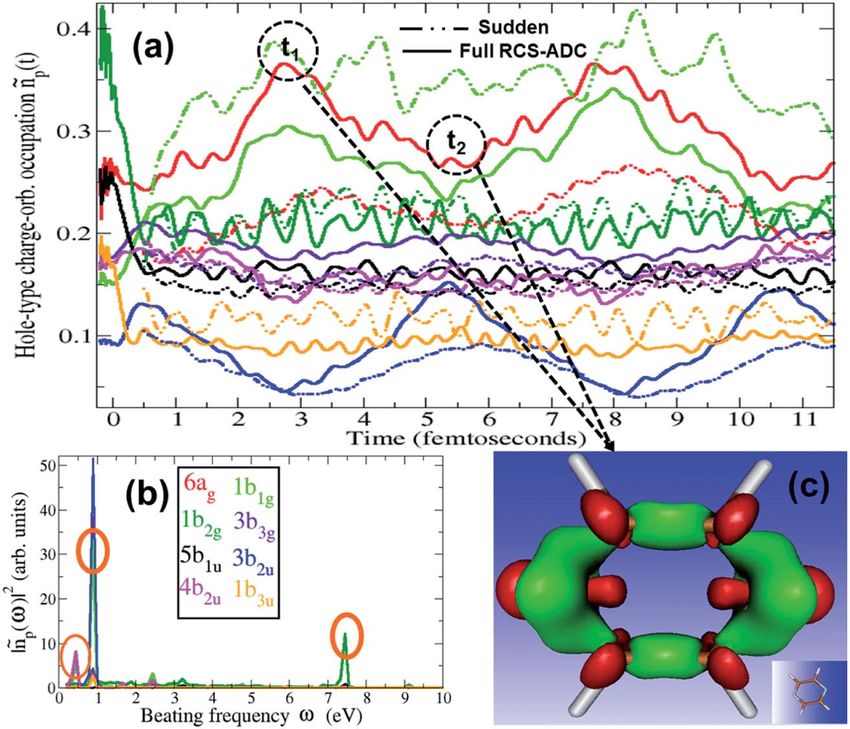
number evolution for the natural charge orbitals, showing a 5.5 fs period
oscillation. The dominant frequencies of the charge dynamics are highlighted in
panel b. As it is possible to see in Fig. 4, the emerging charge dynamics in the
pyrazine cation is characterised by two predominant timescales; a main, relatively
slow one with period 5.5 fs, and a faster one, with period 500 as. The former
dynamics is driven exclusively by electron correlation, i.e. by the coherence
between the main ionic state characterised by 1h 3b2u content at 16.2 eV and its
satellite at 15.45 eV. On the contrary, the faster timescale is a result of the
partially-coherent superposition of the ground (8.7 eV) and rst excited (16.25 eV)
ionic states of Ag symmetry, mainly representing ionisation from the two different
6ag and 5ag molecular orbitals, respectively. Therefore, in spite of the multitude of
This journal is © The Royal Society of Chemistry 2021 Faraday Discuss., 2021, 228, 286–311 | 299View Article Online
Faraday Discussions Paper
channels involved in pump ionisation, the theoretical analysis presented here
This article is licensed under a Creative Commons Attribution-NonCommercial 3.0 Unported Licence.
makes it possible to disentangle the triggered dynamics and attribute it to a few
specic, coherently-populated, ionic channels. In terms of charge redistribution
across the molecular backbone, the periodic 5.5 fs oscillation mode originating
from electronic correlation consists of hole-density uctuations that occur both
off-plane and in-plane along the pyrazine skeleton, between the molecular (C–C
and C–N) bonds and the carbon and nitrogen atomic centres. The 500 as charge
dynamics consists of anti-phase oscillations of the hole-density around the
nitrogen and carbon atoms, as can be seen, in Section 3.2, from the spatially-
Open Access Article. Published on 08 2020. Downloaded on 2021/9/15 9:17:10.
resolved information that can be obtained from the energy-integrated ATAS
spectra. In the present work, molecular ionisation is modelled beyond the sudden
approximation (SA)3 by fully describing the details of the interaction with the laser
pulse as well as the residual interaction between the ionised electron and the
remaining ionic core. Therefore, it is interesting to compare the full TD B-spline
RCS-ADC(2)x results with those obtained using the SA ansatz.3 This is done in
Fig. 4, where the hole-occupation numbers ñp(t) calculated within the SA frame-
work are also shown. The results demonstrate that, in the low-photon-energy
limit, the deviations from the sudden approximation results are strong and
more pronounced with respect to those present at higher photon energies.18 The
pronounced deviations visible in Fig. 4 can be explained by both the different
values of the degrees of coherence, which are assumed maximal in the sudden
approximation ansatz, and, predominantly, the differences in the amplitudes, i.e.
populations and phases, of the created ionic wavepacket. This is due to the fact
that, in the low-photon-energy limit, the ionisation partial cross-sections of the
various open channels (and respective transition dipole matrix elements in the
continuum) usually present a strong non-monotonous energy dependence, which
is more pronounced than at higher photon energies. This feature, as well as the
specic laser pulse parameters and polarisation, is completely neglected within
the sudden approximation and causes the relative ionic-state populations to differ
considerably from the spectral intensity values in Fig. 1. The correct description of
the ionisation amplitudes, which also dene the relative phases imprinted in the
ionic wavepacket (see Fig. 3) and thus the characteristics of the prepared many-
electron system, is necessary for the accurate simulation and interpretation of
ionisation experiments. Therefore, for pulses characterised by photon energies
close to the ionisation thresholds of the system, a quantitative description of the
induced many-electron dynamics requires modelling of the ionisation step
beyond the sudden approximation, including an explicit time-dependent
description of the process and, in addition to the correlated motion of the
bound electrons, the molecular electronic continua.
Moreover, when ionisation happens at photon energies close to the various
ionisation thresholds of the molecular system, it is possible to expect a fraction of
slow photoelectrons to be produced, which will then be interacting in close
proximity with the parent-ion for relatively long times compared to the natural
bound-electron timescales. It is therefore interesting to investigate, in the present
case of XUV pump ionisation, the effect of the residual inter-channel interaction
between the parent-ion and the photoelectron “bath” on the quantum ionic
coherence, the ion–photoelectron entanglement and, ultimately, on the ionic
charge dynamics while the emitted photoelectron is moving away from the
molecular region. In Fig. 5, the full TD RCS-ADC(2)x result for the pump-induced
300 | Faraday Discuss., 2021, 228, 286–311 This journal is © The Royal Society of Chemistry 2021View Article Online
This article is licensed under a Creative Commons Attribution-NonCommercial 3.0 Unported Licence. Paper Faraday Discussions
Open Access Article. Published on 08 2020. Downloaded on 2021/9/15 9:17:10.
Fig. 5 (a) Time-dependent hole-occupation numbers ñp(t) (eqn (11)) of the “occupied”
natural charge orbitals triggered by attosecond ionisation of the C4H4N2 molecule in the
pump step; full lines: full TD RCS-ADC(2)x results; dashed lines: results obtained by
switching off the residual interaction between the parent-ion and the photoelectron at
tfree ¼ 170 as after ionisation. Time evolution of (b) the purity Tr[r2](t) and (c) the von
Neumann entropy of entanglement s(t) of the bipartite ion–photoelectron system after
pump ionisation of the C4H4N2 molecule. (d) Time evolution, upon ionisation by the pump
laser pulse, of the degrees of coherence Gm,n(t) of the pairs of ionic states mostly
contributing to the density-matrix purification (see Fig. 6); the time evolution of the
G1Ag,2Ag(t) (black curve) and G3B2u,4B2u(t) (red curve) coherences, mostly contributing to
the pump-triggered charge dynamics, are highlighted.
charge dynamics in pyrazine is compared to that obtained by neglecting the inter-
channel ion–photoelectron interaction at times t > 170 as aer the ionisation
event. The results show a quantitative deviation between the two results,
demonstrating that, for low-photon-energy pulses, the effect of the interaction
with the slower photoelectron on the ionic coherences is stronger than that
calculated in ref. 18, where higher photon energies (60–80 eV) were considered.
The differences in charge dynamics, when neglecting the residual ion–photo-
electron interaction at t > 170 as, are due to the fact that, as can be seen in panel
(d) of Fig. 5, the driving quantum electronic coherences keep changing in an
appreciable way for longer times. The main coherences responsible for the charge
dynamics, G1Ag,2Ag(t) and G3B2u,4B2u(t), become effectively stationary at t 1 fs
aer ionisation, whereas the values of other coherences either drop or oscillate for
times up to 2 fs. At times t > 2 fs aer the XUV pump ionisation event, the values
of the relevant coherences show an effectively negligible variation, which explains
This journal is © The Royal Society of Chemistry 2021 Faraday Discuss., 2021, 228, 286–311 | 301View Article Online
This article is licensed under a Creative Commons Attribution-NonCommercial 3.0 Unported Licence. Faraday Discussions Paper
Open Access Article. Published on 08 2020. Downloaded on 2021/9/15 9:17:10.
Fig. 6 Schmidt decomposition of the ionic density matrix emerging from XUV pump
ionisation of pyrazine. The weights rn and the expansion coefficients of the 10 pure states
that contribute most to the purification are shown.
why the charge dynamics computed with the full TD B-spline RCS-ADC(2)x
method does not experience any effective damping. The very small residual
variation at t > 2 fs reects the fact that, in agreement with the results presented in
ref. 21, the fraction of photoelectrons with “innitely”-low kinetic energy, that can
remain close to the parent-ion for longer times, is effectively negligible. Moreover,
this result conrms the validity of using eqn (12), which neglects the residual ion–
photoelectron interaction, to describe the interaction of the pump-ionised system
with the probe pulse at time-delays sd > 2 fs. The time evolution of all the indi-
vidual coherences is reected in that of the purity Tr[r2](t) (shown in panel (b)),
which shows a fast decay over the rst fs aer ionisation (with consistent increase
in the ion–photoelectron entanglement as measured by the von Neumann
entropy s(t)) and a further, slower and relatively smaller decay which persists for
the entire time-range of the simulation.
As already mentioned, the results presented in Fig. 4 and 5 have revealed that,
despite the high number of open ionisation channels (see Fig. 1) and triggered
ionic coherences (see Fig. 2 and 3), the charge dynamics in the pyrazine cation can
be effectively traced back to a few quantum electronic coherences, in particular
G1Ag,2Ag(t) and G3B2u,4B2u(t), by which it is mainly driven. The question is then: can
the description of the full state of the ionic system, i.e. the density matrix, also be
simplied and reduced to a few key, physically-relevant, ionic eigenstates? The
key theoretical tool that allows us to answer this question is the Schmidt
decomposition, i.e. the purication of the ionic density matrix (see eqn (9)).
Diagonalization of the ionic density matrix emerging from XUV pump ionisation
302 | Faraday Discuss., 2021, 228, 286–311 This journal is © The Royal Society of Chemistry 2021View Article Online
Paper Faraday Discussions
of pyrazine yields a few pure-state channels with weight greater than 0.1, i.e.
This article is licensed under a Creative Commons Attribution-NonCommercial 3.0 Unported Licence.
whose contributions, more than 10%, dominate the Schmidt decomposition,
while the majority of the resulting pure-state channels have negligible contribu-
tions (weight rn # 0.01). Therefore, the answer to the above question is affirma-
tive. This is shown in Fig. 6, which shows the weights rn and expansion
coefficients |cni|2, in the basis of ionic eigenstates i, of the 10 pure states that
contribute most to the purication. Each pure-state channel is a coherent
superposition of the ionic eigenstates with a non-zero coefficient |cni|2. In
particular, the two coherences G1Ag,2Ag(t) and G3B2u,4B2u(t) arise in the two prin-
Open Access Article. Published on 08 2020. Downloaded on 2021/9/15 9:17:10.
cipal channels with weights r1 and r2, respectively. The r4 channel consists of
a coherent superposition of the 1B1u and 2B1u ionic eigenstates, while the r3 and
r5 channels in Fig. 6 mainly coincide with the 1B3g and 1B2g ionic eigenstates,
respectively. Finally, the coherently-populated ionic eigenstates contributing to
the pure-state channels of weight r1, r2 and r3 are the same as those characterising
the lower-weighted r6, r7 and r8 pure-state channels shown in Fig. 6. The theo-
retical simulation presented here therefore shows that the state of the ionic
system prepared by XUV pump ionisation of pyrazine can be approximated by
a reduced, limited number of physically-relevant pure-state channels, to which
the triggered many-electron dynamics can be ascribed, and further allows one to
identify and characterise them.
Fig. 7 Time-delay dependent orientation-averaged absorption integrated over selected
spectral regions, i.e. the C K-edge (black curve) and N K-edge (magenta curve) energy
windows centred at 272 eV and 393 eV, respectively. The energy-integrated absorption for
X-ray probe fields linearly polarised perpendicular (X polarisation) and parallel to the
molecular plane, namely along (Z polarisation) and perpendicular to (Y polarisation) the N–
N axis, is also shown.
This journal is © The Royal Society of Chemistry 2021 Faraday Discuss., 2021, 228, 286–311 | 303View Article Online
Faraday Discussions Paper
3.2 Simulation of the X-ray probe step: ATAS of pump-ionised pyrazine
This article is licensed under a Creative Commons Attribution-NonCommercial 3.0 Unported Licence.
Here I present the results of the TD-ADC simulation of the X-ray ATAS attosecond
measurements on the fully characterised ionised state prepared by the XUV pump
pulse. The ATAS technique16,30,37–43 is based on the use of a spectrally broadband
attosecond probe pulse, with central photon energies suitable for the excitation of
an electron from a core shell to the valence shell, which is spectrally dispersed
and analysed aer being transmitted through the sample under investigation.
The spectral decomposition of the measured signal gives information about the
different energy level populations within the probed ionic system. Moreover,
Open Access Article. Published on 08 2020. Downloaded on 2021/9/15 9:17:10.
information on the coherent dynamics of the system can be retrieved by varying
the time-delay between the ultrashort pump and probe pulses. This allows one to
monitor the valence electron dynamics with both high temporal and high spectral
resolution. Atomic spatial resolution is also made possible by the strong atomic
localisation of the core orbitals involved in the dynamics as well as the element-
specicity of the core-ionised state’s energies.37,44,45 The simulations presented
here allow one to shed light on the effects of the strong resonant X-ray probe pulse
on the system’s dynamics, model the anticipated experimental pump–probe
signals and directly calculate the attosecond measurement’s observable. The
purpose of this is to provide answers to the two following questions: (i) can
attosecond transient absorption spectroscopy be used successfully in an experi-
ment to evidence and trace the various quantum electronic coherences that can
be triggered in attosecond ionisation of a polyatomic molecule? (ii) Is the X-ray
probe pulse, under the likely conditions of a real experiment where the pulse
intensities are high enough to give measurable signals, “so” enough not to
signicantly perturb the relevant many-electron dynamics it has excited in the
outer- and inner-valence energy regions, and, at the same time, sensitive enough
to capture it?
To answer these questions, the density matrix of XUV-ionised pyrazine inter-
acting with the X-ray probe pulse is time-propagated here by solving the TD von
Neumann equation in eqn (12). This is done for the three independent linear-
polarisation directions of the probe eld relative to the molecular frame,
namely perpendicular to the molecular plane (x-direction), and along (z-direction)
and perpendicular to (y-direction) the C–C bond of the xed-in-space C4H4N2
molecule. In what follows I focus on orientation-averaged cross-sections for
unaligned molecules. The size of the ionic ADC matrices is 4000, making the TD
Hamiltonian matrix amenable to full diagonalization. Therefore, in this work, the
equations of motion (eqn (12)) discussed in the previous section are solved by
fully diagonalizing the time-dependent ionic Hamiltonian at each time-step. The
calculation is performed for 160 values of the pump–probe delay, ranging from 1
to approximately 22 fs. The time-delay sampling used is 140 as, which is in
principle small enough to allow for every coherent oscillation triggered by the
pump pulse bandwidth to be resolved. The simulations are carried out for two
different Gaussian probe pulses with photon energy centred at 272 eV and 393 eV,
i.e. at the average transition-energy between the valence-ionised states of pyrazine
and the C(1s) and N(1s) core-ionised states, respectively. Since the C(1s) to valence
transitions and the N(1s) to valence transitions are energetically well separated,
ATAS allows one to study valence coherent many-electron dynamics in pyrazine
with atomic spatial resolution. Moreover, extremely high time-resolution is
304 | Faraday Discuss., 2021, 228, 286–311 This journal is © The Royal Society of Chemistry 2021You can also read


