Quoting Credit Spread Prices for Ringgit Corporate Bonds (PDS) In Addition to Absolute Yields
←
→
Page content transcription
If your browser does not render page correctly, please read the page content below
Quoting Credit Spread Prices for Ringgit
Corporate Bonds (PDS) In Addition to Absolute
Yields

Briefing Organised by Bank Negara Malaysia and
The Financial Markets Association of Malaysia (PPKM)

Lee K. Kwan
President, Financial Markets Association of Malaysia
Board Member of CIMB Group / PPKM & CIMB Bank
5 November 2015
Outline
•   Decomposing Interest Rate Term Structure versus Credit Spread Term
    Structure Generating Risk/Return Earnings as Separate Individual
    Components
•   PPKM to introduce Credit Spread Price Quotation for Ringgit Corporate
    Bonds in Addition to Absolute Yields
•   Credit Spread Methodology & Learning from the Evolution and Growing
    Pains of the USD and other fixed income markets
•   USD Treasury + Spread Market Practices for both investors and
    corporate issuers to Watch Out for
•   Credit Spread Trading Examples: Portfolio Management, Expanded
    Hedging Risk Reduction Solutions & Expansion of Targeted Risk
    Return Profiles in Both Rates and Credit
•   Conclusion

                                                                            2
Ringgit Bond Markets have Developed Strongly

                              Government                    Corp
                                                                                     • Malaysian government &
ASEAN                                                                       Total      corporate bond markets have
                              Bond Market                Bond Market
                                                                                       developed strongly. Quite
(in
alphabetical                Size                                                       large relative to GDP today
                                                %         Size        %        %
order)                    (in USD
                                             to GDP   (in USD bil) to GDP   to GDP
                             bil)
                                                                                     • However Ringgit Corporate
                                                                                       Bonds are mostly quoted on
Indonesia                   105.5             12%        18.0       2%       14%       absolute yield basis only
Malaysia                    185.0             57%       130.5      40%       97%
                                                                                     • Unable to decompose, price
Philippines                  87.1             31%        17.2       6%       37%       and trade out interest rate
Singapore                   146.5             48%        94.6      31%       79%       term structure versus credit
                                                                                       spread term structure risk
Thailand                    211.2             56%        70.2      19%       75%       return components
                                                                                       individually
Total
                            735.2             41%       330.4      19%       60%
@ Dec-2014
                                                                                     • BUY BOTH risks together or
 Source: ADB / Asianbondsonline, Bloomberg                                             SELL BOTH risks together

                                                                                                                      3
Secondary Ringgit Bond Markets Liquidity
• Ringgit Corporate Bond Markets
serves investors and corporate
issuers well with good levels of
liquidity (price visibility with decent
bid offer spreads good for
respectable amounts)
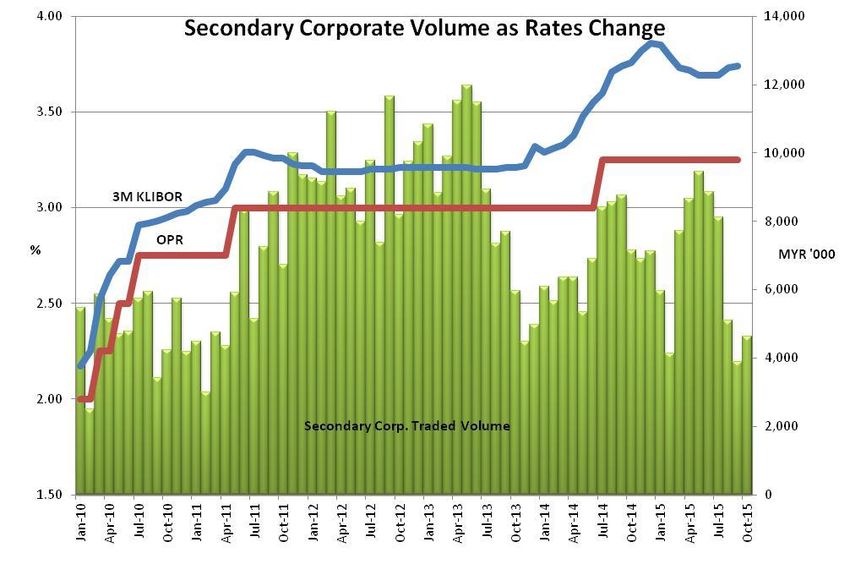
• Except when RM interest rates are
rising or there is fear of rates rising.
Characterized by selling of existing
bond holdings, unwillingness to buy
new bonds and if rates do
rise, mark-to-market losses fuelling
>50% decline in trading redemptions and liquidating in a
volume when rates went up difficult selling environment
• In general, bid offer spreads widen
significantly and liquidity declines
markedly
• And its been a generally declining
interest rate environment since 1998
Source: Bloomberg
where markets have not experienced
rising rates for long time
4De-Composing Interest Rate and Credit Spread Term Structure
Risk Return: Earning 5 year Credit Spread Does not Mean
Taking on 5 Year Interest Rate / Profit Rate Risk
5Yr Corporate Bond / Sukuk Yield
5 Yr Fixed Rates 5 Yr Credit Spread
Interest Yr 1 3m KLIBOR Floating Rate
Rate 5 Yr Credit Spread
Duration + Yr 2 - Yr 5 Fixed Rate
Risk CDS -
Yr 1 - Yr 2 3m KLIBOR Floating Funded Unfunded
Rate + Yr 3 – Yr 5 Fixed 5 Yr Credit Spread Credit Vs Credit
Spread Spread
Yr 1 – Yr 3 3m KLIBOR
5 Yr Credit Spread
Floating + Yr 4 - Yr 5 Fixed
Yr 1 – Yr 4 3m KLIBOR
5 Yr Credit Spread
Floating Rate + Yr 5 Fixed
5 Yr 3m KLIBOR
Floating Rate
5 Yr 3m KLIBOR Float 5 Yr Credit Spread Corporate Loan +
Margin / Spread
5PPKM is Proposing for Banks to Quote Credit Spread Prices
In addition to Absolute Yields for Ringgit Corporate Bonds
(PDS) Slightly wider bid-ask spread
to cover IRS trade
+
6Credit Spread Price Quotation will be (a) Benchmarked off the Interest
Rate Swap Curve (b) on a Duration Matched basis and (c) Employing
the Z Spread Methodology
+ 5 Yr Duration - 5 Yr Duration
Equivalent MGS Negative Dollar
5 Yr Fixed Rate = 5 Yr Cr Spread + 5 Yr Fixed MGS Duration (PV01) Amount
Corporate MGS
Bond Yield Equivalent IRS Negative Dollar
= 5 Yr Cr Spread + 5 Yr IRS
IRS Duration (PV01) Amount
• Why IRS and not MGS?
To trade out and generate the actual credit spread so that price is real and transactable, will require
market-makers and investors to go long the corporate bond and concurrently go short on the
reference benchmark security generating the same negative amount of dollar duration (same PVBP)
To short MGS of equivalent duration is not currently achievable
To sell MGS futures of equivalent dollar duration PV01 is not currently achievable
Credit Spreads quoted off MGS is just a number that cannot be crystalized into a real price
• MYR IRS: market is developed and able to generate negative dollar duration in amount for each
tenor up to 10 years (Pay Fixed IRS with Floating rate KLIBOR daily rate settings strictly monitored
by BNM and PPKM)
7Credit Spread Price Quotation will be (a) benchmarked off the Interest
Rate Swap Curve (b) on a Duration Matched basis and (c) employing
the Z spread methodology
• Why Z spread ?
It is a more accurate representation of the credit spread as opposed to asset
swap or ASW where the latter can involve upfront payments due to bonds
trading above or below par
Z-Spread does not use the YTM of the bond to calculate the credit spread.
It is derived by iteratively shifting the (bootstrapped) zero swap curve in
parallel and using it to Present Value the corporate bond cash flows until the
bond price as calculated off the shifted par swap curve equals the corporate
bond market price
The Z-Spread is the selected corporate bond’s constant spread over the
benchmark zero coupon swap curve, or the number of basis points to add to
the spot curve in order to make the bond NPV equal to its market price
• 0
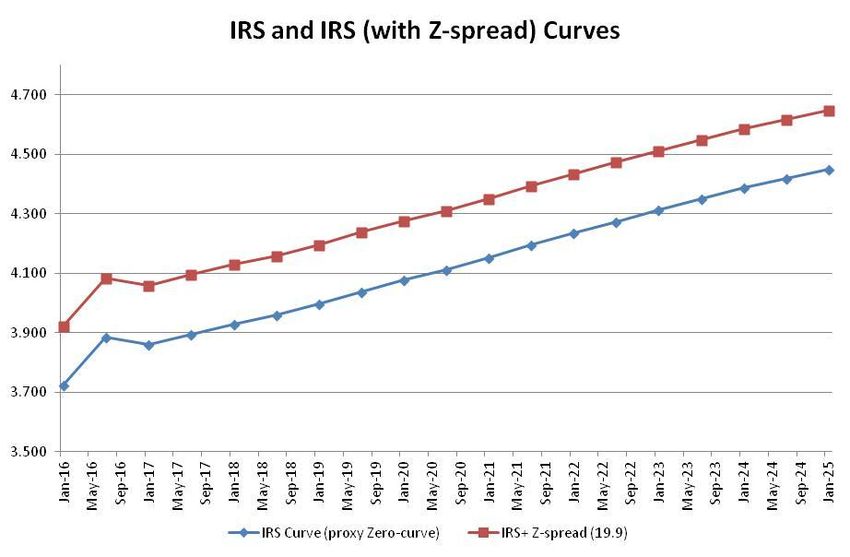
8Z Credit Spread Analytics Widely Available on Bloomberg and
Easy to Use
1. Select a
bond, say
PLUS 4.64 2025
2. Market Price
shows 99.85
Net present value = Market
Value = 99.85
3. Z spread Z spread = 19.9
shows 19.9
Zero swap curve
Formula to determine z-spread:
Price = C1 / (1 + r1 + z )t1 + C1 / (1 + r2 + z )t2 + C1 / (1 + r3 + z )t3 ……. T / (1 + rn + z )tn
Where
P = current clean price of the bond including accrued interest
C = coupon payments
T = total principal and coupon at maturity
r = zero spot rates from interest rate swap curve
z = z spread
9Can Toggle and Sensitize IRS Input levels and/or Corporate Bond
Prices in Bloomberg to Your Heart’s content (NOT plugging for
Bloomberg & have no shares in Bloomberg)
If target
higher price
say at 100.59
for PLUS
4.64% 2025
Z spread
compresses to 9.9
10USD Treasury + Credit Spread: Some Trading Practices
to Look Out For
(a) Rolling Down the Curve
T Spread (bps) UST Benchmark Z Spread (bps) Yield (%)
31 Dec 2 Jan 31 Dec 2 Jan 31 Dec 2 Jan 31 Dec 2 Jan
2014 2015 Change 2014 2015 2014 2015 Change 2014 2015 Change
Toyota CT5 CT2
5 100 + 95 (T 1 ⅝ (T 0 ⅝ 19 16 -3 1.70% 1.66% -0.04%
2.053 2018
12/31/19) 12/31/16)
MALAYS CT10 CT5
68 138 + 70 (T 2 ¼ (T 1 ⅝ 88 93 +5 2.83% 2.84% + 0.01%
4.646 2021
11/15/24) 12/31/19)
T Spread widened due to credit bonds But Z Spread and Bond Yield hardly moved
aging by 1 year and referencing
different US Treasury benchmark
Over course of a week, Dollar Credit spread of Toyota and Malaysian
Sovereign widened dramatically between the end of 2014 and the
start of 2015.
Corporate credit remains solid. Time to go long big?
Source: Bloomberg
11USD Treasury + Credit Spread: Some Trading Practices
to Look Out For
(b) Employing different UST benchmark for different tenor
Security T spread Benchmark Z spread
EXIM Bank (EIBMAL) CT2
130 115
2.875 2017 (T 0 ⅝ 09/30/17)
EIBMAL CT5
116 150
2.874 2019 (T 1 ⅜ 10/31/20)
For the same credit, the UST Spread of the 2Y paper is so much wider vs 4
Years
Markets seem to have mispriced the tenors for the same credit. Go Long
the 2 Year paper and Short the 4 Year paper?
If no mandate to do relative credit trading, buy 2 year paper versus 4 year
paper?
Or if one has the 4Y paper, sell it and buy the 2Y paper?
Source: Bloomberg
12USD Treasury + Credit Spread: Some Trading Practices
to Look Out For
(c) Same benchmark for same issuer with different maturities
Security T spread Benchmark Z spread
PETRONAS (PETMK) CT10
138 186
7.875 2022 (T 2 08/15/25)
PETMK CT10
185 195
7.625 2026 (T 2 08/15/25)
For the same credit,
Why is the 7Y paper so much more expensive than the 11Y paper ?
Dump the 7Y paper and buy the 11Y paper?
Historical USD Treasury credit spread prices relatively
meaningless even within same tenor let alone across tenors - not
apple to apple [Note 1]
Source: Bloomberg
13Credit Spread Quotation will be (a) Benchmarked off the Interest Rate
Swap Curve (b) on a Duration Matched basis and (c) Employing the Z
Spread Methodology
Proposed Z spread methodology does not suffer such weaknesses
Employ methodology that is accurate with strong theoretical basis backed up by
mathematics
Must not be misleading to investors and issuers
Standardize the credit spread quoting convention so that spread quotes from one
bank to the next means the same thing down to same mathematical translation
to actual prices for all market participants
Similar to standardizing yield quotation and pricing formula for bonds and
derivatives (bonds: USD 30/360, MYR Actual/365, IRS: USD 30/360, MYR
Actual/365) so that there is no ambiguity to actual price for any single yield quote
- standardized and mathematically defined
Learn from the weaknesses and mistakes of others – growing pains and
evolution of the USD fixed income markets - Not to reinvent wheel – Go straight
to best practices and best technology unsaddled by history and historical market
conventions
14With Convention Standardized, Credit Spread Price quotation from all banks
will be on same basis and are easily comparable with no ambiguity
Compel your bank to
honor credit spread
quote like they do
absolute yields
+ +
• Reference quote :
spread not
executable today
• Which MGS / GII
benchmark to
reference for each
corporate bond
tenor
• Within benchmark
tenor, on the run
off the run issues
as benchmark
MGS/GII age & drop
off
15USD Bond Markets have Gone Through a Long Evolution Process from
Pure Credit Spread, G Spread and now Z Spread
=> For Malaysia, Adopting Z-Spread will Avoid these Growing Pains
Supported by Deep Bond Futures or Deep Repo Markets
16Credit Spread Markets will Open Up a
Whole New Dimension
Making Possible New Portfolio Risk
Return Trading Strategies
Able to Capitalize on Specific Market
Conditions and Views on Rates and Credits
Plus Much Greater Hedging Alternatives To
Reduce Risks
17Example #1: Earning credit spread by hedging interest rates during
period of uncertain or rising interest rate (in early 2014)
1. Positive Credit View on the AAA rated bond issuer
2. Uncertain Rate View with Bias of Rising Rates
3. On 24 Feb 2014, Credit Spread looks attractive vs historical Z spread level at 24bps over IRS
Spread (%) Yield (%)
Entry
0.35 Trade Exit 1 (yields rise) 4.25
4.15% / 4.20% / CS 23 bps
0.30 CS 24 bps 4.2
Trade Data
0.25 4.15 3M Z
Trade Exit 2 Date Price Yield 5 yr IRS
KLIBOR Spread
0.20 (yields fall)
4.1
4.05% / 2 bps Entry
24/2/2014 99.7 4.15% 3.91% 3.30% 24 bps
0.15 4.05
EXIT 1
0.10 Spread PLUS 2019 4 26/6/2014 99.5 4.20% 3.97% 3.54% 23 bps
0.05 3.95 EXIT 2
25/8/2014 100.1 4.05% 4.03% 3.67% 2 bps
0.00 3.9
Feb-14 May-14 Aug-14
18Example #1: Trade Economics of RM100 million Notional of AAA
PLUS 4.08 2019
TOTAL RETURN
Entry Exit Bond Only Bond + IRS
Trading
(183,000) Trading Gain/Loss 111,035
Gain/Loss
Rising
24/2/2015 26/6/2015
Corporate Bond Carry 1,363,726 Carry 1,200,614
Yield
TOTAL RETURN 1,180,726 TOTAL RETURN 1,311,649
Trading
413,000 Trading Gain/Loss
Gain/Loss 955,665
Falling
Corporate Bond 24/2/2015 25/8/2015 Carry 2,034,411 Carry
Yield 1,832,632
TOTAL RETURN 2,447,411 TOTAL RETURN 2,788,297
• In both scenarios, whether the absolute yield of AAA Plus goes up or down, you don’t
particularly care as MTM losses on the AAA Plus bond is offset by the IRS hedge
• In the interim, you have locked in the credit spread which you will now earn every day
whether bond yields go up or down
• In this trade, what you worry about is the spread and whether the entry point of the
spread trade is attractive enough at 24bps
• MTM risk applies to both strategies of bonds only (rates rising) and bonds + IRS (swap
spreads widen) while interest income is earned over time
19Example 2: Taking advantage of flat swap curve vs normal upward
sloping bond curve (in mid 2013) [Note 2]
1. Investors hold Positive Credit View on the AAA bond issuer
2. Credit Spreads widened significantly: Upward sloping corporate bond curve (cash
credit market) while IRS flattened significantly providing opportunity to hedge rates
cheaply as differential between 5 yr swap rate and 3M KLIBOR was small vs historical ranges.
3. On 27 May 2013, investors could go long credit spread at 25 bps while hedging rates with IRS.
Spread (%) Trade Entry Yield (%) 0.80
0.40 3.60% 4.1
0.70
Trade Exit
25 bps
0.35 3.9 0.60
0.30
3.7 0.50
0.25
3.5 0.40
0.20
0.30
0.15 3.3
0.20
0.10 3.1
0.10 Flat IRS curve
0.05 Spread PLUS 2018
2.9 Trade Entry
0.00
0.00
Jan-13 Apr-13 Jul-13 Oct-13
-0.05Jan-13 Apr-13 Jul-13 Oct-13 2.7
Trade Exit 5yr Swap - 3M KLIBOR
-0.10 2.5
3.91%
-4 bps
20Example 2: Trade Economics of 100 MM Notional of PLUS 3.99 2019
Trade Data
3M
Date Price Yield 5 yr IRS KLIBOR Z Spread
27/5/2013 101.6 3.60% 3.35% 3.21% 25 bps
27/12/2013 100.3 3.91% 3.96% 3.30% -4 bps
TOTAL RETURN
Entry Exit Bond Only Bond + IRS
Flat Swaps Trading
Trading Gain/Loss (1,350,000) 1,346,761
Curve + Gain/Loss
Steep Bond 27/5/2013 27/12/2013
Carry 2,339,342 Carry 2,283,644
Yield
Curve TOTAL RETURN 989,342 TOTAL RETURN 3,630,405
• Significant outperformance
• When reference curve (required to generate negative duration) is flat or inverted, relatively
easy trade to enter into especially when cash markets have not developed credit spread
trading technology and hence is upward sloping
• Bullets to hold on to bonds regardless whether rates going up or down, earning wide credit
spreads every day on a strong credit in worst case scenario
21Example 2A: Going beyond Flat, Inverted swap curve – an even
easier trade (mid 2013)
1. Investors hold Positive Credit View on the AAA bond issuer.
2. Inverted swap curve provides compelling trade to pay fix on IRS which is a positive carry trade. On
17 May 2013, when the 3 yr swap curve was inverted to KLIBOR, investors could go long credit
spread at 25 bps while hedging rates with IRS with positive carry.
3. Seven months later (27 December), swap curve normalized and credit spread tightened
Spread (%) Yield (%)
0.50 4.100 0.50 Trade Exit
Trade Entry
0.40 3.50% / 28 bps 3.900
0.40
3.700
0.30
0.30
3.500
0.20
3.300 0.20
0.10
3.100
0.10
0.00
Jan-13 Apr-13 Jul-13 Oct-13
2.900
Trade Entry
-0.10 Trade Exit 2.700 0.00
3.78% / -9 bps Jan-13 Apr-13 Jul-13 Oct-13
-0.20 2.500 5yr Swap - 3M KLIBOR
-0.10
Spread PLUS 2017
22Example 3: Trade Economics of 100 MM Notional of PLUS 3.90 2017
Trade Data
Date Price Yield 3 yr IRS 3M KLIBOR Z Spread
17/5/2013 101.4 3.50% 3.18% 3.21% 0.28%
Inverted swap curve
27/12/2013 100.3 3.78% 3.74% 3.30% -0.09%
TOTAL RETURN
Entry Exit Bond Only Bond + IRS
Flat Swaps Trading
Trading Gain/Loss (1,016,000) 545,752
Curve + Gain/Loss
Steep Bond 17/5/2013 27/12/2013
Carry 2,589,808 Carry 2,635,836
Yield
TOTAL RETURN 1,573,808 TOTAL RETURN 3,181,587
Curve
• Interest income with hedging is actually higher than without hedging. Being paid to hedge
as opposed to paying to hedge – “cheap” rates hedge
• Regardless of where the fixed rates are, the floating short end of 1 & 3 Month
Klibor will only decline if OPR declines which in this instance the yields in the
cash bond markets are also likely decline – for short rates, OPR gravitational pull
23Example 3: Benefits to Issuers IRS Rate Lock vs Bought Deal (Credit &
Rate Lock)
• USD primary bond market: common for issuers to lock in Treasury levels through Treasury
Rate lock (T Lock) prior to book closure / price fixing and avoid the uncertainty of where
Treasury is heading (leaves the credit spread component open)
Primary Markets New Issuance
5Y USD Bond (T Lock) = USD Treasury Level + Credit Spread at Book
Closure
Fixed Earlier
T Lock Based on Prevailing Treasury
at Book Closure
5Y MYR Bond (IRS Lock) = IRS Level + Credit Spread at Book
Closure
Fixed Earlier
IRS Lock Based on Prevailing IRS at
Book Closure
5Y MYR Bond (Bought deal) = Interest Rate + Credit Spread Lock
= Absolute Yield/Price certainty
• With MGS Lock, like T Lock, there is minimal cost as it is just bid offer spreads on
MYR IRS / USD Treasury
• Sometimes locking in credit spreads as well can be more expensive. But it comes
with outright absolute yield certainty to the issuer – another option to consider
24Industry Support
• FMA PPKM needs support from market players to make this a success:
Bursa Malaysia - ETP Reporting to include Credit Spreads
Bond Pricing Agency Malaysia – To reflect a valuation based on credit spread
of bonds
Broking Market – to reflect bid/offer credit spreads on its bond screen and
daily quotes
Interbank Market – to add the bid/offer credit spread on its secondary trading
axes
• We could work with LIAM, MAAM, MACT on introducing credit spread quotation in
addition to absolute yields
• PPKM will update syllabus on the PKMC Bond Module to improve members’
understanding on credit hedge and deriving credit spreads
25Other issues - Documentation
In order to initiate and execute a credit hedge spread,
1) Funds’ mandate needs to be expanded to include interest rate hedging:
Necessary to protect funds in rising interest rate environement – sitting duck
otherwise with selling bonds as the only risk reduction alternative
Benign rates environment for very long time since 1998
Needs to put in place collateral structure using bonds or cash
2) ISDA Documentation needs to be executed:
Asset Manager – Tri-Party ISDA involving the Trustee needs to be executed on
each of the funds
Insurers & Pensions – General ISDA needs to be in place
26Conclusion
Banks to start publishing credit spreads in addition to absolute yields (not
take them away) in their daily axis
To employ standardised methodology and convention where credit spread
quotation from banks are on same basis, are easily comparable with no
ambiguity
FMA encourages member banks to quote credit spreads with same integrity
as absolute yields – executable into real prices and not just a number
Facilitates the decomposition and pricing of interest rate versus credit
spread term structure risk and return
Ringgit Bond and Sukuk Market becomes less vulnerable when
interest rates / profit term structure rates are rising or fear of rising
Allows much greater hedging / risk reduction strategies (beyond selling
bonds to reduce rate duration/PV01)
Will expand universe of targeted rates and credit term structure risk return
profiles
27Conclusion
Expand for issuers option to lock in just rates versus bought deal which is a
lock on both rates and credit
Facilitates credit spread pricing comparison for issuers/bank borrowers
between bond markets and bank term loans
Once the repo / reverse repo and/or MGS bond futures are developed, FMA
will certainly want member banks to quote MGS + credit spread (duration
matching) where quotes should be of same integrity as absolute yields –
executable into real prices and not just a number
28Important Notice
This presentation has been prepared by CIMB Group / PPKM exclusively for the benefit and internal use of the
recipient in order to indicate, on a preliminary basis, the feasibility of possible transactions. Terms contained in this
presentation are intended for discussion purposes only and are subject to a definitive agreement. All information
contained in this presentation belongs to CIMB Group / PPKM and may not be copied, distributed or otherwise
disseminated in whole or in part without the written consent of CIMB Group / PPKM.
This presentation has been prepared on the basis of information that is believed to be correct at the time the
presentation was prepared, but that may not have been independently verified. CIMB Group / PPKM makes no
express or implied warranty as to the accuracy or completeness of any such information.
CIMB Group / PPKM is not acting as an advisor or agent to any person to whom this presentation is directed. Such
persons must make their own independent assessment of the contents of this presentation, should not treat such
content as advice relating to legal, accounting, taxation or investment matters and should consult their own advisers.
CIMB Group / PPKM or its affiliates may act as a principal or agent in any transaction contemplated by this
presentation, or any other transaction connected with any such transaction, and may as a result earn
brokerage, commission or other income. Nothing in this presentation is intended to be, or should be construed as an
offer to buy or sell, or invitation to subscribe for, any securities.
Neither CIMB Group / PPKM nor any of its their directors, employees or representatives are to have any liability
(including liability to any person by reason of negligence or negligent misstatement) from any
statement, opinion, information or matter (express or implied) arising out of, contained in or derived from or any
omission from the presentation, except liability under statute that cannot be excluded.
29Thank You
30You can also read


