RCE Contributions to a More Sustainable World: Celebrating Five Years of Innovative Projects on Education for Sustainable Development ...
←
→
Page content transcription
If your browser does not render page correctly, please read the page content below
RCE Contributions to a
More Sustainable World:
Celebrating Five Years of
Innovative Projects on
Education for Sustainable
Development (2015–2019)

Editors:
Philip Vaughter
Nancy Pham

Table of Contents
Foreword 2
Featured RCE Award-Winning
Projects 4
Editorial 6
Chapter People 10 Chapter Planet 28 Chapter Prosperity 46
Cultivating Pathways Asia-Pacific SDG Youth Community Mobile Solar
to Sutainability Challenge 2018 Powered Tech Classrooms
RCE Greater Burlington RCE Greater Western Sydney RCE Kano (Africa) 48
(Americas) 12 and RCE Yogyakarta
This document should be cited as: (Asia-Pacific) 30
RCE Contributions to a More Sustainable World:
Celebrating Five Years of Innovative Projects on
Education for Sustainable Development (2015–2019) Thread Counts
UNU-IAS, Tokyo, Japan, 2020 School Empowerment and RCE Severn (Europe) 52
Nutritional Supplementation
Editing: Coastal Institute for
Dr. Philip Vaughter, Research Fellow, UNU-IAS through Agriculture
Sustainability
RCE Minna (Africa) 16
Technical editing and coordination:
Leadership (CISL)
Nancy Pham, Communications Coordinator, UNU-IAS RCE Georgetown (Americas) 34 Improving a Public
Transport System in Inje
Design and layout: RCE Inje (Asia-Pacific) 56
martinbrombacher.de Addressing SDG 4.7: Values
© United Nations University Institute for the and Learning for Sustainability
Green Go! Promoting the Role
Advanced Study of Sustainability 2020 in Initial Teacher Education
of Green Infrastructure in
Published by: RCE Scotland (Europe) 20
United Nations University, Institute for the Sustainable Development Sustainable
Advanced Study of Sustainability (UNU-IAS) of Non-Urban Areas Entrepreneurship in Schools
5-53-70, Jingumae, Shibuya RCE Warsaw Metropolitan RCE Curitiba-Paraná
Tokyo 150-8925, Japan (Europe) 38 (Americas) 60
Promoting ESD through Food,
Email: rceservicecentre@unu.edu
Web: www.rcenetwork.org/portal Agriculture, and Environment
in Rural Communities in
The designations employed and the presentation of material throughout the Cambodia
publication do not imply the expression of any opinion whatsoever on the part of Lake Victoria Catchment Next Steps 65
RCE Greater Phnom Penh
UNU-IAS concerning the legal status of any country, territory, city or area or of its Environmental Education List of Abbreviations 68
(Asia-Pacific) 24
authorities, or concerning its frontiers or boundaries. Project GAP Priority Action Areas 68
RCE Greater Masaka References and Contacts 69
The contributing authors are responsible for the choice and presentation of the
facts contained in this document and for the opinions expressed therein, which
(Africa) 42
Noah Silliman | unsplash
are not necessarily those of UNU or UNU-IAS and do not commit either the
University or the Institute.
Print ISBN: 978-92-808-4647-8
e-ISBN: 978-92-808-4597-6
2 1
Foreword

Foreword

The Regional Centres of Expertise (RCE) on               initiate concrete improvements in its concerned
Education for Sustainable Development (ESD)              area of activities. The projects and practices
Network was launched in 2005, the same year              demonstrated in these case studies mostly have a
the UNESCO Decade of Education for Sustainable           long-term impact (such as raising literacy, mapping
Development (DESD) officially began, with the            green infrastructure and developing an interactive
aim to demonstrate that ESD principles can work          geoportal, improving public transport), or may
in practice. The Decade is finished and also its         serve as inspiring events for others. All of the
follow-up – the UNESCO Global Action                     showcased initiatives are anchored in education,
Programme (GAP) on ESD – which has now                   employing knowledge to generate transition – this
been replaced by the Education 2030 Agenda.              often requires an innovative approach and leads
The RCE founding principles remain and the               to a shift in educational discourse. New methods
network continues to grow, while the Global              are introduced, such as the global peer-to-peer
RCE Service Centre remains to initiate discussions       model and role play simulations, field work and
at local, regional and global levels, bringing new       experiential learning, project work and engagement
perspectives on ESD: its goals, learning processes       workshops.
and quality in general.
                                                         The RCE network is a tool to build social capital in a
But how could these overarching principles and           geographically defined region, promote bottom-up
goals be implemented globally, and what may be           initiatives on this basis, and develop projects that
the unique contribution of RCEs in this universal        draw upon local resources and possibilities. This is a
effort? The case studies comprising this publication     way to shape global sustainability processes from a
show a diversity of examples and stories of success      local starting point, and implement the Sustainable
from different parts of the world.                       Development Goals in a context-specific way.
                                                         Learning processes initiated by RCEs not only raise
The RCE concept is based on the participation of         sustainability knowledge and awareness among
a wide range of actors, who share their interest         citizens, they also empower a wide range of actors
in sustainability transformation of their region.        to inspire or lead others, thus shaping the society of
As demonstrated here, not only students and              the future. The great contribution of this publication
teachers (some in training) and youth may be             is that it presents case studies in a structured way,
involved, but also local communities, governments        making its messages comparable and accessible in
and municipality representatives, business and           a diversity of contexts.
agricultural stakeholders, or those working with
                                                                                                                  Perry Grone | unsplash

ESD in the context of the city (museums, firefighter’s   Dr. Jana Dlouhá
unions, women’s associations). Each RCE must             Advisory Board Member
find a common ground for dialogue, coordinate            COPERNICUS Alliance – European Network on
processes of learning between actors, and address        Higher Education for Sustainable Development
pressing local issues in a participatory way, to         March 2020

 2
RCE Scotland

                                                     RCE Greater Burlington
                                                                                                                                                          RCE Warsaw Metropolitan
                                                                                                                                 RCE Severn

                                                                                                                                                                                                                                       RCE Inje
                                                                                   RCE Georgetown

Featured                                                                                                                                    RCE Kano
                                                                                                                                                                                     RCE Greater Phnom Penh

RCE Award-Winning
                                                                                                                                         RCE Minna
Projects                                                                                                                                                         RCE Greater Masaka

A Regional Centre of Expertise (RCE) is a network of existing formal, non-                                                                                                                             RCE Yogyakarta
formal and informal organisations that facilitate education for sustainable
development (ESD) in local and regional communities. An RCE can involve
local school systems, higher education institutions, environmental NGOs,                                     RCE Curitiba-Paraná
museums, zoos, botanical gardens, local governments, local enterprises,
volunteer groups, media, civic associations and/or individuals who work in
the spheres of sustainable development such as economic growth, social
development, and environmental protection.                                                                                                                                                                                                                RCE Greater Western Sydney
The RCE Awards were created to provide recognition to RCEs that
have provided outstanding service to implement the United Nations’
Sustainable Development Goals (SDGs) through education at the local
and regional level, which draw transformative learning to implement
sustainable development. The projects featured in this publication have all
received the RCE Award during the five years of the GAP (2015-2019).

RCEs Worldwide
As of April 2020, 175 RCEs have officially been acknowledged by the United Nations University.

Africa & Middle East                                                          Europe                                                                       The Americas                                 Asia-Pacific
Cameroon:                • Nyanza                 Senegal:                 Albania:                  • Ostwürttemberg          Russia:                     Argentina:           Mexico:                Australia:             India:                 Japan:               Philippines:
• Buea                   • South Rift             • Senegal                • Middle Albania          • Ruhr                    • Nizhny Novgorod           • Chaco              • Borderlands          • Gippsland            • Bengaluru            • Chubu              • Bohol
Egypt:                   Lesotho:                 South Africa:            Austria:                  • Southern Black Forest   • Samara                    • Cuenca del Plata     Mexico-USA           • Greater Western      • Chandigarh           • Greater Sendai     • Cebu
• Cairo                  • Lesotho                • Gauteng                • Graz-Styria             • Stettiner Haff          Serbia:                     Brazil:              • Western Jalisco        Sydney               • Chennai              • Hokkaido Central   • Ilocos
Eswatini:                Malawi:                  • KwaZulu-Natal          • Vienna                  Greece:                   • Vojvodina                 • Curitiba-Parana    Peru:                  • Murray-Darling       • Delhi                • Hyogo-Kobe         • Northern Mindanao
• Eswatini               • Zomba                  • Makana and             Belarus:                  • Central Macedonia       Spain:                      • Rio de Janeiro     • Lima-Callao          • Tasmania             • East Arunachal       • Kitakyushu         Regional:
Ghana:                   Mozambique:                Rural Eastern Cape     • Belarus                 • Crete                   • Galicia                   • Sao Paulo          Puerto Rico:           • Western Australia      Pradesh              • Okayama            • Pacific Island
• Ghana                  • Maputo                 Tanzania:                Czech Republic:           Ireland:                  Sweden:                     Canada:              • Puerto Rico          Bangladesh:            • Goa                  • Omuta                Countries
Jordan:                  Namibia:                 • Dar es Salaam          • Czechia                 • Dublin                  • North Sweden              • British Columbia   United States          • Greater Dhaka        • Guwahati             • Yokohama           Republic of Korea:
• Jordan                 • Khomas-Erongo          Uganda:                  Denmark:                  Italy:                    • Skane                     • Greater Sudbury    of America:            • Sundarbans           • Jammu                Kyrgyzstan:          • Changwon
Kenya:                   Nigeria:                 • Greater Eastern        • Denmark                 • Euroregion Tyrol        • Uppsala-Gotland           • Mauricie/Centre-   • Georgetown           Cambodia:              • Kodagu               • Kyrgyzstan         • Dobong-gu
• Central Kenya          • Greater Yenagoa          Uganda                 Finland:                  Lithuania:                • West Sweden                 du-Quebec          • Grand Rapids         • Greater Phnom        • Kozhikode            Malaysia:            • Incheon
• Greater Nairobi        • Ilorin                 • Greater Kampala        • Helsinki Metropolitan   • Vilnius                 United Kingdom:             • Peterborough-      • Greater Atlanta        Penh                 • Lucknow              • Central            • Inje
• Greater Pwani          • Kano                   • Greater Masaka         France:                   Poland:                   • East Midlands               Kawartha-          • Greater Burlington   China:                 • Mumbai                 Semenanjung        • Tongyeong
• Kakamega-Western       • Lagos                  • Greater Mbarara        • Bordeaux Aquitaine      • Warsaw Metropolitan     • Greater Manchester          Haliburton         • Greater Portland     • Anji                 • Pune                 • Greater Gombak     • Ulju
  Kenya                  • Minna                  Zambia:                  • Brittany                Portugal:                 • London                    • Saskatchewan       • North Texas          • Beijing              • Srinagar             • Iskandar           Thailand:
• Mau Ecosystem          • Ogun                   • Lusaka                 • Paris Seine             • Açores                  • North East                • Tantramar          • Salisbury            • Greater Shangri-la   • Thiruvananthapuram   • Kuching            • Cha-am
  Complex                • Port Harcourt          Zimbabwe:                Germany:                  • Creias-Oeste            • Scotland                  Colombia:            • Shenandoah Valley    • Hangzhou             • Tirupati             • Penang             • Maha Sarakham
• Mount Kenya            • Zaria                  • Harare                 • Hamburg                 • Porto Metropolitan      • Severn                    • Bogota             Venezuela:             • Hohhot               Indonesia:             New Zealand:         • Sakon Nakhon
• North Rift                                      • Mutare                 • Munich                    Area                    • Wales                     Guatemala:           • Gran Caracas         • Kunming              • Bogor                • Otago              • Trang
                                                                           • Nuremberg               Regional:                 • Yorkshire & Humberside    • Guatemala                                 • Qingdao              • East Kalimantan      • Waikato            Vietnam:
                                                                           • Oldenburger             • Rhine Meuse                                                                                     • Tianjin              • Yogyakarta                                • Southern Vietnam 5
                                                                             Münsterland
Editorial

Education for the Implementation                                                                                The idea of sustainable development has a long
                                                                                                                and nuanced history in many of the world’s
                                                                                                                                                                        • Anticipatory Competence: the ability to
                                                                                                                                                                          forecast a future using sustainable

of Sustainable Development                                                                                      cultures, but within the United Nations system,
                                                                                                                the operational definition comes from the 1987
                                                                                                                                                                          development principles;
                                                                                                                                                                        • Normative Competence: the ability to assess
Dr. Philip Vaughter, Research Fellow, UNU-IAS                                                                   Brundtland Commission, stating that sustainable           the (un)sustainability of current and/or
                                                                                                                development is:                                           futures of socio-ecological systems and then
                                                                                                                                                                          to collectively create a sustainable vision
                                                                                                                “Meeting the needs of the present generation              through negotiation of values, principles,
                                                                                                                without compromising the ability of future                goals, and targets;
What is human development? If you ask a                  and potable water in most regions. Millions were       generations to meet their own needs.”                   • Interpersonal Competence: the ability to
sociologist, an ecologist, and an educator, you may      lifted out of poverty, with reduced poverty rates                                                                facilitate collaborative and participatory
get three completely different answers. Human            especially salient in China, Latin America, and many   With this definition in mind, the questions               problem-solving on sustainable
development can mean many different things               small island states. Furthermore, more children are    became – how do we develop sustainability?                development issues; and
to different people, but for the United Nations          being educated in school systems than ever before,                                                             • Strategic Competence: the ability to translate
(UN) system, it is measured using the Human              with the numbers of boys and girls in attendance       Humanity has long used our ability to learn in            knowledge and strategy into action on
Development Index (HDI). The HDI is a composite          reaching closer to gender parity than ever before in   order to adapt our behaviour to the situation we          sustainability.
index of life expectancy, education, and per capita      many regions.                                          find ourselves in. Our ability to educate and learn
income indicators for the citizenry of a given nation,                                                          from others is critical for this adaptive behaviour,   These key competencies allow for learners to go
which was developed by economists Mahbub ul              However, our patterns of development have              as the exchange of knowledge and skills through        beyond a banking method of education where
Haq and Amartya Sen in order to give the United          caused problems that threaten to undo the great        teaching and learning allows for us to create a        knowledge is retained but not applied, and
Nations Development Programme (UNDP) an                  progress that has been made. While significant gains   knowledge base that is not individual, but societal,   stresses a holistic approach to applied problem
objective measurement for these parameters               have been made in the spheres of human health,         where the innovations and expertise of individuals     solving for the sustainable development of
of human well-being. A nation scores higher in           education, and economic prosperity, the current        can be transferred to the masses through formal,       socio-ecological systems.
HDI when: the lifespan of the average citizen in a       development trends do not benefit all of us, with      non-formal, and informal education channels.
population is longer; the education level obtained       millions still struggling to have these basic needs                                                           With this tremendous potential in mind, the
by the average number of citizens is higher; and,        met. Furthermore, our consumption of material          Because education allows for the swift uptake          Government of Japan proposed an initiative
the gross domestic products (GDP) per capita is          resources in pursuit of these development gains        of knowledge and practices at the societal             around ESD at the 2002 World Summit on
higher. It’s important to note that the HDI is an        threatens the very environmental systems that          level, Education for Sustainable Development           Sustainable Development. Three years later,
index of potential human development – the               we are dependent on for our survival. If we are to     (ESD) is an especially compelling mechanism            the United Nations General Assembly issued a
maximum level of human development that could            continue to make progress in human development –       for the implementation of sustainable                  resolution that between 2005 and 2014, there
be achieved if there were no inequalities within a       or indeed to maintain what progress we have made       development. While ESD encompasses many                would be a Decade of Education for Sustainable
given nation (UNDP 2010).                                – humanity will have to pioneer a new approach to      different components and can be highly context         Development (DESD) that would begin to
                                                         development that makes environmental, social, and      dependent in regards to how it is implemented on       integrate the principles, values, and practices
If we are to keep this definition of human               economic systems not only more fair and equitable,     different topics, one helpful way to think about it    of sustainable development into all aspects of
development in mind, humanity has made                   but also more sustainable.                             in contrast to conventional formal education is to     education and learning (MOFA 2007).
tremendous progress during the latter half of the                                                               illustrate which key competencies it emphasises.
twentieth century and into the first decades of          In response to this imperative, the United Nations     Wiek et al (2011) describe these key competencies      In response to this initiative, United Nations
the twenty-first. Indeed, between 2000 and 2015          launched the Sustainable Development Goals             as follows:                                            University Institute for the Advanced Study
– the period of time for the implementation of           (SDGs) in September of 2015 – a set of 17 Goals                                                               of Sustainability (UNU-IAS) launched its own
the UN’s Millennium Development Goals – huge             that were sourced from the ground-up from               • Systems Thinking Competence: the ability            initiative to link the United Nations Sustainable
changes were witnessed in these traditional              communities around the world, and that challenge          to analyse complex systems across different         Development Agenda to education institutions
spheres of human development. Trends towards             societies around the world about how to safeguard         domains (including environmental, social,           operating in communities around the world
better health and longer lives were seen in most         human development gains while setting the world           and economic);                                      – the Regional Centres of Expertise (RCE) on
regions of the globe, as was better access to food       on a more sustainable path to development.                                                                    Education for Sustainable Development. An RCE

 6                                                                                                                                                                                                                         7
Editorial

is a network of existing formal (including primary    • Be a partnership between at least two           projects that seek to shift our economic systems      systems human societies are embedded in – is
schools, secondary schools, vocational training         different stakeholders within a given RCE;      towards more sustainable modes of operation;          critical for relevant and quality education (SDG 4)
institutions, and universities) and non-formal        • Have been implemented within the                and planet, showcasing some inspiring projects        to be achieved across the world’s school systems.
(including local governments, NGOs, museums,            previous 12 months;                             that seek to use teaching and learning to protect     RCE Inje and RCE Georgetown stress the use of
botanical gardens, zoos, and parks) education         • Be submitted by all of the stakeholders         the earth’s ecosystems.                               education for both anticipatory and interpersonal
organisations that facilitate education for             involved in the given project; and                                                                    competence. These RCEs bring diverse
sustainable development within local and/or           • Not be previously recognised for an RCE         However, throughout the projects featured             stakeholders together across their communities
regional communities. Because of this unique            Award – even for successful projects that       here, it becomes clear that any project related       to strategise what their cities will look like in
synthesis of actors from different sectors, an RCE      run over successive years.                      to education for sustainable development is           relation to climate change and how their cities can
can access a pool of experts from different fields                                                      not a siloed effort that addresses one of the         respond to climate change through climate action
to respond to different sustainable development      Eligible ESD projects are reviewed by a pool       key competencies for ESD nor just one domain          (SDG 13), either through mitigating greenhouse
challenges. This pool of experts are then able to    of ESD scholars and practitioners from the         or one goal in relation to sustainability. While      gas emissions by learning to use a mass transit
better support and facilitate needed changes         Ubuntu Committee of Peers to the RCEs              an RCE will typically use a given Sustainable         system, or through educating about adapting with
through innovative educational approaches.           (including experts from UNU-IAS, UNESCO,           Development Goal as a starting place for a            managed coastal retreat to sea level rise. Indeed,
                                                     UNEP, IAU, and the Copernicus Alliance), as well   project, other domains, goals, and themes are         RCEs all explicitly use interpersonal competence
With the first RCEs acknowledged in 2005, by         as Regional Advisers to the RCEs. The projects     woven into a project with a number of different       stressed in ESD in all of their education activities,
the end of the DESD in 2014 there were over 120      are assessed on a range of criteria, including     competencies to give the learners an experience       as RCEs bring together school systems, universities,
RCEs worldwide. The RCE Awards were launched         the contextualisation of the sustainable           in using systems thinking so critical to education    city government, and many other stakeholders
in 2014 at the end of the DESD to showcase the       development challenges in the region, the          for sustainable development.                          in partnership to address the sustainable
innovative ESD projects that RCEs had piloted        demonstration of transformative learning, the                                                            development challenges facing their regions
over the preceding decade.                           coordination among the project partners, the       RCE Minna and RCE Greater Phnom Penh both             through education, training, and public awareness.
                                                     scale of engagement with the community,            focus in on SDG 2 (Zero Hunger), but these
Because of the great enthusiasm for ESD, the         and its engagement with any existing or            projects on teaching sustainable agriculture          Within this publication, a preview of how
UN General Assembly announced a second               proposed policies relating to education and/or     practices also address the need to learn              education can contribute to a variety of
commitment period to the topic – the Global          sustainable development.                           about sustainable models of consumption               sustainable development issues is offered
Action Programme (GAP) on ESD – between                                                                 and production (SDG 12) and the role of the           across all of the projects, which stress using
2015 and 2019. The main objectives of the GAP        With the conclusion of the GAP and the             farming sector in regards to climate action (SDG      strategic competence to actionable and concrete
were to reorient existing education and learning     announcement that the next commitment              13) and protecting life on land (SDG 15). RCE         results. The projects feature not only classroom
toward ESD, while simultaneously strengthening       period for ESD within the United Nations will      Severn frames a project on sustainable design         curriculums within formal school systems, but
education and learning in all agendas,               be ESD for 2030, now is an excellent time to       through SDG 12 (sustainable consumption and           training and public awareness initiatives that
programmes, and activities that promote              take a retrospective of some of the outstanding    production), but also addresses how students          seek to engage learners beyond school pupils –
sustainable development (UNESCO 2015).               projects that have received the RCE Award          and small business owners can take this               including parents, teachers, and communities at
                                                     during the five years of the GAP. Within this      knowledge and apply it for decent work and            large. We are never truly done learning, and if we
Since the launch of the GAP in 2015, the RCE         overview, you will see projects from educators     economic growth (SDG 8).                              are to truly address the sustainable development
Awards have become an annual showcase                across the globe working on a wide variety                                                               challenges facing us with the urgency required,
for ESD projects conducted over a one-year           of sustainable development challenges              RCE Curitiba-Parana and RCE Scotland both             modalities of engaging adult and senior learners
period. With the launch of the SDGs the same         spanning the 17 SDGs, through teaching and         stress the importance of normative competence         – like the ones offered here – need to go hand in
year, the categories for the awards were chosen      learning. We have tried to pull a representative   in taking stock of the current state of sustainable   hand with what we are educating youth with in
to correspond to the 17 Goals, in order to           sampling from across the three domains of          development in their regions, and training            formal education. It is hoped the award-winning
demonstrate how education and learning can           sustainable development; people, representing      teachers as well as students to develop               projects featured in this publication can inspire
be utilised for the implementation of the entire     outstanding contributions from education           curriculum that allows for learners to create         other educators to craft their own initiatives and
sustainable development agenda.                      projects that seek to make social systems          visions of what local sustainability looks like.      respond to global sustainability challenges with
                                                     more sustainable and equitable; prosperity,        Both of these projects showcase that ESD – with       concrete actions for learning within their own
In order to be eligible, a given ESD project must:   representing some truly amazing education          its ability to engage with the socio-ecological       communities.

 8                                                                                                                                                                                                                 9
Chapter
                          People

                          Cultivating Pathways
                          to Sustainability
                          RCE Greater Burlington (Americas)  12

                          School Empowerment and
                          Nutritional Supplementation
                          through Agriculture
                          RCE Minna (Africa)  16

                          Addressing SDG 4.7: Values and Learning
                          for Sustainability in Initial Teacher Education
                          RCE Scotland (Europe)  20

                          Promoting ESD through Food, Agriculture, and
                          Environment in Rural Communities in Cambodia

Elaine Casap | unsplash
                          RCE Greater Phnom Penh
                          (Asia-Pacific)  24

                                                                      11
support of RCE Greater Burlington network members, the
teams prioritise the 17 SDGs according to which ones they
feel are most critical to creating a sustainable future. They
then work with educators to provide professional learning,
formulate local or school-based projects and implement
them throughout the academic year. Near the end of the
school year, the teams regather to report back to one RCE Greater Burlington
Near East Bay Park, Georgetown, SC.
Sarah M. Webb, Shelburne Farms
another on their work throughout the previous year, share
strategies and plan for the next year.
Activities/Practices
Educators from within RCE Greater Burlington’s partner
organisations partnered with students and teachers in
the region’s secondary schools to integrate the SDGs into
Students arriving at Shelburne Farms to kick off the Cultivating Pathways program. middle and high school curriculum and projects. RCE
educators from outside of the school system (including
Chapter People Shelburne Farms, the University of Vermont, and UP for
Region:
Cultivating Pathways to Sustainability Learning) provided coaching on SDG topics and themes,
as well as how the SDGs present themselves in the local
Americas
RCE Greater Burlington area. Formulating ideas and opportunities for student Country:
United States
voices and projects in addressing these global goals at the
local level is at the heart of this project. Student projects
SDG(s):
have ranged across the state to include efforts to address 4
Quality Education
mental health and gender equity through restorative
justice/practices, to a student-run business focused on Theme(s):
Rationale sustainable products. Students have also engaged a wide Youth, Curriculum
Development
RCE Greater Burlington and its partners recognise Vermont’s Agency of Education with the work the variety of community partners and school-based leaders
that Pre-K-12 education is an essential factor world requires to ensure life on the planet. to implement projects including local conservation Target audience(s):
in moving communities toward sustainability. groups for the development of a solar installation Secondary
Educators and students play a key role in learning Objectives
Ecosystem(s):
and advancing community knowledge and Cultivating Pathways to Sustainability (CPS) Students, part of the Cultivating Pathways to Sustainability program,
Urban/Peri-Urban, Suburban,
competencies in justice-centred practices, climate was started to support educators and students in discuss and prioritise SDGs for local projects.
Rural, Lake, Mountain
education, and place-based innovations. While pairing Vermont’s Agency of Education goals and
Sarah M. Webb, Shelburne Farms
schools are a place for learning about the past to initiatives with the United Nations’ (UN) Sustainable
understand our present day issues, they are also Development Goals (SDGs) and to form a learning GAP Priority Action Area(s): 5
important places for future thinking and building programme in which students create year-long
Language of project:
the skills and mindsets necessary to create more projects to address the SDGs. Projects focus on
English
just and healthy communities. Educators and their building a socially, economically, and ecologically
students are burdened with decades worth of just community at a variety of levels - school, town, Contributing organisation(s):
curriculum in just thirteen years and need support region or globally. • University of Vermont
in integrating skills, content, and relevant real- • Shelburne Farms
• City of Burlington
life issues. Cultivating Pathways to Sustainability Schools form teams of youth and adults, and those
was born out of the desire to help educators teams gather to participate in a day-long kick-off Year awarded RCE Award:
and students do the necessary work outlined by event at the start of their school year. With the 2018
12
PEOPLE RCE Greater Burlington // Cultivating Pathways to Sustainability
in one community. Another group worked Each of the various partners has increased Lessons Learned
within their own school and held a Cultivating their knowledge and understanding of ESD, The programme model is transferable across cultures
Pathways to Sustainability programme for the the SDGs, and how student voice is a powerful and countries as it addresses the UN SDGs and offers
school community thereby scaling the effort agent of change in schools and communities. an opportunity for global student-led projects. Already
to reach hundreds more students. There have Educators have deepened their capacity students have been connecting with programmes in
been wonderful connections between students to integrate sustainability issues into their Africa; specifically, Kenya and Rwanda through one
and network members, further expanding and curriculum and address personalised learning of the RCE network partners. RCE Greater Burlington
strengthening ESD activities in the Greater goals with students. Additionally, teachers have believe this programme could be shared globally
Burlington region. grown leadership capacities in their schools through the RCE Network and would welcome the
and districts as leaders in ESD. Students have chance to do this in partnership with other RCEs.
Results increased their capacity for self-directed learning,
Cultivating Pathways to Sustainability has resulted action planning to effect change in schools and The biggest challenge the network partners face is
in an overall increase in student and teacher communities, and an overall increase in self- capacity. One of the benefits of the programme is an
Sarah M. Webb, Shelburne Farms
engagement in using the SDGs to inform efficacy and civic engagement. Organisations opportunity for students and educators to network in
curriculum and student projects in the region. have developed capacities in serving middle the region, learn from each other, and connect virtually.
The project has led to tools and resources being and high schools, further understanding However as the programme has grown over the past
developed for both educators and students to age-appropriate activities to engage youth three years, it has become harder to keep the size of
develop action plans and projects related to in sustainability issues relevant to their the launch event and the sharing/closing event to a
addressing the SDGs at the local level. Another organisations and contextualised to their local reasonable size to accommodate the aforementioned
practice that has emerged is for students to contexts. goals.
Middle school students gather to engage in project planning for
communicate across the region about sustainable year-long community-based projects addressing the SDGs.
development using an online platform. Students Programme Model
share projects, local challenges, and the outcomes issues in schools and communities in the Greater
of their work both online and in person at the Burlington region, two events have been held Schools form teams of
end of the programme. Additionally, there have each year of the project for student-educator youth and adults
been videos created to document their efforts gatherings to launch new projects and share the
including a student-run business Cougar Co-op, results of completed ones, and there has been a
and Projects for Hope, both community-based general increase in student-led workshops and
Kick-off event – teams choose a
projects. To date, more than 100 student projects presentations on sustainability in general and the
selection of SDGs to focus on
have been created addressing sustainability SDGs in particular throughout the region.
A middle school student engages in a group 'chalk-talk' where they 'talk' with other students about issues that are important to them and their communities.
Formulation of local or
school-based projects
Sarah M. Webb, Shelburne Farms
Implementation of student projects and teacher
professional learning throughout the year
Meeting for teams to report back on work
conducted, to share strategies, and to plan
for the next year
14 15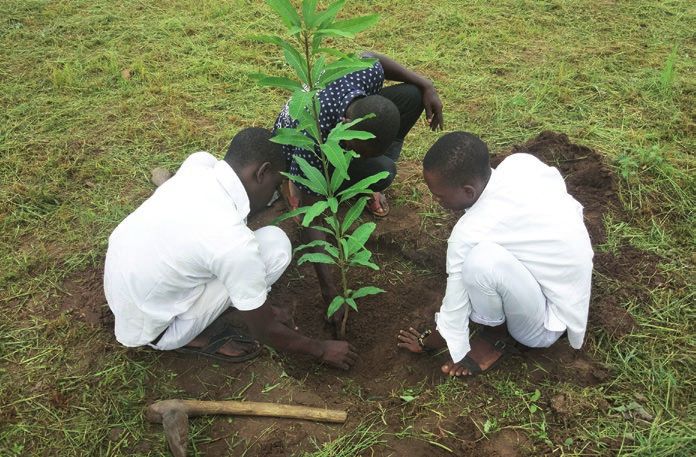
pedagogy and practice around school gardens that each of the vegetable and fruit crops yield.
and environmental protection. Each of the 15 This presented an applied way for students to
boarding schools participating in the project set incorporate lessons from chemistry, geography,
RCE Minna
RCE Minna, SENSA Project 2018
out to create teaching and learning based around and human health into their school day. Some of
the development and care for a school vegetable the crops planted can be harvested up to three
garden with at least five crop varieties, which times during a school year, and were incorporated
would supplement students’ nutrition during into cooking lessons for the students for their
meals. Additionally, each of the participating meals. During school breaks, the vegetables were
schools also created teaching and learning harvested and sold to the surrounding community
activities based on the planting and care of fruit to avoid waste. This not only created a small
A disabled student planting his seedling. and shade trees which supplemented nutrition fund for care and maintenance of the plants, but
and provided additional ecosystem services to the can offer the students lessons on micro-finance
Chapter People school area. and basic economic principles such as supply
and demand. Most critically, teachers used the
Region:
Africa School Empowerment Activities/Practices
Each of the participating schools created a school
day-to-day care of the gardens and tree stands to
showcase the impact humanity – both collectively
Country:
Nigeria and Nutrition through garden and a stand of trees that were actively
tended by students with the supervision of faculty
and as individuals – can have on the surrounding
environment. Students saw firsthand the results
2
SDG(s):
Zero Hunger
Agriculture and experts from RCE Minna. Lessons learned in
the classroom were applied within the garden on
of stewardship vs. negligence, and could gain an
appreciation for the complexity of the interactions
RCE Minna soil fertility, water conservation, and the nutrients within nature.
Theme(s):
Agriculture, Forests/Trees
Students practicing the methods of planting seedlings.
Target audience(s):
Secondary, Teacher Education
RCE Minna, SENSA Project 2018
Ecosystem(s): Rationale
Agricultural Minna is the capital city of Niger State in west-central Nigeria,
GAP Priority Action Area(s): approximately 150 kilometres from the capital of Nigeria in
2, 4 Abuja. While Minna lies close to the bustling capital, the primary
economic activities around Minna consist of farming and informal
Language of project: commercial activities. Despite an economy focused around food
English
production, many students in formal schooling lack awareness
Contributing organisation(s): of agricultural practices. Furthermore, quality nutrition remains a
• Association of Female paramount concern for youth in the region. To tackle these issues
Appointees and Wives of simultaneously, RCE Minna designed a programme to revive
Niger State Officials
school-gardening practices in the region, focusing on sustainable
(AFAWNSO)
• Niger State Urban horticulture and the planting of orchards and other trees.
Development Board –
Ministry of Lands and Housing Objectives
• Development Initiative of The primary objectives of the project were to ensure that
West Africa (DIWA)
boarding schools in the area were developing awareness
Year awarded RCE Award: and commitment among their students on agriculture and
2018 environmental stewardship through the establishment of
17PEOPLE RCE Minna // School Empowerment and Nutrition through Agriculture
RCE Minna, SENSA Project 2018
RCE Minna, SENSA Project 2018
RCE Minna, SENSA Project 2018
Tree planting practice for secondary schools. Students of Government Girls College Tegina, weeding their
SENSA vegetable garden.
Results Lessons Learned
Currently, over 2,000 trees have been planted and This project has succeeded in improving the
have survived as of the end of 2018. In addition skills of school teachers and their students
to the thriving vegetable gardens, the landscapes in the best practices for planting and care of SENSA Sensitization visit to a secondary school by RCE Minna, focusing on the importance of trees to the environment.
around the schools have started to change, with trees and vegetables. Practical demonstrations
a pleasant micro-climate that provides shade and from experts from RCE Minna were critical to RCE Minna to supplement the regular course development in relation to the horticulture activities
habitat. A video of the project has been developed showcase the faculty's best practices so that curriculum, so teachers would have the skills they were engaged with. These supplementary
to share the concept of the project widely with the they could in turn demonstrate these to their necessary to create lessons around basic business trainings for teachers provided by RCE Minna
hope that other RCEs and educational organisations students. This was especially critical around and financial literacy, conflict management, were critical to the success of the project and
will develop similar concepts to encourage the use issues related to the depth required when and environmental awareness and sustainable its continuation.
of school gardens and tree plantings as educational planting tree saplings, the construction of
tools that can improve lives. Understanding and garden beds, and how to safely transplant. It was
15
replicating this idea of using education as a means critical to educate teachers so they had the best
to care for the environment while simultaneously knowledge to ensure a high survival rate among
enhancing nutrition is a worthy goal for any seedlings. In addition, other workshops were
education programme. offered to both teachers and students from
boarding schools have
2,000
Over
Advocacy visit and distribution of tree seedlings by RCE Minna officials. participated in the project.
RCE Minna, SENSA Project 2018
Lessons in the classroom are trees have been planted.
applied within the garden on:
• Soil fertility
• Water conservation
• Nutrition
18 19RCE Scotland
Region:
The project contributes to the Global Action Programme Europe
on Education for Sustainable Development – Objective 1 Country:
“to reorient education and learning so that everyone has Scotland,
the opportunity to acquire the knowledge, skills, values and United Kingdom
attitudes that empower them to contribute to sustainable
SDG(s):
development”, with a focus on Priority Action Area 3: 4
Quality Education
Betsy King
‘Building capacities of educators and trainers’.
Theme(s):
Objectives Curriculum Development
University of the West of Scotland ESD workshop.
The aim of this project was to help teacher educators in
Target audience(s):
Scotland’s universities to work together to respond to
Chapter People Higher Education, Primary,
the imperative to address ESD in all their courses and Secondary, Teacher Education
Addressing SDG 4.7: Values and programmes, as a contribution to SDG 4.7, thereby having
a positive impact on the values, skills and knowledge of Ecosystem(s):
Learning for Sustainability in Initial
Grassland, Wetlands, Forest,
teachers and ultimately on the young people they teach.
Fresh Water, Urban/Peri-urban
Teacher Education By promoting collaboration between all eight universities
involved in initial teacher education (ITE) in Scotland, this GAP Priority Action Area(s): 3
RCE Scotland project focused on supporting teacher educators to embed
Language of project:
Values and Learning for Sustainability in their ITE courses
English
and programmes. In the third year of the project a group of
newly qualified teachers from each of the ITE institutions Contributing organisation(s):
were supported to develop a school-based Practitioner • General Teaching Council
Enquiry around a values and learning for sustainability for Scotland
• University of Aberdeen
Rationale theme. The aim was to help them to interrogate and • University of Dundee
Scotland is a country within the United Kingdom The policy framework in place in Scotland to address improve their practice to have a positive impact on the • University of Edinburgh
with a population of approximately 5.4 million. The SDG 4.7 and ESD in general is embedded within learning of their students. • University of Glasgow
natural environment of the region is diverse; from Scotland’s Curriculum for Excellence. The General • University of the Highlands
and Islands
large urban areas to uninhabitable islands, and from Teaching Council for Scotland's (GTCS) Professional Activities/Practices
• University of Strathclyde
highlands to lochs (lakes) and lowlands. However, Standards for teachers require that they demonstrate Collaboration between partners (GTCS, educators from the • University of Stirling
even in very urban areas, there is an appreciation ESD in their practice. However implementation in eight initial teacher education universities, and teachers) • University of West Scotland
for the region’s natural beauty with the majority schools requires that all educators are able to address developed and piloted a reflection and development tool
Linkages to education and/or
of inhabitants directly exposed to the natural sustainability in their practice. This starts with the that is fit for purpose, and built universities’ commitment to
sustainable development
environment regularly. This exposure is likely to teacher educators in universities who are responsible its use. Collaboration has led to the development of inter- policies:
contribute to a general appreciation for and desire for programmes for trainee teachers. This strategic university research and conference papers (Colucci-Gray, L. National:
to preserve natural resources, embedded within the project convened by RCE Scotland aimed to promote et al., eds. 2019). • Scottish Government Learning
Scottish psyche. collaboration that would support the embedding of for Sustainability Vision 2030+
Report 2017 and Action Plan 2019
ESD across all teacher education programmes in all Teachers were supported through webinars, online • General Teaching Council
Scotland has partial self-government within the UK the eight universities responsible for teacher training, collaboration, and a seminar to develop an ESD practitioner for Scotland Professional
with devolved legislative powers over matters such thereby having a positive impact on both the skills enquiry in the classroom, demonstrating the positive Standards for Educators
as education, health and transport, as specified in and knowledge of teachers and ultimately on young impact of university course programmes on practice and • How Good is Our School
Self-Evaluation Framework
the Scotland Acts 1998 and 2012. people. learner outcomes.
(Version 4) – Scotland
20 Year awarded RCE Award:
2018PEOPLE RCE Scotland // Addressing SDG 4.7: Values and Learning for Sustainability in Initial Teacher Education
693,251 students 50,099 teachers 2,502 schools Schools Primary
( 4,292 from 2017) ( 636 from 2017) ( 12 from 2017) Secondary
3,000 Special
6,823 special 1,883 special 133 special
357 secondary 2,500 155 149 145 144 141 135 133
365 364 362 361 359 360 357
2,000
2,064 2,056 2,048 2,039 2,031 2,019 2,012
1,500
286,152 secondary 23,317 secondary 1,000
400,276 primary 24,899 primary 2,012 primary
500
(Source: Summary Statistics for Schools in (Source: Summary Statistics for Schools in (Source: Summary Statistics for Schools in
Scotland No. 9: 2018 Edition, Chapter 2, Scotland No. 9: 2018 Edition, Chapter 2, Scotland No. 9: 2018 Edition, Chapter 2,
Scottish Government). Scottish Government). Scottish Government). 0
2012 2013 2014 2015 2016 2017 2018
Pupils
Results 13.6 800,000
The impact of the project has been: Student – Teacher ratio 700,000 6,953 6,956 6,940 6,871 6,668 6,654 6,823
1. Initial Teacher Education Courses (same as 2017)
and Programmes: 600,000
500,000 293,562 289,164 284,762 281,939 280,983 281,993 286,152
The Reflection and Development Tool microsite
on the GTCS website is an ongoing significant 400,000
support to all of Scotland’s ITE institutions. 370,680 377,382 385,212 391,148 396,697 400,312 400,276
300,000
During the period of the project there has been Student figure comprises of Primary, Secondary, and Special categories.
Teacher figure comprises of Primary, Secondary, Special, and Centrally 200,000
an increased integration of Values and ESD in employed (school) categories. (Source: Summary Statistics for Schools in
university courses and programmes that have Scotland No. 9: 2018 Edition, Chapter 2, Scottish Government). 100,000
been submitted for GTCS accreditation. 0
2. University Staff: 2012 2013 2014 2015 2016 2017 2018
There has been an increased level of collaborative for ESD has also been included in the Scottish Teachers
thinking and discussions on Values Education
Government Vision 2030+ Learning for
and ESD within and across the ITE institutions Sustainability Action Plan (2019). 60,000
sharing approaches and practice. This has
50,000 2,026 2,020 1,974 1,911 1,869 1,836 1,883
resulted in a research focused publication and Lessons Learned
ongoing collaboration. It is evident that leadership is required in the 40,000
3. Student Teachers: teacher training universities to ensure that the 23,980 23,695 23,401 23,059 22,957 23,150 23,317
30,000
Student teachers are being inspired to address principles and practices of ESD are embedded in all
20,000
the values and Learning for Sustainability courses and programmes. The project engaged both
10,000 22,685 22,905 22,960 23,425 23,920 24,477 24,899
requirements of the GTCS Professional Standards ‘champions’ of ESD and senior managers to ensure
and those involved in practitioner enquiries success. Teacher educators are potentially powerful 0
reported considerable positive benefits for their agents of change in the educational response 2012 2013 2014 2015 2016 2017 2018
students. to sustainable development, but themselves
(Source: Summary Statistics for Schools in Scotland No. 9: 2018 Edition, Chapter 2, Scottish Government).
4. Scottish Education System: require considerable support in acquiring the
We expect Values and Learning for Sustainability necessary knowledge, skills, values, motivation and More information
to be strengthened in the upcoming review of commitment to introduce ESD into their teaching Learning for Sustainability Microsite
the Professional Standards and further support and institutions. Learning for Sustainability Scotland
22 23PLANET // RCE Award Winners Projects Publication
Objectives
This ESD project has the following three objectives: the practices employed by the project to meet its
objectives:
1) To build the capacity of agricultural extension
RCE Greater Phnom Penh officers and other staff in the Provincial 1) Capacity building for agricultural extension
Department of Agriculture, Forestry, and officers through technical trainings in Cambodia
ERECON
Fisheries (PDAFF) and the District Office and Thailand, and through publishing a series of
of Agriculture (DOA) in regards to the guidebooks on sustainable farming with cyclic
Farmers attend a workshop on sustainable agricultural practices.
dissemination of skills, knowledge, and facilities use of natural resources with the RCE members;
Region: for a cyclic use of natural resources in farming;2) Building collaboration among universities, local
Asia-Pacific
Chapter People 2) To use education for sustainable development government, and farmers through workshops and
Country:
Cambodia Promoting ESD through Food, to promote sustainable farming practices to
local farmers; and
trainings facilitated by the RCE;
3) Establishing Centres within local government
SDG(s):
Agriculture, and Environment 3) To use education for sustainable development
to promote conditions for the sale of agricultural
for promoting sustainable agriculture through
education and training;
2
4
Zero Hunger
Quality Education in Rural Communities in products with low chemical inputs. 4) Promoting sustainable farming practices based
12
Responsible Consumption
and Production Cambodia Activities/Practices
on cyclic use of natural resources through
agricultural extension services provided to local
Based on the project’s objectives, through farmers; and
Theme(s): RCE Greater Phnom Penh education for sustainable development, improved 5) Promoting conditions for sales of agricultural
Agriculture, Plants and Animals
farming conditions based on sustainable agriculture products with low chemical inputs through public
Target audience(s): were set up in the project areas. The following are information campaigns.
Community, District and Provincial
Farmers learn and try to make bio-pesticides from plants.
Ecosystem(s):
Agricultural
ERECON
Rationale
GAP Priority Action Area(s): 5 In Cambodia, the usage of chemical fertilisers and pesticides
has significantly increased to promote agricultural productivity.
Language of project:
English, Khmer However, due to the inappropriate use of agro-chemicals such as
overuse and application without sufficient knowledge, especially
Contributing organisation(s): by small-scale farmers, this practice has caused various problems
• Institute of Environmental to both human and environmental health. Although agricultural
Rehabilitation and Conservation
productivity has increased temporarily, environmental issues such
(ERECON), Southeast Asia Office
• Provincial Department of as soil degradation, water contamination from agro-chemicals,
Agriculture, Forestry, and and water degradation through eutrophication have occurred.
Fisheries (PDAFF) – Kampong
Cham
Although many farmers realise the adverse impacts of agro-
• Kampong Cham National
Institute of Agriculture (KNIA) chemicals to human and environmental systems, they lack
• Royal University of Agriculture - knowledge related to sustainable or alternative farming systems.
Cambodia Meanwhile, agricultural extension officials who are responsible for
• Tokyo University of Agriculture - enhancing farmers’ knowledge are simply not enough in number
Japan
compared to any one assigned area. Hence, the intervention from
Year awarded RCE Award: the RCE and its partners such as NGOs and education institutes to
2015 tackle this problem is indispensable.
25PEOPLE RCE Greater Phnom Penh // Promoting ESD through Food, Agriculture, and Environment in Rural Communities in Cambodia
especially for junior officers. Moreover, due to Lessons Learned
the multi-stakeholder approaches, more project As a result of the multi-stakeholder approach
stakeholders participated in the evaluation and employed in the project, relevant agencies such
monitoring process at regular intervals. This gives as NGOs and educational institutes can play a
an opportunity for farmers to feed back their vital role in promoting sustainable agricultural
knowledge and practices learnt from the project’s practices by partnering with local government
activities. Interestingly, some farms of District Model agricultural extension services. The outcomes of
Farmers in the project have become a learning the project can be taken into consideration by the
place for agricultural students from Kampong Cham Department of Agriculture, Forestry and Fisheries,
National Institute of Agriculture (KNIA). Farmers at the national or sub-national level to involve
shared their knowledge and sustainable practices more stakeholders and to implement more
to students in addition to farmers from nearby sustainable agriculture activities.
communities who regularly visited their farm to
learn and exchange experiences of sustainable This is an ongoing project, but the challenges that
ERECON
agriculture practices. were faced during the project implementation
include the low literacy level of farmers. This has
Vegetable farm and paddy field that was applied with compost and bio-pesticide. The project also contributes to the Agricultural challenged the RCE to modify its conventional
Extension Policy in Cambodia in the aspect of outreach material – such as pamphlets or
improving human resource capacity and capability handouts – into demonstrations, which can
After more than five hundred compost boxes officials to farmers. Farmers were asked to attend in delivering extension services in response to local engage more farmers and make them understand
were set in the project area, farmers started to meetings or workshops arranged by the agricultural needs by building capacity of agricultural extension the content and message of the curriculum
make compost and apply it in their farmland office for the given district. Due to the limited officers through a series of trainings. The project more clearly. Encouraging farmers to monitor
continuously. Moreover, after received training on number of extension official staff, the scope of has also contributed to the provincial and district their resource use as well as reciprocal farm
making bio-pesticides from plants, farmers have education was not only one-way, but also very agricultural strategic plans by promoting farmers in visits to learn from other farmers are some of the
applied bio-pesticides instead of chemical ones. limited. the province to produce low agro-chemical input practices that encourage farmers to practice more
Through the participatory training, farmers feed or organic products to local markets. Moreover, sustainable agriculture practices.
back their ideas to the project team to revise media After two years of the project implementation, it the project also has enhanced food security at the
and focus more on demonstration and practice was observed that the knowledge dissemination household and community level through increased
rather than lecture. from agricultural extension officials to District crop diversity and productivity.
Model Farmers and district farmers to general
Results farmers in the project area is well practiced. Crops that farmers have been able to grow sustainably in the project areas include:
Through the series of activities of this five-year District Model Farmers have become the centre
project, agricultural extension officers and of knowledge dissemination to farmers in nearby • Rice
farmers gained more knowledge of sustainable communities. Through this type of education, • Chilli
farming systems and have changed their practices knowledge dissemination has become a two-way • Tomato
from conventional ones, which rely heavily on communication. Farmer’s feedback to the project’s • Lettuce
agricultural chemicals, to sustainable farming curriculum outputs, such as posters and handouts, • Lemongrass (in one particular commune)
practices that have led to responsible consumption led to the improvement of both the curriculum • Mango
and production, as well as healthy producers, and the outreach practices to make messages on • Dragon fruit
consumers, and a healthier environment. sustainable agriculture easier to understand.
Before the project was started, agricultural The capacity of agricultural extension officers
knowledge dissemination was a one-way has been greatly enhanced through technical
communication from agricultural extension training and practice in giving lectures to farmers,
26 27You can also read


