Real rights of persons with disabilities to vote in European Parliament elections - Information report
←
→
Page content transcription
If your browser does not render page correctly, please read the page content below
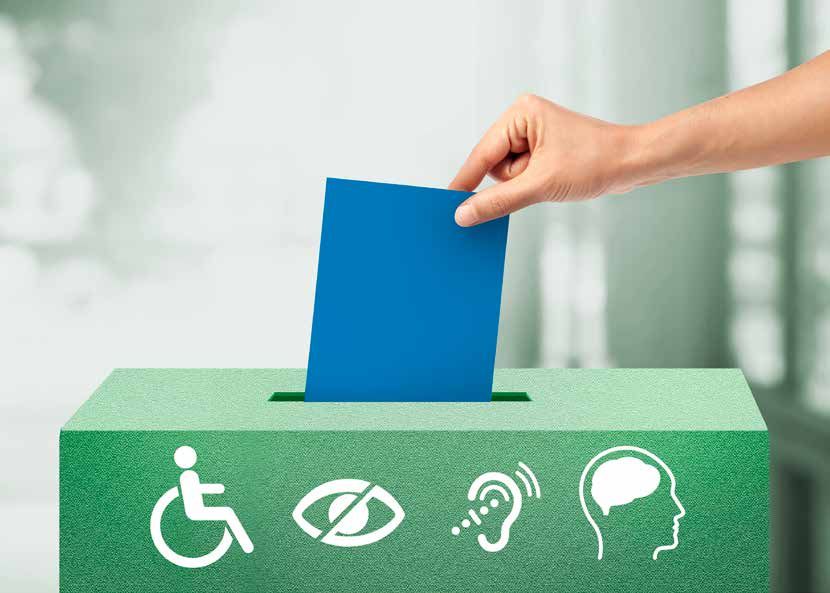
© Shutterstock.com/tsvetina_ivanova

                                        Real rights of persons with
                                          disabilities to vote in
                                      European Parliament elections
                                                Information report

                                                                         Rapporteur: Krzysztof Pater

                                          European Economic and Social Committee
SOC/554
Real rights of persons with
disabilities to vote in EP elections
INFORMATION REPORT
Section for Employment, Social Affairs and Citizenship
Real rights of persons with disabilities to vote in European Parliament elections
Rapporteur: Krzysztof PATER
1/35Legal basis Rule 31 of the Rules of Procedure
Section responsible Section for Employment, Social Affairs and Citizenship
Adopted in section 06/03/2019
Adopted at plenary 20/03/2019
Plenary session No 542
2/351. Introduction
1.1 This report presents the state of play of the implementation of the right of European Union (EU)
citizens with disabilities to vote in elections to the European Parliament (EP). The European
Economic and Social Committee (EESC), an EU advisory body, believes it has a duty, in the
run-up to the EP elections, to provide EU institutions, Member States and EU citizens with a
full picture of how this right is actually implemented. The EESC hopes that at the next elections
in 2024, no EU citizen will be deprived of their right to vote because of their disability.
1.2 The data for this report was provided by several hundred people, representing a significant
number of institutions and organisations from 27 Member States (the United Kingdom was not
considered as it will leave the EU on 29 March 2019, before the 2019 European Parliament
elections) – mostly public authorities in Member States responsible for the election process and
organisations representing or supporting persons with disabilities, but also members of the
European Parliament from the Disability Intergroup and representatives of the European
Disability Forum.
1.3 The main areas of the report consist of an initial short legal analysis of basic acts ensuring that
persons with disabilities have the right to vote (which are often not upheld in real life) and the
legal framework for European Parliament elections, together with possible actions at EU level to
improve the situation. Next, the report presents legal barriers at Member State level which
deprive EU citizens of the right to vote due to their disability, together with good examples of
progress made in recent years in many countries. The report then discusses barriers and also
presents several good practices (in the context of persons with disabilities), firstly taking into
account areas relevant to all countries: access to information during the pre-election period,
organisation of voting in "general" polling stations, ballot papers and their accessibility. The
next few sections cover solutions existing in a limited number of Member States – early voting
in designated polling stations, postal voting, mobile ballot box voting, proxy voting and
electronic voting. Finally some aspects related to arrangements enabling people staying in
hospitals and long-term care institutions to vote, the right of persons with a disability to vote in
countries where voting is mandatory, and procedures in cases when a person with disabilities
has their permanent residence in a different country to their country of origin are presented.
1.4 The purpose of the report is not to criticise any of the EU countries. Rather, most of it is made
up of positive examples, and arrangements that need improvements or changes are usually
discussed without mentioning specific countries affected by a particular problem.
1.5 This report covers procedures in European elections, but similar or the same solutions are also
applied in national parliamentary elections, local elections or referendums. The EESC hopes
that this report will help EU countries draw up comprehensive solutions to remove legal and
technical (organisational) barriers preventing some persons with disabilities from voting. The
EESC is counting on this information being used by civil society organisations that are seeking
to remove barriers to the exercise of voting rights by persons with disabilities, and on public
authorities – often from local level – which can implement many practical arrangements without
any changes to national law.
3/352. Conclusions
2.1 In each of the 27 EU countries, there are laws or organisational arrangements which exclude
some voters with disabilities from participating in EP elections.
2.1.1 About 800 000 EU citizens from 16 Member States are, on account of national rules, deprived
of the right to participate in EP elections because of their disabilities or mental health problems.
The extent of this phenomenon is very uneven across individual countries.
2.1.2 Millions of EU citizens have no possibility to vote because of organisational arrangements
(technical barriers) which do not take into account the needs resulting from their disability.
2.1.3 The main place of voting is the polling station. Many persons with disabilities, even when given
the option of alternative, more convenient forms of voting, want to vote at a polling station,
recognising it as the best form of civic participation. In 12 countries, this may not be possible,
since national legislation does not allow the polling station designated on the basis of residence
to be changed to another which can better accommodate the specific type of disability. In other
countries, participation in elections is made difficult by a number of restrictions at polling
stations.
2.1.4 In eight Member States, anyone who cannot to get to a polling station is not able to vote, as they
do not have the option of an alternative form of voting (postal voting, voting by mobile ballot
box or electronic voting). Three of these countries offer the possibility of voting by proxy.
However, such a solution cannot be regarded as an adequate alternative. In fact, it does not
allow a voter with disabilities to exercise their right to vote, but merely enables the voter to
designate someone to whom they can delegate their vote.
2.1.5 In 18 Member States, blind voters have no way of voting independently; they can only entrust
somebody accompanying them to cast their vote on their behalf.
2.1.6 Another factor preventing people from voting independently or discouraging them from doing
so are specific rules and organisational arrangements – such as the absence of information
adapted to different types of disability, obstacles to mobility in the polling station itself and
burdensome administrative procedures – governing how voters can exercise their right to vote in
an appropriately adapted form.
2.2 If the best practices from across all countries were implemented, an ideal system would emerge
in which every EU citizen with disabilities not only would have the full possibility to vote but
also would be able to choose for themselves the most convenient way in which to vote.
2.3 Current EU legislation already addresses a number of issues concerning EP elections. Thus,
there are no formal obstacles to this legislation also including guarantees on voting options for
persons with disabilities. In any case, however, there is a need for a formal EP legislative
initiative and for it to be approved subsequently by all Member States.
4/353. The main international legal and policy framework applying to the voting rights of
persons with disabilities
3.1 United Nations legal acts
3.1.1 The Universal Declaration of Human Rights was adopted by the UN General Assembly on
10 December 1948. It states in Article 21 that "Everyone has the right to take part in the
government of his country, directly or through freely chosen representatives".
3.1.2 The International Covenant on Civil and Political Rights, adopted by the UN General Assembly
on 16 December 1966, states in Article 25 that "Every citizen shall have the right and the
opportunity, without any of the distinctions mentioned in article 2 and without unreasonable
restrictions: ... (b) to vote ... at genuine periodic elections".
3.1.3 The United Nations Convention on the Rights of Persons with Disabilities (CRPD), adopted in
1
2006, which came into force on 3 May 2008 , is currently the most important UN legal act
relating to persons with disabilities.
2
3.1.3.1 Article 29 of the CRPD explicitly requires States Parties to "ensure that persons with
disabilities can effectively and fully participate in political and public life on an equal basis with
others, directly or through freely chosen representatives, including the right and opportunity …
to vote" and sets out a number of measures to enable this to happen, requiring that:
"voting procedures, facilities and materials [be] appropriate, accessible and easy to
understand and use";
"the right of persons with disabilities to vote by secret ballot ... without intimidation" be
protected;
persons with disabilities be allowed "assistance in voting by a person of their own choice".
3.1.3.2 Article 29 of the CRPD must be read in conjunction with Article 9 (Accessibility), which
requires "Buildings, roads, transportation and other indoor and outdoor facilities" used by the
public to be made accessible. This article should also be read in conjunction with Article 12
3
(Equal recognition before the law) , which recognises that "persons with disabilities have the
right to recognition everywhere as persons before the law" and "enjoy legal capacity on an equal
basis with others in all aspects of life".
4
3.1.3.3 The Committee on the Rights of Persons with Disabilities stated, in its General Comment on
Article 9, that persons with disabilities would be unable to exercise their rights guaranteed by
Article 29 "if States parties failed to ensure that voting procedures, facilities and materials were
1
The CRPD has been ratified by the European Union and all Member States.
2
Malta raised reservations with respect to Article 29.
3
Estonia, France and the Netherlands made declarations and Poland raised reservations with respect to Article 12.
4
The body of independent experts which monitors implementation of the Convention by the States Parties. One of its duties is to
publish general comments on articles of the CRPD which require interpretation.
5/35appropriate, accessible and easy to understand … If not, persons with disabilities are deprived of
their right to participate in the political process in an equal manner." In the General Comment
on Article 12, the Committee underlined that "In order to fully realise the equal recognition of
legal capacity in all aspects of life, it is important to recognise the legal capacity of persons with
disabilities in public and political life (Article 29). This means that a person's decision-making
ability cannot be a justification for any exclusion of persons with disabilities from exercising
their political rights, including the right to vote".
3.2 European Union legal acts
3.2.1 The Treaty on the Functioning of the European Union clearly stipulates, in Article 20(2)(b), that
"Citizens of the Union ... shall have, inter alia: … (b) the right to vote ... in elections to the
European Parliament ... in their Member State of residence, under the same conditions as
nationals of that State".
3.2.2 The Charter of Fundamental Rights of the European Union confirms, in Article 39, the right of
all EU citizens to vote in European Parliament elections. In Article 21(1) the Charter confirms
that "Any discrimination based on any ground such as ... disability ... shall be prohibited".
Article 26 states that "The Union recognises and respects the right of persons with disabilities to
benefit from measures designed to ensure their independence, social and occupational
integration and participation in the life of the community".
3.3 Other key legal and political acts
5
3.3.1 Article 15 of the European Social Charter (revised) explicitly guarantees persons with
disabilities "the effective exercise of their right to independence, social integration and
participation in the life of the community".
3.3.2 The Venice Commission's revised Interpretative Declaration to the Code of Good Practice in
6
Electoral Matters on the Participation of People with Disabilities in Elections states that
"people with disabilities should … be able to exercise their right to vote ... on an equal basis
7
with other citizens" and the Code of Good Practice in Electoral Matters notes that "provision
may be made for depriving individuals of their right to vote" if this is based on mental
incapacity and on condition that it is imposed by an individual decision of a court.
3.3.3 The Recommendation of the Council of Europe Committee of Ministers adopted on
8
16 November 2011 reaffirms that all persons with disabilities have the right to participate in
political and public life on an equal basis with others. It also underlines that accessible ballot
papers and facilities should be available at the time of voting.
5
Ratified by 19 EU Member States.
6
Adopted by the Council for Democratic Elections at its 39th meeting (Venice, 15 December 2011) and by the Venice Commission
at its 89th plenary session (Venice, 16-17 December 2011).
7
Adopted by the Venice Commission at its 52nd session (Venice, 18-19 October 2002).
8
CM/Rec(2011)14.
6/353.3.4 The European Convention on Human Rights does not stipulate a right to vote; however, the
European Court of Human Rights has established that Article 3 of Protocol No 1 guarantees
individual rights, including the right to vote, and that the withdrawal of this right must be
9
subject to a strict assessment of proportionality. In the Alajos Kiss v. Hungary judgment, the
Court accepted that the right to vote "is an area in which, generally, a wide margin of
appreciation should be granted to the national legislature in determining whether restrictions on
the right to vote can be justified in modern times", but at the same time underlined that it cannot
be accepted "that an absolute bar on voting by any person under partial guardianship,
irrespective of his or her actual faculties, falls within an acceptable margin of appreciation", and
that "if a restriction on fundamental rights applies to a particularly vulnerable group in society,
who have suffered considerable discrimination in the past, such as the mentally disabled, then
the State's margin of appreciation is substantially narrower and it must have very weighty
reasons for the restrictions in question". The Court subsequently confirmed this position in other
cases.
3.4 Comments
3.4.1 It is clear that, for many years, the right to vote has been guaranteed for EU citizens thanks to
many legal acts.
3.4.2 In the 21st century, international and European law on the right to vote for persons with
disabilities is changing, from rather general declarations to more detailed solutions, focusing on
the actual implementation of voting rights for such persons.
3.4.3 As regards the technical barriers preventing persons with disabilities from voting in elections,
attention is focusing on various aspects of accessibility – including access to polling stations and
other forms of voting and the ability to fill in or select ballot papers.
3.4.4 As far as legal barriers are concerned, what is crucial is the change in attitude towards persons
with intellectual disabilities or mental health problems who are covered by protective measures
yet who are being deprived of voting rights. The judgments of the European Court of Human
Rights provide a clear indication that all countries whose legal systems automatically remove
voting rights from persons who are deprived of legal capacity should align their systems with
international obligations, at the very least by providing individual judicial assessments. It is very
likely that, in the coming years, the position of the Committee on the Rights of Persons with
Disabilities will confirm that no deprivation of voting rights is acceptable in the framework of
the United Nations Convention on the Rights of Persons with Disabilities.
9
Judgment No 38832/06, 20 May 2010.
7/354. Legal basis for European Parliament elections
4.1 Historical context
4.1.1 The Assembly, set up under Article 137 of the Treaty establishing the European Economic
Community (EEC Treaty), was initially, according to Article 138(1) of the EEC Treaty,
composed of delegates appointed from among members of national parliaments in accordance
with the procedure laid down by each Member State. However, it was clearly indicated in
Article 137 that "The Assembly ... shall be composed of representatives of the peoples of the
States united within the Community".
4.1.2 At its first session, which took place from 19 to 21 March 1958, the Assembly took the name
"Assemblée parlementaire européenne" in French, "Assemblea parlementara" in Italian and,
more significantly, "Europees Parlament" in Dutch and "Europäisches Parlament" in German.
On 30 March 1962, the Assembly decided to harmonise its name in the various official
languages and opted for "Parlement européen" in French and "Parlemento europeo" in Italian.
Since then, the name "European Parliament" has been in common use, in spite of the fact that
the title "Assembly" still remains in legal acts.
4.1.3 Article 138(3) of the EEC Treaty created the legal basis for electoral rules for the European
Parliament. This article provided that "The Assembly shall draw up proposals for elections by
direct universal suffrage in accordance with a uniform procedure in all Member States. The
Council, acting by means of a unanimous vote, shall determine the provisions which it shall
recommend to Member States for adoption in accordance with their respective constitutional
rules."
4.1.4 In keeping with these provisions, the Assembly made a legislative proposal to the Council with
a view to introducing direct universal suffrage, and the Council approved it, unanimously
adopting the Act concerning the election of the representatives of the Assembly by direct
universal suffrage, appended to Decision 76/787/ECSC, EEC, Euratom of 20 September 1976
(Electoral Act of 1976), creating the legal basis for the first direct elections to the European
Parliament, which took place in 1979.
4.2 Current rules
4.2.1 The Electoral Act of 1976 established the following rules for the election process to the
Assembly:
establishing the election of representatives to the Assembly by direct universal suffrage
(Article 1) and the number thereof elected in each Member State (Article 2);
determining the term of office of the Assembly's representatives as being five years
(Article 3);
stating the individuality, personal character and independence of the representatives' votes
(Article 4);
ensuring the compatibility of the office of representative with a national parliamentary
mandate (Article 5);
8/35 stating the incompatibility of the office of representative with other national or European
offices (Article 6);
prohibiting voting more than once in elections of representatives to the Assembly (Article 8);
laying down the electoral period and date of the first elections (Articles 9 and 10);
establishing the verification of credentials (Article 11);
setting out the procedure for filling vacant seats during the five-year term of office
(Article 12).
4.2.2 The Electoral Act of 1976 established the basic rules for the election process to the Assembly. It
was able to lay down only some provisions of universal electoral suffrage and not, as
Article 138(3) provides, a "uniform procedure in all Member States". The Electoral Act of 1976
contained a number of common rules and principles, which could be recognised as a "legislative
framework" rather than a "uniform procedure".
4.2.3 The Electoral Act of 1976 was amended by Council Decision 2002/772/EC, Euratom which
included the following substantive changes:
an obligation on Member States to provide for the election of members of the European
Parliament on the basis of proportional representation using the list system or the single
transferable vote, with permission for Member States to authorise voting based on a
preferential list system (Article 1(1)(2));
free and secret elections (Article 1(3));
freedom for Member States to establish constituencies for European Parliamentary elections,
provided that the proportional nature of the election is not affected (Article 2);
the possibility for Member States to set a national minimum threshold not exceeding 5% of
votes cast and to set a ceiling for candidates' campaign expenses (Article 2A and 2B);
the insertion of new grounds for incompatibility with the office of member of the European
Parliament, including being a member of a national parliament (Article 6(2));
establishment of the principle that the electoral procedure shall be governed by national
provisions in each Member State, provided that the proportional nature of the European
elections is not affected (Article 7);
a ban on making the results of national counts public until the polls in the last voting
Member State are closed (Article 9(2));
clearer provisions for filling seats falling vacant during the five-year term of office
(Article 12).
4.2.4 The amendments introduced to the Electoral Act of 1976 were adopted on the basis of
Article 190(4) of the Treaty establishing the European Community (consolidated version,
hereinafter "EC Treaty"), which provided in this article (ex Article 138 of the EEC Treaty) that
"The European Parliament shall draw up a proposal for elections by direct universal suffrage in
accordance with a uniform procedure in all Member States or in accordance with principles
common to all Member States. The Council shall, acting unanimously after obtaining the assent
of the European Parliament, which shall act by a majority of its component members, lay down
the appropriate provisions, which it shall recommend to Member States for adoption in
accordance with their respective constitutional requirements."
9/354.2.5 Article 8b(2) of the EC Treaty stated that "Without prejudice to Article 138(3) and to the
provisions adopted for its implementation, every citizen of the Union residing in a Member
State of which he is not a national shall have the right to vote and to stand as a candidate in
elections to the European Parliament in the Member State in which he resides, under the same
conditions as nationals of that State. This right shall be exercised subject to detailed
arrangements to be adopted before 31 December 1993 by the Council, acting unanimously on a
proposal from the Commission and after consulting the European Parliament; these
arrangements may provide for derogations where warranted by problems specific to a Member
State."
4.2.6 The essence of this provision is now included in Articles 20(2)(b) and 22(1) of the Treaty on the
Functioning of the European Union, which reiterates the right of migrant EU citizens to vote
and stand as candidates in European Parliament elections in their state of residence on equal
terms with nationals of that state.
10
4.2.7 In keeping with Article 8b(2) of the EC Treaty, Council Directive 93/109/EC was adopted.
The main provisions introduced with this Directive were:
the possibility for EU citizens to vote and stand as candidates in European Parliamentary
elections in a Member State other than their home state under the same conditions as
nationals of that state, with the possibility for a Member State to restrict these rights to EU
voters who have resided for a minimum period not exceeding 5 years (for voting) and 10
years (for standing for office), if the number of non-national voters exceeds 20% of the total
number of EU citizens residing in that state;
the establishment of a procedure for non-national voters or candidates to express the wish to
vote or stand as candidates in their state of residence;
the establishment of a procedure for checking whether non-national voters or candidates
have been deprived of the right to vote or stand as candidates in their home state and the ban
on double votes and candidacies in both the state of residence and the home state.
4.2.8 It is important to point out, however, that the scope of Directive 93/109/EC is very limited and
does not concern the way in which European elections are organised, for which the Electoral
Act of 1976 is the sole basis.
4.3 Possibility to amend the current rules
4.3.1 At present, the legal basis for amendments to the current legal framework on the election of
members of the European Parliament is enshrined in Article 223(1) of the Treaty on the
Functioning of the European Union (TFEU) (ex Article 190(4) and (5) EC Treaty), which states
that "The European Parliament shall draw up a proposal to lay down the provisions necessary
for the election of its Members by direct universal suffrage in accordance with a uniform
procedure in all Member States or in accordance with principles common to all Member States.
10
OJ L 329, 30.12.1993, p. 34.
10/35The Council, acting unanimously in accordance with a special legislative procedure and after
obtaining the consent of the European Parliament, which shall act by a majority of its
component Members, shall lay down the necessary provisions. These provisions shall enter into
force following their approval by the Member States in accordance with their respective
constitutional requirements."
4.3.2 The current legal basis for future modifications to the European electoral system is similar to
the previous one under Article 137 of the EEC Treaty and Article 190(4) of the EC Treaty.
4.3.3 It is also necessary to mention that a lighter, less invasive, type of measure could be introduced,
based on Article 13 of the Electoral Act of 1976, which states that "Should it appear necessary
to adopt measures to implement this Act, the Council, acting unanimously on a proposal from
the Assembly after consulting the Commission, shall adopt such measures after endeavouring to
reach agreement with the Assembly in a conciliation committee consisting of the Council and
representatives of the Assembly".
4.3.4 Based on Article 13, measures may be adopted as long as they serve to implement provisions or
principles already contained in the Electoral Act of 1976. Implementing measures should be
proposed by the Parliament after consulting the Commission and shall be adopted by the
Council by unanimity.
4.3.5 On 11 November 2015, the European Parliament adopted a legislative initiative resolution on
11
the reform of the electoral law of the European Union (2015/2035(INL)) . This initiative
followed the approach of the previous framework, which did not establish a uniform election
procedure, but laid down common principles. The national parliaments of some Member States
have submitted opinions claiming non-compliance with the principle of subsidiarity.
4.4 Comments
4.4.1 Only one legal act aimed at the European Parliament's election system sets out provisions
safeguarding EU citizens' voting rights. These apply to people residing in a Member State other
than their home country.
4.4.2 No legal act touches upon real rights to vote, especially those of persons with disabilities.
4.4.3 As any change to the existing electoral system requires support from the majority of European
Parliament members and a unanimous decision by the Council, followed by Member States'
approval in keeping with their respective constitutional requirements, it seems unlikely that this
system will be amended significantly in the near future. However, it may be possible to adopt
non-controversial changes in a short space of time if they are proposed by the European
Parliament, on the condition that such a proposal is limited in scope. Regulations aimed at
improving real rights to vote for EU citizens with disabilities may be an idea which could attract
widespread support in a short space of time.
11
The legislative initiative report P8_TA(2015)0395 was authorised on 5 February 2015 by the European Parliament's Conference of
Presidents.
11/355. Legal barriers to voting rights
5.1 Deprivation of voting rights
5.1.1 To protect the interests of some persons with intellectual disabilities or mental health problems,
various concepts of guardianship have been introduced across the EU. The common feature is
that the guardian (also called "trustee", "protector", "curator", "counsellor") receives legal
authority to take decisions on almost all (plenary guardianship) or some (partial guardianship)
areas of their ward's life, or at least the right to approve some decisions taken by a ward
(blocking power). In many legal systems, such legal measures are linked to the deprivation of
the ward's legal capacity and hence to the deprivation of their right to vote.
5.1.2 Under the legal systems of nine countries, many people under various protective measures (at
least under plenary guardianship) are automatically excluded from political participation and
thus denied the right to vote. These provisions are usually included in parliamentary legislation,
sometimes directly in the constitution. This is the case in Bulgaria, Cyprus, Estonia,
Germany, Greece, Lithuania, Luxembourg, Poland and Romania.
5.1.3 According to seven national laws, placing a person under guardianship does not automatically
mean the loss of voting rights. The appointment of a guardian is usually done by the
court/judge, who also normally takes a decision on the scope of the guardian's responsibilities
on the basis of an individual assessment. In one country, however, such a decision is taken by a
special Medical Board. Following this procedure, the separate decision to deprive the ward of
voting rights may also be taken by the court. This may happen in Belgium, the Czech
Republic, France, Hungary, Malta, Portugal and Slovenia.12
13
5.1.4 In 11 Member States (Austria, Croatia, Denmark , Finland, Ireland, Italy, Latvia, the
14
Netherlands, Slovakia, Spain, Sweden) , in no circumstances may an individual be deprived
of the right to vote.
5.1.5 The procedures either to establish guardianship leading automatically to the deprivation of
voting rights or to deprive voting rights on the basis of an individual assessment vary between
Member States. In some of them, these procedures are aimed only at people in a very severe
medical condition without any possibility to make contact with other people, while in other
countries thousands of people must go through a complicated process which sometimes even
includes a general knowledge test with very detailed questions15.
5.1.6 Exact or approximate data on the number of people deprived of their voting rights because of a
disability is available only for some Member States. However, on the basis of those figures, it is
12
The number of persons who are deprived of voting rights in a majority of these countries is very small.
13
See details in item 5.2.2
14
And also the United Kingdom.
15
In one Member State, a person who wanted to keep his voting rights had to answer, among other things, the following questions:
What is the speed of light? Who was Catherine the Great?
12/35possible to estimate that about 800 000 EU citizens are prevented from participating in EP
elections on account of national legislation. That said, the extent of this issue is very uneven
across individual countries. In Portugal, for example, around 100 people are unable to exercise
their right to vote, but there are also countries where this figure is above 50 000 or even around
300 000.
5.2 Recent changes in Member States' laws
5.2.1 A clear tendency can be observed in recent years in the Member States' legal systems. Instead of
automatic deprivation of voting rights of all citizens who are placed under guardianship (who
lose legal capacity), the systems are moving towards solutions with either no deprivation of
voting rights or a limited number of cases of deprivation, decided by a court on the basis of an
individual assessment.
5.2.2 The following changes were made in the Member States during the past eight years:
the new constitution which entered into force on 1 January 2012 in Hungary has changed
the existing system of automatic deprivation of voting rights of all citizens who were
deprived of legal capacity into a system whereby a court decision is required in each
individual case to deprive somebody of their voting rights. According to Article XXIII(6) of
the amended constitution: "Those disenfranchised by a court for … limited mental capacity
shall not have the right to vote";
amendments to Section 356 of the Civil Law made in Latvia on 29 November 2012, in force
since 1 January 2013, envisage that "A person shall not be restricted in personal non-
financial rights", which also means that persons deprived of legal capacity shall not be
denied the right to vote;
the legal reform implemented in December 2012 in Croatia, as a reaction to criticism
presented by the Ombudsman for Persons with Disabilities, abolished removing the right to
vote from persons divested of legal capacity (Article 64 of Act on Voter Registry);
according to the new Civil Code, adopted in the Czech Republic on 3 February 2012, which
came into force on 1 January 2014, the concept of automatic deprivation of voting rights was
abolished and instead "A court may limit the legal capacity of an individual to the extent to
which the individual is unable to make juridical acts due to a mental disorder which is not
only temporary, and shall define the extent to which it has limited the capacity of the
individual to make independent juridical acts" (Article 57(1));
the Law of 17 March 2013 adopted in Belgium "reforming disability schemes and
introducing a new protection status in accordance with human dignity" introduced the
presumption of capacity. It is assumed that all people (including persons with intellectual
disabilities) are entitled, as far as possible, to exercise their rights by themselves. The "justice
of the peace", when setting up a "tailor-made" scheme, must specify the acts of which the
protected person is considered to be incapable (both in terms of managing assets and
exercising personal rights). Voting rights may be included among these acts, so the
possibility of the automatic deprivation of some persons' voting rights was changed into a
more flexible mechanism;
13/35 the Assisted Decision-Making (Capacity) Act 2015 was signed into law in Ireland on
30 December 2015. The act provides a modern statutory framework to support decision-
making by adults with capacity-related difficulties. The new system, instead of a
guardianship model, creates a number of different support options (decision-making
assistants, co-decision-makers or decision-making representatives). As a consequence of this
approach, the possibility of depriving somebody of their voting rights was abolished;
in April 2016, the parliament in Denmark changed the rules relating to local authority and
European Parliament elections. Since then, all adult citizens have had the right to vote in
these elections. There are still restrictions referring to national parliament (Folketinget)
elections, as the Danish Constitution states that if a person is deprived of their legal capacity,
they automatically lose the right to vote during a national parliamentary election. However,
from 1 January 2019, when the amendment to the Act on Legal Guardianship allowing for
partial guardianship (parallel to the existing earlier plenary guardianship) came into force,
all people who are only partially deprived of their legal capacity are allowed to vote for the
national parliament too;
in Slovakia, on 22 March 2017, the Constitutional Court ruled that legal deprivation of the
right to vote due to intellectual disability was against the Constitution of the Slovak
Republic. These provisions in the electoral law expired at the end of November 2017, six
months after the date when the Court ruling was published;
on 5 December 2018, the Congress of Deputies in Spain unanimously adopted the Organic
Law 2/2018 amending the Organic Law 5/1985 on the General Electoral Regime to
guarantee the right of suffrage of all persons with disabilities. The new law has been in effect
since its publication on 6 December in the Spanish Official State Gazette (Boletín Oficial del
Estado). After this legal modification, no person with a disability can be deprived of the right
to vote, and those who were deprived previously will recover this right automatically. This
change was adopted as a consequence of a few years' advocacy campaigning undertaken by
the main associations of persons with disabilities in Spain (CERMI, Grupo Social ONCE,
Piena Inclusion, FIAPAS);
on 29 January 2019, the Federal Constitutional Court in Germany ruled that the country's
electoral law provisions on disenfranchisement from voting of persons placed under
guardianship are unconstitutional, however an exclusion from the right to vote can be
constitutionally justified if the law fulfils specific conditions. Following this resolution, the
change in electoral law, which will assure voting rights at least to the significant group of
people, who are currently deprived of voting rights, is expected;
on 16 February 2019, the National Assembly in France has adopted the law of programming
2019-2022 and the justice reform, which includes the repeal of the electoral code article,
giving the guardianship judge the right to withdraw the voting rights of adults under
guardianship – it is expected that all citizens will have the right to vote during the next
municipal elections in 2020 at the latest.
5.3 Comments
5.3.1 The right to vote in European Parliament elections must be recognised not only in the light of
the CRPD and other United Nations legal acts, the fundamental acts of the European Union, and
14/35other key documents adopted by international entities, but first and foremost as an important
element of human dignity.
5.3.2 There is no reason why the provisions aimed at protecting the rights of persons with disabilities,
based on the assistance or guardianship models, should be combined with provisions that do not
allow them to vote – exercising their fundamental rights as a citizen.
5.3.3 The European Parliament and other EU institutions should take all possible measures to
accelerate the process of changes in the Member States' legal systems, leading to the abolition
of all legal restrictions related to the voting rights of persons with disabilities.
6. Technical barriers to voting rights
6.1 Access to information for persons with disabilities in the run-up to election day
6.1.1 Arrangements exist in many Member States to provide persons with disabilities with
information about elections in a form tailored to their needs. Often, such practices are based on
long-standing customs and are not expressly provided for by law. Providing such information is
the responsibility of public authorities, and measures taken by election committees representing
parties or candidates, NGOs or the media on their own initiative and at their own expense can
only complement this information, not replace it.
6.1.2 The right to reliable information about the date of elections, the method of voting and forms of
voting other than going to a polling station, is inextricably linked to the right to participate in
elections. The public institutions responsible for elections in the vast majority of EU countries
provide voters at their place of residence with basic information on the subject and, in some
countries, also with helpline numbers and the web address of that institution. This information
takes the form of leaflets or brochures sent directly to homes or notices displayed in residential
buildings and public spaces, or special named ballot papers provided to all voters, as is the case,
for example, in Denmark or Lithuania. In eight Member States, however, the information from
public institutions is very limited and is provided via the media and the internet only.
6.1.3 Only in some countries does the information given to voters take account of the needs of
persons with disabilities. For example:
The election authority website in Sweden (Valmyndigheten) provides full information for
voters not only in Swedish and 30 other languages but also in easy-to-read Swedish and sign
16
language ;
17
also in Sweden and in Germany , a "speaking" internet portal is available where blind and
visually impaired persons and those with difficulties reading text (for example, persons with
dyslexia) are able to listen to information read aloud;
16
Valmyndigheten - Teckenspråk
17
Der Beauftragter - Barrierefreiheit - Wahlen
15/35 the Central Election Commission in Bulgaria has published a film on voting procedures on
its website, which is aimed at persons with a disability. The film is also in sign language;
the Library for the Blind in Slovakia issues materials on how to vote using the ballot paper
and a complete list of candidates in Braille and as an audio recording;
in Germany, blind and partially blind persons may order ballot paper templates from their
organisation – the Deutscher Blinden- und Sehbehindertenverband, which is legally obliged
and publicly financed to produce and distribute these templates. The template is sent together
with a CD on which the instructions for the template and official information about the
election are provided;
18 19
in Spain and in Poland the films presenting the voting methods for blind voters are
published on the internet by public authorities and NGOs;
in the Czech Republic the Ministry of the Interior sends a general information leaflet (in the
form distributed to all citizens) to the Government Board for People with Disabilities, which
distributes it to several specific organisations for persons with disabilities to prepare this
information for their members/clients in a form tailored to their needs;
in Belgium, a tutorial is recorded prior to elections demonstrating in an accessible way how
20
electronic voting takes place in polling stations ;
in Slovenia, before each election, the relevant ministries send a notice to hospitals and long-
term social care institutions stating how the people staying there can exercise their voting
rights;
also in Slovenia, the lists of confirmed candidates are distributed to all households in the
country no later than 15 days before polling day;
in Romania, the Permanent Electoral Authority provides an online map containing all the
polling stations; with this map voters can identify the location of the polling station and the
way to it either from their current location or from a selected location on the map;
in Finland the election information leaflet in Braille is paid for by the Ministry of Justice but
produced and distributed by the Finnish Federation of the Visually Impaired
(Näkövammaisten liitto ry); information about upcoming elections is published online in
several languages, including written brochures in simple Finnish and simple Swedish and in
21
video form in two sign languages (Finnish and Finland-Swedish) as well as in simple
22
Finnish , simple Swedish and simple English;
in Poland, local authorities' websites include information about the possibility of transport to
polling stations for persons with disabilities;
in Spain, the Electoral Census Office provides a special website where voters can enter their
national identity card number, or their name and birthday, to get information about the
polling station and electoral commission where they can cast their vote;
18
https://www.youtube.com/watch?v=ThjZtOyIM3U
19
http://www.wyborybezbarier.org/braille.html
20
e.g. https://www.youtube.com/watch?v=8sWrV4S-P4c&feature=youtu.be
21
https://www.youtube.com/watch?v=8vOHkq7ugUA&index=1&list=PLBOD3s07Ie2xrtsEnxJT5gLZ6U5zBHEI
22
https://www.youtube.com/watch?v=482izpHIOqY
16/35 in Ireland there is a free hotline available also on the day of election, with an easy-to-
remember phone number (which reflects the day of election), which offers a detailed
explanation of how to vote for persons with a disability;
all press conferences of the National Electoral Commission in Poland that are devoted to the
elections and broadcast on TV and the Internet, are available with sign language
interpretation23.
6.1.4 For persons with reduced mobility (including those using wheelchairs), blind people or those
with significantly impaired vision, it is very important to get information on how a specific
polling station has been adapted to their needs and whether assistance from public authorities
can be provided on request. The right to such information is ensured in very different ways
across individual countries. In some countries, public authorities assume that since there is a
legal obligation to make all polling stations accessible, then every station does actually have to
be fully adapted to the needs of persons with disabilities. Another group is made up of countries
where there is an obligation to vote at the polling station linked to the voter's place of residence
and there is no possibility to change it. For this reason, the authorities recognise that such
information would be of little use and they do not need to provide it. In the vast majority of
countries, however, the authorities try to pass on this important information – mostly this is
done by local authorities which are usually obliged to prepare the polling stations in their
respective areas – either by phone or via their website. Often this information is also available
on the page of the central institution organising elections or via a telephone helpline. It is
sometimes the case, however, that the process of getting hold of information about the
accessibility of a given polling station is excessively formal – a written request must be
submitted, for example.
6.1.5 There are also many positive examples in the EU:
in Lithuania, an electronic map with marked polling stations tailored to persons with
reduced mobility is available on the website of the Central Electoral Commission, and a
similar solution exists in Poland;
in Estonia it is possible to obtain even very detailed, technical answers as each polling
station has its own telephone number;
in Germany the election notification sent to all voters must contain information on whether
or not the polling station is accessible and a service telephone number where information can
be obtained on accessible polling stations.
6.1.6 Comments
a) Information about the date of elections, basic rules and possible forms of voting, as well as
adaptation to the needs of persons with disabilities, must be duly passed on in a way that
considers the different types of disability among voters, taking particular account of the
needs of blind, visually impaired and deaf people and those with intellectual disabilities.
23
E.g. https://www.youtube.com/watch?v=S9tStaM5XSQ
17/35b) When drawing up and communicating such information, the public authorities should
cooperate with organisations representing persons with disabilities in order to ensure that the
information is passed on in the most effective way possible; the financing of activities
undertaken by these organisations should also be considered by the public authorities.
c) Persons with disabilities often have limited independent mobility and are more dependent on
support from those around them. It is therefore very important to provide information
directly in a form adapted to the individual needs arising from the type of disability. Public
media and the internet, even though they are important tools of communication, cannot be
the sole channel for reaching out to these people.
d) Every voter in the EU should be able to easily find out how accessible a given polling station
actually is for persons with limited independent mobility.
e) It is very important to be able to get information by telephone and by asking additional
questions. One concern is the small number of Member States currently offering such a
solution, which should be widely available.
f) Images seem to be one of the most effective ways to provide proper information to persons
with intellectual disabilities. Unfortunately this tool is very rarely used in the European
Union.
6.2 Voting at a polling station
6.2.1 The basic, most popular and, in some countries, the only form of participating in elections is to
vote at a polling station. It is therefore very important for those stations to be fully accessible for
persons with various disabilities and for the electoral commissions, being the bodies responsible
for the election process in the polling stations, to be equipped and allowed to provide the
necessary assistance in accordance with the needs of these people. Other legal and
organisational solutions enabling such voters to participate (e.g. postal voting, voting using a
mobile ballot box, voting by proxy, early voting in some polling stations) may be regarded as
complementary options for persons with disabilities, but not as substitutes for their right to vote
in person at a polling station on election day.
6.2.2 In 12 Member States, persons with disabilities are not entitled to change polling stations – for
example, because they consider another polling station more convenient for them, due to their
disabilities, than the polling station assigned on the basis of their place of residence.
Fortunately, in 15 Member States there is such a possibility. Usually the procedure is simple.
For example:
in Hungary, anyone can indicate (via the website of the National Election Office, by visiting
the municipality office in person, or by sending a request by post) his/her need for an
accessible polling station – as late as two days before an election. A similar procedure exists
in some other countries, including Slovenia with a three-day time limit and Denmark with
an eight-day time limit;
18/35 in Italy such a procedure is possible even on the day of the election and, in addition, the
local authorities provide transport for persons with limited mobility to take them to a polling
station tailored to their needs. The transport is provided also in Bulgaria;
in Croatia and in Poland, voters have two options – they can vote away from their domicile,
provided that they follow the procedure for prior registration (in the register of voters voting
away from their domicile) or obtain a certificate allowing them to vote in any polling station;
in Slovakia, a voter can request a voting card at the municipality of his/her permanent
residence in person, even on the last working day before election day (then the card will be
given to him/her immediately) or by letter or email at least 15 working days before election
day (then the municipality will send the card within three working days from the reception of
the request);
a very flexible procedure was implemented in Lithuania as it may be completed on election
day in the polling station selected by the voter; the electoral commission sends an electronic
request to the polling station assigned to the voter on the basis of the place of residence and,
after receiving electronic confirmation that the voter has not voted in any other polling
station, the person is included on the voters' list of the polling station he/she has gone to;
in the Netherlands too, it is possible to vote in a freely chosen polling station;
in Germany, every voter can apply for a polling card (Wahlschein), until 6pm of the
penultimate day before election day, and with that polling card a person is able to vote in any
polling station in her/his administrative district or town.
6.2.3 The question of adapting polling stations to the needs of persons with disabilities is dealt with
very differently under the laws of the Member States. Eleven EU countries apply the general
principle that all polling stations must be adapted. A closer look reveals, however, that this
accessibility is understood rather narrowly in practice – only as a lack of physical barriers for
wheelchair users arriving at a polling station accompanied by other people who may, if
necessary, help push the wheelchair. A number of other issues have been overlooked, however –
such as the needs of blind people, appropriate organisation of the areas where people are
moving from place to place, and the design and presentation of official notices displayed at
polling stations. Six Member States have no rules on adapting polling stations to the needs of
persons with disabilities. Several Member States have made the accessibility of polling stations
a general rule, which should be taken into account when deciding where stations should be set
up.
6.2.4 Only some Member States have realistically acknowledged that they are unable to fully adapt
all polling stations in the short term. At the same time, they have realised the need to
specifically lay down an obligation to ensure the accessibility of at least some polling stations,
by introducing quantitative indicators:
in Poland, at least 50% of polling stations must be accessible;
in Austria, there should be at least one accessible polling station for each municipality and
one in each district of Vienna;
in Hungary and in Ireland, there must be at least one accessible polling station in each
settlement.
19/35 in Lithuania, the Central Electoral Commission, Lithuanian Disability Forum and
Lithuanian Municipality Association have signed, on 26th November 2018, agreement to
guarantee that at least 50% polling stations are fully accessible.
6.2.5 The polling stations are most frequently located in public buildings (for example schools,
healthcare institutions, local administration offices), which are available for election purposes
free of charge. Unfortunately, many of them are in old buildings, not adapted to the needs of
persons with disabilities. An interesting solution was found in Lithuania24. If it is not possible
to adapt and equip polling stations to accommodate the needs of persons with disabilities,
suitable premises for polling stations should be rented and the cost will be covered by the state
budget.
6.2.6 It often happens that the voter, as a person with disabilities, wants to be accompanied to the
polling station by someone of her/his choice who can assist with at least some voting-related
activities, including collecting the ballot paper, marking or entering the choice on the ballot
paper, and putting the ballot paper in the ballot box. In most Member States, such assistance is
permitted and the rules in this area are very flexible. The choice of an assistant by the voter is
generally binding and cannot be challenged by anyone. A most common restriction is that a
member of an electoral commission may not undertake the role of an assistant. However, in
Sweden, Luxembourg, Denmark and Germany for example, voters may also designate a
member of such a commission as their assistant, in Finland they may designate both a member
of the commission and the so-called electoral assistant present in every polling station, in
Hungary the voter may be assisted either by a freely chosen person or by two commission
members acting together.
6.2.7 Many countries have no age limit and therefore assistance may also be provided by someone
who is still not eligible to vote (e.g. the child or grandchild of a voter). This is the case, for
example, in France, Belgium, Poland, Germany, Sweden, Austria and Lithuania. Many
countries require, however, that the assistant be eligible to vote (and therefore that they meet the
age limit), and even that they have the right to vote in that specific polling station. This poses
difficulties for voters and in some cases may prevent them from voting. Occasionally, the
electoral commission is required to assess whether the assistant designated by the voter with
disabilities will be capable of providing assistance or whether the specific voter actually needs
the help of an assistant. In one Member State voters must first swear an oath that they are in fact
blind and require an assistant. The law specifies the text of the oath and also the set of detailed
questions for the chosen assistant. The whole procedure must be completed up to two hours
before the polling station is closed, otherwise the vote with an assistant can be rejected. These
requirements, as well as rules on the type of disability entitling a voter to the help of an assistant
(e.g. only blind people) and requests for voters (mainly those with visual disabilities) to submit
a medical certificate stating that they are not able to vote independently and need assistance,
should be considered unjustified. The same applies to the obligation for the assistant
accompanying the person with disabilities to be registered in advance.
24
Recent changes to the Law on Elections to the European Parliament, effective on 1 July 2019
20/356.2.8 There are doubts about a rule applied in two countries, under which only the members of an
electoral commission are authorised to perform the tasks of an assistant. This is at odds with the
principle of secret ballots, particularly in small communities where everyone knows everyone
else, and may discourage people from taking part in elections.
6.2.9 In the great majority of Member States it is compulsory to use a designated area (e.g. voting
booth) in order to freely make the choice on the ballot paper. In most cases, however, this rule is
not restrictively observed. There is a similarly flexible approach to the requirement that voting
booths may only be used by one person at a time, at most together with his or her assistant.
6.2.10 In Slovakia, if a polling station is not accessible for someone with disabilities, the ballot paper
and ballot box are brought outside the polling station to allow that person to vote. In Belgium, a
voter may use a voting booth specially adapted to the needs of persons with disabilities, placed
in an accessible area, even if it is located outside the polling station. In Croatia, the members of
the election committee bring the ballot paper outside and give it to the person unable to access
the polling station, take the folded ballot paper with the marked choice which has been placed in
an envelope by that person, and finally, take it inside the polling station, remove the ballot paper
from the envelope and put it into the ballot box.
6.2.11 The issue of the organisation of polling stations in different Member States, including voting
booths, raises many concerns. No EU Member State has implemented comprehensive solutions
to standardise the way in which polling stations are fitted out and run such that they could be
regarded as being user-friendly for all voters. That said, in Poland, for example, there are very
detailed rules laying down the standards to be met by those polling stations that are officially
recognised as accessible for persons with disabilities. In Belgium, meanwhile, a detailed guide
is drawn up for local authorities before every election on how to prepare polling stations. These
instructions are published on the Internet, so that they are widely available for voters too. They
specify, among other things, the font size of notices, the minimum width of corridors, the slope
of ramps and forecourts, the preparation of parking areas in front of polling stations, and the
25
dimensions of ballot boxes .
6.2.12 A very common error is the absence of a concept for the area in which people are moving from
place to place, and therefore the lack of thought given to the location of the subsequent voting
stages in the polling station (location of voter registration and receipt of ballot papers, voting
booths and ballot boxes). This means that voters often have to pass each other in small spaces,
and this is burdensome not only for persons with disabilities.
6.2.13 Some of the most frequent difficulties include: excessively small voting booths, major
difficulties in using them by wheelchair users (for instance, they often have to take away a chair
in order to get the wheelchair up to the table), lack of choice of how to fill out the ballot paper
(sitting or standing), overly small tables to fill in ballot papers (generally the only place where a
voter can put their bag, for example, is on the floor), location of the slot in the ballot box in a
way that prevents some voters with disabilities from independently inserting their ballot.
25
Vlaanderenkiest - Toegankelijke verkiezingen: een overzicht
21/35You can also read


