Differentiated integration within PESCO - clusters and convergence in EU defence - CEPS
←
→
Page content transcription
If your browser does not render page correctly, please read the page content below
No. 2019/04, December 2019

                      Differentiated integration within PESCO –
                       clusters and convergence in EU defence

                                   Steven Blockmans and Dylan Macchiarini Crosson

                                                      Abstract
Differentiation, or what some have called the ‘negative starting point’ of integration, has always
been the norm in EU defence policy. Political leaders in the European Council are nevertheless
mindful of the need to protect their citizens against security threats from within and outside
the EU’s borders. For this reason, a package of defensive measures has been developed with
remarkable speed since 2016. Permanent Structured Cooperation (PESCO) is the most
prominent innovation in this field. Somewhat surprisingly, PESCO has produced the most
inclusive expression of enhanced cooperation, even if it is the most flexible of the differentiated
integration mechanisms provided by the Treaties. This is largely the result of a German push
for inclusivity, which prevailed over a French desire for a higher level of ambition.
Driven by the European Defence Fund, PESCO has been touted as the formula to generate
‘positive differentiation’, or greater convergence in Europe’s defence sector. With varied
clusters of member states lining up behind different types of projects, this report looks at the
deeper forms of differentiated integration that are maturing below the Treaty level in EU
defence. Is PESCO developing in the way that Germany envisaged or France wanted?

      Steven Blockmans is Head of EU foreign policy and Head of Institutional Affairs at CEPS. He is also a
      Professor of EU External Relations Law and Governance at the University of Amsterdam and Dylan
      Macchiarini Crosson was a Research Assistant at CEPS and is currently pursuing his studies in European
      Affairs at Sciences Po (Paris).
      CEPS Research Reports provide in-depth analyses of a wide range of key policy questions facing Europe, drawing
      on state-of-the-art research methodologies and the latest literature.
      As an institution, CEPS takes no position on questions of European policy. Unless otherwise indicated, the
      views expressed are attributable only to the authors in a personal capacity and not to any institution with
      which they are associated.
                                                  978-94-6138-755-4
                        Available for free downloading from the CEPS website (www.ceps.eu)

               CEPS ▪ Place du Congrès 1 ▪ B-1000 Brussels ▪ Tel: (32.2) 229.39.11 ▪ www.ceps.eu
Contents

1.    Multi-layered differentiated integration ............................................................................. 1
2.    Participation in PESCO ......................................................................................................... 3
3.    Emerging clusters in the development of PESCO projects .................................................. 5
     3.1    Project differences ....................................................................................................... 5
     3.2    Explaining cooperation .............................................................................................. 15
4.    Governance within PESCO projects ................................................................................... 22
5.    Conclusions ....................................................................................................................... 23
PESCO Project Acronyms & Abbreviations ............................................................................... 25

List of Figures and Tables
Figure 1. First round of PESCO projects ...................................................................................... 9
Figure 2. Second and third rounds of PESCO projects .............................................................. 10
Figure 3. Enabling, Joint Capabilities ........................................................................................ 12
Figure 4. Maritime capabilities ................................................................................................. 12
Figure 5. Air systems and space capabilities ............................................................................. 13

Table 1. PESCO participation and leadership by member state ................................................. 7
Table 2. Bilateral/trilateral PESCO projects............................................................................... 11
Table 3. Percentage of cooperation between PESCO participating member states,
         by number of bilateral collaborations per state ......................................................... 14
Table 4. European Defence Technological and Industrial Base and Expenditures ................... 16
Table 5. Multi-sectoral and operational defence cooperation in Europe ................................. 18
Table 6. Strategic cultures within PESCO-involved EU member states..................................... 20
Differentiated integration within PESCO –
clusters and convergence in EU defence
Steven Blockmans and Dylan Macchiarini Crosson
CEPS Research Report No. 2019/04, December 2019
1. Multi-layered differentiated integration
Differentiated integration in the EU has been the subject of academic theory for decades. Seen
through a legal-institutional lens, the most notable examples of differentiated integration are
either ‘opt-outs’ 1 by a few member states from designated policy areas laid down in primary
EU law, or the advance of a majority of them, in areas such as: the passport-free travel area of
Schengen, the common currency eurozone and, more recently, Permanent Structured
Cooperation (PESCO) in the area of defence. Special protocols either condition these forms of
enhanced cooperation or address individual member states’ concerns by granting derogations
from treaty obligations. The scope and content of those advances or derogations vary widely.
In fact, primary-level cases constitute the most far-reaching forms of differentiated integration
(Neve 2007, 505), in domains characterised by their proximity to the central functions of state:
migration, money and security. Member states have been able to secure opt-outs from primary
law as they have strong bargaining power in intergovernmental negotiations: EU treaty revision
generally requires unanimous agreement and national ratification. That makes member state
governments and parliaments veto players. Status quo countries 2 can be convinced to waive
their veto by accepting opt-outs from policies they find too integrationist. If they cannot be
convinced, the other member states need to conclude a treaty outside the EU treaty framework
(Schimmelfennig 2018, 1158).
One level down, differentiated integration can be secured through the adoption of secondary
legislation. This is the body of law that fleshes out the EU’s objectives enshrined in the
framework treaties. Following a case-by-case logic and specific procedures laid down in the
treaties (e.g. Article 46 TEU), secondary-level differentiation can be defined as a provision,
often of a more technical nature, that formally exempts at least one member state from
applying a legal rule otherwise valid for all EU member states (Duttle et al. 2017, 410). Legally
binding acts such as EU regulations and decisions may exempt individual member states from
applying them or individual provisions contained therein, or introduce special rules applied to
an avant garde of a minimum of nine member states to establish enhanced cooperation in a
non-exclusive competence area with the aim of furthering the objectives of the Union,
protecting its interests and reinforcing its integration process (cf. Article 20(1) TEU and Articles
1
These can be either complete opt-outs from policy fields or the right to opt-out on a case-by-case basis. Opting
in from opt-out areas is also possible, when contractually agreed.
2
Those countries that would rather not agree to attribute competences to the EU in designated fields.
|12 | BLOCKMANS & MACCHIARINI CROSSON
326-335 TFEU). An example of the latter category would be the Council decision that lays down
governance rules for states participating in PESCO, 3 which leaves the possibility for further
downstream differentiation.
Empirical realities in the realm of Empirical realities in the realm of EU defence policy have so
EU defence policy have so far not far not allowed for the development of sophisticated
allowed for the development of theories. Cooperation between clusters of member states
sophisticated theories. Cooperation in this field is best understood as ‘negative differentiation’:
between clusters of member states “a status quo that poses severe obstacles to integration –
in this field is best understood as rather than a formula that allows for diverse experiences
‘negative differentiation’. and approaches to facilitate integration (‘positive
integration’)” (Howorth 2019). Differences between large
and small countries, nuclear/non-nuclear states, expeditionary and territorial armed forces,
allies and neutrals, professional and conscript armies, big and small spenders, naval and land
army states, and those with or without a defence industrial base have long prevented them
from moving beyond the ‘negative starting point’ of differentiated integration.
And yet, in response to geopolitical shifts around the world, an increasingly volatile
neighbourhood and the spectre of Brexit, great strides have been made to create a defence
architecture for the European Union. A permanent headquarters for military operations has
been set up, located within the European External Action Service (EEAS) in Brussels; the 22
member states that are also NATO allies pledged to increase defence spending to 2% of their
GDP and to earmark 20% of that sum for investment in defence capabilities; a Coordinated
Annual Review on Defence (CARD) mechanism now monitors the implementation of
commitments on defence spending and capability development of member states; PESCO was
formally launched in December 2017; and a €13bn
European Defence Fund (EDF) has been proposed to Given the ulterior aim of creating a
stimulate the development of military capabilities. Given single market and operationalisating
the ulterior aim of creating a single market and European capabilities to serve
operationalisating European capabilities to serve common common strategic interests, can we
strategic interests, can we observe any greater observe any greater convergence
convergence between defence sectors that so far have between defence sectors that so far
been siloed? have been siloed?
While it is too early to draw any definitive conclusions in this regard, especially since it takes
years, if not decades, to develop and procure the most ambitious of platforms, this paper
investigates both the potential and the limitations of positive differentiation in the area of
defence.
With the launch of two waves of 17 projects in both 2017 and 2018 and a third wave of 13
projects in November 2019, we map secondary and tertiary-level differentiation in the field of
3
Cf. Council Decision (CFSP) 2018/909 of 25 June 2018 establishing a common set of governance rules for PESCO
projects, O.J. 2018, L 161/37.DIFFERENTIATED INTEGRATION WITHIN PESCO – CLUSTERS AND CONVERGENCE IN EU DEFENCE | 3
EU defence integration and ask what form it takes and with which resulting dynamics. Following
a brief look at the origins of primary-level differentiation in EU defence integration (section 2),
the report traces member states’ actual participation in PESCO in an effort to establish whether
positive differentiation is emerging between (clusters of) projects (section 3). It drills down
within the projects to examine whether flexible arrangements in the governance of these
projects are being applied (section 4).
2. Participation in PESCO
Article 42(6) TEU allows for the creation of a permanent structured cooperation between
willing member states “whose military capabilities fulfil higher criteria and which have made
more binding commitments to one another in this area with a view to the most demanding
missions”. This provision encapsulates the raison d’être of PESCO: participating states commit
to spend more, and more intelligently, on defence training, equipment and capabilities so that
they are better able to conduct operations at the higher end of the military spectrum. On top
of the entry criteria for PESCO laid down in Article 1 of Protocol No. 10, i.e. proceeding more
intensively to develop defence capacities and having the capacity to supply troops and kit,
Article 2 adds the following baseline commitments for continued participation in the structured
framework:
a) cooperating with a view to achieving higher levels of investment expenditure on
defence equipment in the light of, inter alia, international (especially NATO)
responsibilities;
b) aligning the defence apparatus by identifying military needs, pooling and specialising
capabilities, and encouraging cooperation in training and logistics;
c) taking concrete measures to mobilise forces;
d) reducing capability shortfalls and gaps; and
e) participating in major joint or European equipment programmes in the framework of
the European Defence Agency (EDA).
Despite early attempts by Belgium, Hungary and Poland in a 2010 non-paper of their trio
presidency to outline thoughts on how cooperation might be made inclusive and effective
(Biscop and Coelmont, 2011), and a written request by Italy and Spain to HR/VP Ashton in May
2011 to put PESCO on the agenda of the Foreign Affairs Council, it took until June 2016 for a
High Representative to suggest in the EU Global Strategy that “[e]nhanced cooperation
between Member States should be explored, and might lead to a more structured form of
cooperation, making full use of the Lisbon Treaty’s potential”. The December 2016 European
Council responded by tasking the HR and member states to present “elements and options for
an inclusive Permanent Structured Cooperation based on a modular approach and outlining
possible projects.”4 | BLOCKMANS & MACCHIARINI CROSSON
Compared to other cases of enhanced Unlike the Common Security and Defence Policy (CSDP)
cooperation that are built around one writ large, which suffers from an opt-out by Denmark, EU
piece of legislation, PESCO establishes defence integration in a narrower sense takes the unique
differentiated integration in an entire form of enhanced cooperation between 25 member
policy field; a microcosm in which states (Denmark, Malta 4 and the UK5 chose to stand
secondary and tertiary level aside). Compared to other cases of enhanced
differentiation is taking shape. cooperation that are built around one piece of
legislation, 6 PESCO establishes differentiated integration
in an entire policy field; 7 a microcosm in which secondary and tertiary level differentiation is
taking shape.
Counterintuitively, PESCO has so far produced the most inclusive expression of enhanced
cooperation. 8 This is largely the result of a German push for inclusivity, which prevailed over a
French desire for a higher level of ambition. But rather than presenting this as a binary choice
to the other member states, Berlin and Paris agreed to compromise by applying a “modular
approach” 9 to enhanced cooperation in the field of
defence (Blockmans, 2018). 10 Paradoxically, this PESCO has so far produced the most
modular approach also serves as a permanent vehicle inclusive expression of enhanced
for opt-outs and exemptions in the area of defence. For cooperation. This is largely the result
PESCO to succeed, the key challenge, therefore, is “to of a German push for inclusivity, which
develop a modus operandi [which is] flexible [enough] prevailed over a French desire for a
higher level of ambition.
4
Malta invoked a constitutional commitment to neutrality and non-alignment but kept the door open for future
participation depending on the course of implementation of PESCO (Lazarou and Friede, 2018, at 6).
5
Ibid.: “The UK welcomed the launch of PESCO and ‘its ambition to develop military capabilities that address the
shortfalls in EU and NATO contexts’, as stated by the British Minister of State for Europe, Alain Duncan, in his
answer to the House of Commons.”
6
So far, the general instrument of enhanced cooperation has been triggered only four times. See Council Regulation
(EU) 2017/1939 of 12 Oct. 2017 implementing enhanced cooperation on the establishment of the European Public
Prosecutor’s Office (“the EPPO”), O.J. 2017, L 283/1; Council Decision of 12 July 2010 authorising enhanced
cooperation in the areas of the law applicable to divorce and legal separation, O.J. 2010, L 189/12; Council Decision
of 10 March 2011 authorising enhanced cooperation in the area of the creation of unitary patent protection, O.J.
2011, L 76/53; and Proposal for a Council Directive implementing enhanced cooperation in the area of financial
transaction tax, COM(2013)71 final (currently at a standstill). In all these cases, legislative proposals failed to obtain
unanimous support for EU-wide implementation, with individual countries blocking the adoption of secondary
legislation and sub-groups of member states forging ahead by way of enhanced cooperation.
7
Council Decision (CFSP) 2017/2315 of 11 Dec. 2017 establishing permanent structured cooperation (PESCO) and
determining the list of participating Member States, O.J. 2017, L 331/57.
8
Prior to PESCO, the most inclusive of enhanced cooperative frameworks was the establishment of the EPPO by
16 member states, joined later by 4 more (Wolfstädter and Kreilinger, 2017).
9
European Council Conclusions, EUCO 34/16, 15 Dec. 2016, para 11.
10
The Franco-German Defence and Security Council held on 13 July 2017 also agreed to several long-term bilateral
defence projects, such as merging systems for land forces (KMW and Nexter), developing a new fighter jet and a
joint successor model for the countries’ main battle tanks (Leopard 2 and Leclerc).DIFFERENTIATED INTEGRATION WITHIN PESCO – CLUSTERS AND CONVERGENCE IN EU DEFENCE | 5
to manage diversity [and] solid [enough] to generate tangible collective gains” (Fiott, Missiroli
and Tardy 2017, 53).
3. Emerging clusters in the development of PESCO projects
With Council Decisions (CFSP) 2017/2315, 2018/1797 and 2019/1909, the first, second and
third waves of PESCO projects were respectively defined. It is within the scope of these
secondary legal acts that one can observe a deeper form of differentiated defence integration.
Council Decision (CFSP) 2017/2315 not only established the first list of projects but added the
“more binding commitments” 11 to be undertaken by each PESCO participating state. Legally
binding in nature, states are required to meet certain objectives, thus raising the bar from mere
pledges. These 20 commitments are subdivided into five categories concerning: defence
investment expenditure; harmonisation, capability specialisation and training/logistics
cooperation; force availability, interoperability, flexibility and deployability; “Capability
Development Mechanism” implementation; and equipment programme development through
the EDA. Annual reporting by member states in the form of National Implementation Plans
(NIPs) establish the extent to which member states believe they are meeting these 20
commitments. This secondary level of legal differentiation already gives rise to a set of
interesting observations about the tension between levels of inclusivity and ambition regarding
the projects. Furthermore, a narrative emerges that explains why some participating member
states tend to collaborate with others.
3.1 Project differences
While the inclusivity debate on a PESCO-wide scale is more or less settled (if Malta does
eventually join, then participation will be equal to that of CSDP post-Brexit), membership and
observer status in the projects is in flux in at least three ways.
First, the possibility of third country participation is still under While the inclusivity debate on a
discussion. If and when agreed, then participation may PESCO-wide scale is more or less
increase. Secondly, the inaugural wave of 17 projects led to a settled, membership and
total of 130 ‘participations’. That number then dropped to 66 observer status in the projects is
in the second wave of projects and to 47 in the third wave. in flux in at least three ways.
This, combined with an expected decline in regularity of new
project launches to every two years and the amount of time it takes to develop defence
capabilities means that there will be a gradual slowing down in PESCO activity and,
consequently, a potential downscaling of its management from the political to the technical
level. And thirdly, the differences in participation extend to the project clusters as well as to
country-pairings within projects belonging to different clusters.
11
See https://eur-lex.europa.eu/legal-content/EN/TXT/PDF/?uri=CELEX:32017D2315&from=EN.6 | BLOCKMANS & MACCHIARINI CROSSON
Whereas the level of ambition described in the initial policy documents was maintained, the
first batch of 17 PESCO-branded projects concerned mostly the implementation of off-the-shelf
plans, i.e. existing EDA and NATO projects such as cooperation on a European secure software
defined radio, upgrading maritime surveillance, creating a “deployable military disaster relief
capability package” and setting up a “network of logistic hubs in Europe and support to
operations”. Military mobility, the most ‘populated’ project (all PESCO states minus Ireland), is
another example: developed within NATO and incorporated in the PESCO framework, the
project has been referred to in the press as the “Schengen of defence” (Rettman, 2016). Yet,
rather than creating a free-travel zone for European armies (or a visa-free travel area for third
country troops, for that matter), the project merely aims to facilitate the cross-border
movement of troops, services and goods (e.g. for military exercises) by harmonising rules (e.g.
customs, dangerous goods, trans-European transport networks) and procedures between
participating states.
Following the presentation of the inaugural series of projects, the question was raised whether
projecting unity was more important to the architects of PESCO than using the single
opportunity to activate a unique Treaty basis that would have
The publication of the second allowed for greater ambition with a smaller group of states
wave of 17 projects did show an whose military capabilities fulfil higher criteria (Blockmans,
increased level of ambition. 2018). But the publication of the second wave of 17 projects
did show an increased level of ambition. Perceived shortfalls in
the selection of the initial projects were partially corrected with the addition of projects on a
European Medium Altitude Long Endurance Remotely Piloted Aircraft Systems (MALE RPAS)
and the European TIGER Mark III Attack Helicopter. 12 In this sense, the original French push for
smaller groups with stronger military capabilities that fulfil higher criteria to meet the “more
binding commitments” may have led participating states to be more selective about joining
projects. Then again, the halving of project participation in round two may also have been due
to the reluctance of states to invest in more costly projects and/or to push ahead overzealously
due to as-of-yet untested reporting mechanisms and internal project arrangements.
Comparing rounds, there are significant differences vis-à-vis overall participation. Czechia and
France saw the greatest increase in PESCO participation between the first two waves. After the
third wave, Romania, Hungary and Sweden increased their PESCO participation markedly.
Whereas Germany and Italy have tempered their initial enthusiasm, France increased its
project leaderships from two in December 2017 to ten at the end of 2019 (see Table 1).
12
Other ambitious projects on a potential EU defence to-do list are those related to a future EU combat aircraft
system, such as a sixth-generation combat aircraft.DIFFERENTIATED INTEGRATION WITHIN PESCO – CLUSTERS AND CONVERGENCE IN EU DEFENCE | 7
Table 1. PESCO participation and leadership by member state
Least participation or participation growth Most participation or participation growth
Source: authors’ formulation.8 | BLOCKMANS & MACCHIARINI CROSSON
Comparing rounds, there are significant differences vis-à-vis overall participation. Czechia and
France saw the greatest increase in PESCO participation between the first two waves. After the
third wave, Romania, Hungary and Sweden increased their PESCO participation markedly.
Whereas Germany and Italy have tempered their initial enthusiasm, France increased its
project leaderships from two in December 2017 to ten at the end of 2019 (see Table 1).
Figures 1 and 2 show the differences regarding inclusivity in
Whereas Germany and Italy have concrete terms. They depict the most ‘participated’ PESCO
tempered their initial enthusiasm, projects and the most active participating states for the first
France increased its project three waves respectively. From a visual standpoint, while the
leaderships from two in December first wave resembles a fairly well-balanced constellation, the
2017 to ten at the end of 2019.
second and third waves wave resemble a hub-and-spoke,
with France calling the shots in less populated projects in
both cases. This is not to say that, in the future, participation won’t vary. Between the first and
second wave Poland joined three first-wave projects, while Spain, Portugal, Estonia and France
joined one each and Cyprus withdrew from a project.13 After the second wave was announced,
there were further changes in participation: Portugal withdrew from a project and joined
another, Latvia withdrew from a project, and Italy, Luxembourg, Lithuania, Austria and Poland
each joined a project.14 In successive waves projects could merge or disappear altogether,
depending on the level of implementation, member state
commitment and synergies developed with other projects. In successive waves projects
Indeed, if upward convergence is the objective, then projects could merge or disappear
should gradually fill up and hub-and-spoke diagrams should altogether, depending on the
begin to resemble constellations. level of implementation, member
state commitment and synergies
developed with other projects.
13
Poland: Network of Logistic Hubs in Europe and Support to Operations, Maritime (semi) Autonomous Systems
for Mine Countermeasures, Cyber Rapid Response Teams and Mutual Assistance in Cyber Security; Spain:
European Secure Software defined Radio; Portugal joined and Cyprus withdrew from the EU Training Mission
Competence Centre; Estonia: Rapid Response Teams and Mutual Assistance in Cyber Security; France: Strategic
Command and Control System for CSDP Missions and Operations.
14
Portugal: withdrew from the EU Training Mission Competence Centre and joined Geospatial, Meteorological
and Oceanographic Support Coordination Element; Latvia: Integrated Unmanned Ground System; Italy: Cyber
Rapid Response Teams and Mutual Assistance in Cyber Security; Luxembourg: Strategic Command and Control
System for CSDP Missions and Operations; Lithuania: Network of Logistic Hubs in Europe and Support to
Operations; Austria: Geospatial, Meteorological and Oceanographic Support Coordination Element; Poland: EU
Radio Navigation Solution.DIFFERENTIATED INTEGRATION WITHIN PESCO – CLUSTERS AND CONVERGENCE IN EU DEFENCE | 9 Figure 1. First round of PESCO projects Note: This diagram is a cross-section of the number of projects per country and the number of countries per project from the first wave of projects. The resulting table was restricted four times, gradually eliminating the least active states and least populated projects. The diagram thus displays the most participated projects by the most participating states. 11 member states and 10 projects are depicted. Spain, Italy, France and Germany form the core with Romania, Poland, Portugal, the Netherlands, Belgium, Cyprus and Greece participating in fewer well-populated projects, in a snapshot of PESCO projects in November 2019. This is important because project membership has changed since the launch of PESCO. Source: authors’ formulation. While in the first wave of projects there are on average 7.6 participating states per project, the second wave averages out at about 3.9 participating states and the third wave average is 3.6 participating states. Eight out of 17 projects in the first wave have up to five participating states, whereas 14 of 17 second wave projects and 12 of 13 third wave projects are bilateral, trilateral or minilateral in nature. Finally, while the first wave of projects includes all 25 PESCO member states, this number falls to 21 in the second round and to just 15 in the most recent wave. The trend, therefore, is for project participation to become more exclusive.
10 | BLOCKMANS & MACCHIARINI CROSSON

Figure 2. Second and third rounds of PESCO projects

Note: This diagram is a cross-section of the number of projects per country and the number of countries per project from the
second wave of projects. The resulting table was restricted 3 times, gradually eliminating the least active member states and
least populated projects. The diagram on the left thus displays the most participated projects by the most participating member
states in the second round. 11 member states and 11 projects are depicted. France, Spain and Germany form the core with
Belgium, Greece, Italy, Czechia, Hungary, Romania, the Netherlands and Poland participating in fewer well-populated projects.
The diagram on the right thus displays the most populated projects by the most participating member states in the third round.
Nine member states and 12 projects are depicted. France and Spain form the core with Romania, Italy, Hungary, Portugal,
Sweden, Poland, the Netherlands, and Germany participating in fewer well-populated projects. State of PESCO projects,
November 2019.
Source: authors’ formulation.

Among the three project rounds there are also differences regarding the thematic scope of the
PESCO projects, which provides an additional layer to secondary-level differentiated integration
in EU defence. The projects are divided into the following ‘clusters’: training and facilities; land
and formations systems; maritime; air systems; enabling and joint capabilities; cyber
capabilities; and space systems. In the first wave, the maritime, enabling and joint capabilities
and cyber capabilities project clusters are predominant. While enabling and joint capabilities
are still prevalent in the second wave, air systems, land and formations systems and training
facilities gained traction. Air systems and space capabilities projects, previously not included in
the first wave, saw the greatest increase in number of projects, as did training and facilities. In
the third wave, there were significant changes to the training and facilities cluster, which
doubled in size, and the enabling and joint capabilities cluster, in which the number of projects
increased from seven to eleven.
Digging deeper into the differences between the inclusivity of projects clusters, it is interesting
to observe the PESCO projects characterised by bilateral, trilateral and minilateral cooperation
(as opposed to the larger German-model projects). Specifically, these smaller projects are much
more prevalent in the air systems, space capabilities and maritime capabilities project clusters
– and could be considered as more ambitious.
DIFFERENTIATED INTEGRATION WITHIN PESCO – CLUSTERS AND CONVERGENCE IN EU DEFENCE | 11

Table 2. Bilateral/trilateral PESCO projects

                                Led by one of the big four                         Led by a smaller member state

                   ●    TIGER Mark III (FR, DE, ES)                     ●   Electronic Warfare Capability and
 Only with big     ●    European High Atmosphere Airship                    Interoperability Programme for Future JISR
 four                   Platform - Persistent ISR Capability (IT, FR)       (CZ, DE)
 participating
                   ●    European Military Space Surveillance            ●   EU Cyber Academia and Innovation Hub (PT,
 member
                        Awareness Network (IT, FR)                          ES)
 states
                   ●    European Patrol Corvette (IT, FR)               ●   CBRN Defence Training Range (RO, FR, IT)

                   ●    EU Beyond Line of Sight Land Battlefield
                        Missile Systems (FR, BE, CY)                    ●   Indirect Fire Support (EuroArtillery) (SK, IT, HU)
                   ●    European Training Certification Centre for      ●   Joint EU Intelligence School (GR, CY)
                        European Armies (IT, GR)                        ●   One Deployable Special Operations Forces
 With smaller      ●    Armoured Infantry Fighting                          Tactical Command and Control Command Post
 participating          Vehicle/Amphibious Assault Vehicle/Light            for Small Joint Operations (GR, CY)
 member                 Armoured Vehicle (IT, GR, SK)
 states as well                                                         ●   Helicopter Hot and High Training (GR, IT, RO)
                   ●    Counter Unmanned Aerial System (IT, CZ)         ●   Deployable Modular Underwater Intervention
                   ●    Airborne Electronic Attack (ES, FR, SE)             Capability Package (BL, GR, FR)
                   ●    European Global RPAS Insertion                  ●   EU Network of Diving Centres (RO, BL, FR)
                        Architecture System (IT, FR, RO)

Source: authors’ formulation.

Taking all projects into consideration, there are differences regarding project cluster
participation. Yet again the constellation vs. hub-and-spoke comparison holds. The larger, more
populated project clusters such as land formations and systems and enabling/joint capabilities
follow the German model, while smaller project clusters such as maritime capabilities are less
joined up. In Figures 3 and 4 these differences are apparent. Furthermore, in figures 5 and 6
one can observe that for certain clusters there is a tendency to create silo formations, such as
in air systems and space capabilities, perhaps due to the higher level of ambition of those
projects. Unlike the constellation vs. hub-and-spoke difference between the first and second
wave, it is harder to envisage the projects filling up along the lines of the silo diagrams (in figures
1 and 2) due to the financial commitments inherent in developing the necessary technology
and industrial prowess for those systems.
12 | BLOCKMANS & MACCHIARINI CROSSON Figure 3. Enabling, Joint Capabilities Note: This diagram maps the project and participating states for the Enabling/Joint capabilities project cluster. 16 member states and 11 projects are depicted. France forms the core with Spain, Italy, Romania, Belgium, the Netherlands, Germany, Hungary, Portugal, Austria, Croatia, Slovenia, the Czech Republic, Greece, Spain and Slovakia participating in fewer projects, according to a snapshot of PESCO projects in November 2019. Source: authors’ formulation. Figure 4. Maritime capabilities Note: This diagram maps the projects and participating states for the Maritime capabilities project cluster. 15 member states and six projects are depicted. Greece, France, Italy and Portugal form the core of the participating member states, with Bulgaria, Poland, Spain, Sweden, Romania, Belgium, the Netherlands, Latvia, Cyprus, Croatia and Ireland participating in fewer projects. State of PESCO projects November 2019. Source: authors’ formulation.
DIFFERENTIATED INTEGRATION WITHIN PESCO – CLUSTERS AND CONVERGENCE IN EU DEFENCE | 13

Figure 5. Air systems and space capabilities

Note: These diagrams map the projects and participating states for the Air systems (left) and Space capabilities (right) project
clusters. Six member states and four projects are depicted on the left and six member states and two projects are depicted on
the right. While there is no core group of participating member states in the air systems project cluster, Italy and France form
the core of the space capabilities projects. State of PESCO projects November 2019.
Source: authors’ formulation.

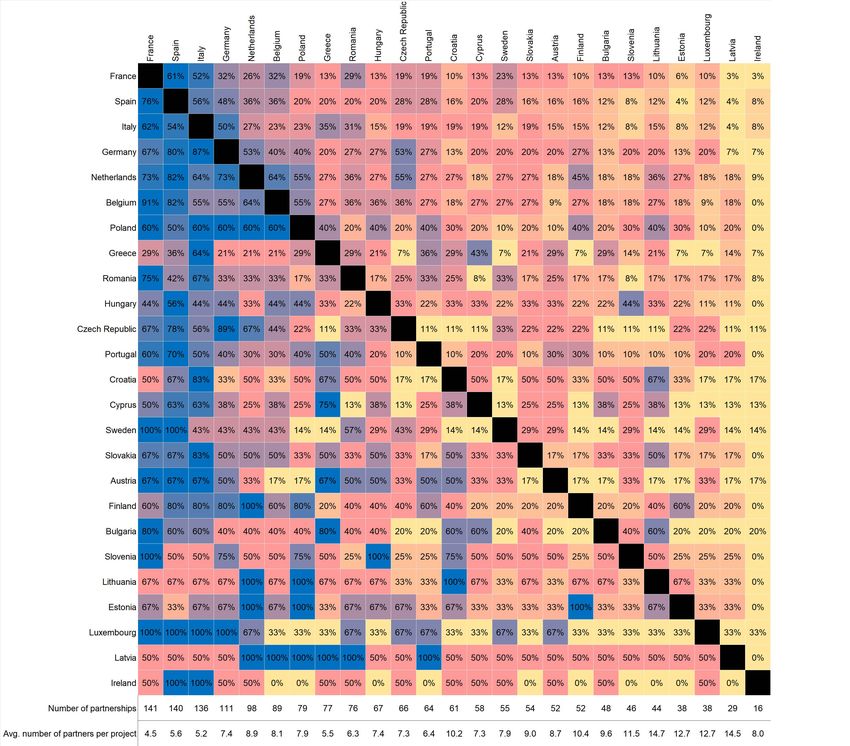
There are also interesting observations to be made about cooperation between certain
member states. The chart below lists the PESCO states in order of the number of collaborations
they have with each of the other member states. It then depicts the percentage of collaboration
with each of the other participating states out of their total participations. For example, while
it is true that Italy and Spain collaborate the most on projects, in percentage terms, their
collaboration on projects is just as strong as that between Italy and Germany.
The potential for differentiated integration does not stop here. Future research threads could
compare the results achieved under the Capability Development Plans (CDP) with those under
the common set of 74 proposals for the implementation of the EU-NATO joint declarations
made in Warsaw and Brussels. This exercise could establish how far there is complementarity
between the PESCO projects and NATO’s objectives. 15 A further categorisation of each PESCO
project could then be derived, which would be useful in classifying the priority each project
should receive when applying for funding from the European Defence Fund.

15
 From a legal standpoint, this research could also examine similarities and differences between NATO programme
Memorandums of Understanding and the PESCO Letters of Reference/project arrangements (See below, section 4).
14 | BLOCKMANS & MACCHIARINI CROSSON

Table 3. Percentage of cooperation between PESCO participating member states, by number
of bilateral collaborations per state

                   Lowest % of bilateral collaboration         Highest % of bilateral collaboration

Source: authors’ formulation.
DIFFERENTIATED INTEGRATION WITHIN PESCO – CLUSTERS AND CONVERGENCE IN EU DEFENCE | 15
So far, PESCO revolves around ‘old’ Europe, which has a higher rate of participation. As a result,
the Central and East European member states collaborate more with their counterparts in the
West, although, on average, they tend to collaborate among themselves to a greater extent
than West European countries do. 16 The geographical
So far, PESCO revolves around ‘old’
balance of each PESCO project could also be considered in
Europe, which has a higher rate of
the allocation of EDF funding. The ‘three companies from
participation. As a result, the
three countries’ standard, along with the nascent practice
Central and East European member
that two countries jointly formulate proposals for
states collaborate more with their
counterparts in the West. forthcoming projects, is far too low a bar to ensure
geographical balance. This all but guarantees a perpetuation
of uneven competition in the single defence market. Together with the observations made
above, we might ask: What factors lead to the formation of certain forms of cooperation
between member states in the projects of the first three waves, the project clusters, and the
individual projects?
3.2 Explaining cooperation
Cooperation (or non-cooperation) naturally stems from factors that unite (or divide) certain
member states. For PESCO, these factors are primarily structural and economic in nature. 17
Firstly, it is intuitive to examine the factors that bring certain member states together within
PESCO through an industrial lens. By comparing the
Cooperation (or non-cooperation)
share of the average value of PESCO participating states’
naturally stems from factors that unite
arms export licences from 2012-17, the average share of
(or divide) certain member states. For
PESCO state-owned or transnational corporations in the
PESCO, these factors are primarily
SIPRI Top 100 of total arms sales worldwide from 2012 structural and economic in nature.
to 2017, the average defence expenditures per member
state from 2012-17 and the amount of active military personnel in 2019, one can observe that
four PESCO participating states are the defence frontrunners: France, Italy, Germany and Spain
(Table 4), with Poland, Greece and Belgium in a second tier. In 9 of the 47 PESCO projects, all
four of these member states are present and three of them are all members in an additional
five projects. 18
16
On average, pre-2004 EU member states have on average 4.3 project collaborations with other pre-2004
enlargement member states, while only 2.7 project collaborations with the newest post-2004 enlargement
member states. On the other hand, the post-2004 enlargement member states have on average 2.6 project
collaborations with pre-2004 enlargement member states and 2.1 project collaborations among themselves.
17
Other factors could be considered such as the strength of ties as expounded upon by ECFRs’ Coalition Explorer.
However, this data primarily relies on perceptions.
18
Of note, there are only three projects in which none of the big four is present. These are: Maritime (semi-)
Autonomous Systems for Mine Countermeasures (Belgium, Greece, Latvia, Netherlands, Poland, Portugal,
Romania), the Joint EU Intelligence School (Greece, Cyprus), and One Deployable Special Operations Force (SOF)
Tactical Command and Control (C2) Command Post (CP) for Small Joint Operations (SJO) – (SOCC) for SJO (Greece,
Cyprus).16 | BLOCKMANS & MACCHIARINI CROSSON
Smaller projects in which three or all of the big four are present are those which, according to
the data currently available, might reward the national defence technological and industrial
base (NDTIBs) of the big four. Examples of these include the natural heirs of off-the-shelf
Organisation for Joint Armament Cooperation (OCCAR) projects such as ESSOR (Leonardo),
European Attack Helicopters TIGER Mark III (Airbus) and the MALE RPAS Eurodrone project
(Airbus, Leonardo, Dassault Aviation and Aero Vodochody). This could indicate that the financial
incentives, in the form of a 10% co-financing bonus offered by the future EDF may, at times, be
the sole reason for projects born outside of the PESCO framework to join. This could hold true
as well for projects in which any of the big four are collaborating on a bilateral or trilateral basis
with smaller member states such as the EU Beyond Line of Sight Land Battlefield Missile
Systems (to be based on the Airbus, BAE, Leonardo conglomerate MBDA’s MMP land combat
missile system) or the Armoured Infantry Fighting Vehicle/Amphibious Assault Vehicle/Light
Armoured Vehicle project (all of these are state-of-the-art Iveco products). In these cases,
increased cooperation, as highlighted on the left side of Table 1 (see above), could be explained
by certain member states’ willingness to tap into the expertise and resources made available
by the largest multinational corporations in the defence industry.
The trend of looking toward each member state’s National Defence Technological and
Industrial Base (NDTIB) is confirmed by the companies involved in some of the trial-run projects
under the Preparatory Action for Defence Research, an EDF trial experiment under the current
multi-annual financial framework: OCEAN2020 and the Generic Open Soldier Systems
Reference Architecture (GOSSRA) projects involve industrial partners such as Leonardo, MBDA,
Fincantieri, Saab, Rheinmetall and PGZ, i.e. all corporations in the SIPRI Top 100 of total arms
sales worldwide. On the other hand, the projects in which all of the big four are present and
have the output goal of stimulating coordination, harmonising standards, and jointly defining
operational frameworks (instead of industrial production), tend to be larger. Examples of these
are the Military Mobility, the Network of Logistic Hubs in Europe and Support to Operations,
the European Military Command and Co-basing projects.
Table 4. European Defence Technological and Industrial Base and Expenditures
Avg. Share of Total Avg. Share of Arms Avg. Military 2019 active military
Value of EU Arms Sales by EU MNCs in expenditure by personnel
Export Licences 2012- the SIPRI Top 100 country according to
2017 2012-2017 IISS, in millions of $US
at current prices and
exchange rates,
2012-2017
Austria 3.2% 3068.5 21200
Belgium 2.1% 4770.7 26550
Bulgaria 0.9% 797.2 31300
Croatia 0.7% 843.1 15200DIFFERENTIATED INTEGRATION WITHIN PESCO – CLUSTERS AND CONVERGENCE IN EU DEFENCE | 17
Cyprus 0.0%* 356.3 15000
Czech Republic 0.6% 2034.1 23200
Estonia 0.0% 487.8 6600
Finland 0.4% 0.3% 3722.3 21500
France 60.6% 29.8% 59864.0 203900
Germany 8.8% 9.0% 44213.0 179400
Greece 0.2%* 5329.5 142350
Hungary 0.8% 1282.7 27800
Ireland 0.1% 1095.0 9500
Italy 6.6% 23.7% 26850.2 171050
Latvia 0.0% 339.0 6210
Lithuania 0.0% 504.9 19850
Luxembourg 0.0% 278.3 900
Netherlands 1.8% 9714.6 35400
Poland 1.4% 1.6% 9642.6 117800
Portugal 0.2% 3959.0 27200
Romania 0.4% 2682.3 69300
Slovakia 0.2% 1004.0 15850
Slovenia 0.0% 476.7 7250
Spain 9.5% 1.0% 16421.5 120350
Sweden 2.0% 4.2% 5944.9 29750
30.3%**
The top six member states per category are in bold.
* Incomplete member state data due to absent national reporting to European institutions.
** Trans-European (Airbus, MBDA)
Source: SIPRI Databases (https://www.sipri.org/databases), IISS Military Balance 2019 and own calculations.18 | BLOCKMANS & MACCHIARINI CROSSON
Another way of explaining cooperation between participating states (also outside of the big
four) is to examine previous frameworks for bi-, tri-, and minilateral defence cooperation in
Europe. Distinctions should be made between operational and capabilities-oriented
cooperation, and among different forms of operational cooperation, i.e. those that are multi-
sectoral and those that are limited to one sector only. In doing so, forms of cooperation as spin-
offs of NATO, such as the Joint Expeditionary Force, created at the 2014 NATO Wales Summit,
or the broader concept of EU pooling and sharing, are left out. Table 5 below presents an
overview of the first type of cooperation, i.e. multi-sectoral and involving operational elements.
Table 5. Multi-sectoral and operational defence cooperation in Europe 19
Cooperation Format Member States
Lancaster House Treaties France and non-PESCO UK
Élysée/Aachen Treaties France and Germany
Sweden, Finland and non-PESCO Denmark, along with
Nordic Defence Cooperation (NORDEFCO)
non-EU Norway and Iceland
Visegrád 4 Poland, Hungary, Czech Republic and Slovakia
Benelux Defence Cooperation (2012 Declaration to
Belgium, Netherlands and Luxembourg
further defence cooperation)
Baltic Defence Cooperation Estonia, Latvia and Lithuania
Hungary, Czech Republic, Slovakia, Austria, Croatia and
Central European Defence Cooperation
Slovenia (with Poland as an observer)
Source: authors’ formulation.
19
Treaty between the United Kingdom of Great Britain and Northern Ireland and the French Republic for Defence
and Security Co-operation, Articles 1-2, https://assets.publishing.service.gov.uk/government/uploads/system/
uploads/attachment_data/file/238153/8174.pdf
Franco-German Treaty of Aachen, Article 4, https://www.diplomatie.gouv.fr/en/country-files/germany/france-
and-germany/franco-german-treaty-of-aachen/
Nordic Defence Cooperation Memorandum of Understanding, Section 1, http://www.nordefco.org/Files/
nordefco-mou.pdf
Long Term Vision of the Visegrád Countries on Deepening their Defence Cooperation, political declaration, Point
1, http://www.visegradgroup.eu/about/cooperation/defence
Central European Defence Cooperation, unable to find the 2012 “light institutionalisation” agreed to in May 2015
in Brdo, Slovenia, as referenced by the current paper in Section 4: https://webapp.uibk.ac.at/ojs/index.php/
OEZP/article/view/1610/1295
Joint Communique of the Baltic Defence Cooperation Ministerial Committee, Point 4,
https://kam.lt/en/news_1098/current_issues/baltic_defence_ministers_agreed_on_mutual_positions_on_aspec
ts_of_the_nato_deterrence_and_defence_measures_at_the_meeting_in_tartu.html. We were unable to retrieve
the constituent document of the Central European Defence Cooperation. Academic papers are sceptical of its
utility (Lang and Schwarzer 2011). See https://www.files.ethz.ch/isn/134241/2011C30_lng_swd_ks.pdf.DIFFERENTIATED INTEGRATION WITHIN PESCO – CLUSTERS AND CONVERGENCE IN EU DEFENCE | 19
These forms of cooperation concern both operations and acquisition of capabilities. The 2010
Lancaster House Treaties for Defence and Security Co-operation, the 2019 Franco-German
Treaty of Aachen marking 56 years from the Élysée Treaty, the NORDEFCO Memorandum of
Understanding, the Long Term Vision of the Visegrád Countries on Deepening their Defence
Cooperation, and the 2012 Benelux Declaration on Defence Cooperation formally structure
cooperation between the parties to those agreements. Baltic Defence Cooperation is not
formally structured in one document yet is still multi-sectoral in nature. Other forms of bi-, tri-
, and minilateral defence cooperation do exist, however. Examples include BeNeSam Naval
Cooperation between Belgium and the Netherlands, Polish-German Submarine Cooperation,
and Dutch-German Battalion and Air Force Cooperation, all operational in nature but limited in
scope. Finally, on the acquisition side of things, France, Italy, Spain, Belgium, Germany, and the
non-PESCO United Kingdom are all full members of OCCAR. This organisation has the objective
of facilitating joint production and procurement programmes for defence equipment. The
Netherlands, Poland, Lithuania, Sweden, Finland and (for now) EU accession country Turkey are
observers and participate in a limited number of these projects.
These pre-existing forms of bi-, tri-, and minilateral cooperation in Europe only explain PESCO
cooperation to a certain extent. Benelux cooperation and Baltic cooperation remain strong in
PESCO, whereas Franco-German, Nordic and Visegrád cooperation is surprisingly low. In the
Franco-German case this could be due to their different views on how PESCO should be run,
reflective of increasing tensions between the two sides of the
Pre-existing forms of bi-, tri-,
Rhine since the beginning of Emmanuel Macron’s presidency.
and minilateral cooperation in
Finland and Sweden, the only PESCO participating states in
Europe only explain PESCO
NORDEFCO, have different preferences vis-a-vis partners, with cooperation to a certain extent.
Finland preferring to cooperate with the German-Dutch-Polish
axis and Sweden choosing France and Spain as its preferred partners. This could be seen
through a European Intervention Initiative (EI2) lens (Zandee and Kruijver, 2019). Sweden, not
a member of this France-led initiative to develop a common strategic culture in Europe, may
want to keep strong ties to its French counterparts, whereas Finland, a member of EI2, would
prefer to strengthen its relationship with the more reluctant Germany, 20 followed in this case
by Poland and the Netherlands, with which it shares staunch support for a leading role for NATO
in providing for Europe’s collective security. As for the Visegrád countries, Poland prefers to
partner with the Dutch, Czechia with Germany, and Hungary and Slovakia with Italy. This raises
the question of whether these seemingly unexpected partnerships are born out of natural
20 German participation in the EI2 could be seen as a way to control the French initiative and prevent it from superseding PESCO
as the main experiment in European-wide defence cooperation. Indeed, the potential for duplication, in particular with PESCO’s
German-led EUFOR Crisis Response Operation Core (EUFOR CROC) project, is real. While stressing the “need to further develop
the emergence of a shared strategic culture through the European Intervention Initiative” in their Meseberg Declaration of 19
June 2018, Macron and Chancellor Merkel agreed to link EI2 “as closely as possible with PESCO.” For that to happen though,
the associate status of the respective non-members is essential.20 | BLOCKMANS & MACCHIARINI CROSSON
synergies in member states’ strategic cultures (cf. EI2) and/or particularly strong integrated
value chains. 21
One key underlying element of PESCO’s 20 binding commitments is the pursuit of alignment in
strategic cultures at the EU level. As Biehl, Giegerich and Jonas (2013) note, EU member states
can be largely categorised into three clusters based on their level of ambition in international
security policy, the scope of action for the executive branch in military-security decision-
making, their foreign policy orientation and their willingness to use military force (linked to
threat perceptions). The clusters that emerge from their analysis, displayed in Table 6, prove
to be interesting input for the discussion on PESCO groupings.
Table 6. Strategic cultures within PESCO-involved EU member states
Security policy as a Security policy as Protecting and projecting
manifestation of statehood international bargaining state power
Relatively high (often
Low to medium (activities
The level of ambition in ‘punching above its weight’
are expected to lead to
international security in order to gain High
indirect effects, i.e. a seat
policy international visibility and
at the table)
credibility)
High flexibility for the
executive (Presidential or
The scope of action for majoritarian
the executive in decision- Strong legislative rights Strong legislative rights parliamentary system) or
making strong informal ties
between the executive
and legislative branches
Functional: NATO for
Strong advocates for
Foreign policy orientation Tendency toward the EU collective defence,
either EU or NATO
otherwise EU preference
High for defence
The willingness to use
Low purposes, lower for crisis High
military force
management
Belgium, Bulgaria,
Czechia, Estonia,
France, Greece,
Germany, Italy, Latvia,
Austria, Cyprus, Finland, Netherlands, Poland,
Lithuania, Romania,
Countries Hungary, Ireland, Sweden (and potential
Slovakia, Slovenia, Spain
Luxembourg, Portugal third country participant
(and potential third
UK)
country participant
Norway)
Source: authors’ formulation.
21According to Pannier and Schmitt (2014), and “contrary to the arguments of many discussions, think-tank reports and
political actors, there is no evidence that institutionalised cooperation leads to policy convergence as far as defence is
concerned.”DIFFERENTIATED INTEGRATION WITHIN PESCO – CLUSTERS AND CONVERGENCE IN EU DEFENCE | 21
Two main conclusions can be drawn from this attempt to cluster EU member states’ strategic
cultures. First, strategic culture alignment plays a role in determining the extent of participation
of certain member states in PESCO. In fact, those states with a strategic culture aimed at
protecting and projecting their state power generally participate in more projects, thanks to
the larger margin for manoeuvre of the executive branch of government and a generally high
willingness to use military force. This is true for France, the Netherlands, Greece and Poland.
Furthermore, those member states that use their security policy to gain visibility and credibility
on the international stage have more heterogeneous participation rates in PESCO. In the final
cluster, for those states that use their security policy as an international bargaining tool, there
is some variation. A schism emerges in this cluster between Atlanticist, pro-NATO and generally
Central and Eastern European member states that are less involved in PESCO, and Europeanist,
Western European member states with higher participation, which could be explained by their
‘functional foreign policy orientation’ (see Table 6).
Moreover, strategic culture alignment can explain cooperation among certain member states
within PESCO. First, while there is greater variation in participation among those states that use
their security policy as a tool for international
Strategic culture alignment can bargaining, the states within this cluster tend to
explain cooperation among certain cooperate more among themselves than do the states in
member states within PESCO. other clusters. This could indicate that such a strategic
culture is correlated with an institutional tendency
towards cooperation. A case in point is Croatia’s strong preference to partner with like-minded
strategic partners within PESCO. Furthermore, some bilateral cooperation within PESCO might
be explained by the alignment of strategic cultures. This could be said for Portuguese
cooperation with both Austria and Finland.
Other variables could also partially explain why states participating in PESCO prefer each other
as partners. Chief among these is geography. Countries like the Czech Republic, Croatia,
Bulgaria, and Estonia have stronger partnerships with one or more bordering countries or
countries in the immediate vicinity. The Baltics and
Other variables could also partially
Balkan countries, in particular, show a high level of explain why states participating in
cohesion among themselves. Geography plays another PESCO prefer each other as partners.
role in the scope of cooperation. For example, all the Chief among these is geography.
states participating in maritime capabilities projects are
seafaring. This is unsurprising from both a practical and industrial standpoint, yet one could
suppose that certain components or competences are not necessarily strictly maritime, i.e. the
Hungarian river minesweeping fleet for the Danube. Secondly, linguistic and cultural proximity
could explain strong Belgian-French, Belgian-Dutch and, above all, Greek-Cypriot cooperation
within PESCO. Finally, it seems that in a few cases, a strong pro-NATO stance (and consequently
a more open position vis-a-vis third country participation) brings EU member states together inYou can also read


