Refining rabbit care A resource for those working with rabbits in research
←
→
Page content transcription
If your browser does not render page correctly, please read the page content below
NEWCASTLE UNIVERSITY

                                                                                                                                                                                                     NOVO NORDISK
                                                                                                                                                                                        Established 1926

                                                                                                                                                     Refining rabbit care
                                                                                                                                                               A resource for those working
                                                                                                                                                               with rabbits in research
ISBN 978-0-901098-06-1

                                                                                                                                                               P Hawkins, R Hubrecht, A Buckwell, S Cubitt, B Howard, A Jackson, G M Poirier
                                                                                                                     Established 1926

                         Wilberforce Way, Southwater, Horsham, West Sussex RH13 9RS            The Old School, Brewhouse Hill
                         Tel: 0300 1234 555 www.rspca.org.uk                          Wheathampstead, Hertfordshire AL4 8AN
                                                                                          Tel: 01582 831818 www.ufaw.org.uk
020108

                         A charity registered in England and Wales, no: 219099
                         We receive no government funding 4.08                                        Registered charity no: 207996
Refining rabbit care                                                                                                      Contents
    A resource for those working                                                                                              Introduction
    with rabbits in research
                                                                                                                              1     Rabbits’ behavioural needs: How to optimise welfare   4
    P   Hawkins a,    R   Hubrecht b,    A   Buckwell c,    S   Cubitt d,   B   Howard b,   A   Jackson e,   GM   Poirier f         1.1   Enclosure size and characteristics              5
                                                                                                                                    1.2   Social housing                                  7
                                                                                                                                    1.3   Solid flooring and substrate                    11
                                                                                                                                    1.4   Raised areas                                    11
                                                                                                                                    1.5   Refuges                                         12
                                                                                                                                    1.6   Gnawing objects and dietary enrichment          13
                                                                                                                                    1.7   Positive interaction with humans                14
                                                                                                                                    1.8   Toys and objects to manipulate                  15
                                                                                                                                    1.9   Special needs of breeding does                  16

                                                                                                                              2     Monitoring refinements and record keeping             18

                                                                                                                              3     Rehoming rabbits                                      20

                                                                                                                              4     Rabbit-related resources                              20

                                                                                                                              5     Feedback                                              21

                                                                                                                              6     Acknowledgements                                      21

                                                                                                                              Appendix: Rabbit ethogram                                   22

    a Royal Society for the Prevention of Cruelty to Animals; b Universities Federation for Animal Welfare;
                                                                                                                              References                                                  25
    c University of Leicester; d Institute of Animal Technology; e Huntingdon Life Sciences; f GlaxoSmithKline

2                                                                                                                                                                                              3
INTRODUCTION 1.1 ENCLOSURE SIZE AND CHARACTERISTICS
(1 to 2”) above floor level. This provides a visual break between individuals,
which can help to reduce aggression, and some rabbits spend much of
This resource was produced by members of the UFAW/RSPCA Rabbit Behaviour and their time resting behind them.
Rabbits move by crawling, hopping, running and jumping, often involving
Welfare Group. It is intended for use by animal technicians, facility managers, quick changes in direction. Sufficient space is needed for all these forms Concerns may be expressed that rabbits might be more difficult to capture
veterinarians and scientists and provides guidance to help meet the needs of the of exercise (and play in young animals) and appropriate social interactions, if they occupy a larger, more complex space. However, staff can be trained
and for the provision of enrichment. In the wild, home range sizes for to use the natural behaviour of the rabbit to facilitate capture without
laboratory rabbit and improve upon the husbandry standards set out by national individuals within rabbit social groups are approximately 50 square resorting to chasing. Rabbits naturally tend to hide when people enter
guidelines or legislation1, 2. The recommendations, guidelines and case studies within metres10, yet the largest European standard size for a rabbit cage is 0.54 their enclosure and so they can often easily be caught by gently and
square metres1. This represents around 1% of the rabbit’s ‘natural’ range. smoothly removing them from their refuge. Once rabbits are accustomed
this book are based on the expertise and practical experiences of people who use and
to being calmly caught in this way, they should usually
care for laboratory rabbits, supported by reference to the current animal welfare The need for exercise and space for social
stop hiding from familiar care staff and allow
NOVO NORDISK
interaction is highly conserved in laboratory
science and laboratory animal science literature. rabbits; for example, a study on New Zealand
themselves to be picked up. See section 2.7 of the
JWGR for more guidance on catching rabbits7.
White (NZW) rabbits housed in a semi-natural
enclosure found that one-third of their active How to provide extra
time was spent exploring, gnawing, and space and height
1 RABBITS’ BEHAVIOURAL NEEDS: HOW TO OPTIMISE WELFARE
performing intensive locomotion and sexual If rabbits must be housed in cages, Comfortable
behaviour11. If they do not have the freedom to Quarters recommends that cages should measure
The first step towards providing good housing and care for any animal is that give cause for concern. In most cases, the best way to prevent
exercise and take sequences of hopping steps, at least 0.68m (27”) wide, 0.8m (31”) long and 0.75m
to define the needs of the species (or strain)3. (We define the term ‘need’ behavioural problems is to consider the whole life experience of the
rabbits may be at higher risk of developing (30”) high8. Rabbits could be housed singly if group
in this document as an animal’s requirements to ensure good welfare.) rabbits and provide them with tailored husbandry refinements from
bone weakness and skeletal abnormalities12. housing is not appropriate (see section 1.2), or in pairs
There are a number of approaches to this, including considering (i) the as early an age as possible. Good communication with breeders will
in cages of these dimensions, although cages of this
animals’ sensory world, biology and habitat in the wild, (ii) the results of help to ensure that rabbits are brought up under suitable conditions Rabbits also need sufficient space so that
size may not be easily available. More space can be
applied animal behaviour and welfare science studies, and (iii) the results (taking the eventual research environment into account, see below) they can use different resources within an
provided by building larger pens, buying larger cages
of other relevant studies, e.g. nutritional and epidemiological research. and supplied in harmonious pairs or groups when appropriate. area for specific behaviours. If they are able
(e.g. housing small rabbits in the largest commercially
This resource is concerned with the first two of these approaches. to, rabbits choose to use separate areas for
In a research setting, it is also necessary to make sure that the housing available cages, rather than adhering rigidly to the
feeding, resting, nest making and excretion.
It is important to consider the behaviour and biology of rabbits in the and care system is compatible with achieving the aims of the research, weight-specific sizes in the European guidelines),
It appears to be especially important for
wild when designing laboratory rabbit housing and care protocols, as otherwise the science will be flawed and animals’ lives may be wasted. adapting current cages or working with
rabbits to be able to disperse when they are
‘domestic’ rabbits retain many wild-type behaviours and express these In addition, specific husbandry needs may arise from particular manufacturers to design larger cages. As health
active and for low-ranking does to be able to
when they are given the opportunity4, 5. While some domestic animals research protocols. This resource has taken account of these issues and safety is a consideration for larger and heavier cages, pens
retreat to the periphery of the enclosure during active periods13.
have been selected for certain behaviours, such as tractability towards by suggesting alternative approaches for each refinement that can may be a more practical option.
humans, rabbits have been selected primarily for their fur and meat. be used if the primary recommendations are not feasible. Rabbits frequently sit in an upright posture with their ears erect,
This means that, from a human-animal interaction point of view, the Pens provide more space. An enclosure length of 1.5 to 2.0m (60 to 79”)
so that they can scan their surroundings7. Pens can allow rabbits
Finally, it is essential that all those involved in implementing the is recommended on the basis that a fully grown NZW will move forward
rabbit is not really very domesticated at all; in fact, the behaviour of to perform this behaviour without their ears touching the roof and
refinements set out in this resource have discussed how any new this distance in just three hops14. Additional space may be needed
wild and domestic rabbits has been found to be very similar indeed6. therefore may be better for the welfare of the rabbits.
measures will be introduced and how people feel about the changes depending on group size. For example, Comfortable Quarters
It is essential to bear this in mind when caring for and handling rabbits.
that are planned. For example, there may be concerns in relation to Background recommends a minimum floor area of 2m2 (21.5ft2) for up to four adult
The rabbits’ needs set out in sections 1.1 to 1.9 below are mainly based staff health and safety, or the time that it will take to clean and monitor rabbits weighing 4 to 6kg (9 to 13lb), with an increase of 0.45m2 (4.8ft2)
Providing sufficient, structured space will benefit any active and physically
on two documents that have used both approaches (i) and (ii) mentioned animals housed using new systems. Researchers should also be for each additional adult. In the authors’ experience, rabbits are commonly
fit animal. One university found that some rabbits, previously housed in
above: the revision of the European Convention that sets out laboratory consulted about how the animals used in their projects are to be cared housed in pens measuring between 1.5 and 2.5m2 (16 to 27ft2), which
small cages without adequate inclusions, developed leg injuries due to
animal husbandry standards1; and the BVA(AWF)*/FRAME/RSPCA/UFAW for, to ensure that refinements are compatible with the experimental are used to house groups of around three or four large rabbits
muscle wastage (or, more rarely, fractures) when placed in the pens.
Joint Working Group on Refinement (JWGR)7. We have also used the needs and will not interfere with research data. However, all the (e.g. NZWs) or four to six of the smaller strains (e.g. dwarf lops).
Adequate monitoring and appropriately designed and equipped
Animal Welfare Institute publication Comfortable Quarters8, other husbandry systems and methods for implementing them described
enclosures will help to prevent injuries; gradually increasing enclosure A physically fit rabbit with strong bones can jump surprisingly high,
recent papers on rabbit behaviour and welfare and the findings of the in this resource have been employed in care routines, including those
size may be a good idea in some circumstances. so pen height should be at least 1.2m (4ft) to stop the rabbits jumping
Pharmaceutical Housing and Husbandry Steering Committee project associated with scientific studies. Considerable benefits are possible
on rabbit husbandry9. in terms of increased interest, satisfaction and morale for animal carers The introduction of large areas of unstructured space may be of limited out or injuring themselves in the attempt (and solid items such as refuges
and researchers alike. It has also been found that housing in floor pens benefit to the animals, because (i) large, barren areas are stressful, which should be positioned away from the sides so that they are not used as
The guidance on how to meet the needs of the rabbit has been drawn springboards to freedom). If a mesh cover is used instead, it should be
can result in savings on money and staff cleaning time**. is why ‘open field’ tests are used as a model of stress, and (ii) rabbits tend
up using current animal welfare science literature, the experience of to carry out distinct activities in different places. It is therefore good at a height that allows the rabbits to sit up in the ‘rearing alert’ position
the authors and practical information kindly made available to us by Ultimately, any concerns should be addressed by effective practice to subdivide the living space using partitions, platforms and without the tips of their ears touching the roof. Suitable materials for
a number of universities, pharmaceutical companies and laboratory communication and discussion between all involved, including the shelters to encourage rabbits to use different areas for different activities. the mesh are stainless steel, which is relatively light and easy to clean,
animal breeders. It includes factors to take into account when changing attending veterinarian and researchers, for example as part of regular This also facilitates harmonious social housing (see below). Partitions can or plastic coated mesh, although this cannot be put through the cage
husbandry, how to introduce each refinement and what to do if the reviews of husbandry refinements within the Ethical Review Process be constructed from sheet materials such as ply (e.g. 0.6 x 0.6m or 24 x washer. As an example, rabbits housed at the University of British
rabbits do not appear to be using a resource or if there are behaviours or other appropriate animal care and use committees. 24”) and suspended from the top of the pen so that they are 25 to 50mm Colombia are housed in pens originally designed for dogs, with indoor
* British Veterinary Association Animal Welfare Foundation, Fund for the Replacement * * For example, in the absence of overheads, rabbit caging can cost ¤900 per cage over a 10-year cage life,
4 of Animals in Medical Experiments which works out at ¤46 per rabbit per year if rabbits are cage housed. Floor housing can cost ¤570 per pen over a
five-year cage life, which can be ¤11 per rabbit per year if animals are housed in groups of 10 (S Cubitt, pers. comm.).
5
and outdoor sections. The indoor areas are 1.5 by 1.7m (5ft by 5ft 7”) and social behaviour that helps to reinforce hierarchies and maintain
the outdoor areas 3.5 by 1.7m (11ft 6” by 5ft 7”). The rabbits are housed in
Troubleshooting 1.2 SOCIAL HOUSING awareness of which animals are present. Rabbits possess scent
groups of six to eight and are free to move from one area to another. ● If the rabbits are not using all the available space or are not glands in the anal region, in the groin and under the chin. Both
carrying out different activities in different areas, review the The rabbit is a naturally gregarious species and wild rabbits live in small,
They are provided with a range of other enrichment items and are able sexes use the chin gland in particular for marking out territory,
number and position of blinds, partitions, platforms or territorial breeding groups. The social unit comprises one dominant male,
to run and climb as well as use the indoor resting areas8. although males do this more frequently than females. In free-ranging
shelters. Try adding or removing some and/or rearranging them. one to nine females, with juveniles, and sometimes several
European rabbits, scent marks are concentrated at the centre of
These pens at Novo Nordisk (below) are purpose-built and measure 2 by sub-dominant males6. Studies of both wild rabbits and laboratory strains
● If fractures or other injuries such as muscle strains occur, the an area controlled by a social group and at the boundaries between
1.5m (6ft 6” by 5ft). The pens are fixed to the wall at waist height to minimise in semi-natural enclosures have shown that they maintain a strict rank
rabbits may not have been strong enough to cope with the extra adjacent social groups22. It is a good idea to give captive rabbits the
bending and lifting by animal care staff and to facilitate catching the rabbits. order and that aggression is often defused by submissive behaviours
space and other resources. In such cases the housing protocol opportunity to scent mark in similar locations within the enclosure.
Plastic sheeting prevents the rabbits from escaping and reduces room and by animals having the ability to get away from one another6, 18.
allergen levels. Each pen is divided in two along its length by a partition should be changed, for example by initially providing a smaller area
In summary, the key advantages of housing young rabbits and
NEWCASTLE UNIVERSITY
that has pop holes to allow the rabbits to run through. A purpose-built and lower platforms, then gradually increasing the space available.
older female rabbits in harmonious social groups are: better welfare
shelter is placed on each side of the partition, so that rabbits can hide or resulting from the presence of social partners; the ability to express
hop on top. The floor is solid, non-slip and covered with a thick layer of litter. a broader range of natural behaviours; and calmer, more docile
The housing system slopes toward the rear end, allowing urine and water Alternative approaches animals. There can also be advantages for humans, including
spillages to be drained into an outlet. Natural light enters through the If sufficiently large, permanent accommodation cannot be provided, a scientific and possible economic benefits and greater job
windows and is supplemented by an artificial light cycle of 12:12. These shared exercise area is a useful alternative. This has been achieved at satisfaction7, 21, 23.
rabbits are used in immunisation and pharmacodynamic studies and are the University of Delaware by adapting a round, non-inflatable plastic
housed in groups of 10 for short-term or eight for long-term projects. children’s paddling pool, 6ft (1.8m) in diameter, into an exercise pen16. Background
The exercise pen is filled to half its depth with shavings and hay, plastic Social housing works best for female rabbits, maintained in groups
that were formed at weaning and allowed to remain stable. If female
NOVO NORDISK
balls with rattles are placed inside and metal fencing is placed around
the pen to contain the rabbits. Rabbits are put into the pen for an hour rabbits have been singly housed in cages for more than six months,
each day – singly at first, then in small groups after they have they may be fearful and are often better off in pair housing rather
habituated to it. The pen is emptied and cleaned once a week with than larger groups.
disinfectant (cage wash is unsuitable for the plastic) and the fence is The principal concern for most people considering group housing
also cleaned weekly. This arrangement allows the rabbits to rear on their is aggression, which will occur to some level. Compatibility depends
hind legs, stretch and play, and investigators reported that the animals on a number of factors, some of which can be controlled by good
were more interested in enrichment items, calmer, less aggressive and husbandry practice (such as pen size and structure, thoughtful
easier to handle. They also reported that blood sampling time has grouping protocols, etc.) and some of which cannot (for example
been dramatically decreased and rabbits now come to the front of the individual temperaments). Compatibility also correlates with sexual
cage instead of running to the back when visitors enter their room. Group housing represents a stimulating form of ‘enrichment’.
activity and stages of pregnancy and may show seasonal variation.
Behavioural studies have found that pair- or group-housed rabbits
It is also possible to construct or adapt a pen, or adapt a room, to act Aggression can be minimised by providing visual barriers and refuges
spend significant amounts of their time in close proximity to others19, 20.
as an exercise area (some establishments simply allow compatible arranged so that animals can engage in contact by approaching
The quality of life of group-housed rabbits is significantly improved in
rabbits to spend periods running free on the floor of the animal others, as well as withdraw out of sight if they feel the need.
If floor pens are not a feasible option, an alternative way of providing comparison with singly housed animals, even for those individuals
room). This is possible for rabbits on all types of study, including regarded as subordinate21. Therefore, young rabbits and older female It may also be possible to reduce aggression by using husbandry
extra space is to join cages together. Modular cage systems that are
regulatory toxicology. For example, NZW does on reproductive toxicology rabbits should be housed in harmonious pairs20 or social groups, regimes that respect rabbits’ scent-marking behaviour. Cleaning out
specially designed to be joined together are available commercially.
studies at AstraZeneca are given access to pens equipped with unless group housing is precluded on veterinary advice or if it is destroys most or all of the marks that the rabbits have laid down
Alternatively, it may be possible to adapt more conventional caging
platforms, tunnels and different floor materials (aspen chips and incompatible with the study design. However, adult entire males and there has to be a balance between the need for acceptable
systems. Cages can be joined horizontally, or vertically using ramps,
shredded paper). The rabbits are exercised in pairs or groups of three, should normally be singly housed because their territorial behaviour hygiene standards and the need to avoid disrupting the animals’
as reported by the UK National Institute for Biological Standards and
for 10 to 20 minutes at least twice a week before blood sampling. may lead to serious fight wounds. olfactory environment, which is likely to be stressful for them.
Control15. This was found to be a practical way to provide more space
Besides the usual benefits of decreased anxiety and improvements Disturbance can be reduced by regularly cleaning out latrines and
for pair-housed NZW and Dutch rabbits.
in physical condition, this also helps to warm the rabbits, promoting Group-housed rabbits need
NEWCASTLE UNIVERSITY
replacing soiled substrate, so that total clean-out frequency is
However housing is modified, rabbits should adapt to using clearly vasodilatation for blood sampling if required. The programme has to be able to initiate or
minimised. The cleaning frequency should be determined as a
defined areas for feeding, resting, exercise/foraging and excretion. had no effect on litter sizes or weights, or on abortion and embryo withdraw from social and
function of the rabbit stocking density, the substrate material and
Physiological improvements may be noticed, such as tending towards or fetus resorption rates17. visual contact at will; this
the experimental design. Transferring objects that have been scent
the ideal body weight and increased muscle tone, but the rabbits will is facilitated by providing
If animals are incompatible, they can use the exercise area individually marked when the enclosure undergoes a total clean out may also
still spend a significant amount of time resting, so do not expect them plenty of space and
instead of with others. It is a good idea to allow each individual or group help to minimise disruption.
to be active in the extra space all the time. However, the authors’ structures such as refuges
to use the area at the same time every day. It has been found that young,
experience is that the rabbits’ behaviour should be calmer; for example, and partitions. Partitions However, aggression can arise for reasons that are not apparent to
fattening rabbits given access to an area for half an hour at the same time
animals should run away less often when visitors enter the room. and other structures also humans and this is obviously much harder to prevent. Ultimately, each
every day performed 65% of their rapid, locomotory play in the run and
provide the rabbits with establishment should consider the potential harms and benefits of
The input of care staff is essential when modifying cages, as they will the remainder in the two hours before their daily exercise period 1. This
additional places to scent social housing and decide what level of aggression is acceptable. For
have to handle, clean and maintain them. Pilot studies are a useful way suggests that it could be important to maintain a regular routine
mark. This is an important example, it may be decided that rabbits should be housed together and
of identifying and dealing with practical or health and safety issues. for access to the exercise area.
6 7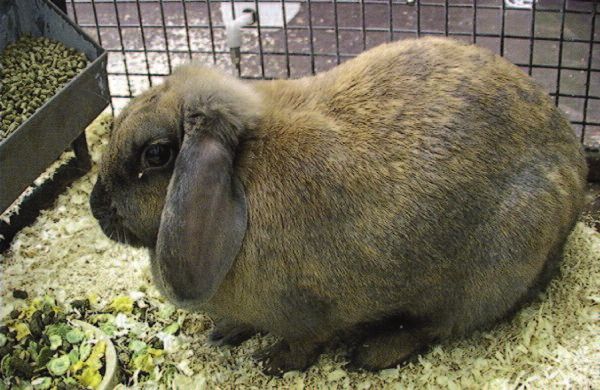
that occasional ‘scuffles’ are acceptable (especially when groups are Aggression frequently occurs at night. If it is available, low-lux CCTV
first established), provided that no wounds occur that require surgical can be used in conjunction with a time-lapse video recorder to monitor Making decisions about castration Stability
repair, the group’s health is not impaired and no individuals are rabbits without disturbing them, including the use of infra-red light There are a number of ethical and welfare issues associated Groups must be stable and harmonious to minimise the risk of
subjected to unacceptable aggression. If such aggression does during the dark cycle. This can be used to identify any aggressors and with castration, as summarised below, and these will need to aggression and injury. Introducing unfamiliar animals can be difficult
occur, the answer may be not to stop group housing permanently animals receiving aggression, as well as indicating whether there are be discussed by the relevant animal care and use or ethics once the animals are mature, which is normally over three or four
but to address housing and husbandry, using the guidance in this issues with housing and enrichment that need to be addressed. committee (or local Ethical Review Process in the UK) in order to months old (depending on the strain and feeding regime), but even
book, and to keep it under continuous review. A reverse light cycle is another option, so that animals can be decide what is acceptable for each establishment. This assumes then care must be taken when introducing such a rabbit to a
monitored during the period when aggression is more likely. that (i) the experimental protocol does not require intact male pre-formed group. Even relationships between pair-housed rabbits
Another concern is that subordinate rabbits may become stressed
in group housing. However, the benefits of social housing outweigh In the authors’ experience, laboratory rabbits can be housed in animals and (ii) castration will be conducted by appropriately are highly individual and pairs should not be swapped over, as this
stress that is solely due to being subordinate (which is a natural part large groups of 30 or more, provided that the animals have an trained personnel, with effective pain management and can lead to severe aggression.
of the experience of being a rabbit), provided that levels of aggression appropriate quality and quantity of space and the groups have supportive perioperative care.
NEWCASTLE UNIVERSITY
are not exacerbated due to inappropriate housing. A study of female been established with care, according to the guidance below. Note that castration is a regulated veterinary procedure in
NZWs housed in non-littermate pairs in double cages found that many countries; for example, in the UK it may only be conducted
enrichments such as nest boxes and ‘bunny blocks’ were not Sex and age by a qualified veterinarian. It is essential to check with the
monopolised by dominant animals20. However, with some double-cage It is best to house rabbits in single-sex sibling groups that have been relevant national legislation before deciding on who will
designs there is a risk that the dominant rabbit can lie with half her kept constant since birth, but an alternative option is to form groups conduct the surgery.
body in each cage, restricting the movement of the other rabbit(s), in at weaning, i.e. at about six weeks of age. It is easiest to group house
which case food and water should be available in both halves of the Castration should be carried out three to four weeks after weaning
young female rabbits, although adult females of placid strains can
cage (Shirley Seaman, pers. comm.). and before the rabbits reach sexual maturity, which will be between
be moved from individual to pair-housing, provided that cages are
50 and 80 days of age, depending on their strain and nutritional
appropriately structured. While group members should always be
Socially housed rabbits should be individually identified, preferably status. Even after castration some aggression may occur; it is less
the same age and sex, they do not necessarily have to be littermates.
in a way that means they can be identified from a distance without frequent than in entire males, but probably commoner than in
Intact mature females not used for breeding can usually be group
undue disturbance. Section 2.8 of the JWGR offers guidance on group-housed females. Also, sufficient time must be allowed after
housed indefinitely, but entire males over 50 to 60 days old should
identifying rabbits7 surgery for the concentration of sex hormones in the blood to
be individually housed, even if they are littermates, to prevent serious
decline – this can take one or two months and is essential if
injuries from dominance fights. It may be better to house entire
How to introduce social housing the males have reached sexual maturity.
males individually from the time they are acquired, to prevent stress
When planning a change from individual to group housing,
due to husbandry changes as they mature. ● Castration involves surgery, which requires suitable
it is essential to consider:
facilities and the provision of appropriate analgesia and Isolation for veterinary or scientific procedures
● sex In the opinion of the authors, housing male and female rabbits so post-operative care. Whenever possible, house individuals separated for experimental
● age that they can sense one another’s presence should be avoided, even or clinical reasons so that they can maintain olfactory and visual
if they are housed in single sex groups (or females are group housed ● After castration, male rabbits generally become less aggressive contact (at least) with the rest of the group. It is not normally
● strain
and males are singly housed). Groups of entire males kept close to and less active and can be housed together. necessary to isolate rabbits after they have recovered
● how the group can be kept stable – how to deal
females tend to fight and urinate more frequently18, so the males are ● No veterinary intervention should be performed unless it is following surgery.
with disruptions such as removal of individuals for
clearly responding to the presence of females. Although there is no in the best interests of the animal concerned.
procedures or introducing unfamiliar animals At the University of British Columbia, female rabbits were pen
evidence that this is stressful for either sex, on the basis of current
● the housing and husbandry system ● Some consider it morally wrong to mutilate animals so that housed in groups of five and the groups were routinely re-formed
knowledge about rabbit behaviour it is possible that being able to
● experimental design. they can live together (or for the sake of human convenience). immediately after surgical insertion of indwelling vascular access
sense, but not gain access to, the opposite sex is frustrating and
ports to the jugular or femoral vein. Items from the operating
stressful. More research into this is needed, but in the meantime ● Some consider that the quality of life of harmoniously
These issues are discussed below. It can be very difficult to form theatre, such as gauze with iodine, were placed in the rabbits’
different sexes should be housed in different rooms where possible. group housed male rabbits justifies castration.
stable, harmonious groups of adult animals if they have not been pens before surgery took place to habituate them to the smell of
group housed before. It is preferable to introduce the system by the theatre. Care was taken with wound closure (using subcuticular
Mature male rabbits will fight, with potentially serious consequences. ● Using female rabbits instead generates another ethical
using it to group house new rabbits as they come into the facility. stitches) and cleaning, then each rabbit was placed back into her
The only way to group house mature males is to castrate them problem as it leads to the wastage of male rabbits.
Whatever approach is taken, adequate time must be allowed to pen to recover. It made no difference whether the pens had been
before they begin to become aggressive towards one another24. It may be the case that castrated males are group housed in
monitor newly formed groups, even if they comprise littermates cleaned or not while the rabbit was undergoing surgery, but the
transported together. Close monitoring is essential for the first week, pens, whereas intact males are housed singly in cages because priority was to provide sufficient space so that the recovering rabbit
especially during the first two days after the group has been formed Strain space does not permit them to have a pen each. The authors of could choose to be with other animals or to rest alone. In practice,
(or re-formed). To facilitate this, it is advisable to group the animals Most commonly used large strains are well suited to group housing – this report are opposed to surgically altering animals for reasons the recovering rabbit would usually seek the company of the others,
early in the working day, so that they can be observed intermittently this includes the NZW, Chinchilla, Russian, Belgian hare and Sandy of economics or convenience, but we recognise that castrating and rather than fighting or interfering with wounds, the rest of the
during the first few hours they are together. At this time, excessive lop. Some of the smaller strains, such as Dutch or Polish rabbits, may male rabbits may make it possible to increase the living space group would lie down beside the animal recovering from surgery
group activity and frequent skirmishes, particularly if the same rabbit be more aggressive. If your establishment is using an aggressive strain, for them in some circumstances. Whether or not this is acceptable and provide warmth, comfort and stimulation, and this hastened
initiates them, could indicate that more serious aggression is likely. it is worth questioning whether there are sound scientific reasons for for each establishment should be decided locally, for example by recovery. This was the case with NZW, watanabe and Dutch belted
It is important to identify the most dominant and subordinate animals, using that particular strain or whether it could be replaced with a more the relevant local committee(s). strains (Mike Boyd, pers. comm.).
and to monitor whether unacceptable aggression is occurring. sociable strain without compromising the research.
8 9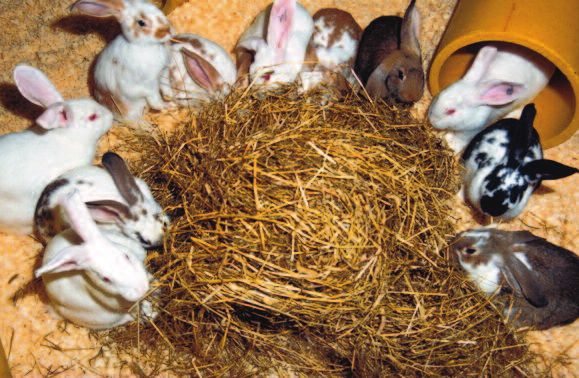
Introducing unfamiliar adults Troubleshooting 1.3 SOLID FLOORING AND SUBSTRATE 1.4 RAISED AREAS
Unfamiliar rabbits have been successfully mixed by sedating ● Aggression is the major concern when rabbits are group
Studies in a range of species have shown that animals often prefer, and Access to at least one raised area, such as a platform that rabbits can
them first using neuroleptoanalgesic* drugs, with the underlying housed. There may be warning signs that an outbreak of
will work to gain access to, solid flooring. This may be because solid jump on and off, provides important weight-bearing exercise and helps
assumption that enough scent is transferred while the animals serious aggression is imminent, such as increased scuffling
floors have various benefits compared to grid floors, such as being to build bone strength. Raised areas are also useful as ‘look out’ points;
are sedated for them to recognise one another as cage mates. or tufts of pulled-out fur in the enclosure, but aggression is
more comfortable to walk and rest on and allowing animals more rabbits will jump on to them and rear alert when disturbed. Being able
For example, mature NZW females to be regrouped were weighed often completely unforeseen. If tufts appear, monitor the
control over their thermal environment. Solid flooring means that to scan their surroundings in this way is likely to reduce anxiety.
and given Fentanyl/Droperidol early in the morning, then the rabbits more frequently (e.g. six to eight times a day).
substrate can be provided, which facilitates and encourages natural
rabbits were placed in a small pen where they were in close Because most aggression occurs at night, rabbits should
behaviours such as digging, foraging and shredding activity.
physical contact with one another. They began to recover after always be checked as early as possible in the morning in
about four hours, when they were reweighed and identified with case individuals need to be separated or veterinary Background
coloured markers before transfer to a large pen. The rabbits attention is necessary. If any warning signs are seen, review Solid flooring will benefit all sexes, strains and ages of rabbit; there
were video monitored for six hours. By the end of the six hours, the husbandry protocol immediately (see below). are very few situations where it is not advisable on health or welfare
the rabbits had completely recovered and some chasing and hair grounds, provided that husbandry is adequate. Substrate should be
● If serious aggression occurs, resulting in open bite wounds,
pulling was observed, but there were no injuries requiring regularly replaced to keep it clean and to prevent sore hocks.
the aggressor or victim should be removed – temporarily or
treatment. The rabbits were then weighed at 24, 48, 72 and 168
hours. The authors made the point that minor amounts of
permanently. It may be possible subsequently to return the How to introduce solid flooring with substrate
victim, even if s/he needed veterinary treatment. If the risk Pen flooring should be easy to clean, well-insulated and slip-proof.
scuffling can be tolerated for a short time. None of the rabbits
of further injury is considered unacceptable, the rabbit will Examples of flooring that has worked well for the authors are concrete
was excluded from the food or water and none lost more
have to be singly housed (and perhaps removed from the protected by epoxy resin paint or sealed vinyl, or securely fixed rubber
than 250g over the total observation period25.
study as soon as possible). Persistent aggressors will matting over a concrete floor. Ribbed rubber sheeting cannot be kept
probably have to be removed, but should not be rehoused clean and stainless steel was found to be too slippery. Sawdust or wood
in visual or olfactory contact with the group. shavings, such as aspen, are suitable substrates that can be used with
Housing and husbandry systems
● It is also important to investigate the fundamental cause of solid flooring, ideally with dust-free straw as enrichment on top. The
Floor (or waist-height) pens are successfully used to group house
the aggression. It may be necessary to review the housing, straw can be irradiated if necessary.
rabbits in a variety of establishments. However, there are other
ways of group or pair housing if pens cannot be provided. For provide more dividers or refuges, or increase the available
example, good modular caging systems allow a number of large space. Increased monitoring will also be required, whether Troubleshooting
cages to be linked together to group house rabbits. Whatever the the problem is addressed by removing animals, reviewing ● Sore hocks (pododermatitis) – seek veterinary advice
husbandry, or both. immediately. Provide thick straw bedding and clean Background
system, it is essential that sufficient space is provided for the
regularly until healed; ensure that all substrate is Raised areas benefit all physically fit rabbits past weaning age,
rabbits to be able to withdraw from sight and contact in the
replaced more frequently. whether they are housed in pens or cages – provided that cages
case of aggression and this requires a well-structured
environment including refuges and barriers or partitions. Alternative approaches ● Coccidiosis – coccidia are common pathogens that are have enough height and adequate floor area to accommodate other
There are veterinary and scientific justifications for single housing prevalent in wet conditions. In view of this, close attention behaviours. However, rabbits housed for long periods in standard-size
Husbandry tactics that can help to prevent aggression when in a variety of circumstances, some of which are described here. cages without a raised area may not have sufficient bone strength
should be paid to ensuring that the litter substrate remains
establishing or re-forming groups are: For example, persistent aggressors and their victims should not be to jump on and off platforms without injury. One way to introduce
dry, including siting nipple drinkers above drain gratings.
housed together; entire adult males are usually singly housed If coccidiosis occurs, more frequent cleaning schedules platforms is to initially supply low ones, gradually increasing the
● scattering faecal pellets and urine-soaked litter from each rabbit
because they are liable to fight and this can result in serious wounds. are required. height. Rabbits must be able to access the raised area(s) easily and,
into the pen for several days before mixing or re-grouping
Metabolic studies and work with particular infectious agents are also ideally, should be able to assume the ‘rearing alert’ posture while on
● scattering food to encourage time-consuming foraging
incompatible with group housing. However, singly housed laboratory top without their ears touching the roof. Avoid placing platforms or
● allowing visual and olfactory contact through wire mesh
dividers, which are subsequently removed rabbits benefit from visual and minimal tactile contact with one Alternative approaches boxes in positions where they can be used to jump out of the
another9. This kind of contact can be facilitated by incorporating A solid resting area can be provided instead, which should account for enclosure, or make sure that the walls are high enough to prevent
● mixing the animals in a neutral pen area
perforated mesh panels into adjoining platforms/shelves or adjacent one-third of the cage or pen area. This may be a solid shelf, roof of a escape. Materials should be easy to clean and non-slip to avoid
● having their usual handler handle them together in small
enclosure walls (making sure that they go down to the pen or cage refuge and/or a solid area of the floor. The animals usually choose to injuries when jumping on and off.
groups before mixing7.
floor), so that the rabbits can lie side by side. The rabbits must be rest on it (this does not necessarily have to account for all the time they
How to introduce raised areas
able to avoid this contact if they want to, so a refuge should be are at rest; the key aim is to provide them with a choice). If the rabbits
Experimental design Raised areas may be provided in the form of boxes that are sturdy
provided. An appropriate gauge and thickness of mesh should be are not resting on the solid area, check that it is large enough, that it
Occasional fighting may introduce increased variability or bias in enough to bear a rabbit’s weight, purpose-built platforms for pens,
used, for example bite wounds have been reported when using mesh is not placed in an area that the rabbit prefers to use as a latrine or, if
some experimental designs, for example if stress hormones are commercially available platforms for cages, or commercially available
with an aperture of 30 x 30mm (1.2 x 1.2”) between pens but not it is raised above floor level, whether there is enough space above it.
being monitored. In such cases, a decision will need to be made – refuges that are an appropriate size and shape (see below). They
with 25mm (1”).
in consultation with the researcher, attending veterinarian and If perforated flooring is being used, it should be comfortable and should be rigid and remain in position when rabbits climb onto them;
relevant animal care and use committees – as to whether animals ‘Observation ports’ or verandas fitted to cage fronts are another way safe for the rabbits. Plastic flooring with recessed round holes is suitable materials are wood or plastic. Straw bales are a very good
should be singly housed. This decision will need to balance the risks of adding interest for singly housed rabbits. These increase visual widely available, but wire grid floors should not be used – they are way of providing raised areas and can also be an additional source
of fighting versus single housing, both as welfare issues and as contact by allowing rabbits to see more of the animal room, uncomfortable, can restrict the ability of animals to thermoregulate of dietary enrichment. Rabbits generally make good use of raised
stressors that may affect experimental outcomes. including other rabbits, which is likely to reduce anxiety. and have often been associated with pododermatitis. areas that are about 250 to 300mm (10 to 12”) high.
* Neuroleptoanalgesic: a combination of a narcotic analgesic and a neuroleptic (tranquillising)
10 drug, which produces analgesia and amnesia. 11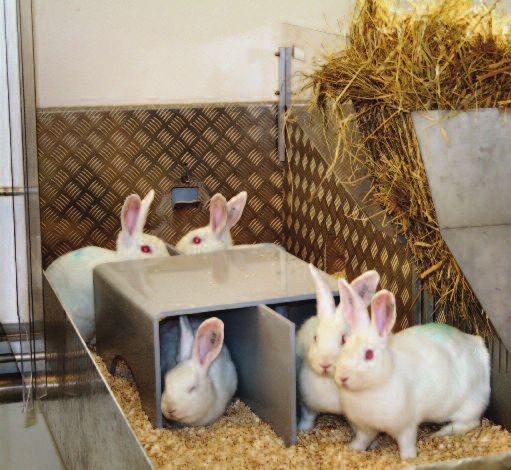
establishments are able to provide more natural chewing items such as
Troubleshooting GNAWING OBJECTS AND DIETARY
● Rabbits do not use raised areas – ensure that there is
1.6 ENRICHMENT
cherry wood branches, which are good for chin marking. All chewing
objects should be provided ad libitum to avoid conflict for access.
sufficient height above them for rabbits to sit up Depending on the study circumstances, it may be possible to provide
Gnawing helps to maintain tooth sharpness and oral health, since
comfortably. Check that they are not made from
rabbits’ teeth grow continuously, like those of mice and rats. Wild rabbits
materials that the rabbits could find uncomfortable or
NEWCASTLE UNIVERSITY
spend about 44% of their time eating26, and rabbits have been shown
slippery or which change position easily when used.
to prefer enrichment based on food items to enrichment based on
● Injuries (other than by fighting) – check that platforms non-food items27. Providing food that the rabbits have to search for
are stable, materials are non-slip and that rabbits are fit or manipulate should therefore encourage natural behaviour, reduce
enough to jump on and off the raised areas. Consider boredom and improve welfare.
lowering them temporarily or permanently.
The digestive system of the rabbit is adapted to deal with large
amounts of low quality food, which may be a mixture of coarse grass,
requirements for toxicity studies. For GLP studies, raised areas are better,
Alternative approaches herbs, fruit, roots, leaves and bark. Standard pelleted diets are very
made of a strong material that cannot be chewed by the rabbits.
different in that they have a higher calorific and nutrient density, are
In rare circumstances, for example some orthopaedic studies, it
Refuges should be large enough for rabbits to enter and turn around eaten in smaller amounts and may be perceived as monotonous and
will not be possible to provide a raised area. In such cases sufficient
in them, but small enough to provide feelings of security. As a guide, boring for rabbits. Rabbits are therefore likely to benefit from a more
space should be provided for appropriate exercise to help maintain
refuge height for an adult NZW should be about 300mm (12”). natural and interesting diet. Hay has been found to be particularly
bone strength and physical fitness.
effective at reducing abnormal behaviours such as bar gnawing,
excessive grooming and sham chewing28, 29.
1.5 REFUGES Troubleshooting Background dietary enrichment in the form of fresh fruit, vegetables or seeds
● Not using refuges – are there enough of them, are (such as flaked maize, barley, oats, peas and soya beans), cabbages,
In common with many other species, rabbits benefit from a refuge or Rabbits benefit from dietary enrichment and gnawing objects and there
they of suitable construction, are they large enough? carrots, parsnips, turnips, mangolds, dandelion leaves, apples and
‘bolt-hole’ that they can retreat to if they are feeling afraid, stressed or are only occasionally veterinary or experimental reasons for withholding
Are the entry and exit holes the right size? hydroponic* grass. Commercially available foraging ingredients or
unwell or simply wish to withdraw from social contact for a while. This them. There is reduced scope for providing dietary enrichment for
mixes consist of dried fruits, beans and seeds, which can all be
is a natural escape response, so rabbits without access to some kind of ● Aggressive competition for a particular shelter – supply rabbits in certain circumstances, for example chew blocks supplied
irradiated. All these supplementary foods can be scattered on the
‘bolt-hole’ are likely to be stressed. Dominant animals may monopolise more refuges; consider the use of visual barriers to in regulatory toxicology studies should have a Certificate of Analysis.
floor to encourage foraging behaviour, or some foods such as carrots
a refuge, so several should be provided – ideally at least one per rabbit. reduce competition. Remove leftover forage feeds to prevent soiling and minimise disease can be stuffed into straw bales. It is vital to be aware of the risk of
Background ● Turning over purpose-built plastic refuges then ignoring risk. If animals are accustomed to eating standard pelleted diets only, introducing pathogens or unbalancing the rabbits’ diet and to ensure
Rabbits benefit from the availability of shelters or refuges throughout them – make solid floors for the refuges that are 50 to they may take time to become accustomed to new foods. The original that the attending veterinarian is aware of feeding protocols.
their lives. These should be high enough to allow animals rapidly to 60mm (2 to 2.4”) larger all round, and screw them on. diet should always be available if the animals’ diet is changed, to ensure
Consider feeding the rabbits in the afternoon rather than the morning,
move underneath, but low enough to act as a secure refuge. (If animals that they are getting enough to eat if they are slow to eat new foods.
● Shredding cardboard boxes – this is generally regarded as as this corresponds better with their main period of foraging activity
can hop onto them as well, refuges will also fulfil the functions of a
an extra activity and is not viewed as a negative response. How to introduce gnawing objects in the wild – that is, late afternoon and night time31. For example,
raised area, as above.) Group-housed rabbits should ideally be provided
If this occurs, new boxes should be provided (staff can be and dietary enrichment research at Odense University compared the incidence of abnormal
with at least one refuge each, regardless of whether they are platforms
asked to donate suitable boxes). behaviour in groups of female Ssc:CPH rabbits housed with a light
or shelves that also serve as refuges. This prevents monopolisation by Rabbits should be provided with dietary enrichment and gnawing
period from 04:00 to 16:00 and fed at either 08:00 or 14:00. The study
dominant rabbits and so minimises competitive aggression. Refuges objects from the time that they leave the nest. A wide range of gnawing
found that afternoon feeding reduced abnormal activity such as bar
with two entry/exit holes for group-housed rabbits will provide an objects is commercially available, including wooden (e.g. aspen) and
biting or paw scraping during the dark period32.
escape route in case of aggressive encounters. However, rabbits often synthetic chew blocks. Most come with a Certificate of Analysis and
share refuges, so some should be large enough to allow this. many can be cage washed, autoclaved or irradiated if necessary. Wood
blocks with holes through the centre can be threaded onto a string and Troubleshooting
suspended from the enclosure wall for added interest. If chemical ● Not gnawing – try different gnawing objects and/or check
How to introduce refuges
content is not an issue, thin ‘logs’ of hardwood tree trimmings – 40 that there are no dental problems.
Suitable shelters include: commercially available rabbit refuges; boxes
to 50mm (1.6 to 2”) in diameter and 150mm (6”) long with the bark ● Competition for gnawing objects – ensure that several are
such as cardboard boxes; wooden boxes; paper sacks (e.g. sawdust
attached – are often preferred by rabbits. available. Fix some to different areas of the pen so that
bags); dustbins; sections of wide-bore plastic or fired-clay drain pipes
NOVO NORDISK
(e.g. 450mm [18”] diameter PVC pipe); and shelves or planks that the Loose or pressed hay, or straw, takes time to manipulate and provides dominant rabbits cannot monopolise them.
animals can get under. Make sure that items such as cardboard boxes additional dietary roughage. (Straw also helps to prevent outbreaks ● Not foraging – it may simply be that animals are unused to
and sawdust bags have not been stored in areas where they may have of hair pulling30.) To prolong handling time and interest, hay can be foraging and need more time to become accustomed to the
become contaminated. Two plastic washing up bowls screwed together scattered on the cage or pen floor, scattered on the roof of a cage to be idea. It will help if animals are used to foraging from
with entry and exit holes can also work well as a refuge. In the authors’ Alternative approaches pulled through, placed in a hay rack or net or stuffed inside a dry water weaning – this may involve discussions with the breeder. It
experience, rabbits do not favour lighter plastic tubes or boxes and they Rabbits should be provided with refuges – this is reflected in current bottle. Putting vegetables or other dietary enrichment inside cardboard could also be that the rabbits would prefer different foods.
will not use 300mm (12”) clay drainage pipe bends. Cardboard boxes European guidelines 1. If they are housed in cages that are too small for tubes and stuffing the ends with hay can also increase foraging time. If necessary, make small quantities of a treat available in
may not be compliant with Good Laboratory Practice (GLP) refuges to be added, then more space should be provided. Rabbits also make good use of alfalfa grass cubes and some
* Hydroponic: grown in nutrient solution, without soil. This is a way of providing plants for
12 laboratory animals without introducing soil pathogens. 13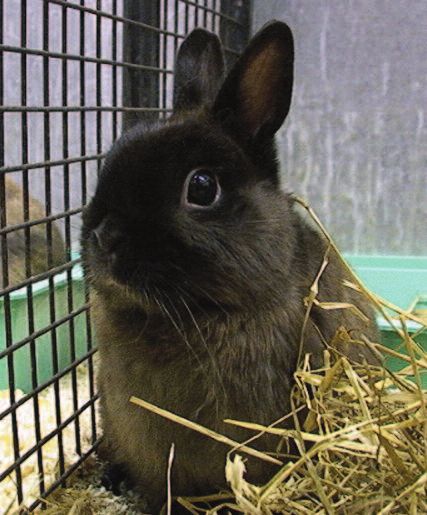
Many people believe that turning rabbits upside down so that they are benefits with respect to reduced fearfulness and anxiety around humans
the substrate alongside the normal food in hoppers, then in a state of tonic immobility (TI) puts them into a ‘trance’ and that this were still realised, maybe because they were handled for longer35. 1.8 TOYS AND OBJECTS TO MANIPULATE
introduce increasing quantities of normal food to the floor. is not unpleasant or stressful for the animals. However, this is not the
There is a range of commercially available enrichment items that can
● Losing body weight – this is unlikely to be a problem if the case. During recovery from TI, heart rate, respiration and plasma
be given to rabbits. These include mirrors40, plastic or rubber objects,
rabbits have become fitter because they are foraging and corticosterone levels are significantly elevated and subsequent
stainless steel rattles and balls. The authors could not come to a
gnawing more, as opposed to overeating and not exercising. grooming and hiding behaviours also increase. Fear responses such as Training for cooperation with oral unanimous conclusion about the merits of these items for rabbits.
If rabbits weigh significantly less than the optimum weight flattened ears, pupillary dilation and struggling also occur while TI is administration of substances Some were positive about enrichment devices because they can
for their strain, consult the veterinarian and ensure that being induced36. These responses are all similar to those that occur This protocol is from the University of Texas, where researchers increase the rabbits’ behavioural repertoire and reduce stereotypic
sufficient standard diet is available to all animals. before and after other stressful events, which indicates that TI is wanted to administer antibiotics to rabbits used to evaluate an behaviours, especially in cage-housed rabbits. Others were more
distressing and should not be induced without good reason. It may oral therapy for Staphylococcus aureus without using gastric sceptical, arguing that some items do not seem to be designed to
be acceptable to induce TI if it means that mild but potentially stressful gavage39. They found that the technique below produced the
Alternative approaches meet the rabbits’ needs or natural behaviour. These members did not
veterinary procedures such as nail or tooth examinations will be carried desired serum and bone concentration of antibiotic and was
There are some occasions (such as some dental studies or where believe that the welfare benefits had been proven or were concerned
out more quickly and thoroughly. It is not acceptable to use TI alone to time-efficient, never required more than one technician and
animals have injuries to the mouth) when wooden or synthetic blocks, that some items could be aversive. It was agreed by all that items
facilitate any type of procedure that would normally require sedation, eliminated stress and any risks to the animal due to
non-toxic plastic rods or strips or something similar cannot be provided should be carefully researched, monitored and evaluated. It was also
anaesthesia or analgesia. misplaced intubation.
for gnawing. Similarly, dietary enrichment may not be compatible with agreed that more research is needed into the welfare impact of
some metabolic studies. In this instance, consideration should be given Prepare a solution of 0.5% methyl cellulose, which tastes sweet; different toys for rabbits.
How to initiate a training and socialisation
to the possibility of providing the enrichment in-between study periods. draw this up into a 1ml tuberculin syringe and dip the tip in sugar.
programme
NEWCASTLE UNIVERSITY
Four to five days before the study, offer the solution to each rabbit
Although rabbits of any age can benefit from positive interaction
1.7 POSITIVE INTERACTION WITH HUMANS with humans, the critical window for socialisation in rabbits is the
by placing the syringe into the animal’s mouth (there should be
no need to enter the enclosure), then slowly injecting the solution
first six weeks of life, so it is extremely helpful if the breeder can
Rabbits are easily frightened and need to be handled with great care33. so that the rabbit can taste and drink it three times a day. (The
ensure that young animals are well socialised and habituated to
Human-rabbit interactions are less likely to cause stress during investigators reported that within two days, 80% of the rabbits
human contact. Published studies on the effects of starting to handle
husbandry or scientific procedures if staff behave in a way that is voluntarily swallowed the solution from the syringe and the
rabbit pups from 10 days old35 or in the first week of life37, 38, found
compatible with the natural behaviour of the rabbit. Rabbits can others did so with minimal encouragement.) After the five-day
that handled pups were less fearful and approached humans more
recognise and discriminate between different humans34, so positive training period, the compound of choice can be dissolved in the
readily than unhandled controls. One study also reported an increased
contact with familiar humans in the form of handling (stroking and methyl cellulose solution. Continue to coat the syringe tip with
growth rate and reduced mortality rate35. However, nervous does may
grooming), training and general habituation to human contact will sugar and the rabbits should take the compound, unless it
kill pups if they carry human scent, so it is probably best not to begin
provide interest for the animals and reduce stress when they are handled tastes particularly unpleasant.
until the young are ten days old. Make sure that all the pups are
during the conduct of procedures. Not all rabbits respond positively to
handled during each session, to prevent one subsequently being
such manipulations, but studies have shown that gentle and frequent
‘singled out’ by the mother.
handling of young rabbits not only reduces their fear of humans but
also has a positive effect on growth rate and reduces mortality35. Studies have found that rabbit pups exposed to even minimal contact Troubleshooting
with humans were significantly less fearful and more likely to approach ● A doe rejects or harms pups following handling – take care to
Stroking and grooming rabbits, and regularly giving treats, helps to
people as adults, provided that the contact occurred within half an hour ensure that she is not stressed while one or more pups are
win the confidence and trust of the rabbits and can be combined
after their daily suckling period. Contact comprised either weighing or away; make sure that human scent is not left on the pups by
with health monitoring, such as checking body weight or tooth
briefly touching, which took less than three to five minutes for a whole wearing clean gloves and re-apply the dam’s odour via her
condition. Unwell animals may interact differently with carers, which
litter. This level of contact may have been effective, despite being so soiled litter or nest materials.
could be the first sign that health or welfare is compromised.
brief, because the pups were still relatively aroused following feeding
● Rabbits may become over-enthusiastic and demanding about
Background and were more sensitive to learning37, 38. From the above, it appears Background
interactions with humans, evidenced by dominance behaviours
An appropriate programme of positive interactions with humans that if it is only possible to handle pups for brief periods, the best time Toys should be carefully evaluated to ensure that there is sufficient
such as enurination* or bar biting when carers enter the room –
benefits all rabbits, even if they have been housed in the laboratory is within 30 minutes of them suckling. This requires careful monitoring evidence of use, they are non-toxic and they will not cause injury.
if this occurs, seek advice from a veterinarian or animal
for some time – it is never too late. Staff will need to have an of daily suckling times before the socialisation programme begins, as Items that animals can eat, chew or hide in seem to be preferred.
behaviourist.
adequate understanding of rabbit behaviour and, where applicable, nursing is over very quickly (see section 1.9).
Group housed rabbits need to be provided with sufficient items to
may need to learn animal training techniques such as positive If more time is available for handling, then pups can be handled outside avoid aggressive competition. Individual animals may show preferences
reinforcement. This will take time and resources and, in the case this 30-minute period. This may be a preferable option if nursing occurs Alternative approaches for particular items or may become accustomed to items and lose
of training animals, will also require some commitment. late in the day (see section 1.9). In a study involving longer human Animal care staff should be knowledgeable about rabbit behaviour, in interest in them. In the experience of the authors, rabbits often have
Rabbits can learn to cooperate during handling and during some contact, begun when rabbits were 10 days old35, up to three NZW pups order to appreciate how their own behaviour might affect the animals. quite a low boredom threshold with respect to toys. A programme of
procedures, but if they need to be restrained stress can be minimised at once were taken from their nests or cages each day, always by the If there is no opportunity for structured socialisation programmes, rotating items, for example on a weekly or fortnightly basis, can help
by habituating the animals and keeping them calm, for example by same (female) person. Each group of pups were stroked and talked to empathetic interactions with the rabbits during routine husbandry to prevent boredom41. The odour of other rabbits on an item may be
gently wrapping them in a blanket. This should complement, not “in a friendly way” for a period of 10 minutes between 9:00 and 12:00, procedures will reduce stress and improve welfare. stressful, so it is good practice to wash items before rotating them.
replace, the administration of sedatives and analgesics prior to then replaced into the nest or cage. Although some of these pups Chews and other wooden objects are harder to clean so should
the conduct of painful or stressful procedures. were handled more than 30 minutes after they had finished nursing, the remain with the same group or be discarded.
* Enurination: spraying urine during a twisting/jumping action, usually at another
14 rabbit during courtship or as an aggressive act. 15
You can also read


