Responding to the COVID-19 second wave in Thailand by diversifying and adapting lessons from the first wave
←
→
Page content transcription
If your browser does not render page correctly, please read the page content below
Practice
Responding to the COVID-19 second
wave in Thailand by diversifying and
adapting lessons from the first wave
Nattadhanai Rajatanavin ,1 Titiporn Tuangratananon,1,2
Rapeepong Suphanchaimat,1,3 Viroj Tangcharoensathien1
To cite: Rajatanavin N, ABSTRACT
Tuangratananon T, Summary box
Thailand’s first wave of COVID-19 in March 2020 was
Suphanchaimat R, et al. triggered from boxing events and nightclubs in Bangkok,
Responding to the COVID-19 ►► Public health (test, trace and quarantine) and social
which spread to 68 provinces. The nation responded
second wave in Thailand by measures (face masks, physical distancing, hand
rapidly with strong public health and social measures on
diversifying and adapting hygiene, generalised restriction of travelling) were
lessons from the first 26 March 2020. Contact tracing was performed by over
fully applied in the first wave of COVID-19 with fa-
wave. BMJ Global Health 1000 surveillance and rapid response teams with support
vourable results; there was no local transmission
2021;6:e006178. doi:10.1136/ from 1.1 million village health volunteers to identify, isolate
after 25 May 2020 until December 2020.
bmjgh-2021-006178 and quarantine cases.
►► Public health measures were diversified to include
Thailand implemented social measures in April 2020
active case findings and five-sample pooled saliva
Handling editor Seye Abimbola including a full-scale national lockdown, curfews and
tests to save costs on a very large number of daily
14-day mandatory quarantine for international travellers.
tests.
Received 2 May 2021 With a strong health system infrastructure, people’s
Accepted 8 July 2021 ►► Migrant health workers and volunteers were de-
adherence to social measures and a whole-of-government
ployed to garner support for public health and social
approach, the first wave recorded only 3042 cases and 57
measures.
deaths with 1.46% case fatality rate. Economic activities
►► Social measures, notably face masks, physical dis-
were resumed on 1 May 2020 until the end of the year.
tancing and hand hygiene continued, while selective
On 17 December 2020, a second wave was carried by
and targeted restrictions were applied through the
undocumented migrants who were not captured by the
provinces with differentiated interventions.
quarantine system. As the total lockdown earlier led
to serious negative economic impact, the government
employed a targeted strategy, locking down specific areas
and employing active case finding. Essential resources was under 200; but by 25 May 2020, there
including case finding teams, clinicians and medicine were were 3042 cumulative cases and 57 deaths.
mobilised. Epidemiology evidence reported no local
With synergistic multisectoral efforts involving health, non- transmission after 25 May as all subsequent
health and private sector, the outbreak was contained in cases were diagnosed in international trav-
February 2021. Total cases were seven times higher than ellers, both Thai and non-Thai, at the state
the first wave, however, early admission and treatment
© Author(s) (or their
quarantine systems.
resulted in 0.11% case fatality rate. In conclusion,
employer(s)) 2021. Re-use The second wave was triggered by some
experiences of responding to the first wave informed
permitted under CC BY-NC. No
the second wave response with targeted locking down Thai workers who, having worked in an
commercial re-use. See rights entertainment complex in a northern state
and permissions. Published by of affected localities and active case findings in affected
BMJ. sites. of Myanmar, entered Thailand illegally and
1 were not captured by state quarantine. They
International Health Policy
Program, Ministry of Public carried the virus and spread it to several
Health, Nonthaburi, Thailand northern provinces in Thailand. In addi-
2
Bureau of Health Promotion, INTRODUCTION tion, a large number of migrant workers who
Department of Health, Ministry Thailand responded effectively to the first carried the virus travelled directly and illegally
of Public Health, Nonthaburi,
wave of COVID-19, which began in March from Myanmar and worked in factories and
Thailand
3
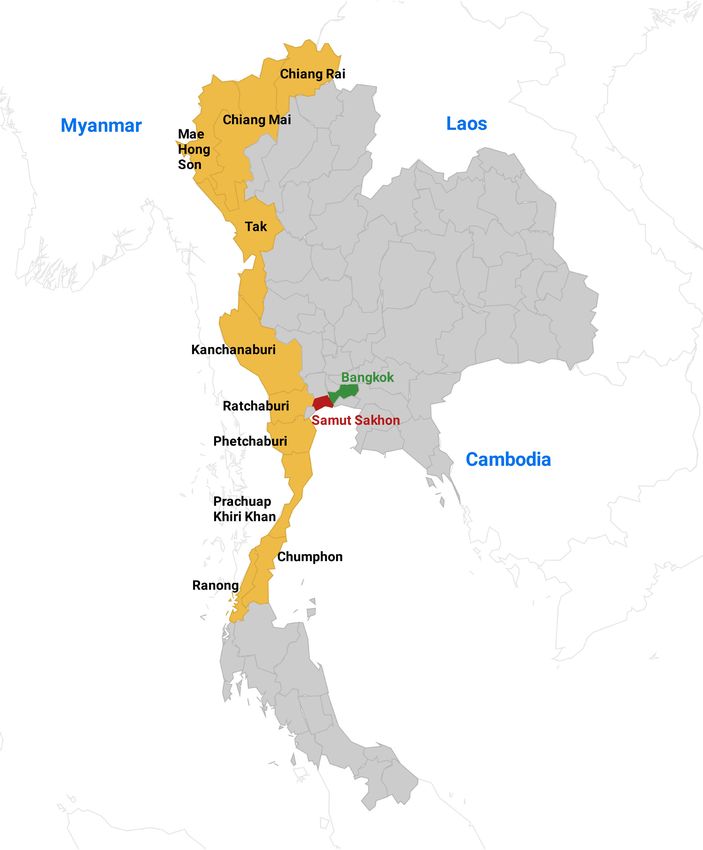
Bureau of Epidemiology, 2020. The epidemic was triggered by clus- seafood markets in Samut Sakhon province,
Department of Disease Control, ters of cases related to events at the boxing a neighbouring province of Bangkok (see
Ministry of Public Health, stadium and nightclubs in Bangkok and figure 1). Infection among workers in this
Nonthaburi, Thailand which later spread to 68 provinces.1 Muslim seafood market, the largest supplier to the
Correspondence to
pilgrims returning from Malaysia and Indo- whole country, triggered local transmission to
Dr Nattadhanai Rajatanavin; nesia also spread the virus to various southern more than half of the provinces nationwide.
nattadhanai@ihpp.thaigov.net provinces.2 3 The peak of daily cases in March Simultaneously, a few large clusters spread
Rajatanavin N, et al. BMJ Global Health 2021;6:e006178. doi:10.1136/bmjgh-2021-006178 1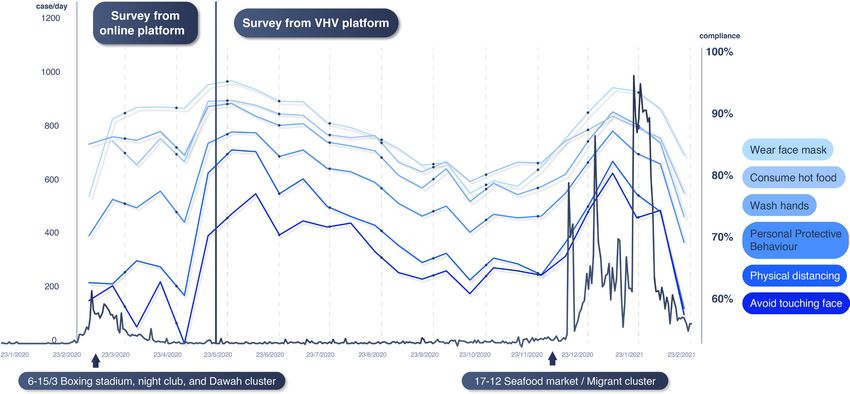
BMJ Global Health

Figure 1 Map of Thailand borders and Samut Sakhon province. The yellow shade are 10 provinces with 2400 km land border
from Myanmar.

from illegal casino sites in three eastern provinces. Index       The second wave was far greater and more complex
cases suspected undocumented Cambodian migrants                 than the first wave. With 21 584 additional cases in 2.5
working in these sites.                                         months (between 18 December 2020 and 27 February

2                                                        Rajatanavin N, et al. BMJ Global Health 2021;6:e006178. doi:10.1136/bmjgh-2021-006178
BMJ Global Health
2021), the caseload was seven times than that of the 3042 (RT-PCR) laboratory capacity was scaled up nationwide,
cases during the first wave. By the last week of February from 80 certified laboratories in April 2020 to 110 in June
2021, daily cases decreased to less than 100, which demon- 2020 and 230 (154 public and 76 private laboratories)
strates that the situation is gradually under control. in October 2020 covering all 77 provinces; all provided
This paper analyses how drawing on experiences a turnaround time of 24 hours for results.5 Installation
of public health and social measures and governance of negative pressure intensive care units and the stock-
responses during the first wave informed the second piling of personal protective equipment and medicines
wave response, and identifies lessons and gaps for further were key preparedness measures in this wave for future
improvement. We used secondary data from various unforeseen large outbreaks.
sources such as official reports, surveys, secondary data Containing the outbreak also relies on the key role of
analysis and minutes of the Ministry of Public Health- more than 1000 surveillance and rapid response team
Emergency Operation Centre (MOPH-EOC), for which (SRRT) members comprising public health nurses and
the authors have had direct observations in all EOC officers, with epidemiologists in some teams.6 SRRT are
meetings since May 2020. stationed at provincial health offices and district hospi-
tals and are networked with subdistrict health centres.
In Bangkok, the SSRT are linked to the Department of
PUBLIC HEALTH AND SOCIAL MEASURES USED IN THE FIRST
Diseases Control and Bangkok Metropolitan Admin-
WAVE
Public health measures istration. At the subdistrict level, more than 1 million
During the first wave, conventional public health meas- village health volunteers (VHVs) and staff from subdis-
ures were applied including the following: identifying the trict health centres supported the SRRT. VHVs helped
index cases using case definitions produced and updated in assessing villagers’ risk of exposure to infection and
regularly by the MOPH; tracing and testing of all high- liaised with the subdistrict health centres.7 The cost of lab
risk contacts; treatment of all cases in hospitals; and isola- testing and treatment was fully subsidised by the govern-
tion in quarantine sites at least 14 days from the onset ment in all cases regardless of nationality (see figure 2).
of symptoms in order to prevent transmission.4 All these
were enforced through the 2015 Communicable Diseases Social measures
Act. In the absence of global guidelines on what constitutes
As the laboratory is a necessity for case detection, the effective social measures, the government aimed to mini-
MOPH understood that limited laboratory capacity was a mise droplet transmission through the use of face masks,
major barrier to pandemic containment. Real-time PCR hand hygiene, physical distancing and discouragement
Figure 2 Network diagram of surveillance and rapid response teams (SRRTs) and village health volunteers (VHVs). DDC,
Department of Disease Control; DHO, District Health Office; EOC, Emergency Operation Center; LGO, Local Government
Office; MOPH, Ministry of Public Health; PHO, Provincial Health Office.
Rajatanavin N, et al. BMJ Global Health 2021;6:e006178. doi:10.1136/bmjgh-2021-006178 3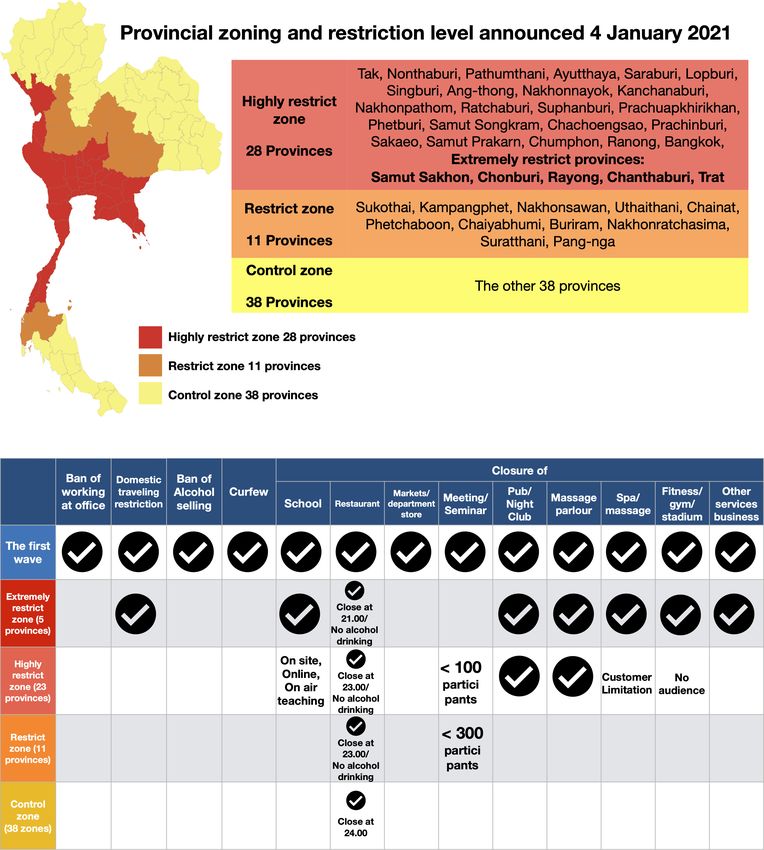
BMJ Global Health
of social gatherings. The government declared and respondents per round. The data were collected using
enforced a State of Emergency Decree on 26 March 2020 Google forms accessed by a QR code or URL link through
and curfews between 22:00 and 04:00 on 2 April 2020. mobile phones. Although respondents were numerous,
Among other measures, the government also advocated, 70% were women and there was potential positive bias in
although did not make mandatory, a ‘stay home’ policy the self-reporting of personal protection such as use of
for the whole of April 2020, cancelled national holidays face masks. Misinterpretation of the questions and survey
to prevent massive social gatherings and domestic travel, fatigue were also key limitations (see figure 3).
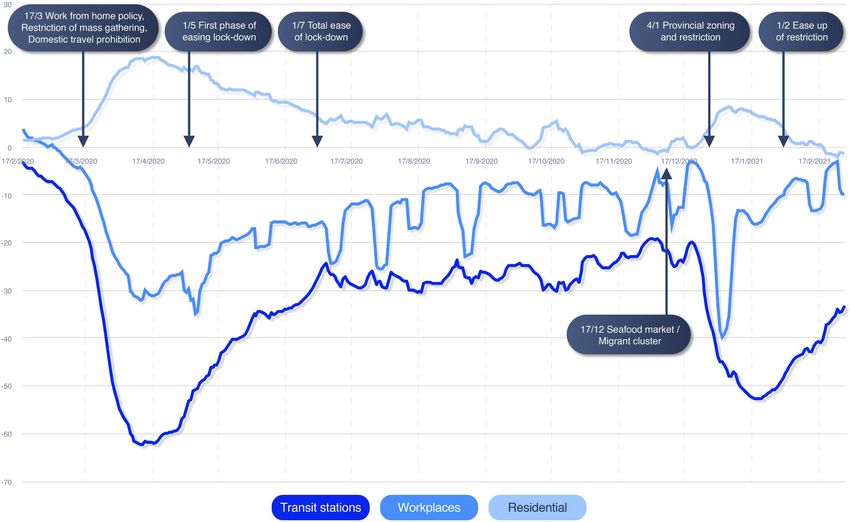
and imposed school closures and restrictions of access to Population compliance with the social measures was
all public spaces except the essential. All international also monitored through Google mobility data.9 There
flights were suspended from 4 April 2020; only emer- was a significant reduction of population mobility in April
gency or authorised flights were permitted. 2020 to major transit coach and railway stations (−60%)
All social measures were applied throughout the and workplaces (−30%), and a moderate increase in
country by a single command centre, the Centre for people staying in their residential areas (+20%) (see
COVID-19 Situation Administration (CCSA), led by the figure 4).
prime minister. The CCSA is a whole- of-
government Combined public health and social measures intro-
effort. The centre monitored and assessed the situation, duced in the early phase of the epidemic was effective
then formulated national policies and actions. Coherent with no local transmissions occurring since 25 May
policy and daily updates prevented confusion and anxiety 2020. The government monitored closely any infections
in the population. brought in by international travellers, including nationals
All people including foreign residents were asked to and non-nationals, through state quarantine, mandatory
wear face masks (although this was not mandatory), to for all travellers entering Thailand through air, land and
keep a physical distance of more than 2 m and to adhere sea. Daily cases were under 10 and sentinel surveillance
to hand hygiene. The coverage of face mask use was high conducted in May–June revealed no new cases.10 In July
well before evidence of its effectiveness.8 The popula- 2020, the improved epidemiological situation and need
tion’s adherence to social measures through regular to reduce the negative economic impact from travel
surveys was reported to the CCSA. restrictions triggered the phasing out of certain social
The April 2020 weekly online surveys were promoted measures and the resumption of economic activities.11
through social media, with 100 000 respondents, although In parallel, people lowered their personal protection
samples were dominated by responses from Bangkok measures and increased their mobility.
residents and the highly educated. Other online nation-
wide surveys (weekly, fortnightly or monthly depending
on the epidemic context) took place between May
2020 and February 2021 and were conducted through
VHVs reaching out to households, with 50 000–60 000
Figure 3 Daily cases and personal protective behaviours trend; 1 April 2020–28 February 2021. *The result from 1 to 30 April
2020 was from online platform, while onwards was derived from the VHV-assisted platform. VHV, village health volunteer.
4 Rajatanavin N, et al. BMJ Global Health 2021;6:e006178. doi:10.1136/bmjgh-2021-006178BMJ Global Health Figure 4 Google mobility data and social measures, February 2020–2021. LEARNING FROM FIRST WAVE EXPERIENCES TO APPLY TO Medical Science as responsible for the outbreak in this SECOND WAVE RESPONSES province.15 Although Thailand relies on migrant workers, mostly At the beginning of the second wave, the reproduc- from Myanmar and in particular the fishery industry, tive number of 35 was much greater than the 9 in the the government failed to establish active surveillance in first wave. A few reasons explain this large reproductive migrant communities. Many migrants entered Thailand number. Most migrant workers (86%) were asymptomatic illegally through the 2400 kilometre-long porous natural and therefore the virus spread unnoticeably.16 Without border between Thailand and Myanmar and possibly the use of face masks as source control among migrant through labour trafficking.12 Myanmar’s epidemic workers and as primary protection for market customers, peaked in November and December 2020.13 Another the virus spread quickly.17 Large transmissions occurred lesson was that Thailand population felt complacency among migrant workers due to overcrowded dormitories due to the small number of cases, which resulted in and the market itself, which accelerated the number of reduced face mask coverage, the lowest level of which was infections. Due to the very high caseload and identifi- 77% in September 2020. able hotspot, the main disease control strategy in Samut Asymptomatic infections in migrant workers in a Sakhon shifted from individual contact tracing to active wholesale seafood market in Samut Sakhon triggered case finding by testing everyone in the suspected factories the massive second wave. The market serves customers or construction sites. Individual contact tracing was time- nationwide; retailers from other provinces came to consuming through single interviews of cases to identify purchase goods, were infected and transmitted the virus their high-risk contacts, and their phone numbers and back in their provinces. A cluster was identified through home addresses. Active case finding then became the contact tracing and active case finding starting from an more cost-effective and timely intervention, and was only index case in a hospital. In a single day, more than 500 applied in areas with a high prevalence of infections. cases were detected, and 90% were migrant workers. This However, contact tracing still played an effective role in means that transmission circulated in the community low-prevalence provinces.18 for at least three to four generations before detection. The second wave response, instead of a nationwide Additionally, the WHO has classified COVID-19 into lockdown, categorised provinces into three different seven different clades: namely S, V, L, G, GH, GR and O levels depending on the outbreak situation and risk. This (others).14 The GH clades, which widely spread in India included locking down five hotspot provinces to facilitate and Myanmar, were confirmed by the Department of active case findings until all the suspected population Rajatanavin N, et al. BMJ Global Health 2021;6:e006178. doi:10.1136/bmjgh-2021-006178 5
BMJ Global Health Figure 5 Provincial zoning and restriction level announced 4 January 2021 and comparison of social measures used in the first wave and specific zones during the second wave. Five extremely restrict provinces are Samut Sakhon, Chonburi, Rayong, Chanthaburi and Trat. groups had been fully investigated (see figure 5). Within for testing. In the active case findings, a standard indi- the sealed areas, workers were allowed to travel between vidual RT-PCR test was replaced with a five-sample pooled their dormitories and the factory, which encouraged saliva test for cost-savings in relatively lower prevalence economic activity to continue and gained the employers’ areas around the hotspot.19 A study shows that in areas support. The waiver of legal action against undocu- of prevalence of >3%, a five-sample pooled saliva test mented migrants ensured their cooperation to show up requires the least overall number of RT-PCR tests.20 Saliva 6 Rajatanavin N, et al. BMJ Global Health 2021;6:e006178. doi:10.1136/bmjgh-2021-006178
BMJ Global Health
test (pooled and non-pooled) in Samut Sakhon prov- rabies. SRRT capacity through regular drills ensured the
ince between 26 December 2020 and 28 February 2021 SRRT was ready for major epidemics such as the highly
showed that of the total 95 078 tests, 8.5% (8074 tests) pathogenic avian influenza in 2004,28 SARS in 200329 and
were positive.21 Middle East respiratory syndrome coronavirus in 2015.30
After the second wave outbreak was announced, the Field epidemiologist training since 1980 has resulted
population’s preventive behaviour significantly improved in the critical mass of epidemiological capacity in Thai-
and their mobility decreased. Schools in high-infection land.31 However, even after four decades of training, the
areas were closed in January 2021. Although domestic number of epidemiologists has reached only half the
travel restrictions were not applied nationwide, the down- target of 1 epidemiologist per 200 000 people as recom-
ward trend of people’s movement to transit stations and mended by the WHO.32 Thailand’s surveillance capacity
workplaces in January 2021 was similar to that of April to detect variants of concern, notably B.1.1.7 and B.1.351
2020. variants, has been strengthened through ensuring inter-
Migrant health workers and volunteers, trained by national travellers stay in state quarantine.33–35
MOPH to support health services in migrant commu- In a normal situation, VHVs support the screening of
nities, were fully deployed.22 23 Over 3000 field hospital diabetes and hypertension in their community, mobilise
beds were immediately set up in temples, military camps community awareness of dengue prevention and control,
and large warehouses, fully supported by the Provincial and support health workers during home visits to home-
Chamber of Commerce and Provincial Chapter of Feder- bound and bedridden patients.36 During the avian influ-
ation of Thai Industries. Field hospitals accommodated enza epidemic in 2004, these volunteers monitored any
asymptomatic cases while moderate to severe cases were abnormal number of deaths in poultry and free-grazing
treated in hospitals. Human resources were pulled from ducks and alerted animal and human health authorities
other provinces, both from MOPH and outside. to investigate. This early detection and control at source
Although the second wave had a much higher caseload, helped the rapid containment of avian influenza.37 38
the case fatality rate was 0.11%, much lower than 1.46% During the COVID-19 pandemic, the VHVs contrib-
in the first wave. More cases were among young healthy uted significantly to support surveillance and advocated
working-age people and were mostly asymptomatic.24 personal prevention measures.3 39–41 The volunteers
greatly supported SRRT to identify contact cases for
MULTILEVEL GOVERNANCE OF COVID-19 RESPONSES investigation. In Samut Sakhon province, migrant
The CCSA, established in March 2020, continued its health workers and health volunteers, mostly Myanmar
proactive work with daily briefings televised nationwide nationals, played a significant role to support contact
to report the epidemiological situation and advocate the tracing as they know the community and speak the same
need for people’s adherence to face mask coverage and dialect.23
hand hygiene.25 The MOPH-EOC met daily including at Universal Health Coverage facilitated full access to
weekends to monitor and provide advice and support. quality COVID-19 services without copayment. Early
MOPH- EOC meetings also held ‘live briefings’ with hospital admission of moderate and severe cases resulted
provincial chief medical officers in affected provinces. in the low mortality rate. The government approved a
In the second wave, the principle of containment shifted significant budget to MOPH for scaling up certified PCR
from a nationwide approach to a more strategically selec- laboratory tests nationwide and payment for tests for
tive and targeted approach. This meant zoning prov- all nationals and non-nationals. All district and provin-
inces into red, orange, and yellow according to weekly cial hospitals were mandated to detect, test and conduct
new cases per million of over 15, between 5 and 15, and outbreak investigations and responses.42
less than 5, respectively, and differentiated interventions
according to the zone.26 Remaining challenges
The porous land border and fragile political situation in
KEY SUCCESS FACTORS, REMAINING CHALLENGES AND Myanmar are the main causes of migrant influx into Thai-
RESPONSES land, despite border police and army patrol push back.43
Key success factors The geographical challenge is exacerbated by unre-
The legacy of surveillance and preparedness capacity solved labour trafficking activities. Thailand lacks a
over years played a critical role. Thailand ranks sixth clear labour policy for migrant workers despite crit-
in the Global Health Security Index as a result of four ical labour shortages in some sectors, which provides a
decades of investment in surveillance and prepared- fertile ground for corruption and continued labour traf-
ness and integration of these capacities into district ficking.44 Despite the government’s increased efforts,
health systems.27 The district level SRRT preparedness corruption and official complicity facilitates trafficking
and response capacity was gradually strengthened and and continues to impede anti-trafficking efforts.45 Both
sustained through regular outbreak investigations and factors contribute to a substantial number of undocu-
responses in the community to diseases such as dengue, mented migrants entering the country where infections
meningococcemia, hand, foot and mouth disease, and are not captured by the quarantine system.
Rajatanavin N, et al. BMJ Global Health 2021;6:e006178. doi:10.1136/bmjgh-2021-006178 7BMJ Global Health
An additional problem is that undocumented migrant Funding This study was funded by WHO, Bundesministerium für Gesundheit.
workers do not show up for tests for fear of legal action Map disclaimer The inclusion of any map (including the depiction of any
and deportation, despite awareness campaigns by boundaries therein), or of any geographic or locational reference, does not imply the
expression of any opinion whatsoever on the part of BMJ concerning the legal status
migrant health workers and migrant health volunteers
of any country, territory, jurisdiction or area or of its authorities. Any such expression
in Samut Sakhon province. Similarly, employers who remains solely that of the relevant source and is not endorsed by BMJ. Maps are
hire undocumented migrants fear prosecution them- provided without any warranty of any kind, either express or implied.
selves. Policy incoherence between national security Competing interests None declared.
and pandemic containment complicated Thailand’s Patient and public involvement Patients and/or the public were not involved in
COVID-19 response. the design, or conduct, or reporting, or dissemination plans of this research.
Patient consent for publication Not required.
Responses to challenges Provenance and peer review Not commissioned; externally peer reviewed.
Labour trafficking could be solved by policy coherence
Data availability statement (6) Data may be obtained from a third party and are
across government sectors: labour, national security and not publicly available
health, and zero tolerance to corruption. Responses to Open access This is an open access article distributed in accordance with the
large clusters of COVID-19 applied active case findings Creative Commons Attribution Non Commercial (CC BY-NC 4.0) license, which
with five-sample pooled saliva tests in suspected factories permits others to distribute, remix, adapt, build upon this work non-commercially,
and the lockdown of specific localities. At the operational and license their derivative works on different terms, provided the original work is
properly cited, appropriate credit is given, any changes made indicated, and the
level, the suspension of prosecution to undocumented use is non-commercial. See: http://creativecommons.org/licenses/by-nc/4.0/.
migrants and their employers for pandemic containment
was adopted.46 ORCID iD
Nattadhanai Rajatanavin http://orcid.org/0000-0001-6505-7911
CONCLUSION
The immediate public health measures and national lock- REFERENCES
1 World Health Organization Country Office Thailand. Thailand
down in the first wave resulted in no local transmission COVID-19 situation report 1st May 2020. Available: https://www.
after May 2020 at the expense of the economy, leading who.int/docs/default-source/searo/thailand/2020-05-01-tha-sitrep-
69-covid19-th.pdf?sfvrsn=11dff472_2 [Accessed 7 Jun 2021].
to catastrophic economic consequences and government 2 Marome W, Shaw R. COVID-19 response in Thailand and its
financial rescue programmes. Small numbers of cases implications on future preparedness. Int J Environ Res Public Health
then encouraged population complacency and more 2021;18:1089–11.
3 Issac A, Radhakrishnan RV, Vijay VR, et al. An examination of
relaxed personal prevention behaviour. Undocumented Thailand’s health care system and strategies during the management
migrants through labour trafficking brought asympto- of the COVID-19 pandemic. J Glob Health 2021;11.
4 Ministry of Public Health Thailand. Thailand national COVID-19
matic infections and triggered a second wave larger than treatment guideline. Available: https://covid19.dms.go.th/backend/
the first one. Structural responses from the first wave, Content/Content_FIle/Bandner_(Big)/Attach/25640507102416AM_
notably nationwide scale-up of PCR laboratory services, CPG_COVID_v.14_n_20210506.2.pdf [Accessed 4 Jun 2021].
5 Ministry of Public Health Thailand. Laboratory SAR-COV2 detection
negative pressure rooms and stockpiling of personal network. Available: https://service.dmsc.moph.go.th/labscovid19/
protective equipment, are legacy for responses in the indexen.php [Accessed 6 Mar 2021].
6 Ministry of Public Health Thailand. Outbreak surveillance: Situation
second wave. Agile and adaptive responses were adopted Awareness Team & Joint Investigation Team Standard. 107.
in the second wave, especially active case finding, use of Available: http://www.pngo.moph.go.th/pngo/images/meeting2/
620621/2406-6.pdf [Accessed 6 Mar 2021].
pooled saliva tests and maintaining economic activities 7 World Health Organization. Thailand’s 1 million village health
through targeted lockdown of affected localities.47 volunteers - “unsung heroes” - are helping guard communities
Lessons can be drawn and shared with other countries. nationwide from COVID-19, 2020. Available: https://www.who.int/
thailand/news/feature-stories/detail/thailands-1-million-village-
First, timely implementation of public health and social health-volunteers-unsung-heroes-are-helping-guard-communities-
measures through harmonised single command resulted nationwide-from-covid-19 [Accessed 12 Apr 2021].
8 Howard J, Huang A, Li Z, et al. An evidence review of
in successful containment of COVID-19. Second, scaled face masks against COVID-19. Proc Natl Acad Sci U S A
up capacity of, notably, laboratory tests and the stock- 2021;118:e2014564118.
piling of essential medical resources are the foundations 9 Our World in Data. Google community mobility trends. Available:
https://ourworldindata.org/covid-google-mobility-trends [Accessed
for responding to unpredictable large and different 15 Mar 2021].
disease outbreaks. Third, agile and adaptive responses 10 Ministry of Public Health Thailand. Sentinel surveillance guideline,
2020. Available: https://ddc.moph.go.th/viralpneumonia/file/g_srrt/
are critical to respond to the different sizes and nature of g_srrt_target_group.pdf
transmissions. Finally, targeted lockdown and active case 11 Oxford Policy Management and The United Nation Thailand. Social
findings are adaptive responses to maintain the economic impact assessment of COVID-19 in Thailand. 2020;186. Available:
https://www.unicef.org/thailand/media/5071/file/Social Impact
activity and increase effectiveness of case identification. Assessment of COVID-19 in Thailand.pdf#page=132
12 Royal Thai Government. Interception of Undocumented migrant
Acknowledgements This publication has been supported by the German Federal guideline for prevention of COVID-19 7th December 2020. Available:
Ministry of Health (BMG) COVID-19 research and development funding to the WHO. http://www.ratchakitcha.soc.go.th/DATA/PDF/2563/E/286/T_0021.
PDF [Accessed 7 Jun 2021].
Contributors All authors conceived and framed the manuscript. VT (the guarantor 13 Our World in Data. COVID-19 Data Explorer (Myanmar) - Our
of the paper) provided concept and support to the manuscript. All the authors World in Data. Available: https://ourworldindata.org/explorers/
contributed to the drafting of the manuscript and approved the final version prior to coronavirus-data-explorer?zoomToSelection=true&time=40.latest&
submission. pickerSort=desc&pickerMetric=new_cases_smoothed_per_million&
8 Rajatanavin N, et al. BMJ Global Health 2021;6:e006178. doi:10.1136/bmjgh-2021-006178BMJ Global Health
Metric=Confirmed+cases&Interval=New+per+day&Relative+to+ 30 Plipat T, Buathong R, Wacharapluesadee S, et al. Imported case of
Population=false&Align+outbreaks=false & [Accessed 12 Apr middle East respiratory syndrome coronavirus (MERS-CoV) infection
2021]. from Oman to Thailand, June 2015. Eurosurveillance2017;22:30598.
14 Hamed SM, Elkhatib WF, Khairalla AS, et al. Global dynamics of 31 Jones DS, Dicker RC, Fontaine RE, et al. Building global
SARS-CoV-2 clades and their relation to COVID-19 epidemiology. epidemiology and response capacity with field epidemiology training
Sci Rep 2021;11:8435. programs. Emerg Infect Dis 2017;23:S158–65.
15 Ministry of Public Health Thailand. Thailand COVID-19 situation 32 Williams SG, Fontaine RE, Turcios Ruiz RM, et al. One field
report 23rd December 2020. Available: https://ddc.moph.go. epidemiologist per 200,000 population: lessons learned from
th/viralpneumonia/file/situation/situation-no355-231263n.pdf implementing a global public health workforce target. Health Secur
[Accessed 10 Jun 2021]. 2020;18:S-113–S-118.
16 Ministry of Public Health Thailand. Samutsakorn COVID-19 33 Mahase E. Covid-19: what have we learnt about the new variant in
Investigation December 2020 - January 2021. the UK? BMJ 2020;371:m4944.
17 Esposito S, Principi N, Leung CC, et al. Universal use of 34 Ministry of Public Health Thailand. Daily news briefing 3rd January
face masks for success against COVID-19: evidence and 2021. Available: https://pr.moph.go.th/_WEBADMIN/uploads/attfiles/
implications for prevention policies. Eur Respir J 2020;55. 5zpwtso4hg4c0kwwo.pdf [Accessed 7 Jun 2021].
doi:10.1183/13993003.01260-2020. [Epub ahead of print: 18 06 35 Royal Thai Government. Emergency operation center briefing 15th
2020]. February 2021. Available: https://media.thaigov.go.th/uploads/
18 Ministry of Public Health Thailand. COVID-19 Outbreak Surveillance public_img/source/150264.pdf [Accessed 7 Jun 2021].
& Investigation guideline. Available: https://ddc.moph.go.th/ 36 Kowitt SD, Emmerling D, Fisher EB, et al. Community health workers
viralpneumonia/file/g_srrt/g_srrt_150563.pdf [Accessed 10 Jun as agents of health promotion: analyzing Thailand's village health
2021]. volunteer program. J Community Health 2015;40:780–8.
19 Wacharapluesadee S, Kaewpom T, Ampoot W, et al. Evaluating 37 Guan Y, Chen H, Li KS, et al. A model to control the epidemic of
the efficiency of specimen pooling for PCR-based detection of H5N1 influenza at the source. BMC Infect Dis 2007;7:1–8.
COVID-19. J Med Virol 2020;92:2193–9. 38 Olsen SJ, Ungchusak K, Birmingham M, et al. Surveillance for
20 Watkins AE, Fenichel EP, Weinberger DM. Pooling saliva to increase avian influenza in human beings in Thailand. Lancet Infect Dis
2006;6:757–8.
SARS-CoV-2 testing capacity. medRxiv.
39 Vicerra PMM. Knowledge-Behavior gap on COVID-19
21 Ministry of Public Health Thailand. Active case finding test result
among older people in rural Thailand. Gerontol Geriatr Med
(Samut Sakhon) 2020.
2021;7:233372142199720.
22 Pocock N, Suphanchaimat R. Moving towards culturally competent,
40 Tejativaddhana P, Suriyawongpaisal W, Kasemsup V. The roles
migrant-inclusive health systems: a comparative study of Malaysia
of village health volunteers: COVID-19 prevention and control in
and Thailand. New Delhi, 2021.
Thailand. Asia Pacific J Heal Manag 2020;15:477.
23 Kosiyaporn H, Julchoo S, Sinam P, et al. Health literacy and its 41 Kaweenuttayanon N, Pattanarattanamolee R, Sorncha N, et al.
related determinants in migrant health workers and migrant health Community surveillance of COVID-19 by village health volunteers,
volunteers: a case study of Thailand, 2019. Int J Environ Res Public Thailand. Bull World Health Organ 2021;99:393–7.
Health 2020;17:2105. 42 Ministry of Public Health Thailand. Thailand’s Experience in
24 Royal Thai Government. Emergency operation center briefing 1 the COVID-19 Response. Available: https://ddc.moph.go.th/
March 2021, 2021. Available: https://media.thaigov.go.th/uploads/ viralpneumonia/eng/file/pub_doc/LDoc9.pdf [Accessed 10 Jun
public_img/source/010364.pdf [Accessed 4 Jun 2021]. 2021].
25 Royal Thai Government. Establishment of centre for COVID-19 43 United Nations. Security Council press statement on situation in
situation administration (CcsA) 12th March 2020. Available: https:// Myanmar. Available: https://www.un.org/press/en/2021/sc14430.
media.thaigov.go.th/uploads/document/66/2020/03/pdf/Doc_ doc.htm [Accessed 7 Jun 2021].
20200314193011000000.pdf [Accessed 26 Feb 2021]. 44 Suphanchaimat R, Putthasri W, Prakongsai P, et al. Evolution
26 Ministry of Public Health Thailand. COVID-19 outbreak zoning and complexity of government policies to protect the health
criteria 24th December 2020. Available: https://ddc.moph.go. of undocumented/illegal migrants in Thailand - the unsolved
th/viralpneumonia/file/im_commands/im_commands12_1.pdf challenges. Risk Manag Healthc Policy 2017;10:49–62.
[Accessed 10 Jun 2021]. 45 United States Department of State. 2020 trafficking in persons
27 John Hopkins Univerity. 2019 global health security index. Available: report: Thailand. Available: https://www.state.gov/reports/2020-
https://www.ghsindex.org [Accessed 25 Feb 2021]. trafficking-in-persons-report/thailand/ [Accessed 10 Jun 2021].
28 Tiensin T, Chaitaweesub P, Songserm T, et al. Highly pathogenic 46 Royal Thai Government. Amnesty of Undocumented migrants
avian influenza H5N1, Thailand, 2004. Emerg Infect Dis annoucement 30th December 2020. Available: http://www.
2005;11:1664–72. ratchakitcha.soc.go.th/DATA/PDF/2563/E/305/T_0012.PDF
29 ChaovChaovavanich A, Wongsawat J, Dowell S. Early containment [Accessed 11 Jun 2021].
of severe acute respiratory syndrome (SARS); experience 47 Janssen M, van der Voort H. Agile and adaptive governance in crisis
from Bamrasnaradura Institute, Thailand. J Med Assoc Thail response: lessons from the COVID-19 pandemic. Int J Inf Manage
2004;87:1182. 2020;55:102180.
Rajatanavin N, et al. BMJ Global Health 2021;6:e006178. doi:10.1136/bmjgh-2021-006178 9You can also read


