RN-MSN AND M.S. IN NURSING STUDENT HANDBOOK - ACADEMIC YEAR 2019-2020 - EDYTH T. JAMES DEPARTMENT OF NURSING
←
→
Page content transcription
If your browser does not render page correctly, please read the page content below

EDYTH T. JAMES DEPARTMENT OF NURSING

 RN-MSN AND M.S. IN NURSING
    STUDENT HANDBOOK

  ACADEMIC YEAR 2019-2020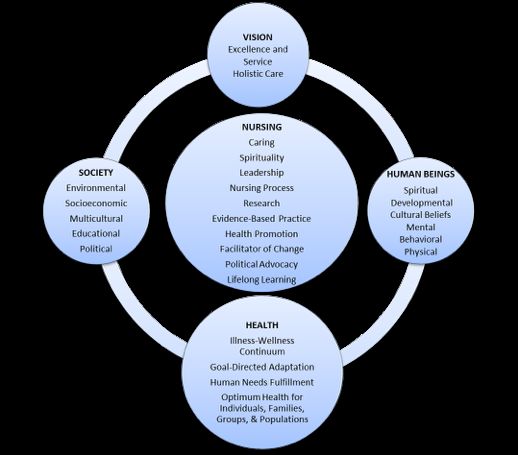
Table of Contents                    Pg.

Greetings from the Director of Nursing                               4
Greetings from the Dean of SGPS                                      5

Greetings from the Coordinator of RN-MSN and MS in Nursing Program   6
Introduction                                                         7

Mission                                                              7
Goal of the MS in Nursing Program                                    7

Expected Student Outcomes for M.S. in Nursing Program                7
Philosophy of Nursing Program                                        9

Model of WAU Department of Nursing Philosophy                        10
ANA Code of Ethics                                                   11
   ● Curriculum                                                      12
   ● Essentials of Master’s Education in Nursing
   ● NLN Competencies for Nurse Educators
   ● AONE Nurse Executive Competencies
   ● The Institute of Medicine Key Recommendations
Accreditation of Nursing Program                                     13
Statement of Student Policies                                        13
   ●               Overview
   ●               Technology Requirements
Communication                                                        14
   ●               Appointments
Change of Name, Address, or Telephone number                         15
   ! Academic Integrity Policy
   ! Attendance Policies
   ! Classroom Management Policies
   ! Policy for Class Projects and Written Assignments

                                                                           2
Academic Grievance Procedure 16
Grading 16
Academic Alert 17
Grounds for Dismissal
Departmental Policies 18
Blood and Body Fluid Exposure Policy and Procedure 18
Disability Support Services 19
Academic Support Services 19
Statement of Faith and Learning 19
School of Graduate and Professional Studies 20
Housing
Online Resources
Academic Advising
Appendices
A. Request for Incomplete 22
B. Report of Exposure, Injury, or Incident 23
C. Academic Alert 24
D. Student Learning Contract 25
E. Criminal Background Check and Drug Test Requirements 26
F. Immunization and Health Requirements 27
G. Castle Branch Requirements for Clinical Practicum Hours 29
H. Student Agreement Form 30
I. Preceptor Agreement Form – Nursing Education 31
J. Preceptor Agreement Form – Nursing Business and Leadership 32
K. Preceptor Evaluation Tool (Student Feedback) 33
L. Preceptor Evaluation of Course and Course Faculty 36
M. Course List: RN-MSN program 39
N. Course List: MS in Nursing 40
3Welcome Letter from the Director of the Nursing Program
Welcome to the Department of Nursing at Washington Adventist University. Our nursing program has a rich
110 -year history that includes being the first baccalaureate nursing school established in the state of
Maryland. The Washington Missionary College was incorporated in 1904, founded to train young men and
women for purposeful living and Christian Service. In the early years our nursing school was named the
Washington Sanitarium Training School for Missionary Nurses. In 1909, the nursing program started as a
three-year hospital-based program, and then in 1926, the program transitioned to a baccalaureate
curriculum. We still provide opportunities for our nursing students to serve abroad and our University offers
four short-term mission trips to foreign countries each year. In addition to the BSN degree, WAU offers the
Masters of Science in Nursing.
You have selected one of the best professions for future employment growth and career satisfaction.
According to the Bureau of Labor and Statistics, employment of registered nurses is projected to grow 19%
from 2012 to 2022, faster than the average (11%) growth of other occupations. Growth will occur primarily
because of technological advancements and an increased emphasis on preventative care. The large, aging
baby-boomer population will demand more healthcare services as they live longer and enjoy more active
lives. The Health Resources and Services Administration (HRSA) estimates a nursing shortage of one
million nurses by 2020. Also, recent changes in the healthcare system have resulted in a need for nurses
who will serve at the advanced practice level.
We will work with you towards the goal of completing your nursing degree within our supportive, spiritual,
Christian learning community. We have a new, comprehensive curriculum and many success strategies in
place that will help you progress through our program. Your success is important to us. The faculty, staff,
and I look forward to working with you as we complete this journey together.
Sincerely,
Tijuana G. Griffin
Tijuana Griffin, PhD, MSN, RN
Director of Nursing Program
Edyth T. James Department of Nursing
Washington Adventist University
7600 Flower Avenue.
4Takoma Park, MD 20912
Greeting from the Dean of the School of Graduate and Professional Studies
Dear Graduate Nursing Student,
Welcome to the School of Graduate and Professional Studies (SGPS) at Washington Adventist
University! We are so happy that you have decided to join our campus community. At
Washington Adventist University, we are committed to excellence—not only in our academics, but
also in the service that we offer to students, alumni, and fellow members of the campus
community. We understand that you are busy working professionals, and we strive to create an
environment that is mindful of your needs. We hope that this is reflected in every aspect of your
experience with the School of Graduate and Professional Studies. If you have any questions or
suggestions for improvement, please don’t hesitate to contact me.
Thank you again for choosing to be a part of the WAU/
SGPS community!
Sincerely,
Brenda Chase, BS, MBA, PhDc
Dean, School of Graduate and Professional Studies
Contact Information :
bchase@wau.edu Phone: 301-891-4146
5Greeting from the Coordinator of RN-MSN and M.S. in Nursing Programs
2019-2020
Dear Graduate Nursing Student,
Welcome to the Department of Nursing at Washington Adventist University, a nursing program
with a rich 110-year history. We are delighted that you have chosen WAU for your graduate
nursing education. As a graduate student, you are an important part of our university community
and our competent professionals will strive to provide the best learning opportunities for you to
serve in the local, national, and global arena.
Our graduate nursing education will provide you with the academic preparation and skills
necessary for role development in advanced nursing practice. Whether you have chosen to study
nursing education or business and leadership, you will grow as a care provider, patient advocate,
and a leader in your field. We will work with you toward the goal of completing your graduate
nursing degree within our supportive, Christian learning community. We have a comprehensive
curriculum, with many strategies in place that will help you progress through the program.
As the Coordinator of the RN-MSN and M.S. in Nursing program, I want to assure you that your
success is very important to us. I look forward to working with you and I wish you the very best in
your journey. Please feel free to contact me if you have any questions.
Warm regards,
Helen John Wilson, DNP, MSN, RN, CRRN, CNE
Asso. Director | MSN Coordinator | Professor of Nursing
Email: hjwilson@wau.edu | Phone: 240 688 1586
6"
Introduction
The handbook is a working document designed to provide information to students in order to
be successful in the graduate nursing program. This handbook is not a substitute for the
University’s Student Handbook or the WAU Academic Bulletin, but is a supplement to them. The
faculty reserves the right to revise this handbook as necessary. The information contained in this
handbook is subject to periodic revision. Students will be given written notice of any amendments
or revisions. Students are expected to read and adhere to policies found in the Student Handbook
for the RN – MSN and MS in Nursing Program. Students must understand that they are
responsible for any updates implemented during their program of study in the Department of
Nursing. A signed receipt of this document will be required by the end of the first week of class
(see Student Agreement Form).
Mission, Program Goals, Expected Student Outcomes, and Philosophy of
Nursing Program
Mission
The primary mission of the Department of Nursing Graduate Program is the immersion of students
into a Christocentric nursing environment which fosters the harmonious development of human
beings, while instilling the essence of Christian caring in the nursing role with a focus on service
through practice, research, and global leadership.
Goal of M.S. in Nursing Program
7The goal of the master’s program is to prepare skilled, competent nurses, who will demonstrate
personal and professional growth through lifelong learning; work to improve patient care and
safety through innovative, evidence-based practice; and function as a collaborative partner of the
health care team in the advanced practice roles of education or administration.
Expected Student Outcomes for M.S. in Nursing Program
Graduates of the MS in Nursing program will be able to:
M.S. in Nursing Core Courses
1. Demonstrate organizational and systems leadership that will improve quality and safety
outcomes in nursing education or health care organizations.
2. Evaluate nursing research and evidence-based practices to improve the health of individuals,
families, communities, and populations.
3. Evaluate current practices and standards of care related to health promotion, disease and injury
prevention and management in order to improve the health of individuals, groups, communities
and populations.
4. Integrate principles of social justice and health policy formation to improve the health of the
public.
5. Analyze the political, social, organizational, cultural, and economic systems that impact health
and health care.
6. Demonstrate effective inter-professional communication, collaboration, and consultation when
practicing in an advanced nursing practice specialty role.
Nursing Education Concentration Nursing Business and Leadership
Courses Objectives Concentration Courses Objectives
87. Design and implement health promotion 7. Synthesize knowledge of ethical and legal
or educational programs for patients, practices when assessing, providing and
students, families, communities, and evaluating health care, and holding self and
populations using evidence-based practice, others accountable for the improvement of
informatics, and health care technologies. patient outcomes and the quality and safety of
care.
8. Demonstrate the ability to provide
humanistic care in an advanced specialty 8. Demonstrate the ability to provide humanistic
nursing practice, respectful of a client’s care in an advanced specialty nursing practice,
cultural, spiritual, ethnic, and gender respectful of a client’s cultural, spiritual, ethnic,
diversity, within an increasingly global, and gender diversity, within an increasingly
multicultural society. global, multicultural society.
9. Synthesize knowledge from the basic 9. Utilize change theory in the planning and
natural sciences, humanities, and delivery of innovations within complex health
informatics in the planning and delivery of care systems.
advanced nursing care in complex
educational systems. 10. Formulate strategies for improved quality
and safety outcomes in community and health
10. Formulate strategies for improved care settings that employ informatics and
quality and safety outcomes in community effective leadership and management principles.
and nursing education settings that employ
informatics and effective leadership and 11. Demonstrate the knowledge, skills, and
management principles. attitude necessary to build collaborative
relationships within a multi-cultural multi-faith
11. Demonstrate the knowledge, skills, and environment to meet the spiritual needs of
attitude necessary for assessment and clients and self.
identification of spiritual needs within a
multi-cultural multi-faith environment to
meet the spiritual needs of clients and self.
Philosophy of Nursing Program
The Edyth T. James Department of Nursing upholds the mission statement of Washington
Adventist University, a learning community committed to the Seventh-day Adventist Christian
vision of excellence and service. The nursing faculty provides learning opportunities within a
Christian environment that fosters the harmonious development of human beings. Human beings
were created perfect in the image of God with the power to think, feel, and act. Through God’s
plan of salvation, human beings can have eternal life. While human beings no longer live in a
perfect state, God’s relationship with them continues to give them dignity, choice, and rights that
can be responsibly directed toward experiencing maximum health through creative human need
fulfillment.
9Human beings are biopsychosocial and spiritual in nature with similar needs and different modes
of adaptation. Throughout life, as unique holistic systems, human beings adapt and develop
through the interchange of energy with the environment and the utilization of resources in society.
Society and human beings are changing, interacting systems with spiritual, physical, mental,
behavioral, developmental, cultural, social, educational, political, economic, and environmental
conditions that affect the survival and health of its members.
The nature of being human is to be caring. Society seeks caring from the nursing community.
Caring nurses reflect on their own beliefs, attitudes, and values as they provide holistic care and
respond to issues that impact professional practice, such as vulnerable populations, unethical
practices, and diversity in a multicultural healthcare environment.
Health reflects the dynamic interplay of human needs, potential alterations, and actual alterations
in human need fulfillment. Health can be conceptualized as being on an illness-wellness
continuum. Wellness involves an individual’s goal-directed adaptation, growth, development, and
realization of human need fulfillment within a changing multicultural society. Impaired health
presents the individual with an opportunity for adaptation, growth, and the ongoing pursuit of
optimum health potential through human need fulfillment. The subjective experience of the
individual influences the person’s definition of health and one can move towards health and
wellbeing through awareness, education, and growth.
The profession of nursing is a scholarly practice discipline. Through a variety of processes such as
caring, spirituality, health promotion, leadership, research, evidence-based practice, the nursing
process, facilitation of change, political advocacy, and life-long learning, nursing positively
impacts the illness-wellness continuum. The responsibility of society’s health care is shared by
nurses, other health professionals, and consumers. Nursing leadership is a communication and
relationship process seeking to envision the needs, strengths and resources of human beings while
influencing the individual, family, group, community, and population in the purposeful attainment
of mutually defined health goals. Through the use of best research evidence, logical reflective
reasoning, clinical judgment, and consideration of patient values, the professional nurse provides
an evidence-based, health-oriented service to society.
The professional nurse facilitates change within systems through the roles of provider, designer,
manager, coordinator, educator, advocate, and counselor. As advocates for quality health care,
nurses are active in the political processes that affect the healthcare delivery system. The
professional nurse is committed to lifelong learning and the continued development of self-
awareness, responsibility, and accountability.
10Model of Washington Adventist University Department of Nursing Philosophy
ANA Code of Ethics
The nurse practices with compassion and respect for the inherent dignity, worth, and unique
attributes of every person.
1. The nurse’s primary commitment is to the patient, whether an individual, family,
group, community, or population.
112. The nurse promotes, advocates for, and protects the rights, health, and safety of the
patient.
3. The nurse has authority, accountability, and responsibility for nursing practice; makes
decisions; and takes action consistent with the obligation to promote health and to
provide optimal care.
4. The nurse owes the same duties to self as to others, including the responsibility to
promote health and safety, preserve wholeness of character and integrity, maintain
competence, and continue personal and professional growth.
5. The nurse, through individual and collective effort, establishes, maintains, and
improves the ethical environment of the work setting and conditions of employment
that are conducive to safe, quality health care.
6. The nurse, in all roles and settings, advances the profession through research and
scholarly inquiry, professional standards development, and the generation of both
nursing and health policy.
7. The nurse collaborates with other health professionals and the public to protect human
rights, promote health diplomacy, and reduce health disparities.
9. The profession of nursing, collectively through its professional organizations, must
articulate nursing values, maintain the integrity of the profession, and integrate
principles of social justice into nursing and health policy.
The profession of nursing, collectively through its professional organizations, must
articulate nursing values, maintain the integrity of the profession, and integrate principles of
social justice into nursing and health policy.
To access the ANA Code of Ethics with Interpretive Statements:
http://nursingworld.org/MainMenuCategories/EthicsStandards/CodeofEthicsforNurses/Code-
of-Ethics-For-Nurses.html
American Nurses Association (2015). Code of Ethics for Nurses with Interpretive Statements.
Washington, D.C.: American Nurses Publishing.
MS in Nursing Program Curriculum
The elements and framework for building the graduate nursing curriculum are based on The
Essentials of Master’s Education in Nursing (2011), the American Organization of Nurse
Executives (AONE) Nurse Executive Competencies (2011), the National League for Nursing (NLN)
12Competencies for Nurse Educators (2012) and the Institute of Medicine (IOM) Future of Nursing
Recommendations (2010).
The Essentials of Master’s Education in Nursing
I. Background for Practice from Sciences and Humanities
II. Organizational and Systems Leadership
III. Quality Improvement and Safety
IV. Translating and Integrating Scholarship into Practice
V. Informatics and Healthcare Technologies
VI. Health Policy and Advocacy
VII. Inter-professional Collaboration for Improving Patient and Population
Health Outcomes
VIII.Clinical Prevention and Population Health for Improving Health
IX. Master’s-Level Nursing Practice
The AONE Nurse Executive Competencies
1. Communication and Relationship-Building
2. Knowledge of the HealthCare Environment
3. Leadership
4. Professionalism
5. Business Skills
The NLN Competencies for Nurse Educators
1. Facilitate Learning
2. Facilitate Learner Development and Socialization
3. Use Assessment and Evaluation Strategies
4. Participate in Curriculum Design and Evaluation of Program Outcomes
5. Function as a Change Agent or Leader
6. Pursue Continuous Quality Improvement in the Nurse Educator Role
7. Engage in Scholarship
8. Function within the Educational Environment
The IOM Key Recommendations
1. Nurses should practice to the full extent of their education and training.
2. Nurses should achieve higher levels of education and training through an improved
education system that promotes seamless academic progression.
3. Nurses should be full partners, with physicians and other healthcare professionals,
in redesigning health care in the United States.
4. Effective workforce planning and policy
making require better data collection and an improved information infrastructure.
Accreditation of Nursing Programs
13The baccalaureate degree in nursing and master’s degree in nursing programs at Washington
Adventist University are accredited by the Commission on Collegiate Nursing Education
(www.aacn.nche.edu/ccne-accreditation).
The University is accredited by the Middle States Commission on Higher
Education (www.msche.org) and the Accrediting Association of Seventh-day Adventist Schools,
Colleges, and Universities (http://adventistaccreditingassociation.org).
Statement of Student Policies
Overview
Consistent with the mission of the Department of Nursing is the expectation that graduate
students will exhibit the highest standards of professional behavior. Each student is required to
conduct him or herself with honesty, integrity, and in a professional manner while in the classroom,
university buildings, laboratory, or practicum settings.
Technology Requirements
1. Students are expected to use their wau.edu email address for all communications with
faculty and administrators within the Department of Nursing. Please do not forward your
WAU email to another device, as this has caused problems in the past.
2. Students are expected to check their wau.edu email accounts daily and respond as
requested. They are responsible for all communications sent to the wau.edu email account.
3. Students are expected to daily check Desire to Learn (D2L) for announcements and
updates. Use Turnitin.com on all written assignments. Students will utilize Microsoft
Word for all typed assignments and use PowerPoint as needed. Also, students should
access and use Grammarly and SmartThinking through D2L.
4. Students must behave professionally in the use of social media, and not engage in any
activity that represents a violation of HIPPA policies.
14Communication
Main Office
The Department of Nursing administrative suite is located in Room 211 of the Boyer
Building. In addition to providing support for the daily operation of the Department, the
Department of Nursing staff serves as a resource of information for students, faculty, other WAU
offices, and members of the greater community. Students are welcome to visit the office during
regular operating hours to conduct business, or to make appointments to meet with nursing
administrators or faculty. Hours: Mon. – Thurs. 8:30AM to 5:00PM; Fri. 8:30AM to 12:00PM.
Common Courtesy
Since interaction with office personnel is as much a component of professional behavior as
is performance in the clinical and classroom setting, nursing students are expected to exhibit the
same professionalism and courtesy when interacting with any member of the office staff as they
would with members of the faculty and other professionals. As part of a professional office, each
staff member is committed to delivering quality service.
The reception area is particularly designed to welcome students, faculty and other members
of the community. All visitors to the Department of Nursing offices should enter the reception area
first, to be assisted by the receptionist. In the interest of courtesy and privacy, students are not
permitted to enter directly into any faculty or administrative office without first being invited to do
so.
Chain of Command
If students have a concern or complaint to discuss, it is important to follow the chain of
command. First, make an appointment with your course professor. If you do not find satisfaction,
meet with your advisor. If you feel the need to proceed for resolution of your issues or concerns to
a higher level, make an appointment with your director of the nursing program. Listed below is
your chain of command:
1. Course professor
2. Advisor
3. Coordinator of MSN/RN-MSN Nursing
4. Director of Nursing
5. Provost
Appointments
Appointments and requests for letters of recommendation may be made via email with
detailed information about the request. As a part of professional behavior, students are expected to
15keep scheduled appointments, or, in the event of an emergency, to notify the office in advance if a
scheduled appointment must be cancelled or rescheduled.
Change of Name, Address or Telephone Number
Students are responsible to report to the Office of the Registrar as soon as possible for any
changes in name, address or telephone numbers. Students who do not keep the Office of the
Registrar apprised of this information are still responsible for any information or correspondence
sent to them at the last address on file. New identification cards and badges should be procured
accordingly.
Academic Integrity Policy
The academic integrity policy can be found in the Academic Bulletin under the section on
Academic Information. Academic dishonesty includes, but is not limited to:
1. Cheating – intentionally using or attempting to use unauthorized materials, information, or
study aids in any academic exercise
2. Plagiarism – intentionally or knowingly representing the words or ideas of another as one’s
own in any academic exercise
3. Fabrication – Intentional and unauthorized falsification or invention of any information or
citation in an academic exercise
4. Copying information from another student, assisting another student when not explicitly
stated as allowed, and failure to properly cite sources according to APA guidelines
constitutes a violation of the academic integrity policy.
Attendance Policies
1. Students are expected to be on time and to attend all classes. The Department of Nursing
realizes that, at times, lateness is unavoidable. In these situations, students must notify
faculty by text or email prior to the start of class. Also, if it is necessary for a student to be
absent from class, the instructor must be notified prior to class time via email.
2. Students who miss more than one class in an eight week term are in danger of failing or
may be withdrawn from the course at the discretion of the course professor.
3. Students who are absent from class are responsible for obtaining the missed class material.
Classroom Management Policies
1. The Faculty reserves the right to change the content or schedule of the course syllabus as
needed in special circumstances. Students will be notified of any such changes. It is the
student’s responsibility to abide by the most current syllabus posted in D2L.
162. Graduate students are expected to prepare for class by reading assignments prior to each
class and participating in class discussions.
3. Cell phones are required to be turned off while students are in class.
4. Students failing a course at mid-term will be required to meet with their professor for
counseling and to complete a student learning contract.
Policies for Class Projects and Written Assignments
1. Students are responsible for submitting class projects and written requirements on the due
date specified in the course syllabus, at the beginning of class in the dropbox on D2L
unless the instructor has granted expressed permission, in advance, to submit materials at
another time.The privilege to submit late assignments will be at the discretion of the
professor.
2. All written assignments must be typed, double spaced using APA format, 12-point Times
New Roman font, with proper spelling and grammar. Always keep a copy of the
assignment. Scholarly writing is always expected.
3. All assignments must be the student’s own original work: not copied from another source;
not submitted from another course; and not the work of another student. All written
assignments are reviewed by the Turn-It-In plagiarism detection system.
All assignments must be the student’s own individual original work unless specified as a
group assignment.
Academic Grievance Procedure
Students who feel that they have received prejudiced academic evaluation are entitled to
appeal for an impartial review and reconsideration of their cases. Procedures to be followed are
listed in the Academic Bulletin in the section on Academic Information. The order of appeal is as
follows:
1. Coordinator of MSN Program
2. Director of Nursing Program
3. Academic Appeals Committee
4. Dean of SGPS
5. Provost
Grading
As stated in the WAU Academic Bulletin:
17Evaluation of student academic performance is the responsibility of the course instructor.
All core courses must be completed with “B” or better in order to progress into a concentration. In
addition, all specialty courses must be completed with a “B” or better (Academic Bulletin, p. 306).
Students are allowed only one grade of “C+” or “C” during their entire graduate program.
A student who receives a second grade of “C+” or “C” will be placed on graduate academic
probation and required to repeat the course the next time that it is offered. On the second attempt,
the student must obtain a grade of “B” or higher (Academic Bulletin, p. 306).
No student may carry more than two incomplete (I) grades at any one time in the program.
All (I) grades must be resolved within eight weeks after the original course grade was issued
(Academic Bulletin, p. 306).
The following is the Department of Nursing Grading Scale for the graduate program:
A 94-100 C+ 77-79
A- 90-93 C 74-76
B+ 87-89 C- 70-73
B 84-86 D 65-69
B- 80-83 FCoordinator of the Graduate Program, and the Director of the Nursing Program.
Grounds for Immediate Dismissal from the Nursing Program
Demonstration of any of the following actions or behaviors will result in immediate
dismissal from the Department of Nursing graduate program:
Violation of Academic Integrity Policy as outlined in WAU Academic Bulletin (pp. 20-23)
1. Behavior that threatens the health and safety of clients, students, faculty, or college staff.
2. Impairment due to alcohol or drugs, or behavior suggesting impairment.
3. Behavior or actions that engage in or condone discrimination on the basis of race, gender,
age, citizenship, religion, national origin, sexual orientation, or disability.
4. Violations of client confidentiality (HIPPA policies).
5. Client abandonment
6. Using any social media that brings discredit upon the University, Department of Nursing,
students, health agencies, patients and the nursing profession.
Departmental Policies
Department of Nursing Dress Code
Graduate students attire should be appropriate for the situation, and reflect standards of
professionalism in both classroom and practicum settings. A white lab coat should be worn for lab
and clinical sessions. Cooperation in adhering to the regulations is a matter of personal integrity
and the willingness to adhere to regulations suggests maturity and sense of responsibility.
Criminal Background Checks and Drug Test Requirements
All applicants must submit a completed criminal Background Check and urine Drug Test
through Castle Branch (CB22) prior to admission into the program. There is a fee associated with
this process. It will take one to two weeks for the background check to run its full report.
Immunization and Health Requirements
Background Checks, Urine Drug Tests, Physical Exams, Immunizations, TB testing, and
must be kept up to date once accepted into the program. Requirements are subject to change in
order to abide by the hospital/ practicum requirements.
Blood and Body Fluid Exposure Policy and Procedure
19Occupational Exposure Guidelines
According to the Centers for Disease Control and Prevention, the primary means of
preventing occupational exposure to HIV and other blood borne pathogens is the strict adherence
to infection control standards, with the assumption that the blood and other body fluids of all
individuals is potentially infectious. The routine utilization of barrier precautions when anticipated
contact with blood or body fluids, immediate washing of hands or other skin surfaces after contact
with blood of body fluids, and careful handling/disposing of contaminated sharp instruments or
other equipment during and after use is recommended.
For more information: http://www.cdc.gov/mmwr/preview/mmwrhtml/rr5409a1.htm
Student Responsibility
Graduate students in the practicum setting should become familiar with and maintain the
infection control and safety standards of their individual agency or organization. Any adverse event
or exposure should be reported to the Department of Nursing as soon as possible, and an Incident
Form completed. (See Department of Nursing Forms).
Please note: Decisions regarding post-exposure management, prophylaxis, and follow-up will be
at the discretion of the individual and his/her health care provider.
The injured party will be financially responsible for any emergency treatment, prophylaxis and
follow-up care that may be necessary as a result of the incident.
Disability Support Services
Any student who may need accommodations because of the impact of a disability should
register with the Office of Disability Services in the Betty Howard Center for Student Success
(BHCSS) located in Wilkinson Hall, Suite 133. Guidelines for accessing disability services are
listed in the Academic Bulletin under the BHCSS section.
Academic Support Services
The Betty Howard Center for Student Success (BHCSS) provides a variety of support and
academic enrichment programs to assist students in adjusting to college and in achieving personal
and professional goals. Free services are provided to students who need to improve verbal,
written, and reading skills. Academic early-alert services, advising, tutoring, and workshops on
academic success strategies are provided for all students as needed.
On the wau.edu home page, at the top, you can access the Desire2Learn site. There are tutorials
for you including a video on the Basics of APA Style and information on Turnitin which is an
internet-based plagiarism-prevention service. WAU has purchased a license for students to submit
20their papers to this service. Free help with APA style can also be obtained at https://
owl.english.purdue.edu/owl/resource/560/01/.
Library and Online Databases
The Weis Library is a member of the Maryland Interlibrary Consortium which shares a Web-based
public catalog. The library provides access to dozens of electronic databases. Students have
remote access to the library’s licensed databases and can go to the Weis Library website to the
section on Search Databases and Indexes.
Statement on Faith and Learning
The faculty of the Department of Nursing seeks inspiration and guidance in assisting
students to learn. The faculty embraces the Washington Adventist University (WAU) belief
statement that, “The highest development of the individual takes place in the moral and ethical
code implied in the life and teachings of Jesus Christ as recorded in the scriptures and the search
for truth is most fruitful within a philosophical framework based on the Bible.” The Department of
Nursing faculty supports the WAU Statement of Mission, Objectives, and Statement of
Community Ethos. In addition, the faculty adheres to the WAU Code of Ethics for Teachers
(Policy Handbook for Administration and Faculty at Washington Adventist University).
School of Graduate and Professional Studies (SGPS) Specific Information
SGPS Virtual Bookstore
SGPS partners with a virtual bookstore, MBS Direct, accessible at http://
bookstore.mbsdirect.net/wau.htm which provides for books to be delivered to you. You can order
books online at competitive prices from a variety of sellers, or rent a book and eventually sell it
back to MBS, if you choose. MBS Direct will automatically provide you with the required books
once you select the course in which you have enrolled. Please contact the Support Services
Manager at 301-891-4007 to discuss utilizing Financial Aid to purchase your books. You can order
books by phone at 800-325-3252.
Online Academic Resources
21ALL STUDENTS must set up their account information. If you are a new student or if you have
forgotten your password or user name, you will be able to get or reset your password by following
the steps listed in the SGPS Student Welcome and Orientation Packet (page 9). Also, ALL
STUDENTS must set up a WAU email account. Instructions for doing this can be found in the
same booklet (page 10).
Information about WebAdvisor, Desire2Learn, Smartthinking and other useful online resources,
as well as information about tutoring and counseling services, can also be found in the SGPS
Student Welcome and Orientation Packet (page 10-12).
Academic Advising
Following initial registration by the SGPS Program Coordinator, the Coordinator of the MS in
Nursing Program serves as academic advisor to all graduate nursing students. Students enrolled in
the MS and RN-MSN programs must meet with their academic advisor each semester during their
course of study, prior to registration, to monitor academic progress and for course planning.
22APPENDICES
23APPENDIX A: REQUEST FOR INCOMPLETE IN A COURSE
WASHINGTON ADVENTIST
UNIVERSITY Request for Incomplete
Records Office (Wilkinson Hall 316)
7600 Flower Avenue
Takoma Park, MD 20912
301-891-4119
“An Incomplete (I) indicates that a student’s work in the course is incomplete because of illness
or unavoidable circumstances and not because of negligence or inferior performance.”
For further details see the Academic Bulletin.
I. To be completed by the student:
Student Name: SSN/ID:
Semester :Spring Course Number: Course
Instructor’s Name (printed):
Reason for request: Student is traveling out of the country and unable to complete the final exam
Student’s Signature: Date:
II. To be completed by the instructor:
Note: Incomplete grades should be removed by mid-semester of the following semester (summer
semester NOT included). Dates later than this should have supporting documentation.
Requirements to be completed: Dates to be Completed:
If an Incomplete Removal Form has not been submitted by the instructor by the last date above,
the Records Office should change the Incomplete grade to a grade of________ :
Instructor’s Signature: Date:
24Department Chair’s Signature: Date:
Computer Entry Grade/Course Report Change
For Office Use Only:
RAP Sheet Update Notice to Student
APPENDIX B : REPORT OF EXPOSURE, INJURY, OR INCIDENT
To be completed by the clinical supervisor and student
Name of Individual involved:__________________________________________________
Immediate Faculty/Preceptor:_________________________________________________
Clinical facility where exposure occurred:_______________________________________
Date/Time of Exposure: ____________ Type: Needle Stick:____ Splash:_________
Mucous Membrane______ Other:_____
Describe how the incident occurred:_______________________________________________
Personal Protective Equipment Being Used_________________________________________
Actions taken (decontamination, clean-up, reporting, counseling, etc.) __________________
______________________________________________________________________________
Date and Time Incident was reported to Infection Control/Occupational Health: _____________
Name/Title of Individual to whom the incident was reported: ____________________________
CHECK LIST
□ Student was provided with the Department of Nursing Blood and Body Fluid Exposure Policy and
25Procedure
I have received and read the Department of Nursing Blood and Body Fluid Exposure Policy and Procedure
guidelines. I understand that I have been advised to contact my health care provider for care that is needed
as a result of the exposure that has occurred.
________________________________________ ______________
Student Name (Printed) and Signature Date
APPENDIX C: ACADEMIC ALERT
Student Name ____________________________ ID#___________________________________
Course _________________________________ Instructor _____________________________________
The Department of Nursing faculty wants to provide you with the assistance you need to succeed in your
program. We are concerned about your progress and urge you to take the step (s) indicated below
immediately.
Academic Concern Attendance / Clinical Concern / Professionalism
□ The grade you have earned in this course □ You have had one class/lab/clinical absence on
is 80% or less will receive a ________
clinical, academic or lab alert You have a total of _____________course absences
thus far.
Date: ________________________
□ WARNING: You are in danger of being
Grade ________________________
administratively
withdrawn (AW) due to excessive absences
□ WARNING: Your current test grade
average
□ Your clinical performance on ________ was
indicates you are in danger of not progressing
unsatisfactory.
to
the next level.
The following clinical course objective(s) is/are not being
Current test average
met:
_____________________
1.
2.
3.
Recommended Activity: Any remediation activities was be completed by
(date)______________________
□See me in my office after class or during office hours by (date) ______ Office # ________ Phone:
__________
□Utilize appropriate college resources (counseling/disability)
26_________________________________________
______________________________________________________________________________________
______
Instructor Signature: ____________________________________________ Date:___________________
Did the student come for help by the date indicated? ___ Yes _____ No
Comments:
Student’s Signature: ________________________________________________ Date:
____________________
APPENDIX D: STUDENT LEARNING CONTRACT
Student Name: ______________________________ Course: ______________________________
Faculty Name: ______________________________
I am contracting to improve my grade from a _____ to a _____ and am willing to achieve this as follows:
Learning Objectives Learning Resources Target Date Evidence of Faculty
and Strategies for Accomplishment of Initials
(Consider student learning Completion Objectives
SMART objectives are: style…can include study
Specific groups, study partner,
Measurable practice questions, test
Achievable review sessions, tutoring
Results oriented services)
Time bounded
27Student Signature: ________________________________________ Date: ____________________
Faculty Signature: ________________________________________ Date: ____________________
APPENDIX E: CRIMINAL BACKGROUND CHECK AND DRUG TEST
REQUIREMENTS
All applicants must submit a completed criminal Background Check and urine Drug Test through
Castle Branch (CB22) prior to admission into the program. There is a fee associated with this process. It
will take one to two weeks for the background check to run its full report.
Background Check: The records must indicate that the student has never been convicted of any of the
following offenses:
• Murder
• Arson
• Assault, battery, assault and battery, assault with a dangerous weapon, mayhem or threats to do
bodily harm
• Burglary
• Robbery
• Kidnapping
• Theft, fraud, forgery, extortion or blackmail
28• Illegal use or possession of a firearm
• Rape, sexual assault, sexual battery, or sexual abuse
• Child abuse or cruelty to children
• Unlawful distribution, or possession with intent to distribute, a controlled substance
A urine drug test takes 3-5 business days from the time the sample is placed. However, if the test is positive
this will take longer; it goes to the Medical Review Officer for review and for students to provide any
prescription. Make arrangements to order this package and submit a urine sample well before the start date.
Students with a positive drug test will not be accepted into the nursing program.
Drug Test: A 10-Panel Urine Test Substances Tested
1. Amphetamines
2. Barbiturate
3. Benzodiazepines
4. Cannabinoids
5. Cocaine
6. Methadone
7. Methaqualone
8. Opiates
9. Phencyclidine
10. Propoxyphene
APPENDIX F: IMMUNIZATION AND HEALTH REQUIREMENTS
Background Checks, Urine Drug Tests, Physical Exams, Immunizations, TB testing, and must be kept up to
date once accepted into the program. Requirements are subject to change in order to abide by the hospital/
clinical/practicum requirements.
*Background Check
Within last year through Castle Branch (CB22)
*Urine Drug Toxicology Screen
Within last year through Castle Branch (CB22)
Once accepted into the program, students will need to meet the following immunization and health
requirements. This documentation must be submitted into the document manager of Castle Branch
(CB22im) before starting any clinical/practicum postings.
1. CPR Certification
Submit a copy of your CPR card from the American Heart Association Basic Life Support for
Healthcare Provider course. (If there is a paper card, it must be signed. Computer printouts are
acceptable.)
2. Health Insurance
29Submit a copy of both the front and the back of your current health insurance card or proof of
coverage. If the name on the card does not match the student’s name, written verification of
coverage from the provider is required.
3. Influenza (between 08/01 and 10/1)
Submit documentation of a flu shot administered between 08/01 and 10/1
4. Physical Examination ( completed after May 1)
Download, print & complete the Washington Adventist University Pre- Entrance Health Requirements form
(3 pages) and upload. The exam must be completed by a Licensed Health Care provider and documented on
the form provided. (Your Provider must sign and date the appropriate pages. Your name and date must be on
each page.)
6. TB Skin Test OR Blood Test QuantiFERON Gold/IGRA/T-Spot (completed after May 1)
Submit documentation of one of the following:
● 2 step TB skin test (1-3 weeks apart) OR
● 2 consecutive annual tests (no more than 12 months between tests) WITH a 1 step TB
skin test within the past year
7. Chest X Ray (if positive TB Test results)
● Submit a clear Chest X- Ray report within the last 5 years.
8. TB Questionnaire (completed after May 1)
● During the 5 year period, you must complete a questionnaire annually reviewed by an examining
physician/health care provider after May 1 stating no current signs or symptoms of Tuberculosis are
present.
9. Hepatitis B
Submit documentation of one of the following:
● Quantitative antibody titer (lab report required) OR
● A series of 3 vaccinations
10. Polio
Submit documentation of one of the following:
● Quantitative antibody titer (lab report required) OR
● A series of 3 vaccinations
11. Measles (Rubeola) *
Submit documentation of one of the following:
● Quantitative antibody titer (lab report required) OR
● A series of 2 vaccinations
12. Mumps *
Submit documentation of one of the following:
● Quantitative antibody titer (lab report required) OR
● A series of 2 vaccinations
13. Rubella *
Submit documentation of one of the following:
● Quantitative antibody titer (lab report required) OR
● A series of 2 vaccinations
14. Varicella (Chicken Pox)
30Submit documentation of one of the
following:
● Quantitative antibody titer (lab report required) OR
● A series of 2 vaccinations
15. Tetanus, Diphtheria & Pertussis (Tdap)
Submit documentation of a Tdap (not Td or DTaP) booster within the past 10 years
* may be grouped together as MMR (Measles, Mumps, Rubella)
APPENDIX G: CASTLE BRANCH REQUIREMENTS FOR CLINICAL PRACTICUM HOURS
To Place Orders in Castle Branch: Login account in https://portal.castlebranch.com/cb22 and order
the specific codes / If you have any problems: Call 1.888.723.4263
Required on admission Required Annually
Castle Branch code: Castle Branch code: CB22im Castle Branch code: CB22re
CB22 Amount: ($20.00) Amount: ($60.00)
Amount: ($100.00)
Background Check To submit documents, Background Check
1.) Login in to Castle Branch at
Drug Test (10 https://www.castlebranch.com Drug Test (10 Panel)
Panel) using your email and password,
2.) Fax or 3.) Mail Castle Branch code: CB22im
Amount: ($20.00)
1 CPR CPR
2 Health Insurance Health Insurance
3 Influenza Influenza
8/1 to 10/1 8/1 to 10/1
4 WAU PreEntrance Health Record Annual Physical Examination (2
Physical Examination (3 pages) pages)
5 Tuberculosis (TB) Skin Test (2 Tuberculosis (TB) Skin Test (1
Step) OR Quantiferon Gold Blood Step) OR Quantiferon Gold Blood
Test Test
316 Chest XRay every 5 years OR If Chest XRay is current and clear,
TB Questionnaire complete TB Questionnaire
7 Hepatitis B Only if incomplete
3 immunizations OR
titer
8 Polio Only if incomplete
3 immunizations OR
titer
9 Measles (Rubeola) Only if incomplete
2 immunizations OR
titer
10 Mumps Only if incomplete
2 immunizations OR
titer
11 Rubella (German Measles) Only if incomplete
2 immunizations OR
titer
12 Varicella (Chicken Pox) Only if incomplete
2 immunizations OR
titer
13 Tetanus, Diptheria & Pertussis Only if incomplete
(Tdap) Every 10 years
Note: Questions related to WAU Castle Branch requirements must be directed to:
Evelyn Khandagale, Room 205A, Nursing Education Clinical Coordinator
301 891 4182 (Office) 301 891 4191 (Fax), ekhandag@wau.edu (email)
32APPENDIX H: STUDENT AGREEMENT FORM
DO NOT SUBMIT UNTIL YOU HAVE READ THE ENTIRE HANDBOOK
I, the undersigned student, having read and reviewed the entirety of the Washington Adventist University
Edyth T. James Department of Nursing Student Handbook and do agree to adhere to and abide by all
University and Department of Nursing policies during my matriculation at WAU. Furthermore, I agree to
adhere to the conduct codes and performance policies of the Clinical Education sites to which I may be
assigned. I clearly understand that failure to adhere to and abide by these policies and regulations of the
University, Department of Nursing, Hospital and/or Clinical Site may result in my removal and subsequent
withdrawal from the clinical site/classroom and/or program.
I also understand that in addition to faculty employed at the University, there may be employees of the
Hospital/Clinical Agency or Practicum site which are designated by the University as a Supervisor/
Preceptors/Clinical Instructors. As such, these individuals will be functioning as members of the team of
instructors within one or more of the Program’s clinical or practicum courses. Therefore, I understand that
assessment / evaluation information about my academic and/or clinical or practicum performance may be
shared with the designated/appropriate Supervisor or Clinical Site staff member(s) for the sole purpose of
providing them with information needed by them for patient / client assignment or University required
clinical performance evaluation/assessment. Furthermore, my academic and/or clinical records may be
reviewed by duly authorized representatives of Professional, State, or National accreditation agencies.
I further understand that the Hospital or Clinical agencies or Practicum site to which I may be assigned may
require that I receive clearance from the State of Maryland that I do not have a criminal record of an offence
which would compromise the safety or well- being of the clients or patients of that site. Therefore I
understand that my name will be submitted to the state for a CORI (criminal offender record information)
and SORI (sexual offender registry information) check. A CORI/SORI check report of such an offence may
preclude my eligibility for clinical or practicum assignment and thereby may negate my matriculation in the
program.
Lastly, I understand that I am required to satisfy the Department of Nursing Medical History/Immunization
Records requirement and CPR requirement. Failure to do so will preclude my eligibility to participate in
the clinical or practicum phase and may result in my inability to complete the program.
Please sign and date two copies and submit this form when requested by a faculty member. One copy will
be kept on file at the WAU Department of Nursing; the other copy is for your records.
Student's Name (Printed): _______________________ Student's signature _____________________
Witness's Name (Printed): _______________________ Witness’s signature_____________________
Faculty’s Name & Title: ________________________ Faculty’s signature_____________________
Program: _______________________ Received on (Date):_____________________
Note: Submission of this form is required prior at the end of the first week of classes
APPENDIX I: PRECEPTOR AGREEMENT FORM, NURSING EDUCATION
33Date: _____________________ Term: _____________________ Course: _____________________
Student’s Name: ________________________________________ RN License #: _______________
Student’s Mailing Address______________________________________________________________
Student’s Email: ____________________________________ Phone: _________________________
* Student to attach Personal Objectives
PRECEPTOR INFORMATION
Preceptor Name: _______________________________________ Credentials: __________________
Preceptor Title: ________________________________________ Phone: ______________________
Agency Name: _________________________________________ Fax: ________________________
Agency Address: ______________________________________________________________________
SIGNATURES
Student: ____________________________________________________ Date: __________________
Preceptor: __________________________________________________ Date: __________________
Program Coordinator: ________________________________________ Date: __________________
APPENDIX J: PRECEPTOR AGREEMENT FORM, NURSING AND BUSINESS
LEADERSHIP
34Date: _____________________ Term: _____________________ Course: _____________________
Student’s Name: ________________________________________ RN License #: _______________
Student’s Mailing Address______________________________________________________________
Student’s Email: ____________________________________ Phone: _________________________
* Student to attach Personal Objectives
PRECEPTOR INFORMATION
Preceptor Name: _______________________________________ Credentials: __________________
Preceptor Title: ________________________________________ Phone: ______________________
Agency Name: _________________________________________ Fax: ________________________
Agency Address: ______________________________________________________________________
SIGNATURES
Student: ____________________________________________________ Date: __________________
Preceptor: __________________________________________________ Date: __________________
Program Coordinator: ________________________________________ Date: __________________
"
APPENDIX K: PRECEPTOR EVALUATION TOOL
(Student Feedback)
35Preceptor Name:___________________________ Course: ___________________________
Date: __________________________ Site: _________________________________________
Completed by Student: _________________________________________________________
Please consider the completion of this survey as a method to provide feedback to Washington
Adventist University. This survey is being conducted to assess your satisfaction with your
preceptor. Your opinion is important to us and change cannot occur without feedback. Please
return this survey to the Coordinator of the RN-MSN and MS in Nursing Program. Information in
this survey is confidential. All information will be analyzed and then reported by group rather than
individually. Students will not be identified to any faculty member or preceptor throughout the
whole survey process. If you have any questions about this survey, please contact Dr. Helen
Wilson - hjwilson@wau.edu
1. The preceptor oriented me well to the clinical area and expectations of my role.
⃝ Strongly Agree
⃝ Agree
⃝ Somewhat Agree
⃝ Disagree
⃝ Strongly Disagree
2. The preceptor exhibited expertise and was knowledgeable and competent in his/her nursing
role.
⃝ Strongly Agree
⃝ Agree
⃝ Somewhat Agree
⃝ Disagree
⃝ Strongly Disagree
3. The preceptor collaborated with and assisted you in planning learning objectives and
experiences.
⃝ Strongly Agree
⃝ Agree
⃝ Somewhat Agree
⃝ Disagree
⃝ Strongly Disagree
4. The preceptor provided resources to you to facilitate learning.
⃝ Strongly Agree
36⃝ Agree
⃝ Somewhat Agree
⃝ Disagree
⃝ Strongly Disagree
5. The preceptor provided appropriate feedback to improve your performance.
⃝ Strongly Agree
⃝ Agree
⃝ Somewhat Agree
⃝ Disagree
⃝ Strongly Disagree
6. The preceptor led you through problem-solving activities to improve your
critical-thinking and decision making skills.
⃝ Strongly Agree
⃝ Agree
⃝ Somewhat Agree
⃝ Disagree
⃝ Strongly Disagree
7. The preceptor encouraged questions and offered constructive comments.
⃝ Strongly Agree
⃝ Agree
⃝ Somewhat Agree
⃝ Disagree
⃝ Strongly Disagree
8. The preceptor communicated well, giving clear explanations and instructions.
⃝ Strongly Agree
⃝ Agree
⃝ Somewhat Agree
⃝ Disagree
⃝ Strongly Disagree
9. The preceptor exhibited a caring and respectful attitude.
⃝ Strongly Agree
⃝ Agree
⃝ Somewhat Agree
⃝ Disagree
⃝ Strongly Disagree
37You can also read


