Role of POCUS in the Diagnosis of Acute Pericarditis - Ultrasound Scholarly Concentration Case Conference #1 5.19.2021 Diwash Thapa, MS3 - UNC ...
←
→
Page content transcription
If your browser does not render page correctly, please read the page content below

Role of POCUS in the
Diagnosis of Acute Pericarditis
Ultrasound Scholarly Concentration

Case Conference #1 5.19.2021

Diwash Thapa, MS3
Case Series Outline

I.   Case
II. Clinical Question
III. Literature Review
IV. Key Points

This presentation contains video and audio clips. Please click on the
underlined text to be directed to the appropriate media online.
Case Presentation

• 56-year-old female with no past medical history due to a lack of
  longitudinal medical care
• >12 hours of shortness of breath, palpitations, and pleuritic chest pain
• Denies any radiation of the chest pain, diaphoresis, nausea, vomiting,
  abdominal pain, dizziness, orthopnea, or peripheral edema
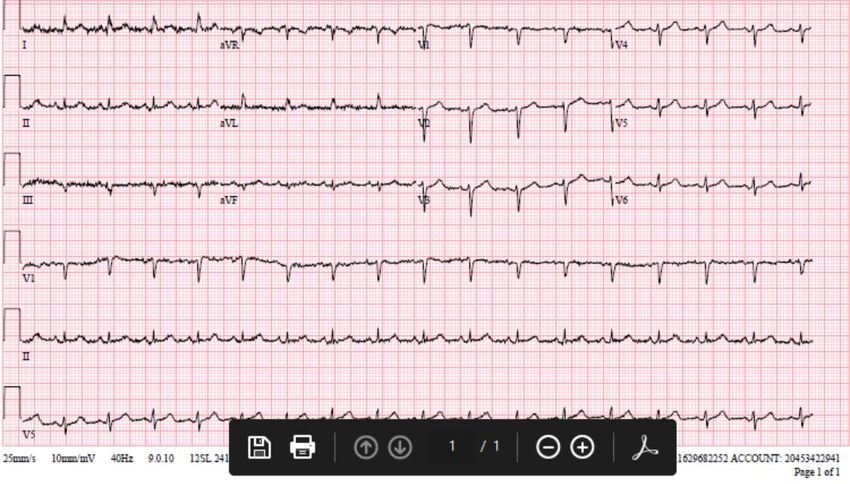
Objective Data

•   VS: Temp = 36.6 °C, Heart rate = 119
    BPM , BP = 148/76 mm Hg, RR=18
    breaths/min, SpO2=97% on room air
•   Labs: Hb = 7.2 g/dL, MCV = 61.6 fL,
    Plt = 536 X 109 /L, pro-BNP = 411
    pg/mL, Ca = 8.2 mg/dL, d-dimer =
    990 ng/mL, troponin =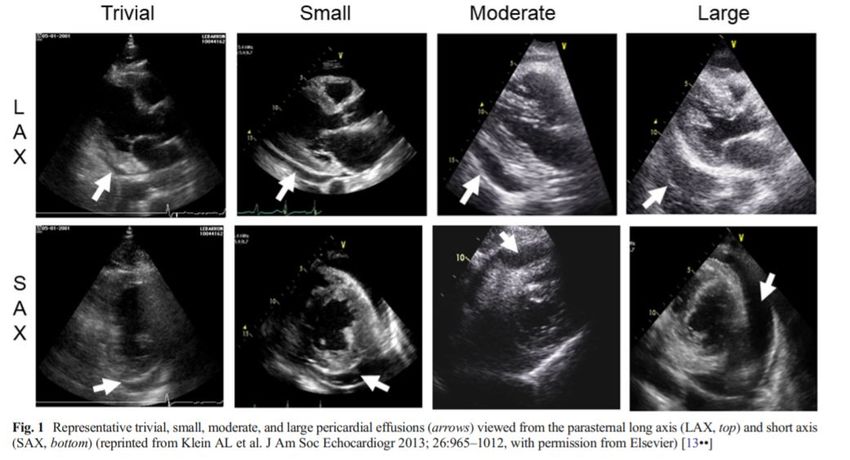
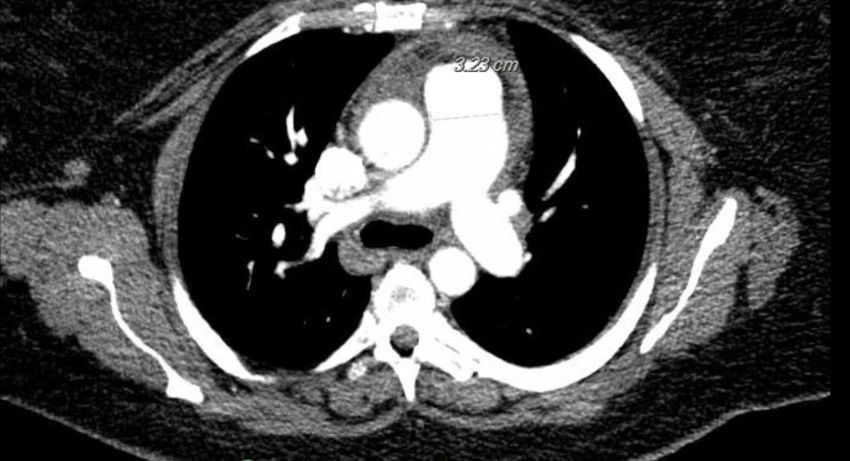
Case Imaging Helical CTA

                           Differential Diagnosis
                           1. Microcytic anemia
                                a. Iron deficiency
                                b. ACD
                                c. Sideroblastic
                                d. Thalassemia
                           2. CHF
                           3. PAH
                           4. Pericarditis
Case Imaging US Parasternal Long

              POCUS                Formal ECHO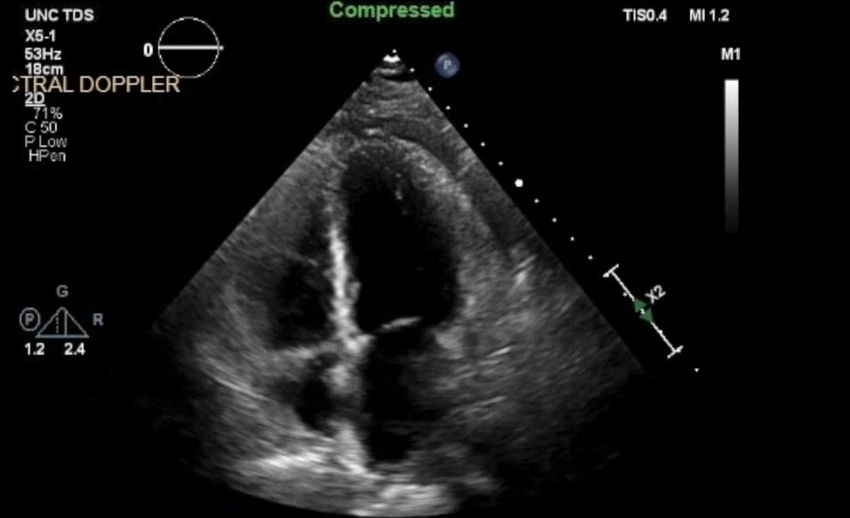
Case Imaging US Parasternal Short (Apex)

               POCUS                       Formal ECHO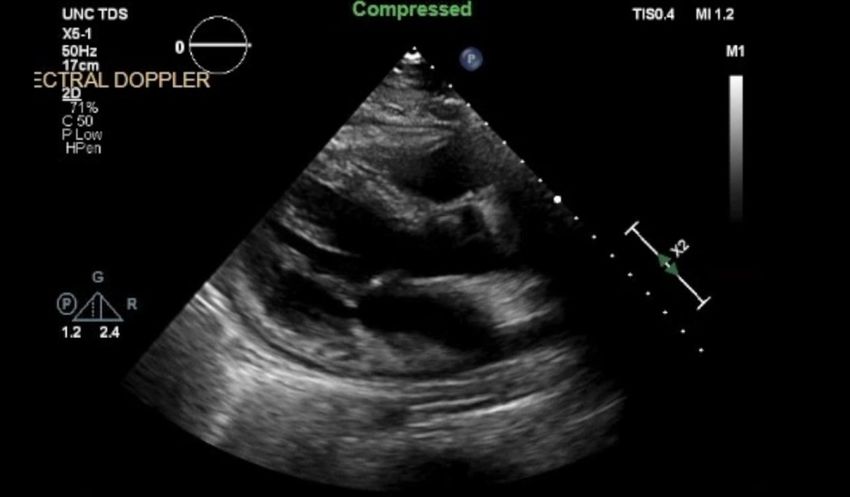
Case Imaging US Apical 4 Chamber

              POCUS                Formal ECHO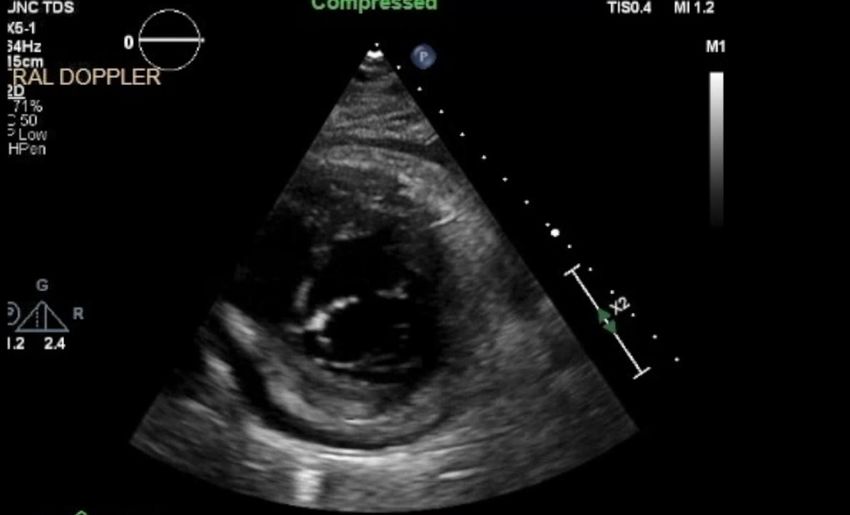
Case Presentation Continued...

• Review of systems: patient reports heavy menses one a week ago (not an
  unusual occurrence with her monthly menses including ~4
  days requiring 3-4 pads)
• Family history: both her parents had sudden cardiac death. One of her
  sisters died at age 44 due to an atypical MI that was thought to be
  cholecystitis and another sister has SLE which first presented as anemia
Hospital Course for Management and Workup of Anemia
and Pericardial Effusion
Full Autoimmune workup due to suspected SLE was   Case resolution: discharge home after diagnosis of acute
negative                                          pericarditis on day 4 with
ESR 49 mm/h
                                                  •   Colchicine 0.6 mg BID
CRP 87.4 mg/L
                                                  •   Ibuprofen 600 mg TID for 12 days
ANA Positive (Titer 1, 1:160 and Titer 2, 1:80)   •   Famotidine 40 mg once daily for 12 days
ANCA IF Positive, Perinuclear Pattern
MPO ELISA Negative                                Follow up with PCP for age-appropriate outpatient
                                                  cancer screening
PR3 ELISA Negative
C3 141 mg/dL                                      •   Colonoscopy
C4 30.5 mg/dL                                     •   Endometrial biopsy
                                                  •   Mammography
dsDNA Negative
                                                  •   Pap smear
ENA Negative
QuantiFERON TB Gold Plus Negative
Clinical Question
Could the diagnosis of acute pericarditis have been made sooner
based on symptoms and imaging findings?Literature Review
Acute pericarditis = inflammation of the pericardial sac.
Western Europe (2007-2012)1 Africa (1995-2001)2
Idiopathic 516 (55.0%) 32 (13.7%)
Specific etiology 417 (46.0%) 201 (86.3%)
• Neoplastic 85 (8.9%) 22 (9.4%)
• Tuberculosis 4 (Literature Review
At least two of these features should be present to make the
diagnosis.
• Chest pain – Typically sharp and pleuritic, improved by
sitting up and leaning forward
• Pericardial friction rub – A superficial scratchy or squeaking
sound best heard with the diaphragm of the stethoscope over
the left sternal border
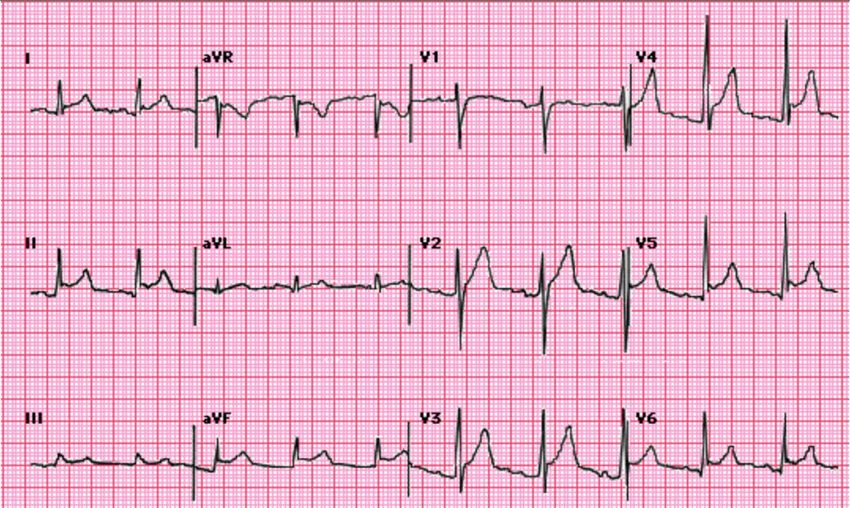
• Electrocardiogram (ECG) changes – New widespread ST
elevation or PR depression
• Pericardial effusion
Adler Y, Charron P, Imazio M, Badano L, Barón-Esquivias G, Bogaert J, Brucato A, Gueret P, Klingel K, Lionis C, Maisch B, Mayosi B, Pavie A, Ristic AD,
Sabaté Tenas M, Seferovic P, Swedberg K, Tomkowski W; ESC Scientific Document Group. 2015 ESC Guidelines for the diagnosis and management of
pericardial diseases: The Task Force for the Diagnosis and Management of Pericardial Diseases of the European Society of Cardiology (ESC)Endorsed by: The
European Association for Cardio-Thoracic Surgery (EACTS). Eur Heart J. 2015 Nov 7;36(42):2921-2964. doi: 10.1093/eurheartj/ehv318. Epub 2015 Aug 29.
PMID: 26320112; PMCID: PMC7539677.Literature Review: Detecting Pericardial Effusion While one may infer the presence of pericardial effusion via clinical evaluation together with ECG and CXR findings, echocardiography is usually required to confirm the diagnosis, a practice supported by the 2015 ESC Guidelines Hoit BD. Pericardial Effusion and Cardiac Tamponade in the New Millennium. Curr Cardiol Rep. 2017 Jul;19(7):57. doi: 10.1007/s11886-017-0867-5. PMID: 28493085.
Literature Review: Performance of POCUS in Imaging
Pericardial Effusion

                                                                                        Study design: Prospective
                                                                                        Inclusion criteria: High risk population for pericardial
                                                                                        effusion
                                                                                        Total participants= 515 patients, of which 103 were
                                                                                        ultimately deemed to have a pericardial effusion
                                                                                        Comparative standard/ground truth: ECHO read by an
                                                                                        echocardiographer from the Department of Cardiology
                                                                                        Result: “Emergency physicians who participated in a 16-hour
                                                                                        course on ultrasonography with 1 hour of instruction and 4
                                                                                        hours of practical training detected pericardial effusion with a
                                                                                        sensitivity of 96% (95% confidence interval [CI] 90.4% to
                                                                                        98.9%), specificity of 98% (95% CI 95.8% to 99.1%), and
                                                                                        overall accuracy of 97.5% (95% CI 95.7% to 98.7%).”

Mandavia DP, Hoffner RJ, Mahaney K, Henderson SO. Bedside echocardiography by emergency physicians. Ann Emerg
Med. 2001 Oct;38(4):377-82. doi: 10.1067/mem.2001.118224. PMID: 11574793.
Did We Choose Wisely? “Initial testing in all suspected cases: An ECG Chest radiography Complete blood count, troponin level, erythrocyte sedimentation rate, and serum C-reactive protein level Echocardiography, even a small effusion can be helpful in confirming the diagnosis of pericarditis, although the absence of an effusion does not exclude the diagnosis Selected additional testing Blood cultures if fever higher than 38ºC (100.4ºF), signs of sepsis, or a documented, concomitant bacterial infection (eg, pneumonia). Viral studies but they are not routinely obtained, since the yield is low and management is not altered for the vast majority of patients. Antinuclear antibody (ANA) titer in selected cases (eg, young women, especially those in whom the history suggests a rheumatologic disorder). Rarely, acute pericarditis is the initial presentation of systemic lupus erythematosus (SLE). Tuberculin skin test or an interferon-gamma release assay if not recently performed. Cardiac magnetic resonance (CMR) with administration of gadolinium or computed tomography (CT) imaging for selected patients (eg, nondiagnostic echocardiography, concerns about constrictive pericarditis, complicated course, suspicion of specific etiology, etc) Pericardiocentesis should be performed for therapeutic purposes in patients with cardiac tamponade” Imazio, M., LeWinter, M., & Yeon, S.B. (2021). Acute pericarditis: Clinical presentation, diagnostic evaluation, and diagnosis., UptoDate.
Key Points

• Acute pericarditis can be diagnosed with > 2 of 4 cardinal signs
  and symptoms 1. pleuritic chest pain, 2. pericardial friction rub,
  3. EKG changes, 4. pericardial effusion on imaging
• POCUS has an excellent sensitivity and specificity in the
  detection of pericardial effusion
• Chasing the etiology of acute pericarditis may be difficult! Base it
  on clinical judgment and risk factors for the etiologies
You can also read


