Saving woes stretch retirement outlook - ING International Survey Savings February 2019 - ING Think
←
→
Page content transcription
If your browser does not render page correctly, please read the page content below

Saving woes stretch
retirement outlook
Europe’s savers may fight to meet future money goals

ING International Survey Savings February 2019

                                                       This survey was conducted
ING International Survey Savings February 2019
                                                       by Ipsos on behalf of ING
                                                                                   1
Table of contents
3 About the ING International Survey
4 Executive summary
5 Infographic
6 Fruits of your labour not so sweet?
› Many fear they won’t be able to afford to retire
› When will you retire? Reality may not match expectations
› Will you enjoy the same living standard once retired?
› “I could go on working perhaps in the gig economy”
› “The state should look after us but others have a role”
› Two in five expect less back than they paid into a pension
13 Savings can you see a bright future?
› Many in Europe, the USA and Australia have no savings
› Two in three with no savings say their income is too low
› Living on the edge or just about managing
› Most cut their spending but many resort to credit cards
› Mobile apps may make it easier to spend, not save
› Which tools might help people save or invest more?
20 Contact details
21 Disclaimer
ING International Survey Savings February 2019 2
The survey

About the ING
International Survey
The ING International Survey promotes a better
understanding of how people around the globe
spend, save, invest and feel about money. It is
conducted several times a year, with reports
hosted at www.ezonomics.com/iis.
This online survey was carried out by Ipsos from
17 October to 2 November 2018.
Sampling reflects gender ratios and age
distribution, selecting from pools of possible
respondents furnished by panel providers in
each country. European consumer figures are
an average, weighted to take country
population into account.

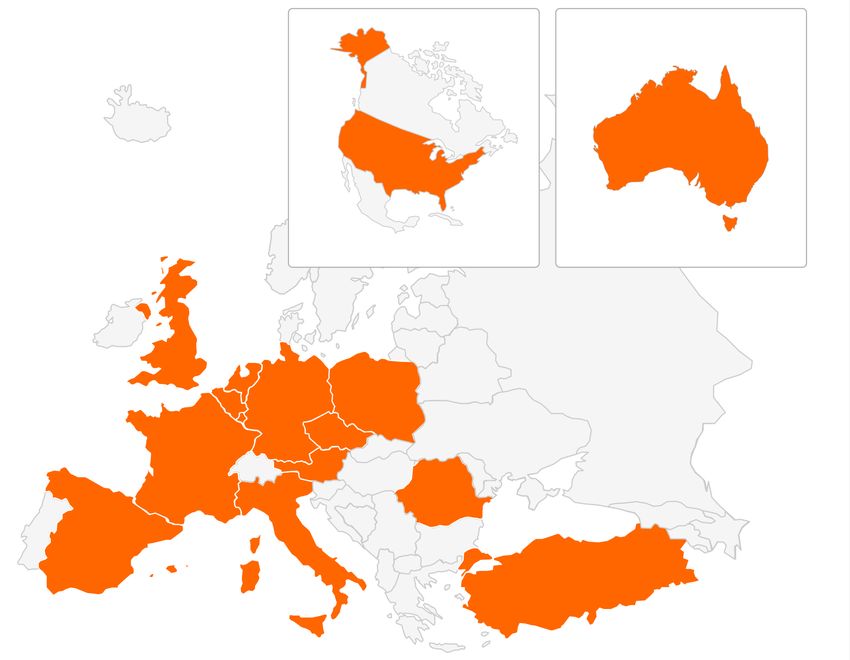
                                                   Austria

15                                                 Belgium
                                                   Czech Republic
countries are compared                             France
in this report.                                    Germany
                                                   Italy

1,000                                              Luxembourg
                                                   Netherlands
respondents on average were surveyed in            Poland
each, apart from Luxembourg, with 500.             Romania
                                                   Spain

14,695                                             Turkey
                                                   United Kingdom
is the total sample size of                        USA
this report (2,747 retired;                        Australia
11,948 non-retired).

ING International Survey Savings February 2019                      3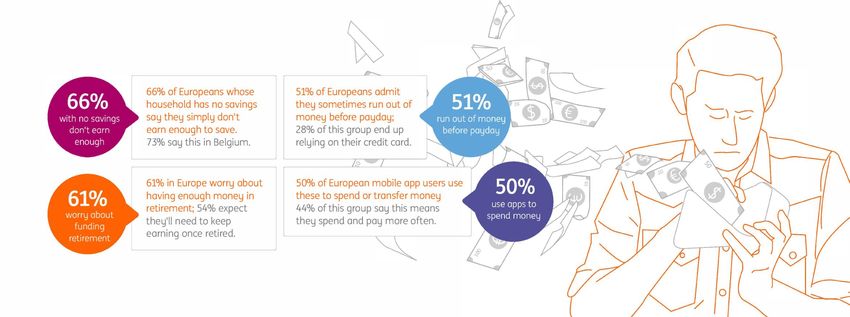
Executive summary
Many worry about making ends meet now let alone in retirement
People in Europe, the USA and Australia could be sleepwalking into long-term saving and spending problems
The ING International Survey Savings 2019, the The typically recommended minimum emergency Can mobile tech change the game?
eighth in an annual series, confirms that 61% of buffer is the equivalent of three to six months’ net If you follow tech trends, you could be forgiven for
people living in 13 European countries worry about pay. But our full data set shows that even among thinking mobile tech in particular might help people
having enough money in retirement. Responses are Europeans who have savings, 42% have no more manage their money better which is what 71% of
similar in the USA and Australia. than three months’ take-home pay put aside. Europeans reported in the ING International Survey
About half of retirees in Europe tell us that they don’t And if people cannot save today, how can they save Mobile Banking 2016.
continue to enjoy the same standard of living they for retirement? Half of respondents in our Europe sample tell us they
had when they were working. use mobile apps for spending or transferring money.
Two in five (39%) of those in Europe who have not However, they admit the main impact of this is
Forty-two percent with savings have simply being able to spend money more often
yet retired confirm they expect to get less in
retirement than they paid into their pension. no more than three months’ take- hardly conducive to boosting long-term savings.
And more than half (54%) of Europeans who have home pay put aside. How can they Smaller percentages give answers that suggest using
mobile apps, for example, benefits their long-term
not yet retired tell us they expect they’ll need to save for retirement?
continue to earn some money after they’ve officially savings or investments.
stopped working. Many are struggling to save anything at all. So, with
Incomes don’t go far enough
Adding to the uncertainty, studies suggest many state pension systems in some countries under
Two-thirds (66%) of Europeans who have no savings
may end up retiring earlier than they expect and strain, it’s important to take a fresh look at how to
tell us they simply don’t earn enough to put anything
not by choice. meet people’s hopes for the future.
aside for the future.
Yet many have no savings Another 14% in Europe report that unexpected
Savings are a key way to invest in the future. Yet our expenses have eaten away at their earnings, leaving
survey reveals that about one in four (27%) them with nothing to save.
Europeans have no savings at present. Beyond
And around half (51%) tell us their pay sometimes Jessica Exton, behavioural scientist
Europe, the shares are similar in Australia (22%) and
doesn’t cover the whole period between paydays Fleur Doidge, editor
the USA (27%).
forcing many to reduce their spending (sometimes
Without even a minimal savings buffer, families and also using credit cards or another form of borrowing).
individuals are less able to mitigate unexpected near-
It appears that many people are if not quite living
term events, such as car breakdowns or health
on the edge in budgetary terms barely managing
emergencies, let alone build funds for retirement.
to keep their heads above water.
ING International Survey Savings February 2019 4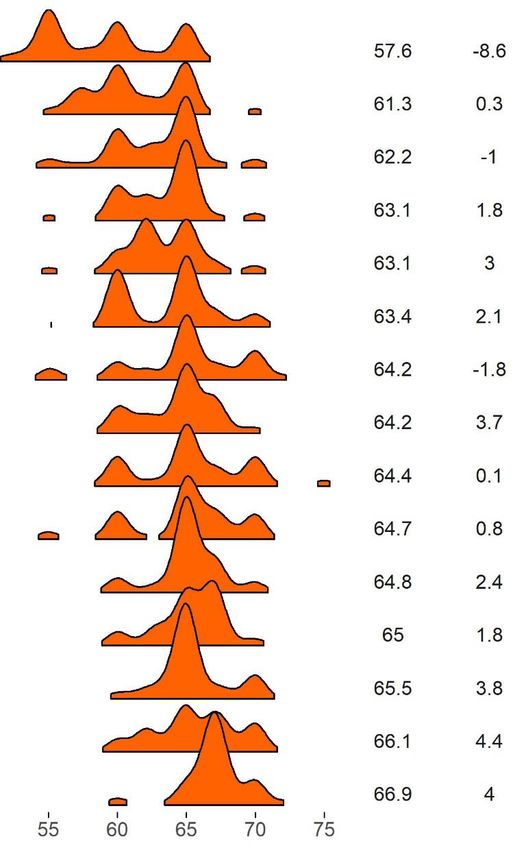
Infographic

Can you save enough for retirement?
Look after the pennies and the pounds will look after themselves, as the old
saying goes. Saving now means funds have a better chance of adding up over
time, all the way to a happy and secure retirement. However, the ING
International Survey Savings 2019 of nearly 15,000 people in 15 countries
confirms that many people struggle to save today.

ING International Survey Savings February 2019                                 5
Fruits of
your labour
not so sweet?

ING International Survey Savings February 2019   6
Fruits of your labour not so sweet?

                                                                         The question

Many fear they won’t                                                     “I worry about whether I will have enough money in
                                                                         retirement.”
be able to afford to retire                                              Shares of the not yet retired who reply “agree” or “strongly agree”. Other possible answers were “neither
                                                                         agree nor disagree”, “disagree”, “strongly disagree” or “I don’t know”.

As the chart shows, 61% of Europeans who have not yet retired worry
about having enough money in retirement. The shares are highest in             Total Europe                                      61%
Spain, France, and Poland.
In our full dataset, those who say they are “uncomfortable” (80%) or            Netherlands                          40%
“very uncomfortable” (86%) with the amount they have in savings
                                                                                        Turkey                                55%
today are the most likely to agree with the statement.
Women are also more likely to agree (66%) that they worry about this                    Austria                               56%

than men (56%).                                                                Luxembourg                                      57%

Across the age brackets, shares are relatively low at age 18-24 (57%),     United Kingdom                                      58%
peaking around age 25-34 (64%) and tapering off to 45% by age 65+.
                                                                                   Germany                                      58%
We also explore attitudes towards the role any long-term assets
                                                                                     Belgium                                    60%
might have in funding retirement.
                                                                             Czech Republic                                       62%
In Europe, 35% of those with long-term assets reply “I do not consider
these part of (funding) my retirement” while 27% say simply “I do not                     Italy                                     65%
have these”.
                                                                                    Romania                                         65%

                                                                                        Poland                                       66%

                                                                                        France                                       67%

Will many pass on an inheritance?                                                        Spain                                        69%
Of Europeans who have not yet retired, 38% tell us they expect to
pass on an inheritance, with the shares highest in Poland (61%) and
Luxembourg (56%). Males (42%) are more likely to say this than                      Australia                                   59%
females (34%) as well as those who say they’re “very comfortable”                         USA                                     62%
(57%) or “comfortable” (51%) with the amount they’ve saved.

                                                                                                                         Sample size: 11,948

ING International Survey Savings February 2019                                                                                                                                       7
Fruits of your labour not so sweet?
The question
When will you retire? Reality At what age do you expect to retire?
Orange area denotes individual replies around expected retirement age. These were averaged and compared
may not match expectations with the average actual (real) ages at retirement reported in OECD Pensions at a Glance 2017 statistics.
Expected retirement age; orange Average expected Years from actual
area = all individual answers; age at retirement average age of
Nobody can predict the future. At the same time, people typically peaks = most frequent (ING) (ING) retirement (OECD)
(OECD)
focus on the now, making future retirement an abstract concept. reage
Turkey
Some may retire later than they expect, with fewer years left in which
to support themselves. Others may retire earlier, before they’ve saved
Luxembourg
enough. Reasons might include poor health, age discrimination or a
weak labour market. Romania
In our study, the mean expected age of retirement in Europe is 63.4.
Austria
According to Prudential’s “Planning your Retirement: Expect the
Unexpected” 2018 report, just 23% of early retirees in the USA chose France
to do this; 46% were forced to retire due to health problems. Retiring
just five years early can reduce retirement income by 36%, the Poland
Prudential report says.
USA
ING Poland economist Karol Pogorzelski notes a pattern to the chart’s
camel-like humps, with single dromedary-type humps reflecting a Belgium
single retirement age for both sexes. Twin (Bactrian camel) humps are
countries with different retirement ages for men and women. Australia
The more ambiguous or multiple-hump pattern reflects countries in United Kingdom
transition from this situation to a single official age of retirement.
Spain
“Like the three humps in Turkey, UK, Germany and Italy. One reason is
because the retirement age is becoming unisex in some places; the
Germany
other is when many retire early,” he says. “The general lesson would
be that people’s expectations about their retirement are adapting to Czech Republic
the regulatory possibilities.”
Italy
Netherlands
Age (years)
ING International Survey Savings February 2019 8Fruits of your labour not so sweet?
The question
Will you enjoy the same “In retirement I enjoy the same standard of living I had when
working / expect to enjoy the same living standard as today”
living standard once retired? Shares who “disagree” or “strongly disagree” per country. Other possible answers are “strongly agree”,
“agree”, “neither agree nor disagree”, and “I don’t know”.
Nearly two in five not-yet-retired Europeans don’t expect to enjoy the 50%
Total Europe 38%
same standard of living when they retire that they have today.
The already-retired in our survey are a small sub-group. But half of the
Netherlands 36%
people in this group confirm they don’t have the same standard of 26%
living they did when working. United Kingdom 27%
29%
For most who say this, the assumption is that their living standards Romania 49%
30%
have declined. Some may have seen their living standards rise. 47%
Spain 31%
France shows the largest gap between expectations of those not-yet-
Luxembourg 28%
retired and the experience of current retirees. 34%
Austria 46%
Our full data set shows that unretired European males (30%) are more 37%
likely to express optimism about their eventual standard of living in Turkey 56%
38%
retirement than females (23%). 36%
Italy 38%
Across the not-yet-retired age brackets, expectations of achieving a 46%
Belgium 40%
roughly similar lifestyle as a pensioner are highest among the 65+
Germany 54%
bracket (39%). 41%
Poland 58%
This group is nearest to the retirement age and presumably better 42%
able to accurately analyse their likely situation, are already adjusting, France 69%
48%
or have this front of mind. 62%
Czech Republic 49%
Among younger age brackets (31% of 18-24s; 28% of 25-34s; 26% of
35-44s; 22% of 45-54s) decreasing shares of Europeans expect to have
USA 30%
the same standard of living once retired. However, the share rises 24%
again around age 55-64 (25%), hitting 39% among the 65+ group. Australia 44%
29%
Retired, disagree: My income and financial position let me enjoy the same standard
of living I had when working
Not yet retired, disagree: My income and financial position will let me enjoy the
same standard of living I enjoy today
Sample size: 2,747 (Retired) 11,948 (Not yet retired)
ING International Survey Savings February 2019 9Fruits of your labour not so sweet?
The question
“I could go on working “I expect I’ll need to keep earning some money in retirement.”
Shares of non-retirees who reply “strongly agree” or “agree”. Other possible answers include “neither agree
perhaps in the gig economy” nor disagree”, “disagree”, “strongly disagree” or “I don’t know”.
More than half of European non-retirees in our survey tell us they
expect they’ll need to earn something in retirement. Total Europe 54%
Shares who agree with the statement are largest in the Czech
Republic, Romania, and beyond Europe in the USA and Australia. Netherlands 32%
Only about one in three respondents in the Netherlands and Luxembourg 35%
Luxembourg, on the other hand, agrees he or she will need to earn
Germany 45%
some money once retired.
When asked specifically, 63% of European residents in our survey Belgium 46%
agree it can be good to keep working, perhaps for social reasons or Austria 46%
improved physical fitness.
Poland 50%
But a 2017 Kings College London study of retirees in the United
United Kingdom 54%
Kingdom suggests the opposite: that people who keep working may
do so because they’re still healthy or have social advantages, such as Spain 57%
a good network of contacts.
France 57%
Italy 59%
Turkey 59%
Romania 63%
Pathways to earning in retirement Czech Republic 63%
Our data also shows that 58% of Europeans who expect to need to
earn once retired say they’ll take on gig/temporary work, either in a
similar field to current employment (36%) or a different field (23%). Australia 60%
Next is letting property (14%), starting a small business (13%),
USA 64%
selling assets (7%), other (5%), and property development (3%).
Sample size: 11,948
ING International Survey Savings February 2019 10Fruits of your labour not so sweet?
The question
“The state should look after How much responsibility should these groups have for the
financial situation of retired people?
us but others have a role” Percentages show amount of responsibility that people in different countries, on average, think each of the
below groups should bear for the situation of retired people.
In Europe overall, people tell us they feel the state should retain about
43% of the responsibility for the financial situation of retired people. Total Europe 43% 27% 19% 7% 5
Europeans maintain that retirees themselves should bear only about
27% of the responsibility for their finances on average. United Kingdom 31% 41% 17% 7% 4
This hides some key country differences. In Spain, the Czech Republic
Netherlands 35% 33% 23% 5 5
and Italy, people feel the state should have about half the
responsibility. Turkey 37% 27% 20% 10% 7%
Brits say individuals should bear 41% of the responsibility for their Romania 42% 25% 18% 9% 6%
financial situation once retired. Australia and the USA also favour
France 43% 23% 22% 7% 5
greater individual responsibility.
Poland 43% 25% 21% 7% 4
It’s generally felt in all countries, though, that retirees’ families have
less responsibility for the finances of the retired, even compared to Austria 44% 29% 17% 5 4
employers.
Luxembourg 44% 28% 22% 4
Variations reflect cultures, traditions, social infrastructures and
Germany 45% 28% 17% 5 4
political climates. Yet state pension provisions are under pressure in
many places: do individuals need to play a larger role? Belgium 47% 25% 18% 5 4
Italy 49% 20% 20% 7% 4
Czech Republic 50% 25% 14% 8% 4
Half plan for extra savings or insurance
In our data, 48% in Europe tell us that they plan for retirement in Spain 52% 24% 16% 6% 4
addition to state, employer, or other contributions, perhaps by
saving or taking out retirement insurance. Yet 47% of Europeans
USA 22% 46% 18% 8% 6%
don’t know the amount contributed to their pension every year. Are
some burying their heads in the sand? In France and Spain, the Australia 28% 44% 16% 7% 5%
shares who say this are at 58% and 57%, respectively.
The state Retirees themselves Employers Retirees’ families Other
Sample size: 14,695
ING International Survey Savings February 2019 11Fruits of your labour not so sweet?
The question
Two in five expect less back Which option best describes what you expect in retirement?
Asked only to those who have not yet retired. All possible answers shown on the chart.
than they paid into a pension
People in many countries see the state as bearing the greatest share
Total Europe 39% 22% 18% 13% 8%
of responsibility for retirees, as the previous page shows.
But there’s an acceptance that the individual should play a role too
Turkey 22% 28% 9% 32% 8%
for example, via extra personal contributions to funding.
United Kingdom 27% 21% 25% 12% 15%
Yet two in five (39%) of those in Europe who have not yet retired say
Spain 30% 36% 15% 15% 5%
they expect to receive less money in retirement than they contributed
for that purpose. Netherlands 33% 20% 22% 9% 17%
Belgium 42% 16% 23% 9% 10%
Almost one in four (22%) Europeans say, perhaps optimistically, that
they expect to receive in retirement roughly the same amount as Austria 43% 19% 25% 8% 6%
they contributed. In Spain, more than a third (36%) say this. Czech Republic 43% 17% 25% 12% 4
A few (13%) across Europe indicate they expect to get more money Romania 43% 26% 11% 13% 7%
back than they paid in. Germany 45% 19% 21% 8% 8%
About one in five (18%) replies “I don’t know” which might suggest Italy 47% 19% 20% 5% 10%
they find retirement planning schemes and funds confusing. Luxembourg 47% 22% 18% 6% 7%
It may even mean they have not thought about it. Some may be Poland 49% 24% 13% 11% 3
avoiding engaging with the subject of how much money they might France 54% 14% 19% 7% 7%
have to support them in retirement.
Surprisingly high shares respond that the question “is not relevant”, USA 24% 26% 18% 15% 19%
especially in the USA, Netherlands, UK and Australia. Australia 25% 20% 24% 16% 15%
Answers given may refer to state or private retirement funding
arrangements.
I expect to receive less money during retirement than I paid in
I expect to receive roughly as much money in retirement as I paid in
I don't know
I expect to receive more money during retirement than I paid in
This is not relevant to me
Sample size: 11,948
ING International Survey Savings February 2019 12Savings can you see a bright future? ING International Survey Savings February 2019 13
Savings can you see a bright future?
The question
Many in Europe, the USA and Does your household have any savings?
Shares who reply “no”. Sample excludes the share who reply “prefer not to answer” to the question.
Australia have no savings
We continue to find that large shares in every country have no
savings. This year, more than one in four (27%) people in Europe tell us
their household has no funds put aside.
Total Europe 27%
The shares are similar in Australia and the USA.
With no savings, families and individuals exert less control over their
Luxembourg 13%
lives both now and in the future. Decision-making may be restricted,
narrowing opportunities throughout life. Turkey 17%
People with no savings typically have less choice of where to live, what Netherlands 20%
healthcare they can afford, and what training or education they or Belgium 24%
their children can receive, for example.
Czech Republic 24%
European Central Bank (ECB) monetary policy has in recent years kept
Italy 24%
interest rates low, reducing the incentive to save.
Spain 26%
It gets worse: our full data set shows that 42% of the Europeans who
have savings have no more than three months’ take-home pay put Poland 27%
aside rising to 60% in Turkey and 58% in Romania. The lowest is in France 29%
Luxembourg (25%).
Austria 30%
Three to six months’ worth of savings is the minimum recommended
United Kingdom 31%
size for an emergency buffer to cover unexpected events.
About 5% on average in Europe reply “prefer not to answer”; they Germany 33%
were excluded from the calculation shown on the chart. Romania 39%
Australia 22%
USA 27%
Sample size: 14,009
ING International Survey Savings February 2019 14Savings can you see a bright future?
The question
Two in three with no savings What is the main reason your household doesn’t have any
savings?
say their income is too low Asked only to the share who tell us they have no savings. Respondents could select one reason only. All
possible answers shown on the chart.
We took the 27% in Europe, 27% in the USA and 22% in Australia who
Total Europe 66% 14% 12% 4 4
told us their household has no savings and asked them why they are
in this situation.
Austria 55% 20% 11% 9% 6%
As the chart shows, two-thirds (66%) of this group across Europe alone
tell us that they simply don’t earn enough to put anything aside. Turkey 57% 9% 28% 3 4
Luxembourg 60% 3 19% 9% 9%
The share of those who have no savings and say this is because they
don’t earn enough rises to a high of 73% in Belgium, with the UK next Czech Republic 63% 10% 17% 8%
(72%). The USA (65%) and Australia (59%) respond similarly. Germany 63% 14% 10% 4 9%
This likely reflects low wages in relation to the cost of living in each Spain 64% 18% 12% 4
country. Italy 67% 15% 12% 4 3
Another 14% in Europe report that they have no savings because France 67% 21% 10%
unexpected expenses have eaten away at their earnings. This could be Poland 68% 10% 11% 7% 4
anything from medical expenses to a car breakdown, or even just a Romania 69% 19% 8%
larger than usual utility bill. Netherlands 69% 12% 7% 6% 7%
About one in ten (12%) Europeans with no savings say this is because United Kingdom 72% 11% 12% 3
they have spent anything spare on discretionary items. Belgium 73% 11% 9% 3 5
“Discretionary items” refers to products or services that an individual
chooses to buy, rather than having to, such as relating to leisure Australia 59% 17% 13% 7% 4
activities or other optional purchases.
USA 65% 16% 11% 3 6%
Spending decisions are typically made through a process of mentally
prioritising everyday demands and plans according to the need to We don’t earn enough to save
stay financially afloat. Future needs, as a result, can sink to the We have had some unexpected expenses such as a car breakdown
bottom of the pool. We sometimes spend what we save, on discretionary things
Other, please specify
Prefer not to answer
Sample size: 3,636
ING International Survey Savings February 2019 15Savings can you see a bright future?
The question
Living on the edge Do you ever find yourself running out of money at the end of
the pay period?
or just about managing Shares in each country who reply “yes – occasionally” or “yes – most of the time”. Other possible answers
include “no”, “I don’t know”, and “prefer not to answer”.
High shares tell us they sometimes run out of money by payday. As
we saw on previous pages, many don’t earn enough to save let Total Europe 51%
alone cover unexpected expenses.
It’s unlikely that many run out of money because of irresponsible
Luxembourg 36%
behaviour. Many may be struggling to keep up, due in part to slow
income growth, as described by the OECD’s Better Life Index 2017. Poland 42%
About 2% reply “prefer not to answer” and 2% “don’t know”. Germany 43%
Maria Ferreira, economist at ING, adds: “Our full data set suggests that Spain 48%
those who review bank statements regularly, perhaps also tracking
Netherlands 50%
spending in other ways, are less likely to run out of money.”
United Kingdom 50%
Additional analysis also shows that people in Europe with no savings
are likelier to say they sometimes run out of money by payday (78%) Belgium 52%
than those who have some savings (42%). Czech Republic 53%
Those in Europe who say they have no savings because they don’t France 54%
earn enough are also more likely to say they sometimes run out of
money (85%) between pays, according to our data. Italy 54%
Austria 55%
Turkey 58%
Not everyone keeps track of spending Romania 69%
Our full dataset finds that 9% of Europeans do not track their
everyday spending. When asked why, 40% reply “I never thought
Australia 52%
about it”; 16% say they won’t run out; and 15% say they don’t have
time. Some 14% say it makes them “feel bad”, 11% that it’s “too USA 56%
much effort”: does this stem from feeling out of control when
money is a scarce resource?
Sample size: 14,695
ING International Survey Savings February 2019 16Savings can you see a bright future?
The question
If you run out of money, what do you do?
Most cut their spending but Shares who replied previously that they run out of money “occasionally” or “most of the time” and their
many resort to credit cards choice of resolution. All possible answers shown. Multiple selections permitted.
On the previous page, we saw that half (51%) of European
respondents run out of money between pay periods, either “most of Total Europe 74% 28% 20% 8
the time” or “occasionally”. The latter might happen because of an
unexpected or large one-off bill.
Romania 63% 24% 42% 12
Three-quarters of respondents in Europe respond to the situation in a
Netherlands 63% 14% 12 8 8 5
straightforward, sensible way by reducing their spending.
Turkey 64% 59% 31% 16%
In addition, nearly three in ten (28%) tell us they start spending on
Belgium 64% 30% 12 4 7
their credit card once they’ve run out of pay. The shares who resort to
a credit card are highest in Turkey (59%), Luxembourg (38%) and United Kingdom 66% 24% 24% 9
Spain (35%). Spain 75% 35% 20% 5
Credit cards usually have high interest rates, so customers who don’t Poland 78% 26% 22% 11
pay their whole debt off immediately must pay much more back.
Germany 78% 21% 17% 4
And it can be hard to calculate how large the debt is set to grow
Austria 79% 21% 20% 6
meaning it takes even more time to pay back, and requires even more
day-to-day thought. Czech Republic 81% 18% 22% 6
When resources are scarce, cognitive overload can be the result. It can France 81% 18% 11 6
be tough to make good decisions when money or time is tight. Luxembourg 82% 38% 8
One in five (20%) indicates he or she borrows funds from friends or Italy 83% 22% 12 4
family rising to two in five (42%) in Romania.
Borrowing via a source other than credit cards or friends or family was USA 65% 28% 17% 10 7
less common, with just 8% of respondents in Europe indicating they
Australia 70% 29% 16% 5
chose this option to cover a pay gap. Examples might include banks,
payday lenders, credit unions, or even employers. I reduce my spending I use my credit card
I borrow money from friends or family I borrow money from another source
I don’t know Prefer not to answer
Sample size: 7,588
ING International Survey Savings February 2019 17Savings can you see a bright future?
The question
Mobile apps may make it What has been the impact of using mobile apps for spending
or transferring money?
easier to spend, not save Shares of mobile app users in each country who indicate they use a mobile app for spending or transferring
money – that is, for making payments. Multiple selections permitted.
Seventy-one percent of European users of mobile technology for
Total Europe 44% 32% 31% 10%
banking have previously told us that it helps them manage money
the figure is from our ING International Survey Mobile Banking 2016.
But in 2019 we dug a little deeper. And, when asked, 44% of Czech Republic 29% 31% 39% 18%
Europeans who use mobile apps to spend or transfer money tell us the Poland 36% 37% 34% 10%
impact is that they spend or transfer money more often.
Italy 39% 29% 32% 12%
About a third (32%) of those who spend or transfer money by mobile
United Kingdom 42% 41% 27% 9%
app say they are now more confident doing so as a result.
Romania 43% 29% 36% 9%
Only three in ten (31%) say they “get better performance” as a result
of spending or transferring by app perhaps being able to pay at any Netherlands 45% 25% 22% 19%
time means fewer payments are missed, for example. Spain 46% 29% 32% 9%
And for many people, the more often they spend, the higher the sums France 47% 27% 21% 14%
might be and the harder it can be to save.
Turkey 47% 34% 38%
One in ten says he or she hasn’t received any of the suggested
Austria 47% 25% 34% 11%
benefits from using a mobile app to spend money or transfer funds.
Germany 49% 28% 33% 13%
Our full dataset confirms that half of all Europeans indicate they use
mobile apps for spending or transferring money; with 28% saying they Luxembourg 49% 17% 33% 20%
have been doing this for five years or longer. Belgium 52% 24% 22% 14%
We also asked about investing by app see the next page for more on
this sub-group.
USA 34% 40% 29% 13%
Australia 37% 48% 24% 11%
I do this more often
I am more confident in this activity
I get better performance from this activity
None of these
Sample size: 7,413
ING International Survey Savings February 2019 18Savings can you see a bright future?
The question
Which tools might help What has been the impact of using mobile apps for making
investments?
people save or invest more? Asked only to the shares of mobile app users in each country who indicate they use a mobile app to make
investments. Multiple selections permitted. Possible answers include “not sure”.
Just 21% of those in Europe tell us they use mobile apps for making
investments. We asked this small sub-group about the impact of Total Europe 35% 38% 33% 8%
investing by mobile app.
Nearly two in five (38%) indicate investing via mobile apps has United Kingdom 23% 47% 30% 12%
boosted their confidence in making investments which could benefit Spain 25% 36% 38% 11%
their savings long term.
Czech Republic 27% 32% 38% 10%
One in three replies that he or she gets better performance by
Poland 30% 42% 30% 11%
investing with a mobile app. “Better performance” can be interpreted
in many ways, including ease of use, taking less time to invest or Belgium 31% 33% 25% 17%
getting a better return on the activity. Italy 31% 36% 36% 9%
Investing can be a way to grow savings longer term, especially when Netherlands 35% 38% 29% 11%
interest rates remain low. In our full data set, 46% in Europe agree
Romania 37% 29% 29% 10%
that investing their savings is a good way to build wealth.
Austria 39% 31% 26% 15%
Only half of our European sample agree technology is making it easier
to invest. And just 37% say they are comfortable investing some of Turkey 40% 37% 37%
their wealth. France 40% 32% 26% 11%
When asked what would be the one thing that would encourage them Germany 41% 42% 28% 11%
to start investing more, 41% say “having more money available”.
Luxembourg 42% 19% 26% 35%
Meanwhile, people’s typical focus is on immediate needs. Saving more
is difficult, as previous pages show.
Australia 20% 50% 27% 13%
Might new behavioural approaches be developed that help people in
USA 30% 41% 25% 12%
all countries save more, right up to and beyond retirement? This could
help people secure their futures. I do this more often
I am more confident in this activity
I get better performance from this activity
None of these
Sample size: 2,690
ING International Survey Savings February 2019 19Contact details Country Name Phone number Email Australia David Breen +61 2 9028 4347 david.breen@ingdirect.com.au Austria Patrick Herwarth von Bittenfeld +43 168 0005 0181 presse@ing-diba.at Belgium Press Office +32 2 547 2484 pressoffice@ing.be Czech Republic Martin Tuček +420 2 5747 4364 martin.tuček@ing.cz France Virginie La Regina +33 1 57 22 52 89 virginie.la.regina@ing.com Germany Zsofia Köhler +49 69 27 2226 5167 zsofia.koehler@ing-diba.de Italy Lucio Rondinelli +39 02 5522 6783 lucio.flavio.rondinelli@ingdirect.it Luxembourg Barbara Daroca +35 2 4499 4390 barbara.daroca@ing.lu The Netherlands Marten van Garderen +31 6 3020 1203 marten.van.garderen@ing.com Poland Miłosz Gromski +48 22 820 4093 milosz.gromski@ingbank.pl Romania Elena Duculescu +40 73 800 1219 elena-andreea.duculescu@ing.ro Spain Nacho Rodriguez +34 9 1634 9234 nacho.rodriguez.velasco@ing.com Turkey Hasret Gunes +90 21 2335 1000 hasret.gunes@ingbank.com.tr United Kingdom Jessica Exton +44 20 7767 6542 jessica.exton@ing.com Ipsos Nieko Sluis +31 20 607 0707 nieko.sluis@ipsos.com ING International Survey Savings February 2019 20
Disclaimer
This publication has been prepared by ING solely for information
purposes. It is not intended as advice or an offer or solicitation to
purchase or sell any financial instrument or to take any other
particular action. Reasonable care has been taken to ensure that
this publication is not untrue or misleading when published, but
ING does not represent that it is accurate or complete. The
information contained herein is subject to change without notice.
Neither ING nor employees of the bank can be held liable for any
inaccuracies in the content of this publication or for information
offered on or via the sites. Authors rights and data protection
rights apply to this publication. Nothing in this publication may be
reproduced, distributed or published without explicit mention of
ING as the source of this information. The user of this information
is obliged to abide by ING’s instructions relating to the use of this
information. The distribution of this publication may be restricted
by law or regulation in different jurisdictions and persons into
whose possession this publication comes should inform
themselves about, and observe, such restrictions. Dutch law
applies. ING Bank N.V. is incorporated with limited liability in the
Netherlands and is authorised by the Dutch Central Bank.

ING International Survey Savings February 2019                          21
You can also read


