Section 02: Vehicle Registration and Licensing
←
→
Page content transcription
If your browser does not render page correctly, please read the page content below
Section 02:
               Vehicle Registration
               and Licensing

Minnesota Trucking Regulations   11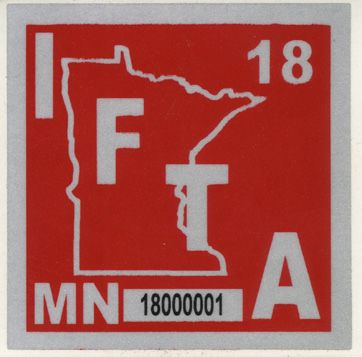
Section 02
Vehicle Registration and Licensing
Minn. Stat. § 168.013, 168.187

Intrastate Registration Requirements: Vehicles traveling exclusively within
Minnesota are required to display Minnesota-based license plates. Intrastate
vehicles may be registered and plates obtained at any deputy registrar’s office
located throughout the state. Registration fees are determined by the gross
vehicle weight and model year of the vehicle. A USDOT number is required.
For more information contact Driver and Vehicle Services at 651-297-2126 or
visit the website at https://dps.mn.gov/divisions/dvs/.

           Intrastate Bus Plate               Intrastate Truck Plate

One-Ton Pickup Trucks for Non-commercial use (Minn. Stat. § 168.002):
Effective August 1, 2011, legislation established a distinction in registration
and license plate display between commercial and non-commercial full size
one-ton pickup trucks. Person declaring “personal/non-commercial use only”
can register in the “Y” non-commercial truck class for registered weights of
10,000, 12,000 and 15,000 pounds. There is no difference in the registration
tax amount; it is merely a plate designed to allow the owner to declare non-
commercial use which is exempt from the USDOT number requirement. The
plate identifies the vehicle a non-commercial truck.

                           Non CMV Plate

   12                       Minnesota Trucking Regulations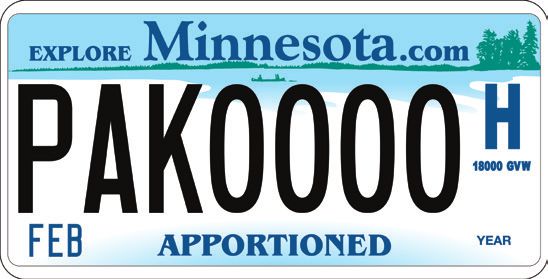
Heavy Vehicle Use Tax: All vehicles or combination of vehicles having a
registered gross weight over 54,999 pounds and traveling more than 5,000
miles on public highways (7,500 miles for agricultural vehicles) are subject
to federal HVUT (IRS Form 2290, Schedule 1). Vehicles that travel less than
5,000 miles on public highways (7,500 miles for agricultural vehicles) are
still required to file IRS Form 2290, but do not have to pay the tax. Proof of
payment of HVUT (electronic verification or stamped copy 2290 schedule)
must be submitted when a vehicle registration is renewed. When a vehicle is
newly purchased, payment of HVUT is due the last day of the month following
first use of the vehicle. For additional information, contact the Minnesota
Internal Revenue Service-HVUT office at 866-699-4096.

International Registration Plan: Qualified registrants based in Minnesota who
travel in Minnesota and another IRP state or province must display IRP license
plates and IRP cab card, or obtain valid trip permits for the state or province
in which they wish to travel. Registrants based in another IRP jurisdiction must
have IRP plates and their IRP registration cab card with the correct weight, or
display a valid Minnesota trip permit. The program allows the display of the
base state-apportioned license plate. The base state collects and distributes
the appropriate registration taxes for the respective states.

Each IRP registrant is required to file an annual application with the base
jurisdiction. The application lists the vehicles to be apportioned, the fleet
mileage, and the declared gross weight for each jurisdiction. Mileage is
reported from the previous July 1 through June 30. When all fees are paid,
the registrant is issued a cab card and validation stickers for each vehicle.
The cab card lists all IRP jurisdictions and the vehicles gross weight for each
jurisdiction.

IRP Participating States and Provinces:

     • All U.S. states except Alaska and Hawaii
     • All Canadian Provinces except Yukon, Northwest Territories, and
        Nunavut

                          Minnesota Trucking Regulations                     13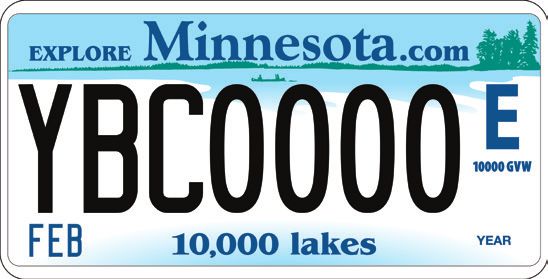
Qualified Vehicles: A qualified motor vehicle means any power unit that is
used or intended for use in two or more member jurisdictions and that is used
for the transportation of persons for-hire, or designed, used, or maintained
primarily for the transportation of property and:

       • Has two axles and a gross vehicle weight or a registered gross vehicle
         weight over 26,000 pounds;
       • Has three or more axles regardless of weight;
       • Is used in combination when the gross vehicle weight of the
         combination exceeds 26,000 pounds; or
       • A power unit involved in intrastate transportation outside the State of
         Minnesota regardless of gross vehicle weight or axles.

Exempt Vehicles: The following vehicles are exempt from registering under
the IRP:

       • Government-owned vehicles
       • Recreational vehicles
       • Vehicles operating under separate state reciprocity agreements

A truck or truck tractor, or the power unit in a combination of vehicles having
a gross vehicle weight of 26,000 pounds or less may be registered under the
IRP at the option of the registrant.

Minnesota Base State Requirements: Minnesota is the base state for the
purposes of fleet registration if the following conditions apply:

1. The registrant has an established place of business in Minnesota that
   meets all of the following conditions:
     • Physical structure located within Minnesota (building or office) owned
        or leased by the registrant
     • Street address (not a post office box)
     • Open for business (list business hours)
     • Vehicles will accrue miles in Minnesota
     • Located within the physical structure:
              Permanent employee(s) of the registrant conducting the
              registrant’s truck related business
              The operational records of the fleet and presented to the state
              when requested

  14                      Minnesota Trucking Regulations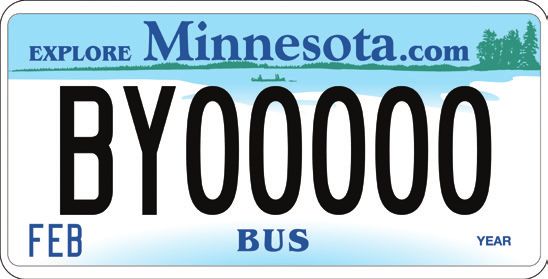
• The following must be presented to obtain IRP registration:
              Articles of Business Incorporation (including certificate) issued
              by authorized state agency
              Minnesota Secretary of State Certificate of Authority (required
              for foreign state/province corporations)
              Ownership documents or Lease agreement records associated
              with the physical structure
              Written statement that the registrant has one or more
              permanent employees listing major truck related job tasks

2. The registrant is a Minnesota resident and does not have an established
   place of business. Registrant must:
      • Accrue miles in Minnesota
      • Maintain operational records of the fleet in Minnesota and present
        them to the state when requested
      • Remit three documents from either A or B listed below

All documents shall be current and list registrant name and Minnesota
address.

A: Individual
     • Minnesota driver’s license card
     • Federal income tax return (filed)
     • Minnesota personal income tax records (paid)
     • Minnesota property/state tax records (paid)
     • Current utility billing statement issued within last 90 days (i.e. phone,
        cable, gas, electric, water, etc.)
     • Minnesota motor vehicle title or registration (in registrant’s name)
     • Residential lease agreement

B: Business Entity
     • Minnesota driver’s license card (principal owner must be a Minnesota
        resident)
     • Minnesota Secretary of State Articles of Incorporation
     • Federal income tax return (filed)
     • Minnesota personal income tax records (paid)
     • Minnesota property/state tax records (paid)

                          Minnesota Trucking Regulations                    15
• Current utility billing statement issued within the last 90 days (i.e.
phone, cable, gas, electric, water, etc.)
• Minnesota motor vehicle title or registration (in registrant’s name)
• Residential lease agreement
Documentation Required for IRP Registration:
1. Legal name
2. Business address
3. Phone number
4. Actual miles traveled between July 1 and June 30. Example, for
registration year 2018 the mileage reporting year is July 2016 to June
2017.
5. Gross vehicle weight for each jurisdiction
6. Vehicle proof of ownership for new applicants and added vehicles.
Proof of ownership may be any of the following items: Manufacturer
Statement of Origin, Minnesota certificate of title, or an out of state
title
7. USDOT and Federal Employee Identification number for each vehicle
8. Copy of lease agreements for an owner-operator registering in his or
her own name and leased to a carrier where the carrier is providing
the vehicle liability insurance and operating authority. If the vehicle is
being registered in a name other than that of the titled owner, a copy
of the lease agreement must also be provided.
Display of Credentials: A valid annual registration cab card, temporary
credential, or trip permit must be carried in the vehicle at all times. Minnesota
vehicle registrations under the IRP expire at 12:01 a.m. March 2. An IRP
registered vehicle may operate with a faxed temporary credential for 30 days
without displaying a registration plate.
Interstate IRP Plate Interstate Vehicle Cab Card
16 Minnesota Trucking RegulationsTemporary Registration and Fuel Tax Permits: A vehicle owned and currently
registered by an out-of-state resident and not apportioned with Minnesota,
may obtain a temporary Minnesota registration trip permit. This cost is $15.00
plus a $10.00 filing fee, and is valid for 120 hours. A temporary registration trip
is limited to 1 permit every 30 days per vehicle. A temporary fuel tax permit
costs $25.00 and is valid for 120 hours.
Temporary Weight Increase: For currently registered vehicles, registrants
may increase the weight of a vehicle for more than 80,000 pounds. For
each 30-day period, the additional tax is $4.17 per ton. A $10.00 filing fee is
required for each request. When operating an oversize/overweight vehicle,
the registrant is responsible for contacting and obtaining approval from each
local road authority (see Section 5). The weight increase does not replace any
requirement for overweight authorization.
30 Day Temporary Registration: A vehicle owned and currently registered
by an out-of-state resident and not apportioned with Minnesota may obtain
a 30 day registration for the time period the vehicle will be temporarily used
for interstate and intrastate travel. The registration fee is 1/12 of the annual
fee based on the gross vehicle weight, and is available in 30, 60, and 90 day
increments.
International Fuel Tax Agreement: Minn. Stat. § 168.D. The IFTA is a base
jurisdiction fuel tax program. The program allows carriers to file one fuel
report per quarter for all participating IFTA jurisdictions.
The base jurisdiction collects the appropriate fuel tax and distributes the tax
to the applicable IFTA states or Canadian provinces.
Qualified Vehicles: The following vehicles are required to display fuel
credentials and report fuel use under the IFTA program if operating in two or
more member jurisdictions. A qualified motor vehicle means a motor vehicle
used, designed, or maintained for transportation of persons and property,
and:
• Power unit having two axles and a gross vehicle weight or registered
gross vehicle weight exceeding 26,000 pounds; or
• Power unit having three or more axles, regardless of weight; or
• Power unit used in combination when the weight of such combination
exceeds 26,000 pounds gross vehicle weight or registered gross
vehicle weight.
Minnesota Trucking Regulations 17Recreational vehicles are exempt from IFTA fuel tax licensing and reporting.
Display of Credentials: A legible photocopy of the IFTA license must be carried
in the cab of each qualified vehicle in the fleet. Two decals are required per
vehicle. Place one decal on each side of the exterior portion of the cab. The
original license should be kept with the business records. The IFTA license and
decal is valid for the current calendar year.
The IFTA license is required to maintain a listing of the IFTA decal serial
number assigned to each vehicle by recording the unit number and vehicle
identification number. DVS will use this data to review the licensee’s
accountability of the IFTA decals. The number of decals purchased will be
matched to the vehicles displaying the IFTA decal.
Key dates:
October 15 - annual renewal begins
December 1 - earliest display date of license and decals for next calendar year
December 31 - renewal filing deadline
Note: A two month grace period is allowed to display license and decals if
renewed by December 31.
IFTA Vehicle Decal IFTA License
IFTA Fees: Minnesota fees for license and decals:
$28.00 Annual Fuel License Fee
$10.00 Annual Filing Fee
$2.50 per vehicle decal fee
Fuel Tax Quarterly Return: All licensees are required to file a quarterly IFTA
fuel tax return with payment of fuel taxes. IFTA returns are filed on a quarterly
basis as follows:
18 Minnesota Trucking RegulationsReporting Quarter Filing Due Date
January 1 through March 31 April 30
April 1 through June 30 July 31
July 1 through September 30 October 31
October 1 through December 31 January 31
Exemptions: Under certain circumstances carriers may be exempt from
obtaining an IFTA license and having to file fuel returns under the IFTA
program. Carriers who qualify for an exemption must notify the DVS office in
writing. Exemptions include:
• A company that has an IFTA license in another state or is leased to a
carrier that reports fuels tax; or
• A company operating 2-axle vehicles having a gross registered
weight of 26,000 pounds or less in each state where the company is
registered.
Late Filing Penalties: For failing to file a fuel return, or for filing a late return,
or for underpayment of taxes due:
• A penalty of $50.00 or 10% of the net tax liability, whichever is
greater; and
• Interest on delinquent fuel taxes due each jurisdiction.
License Revocation: Operation of a qualified vehicle under revocation may
result in a citation and fines. Minnesota law enforcement agencies and
member IFTA jurisdictions will be notified of any revocation. There is a
$100.00 reinstatement fee to reinstate a revoked IFTA license.
The IRP and/or IFTA license may be canceled, suspended, or revoked for the
following reasons:
• Failure to file an IFTA quarterly tax return
• Failure to pay delinquent IRP or IFTA taxes in any jurisdiction
• Failure to maintain and follow record keeping requirements
• Failure to pay or appeal an audit assessment within the established
time period
• Failure to comply with all applicable provisions of the Minnesota
Statutes and the IRP and IFTA Agreements
• Improper use of the license or decal
Minnesota Trucking Regulations 19Free Zone/Reciprocity Agreements: Minnesota has entered into reciprocity agreements with border states regarding registration requirements. These agreements allow Minnesota intrastate plated vehicles (MN Y class, farm class and buses) to travel a limited distance into a border state without an IRP or IFTA license. Reciprocity is not extended to intrastate operation except for Minnesota and North Dakota farm plated vehicles operating in Minnesota and North Dakota. Farm plated vehicles can operate interstate and intrastate when transporting their own farm products, farm supplies or farm equipment. 20 Minnesota Trucking Regulations
Border Reciprocity Agreements

Jurisdiction    Registration                                    Fuel Tax
Iowa            • Farm registered vehicles*                     • Vehicles operated within
                                                                  30 miles of the border
                • Chartered and School Buses*
                                                                • State or any political
                • Dealer, Transporter, In-transit permits*
                                                                  subdivision vehicles*
                • State or any political subdivision
                                                                • Buses used in pupil
                   vehicles*
                                                                  transportation*
South Dakota    • Vehicles operated within 20 miles of          • No Reciprocity
                   the border

                • State or any political subdivision
                   vehicles*
North Dakota    • Vehicles operated within 20 miles of          • Vehicles operated within
                   the border                                     20 miles of the border

                • ND farm registered vehicles may travel        • Farm registered vehicles*
                   in the western half of MN (includes
                                                                • State or any political
                   intrastate and interstate operations)
                                                                  subdivision vehicles*
                • MN farm registered vehicles may
                                                                • Buses used in pupil
                   travel in the eastern half of ND (call for
                                                                  transportation*
                   specific location)

                • State or any political subdivision
                   vehicles*
Wisconsin       • Vehicles operated within 30 miles of          • Vehicles operated within
                   the border                                     30 miles of the border

                • Chartered and School Buses*                   • State or any political sub
                                                                  division vehicles*
                • In-transit, dealer, transporter,
                   temporary operation plates and permit        • Buses used in pupil
                   vehicles*                                      transportation*

                • State or political subdivision vehicles*
Manitoba        • School buses*                                 • No Reciprocity
                • Dealer, transporter, in-transit please*
                • State or political subdivision vehicles*

* Denotes no mileage limitation.

                          Minnesota Trucking Regulations                                   21
IRP and IFTA Record Keep Requirements: The maintenance of mileage and
fuel records is a requirement of the IRP and IFTA programs. Mileage and fuel
records are needed to ensure proper tax distribution among states/provinces.
The carrier and driver are responsible for maintaining vehicle trip reports,
which record by state/province every mile driven and every gallon of fuel put
into the licensed power unit.
Trip Report: A “Trip Report” is the source document completed by the driver
that records in detail the vehicle miles traveled and fuel purchased. The
mileage and fuel trip report must contain the following items:
1. Date of trip (starting and ending)
2. Trip origin and destination. Destination is considered the furthermost
point from the trip origin
3. Routes of travel
4. Beginning and ending odometer or hub odometer reading of the trip
5. Total trip miles
6. Mileage by state/province (determined by state line odometer reading
or route of travel)
7. Unit number or vehicle identification number
8. Vehicle fleet number
9. Registrant’s name
Vehicle Trip Report Produced by GPS: The IRP and IFTA programs require the
vehicle distance trip reports contain the following items for distance records
produced by a vehicle tracking system, including a system based on a global
positioning system (GPS):
1. The original GPS or other location data for the vehicle to which the
records pertain
2. The date and time of each GPS or other system reading
3. The location of each GPS or other system reading
4. Beginning and ending readings from the odometer, hubodometer,
engine control module, or any similar device
5. Calculated distance between each GPS or other system
6. The route of the vehicles travel
22 Minnesota Trucking Regulations7. The total distance traveled by the vehicle
8. The distance traveled in each jurisdiction
9. The vehicle identification number or vehicle unit number
Fuel Records: To obtain credit for tax paid purchases, a receipt or invoice,
credit card receipt or automated vendor-generated invoice must be kept
showing evidence of fuel purchases.
For a tax paid credit, a valid retail receipt, invoice, or transaction listing,
receipt must contain:
1. Date of fuel purchase
2. Seller’s name and address
3. Number of gallons or liters purchased
4. Fuel type
5. Price per gallon or liter or total price of fuel purchased
6. Unit number or identification of the vehicle into which fuel was placed
7. Purchaser’s name (in case of a lessee/lessor agreement, receipts will
be accepted in either name, provided a legal connection can be made
to the reporting party)
Bulk Fuel: Report fuel withdrawn from a bulk tank when placed into the tank
of the vehicle. Credit for fuel tax must be substantiated by:
1. Date of withdrawal
2. Number of gallons
3. Fuel type
4. Unit number, license plate number, or vehicle identification number
5. Purchase and inventory records to substantiate that tax was paid on
all bulk fuel purchases
6. Capacity of tank and quarterly inventory reconciliation for the tank
Mileage and Fuel Summaries (Recaps): IRP and IFTA require each carrier to
maintain a monthly summary of miles traveled and fuel purchased for each
vehicle. Monthly totals for the following items are required for all vehicles in
the fleet:
Minnesota Trucking Regulations 231. Miles driven by state/province
2. Fuel purchased by state/province
3. Total mileage driven
4. Total fuel purchased
Record Retention
IFTA Retention Requirement
Records used to support the information reported on the fuel tax
returns (miles and fuel purchases) must be retained for four years
from the filing date of the return.
IRP Retention Requirement
Mileage records used to support the information reported on the
annual renewal are required to be retained for 5 1/2 years.
Audit: Carriers are audited periodically to ensure that acceptable records
are maintained and payment of proper tax liability has been made. Failure to
provide adequate mileage and fuel documentation may result in the following
audit assessments including posting a bond and denial of registration:
IRP Registration Tax Penalty
The IRP Agreement mandates that the Base Jurisdiction shall
impose an assessment in the amount of twenty percent (20%) of the
apportionable fees paid for the registration. The second offense, the
Base Jurisdiction shall impose an assessment of fifty percent (50%)
of the apportionable fees paid for the registration. The third offense,
and on any subsequent offenses, the Base Jurisdiction shall impose an
assessment of one hundred percent (100%) of the apportionable fees
paid for the registration of its fleet in the registration year to which
the records pertain.
Fuel Tax Assessment
In the absence of adequate mileage records, a standard of four
miles per gallon will determine fuel tax liability for audited periods.
In addition, failure to maintain fuel receipts or invoices will result in
denial of a fuel tax credit. An audit assessment may be $10,000 to
$15,000 per year per vehicle for non-compliant records.
24 Minnesota Trucking RegulationsOnline IRP and IFTA Services: Secure, online services are available to motor
carriers 24/7. To begin taking advantage of these services, complete an access
application. You will find the application at
https://mnec.exploredata.com.
Here’s what you can do online:
• Renew IRP and IFTA fleet
• File quarterly IFTA return
• Order additional IFTA decals
• Apply for replacement plates, stickers, and cab card
• Print cab cards and fuel license
• Add/delete vehicle to fleet
• Change vehicle weights
For additional assistance contact:
Department of Public Safety, IRP/IFTA Office at 651-205-4141 or e-mail:
dvs.prorate@state.mn.us
For a list of deputy registrars in your area, visit:
https://dps.mn.gov/divisions/dvs/locations/Pages/find-office-locations.aspx
For online IRP/IFTA visit: https://mnec.exploredata.com
IFTA Web site: www.iftach.org
IRP Web site: www.irponline.org
Minnesota Trucking Regulations 2526 Minnesota Trucking Regulations
You can also read


