Selecting, Planting, and Managing Grasses for Vegetative Barriers - Plant Materials Technical Note 6
←
→
Page content transcription
If your browser does not render page correctly, please read the page content below
Natural Resources
Conservation Service

Plant Materials Program
Washington, D.C.

July 2021

                              Plant Materials Technical Note 6

                          Selecting, Planting, and Managing
                           Grasses for Vegetative Barriers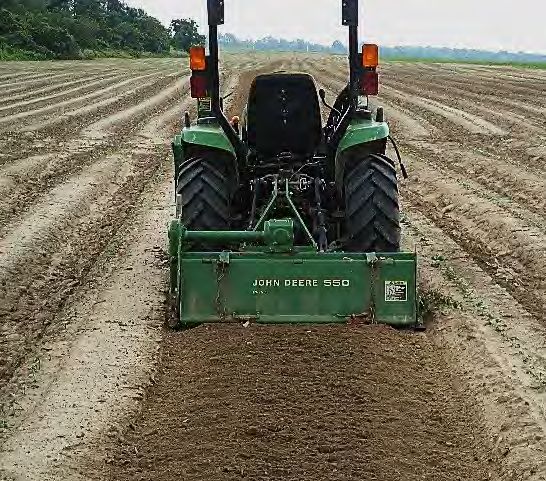
Selecting, Planting, and Managing
                                                                                                   Grasses for Vegetative Barriers

                                       Acknowledgements
Issued July 2021

Plant Materials Technical Note 6 was prepared by: Jon K. Allison, Farm Foreman, Jamie L.
Whitten Plant Materials Center, Coffeeville, MS; Joel Douglas, Plant Materials Specialist,
Central National Technology Support Center, Fort Worth, TX; Heather Dial, Plant Materials
Specialist, West National Technology Support Center, Portland, OR; Steve Woodruff,
Agronomist, East National Technology Support Center, Greensboro, NC; and John Englert,
National Program Leader-Plant Materials, Washington, D.C.

Plant Materials Centers (PMC) contributing to the development of Plant Materials Technical
Note No. 6: Jimmy Carter PMC, Americus, GA; Lockeford PMC, Lockeford, CA; Hoolehua
PMC, Hoolehua, HI; Aberdeen PMC, Aberdeen, ID; Manhattan PMC, Manhattan, KS; Norman
A. Berg National PMC, Beltsville, MD; Elsberry PMC, Elsberry, MO; Bismarck PMC,
Bismarck, ND; Cape May PMC, Cape May Court House, NJ; E. “Kika” de la Garza PMC,
Kingsville, TX; and Pullman PMC, Pullman, WA.

The technical note benefitted from review by other NRCS technical staff.

Suggested citation:

NRCS National Plant Materials Program. 2021. Plant Materials Technical Note 6: Selecting,
Planting, and Managing Grasses for Vegetative Barriers. USDA Natural Resources Conservation
Service, Washington, D.C.

In accordance with Federal civil rights law and U.S. Department of Agriculture (USDA) civil rights regulations and policies, the
USDA, its Agencies, offices, and employees, and institutions participating in or administering USDA programs are prohibited from
discriminating based on race, color, national origin, religion, sex, gender identity (including gender expression), sexual orientation,
disability, age, marital status, family/parental status, income derived from a public assistance program, political beliefs, or reprisal
or retaliation for prior civil rights activity, in any program or activity conducted or funded by USDA (not all bases apply to all
programs). Remedies and complaint filing deadlines vary by program or incident.

Persons with disabilities who require alternative means of communication for program information (e.g., Braille, large print,
audiotape, American Sign Language, etc.) should contact the responsible Agency or USDA's TARGET Center at (202) 720-2600
(voice and TTY) or contact USDA through the Federal Relay Service at (800) 877-8339. Additionally, program information may
be made available in languages other than English.

To file a program discrimination complaint, complete the USDA Program Discrimination Complaint Form, AD-3027, found online
at How to File a Program Discrimination Complaint and at any USDA office or write a letter addressed to USDA and provide in
the letter all of the information requested in the form. To request a copy of the complaint form, call (866) 632-9992. Submit your
completed form or letter to USDA by: (1) mail: U.S. Department of Agriculture, Office of the Assistant Secretary for Civil Rights,
1400 Independence Avenue, SW, Washington, D.C. 20250-9410; (2) fax: (202) 690-7442; or (3) email: program.intake@usda.gov.

USDA is an equal opportunity provider, employer, and lender.

                                          Technical Note No. 190-PM-6, Jul 2021
                                                                                                                                      2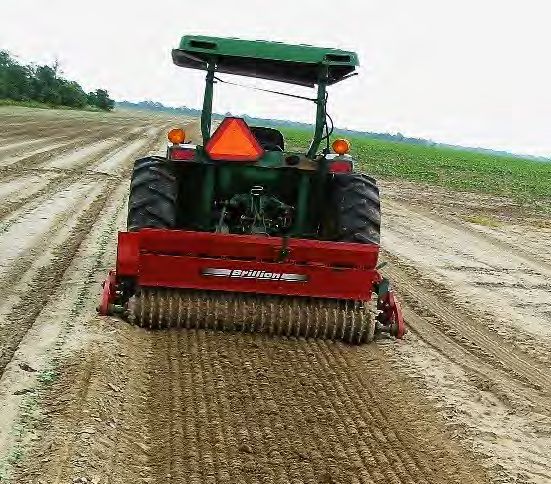
Selecting, Planting, and Managing
                                                                          Grasses for Vegetative Barriers

                                          Preface
The U.S. Department of Agriculture (USDA) Natural Resources Conservation Service (NRCS)
Plant Materials Program has been involved in the evaluation of conservation plants and planting
technology for more than 80 years. The Plant Materials Program releases plant material for use
in conservation applications. This technical note provides information on perennial warm and
cool season grasses that meet requirements for the installation of NRCS Conservation Practice
Standard Vegetative Barrier (VB) (Code 601) or those suitable for improving the efficiency of
other conservation buffers such as filter strips, field borders, riparian forest buffers, and contour
buffer strips. Species not meeting the VB standard are listed in Appendix A of this technical note
for reference.

For additional information on specific species of plants mentioned in this publication, please see
the USDA PLANTS database at https://plants.sc.egov.usda.gov/home or contact the nearest Plant
Materials Center or plant materials specialist at
https://www.nrcs.usda.gov/wps/portal/nrcs/main/plantmaterials/contact/directory/ that serves the
State. Additional technical resources are on the National Plant Materials Program website at
https://www.plant-materials.nrcs.usda.gov/.

                               Technical Note No. 190-PM-6, Jul 2021
                                                                                                       3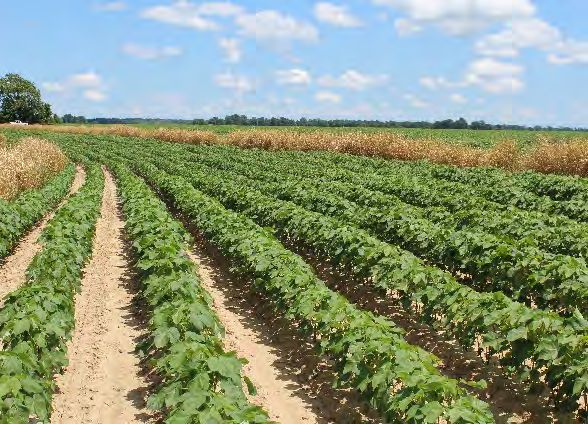
Selecting, Planting, and Managing
                                                                              Grasses for Vegetative Barriers

Introduction
NRCS Conservation Practice Standard (CPS) Vegetative Barrier (VB) (Code 601) is a
conservation buffer practice consisting of permanent strips of stiff, narrow (3- to 5-ft wide),
dense vegetation planted along the general contour of slopes or across concentrated flow areas at
angles convenient for farming (Kemper et al., 1992; fig. 1). They reduce sheet and rill erosion,
decrease ephemeral gully erosion, manage water flow, stabilize steep slopes, and trap sediment
(Dabney et al., 1993; Meyer et al., 1994, fig. 2). Vegetative barriers may be used in conjunction
with other conservation practices or conservation tillage system (McGregor and Dabney, 1993)
to reduce soil erosion and improve water quality.

  Figure 1: Vegetative barrier planted to ‘Alamo’          Figure 2: Vegetative barrier trap sediment on
  switchgrass in a cotton field in Quitman                 the upslope side of the barrier.
  county, MS.

Vegetative Barrier Vegetation Requirements
Research at the USDA-Agricultural Research Service, National Sedimentation Laboratory,
Oxford, MS, established minimum stem diameter and stem density values for vegetation stiffness
index (VSI) for concentrated flow areas (VSI = 0.10) and other purposes (VSI = 0.05) to
improve the efficiency of conservation buffer practices such as NRCS CPSs Filter Strip (Code
393), Field Border (Code 386), Riparian Forest Buffer (Code 391), and Contour Buffer Strips
(Code 332) (table 1).

Selecting Grasses for Vegetative Barriers
Research has shown that perennial grasses that have coarse stems will work as VB if they can be
established as a uniform and dense strip and are tolerant of sediment deposition (Dabney et al.,
1999). Vegetative barriers consist of stiff, erect, perennial grasses adapted to local soil and
climatic conditions with enough stem strength to remain erect against expected water flows.

Suitable VB plants must satisfy several criteria. They must be tolerant to the following: (a)
herbicides used on adjacent cultivated crops; (b) partial shading from cultivated crops; (c)
inundation by sediment; (d) local climatic extremes (wetness, drought, freezing temperatures,
etc.); and, (e) easily established (Dewald et al., 1996). They must also be long-lived and
manageable as a narrow strip, non-weedy and not too competitive with adjacent cultivated crops.

                                   Technical Note No. 190-PM-6, Jul 2021
                                                                                                           4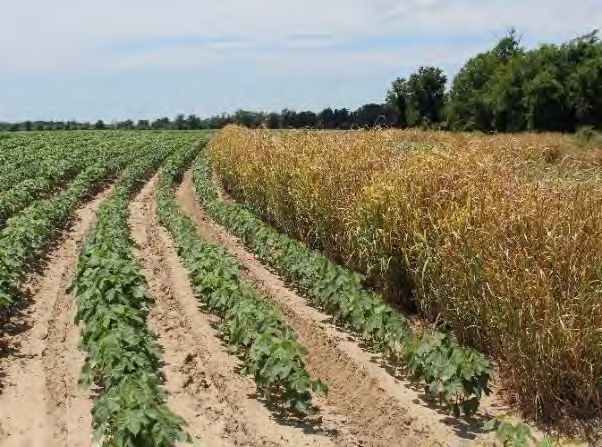
Selecting, Planting, and Managing
                                                                                        Grasses for Vegetative Barriers

Table 1. Stem diameter and minimum stem density values for vegetation
stiffness index (VSI) of 0.10 and 0.051/.
                    Concentrated Flow Areas        Other Purposes
  Stem Diameter            Stem Density             Stem Density
      (Inches)           Per Square Foot           Per Square Foot
                           @ VSI=0.10               @ VSI=0.05
        0.10                   1,000                     500
        0.15                            200                                    100
        0.20                             60                                    30
        0.25                             30                                    15
        0.30                             15                                     7
        0.35                              7                                     4
        0.50                              3                                     2
      =/>1.00                             1                                     1
1/ Table adopted from the 2020 revised Vegetative Barrier Practice Standard.

Stem Properties of Warm and Cool Season Grasses
Plant Materials Centers collected stem diameter and stem density values of commercially
available cultivars and pre-varietal germplasms of native and introduced, cool and warm season
perennial grasses to determine their usefulness as a vegetative barrier based on the calculation of
VSI of the grass (Dunn and Dabney, 1996).

                   Vegetation Stiffness Index = Stems/ft2 x Stem diameter to the 4th power
For example: Grass has 70 stem/ft2 with an average stem diameter of 0.20. To calculate the VSI
multiply 70 by 0.20 to the 4th power. The VSI calculation is 0.112.

The product from the VSI calculation must be > 0.10 for concentrated flow areas and > 0.05 for
other conservation buffer practices such as CPSs Filter Strip (Code 393), Field Border (Code
386), Riparian Forest Buffer (Code 391), and Contour Buffer Strips (Code 332).

Plant grasses at the recommended critical area (CPS Critical Area Planting (Code 342)) seeding
rate for quick, dense stands to meet the minimum requirements for VSI. Grasses listed in tables 2
and 3 met the VSI of 0.10 and/or 0.05. It is important to note that grass cultivars or pre-varietal
germplasm selections that meet VSI requirements in the region tested may not necessarily meet
the VSI requirements when grown in a different region of the United States, where adapted. For
example, ‘Alamo’ switchgrass met the VSI requirements for concentrated flow areas in
Kingsville, TX, and Coffeeville, MS, but did not meet the VSI requirement in Beltsville, MD.
However, Alamo met the VSI of 0.05 for other purposes of the practice in MD. To determine the
area of adaptation of a cultivar or pre-varietal germplasm, see the release brochure hyperlinked
in tables 2 and 3 or visit the Plant Materials Program Releases webpage.

                                        Technical Note No. 190-PM-6, Jul 2021
                                                                                                                     5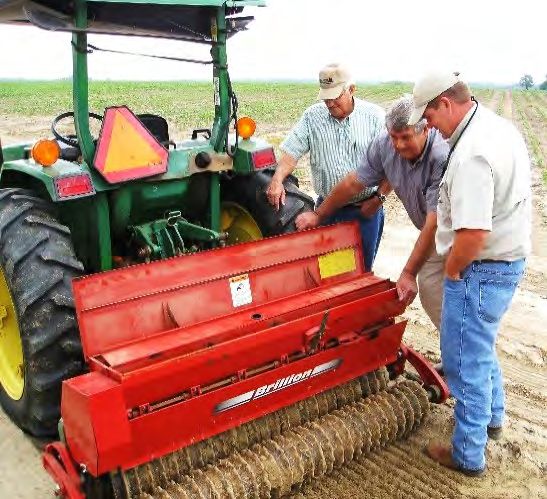
Selecting, Planting, and Managing
                                                                              Grasses for Vegetative Barriers

     It is critical that conservation planners plan the VB practice based on cultivars or pre-varietal
     releases from table 2 and 3 and not based on the species alone, unless the VSI of the grass is
     known. Furthermore, do not recommend unnamed species (VNS or variety not stated). If a
     perennial grass has the desirable characteristics of a VB species, and is not on the list, a VSI
     must be determined before recommending it for the practice. Failure to consider this step in the
     planning process may jeopardize the planting and effectiveness of the conservation practice.
     Named selections of grasses which do not meet a VSI of at least 0.05 at the time of this
     publication are included in Appendix A, tables 4 and 5. As additional measurements are made
     some of these grasses may be found to meet VSI or 0.10 or 0.05 and these tables will be updated.

Table 2. Warm and cool season perennial grasses meeting the vegetation stiffness index of 0.10 and 0.05.
 Cultivar/Pre-varietal                                                     PMC where stem attributes
 Germplasm                Scientific Name             Common Name were measured
 Alamo                      Panicum virgatum           switchgrass           Kingsville, TX; Coffeeville, MS
 Falfurrias Germplasm       Sporobolus wrightii        big sacaton           Kingsville, TX
 Magnar                     Leymus cinereus            basin wildrye         Aberdeen, ID
 Sunshine                   Chrysopogon zizanioides    vetivergrass          Kingsville, TX; Hoolehua, HI
 Timber Germplasm           Panicum virgatum           switchgrass           Cape May, NJ

Table 3. Warm and cool season perennial grasses meeting the vegetation stiffness index of 0.05.
 Cultivar/Pre-varietal                                                        PMC where stem attributes
 Germplasm                  Scientific Name            Common Name            were measured
 Alamo                      Panicum virgatum           switchgrass            Beltsville, MD
 Atlantic                   Panicum amarum             coastal panicgrass     Cape May, NJ; Beltsville, MD
 Blackwell                  Panicum virgatum           switchgrass            Beltsville, MD
 Bromar                     Bromus marginatus          mountain brome         Pullman, WA
 Coastal Germplasm          Sorghastrum nutans         Indiangrass            Cape May, NJ
 High Tide Germplasm        Panicum virgatum           switchgrass            Cape May, NJ
 Kanlow                     Panicum virgatum           switchgrass            Manhattan, KS
 Niagara                    Andropogon gerardii        big bluestem           Beltsville, MD
 Rumsey                     Sorghastrum nutans         Indiangrass            Beltsville, MD
 Southlow Germplasm         Andropogon gerardii        big bluestem           Beltsville, MD
 Suther Germplasm           Sorghastrum nutans         Indiangrass            Cape May, NJ

                                   Technical Note No. 190-PM-6, Jul 2021
                                                                                                           6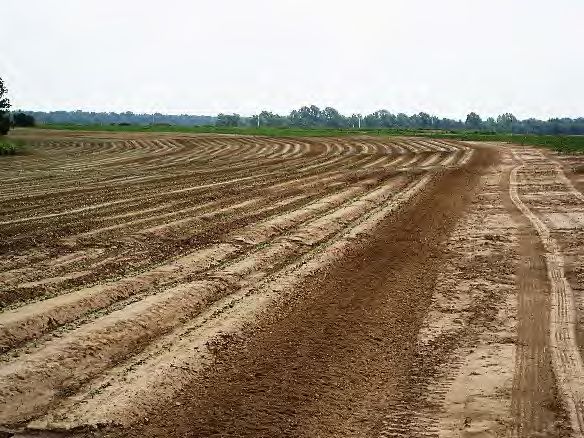
Selecting, Planting, and Managing
                                                                            Grasses for Vegetative Barriers

Planting Vegetative Barriers
General Planning
Plan the VB practice several months in advance of the planting. Row spacing and width of the
farming equipment are critical factors in the planning process. Planners may need to adjust the
location of the VB in the field based on the producer’s row crop equipment. For example, a
producer with 8 row, 40-in. equipment (26.7 ft wide), may prefer to make two passes between
each VB so the distance between each barrier would be about 54 ft.

Cropping history is also important in the planning process because residual herbicide from a
previous season may damage or affect germination of the VB grass. The use of precision
agriculture technology such as GPS guidance systems and/or field mapping, allow a producer to
plan where future VBs will be installed prior to their establishment. Detailed planning can
prevent loss to a producer because the strip(s) can be unplanted to the cash crop and excluded
from herbicide use.

Timing
It is beneficial for the producer to get as many of the normal cropping system applications
(tillage, spraying, etc.) completed before seeding the VB. This may cause the planting date to be
later than the normal planting window of the VB grass species, but with less risk of mechanical
or herbicide injury to young seedlings. Soil moisture should be the limiting factor on the latest
possible planting date of a VB.

Planting
After laying out the VB strip(s) according to the design plan and specifications in the VB
practice standard, determine the total number of linear feet of VB to plant (fig. 3). The total
number of linear feet is important for calculating
the amount of seed needed for the VB.

For example: 5,000 linear feet of planned VB
multiplied by 5 ft (width of the VB) equals 25,000 ft2
divided by 43,560 equals 0.6 acres.

       5000 ft*5ft = 0.6 acres
 43,560 ft2 in an acre

The critical area (conservation practice standard
342) seeding rate for the VB species is 10 PLS/acre.
The amount of seed needed to purchase is 6 PLS lbs. It’s always a good idea to purchase a few
extra pounds of seed in case there are issues during the planting operation.
       10 PLS lbs * 0.6 acres = 6 PLS lbs                 Figure 3: Determine the number of linear feet
                                                          of VB to plant.

                               Technical Note No. 190-PM-6, Jul 2021
                                                                                                          7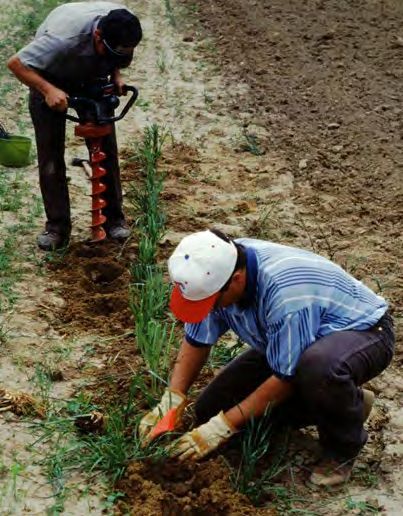
Selecting, Planting, and Managing
                                                                              Grasses for Vegetative Barriers

Seedbed Preparation
A 5-ft-wide rototiller is ideal for preparing a seedbed for VB planting (fig. 4). Firm the soil using
a cultipacker or similar implement prior to planting (fig. 5). Broadcast seed with hand-operated
spreader and cultipack afterwards to ensure a seed-to-soil contact (fig. 6) or use a cultipacker
seeder to plant the seed and firm the soil in one operation (fig. 7). For vegetative plant materials,
establish a double row of transplants, 6 inches apart in the concentrated flow areas (fig. 8).
Additional measures to secure new transplants in the concentrated flow areas may include
staking haybales end to end on the upslope side of the VB or attaching burlap or silt fencing to
stakes across concentrated flow area to protect the transplants until they are established (fig. 9).

Figure 4: Preparing a seedbed with a 5-ft                      Figure 5: Firm the soil prior to planting.
wide rototiller.

Figure 6: Planting VB on a well-prepared                      Figure 7: Cultipacker seeder.
seedbed.

                                   Technical Note No. 190-PM-6, Jul 2021
                                                                                                            8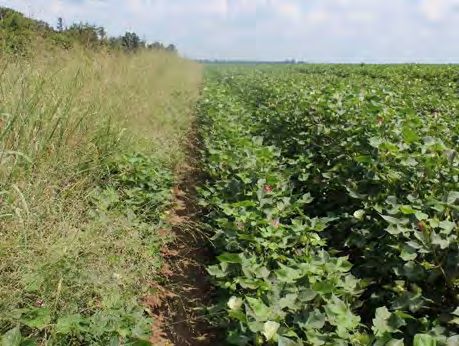
Selecting, Planting, and Managing
                                                                             Grasses for Vegetative Barriers

                                                          Figure 9: Haybales positioned across the
                                                          concentrated flow area to protect new ‘Alamo’
                                                          switchgrass transplants.

 Figure 8: Repairing washout in
 concentrated flow areas using ‘Alamo’
 switchgrass transplants.

Maintenance
To repair washouts in the concentrated flow areas or fill in gaps in the VB, follow the general
guidance provided above for establishing plants in concentrated flow areas.

Control weeds in the VB before they become aggressive or spread into the adjacent crop. Apply
labeled herbicides that will not harm the VB species or the cash crop. Spot spraying weeds with a
broad-spectrum herbicide is also an option for controlling weeds in the VB. Contact your local
extension weed specialist for assistance with herbicide recommendations, rates and dates of
application in your state.

Generally, enough fertilizer is applied during the fertilization of the cash crop to maintain
healthy VB plants. However, if this is not the case, fertilize the VB plants with a maintenance
fertilizer rate to keep plants growing vigorously.

Mowing VB may be used as a management practice to encourage the development of a dense
stand and prevent shading of crops in adjacent rows. Mow no closer than 15 inches. Mowing in
concentrated flow areas is discouraged because it will reduce stem diameter and lower the VSI.
If residue control is needed in concentrated flow areas, mow in the dormant season.

For more information on design specifications, operation, and maintenance refer to the CPS
Vegetative Barrier (Code 601) (National Conservation Practice Standards).

                                  Technical Note No. 190-PM-6, Jul 2021
                                                                                                          9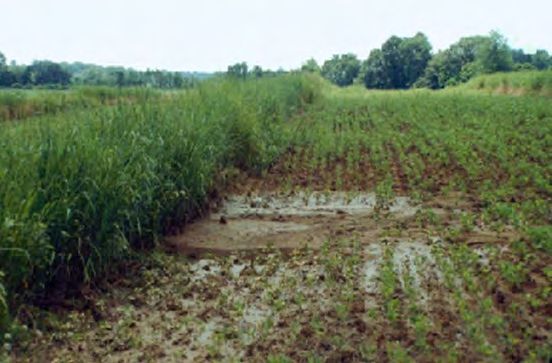
Selecting, Planting, and Managing
                                                                         Grasses for Vegetative Barriers

                                     References
Dabney, S. M., K. C. McGregor, L. D. Meyer, E. H. Grissinger and G. R. Foster. 1993.
   Vegetative barriers for runoff and sediment control. pp.60-70. In J. K. Mitchell (ed.).
   Integrated Resource Management and Landscape Modification for Environmental
   Protection, American Society of Agricultural Engineers, St. Joseph, MI.
Dabney, S.M., Z. Liua, M. Lane, J. Douglas, J. Zhua, D.C. Flanagan. 1999. Landscape benching
   from tillage erosion between grass hedges. Soil & Tillage Research (51): 219-231.
Dewald, C., J. Henry, S. Bruckerhoff, J. Richie, D. Shepard, S. Dabney, J. Douglas, and D.
   Wolfe. 1996. Guidelines for the establishment of warm season grass hedge for erosion
   control. J. Soil and Water Conserv. (1): 16-20.
Dunn, G and S. M. Dabney. 1996. Modulus of elasticity and moment of inertia of grass hedge
   stems. Trans. of the ASAE. 39. 947-952.
Kemper, D., Dabney, S., Kramer, L., Dominick, D. and Keep, T. 1992. Hedging against erosion.
   J. Soil Wat. Conserv. 47(4), 284-288.
McGregor, K. C. And S. M. Dabney. 1993. Grass hedges reduce soil loss on no-till and
   conventional-till plots. Proceedings Soil Conservation Tillage Conference for Sustainable
   Agriculture, Monroe, LA. pp. 16-20.
Meyer, L. D., S. M. Dabney and W. C. Harmon. 1994. Sediment-trapping effectiveness of stiff-
   grass hedges. American Society of Agricultural Engineers Paper No.94-2186, American
   Society of Agricultural Engineers, St. Joseph, MI.

                              Technical Note No. 190-PM-6, Jul 2021
                                                                                                    10
Selecting, Planting, and Managing
Grasses for Vegetative Barriers
Appendix A
Grasses listed in tables 4 and 5 do not meet the VSI of 0.10 and/or 0.05 at the time of
publication and are included for reference.
Table 4. Warm and cool season perennial grasses that may have potential to meet the vegetation stiffness
index of 0.05 with additional stem counts but are not currently recommended for use in the VB practice.
Cultivar/Pre-varietal PMC where stem attributes
Germplasm Scientific Name Common Name were measured
Bison Andropogon gerardii big bluestem Bismarck, ND
Bonilla Andropogon gerardii big bluestem Bismarck, ND
Kaw Andropogon gerardii big bluestem Bismarck, ND
Rountree Andropogon gerardii big bluestem Bismarck, ND
Whitepass Germplasm Elymus glaucus blue wildrye Pullman, WA
Red River Germplasm Spartina pectinata prairie cordgrass Bismarck, ND
Americus Sorghastrum nutans Indiangrass Americus, GA
Carthage Panicum virgatum switchgrass Cape May, NJ
Cave-in-Rock Panicum virgatum switchgrass Beltsville, MD; Elsberry, MO
Shawnee Panicum virgatum switchgrass Elsberry, MO
Shelter Panicum virgatum switchgrass Beltsville, MD
Alamo Panicum virgatum switchgrass Americus, GA
Alkar Thinopyrum ponticum tall wheatgrass Pullman, WA
Table 5. Warm and cool season perennial grasses that have been evaluated and do not meet the vegetation
stiffness index for concentrated flow areas or other purposes of the practice.
Cultivar/Pre-varietal PMC where stem attributes
Scientific Name Common Name
Germplasm were measured
Rio Leymus triticoides beardless wildrye Lockeford, CA
Berber Dactylis glomerata orchardgrass Lockeford, CA
Windbreaker Sporobolus wrightii big sacaton Lockeford, CA
Bell Chloris gayana rhodesgrass Hoolehua, HI
Blackwell Panicum virgatum switchgrass Manhattan, KS
Prairie View Germplasm Sorghastrum nutans Indiangrass Beltsville, MD
Forestburg Panicum virgatum switchgrass Bismarck, ND
Dacotah Panicum virgatum switchgrass Bismarck, ND
Sunburst Panicum virgatum switchgrass Bismarck, ND
NE 28 Panicum virgatum switchgrass Bismarck, ND
Trailblazer Panicum virgatum switchgrass Bismarck, ND
NE 2643 Panicum virgatum switchgrass Bismarck, ND
Shawnee Panicum virgatum switchgrass Bismarck, ND
Pathfinder Panicum virgatum switchgrass Bismarck, ND
Shelter Panicum virgatum switchgrass Bismarck, ND
Manska Thinopyrum intermedium pubescent Bismarck, ND
wheatgrass
Technical Note No. 190-PM-6, Jul 2021
11Selecting, Planting, and Managing
Grasses for Vegetative Barriers
Cultivar/Pre-varietal PMC where stem attributes
Scientific Name Common Name
Germplasm were measured
Manifest Thinopyrum intermedium Intermediate Bismarck, ND
wheatgrass
Bounty Andropogon gerardii big bluestem Bismarck, ND
Latar Dactylis glomerata orchardgrass Pullman, WA
Union Flat Germplasm Elymus glaucus blue wildrye Pullman, WA
Whitmar Pseudoroegneria spicata bluebunch Pullman, WA
ssp. inermis wheatgrass
Secar Elymus wawawaiensis Snake River Pullman, WA
wheatgrass
Durar Festuca brevipila hard fescue Pullman, WA
Canbar Poa secunda Canby bluegrass Pullman, WA
Technical Note No. 190-PM-6, Jul 2021
12You can also read


