Seminar: Facilities' Market Concentration and Remedies - Margaret E. Guerin-Calvert and Jeremy Nighohossian, Ph.D. 9 April 2019
←
→
Page content transcription
If your browser does not render page correctly, please read the page content below
Seminar:
Facilities’ Market
Concentration and Remedies

                       Margaret E. Guerin-Calvert and
                       Jeremy Nighohossian, Ph.D.
                       9 April 2019
Summary and Overview of Comments

◼   Data and expert analyses strongly support competitive, dynamic marketplace.
    ̶ National market is not highly concentrated, as now conceded by HMI new analysis.
    ̶ Dynamic competitive market: Significant entry by NHN and independents and more projected.
    ̶ HMI uses novel, unsupported methods to define local markets that produce unreliable and
      inconsistent results: No evidence of local concentration constraining effective bargaining.
    ̶ Data and actual network outcomes show competitively functioning market.

◼   No demonstrated harm from structure or competition issues.
    ̶ Empirical evidence rejects every HMI’s theorised test of harm from market power or
      concentration: No price-concentration link, no excess tariffs or profits, no quality or reduced access
    ̶ The only outcome of HMI concern —“over-utilisation” —is not caused by market power or
      competitive conditions; not market failure; and is unsupported by sound analysis or evidence.

◼   Recommendations are disproportionate and not supported by data or results.
    ̶ There is no evidence base for proposed far-reaching interventions.
    ̶ Unnecessary regulation leads to significant costs, disruption and inefficiencies: Smaller-scale,
      targeted interventions to address data and information could be constructive.
    ̶ HMI should rely on competition, not regulation of price, entry, or share, with antitrust enforcement
      as required.
                                                                                                         2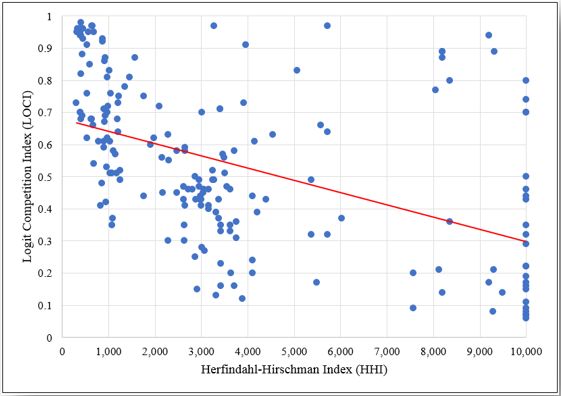
National market is not highly concentrated

                                                                              ◼       HMI now agrees private
                                                                                      hospital market is not highly
                                                                                      concentrated:*
                                                                                  ̶    HHI below 2500 since 2010.
                                                                                  ̶    NHN at 18% (or more).
                                                                              ◼       New HMI HHIs still overstate
      2 500
                      HMI’s new HHI calculations                                      concentration; misstate trend.
                                 (Registered Beds)                            – HMI sample is too small: At least
      2 450
              2 446
                                                                                14 NHN general acute hospitals
                      2 432   2 428                                             excluded from HMI’s original and
                                                              2 416   2 421
      2 400                           2 415   2 415   2 414                     new calculations**
HHI

                                                                              – Addition of these further reduces
      2 350                                                                     HHIs; increases NHN share and
                                                                                reduces others’ shares; shows
      2 300                                                                     actual deconcentration trend.
                                                                              *Most other stakeholders, including Medscheme in April 8th
                                                                              submission, conclude the national market is not highly
      2 250                                                                   concentrated. **NHN hospitals in NMG data and not included in
                                                                              HMI sample. Table 19, Compass-Lexecon Annexures to Response.
              2010    2011    2012    2013    2014    2015    2016    2017    (NHN 57/58 hospitals entering pre-2016)
                                                                                                                                       3
National market concentration has declined substantially
◼ HMI’s own registered bed data shows substantial deconcentration of national market since
2000 – even when sample is limited to general acute care hospitals (57/58).
◼ There is even greater de-concentration trend including day hospitals (77), which are a
significant part of private healthcare delivery in South Africa for all hospital groups.
Note: Data and calculations from HMI data set used for new HMI HHIs and bed calculations. List of hospitals, affiliations, types, and beds available upon request.
4Deconcentration trends are due to NHN and Independent entry
National bed additions by hospital group* National shares of beds (2017)
Source: 2017 HASA Conference
New hospitals (HMI data)
Between 2010 ◼ Entry since 2014 by NHN and independents
Network 2010 and 2016 2016
Mediclinic 46 3 49 outpaced adds by Life, Mediclinic, and Netcare:
Netcare 45 1 46 leading to 4 large hospital groups.*
Life Healthcare 42 2 44
National Hospital Network 35 17 52 ◼ Even for HMI data, most (83%) of the 43 new
Independent 11 19 30 hospitals are NHN (17) and independents (19).
Unknown 1 1
Total 179 43 222 ◼ Significant projected entry (2018+) is mostly by
independent hospitals (93.6% of new beds).
* All facilities in data. Note:There may be some changes in bed counts by hospital group from 2017 numbers due to acquisitions or additions; e.g.,
2017 NHN numbers include 686 DOH licenced beds at Akeso which Netcare acquired in 2018. Projected entry based on approved licences. 5Data show strong national and local competitive alternatives that
support effective bargaining and competition
◼ NHN created a strong 4th national health group to bargain collectively with funders.
̶ An exemption through 2023 allows NHN “to collectively conclude tariff negotiations, conduct central procurement,
and negotiate global fee agreements on behalf of NHN members. This exemption underscores the influence of the
NHN as a collective.” and “enabled them to grow in competition with the big three hospitals.” Medscheme
notes that “NHN growth has created addition competition – an alternative network.” Medscheme Presentation.
̶ NHN is now the largest hospital group with extensive hospital, day clinic, and specialised facilities; its national
share grew from 16% in 2010 to over 25% in 2017 based on beds.
◼ Schemes and patients have many competitive alternatives for healthcare services –
locally and nationally –conditions are conducive to effective bargaining and competition.
Private Hospitals by group (2016) 6HMI uses novel, untested local market definition methods
◼ HMI Report uses novel and unconventional methods to measure
concentration and define geographic markets (catchment areas).
̶ Methods are unreliable and not consistent with standard merger or market definition
methods (e.g., SSNIP test) for defining geographic markets and competitive alternatives.
̶ Lavielle method has not been used before for market definition in South Africa or
internationally;* LOCI critiqued widely for misstating market shares and concentration.
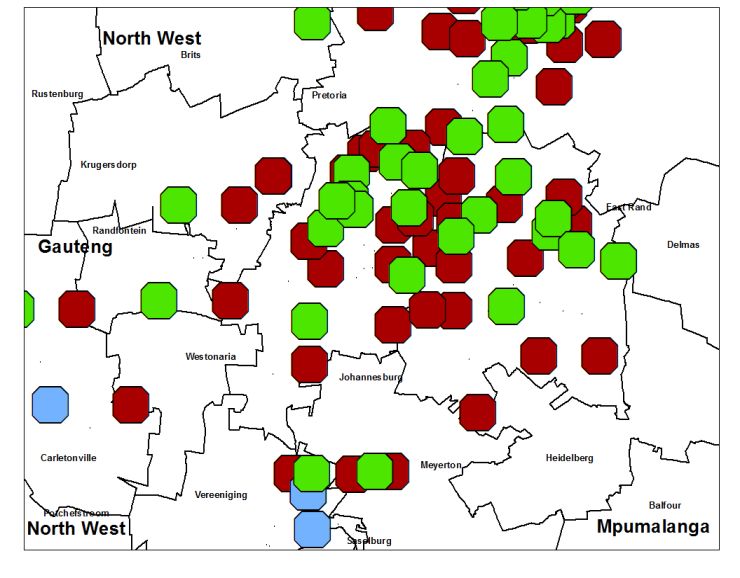
◼ HHI & LOCI produce unreliable, contradictory results: One in four catchment
areas are classified as highly concentrated by one measure and competitive by other.**
Dots in shaded areas are hospitals where HHI
and LOCI indicate opposite conclusions
These hospitals are solus according to HHI
but not concentrated according to LOCI.
** HMI report defines highly concentrated as a hospital having an HHI above 2,500 or LOCI under 0.60.
*The Lavielle method is commonly used to determine animal movement coverage areas. 7HMI uses novel, untested local market definition methods
◼ HMI defined local “markets” do not reflect the actual hospital
alternatives available to medical schemes in forming networks.
◼ HMI measures do not reliably show competitive
alternatives: particularly in urban areas, where
majority of privately insured beneficiaries reside.
◼ Nearby hospitals have very different concentrations
– 70 cases of hospitals within just 5 km of each other that
HMI classifies differently for concentration. About 96% of
beneficiaries are in areas w/ conflicting measures.
◼ HMI methods misstate or overstate local
Gauteng concentration and produce contradictory results.
◼ Unreliable and inconsistent concentration results mean that any
HMI analyses and conclusions based on either of these local
concentration measures are not supportable.
8Expert analyses and HMI’s own findings do not support any
theories of competitive harm – there is effective competition
◼ Netcare experts addressed every HMI theory of harm: price,
inflation trends, drivers of hospital pricing, (excess) profitability,
No Competitive bargaining, must-have hospitals, price-concentration.
Concerns: ◼ HMI and other experts also found: No economic support for
Price and anticompetitive pricing, excess pricing or expenditure due to
Bargaining competition issues; no price-concentration relationship.
◼ HMI finds tariff increases in line with CPI increases; HMI
experts show price and cost trends consistent with CPI.
◼ Analyses and actual bargaining results show credible
alternatives: no support for bargaining power concerns.
◼ HMI concludes that excess profitability is unsupported.
No Competitive
Concerns: ◼ Netcare experts demonstrate that HMI Report’s efficiency
assessment overstates or misstates any claimed inefficiencies.
Non-price
◼ Only alleged harm (over-utilisation) has no relationship to
market concentration nor theoretical basis for concern and no
evidence to this effect led by HMI.
9No support for bargaining or pricing concerns from concentration
Bargaining theory and competition:
◼ No evidence of unilateral or coordinated price effects*: Market conditions are not
conducive to either with credible alternatives that provide strong competitive incentives.
◼ Analyses of standard bargaining theory and actual outcomes show sufficient credible
alternatives (locally and nationally) to support strong competition and outcomes.
̶ Netcare experts’ theory, analyses and data show lack of “must-have” status, constraints on
any “leverage” of solus hospitals and practical evidence of effective options ** - medical
schemes can exercise a range of options to exclude or threaten to exclude Netcare (or MediClinic
and/or Life) hospitals in whole or in part from networks to achieve competitive pricing.
̶ Bargaining depends on outside options; GEMS/DH and others have countervailing bargaining
power. Discovery and GEMS have substantial market share providing additional bargaining power.
◼ Evidence does not support that prevalence of ARMs is determined by provider market
power. Use of ARMs (based on outdated analysis) is independent of current market
structure and degree of competition.
*After controlling for funder mix, procedure mix, and patient acuity mix, there is no evidence that tariff or revenue/admission vary
with concentration (Davis 2014). Evidence does not support collective bargaining approaches permitted in the past led to significantly
higher or anticompetitively higher prices. ** Davis 2014 pp 87-88; noting small volume at Netcare solus hospitals of its total; incentives
with regard to broader set of hospitals for inclusion in networks and associated volumes; and fact that Netcare solus hospitals are not
included in all DSP networks; 10No support for bargaining or pricing concerns from concentration
◼ Actual evidence on medical scheme approach to network formation,
demonstrated availability of sufficient competitive alternatives* and actual
outcomes show competition can be relied upon in private healthcare market.
◼ Medical schemes use the availability of sufficient competitive hospitals and
hospital group alternatives in negotiations and network formation:
̶ Exclude one or more hospital groups from network - Select hospital groups in their entirety;
select anchor hospital groups with filler hospitals to ensure access across market areas.
̶ Include/exclude on a hospital-by-hospital basis: Exclude particularly cost inefficient hospitals;
hospitals providing redundant services (even for anchor hospital group); include specific hospitals
with needed services or particularly cost effective (even for hospital group not in-network).
◼ Negotiations include threats or actual loss/gain of large patient volumes.
“…the use of networks by funders has driven competition among hospital groups and resulted in
substantial discounts being offered to funders for inclusion in networks .” Provisional Report, p 221
* Competition literature on hospital networks shows competitive outcomes where there are sufficient close substitutes
and that HHIs are poorer measures of sufficiency or nature of hospital network competition. (Garmon 2017).
11Actual networks demonstrate market functions competitively
◼ Many network examples of exclusion of hospital groups or specific hospitals – the market
is well positioned to rely on competition to constrain prices and services. CMS and
other data confirm expanded network options and their use since 2016.
Numerous Representative Examples* (through 2019)
One or more Hospital Groups excluded: Anchor hospitals, selective adds, exclusions:
◼ Health Squared Medical Scheme: Life Health excluded. ◼ Polmed DSP – Filler Hospital: Netcare excluded as
◼ Medshield DSP – Network: Mediclinic generally excluded.
anchor DSP status for scheme;17 Netcare facilities
added as filler sites. 14 Same Day facilities; 11
◼ Selfmed DSP: DSP Option reinstated with Netcare;
Psychiatric Facilities.
LifeHealth excluded. ◼ Profmed Savvy EDO – Filler Hospital: Mediclinic
◼ Medipos DSP – Hospital Network: All Netcare facilities and Life Health as anchor network. 16 Netcare as
excluded from DSP; all scheme options for 2019. fillers (16 acute; 12 psych;15 same day facilities).
◼ Umvuzo EDO/Filler Hospital: All Netcare facilities ◼ Keyhealth DSP – Options awarded to Netcare as
excluded - new EDO Ultra Affordable Option & DSP anchor: Equilibrium, Essence Silver, Netcare and Life
Proposal for Activator Option. Health were awarded the DSP contract. Mediclinic
◼ Fedhealth EDO “Elect” Option – Hospital Network: All and NHN excluded with exception of specific regions.
Netcare facilities excluded from new very limited EDO ◼ Bonitas – DSP Network: DSP Network inclusive of
which has Government, Lifehealth, Mediclinic and NHN all Netcare hospitals for options which do not have
hospitals except for Ceres Hospital. own EDO network. Excludes 14 Life Health facilities
◼ GEMS – Emerald EDO Option: Value Option (EVO).
in major metro areas.
◼ Fedhealth EDO Options – Netcare as anchor: Benefit
Netcare and Life Health plus 10 NHN hospitals. Mediclinic
excluded from the EVO. Options Included . Mediclinic, LifeHealth excluded
with exception of some specific regions.
12
* Network options include both DSPs, EVOs and preferred networks.Review of HMI Recommendations Regarding Concentration
◼ Data and expert analyses, and PR findings, demonstrate no competitive harms with regard to
pricing, price trends, profitability, entry, bargaining or unilateral or coordinated effects: no
empirical or analytical basis for recommendations for concentration, price or entry regulation.
◼ Many proposed recommendations would impose significant costs for no demonstrated benefit.
Regular Data Collection, Reporting, and Standardisation Measures
◼ Increased and standardised reporting by healthcare facilities – is likely consistent with
improved data collection and information to overcome gaps in information on beds, facilities
and differences in the availability of information on both private and public facilities.
Share Caps or Divestiture or Licencing Moratorium
◼ No support that three hospital groups have market power or that concentration is increasing; rather
declining. Already have significant expansion by NHN and independents.
◼ Would result in substantial distortions and limitations on competition - unintended consequence
of constraining hospital groups with greatest potential to offer group-wide structures and ability to
take on new payment models and facilitate choices; no basis for moratorium for all groups.
◼ No empirical or other evidence for 20% as an ideal market share for any hospital group. Difficult to
implement - many local markets but share caps would be established at national level. Also, the
Competition Act identifies in Section 7 a presumptive dominance threshold of 45%.
13Review of HMI Recommendations Regarding Concentration
Utilisation Controls
◼ Controls to address utilisation are best pursued by reliance on market mechanisms
such as pre-authorisation and benchmarks rather than explicit regulation.
◼ MCO’s and schemes have increased authorisation role which has had effect of increased
scheme oversight on admissions into hospitals – provides market-based solution.
◼ Recommendations for physician employment or limits on physician incentive contracts,
if appropriately defined, could address perceived issues with incentives for admissions.
◼ We recommend targeted approaches for disclosure or that address incentive contracts.
Proposed CON Regulation with Approval Process by Funders
◼ CON regulation can impose significant and unintended costs.
◼ CON laws have had limited success internationally; many repealed because they were ineffective
and deemed too restrictive on health care providers and responsiveness to market demand.
◼ HMI does not clearly make the case or explain the areas in which the existing provincial
licensing regimes are deficient and how CON (or broader centralised licencing framework)
would address such issues.
14Review of HMI Recommendations Regarding Concentration
Price Regulation
◼ Comments by Prof. Fonn at the HASA conference make it ambiguous whether price regulation
recommendations would supersede bilateral negotiations between hospitals and funders.
◼ Price regulation is without foundation. There is no basis for concluding that prices are
excessive or that funder and private hospitals cannot effectively negotiate prices.
◼ Setting prices is complex and time-consuming process, even when there are few tariffs. The HMI
presents no support for assumption dispute process can work on a cost-efficient and timely basis.
◼ The HMI provides no evidence to show how the purported and undefined benefits of the
proposed regulatory pricing regime will outweigh the costs.
◼ While the HMI seeks greater use of risk-based methods and reduced FFS pricing, continued
predominance of FFS (if the case) does not support a finding of market failure, or need for
pricing regulation.
◼ If the HMI’s price control proposals are meant to encourage greater adoption of ARMs, remedies
designed to minimise any existing costs/barriers to the adoption of ARMs may be sufficient and
would be far less onerous than price controls. The HMI has not considered such possibilities.
15Conclusions
HMI concedes national HHI below 2500 since
Is private hospital market highly concentrated?
2010; evidence supports lower shares/HHIs
Evidence of substantial entry by NHN and
Are there high barriers to entry? independents creates dynamic marketplace;
HMI concludes no barriers
Methods (particularly local market definition)
Does HMI analysis use conventional methods? What are
are novel and yield unreliable, inconsistent
implications? results – affects all analyses relying on them
Has evidence before HMI demonstrated significant competitive Evidence of sufficient competitive alternatives
constraints in bargaining? Has evidence demonstrated that for bargaining; against must-have hospitals;
hospitals have or use market power to undermine market? significant funder countervailing power
Can HMI can rely on competition to discipline pricing, access, and Yes. Market conditions supports effective
outcomes? competition; can rely on antitrust policy
No excess profits, prices, reduced quality or
Empirical evidence for HMI theories of harm?
access or unilateral/coordinated effects
Market is not highly concentrated; remedies
Recommendations to address concentration are necessary?
are disproportionate and harmful
Reporting of outcomes, quality of treatment,
Recommendations to address data quality beneficial?
and bed data, etc.
16Primary authors are Margaret E. Guerin-Calvert, Senior Consultant with Compass Lexecon, LLC ("Compass Lexecon"); she is
also President and Senior Managing Director of the Center for Healthcare Economics and Policy (“Center”), a business unit of
the Economics Practice at FTI Consulting, Inc. that specialises in healthcare economics and applied microeconomics, and
Jeremy Nighohossian Ph.D., Managing Director, Center. The views and opinions presented are solely those of the authors and do
not necessarily reflect the views of Compass Lexecon or other organisations with which the authors are or have been affiliated.
17You can also read


