SFVegas 2021 - Investor Presentation - October 2021 - Navient
←
→
Page content transcription
If your browser does not render page correctly, please read the page content below
SFVegas 2021 - Investor Presentation
October 2021
Forward-Looking Statements; Non-GAAP Financial
Measures
The following information is current as of June 30, 2021 (unless otherwise noted) and should be read in connection with Navient Corporation’s “Navient” Annual Report on Form 10-K for the year ended December 31,
2020 (the “2020 Form 10-K”), filed by Navient with the Securities and Exchange Commission (the “SEC”) on February 26, 2021 and subsequent reports filed by Navient with the SEC. Definitions for capitalized terms in
this presentation not defined herein can be found in the 2020 Form 10-K. This presentation contains “forward-looking statements”, within the meaning of the federal securities laws, about our business, and other
information that is based on management’s current expectations as of the date of this presentation. Statements that are not historical facts, including statements about the company’s beliefs, opinions or expectations
and statements that assume or are dependent upon future events, are forward-looking statements and often contain words such as “expect,” “anticipate,” “intend,” “plan,” “believe,” “seek,” “see,” “will,” “would,”
“may,” “could,” “should,” “goal,” or “target.” Forward-looking statements are subject to risks, uncertainties, assumptions and other factors that may cause actual results to be materially different from those reflected
in such forward-looking statements.

For Navient, these factors include, among others, the risks and uncertainties associated with:
• the severity, magnitude and duration of the COVID-19 pandemic, including changes in the macroeconomic environment, restrictions on business, individual or travel activities intended to slow the spread of the
pandemic and volatility in market conditions resulting from the pandemic including interest rates, the value of equities and other financial assets;
• the risks and uncertainties associated with increases in financing costs;
• unanticipated increases in costs associated with compliance with federal, state or local laws and regulations;
• changes in the demand for asset management and business processing solutions or other changes in marketplaces in which we compete (including increased competition);
• changes in accounting standards including but not limited to changes pertaining to loan loss reserves and estimates or other accounting standards that may impact our operations;
• adverse outcomes in any significant litigation to which the company is a party;
• credit risk associated with the company’s underwriting standards or exposure to third parties, including counterparties to hedging transactions; and
• changes in the terms of education loans and the educational credit marketplace (including changes resulting from the CARES Act or other new laws and the implementation of existing laws).

The company could also be affected by, among other things:
• unanticipated repayment trends on loans including prepayments or deferrals in our securitization trusts that could accelerate or delay repayment of the bonds;
• reductions to our credit ratings, the credit ratings of asset-backed securitizations we sponsor or the credit ratings of the United States of America;
• failures of our operating systems or infrastructure or those of third-party vendors;
• risks related to cybersecurity including the potential disruption of our systems or those of our third-party vendors or customers or potential disclosure of confidential customer information;
• damage to our reputation resulting from cyber-breaches, litigation, the politicization of student loan servicing or other actions or factors;
• failure to successfully implement cost-cutting initiatives and adverse effects of such initiatives on our business;
• failure to adequately integrate acquisitions or realize anticipated benefits from acquisitions including delays or errors in converting portfolio acquisitions to our servicing platform;
• changes in law and regulations whether new laws or regulations or new interpretations of existing laws and regulations applicable to any of our businesses or activities or those of our vendors, suppliers or
customers;
• changes in the general interest rate environment, including the availability of any relevant money-market index rate, including LIBOR, or the relationship between the relevant money-market index rate and the rate
at which our assets are priced;
• our ability to successfully effectuate any acquisitions and other strategic initiatives;
• activities by shareholder activists, including a proxy contest or any unsolicited takeover proposal;
• changes in general economic conditions; and
• the other factors that are described in the “Risk Factors” section of the 2020 Form 10-K and in our other reports filed with the Securities and Exchange Commission.

The preparation of the company’s consolidated financial statements also requires management to make certain estimates and assumptions including estimates and assumptions about future events. These estimates
or assumptions may prove to be incorrect and actual results could differ materially. All forward-looking statements contained in this release are qualified by these cautionary statements and are made only as of the
date of this release. The company does not undertake any obligation to update or revise these forward-looking statements except as required by law.

Navient reports financial results on a GAAP basis and also provides certain non-GAAP performance measures, including Core Earnings, Adjusted Tangible Equity Ratio, and various other non-GAAP financial measures
derived from Core Earnings. When compared to GAAP results, Core Earnings exclude the impact of: (1) mark-to-market gains/losses on derivatives; and (2) goodwill and acquired intangible asset amortization and
impairment. Navient provides Core Earnings measures because this is what management uses when making management decisions regarding Navient’s performance and the allocation of corporate
resources. Navient Core Earnings are not defined terms within GAAP and may not be comparable to similarly titled measures reported by other companies. For additional information, see Core Earnings in Navient’s
second quarter earnings release and pages 28 - 30 of this presentation for a further discussion and a complete reconciliation between GAAP net income and Core Earnings.

© 2021 Navient Solutions, LLC. All rights reserved.                                                                                                                                                                          2
We are the leader in education loan management and business processing solutions
for education, healthcare and government clients at the federal, state and local levels
We help our clients and millions of Americans achieve financial success through our services and support,
leveraging our 45+ years of data, analytics and processing experience and excellence
Originations Franchise and Existing Loan Portfolio Generate Significant Cash Flows
Our originations platform with its low-cost to acquire Education loan portfolios will generate predictable and
model generates highly accretive loans stable cash flows over 20+ years
Leveraging Our Scalable Technology Platform to Deliver Value
Through our dynamic operating model, we continue to Optimized scale and infrastructure leave us well
deliver solutions to a broad universe of customers positioned for continued EBITDA growth
Disciplined Expense Management & Prudent Capital Allocation
We drive efficiency through continuous expense Focused on maintaining our dividend and returning
rationalization throughout the business excess capital to shareholders
Executing on our long-term value-creation strategy and utilizing our core strengths
© 2021 Navient Solutions, LLC. All rights reserved. 3Delivering Long-term Value
Federal Education Loans Consumer Lending Business Processing
Segment Segment Segment
Providing payment relief to Originated $1.3 billion of high- Over 3,600 Navient employees
borrowers impacted by quality Private Education support our state and municipal
COVID-19 Loans, meeting our mid teens clients through unemployment
ROE target return thresholds insurance, contact tracing, and
vaccine administration
Stable net interest margin services
of 97 bps, as we continue to Driving sustainable long-term
benefit from a favorable interest profits through an optimized
rate environment and a lower balance sheet New contracts drove year over
cost of funds year revenue expansion
despite unprecedented
Annual charge-off rate declined disruption
Annual charge-off rate declined to 0.71% basis points, driven
to 0.04% basis points, driven by our data-driven risk
by our data-driven risk management platform and Affirmed our franchise value
management platform and borrowers benefitting from through our technology enabled
borrowers benefitting from stimulus programs platform and differentiated
stimulus programs expertise
97 bps NIM 295 bps NIM 30% EBITDA margin 1
Note: Quarterly data is as of 6/30/2021 and is compared to the year ago quarter.
1 Item is a non-GAAP financial measure. See pages 28 - 30 for a description and reconciliation.
© 2021 Navient Solutions, LLC. All rights reserved. 4Federal Education Loans Segment
“Core Earnings” Basis
Selected Financial Information and Ratios 2nd Quarter Highlights
($ In millions) Q2 21 Q1 21 Q2 20 Federal Education
Segment net interest margin 0.97% 0.97% 1.07% • Q2 21 Net Interest Margin: 97 basis points
• Q2 21 Annualized Charge-off Rate: 4 basis points
FFELP Loans:
Provision for loan losses $- $- $3 • As expected, net interest income decreased $30 million
Charge-offs $5 $6 $12 primarily due to a decrease in annual reset income as a result
of the rate reset that occurred on July 1, 2020
Annualized charge-off rate 0.04% 0.06% 0.11% - Net interest margin continued its strong performance,
Greater than 30-days benefitting from favorable interest rate and funding
8.3% 8.3% 8.2%
delinquency rate environments
Greater than 90-days
3.8% 3.5% 3.8%
delinquency rate
Forbearance rate 13.9% 15.5% 26.6% • Delinquency rate rose to 8.3% from 8.2%, as credit begins to
normalize
Average FFELP Loans $56,649 $58,078 $62,141
Operating Expense $55 $63 $70
• Annualized charge-off rate declined to 0.04% from 0.11%
Net Income $113 $112 $146
Number of accounts serviced for
5.6 5.6 5.6
ED (in millions) • Providing payment relief to borrowers impacted by COVID-19
Total federal loans serviced
$283 $285 $282
(in billions)
Contingent collections
receivables inventory - education $11.3 $11.7 $13.5
loans (billions)
© 2021 Navient Solutions, LLC. All rights reserved. 5Consumer Lending Segment
“Core Earnings” Basis
Selected Financial Information and Ratios 2nd Quarter Highlights
($ In millions) Q2 21 Q1 21 Q2 20 Consumer Lending
• Q2 21 Net Interest Margin: 295 basis points
Segment net interest margin 2.95% 2.99% 3.20% • Q2 21 Annualized Charge-off Rate: 71 basis points
Private Education Loans (including
Refinance Loans): • Originated $1.3 billion of high-quality private education loans
in the quarter, and $3.0 billion year-to-date
Provision for loan losses $(1) $(87) $41
Charge-offs $35 $35 $48
• Credit performance continues to reflect the strength of our
portfolio and default mitigation strategy
Annualized charge-off rate 0.71% 0.68% 0.97%
- As expected, delinquencies increased to 2.6% from 2.0%
Greater than 30-days delinquency as credit trends begin to normalize
rate
2.6% 2.3% 2.0%
- Annualized charge-off rate declined to 0.71% from 0.97%
Greater than 90-days delinquency
1.0% 0.9% 1.0%
rate
• Providing payment relief to borrowers impacted by COVID-19
Forbearance rate 3.0% 3.9% 8.4%
Average Private Education Loans $20,730 $22,143 $23,008
Operating Expense $39 $41 $34
Net Income $96 $234 $87
© 2021 Navient Solutions, LLC. All rights reserved. 6Originating Education Loans is An Attractive
Opportunity
Sizable Market With Attractive Yields1 Leveraging Our Existing Infrastructure to Generate Value
Estimated Total Market Annual Originations and Yields ($’s in billions) • Private Education Refinance Loans:
Grad PLUS - Using our data and expertise to deploy capital
In-School Private Education Loans at mid-teens ROE
Private Education Refinance Loans
$15 - Life of loan loss expectation of 1.25% 2
- Weighted average life of ~3.5 years
$11 • In-School Private Education Loans:
$10 - Using our data and expertise to deploy capital
at high-teens ROE
- Life of loan loss expectations of 6% 2
- Weighted average life of ~8 years
Typical Refi Borrower Profile 3
Estimated 2020 Originations
Borrower Age 32
~8% Months since Graduation 72
Education 60% advanced degrees
~5%
~4% FICO 765
Income $130,994
Monthly Real Free Cash Flow $4,263
Estimated Average Yield Original Loan Amount $69,304
1 Source: Navient estimates for total originations based on “Jennifer Ma, Matea Pender, and CJ Libassi (2020), Trends in 2 Life of loan loss expectations are on a gross basis.
Student Aid 2020, New York: The College Board”; Navient estimates for average yields based on FSA Data Center and 3 Weighted average.
third-party company filings.
© 2021 Navient Solutions, LLC. All rights reserved. 7Business Processing Segment
“Core Earnings” Basis
Selected Financial Information and Ratios 2nd Quarter Highlights
($ In millions) Q2 21 Q1 21 Q2 20
Business Processing
Government Services $66 $63 $43 • Q2 21 EBITDA Margin 1: 30%
Healthcare RCM Services $64 $62 $21 • Revenue increased $66 million or 103% compared to a year
ago, primarily as a result of revenue earned from new
Total Business Processing contracts to support states in providing unemployment
$130 $125 $64
Revenue
benefits, contact tracing and vaccine administration services
Operating Expenses $92 $91 $57
EBITDA 1 $40 $36 $8
• EBITDA 1 increased $32 million or 400% to $40 million
compared to the year ago quarter, continuing to demonstrate
EBITDA Margin 1 30% 29% 13% the scalability and efficiency of our infrastructure
Net Income $29 $26 $6
• Net income increased $23 million compared to $6 million in
Contingent collections receivables the year ago quarter
$15.5 $17.9 $14.5
inventory (billions)
1 Item is a non-GAAP financial measure. See pages 28 - 30 for a description and reconciliation.
© 2021 Navient Solutions, LLC. All rights reserved. 8Funding & Liquidity © 2021 Navient Solutions, LLC. All rights reserved. 9
Financing and Capital Management
Capital Management Financing
✓ Returned $227 million through share Issued $7.5 billion of Term Education Loan
repurchases and dividends ABS transactions
• Paid dividends of $27 million • On September 21, priced $991 million
• Repurchased 11.8 million shares for of Private Education Refinance Loans
$200 million
• Total remaining share repurchase
Issued $500 million of unsecured debt 1
authority of $300 million 1
Reduced unsecured debt by $1.4 billion
Adjusted Tangible Equity (ATE) ratio of 6.3% compared to the year ago quarter
• Pro Forma Adjusted Tangible Equity • Called $750 million of debt, which
Ratio (ATE) 2 of 8.0% settled on July 12, 2021
1 As of 6/30/2021
2 Item is a non-GAAP financial measure. See pages 28 - 30 for a description and reconciliation.
© 2021 Navient Solutions, LLC. All rights reserved. 10Education Loan Portfolio Generates Meaningful
Cash Flows Over the Next Five Years
Projected Annual Private Education Loan Cash Flows Projected Annual FFELP Loan Cash Flows
Cash Flows assuming call option can be exercised at 10% Cash Flows assuming trusts run to maturity
$1.2 $1.2 $1.1
$1.0 $1.0
$1.0 $1.0 $0.9 $0.9
$0.9
($’s in Billions)
($’s in Billions)
$0.8 $0.8
$0.8 $0.8
$0.6
$0.6 $0.5
$0.6
$0.4 $0.4
$0.2 $0.2
$0.0 $0.0
2021 2022 2023 2024 2025 2021 2022 2023 2024 2025
Remaining Remaining
Private Education Loan Portfolio Assumptions FFELP Loan Portfolio Assumptions
• The Private Education Loan portfolio is projected to generate $4.2 billion in cash • The FFELP loan portfolio is projected to generate $4.3 billion in cash flows through
flows through 2025 excluding operating expenses, taxes and unsecured debt 2025 excluding operating expenses, taxes and unsecured debt principal and interest
principal and interest payments payments
• Future loan originations are not included
• Unencumbered loans of $0.3 billion are not securitized to term
• Unencumbered loans of $2.3 billion are not securitized to term
• Includes projected floor income
• Includes the repayment of debt related to asset-backed securitization repurchase
facilities when the call option is exercised
These projections are based on internal estimates and assumptions and are subject to ongoing review and modification. These projections may prove to be incorrect.
© 2021 Navient Solutions, LLC. All rights reserved. 11Managing Unsecured Debt Maturities
(par value, $ in billions)
As of July 12th, called $750 million of unsecured debt that would have
matured in January of 2022, reducing 2022 maturities to under $1 billion
$1.8
$1.7
$1.5 $1.5
$1.4 $1.4
$1.1 $1.1
$0.7 $0.7
$0.6 $0.6 $0.6
$0.5 $0.5 $0.5
$0.2 $0.2
$0.0 $0.0
2021 2022 2023 2024 2025 2026 2027 2028 2029 2030+
As of June, 2020 As of June, 2021
Long-term Conservative Funding Approach
• Navient prioritizes continued access to the unsecured debt market as an important component in our
capital structure
• We continue in our conservative approach to unsecured debt
© 2021 Navient Solutions, LLC. All rights reserved. 12Secured Funding
2021 YTD ABS Issuance ($’s in millions) • 2021 YTD Issuance
1 Santander $15,631 Auto • FFELP ABS Financing
2 GM Financial $11,371 Auto • Issued 2 transactions for $2.0B
3 Toyota $9,350 Auto
• Private Education ABS Financing
4 Navient $7,463 Student Loan
• Issued 6 transactions for $5.4B
5 Nelnet $6,417 Student Loan
6 Hyundai $6,215 Auto
7 CarMax $6,205 Auto
• 2020 Issuance
8 Ford $5,232 Auto
9 World Omni $5,129 Auto • FFELP ABS Financing
10 Honda $4,385 Auto • Issued 2 transactions for $1.5B
11 Progress Residential $4,174 Single-Family Rental
12 Hertz $4,000 Rental Car • Private Education ABS Financing
• Issued 9 transactions for $6.3B
13 Exeter $3,611 Auto
14 Mercedes-Benz $3,549 Auto
15 Carvana $3,500 Auto
16 Westlake $3,054 Auto
17 Capital One $3,000 Credit Card
18 BMW $2,500 Auto
19 Dell $2,434 Equipment
20 Avis $2,358 Rental Car
Table Source: Barclays Database, ABS volume as of September 21, 2021
© 2021 Navient Solutions, LLC. All rights reserved. 13Private Education Loan ABS Issuance
Characteristics
Private Education Loan ABS Transaction Features Collateral Characteristics
• Issue size of $500M+ • Collateralized by loans made to students
and parents to fund college tuition, room
• Senior and subordinate notes and board
- Seasoned assets benefiting from
• Amortizing tranches with 1 to 10 year proven payment history
average lives - Refi assets with strong credit factors
including high FICO scores, income,
• Fixed rate and floating rate securities and ability to pay
• Compliant with U.S. risk retention and, • Underwritten using a combination of
depending on the transaction, with FICO, custom scorecard & judgmental
European risk retention criteria with risk based pricing, debt-to-
income, household income, and free cash
• Navient Solutions, LLC is master servicer flow, as applicable
© 2021 Navient Solutions, LLC. All rights reserved. 14Private Education Loan ABS Transactions
NAVSL 2021-F NAVSL 2021-E
Pricing Date: September 21, 2021 July 19, 2021
Settlement Date: September 28, 2021 July 29, 2021
Issuance
$991,300,000 $1,019,000,000
Amount:
Collateral: Private Education Refi Loans Private Education Refi Loans
Prepayment
15% CPR 15% CPR
Speed 1:
Ratings Ratings
Class Amt ($M) WAL3 Pricing 3 Class Amt ($M) WAL3 Pricing 3
(D/F/M) 2 (D/M) 2
Tranching:
A AAA/AAA/Aaa $946 2.93 Swaps + 0.57% A AAA/Aaa $964 2.80 Swaps + 0.55%
B AA/NR/NR $46 7.63 Swaps + 0.95% B AA/NR $55 7.38 Swaps + 1.05%
1 Constant Repayment Rate (CPR) estimated based on a variety of assumptions concerning loan repayment behavior.
2 Represents ratings by DBRS (D), Fitch (F) and Moody’s (M).
3 Weighted Average Life (WAL) and Pricing are to the expected call date.
© 2021 Navient Solutions, LLC. All rights reserved. 15Navient Private Education Loan Programs
Smart Option Undergrad/Grad/ Med/Law/MBA Direct-to-Consumer (DTC)
Origination Channel School School Direct-to-Consumer
Typical Borrower Student Student Student
Typical Co-signer Parent Parent Parent
$10k avg orig bal, 10 yr avg term, in-school
$10k avg orig bal, 15 yr term, deferred $12k avg orig bal, 15 yr term, deferred
Typical Loan payments of interest only, $25 or fully
payments payments
deferred
Origination Period March 2009 to April 2014 All history through 2014 2004 through 2008
Certification and School certified and School certified and Borrower self-certified, disbursed to
Disbursement disbursed disbursed borrower
FICO,
Borrower
custom credit score model, and judgmental Primarily FICO Primarily FICO
Underwriting
underwriting
$100,000 Undergraduate, $150,000
Borrowing Limits $200,000 $130,000
Graduate
Made to students and parents primarily Made to students and parents through Terms and underwriting criteria similar
through college financial aid offices to fund college financial aid offices to fund 2- to Undergraduate, Graduate,
2-year, 4-year and graduate school college year, 4-year and graduate school college Med/Law/MBA with primary differences
tuition, room and board tuition, room and board being:
Also available on a limited basis to Signature, Excel, Law, Med and MBA - Marketing channel
students and parents to fund non-degree Loan brands - No school certification
Additional Title IV schools only 1
granting secondary education, including - Disbursement of proceeds directly
Characteristics Freshmen must have a cosigner with
community college, part time, technical and to borrower
1
trade school programs limited exceptions Title IV schools only
1
Both Title IV and non-Title IV schools Co-signer stability test (minimum 3 year Freshmen must have a co-signer with
repayment history) limited exceptions
Co-signer stability test (minimum 3 year
repayment history)
1Title IV Institutions are post-secondary institutions that have a written agreement with the Secretary of Education that allows the institution to participate in any of the Title IV federal student financial assistance programs and the
National Early Intervention Scholarship and Partnership (NEISP) programs.
© 2021 Navient Solutions, LLC. All rights reserved. 16Navient Private Education Loan Programs
Consolidation (Legacy) Private Education Refi Private Education Origination
Origination Channel Lender Lender School
College Graduates & Select Non-
Typical Borrower College Graduates Student
Graduates
Typical Co-signer Parent Parent Parent
$15k avg orig bal, 5-15 year term, in-
$43k avg orig bal, 15-30 year term $50k-75k avg orig bal, 5-20 year term
school payments of immediate
Typical Loan depending on balance, immediate depending on balance, immediate
repayment, interest only, $25 or fully
repayment repayment
deferred
Origination Period 2006 through 2008 2014 through current April 2019 through current
Certification and Proceeds to lender to pay Proceeds to lender to pay School certified and
Disbursement off loans being consolidated off loans being consolidated disbursed
Borrower FICO, Debt-to-Income, Income, Free FICO, Debt-to-Income, Income, Free
FICO and Debt-to-Income
Underwriting Cash Flow (as applicable) Cash Flow (as applicable)
Up to total cost of attendance
Borrowing Limits $400,000 Maximum $550,000
Private Aggregate Loan Limit of $250,000
Loans made to students and parents to Loans made to high FICO / high income Made to students/cosigners with high
refinance one or more private education customers with positive free cash flow FICO / high income / positive free cash
loans and/or established credit profiles flow and/or established credit profiles, to
Additional Student must provide proof of fund 4-year and graduate school college
Characteristics graduation in order to obtain loan tuition, room and board
9-month grace period after graduation
Title IV and non-profit schools only
1Title IV Institutions are post-secondary institutions that have a written agreement with the Secretary of Education that allows the institution to participate in any of the Title IV federal student financial assistance programs and the
National Early Intervention Scholarship and Partnership (NEISP) programs.
© 2021 Navient Solutions, LLC. All rights reserved. 17FFELP ABS Issuance Characteristics
FFELP ABS Transaction Features Collateral Characteristics
• Issue size of $500M+ • Guarantee of underlying collateral
insulates bondholders from most risk of
• Senior and subordinate notes loss of principal 1
• Amortizing tranches with 1 to 10(+) year
average lives • Typically non-dischargeable in bankruptcy
• Fixed rate and floating rate securities
• Compliant with U.S. risk retention
regulations
• Navient Solutions, LLC is master servicer
1 Principal and accrued interest on underlying FFELP loan collateral carry insurance or guarantee of 97%-100% dependent on origination year and on meeting the servicing requirements of the U.S. Department of Education.
© 2021 Navient Solutions, LLC. All rights reserved. 18FFELP ABS Transactions
NAVSL 2021-2 NAVSL 2021-1
Pricing Date: April 12, 2021 February 8, 2021
Settlement Date: April 22, 2021 February 18, 2021
Issuance
$1,011,600,000 $1,015,900,000
Amount:
U.S. Government Guaranteed U.S. Government Guaranteed
Collateral:
FFELP Consolidation and FFELP Non-Consolidation Loans FFELP Consolidation and FFELP Non-Consolidation Loans
Prepayment 4% CPR Consolidation / 6% CPR Non-Consolidation
4% CPR Consolidation / 6% CPR Non-Consolidation
Speed 1: 8% CPR Rehabilitation
Ratings Amt. Ratings Amt.
Class WAL3 Pricing 3 Class WAL3 Pricing 3
(D/M/S) 2 ($M) (D/M/S) 2 ($M)
A-1A AAA/Aaa/AA+ $300 5.72 Swaps + 0.55% A-1A AAA/Aaa/AA+ $150 5.77 Swaps + 0.60%
Tranching:
A-1B AAA/Aaa/AA+ $697 5.72 1ML + 0.55% A-1B AAA/Aaa/AA+ $852 5.77 1ML + 0.60%
B AAA/Aaa/NR $14 12.76 1ML + 1.35% B AAA/Aaa/NR $14 12.85 1ML + 1.45%
1 Constant Repayment Rate (CPR) estimated based on a variety of assumptions concerning loan repayment behavior.
2 Represents ratings by DBRS (D), Moody’s (M) and S&P (S).
3 Weighted Average Life (WAL) and Pricing are to the expected call date.
© 2021 Navient Solutions, LLC. All rights reserved. 19FFELP Loan Program Characteristics
Parameter Subsidized Stafford Unsubsidized Stafford PLUS/Grad PLUS Consolidation
Borrower Student Student Parents or Graduate Students Student or Parents
Needs Based Yes No No N/A
Federal Guarantee of Principal
97 - 100% 97 - 100% 97 - 100% 97 - 100%
and Accrued Interest
Interest Subsidy Payments Yes No No Yes
Special Allowance Payments
Yes Yes Yes 1 Yes
(SAP)
Original Repayment Term 2 120 months 120 months 120 months Up to 360 months
Undergraduate: $23,000 Undergraduate 3: $57,500
Aggregate Loan Limit None None
Graduate: $65,500 Graduate: $138,500
1 Onlyapplies for loans made between July 1, 1987 through January 1, 2000 if cap is reached.
2 Repayment Term may be extended through various repayment options including Income Driven Repayment plans and Extended Repayment.
3 Aggregate loan limit for a Dependent Undergraduate is $31,000.
Note: As of July 1, 2011.
© 2021 Navient Solutions, LLC. All rights reserved. 20Student Loan Options During the National Emergency: What You Need to Know
If you have impacted by COVID, options depend on your loan types. Contact your servicer to discuss what’s right for you.
Department of Education • These loans have been automatically placed into forbearance (payments suspended) through September
(Direct) Loans: 2021 and interest rates have been set to 0% according to the terms of the CARES Act and extended
through executive order. Your Auto Pay payments were paused automatically.
• Watch for communications concerning payment resumption in October.
• Contact Navient to discuss your options if you are not able to resume making payments. If you were in an
income-driven repayment plan before this forbearance, your recertification date has been pushed back.
• October 2021: Payments are due on your normal due date and interest rates return to normal.
Note: If you are pursuing a loan forgiveness program, you will receive credit during the period of suspension
(April 2020 – September 2021) as though you made on-time monthly payments.
FFELP Loans: Contact Navient to discuss your best option for payment relief. Options include:
• National Emergency Forbearance
• Income-Driven Repayment (IDR) Plan
• Unemployment Deferment
• Loan Consolidation into a Direct Loan
Note: If you’re already in an IDR plan but your income recently changed, you can have your
payment recalculated.
Private Loans: Contact Navient to discuss your best option for payment relief. Options include:
• National Emergency Forbearance
• Extended Repayment
• Interest-Only payment
• Rate Reduction program
Not sure what type of loan you have? Login to your account at Navient.com to see your loans at a glance. “Type” is next to the loan column and is either Direct,
FFELP, or Private. For “FFELP”, click the purple plus sign to check your interest rate. If it’s been set to 0%, that loan has the same relief benefits as Direct
(Department of Education) loans, otherwise see the FFELP Loan relief options above.
© 2021 Navient Solutions, LLC. All rights reserved. 21Higher Education Industry © 2021 Navient Solutions, LLC. All rights reserved. 22
At $1.6 trillion in student loans, the federal government
is the largest non-mortgage consumer lender
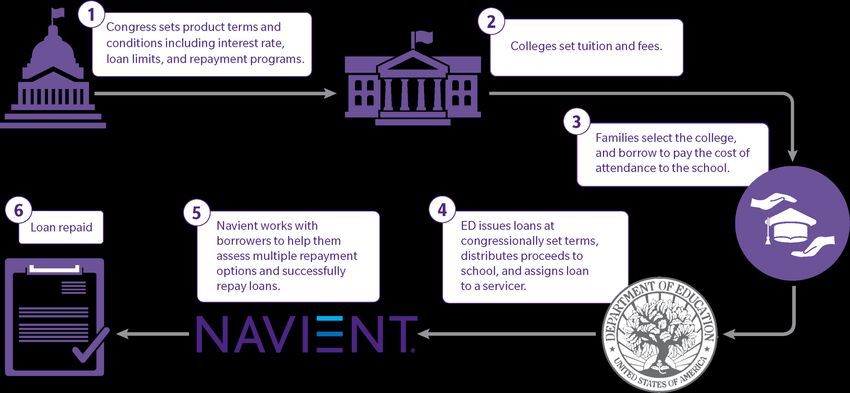
      •               Federal loan interest rates, limits and terms are set by Congress.
      •               All federal loans are issued directly by the U.S. Department of Education since 2010 when federally guaranteed
                      loans ended.
      •               Federal loans have no traditional underwriting, and no truth in lending disclosures.
      •               In AY 19-20, ED disbursed $88B in student loans, a decline from peak of $125B in AY 10-11.
      •               The number of federal borrowers is up by 52% since 2007.

      Total student loan originations, by type                                                                                                                 Ownership distribution of student loans

                                                                                                                                                                FFELP       Private         92% of student
                110                                                                                                             The increasing dominance       guarantors
                               Federal                                                                                                                                       7.9%           loans outstanding
                100                                                                                                                                              1.5%
                               student                                                                                          of federal student loan                                     are owned or
                 90                                                                                                                                                                         guaranteed by the
                 80
                               loans                                                                                            originations versus private     FFELP
                                                                                                                                                                 owned                      federal
                 70                                                                                                             loans reflects the federal      privately                   government.
                                                                                                                                government's massive              7.4%
  Billions, $

                 60
                                                                                                                                                               Perkins
                 50                                                                                                             involvement in student          0.3%
                 40                                                    Private                                                  loans: it owns or                                      Dept of
                 30                                                    education                                                                                                      Education
                 20                                                    loans
                                                                                                                                guarantees 92% of the                                   loan
                 10                                                                                                             $1.7 trillion outstanding in                           82.9%
                  0                                                                                                             student loans.
                                                                                                           2018
                      2006

                             2007

                                    2008

                                           2009

                                                  2010

                                                         2011

                                                                2012

                                                                        2013

                                                                               2014

                                                                                      2015

                                                                                             2016

                                                                                                    2017

                                                                                                                  2019

                                                                                                                         2020

                                                  Academic year ending in…

     Source: Outstanding data from FSA Data Center, Student Loan Portfolio data for 3rd quarter 2021 (3/31/2021); originations from College Board, “Trends in Student Aid 2020”
     Note: The $1.6 trillion in the title refers to the total amount owned or guaranteed by the federal government

© 2021 Navient Solutions, LLC. All rights reserved.                                                                                                                                                             23
In its role as a federal student loan servicer, Navient helps borrowers successfully repay their loans Servicers begin helping borrowers navigate repayment after important financial decisions about the total cost and experience of their education have already been made. © 2021 Navient Solutions, LLC. All rights reserved. 24
The borrowers who struggle most are often
non-completers with less than $10,000 in debt
Borrowers who do not complete a degree                                                                                    … As a result, borrowers who run into trouble
default at a rate almost three times higher                                                                               repaying usually have below-average amounts
than borrowers who earned a degree …                                                                                      of debt.
Borrowers in default by attainment                                                                                        3-Year Default Rate by loan size and Repayment
                                                                                                                          Cohort (parentheses contain share of all defaults)
                                               2.8X                                                                                         (35%)
                                                                                                                               25
                                                                  25%
     25
                                                                                                                               20                             (31%)
     20
                                                                                                                               15
%

                                                                                                                        %
     15                                                                                                                                                                (18%)

                              9%                                                                                               10                                               (11%)
     10                                                                                                                                                                                 (4%)

        5                                                                                                                         5

        0                                                                                                                         0
                     Completed                              Did Not                                                                       $40,000
                      Degree                               Complete                                                                                           10,000   20,000   40,000
                                                            Degree
    Source: President Obama’s Council of Economic Advisors, "Investing In Higher Education: Benefits, Challenges, And The State Of Student Debt," July 2016
    Note: Years are fiscal years. Loan size is based on balance of loan when entering repayment.

© 2021 Navient Solutions, LLC. All rights reserved.                                                                                                                                              25
Navient Corporation Appendix © 2021 Navient Solutions, LLC. All rights reserved. 26
Navient Continues to Advance Environmental,
Social and Governance Initiatives
  Social Initiatives                                                                         Environmental Initiatives
  Community partnerships                                                                     • Ongoing efforts to reduce already low carbon footprint
  • National partnership with Boys & Girls Clubs of America to                               • Enterprise-wide emphasis on electronic communications to
    bring career and college planning resources to support                                     support enhanced customer experience and reduce
    equity for youth, including those from under-resourced                                     environmental impact and cost
    communities                                                                              • Energy-efficient buildings and systems
                                                                                             • Flexible work options and use of technology that can
  Customer initiatives                                                                         reduce commuting, travel and office footprint
  • Advocacy to improve the education finance system                                         • Participant in the Carbon Disclosure Project (CDP)
    in America
  • Tools and resources to help people successfully manage
    their student loans and develop healthy credit habits                                    Governance Initiatives
  • More than 400,000 student loan borrowers serviced by
    Navient pay off their student loans every year                                           • Strong focus shareholder rights, including majority voting,
                                                                                               proxy access and annual election for all board members
  Philanthropy                                                                               • Adoption of governance best practices, board refreshment
  • Giving in our communities through employee-led                                             policies, annual board and committee assessments
    fundraising and the Navient Community Fund                                               • Emphasis on board diversity—Navient’s Board of Directors
  • Up to four hours of paid time off per month for employees                                  continues to be recognized for its leadership in gender
    to volunteer in their communities                                                          parity by Women’s Forum of New York, 2020 Women on
                                                                                               Boards, Forum of Executive Women and New York Stock
  Employee programs                                                                            Exchange Governance Services
  • Inclusion, Diversity & Equity Council                                                    • Long-term compensation incentive metrics designed to
  • Employee Resource Groups                                                                   promote growth and sustainable profitability
  • Award-winning employee training and development                                          • Robust risk and compliance oversight framework
    opportunities such as Leadership Development Program

  Learn more in our Corporate Social Responsibility Report at about.navient.com/Social-Responsibility

© 2021 Navient Solutions, LLC. All rights reserved.                                                                                                          27
Notes on Non-GAAP Financial Measures
(Dollars in Millions)
In addition to financial results reported on a GAAP basis, Navient also provides certain performance measures which are non-GAAP financial measures. The following non-GAAP
financial measures are presented within this Presentation:
1. Core Earnings – The difference between the company’s Core Earnings and its GAAP results is that Core Earnings excludes the impacts of: (1) mark-to-market
gains/losses on derivatives and (2) goodwill and acquired intangible asset amortization and impairment. Management uses Core Earnings in making decisions regarding
the company’s performance and the allocation of corporate resources and, as a result, our segment results are presented using Core Earnings. In addition, Navient’s
equity investors, credit rating agencies and debt capital investors use these Core Earnings measures to monitor the company’s business performance. For further detail
and reconciliation, see page 51 of this presentation and pages 15 - 23 of Navient’s first quarter 2021 earnings release.
2. Core Earnings Return on Equity (CEROE) – Core Earnings Return on Equity is calculated as Adjusted Core Net income, excluding restructuring and regulatory-related
expenses, divided by the quarterly average of GAAP equity for the trailing four quarters. This measure allows management, as well as investors and analysts, to measure
the company’s use of its equity. The calculation for Q1 2021 is as follows:
Adjusted Core Earnings Net income $316 (1)
Q1 2021 = = = 54% (2)
Average Equity ($2,115 + 2,254 + $2,433 + 2,723) / 4
3. Core Earnings Efficiency Ratio – The Core Earnings Efficiency Ratio measures the company’s Core Earnings Expenses, excluding restructuring and regulatory-related
expenses, relative to its Adjusted Core Earnings Revenue. This ratio can be calculated by dividing Core Earnings Expenses, excluding restructuring and regulatory-
related expenses, by Adjusted Core Earnings Revenue. Adjusted Core Earnings Revenue is derived by adding provision for loan losses, and excluding gains or loss on
debt repurchases, to Total Core Earnings Revenue. This is a useful measure to management as we plan and forecast, as it removes variables that cannot be easily
predicted in advance. By using this measure, management can make better short-term and long-term decisions related to expense management and allocation. The
calculations for Q1 2021 is as follows:
Adjusted Core Earnings Expense $251 (1)
Q1 2021 = = = 44%
Adjusted Core Earnings Revenue $576
1 Excludes $14 million of net restructuring and regulatory-related expenses in first quarter 2021.
2 Return on Equity has been annualized.
© 2021 Navient Solutions, LLC. All rights reserved. 28Notes on Non-GAAP Financial Measures
(Dollars in Millions)
4. Earnings before Interest, Taxes, Depreciation and Amortization Expense (“EBITDA”) – This metric measures the operating performance of the Business Processing
segment and is used by management and our equity investors to monitor operating performance and determine the value of those businesses. For further detail and
reconciliation, see page 23 of Navient’s first quarter earnings release.
5. Adjusted Tangible Equity Ratio (ATE) – The Adjusted Tangible Equity Ratio measures Navient’s tangible equity, relative to its tangible assets. We adjust this ratio to
exclude the assets and equity associated with our FFELP portfolio because FFELP Loans are no longer originated and the FFELP portfolio bears a 3% maximum loss
exposure under the terms of the federal guaranty. Management believes that excluding this portfolio from the ratio enhances its usefulness to investors. To determine
Adjusted Tangible Equity Ratios, we calculate the Adjusted Tangible Equity, (GAAP Total Equity less Goodwill & Acquired Intangible Assets less Equity held for FFELP
Loans), and divide by Adjusted Tangible Assets (Total Assets less Goodwill & Acquired Intangible Assets less FFELP Loans). For further detail and reconciliation, see page
23 of Navient’s first quarter earnings release.
i. Pro Forma Adjusted Tangible Equity Ratio – The following provides a pro forma of what the Adjusted Tangible Equity Ratio would be if the cumulative net
mark-to-market losses related to derivative accounting under GAAP were excluded. These cumulative losses reverse to $0 upon the maturity of the individual
derivative instruments. As these losses are temporary, we believe this pro forma presentation is a useful basis for management and investors to further analyze
the Adjusted Tangible Equity Ratio. For further detail and reconciliation, see page 23 of Navient’s first quarter earnings release.
© 2021 Navient Solutions, LLC. All rights reserved. 29Differences Between Core Earnings And GAAP
Quarters Ended
Core Earnings adjustments to GAAP: Jun. 30, Mar. 31, Jun. 30,
(Dollars in Millions) 2021 2021 2020
GAAP net income (loss) $185 $370 $125
Net impact of derivative accounting (30) (91) 59
Net impact of goodwill and acquired intangible assets 5 5 5
Net income tax effect 5 21 (10)
Total Core Earnings adjustments to GAAP (20) (65) 54
Core Earnings net income (loss) $165 $305 $179
© 2021 Navient Solutions, LLC. All rights reserved. 30Investor Relations Website
www.navient.com/investors
www.navient.com/abs
• NAVI / SLM student loan trust data (Debt/asset backed securities – NAVI / SLM Student Loan Trusts)
- Static pool information – detailed portfolio stratifications by trust as of the cutoff date
- Accrued interest factors
- Quarterly distribution factors
- Historical trust performance – monthly charge-off, delinquency, loan status, CPR, etc. by trust
- Since issued CPR – monthly CPR data by trust since issuance
• NAVI / SLM student loan performance by trust – Issue details
- Current and historical monthly distribution reports
- Distribution factors
- Current rates
- Prospectus for public transactions and Rule 144A transactions are available through underwriters
• Additional information (Webcasts and presentations)
- Archived and historical webcasts, transcripts and investor presentations
• Environmental Social Governance (ESG) Information
© 2021 Navient Solutions, LLC. All rights reserved. 31You can also read


