EU Blending and External Investment Plan - AECID TRAINING 21 December 2017 Madrid
←
→
Page content transcription
If your browser does not render page correctly, please read the page content below

EU Blending and
External Investment Plan

            AECID TRAINING
           21 December 2017
                     Madrid
Blending is defined as …..

  THE STRATEGIC USE OF A LIMITED AMOUNT OF EU
    FINANCIAL SUPPORT TO MOBILISE FINANCING
   FROM PARTNER FIs AND OTHER SOURCES (INCL.
 PRIVATE SECTOR) TO ENHANCE THE DEVELOPMENT
         IMPACT OF INVESTMENT PROJECTS

        LEVERAGE

        financing

Grant
                      International
                      Cooperation               2
                      and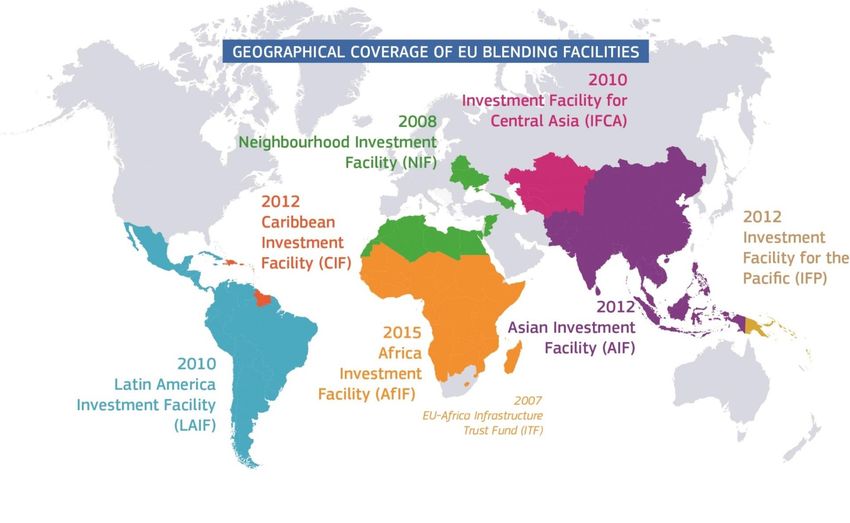
Blending is useful when…..
• Projects have issues:
Affordability problems
Poor financial performance Capital intensity
Perceived risk/market failure New technology
Pricing issues Pioneering new approach
Multi-component Issues beyond sponsor
And/or Public goods
• Countries are:
Too ‘rich’ for all-grant (LMICs, MICs)
Too poor for all-commercial loan (DSF concessionality & limits)
And/or
• Actors:
Financiers have constraints and specific policy objectives
Beneficiaries ‘shop’ for best deal
International
Cooperation 3
and
3 Main ‘types’ of partners
             always a LEAD FI
a) Multilateral European Finance
   Institutions (e.g. EIB,…).                    ‘Lead’ FI
                                                 (entrusted
                                                 with budget
b) European National                        implementation tasks)
   development finance institutions
   from Member States (e.g. AFD,
   KfW, AECID, CDP, FMO…)

c) Regional and other multilateral
   banks: can act as lead (e.g.
                                             Supporting FIs
   AfDB in AfIF; IaDB, CDB in CIF),
   as co-financiers in others.

                            International
                            Cooperation                             4
                            and
The EU support is part of a financing package

  Project financing mix

   Equity/Own funds (beneficiary)

       Government Financing

 Finance institutions (IFIs) Loans ++

 Other (Grant donors and/or Private)
                                                          Average EU
       EU Financial Support
                                                        grant size €5-10
                                                            million
                                        International
                                        Cooperation                        5
                                        and
So far, blending takes one of 5 forms
 BLENDING GRANT                  …WHICH CAN ELIMINATE
      TYPE                          A KEY PROBLEM
                           Reduce cost to end users or beneficiary country by
 Direct Investment Grant
                           partly financing the total investment cost

                           Reduce cost to end users or beneficiary country by
  Interest Rate Subsidy
                           reducing interest cost and/or avoiding IMF debt-
          Grant
                           ceilings (not a favoured tool for EU)

  Technical Assistance     To boost management, speed, project design,
         Grant             feasibility/preparation and quality i.e. address risks

                           To address perceived high risk by providing funding
                           which absorbs some of this risk and thereby lowers
      Risk Capital
                           investors' risk perception (often with the objective of
                           mobilising private capital)
                           To address perceived high risk by partly guaranteeing
       Guarantee           certain types of investments (often with the objective
                           of mobilising private capital)
                                    International
                                    Cooperation                                      6
                                    and
Global Blending Instruments
                                        3%

                                             5%
guarantees

risk capital                                       16%

interest rate subsidy   48%

technical assistance

investment grant                                  28%

        2 of these are still small
                        International
                        Cooperation                      7
                        and
EXAMPLES & INSTRUMENTS:

1: Direct investment grant

2: Interest rate subsidy grant

3: Technical assistance

4: Risk capital

5: Guarantees (fully funded)

                   International
                   Cooperation     8
                   and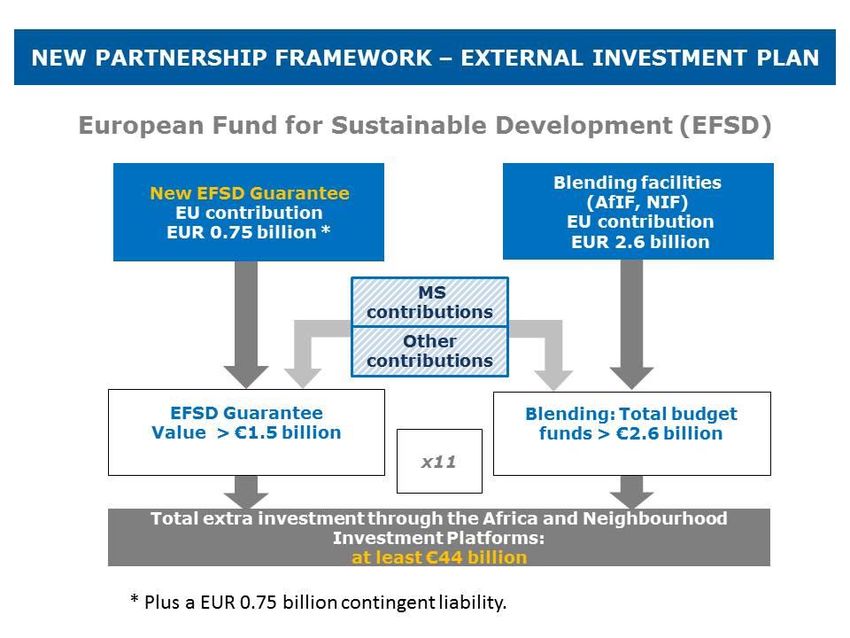
1 Investment Grant
          Direct Investment Grant

      E.g. A reduction in consumer price per KW

         €
                              Unit price per KW: solar

               Unit price per KW: thermal

                                               time

                               International
                               Cooperation               9
                               and
1 Direct Investment grant

Ouarzazate
solar power
 plant (NIF)
                Solar power plant with initial capacity of
                160 MW in Morocco. Reduces
                dependence on energy imports and
                avoids the generation of at least 250000
                tons of CO2.
                International
                Cooperation                                  10
                and
1 Direct Investment Grant
Part of the Moroccan Solar Plan. When fully
developed (4 phases: 2GW target capacity), the
largest solar power plant in North Africa.
Project promoter is the Moroccan Agency for Solar
Ouarzazate
Energy (MASEN).
Independent power producer (IPP) to implement
solar power the project is determined by MASEN through
competitive bidding.
plant (NIF) The NIF direct investment grant aims to align
(lower) the cost of solar power to the cost of
thermal power.
Total project volume: €807mn-phase 1;
€1,000mn- phase 2; € 850mn- phase 3.
Grant contribution: €30mn(phase 1);
€40mn(phase 2); €50mn(phase 3)
Involved EFIs: EIB, AFD, KfW
International
Cooperation 11
and2 Interest Rate Subsidy (IRS)
Interest rate subsidy
Increase concessionality
Debt servicing
without grant
€
IMF limits
More concessionality
with grant
time
International
Cooperation 12
and2 Interest Rate Subsidy
Lake Victoria
WATSAN
Initiative
(ITF)
Regional initiative aiming at
reversing the environmental
deterioration of Lake Victoria and
improve living conditions in the
lake basin.
International
Cooperation 13
and2 Interest Rate Subsidy
Three projects are supported by the ITF in the
context of the LV WATSAN initiative in
Uganda, Kenya and Tanzania.
Lake Victoria In Uganda, the project aims at increased
WATSAN coverage, reliability and access of water
supply & sanitation for the population of
Initiative metropolitan Kampala.
(ITF) Interest Rate Subsidy needed to meet
objectives set by the Ugandan debt
strategy and concessionality
requirements in the context of IMF
programme (Uganda classified as
‘medium risk’ by IMF).
Total project volume: €212 m
Grant contribution: €14 m IRS / €8 m TA
Involved EFIs: KfW, AFD, EIB
International
Cooperation 14
and3 Technical Assistance Feasibility
Management support
1 Financial returns Policy analysis
to attract financiers
Technical support
Monitoring & evaluation
6 Competent ‘Green
management to 2 Economic / social /
lights’ for
ensure success environmental returns to
project make it worthwhile
financing
5 Risk
management to
3. Adequate policy
ensure appropriate
framework & operating
implementation and
repayments 4 Beneficiaries commitment to environment to facilitate
provide ownership impact and success
International
Cooperation 15
and3 Technical Assistance
Rural road
program
El Salvador
(LAIF)
Improve the rural road infrastructure in
order to reverse the conditions that affect
rural poverty and low economic activity in
those areas. Strengthen the institutional
capabilities and reduce vulnerability to
climate changes.
International
Cooperation 16
and3 Technical Assistance
Focus on access and population movements,
especially those living in poverty, as well as on
rural areas with potential for productive
development.
Rural road TA will finance institutional strengthening
program activities, climate change adaptation programs,
supervision activities, trainee programs as well
El Salvador as institutional
equipment.
software and hardware
(LAIF) Strengthens the processes, staff
competence, methods and tools for
sustainable improvement of the cycle of
road projects.
Total project volume: €49.5 million
Grant contribution: €4 million
Involved EFIs: AECID, IDB
International
Cooperation 17
and4 Risk Capital
is usually equity (first loss)
LAST LOWER
‘A’ SHARES
Private investors & lenders Sequence
of Income
absorbing waterfall;
‘B’ SHARES any losses relative
Public Finance Institutions that may returns for
arise risk
(sub-
‘C’ SHARES ordination)
First loss tranche (donors)
FIRST HIGHER
International
Cooperation 18
and4 Risk Capital
Microfinance
Initiative for Asia
(MIFA)
Debt Fund
(AIF/IFCA)
Pools public and private investments to
provide loans to microfinance institutions
and thus provide access to finance for
MSMEs and low income households in Asia
and Central Asia.
International
Cooperation 19
and4 Risk Capital
Grant used as TA and as a first-loss tranche
invested in the Structured Fund.
The first-loss (or junior) tranche is also
funded by Germany's BMZ (€15 million).
Reduces risk for other investors and allows
MIFA them to invest in the mezzanine (public
Debt Fund finance institutions) or senior tranche
(AIF/IFCA) (private investors).
TA used for capacity building in particular for
Tier II and Tier III institutions.
Total project volume: €79 million
Grant contribution: €7 million (C-shares) and €2
Note also million (TA)
EFSE Involved EFIs: KfW, IFC
International
Cooperation 20
andThe impact of Risk Capital instrument
MIFA Brings in private
investors
MIFA provides resources
not available elsewhere
MFI MFI MFI MFI MFI MFI MFI
TA for
MFIs and
MSMEs
Micro & SMEs (MSMEs)
International
Cooperation 21
and5 Guarantees
Definition Main features
Guarantees are legally binding
• Provide lender with added
agreements under which a party (the
protection – are ‘risk sharing’
guarantor) agrees to pay part or all of
the amount due on loan or equity upon • Typically cover only part of first
realisation of a number of agreed loss – around 50-70% - to
events avoid ‘moral hazard’
• First loss typically capped at
Often, they are disbursed to FIs and 10-15% of guaranteed portfolio
then ‘earmarked’ but not disbursed by • Can be free or remunerated
the FI until there is an actual loss (i.e.
efficient). Undisbursed amounts • Should generate leverage, and
returned to EU upon closure. improve access to finance
International
Cooperation 22
and1 EIP AND BLENDING
5 Guarantee Mechanism
SME Finance
Facility (NIF)
Increasing the availability of long-term funding
and financial services to SMEs in the Eastern
Neighbourhood by enhancing FI capacity as well
as their willingness to lend to SMEs.
International
Cooperation 23
and5 Guarantee Mechanism
EU grant resources are used to finance a
combination of Technical Assistance to local
partner financial intermediaries (PFI) and/or
credit enhancement support for PFIs (in the
form of a guarantee) to leverage new on-
SME Finance lending by PFIs to SMEs. Accompanied by
EBRD/KfW credit lines to PFIs.
Facility (NIF)
Up to €10 million for guaranteeing up to
50% of individual loans and up to 10% of
the loan portfolio risk.
Total project volume: up to €100 million
Grant contribution: €10m (Guarantee)
incl. up to €1m (TA)
Involved EFIs: EBRD, KfW
International
Cooperation 24
andThe Impact of Guarantee Instrument
PFI PFI PFI PFI PFI PFI PFI
50% guarantee
TA for PFIs provided to PFIs for
and SMEs their lending to SMEs
(and 10% of SME
portfolio)
SME Borrowers
International
Cooperation 25
andHow blending amounts are calculated
BLENDING GRANT
Basis of calculation
TYPE
Direct Investment Should be linked to a quantified target e.g. reducing a tariff by 5% or
10% etc. It could also be used to finance additional project components/
Grant attain higher quality standards etc.
Whenever the interest rate charged for a loan is lower than the market
rate, the difference reflects the concessional or subsidy element. This is
Interest Rate often required where debt sustainability analyses point to limits in the
Subsidy Grant Government's capacity to absorb additional public or publicly guaranteed
debt.
Technical Bottom-up estimate of what grant support is needed to improve the
design, quality, timing, sustainability, innovation, impact and/or scale of a
Assistance Grant project.
Calculation based on financial ratios e.g. desired debt/equity ratio and/ or
Risk Capital risk protection required by typically private investors (could be high e.g.
30-40%).
Guarantees often have a maximum amount (‘cap’), an absolute figure, to
limit the cover and potential costs for the EU, which is based, inter alia,
Guarantee on the expected loss percentages, as calculated by the financial
institutions.
International
Cooperation 26
and2009
Western Balkans
Investment Framework
(WBIF)
DG DEVCO:6 facilities (AfIF/ITF, LAIF, CIF, IFCA, AIF, IFP)
DG NEAR: 2 facilities (NIF & WBIF)
International
Cooperation 27
and2007-2016 Blending Operations
Annual grant approvals (in € million) Grant approvals by sector (in %)
800
700 Thematic
Urban development 1%
600 AfIF
ICT 1%
IFP Mixed
500 1%
CIF Agriculture 3%
400
AIF Social 3%
300 IFCA Private Sector 12%
Environment 17%
200 LAIF
Transport 22%
100 ITF
Energy 41%
NIF
0 0% 10% 20% 30% 40%
2007 2008 2009 2010 2011 2012 2013 2014 2015 2016
All facilities grant EFIs financing to Total investment
approvals to 380 approved projects ¹ amount
operations *
€ 3.4 billion
Average: € 9 million
€ 57.3 billion
€ 26.2 billion Leverage: 16.8/1
per operation
Leverage: 7.7/1
¹ Regional Banks (AfDB, IADB, CDB, ADB ,...) and WB/IFC are NOT included. International
Cooperation 28
andAverage leverage is c. 17x
€ 3.4 billion EU grants
UNLOCKING
€52 billion ADDITIONAL
FINANCING
[GRANTS, LOANS & INVESTMENTS]
At least €24 billion are provided by
eligible public finance institutions
International
Cooperation 29
andIndicative allocations 2014-2020
LAIF AIF IFCA NIF
Indicative
€ 320 million € 320 million € 140 million € 2.1 billion
2014-2020 allocation
AfIF CIF IFP WBIF
€ 1,0 billion
Indicative (RIP)
c. € 1 billion € 135 million € 20 million (plus €100
2014-2020 allocation
m for TA)
International
Cooperation 30
andThematic Investment Facilities
So far, two thematic initiatives aiming at de-risking
investments:
ElectriFI: The Electrification Financing Initiative (ElectriFI) is an innovative
enabling facility to unlock, accelerate and leverage private sector investment
to increase or improve access to affordable, reliable, sustainable and
modern energy in developing countries.
Focus on connection in rural underserved areas via renewable energy.
ElectriFI can provide funding and support to developers/investors across a
range of business models.
Example: EDFI ElectriFI (http://electrifi.org)
International
Cooperation 31
andThematic Investment Facilities
AgriFI: AgriFI is an initiative that aims at increasing investment in
smallholder agriculture and agribusiness MSMEs in order to achieve
inclusive and sustainable agricultural growth
Focus on mobilising public and private investment to promote agricultural
value chains via risk capital and guarantees (de-risking the investment)
AgriFI responds to the lack of financing mechanisms adapted to farmers and
agri-entrepreneurs, particularly for smallholders and agribusiness MSMEs.
AgriFI will be backed-up by technical capacity to support business
development and advisory services for farmers and agri-entrepreneurs.
International
Cooperation 32
andThere are other blending mechanisms
Additional Blending Mechanisms
1. GEEREF: The Global Energy Efficiency and
Renewable Energy Fund
2. EU EDFI Private Sector Development Facility
(only Africa)
International
Cooperation 33
andConclusions from the 2016 Evaluation
of Blending: Achievements*
Blending allowed the EU to engage more broadly and with strategic
advantage (large infrastructure projects)
Significant value to the EU's grant based development cooperation
and IFI loan operations
Important role in supporting private sector development mainly
within financial sector
High quality of blending process especially with higher risk projects
approved by the EU
Development of a body of good practice forms a basis for continual
improvement
Large extent of the projects have been successful and there is evidence
that the outputs are being used and appreciated by the
beneficiaries
*Based on the Evaluation of Blending Final Report 12/2016 International
Cooperation 34
andConclusions from the 2016 Evaluation of Blending:
Opportunities for Further Enhancement*
Further strengthen the additionality of the grant part of blending
Explore new partnerships with IFIs
Sharpen alignment with national policies
Build on the post 2014 blending guidance framework
Expand the use of risk sharing instruments to financial intermediaries
selected for their strategy and policies (with respect to pro-poor and pro-
development risk taking)
Greater focus on job creation and poverty alleviation
Need for a pro-active stance on visibility
*Based on the Evaluation of Blending Final Report 12/2016
International
Cooperation 35
andEUBEC Platform's objectives
Established 2012 (policy and technical group):
Improve the quality and efficiency of EU external
blending mechanisms
Harmonise key principles while differentiating by
sectors and regions
Focus on sectors where financial instruments can be
most usefully deployed
Strengthen coherence with EU policies
International
Cooperation 36
and1. Understanding
EU Blending Operations
International
Cooperation 37
andTwo ‘levels’ of Commission financing
decisions
Funding to Blending
Facilities through Annual
BLENDING Action Plans, based on
FACILITY
sectors / priorities defined
in the programming
exercise
Facility and Partner FI
BLENDED
PROJECTS
funding of specific projects
via the project cycle
International
Cooperation 38
andWith different documents & inputs
BLENDING
FACILITY (9)
BLENDED
PROJECTS
International
Cooperation 39
andProgramming the funding of Facilities
As part of the programming process, Commission,
EEAS and partner countries/regional organisations
discuss regional and national priorities and
development objectives that would be best met using
the blending modality;
Relevant sectors and indicative envelopes are defined
in the regional or national multiannual indicative
programmes
International
Cooperation 40
andAnnual Action Programmes & blending
Programming documents are transposed into
Implementing Decisions which set up the
Blending facilities and allocate financing to them;
Blending Facility Action Document defines
financial allocation, objectives, expected
activities, results and target leverage, eligible
instruments and basic governance structure of
each Facility;
International
Cooperation 41
andStrategic Discussions
Objective is to update/further specify strategic
priorities and orientations based on programming
documents and implementing Decisions;
Partner countries/Regional Organisation
participate; meetings are co-chaired by
Commission and EEAS
Varies in format and timing region by region
International
Cooperation 42
andThe second phase: financing projects
EU funding to the 8
blending Facilities through
BLENDING AAP, based on sectors and
FACILITY
priorities defined in the
programming exercise
Facility and Partner FI
BLENDED funding of specific
PROJECTS
projects via the
project cycle
International
Cooperation 43
andRoles: ‘who does what and how’
The EU Blending project cycle
Board
Peer review Opinion &
Identification Preparation Contracting Monitoring Evaluation
& screening COM
Decision
EU
Delegation/ √ √ √ √ √ √
Geo Reg
Lead (Geo Lead (Geo Lead (Geo
DEVCO HQ √ √ √ √
Director) Director) Director)
Resp. as Resp. as
Partner FI Lead Lead √ √ entrusted entrusted
entity entity
Beneficiary √ √
√ √ √
Member
√
States
Line DGs
EEAS and
Other DEVCO C,
Line DGs
Geo, EEAS
International
Cooperation 44
andApplication form
Blending application form
Latest version January 2016
2 parts (identity of the project and detailed
description of the project), 40 sections and 5
Annexes
Recommendations of the EUBEC Platform
included in the relevant sections of the
application form.
International
Cooperation 45
andApplication form
Key requirements check-list in Annex 1
12 main requirements: yes-no
1. Benefits eligible countries 7. Explains use of grant
2. Consistent with EU 8. Technically & financially
principles sound
3. ODA eligible
9. Helps leverage loans
4. No duplication with other
operations 10. Avoids distortions or
5. Complementary to other replacing private financing
ops 11. Impacts poverty alleviation
6. Fulfils Facility objectives 12. Justifies grant size
International
Cooperation 46
andApplication form
Guidance notes
27 pages explaining each of the 40 sections
9 Annexes providing explanations as well
Annex VIII: useful questions to guide assessment
HOWEVER, NOTE THAT THE PROJECT FILE IS WITH THE
PARTNER FI; the form remains ‘an extract’
International
Cooperation 47
andInternal EU review occurs in preparation to
the technical meeting
Delegation
DEVCO Geographics
DEVCO Thematics
EEAS
Line DGs: ECFIN, ENV, CLIMA, MOVE, ENER etc
Not a formal inter-service consultation, but similar.
Simplified quality assessment document, including guidance on
what aspects of the application to focus on depending on
expertise.
International
Cooperation 48
andParticipants at the technical assessment
meeting (TAM) - screen projects
review the application form
request additional information from FI
‘push and probe’ lead FI
pre-check compliance with Annex I AF
recommend whether the project should go
forward to the Operational Board
International
Cooperation 49
andPositive opinion of the Board requires full
compliance
a) Meets the 12 main requirements:
1. Benefits eligible countries 7. Explains use of grant
2. Consistent with EU principles 8. Technically & financially sound
3. ODA eligible 9. Helps leverage loans
4. No duplication with other operations 10. Avoids distortions or replacing private
5. Complementary to other ops financing
6. Fulfils Facility objectives 11. Impacts poverty alleviation
12. Justifies grant size
b) AND meets ‘priority criteria’
Once the Board has delivered its opinion the second
Commission Decision is prepared
International
Cooperation 50
andContracting is driven by
rules and templates
Rules of Financial Regulation (FR)
Specific templates :
PAGODA "Blend" (Special conditions – Article VIII):
Investment Grants, Technical Assistance, Interest Rate
Subsidies;
PAGODA "Financial Instruments" (Special and General
Conditions): Risk sharing operations (and autonomous
Technical Assistance).
International
Cooperation 51
and3 OPERATIONS
Contract templates
TA and investment Risk sharing mechanisms
grants (risk capital & guarantees)
(non-reimbursable) (reimbursable)
Title VIII partial Title VIII
PAGoDA "FI"
PAGoDA "Blend"
EIB DA template
EIB DA template
Risk sharing Window
Additional Tasks Window
International
Cooperation 52
andGeneral Principle
• IMPORTANCE OF THE APPLICATION FORM
• Application form is the main source for the
content of Annex I ( No template)
• Main elements must have been discussed and
agreed at the level of the application form during
the technical assessment process; (setting up,
governance structure, contracting process,
indicators, who does what, clear description of the
action….)
International
Cooperation 53
andANNEX I: STANDARD CONTENT
• 1. Background
• 2. Rationale
• 3. Objectives
• 4. Expected Results and Indicators
• 5. Scope of Work and Activities
• 6. Location and Duration
• 7. Implementation Arrangements
• 8. Additionality
• 9. Sustainability
• 10. Reporting, monitoring and Evaluation
• 11. Communication and Visibility
International
Cooperation 54
andSpecial Conditions
1. WHAT IS BOTH IN PAGODA BLEND AND FI?
Target leverage effect – same
Remuneration – same
Added value of the EU contribution
2. WHAT IS ONLY IN PAGODA FI?
Selection of Financial Intermediaries
Fiduciary account
Exit strategy /reflows
Governance at project level
Reporting requirements
International
Cooperation 55
andMonitoring of projects is with the FI and
the EC
MONITORING
Unit/Entity Task Output
Receive and approve
Corrective actions
periodic reports from lead
FI, ensure appropriate
Delegation / Geo Reg. Inclusion of results in
monitoring and progress.
Blending Facility annual
Initiates proposals for
reports)
ROM projects
Participates in the
DEVCO & NEAR
selection of projects to be ROM reports
geographicals
proposed for the ROM
Primary responsibility for
monitoring and reporting Regular monitoring and
Lead FI
according to contractual progress reports
obligations
Internal player External player International
Cooperation 56
andThe External Investment Plan (EIP) and
the European Fund for Sustainable
Development (EFSD) GuaranteeEIP> a 3 Pillar Structure
1 2 3
E European Fund for
Sustainable
Development (EFSD)
Technical
assistance
Enhanced
Investment Climate
To help developing Political and policy
I
To mobilise investments bankable projects which dialogue for economic
and improve access to could be financed under reforms
finance through the pillar 1
Support legal,
Regional Investment To support activities institutional and
P
Platforms aimed at enhancing regulatory frameworks
business climate under
(Africa + EU pillar 3 Engaging with the private
Neighbourhood) sector
Blending Facilities
New EFSD Guarantee
One-stop-shop / web portal
International
Cooperation 58
andEIP> Pillar 1> EFSD> blending operations
Blending
operations
Africa Investment Platform
AfIF
Neighborhood Investment NIF
Platform
International
Cooperation 59
andEIP> Pillar 1> EFSD> resources from EU and leverage
International
Cooperation 60
andEIP> Pillar 1> EFSD> EFSD Guarantee
The EFSD Guarantee will be an unconditional, irrevocable
guarantee on first demand.
It serves as a risk mitigation mechanism to stimulate
investments in Africa and the Neighbourhood.
It provides guarantee capacity for credit enhancement - will
ultimately benefit the final investments and allow risk sharing with
other investors, notably private actors.
Will leverage additional financing, in particular from the private
sector (crowding in), by reducing the risk associated with specific
operations.
Will be cushioned by a guarantee fund (cash liquidity).
International
Cooperation 61
andEIP> Pillar 1> EFSD> EFSD Guarantee> eligibility criteria (EFSD Regulation Art. 3, 9, 10.1., 13.6.)
Objectives, i.a.
SDG and root causes of irregular migration for economic reasons
Socio economic sectors
Leverage private sector finance
Eligible instruments/risks covered, i.a.
Loan (including local currency loans)
Equity or quasi equity participations
Guarantees or counter-guarantees
Capital market instruments
Any other form of funding/credit enhancement/insurance
Other criteria
Additionality
Economically and financially viable (with regard to specific circumstances)
Technically viable
Socially and environmentally sustainable
International
Cooperation 62
and© Günter Menzl - fotolia.com © Ezume Images - fotolia.com
1. Sustainable Energy and Connectivity
First proposed 2. Micro, Small and Medium Enterprises (MSMEs)
investment windows Financing
3. Sustainable Agriculture, Rural Entrepreneurs and
Agribusiness
4. Sustainable Cities
5. Digital for Development
Cross-cutting objective: local currency financing, focus on fragile states
International
Cooperation
and1. Sustainable Energy and
Connectivity
Guarantees covering off-take
agreements
Guarantees to support energy
performance contracting
Guarantees to promote the
development of capital markets,
such as green bonds
Credit enhancement for
investment funds
International
Cooperation
and2. Micro Small Medium
Enterprises (MSMEs) Financing
Risk mitigation for local
MSMEs Finance
Promoting start-ups
and innovation
Financial inclusion to catalyse value- additive equity financing
to young innovative enterprises and entrepreneurs
International
Cooperation
and3. Sustainable Agriculture, Rural
Entrepreneurs and Agribusiness
Given the high risk profile of agriculture
and agribusiness environment
guarantees could be used to cover
equity contributions or debt
Enhancing long-term financing
for commercial and
non-banking financial institutions
Structured funds for agribusiness finance could benefit from first
loss guarantees to bring the risk profile to investment grade for
private sector investors.
International
Cooperation
and4. Sustainable Cities
Guarantees to local service
providers, to grant further access to
private finance
Credit enhancement for private
actors investing in municipal
infrastructure and services
Guarantees to private sector
operators to roll out climate-smart
technologies
International
Cooperation
and5. Digital for Development
Facilitating private sector investment
in connecting African citizens,
businesses and public institutions
Guarantees for digital service
projects (i.e. e-Government
services)
Improving access to finance for
African start-ups and African-EU
start up partnerships
International
Cooperation
andTypology of basic guarantee structures
International
Cooperation
and2. Eligibility criteria: investment windows and eligible risks
EIP> Pillar 1> EFSD> EFSD Guarantee>
Example 1: SME lending
EU COM
Guarantee Agreement
LEAD FINANCIAL INSTITUTION
Guarantee Agreement
PFI PFI PFI PFI PFI PFI PFI
X% guarantee provided to PFIs
for their lending to SMEs
(capped at X% of SME
portfolio)
SME Borrowers
International
Cooperation 70
andEIP> Pillar 1> EFSD> EFSD Guarantee>
Example 2: Structured fund (Renewable Energy)
EU COM ‘A’ SHARES
Private investors & lenders
Guarantee Agreement ‘B’ SHARES
Public Finance Institutions
LEAD FINANCIAL INSTITUTION
‘C’ SHARES
First loss tranche
Renewable Renewable Renewable Renewable
Energy Energy Energy Energy
Project Project Project Project
1 2 3 4
International
Cooperation 71
andEIP> Pillar 1> EFSD> EFSD Guarantee>
Example 3: Direct guarantees to beneficiaries
EU COM
Guarantee Agreement
LEAD FINANCIAL INSTITUTION
X% guarantee provided to
beneficiary (capped at X% of
investment)
Beneficiaries (e.g. agriculture business)
International
Cooperation 72
andThe EFSD Guarantee Risk Policy Framework (GRPF): Purpose
Sets out the risk-taking capacity and thus the type of
financing instruments the EFSD Guarantee can support.
Translates political guidance of EFSD Regulation into technical
guidance for eligible financing institutions.
Prepared by the Commission with the assistance of the EIB for
banking-related calculations
Forms the basis for the work of the Guarantee Technical
Assessment Group (G-TAG),
Informs the Operational Board about the aggregate risk
exposure the EFSD Guarantee is set to take.
International
Cooperation
andMain Elements
Guarantee fund acts as liquidity cushion to ensure prompt
payments in event of calls
Under no circumstances can the total amount of guarantees
granted exceed the maximum level of the EFSD guarantee of
EUR 1.5 billion
Remuneration of guarantee to reflect risk level, but
Concessional terms can be given in fragile/ conflict affected
countries, LDCs and HIPCs
As a result, guarantee fund will gradually deplete over the life of
the guarantee
International
Cooperation
andMain Elements
The EFSD is a development cooperation instrument.
The Commission will apply zero cost of capital for the
calculation of the risk premium and it will generally price only
the expected loss, reflecting the origin of the EFSD funds.
A mark-up can be applied for large individual transactions, which
can lead to risk concentrations.
The Commission will thus fully pass on to the recipients of the
guarantee the benefits the portfolio diversification expected
across the different investment windows.
For each PIP, G-TAG will provide a recommendation on the
guarantee remuneration. This will include the need to avoid
market distortions.
International
Cooperation
andMain Elements
Eligible counterparts will be required to pass on the benefits of
the guarantee to the final beneficiaries.
The duration of the guarantees are not foreseen to generally
exceed 15 years.
After 2020, the high risks taken by the EFSD Guarantee are
expected to lead to a gradual depletion of the guarantee fund.
International
Cooperation
andEIP> Pillar 1> EFSD> EFSD governance
"shall ADVISE the Commission on the STRATEGIC orientations and priorities of the EFSD guarantee
investments including indicative and thematic coverage for investment windows"… "shall also support
overall COORDINATION, COMPLEMENTARITY and COHERENCE between the" regional
investment platforms, the three pillars , the Union's efforts on migration and EIB's operations
STRATEGIC BOARD
"SUPPORTS the European Commission, HRVP Representative, EU Member States, EIB
Commission in defining + European Parliament , IFIs, partner countries as observers
regional and sectorial
INVESTMENT GOALS,
regional, sectorial and thematic OPERATIONAL BOARD
investment windows, SECRETARIAT
formulates OPINION on the EU Commission, EEAS & EU Member States
blending operation and Web Portal
discusses the use of the EFSD (one-stop-shop)
Guarantee in line with the
AFRICA NEIGHBORHOOD External Expertise
investment windows to be
defined" INVESTMENT INVESTMENT Commission Services
PLATFORM PLATFORM
Regional investment platforms for investments and portfolios of
investments in specific regions, countries or sectors
International
77
Cooperation
andEIP> Pillar 1> EFSD> EFSD Guarantee>
Application process and assessment
STEP 1:
drafting a Proposed INVESTMENT WINDOW
Investments Programs under a
specific Investment Window IFI Proposal EDFI Proposal Priv. Sect. Proposal
STEP 2: EFSD Secretariat – One Stop Shop
Submission of the proposals (Pre-screening)
G-TAG
(Financial Assessment)
STEP 3: Operational Board of the RIP
(Opinion)
assessment
DECISION BY THE COMMISSION
STEP 3: COM – Priv. Sect.
COM – IFI COM – EDFI
Signature of Guarantee (Pillar Assessed)
Guarantee Agreem. Guarantee Agreem.
Agreements Guarantee Agrem.
Final Final Final Final Final Final
Beneficiaries Beneficiaries Beneficiaries Beneficiaries Beneficiaries Beneficiaries
STEP 4:
Financing phase
Other (mainly private) investors
International
Cooperation 78
andThe proposed application template
o Same structure as the template for blending
o Adapted to the particularities of the Guarantee:
1. For requesting EU financial support under the
form of a Guarantee through the EFSD
2. Referring to a portfolio of projects
(not individual projects)
International
Cooperation
andAdaptation to EFSD Guarantee:
Part 1 • Structure of the existing bending
template
Part 2 New part added to gather
information needed for the G-
TAG risk assessment and to
comply with Regulation /
requests of European Parliament
International
Cooperation
andAnnex 1 and TA requests
Annex I (requirements checklist):
• Adapted to refer to the eligibility criteria and
objectives established in the regulation.
• One single application form can be used,
should some technical assistance be needed for
the implementation of a portfolio being
presented for the Guarantee.
International
Cooperation
andPillar 2: Technical Assistance in support of Pillars 1 and 3
Support Pillar 3
Market intelligence, Investment
Climate Analysis, Dialogue
Government Reforms
Capacity building and value chains
upgrading
Pillar 2
Investment pre-identification phase
Investment preparation
Investment phase
Support Pillar 1 International
Cooperation
andPillar 3: Promoting a conducive
investment climate
International
Cooperation
andPillar 3: Promoting a conducive investment climate
Structured dialogue Country analysis: sector Policy and political
with business and value chains dialogue with partner
countries
Bring in private sector
Market intelligence,
perspective on business Governance, reforms,
investment opportunities, in
constraints value chain upgrading,
key sectors and value
(SB4A) TA, budget support
chains
Coherence and complementarity
Key role of EU Delegations
International
Cooperation
andPillar 3: Support to value chains development and upgrading
Identification of value chains Increase local value added Development and upgrading
with high potential
Thematic priorities: economic empowerment of women and youth; decent work and living
wages; transparency and traceability in the value chain
International
Cooperation
andPillar 3: Structured dialogue with private sector
THE SUSTAINABLE BUSINESS FOR AFRICA PLATFORM
(SB4A)
African and EU Business perspective on addressing
constraints in investment climatePillar 3: Sustainable Business for Africa Platform (SB4A) Structured
Dialogue for Private and Public Sector
Building on existing work…
Bring in African and EU Business
perspective on constraints and ideas
for better investment climate
Launched at EU-Africa Business Forum,
Abidjan 27/11/2017The EIP – Find your way and influence!
✓ One-stop-shop
• Single entry point for investors and
partners
• Enhancing accessibility
✓ Structured Dialogue
• Identifying key constraints to
investment
• Country, sector and strategic level -
EU Delegations
International
Cooperation
andSummary
✓ Integrated three-pillar approach
– Seizing Synergies
✓ Enhancing Transparency
Accessibility and Efficiency
✓ EFSD Guarantee – innovative
instrument, providing more
funds and more flexibility
International
Cooperation
andYou can also read


