Shareholding and Financial Advisory Division (SFAD) - Fact Book: April 2021
←
→
Page content transcription
If your browser does not render page correctly, please read the page content below
Shareholding and Financial
Advisory Division (SFAD)
Fact Book: April 2021

Section 1:   Introduction
Section 2:   State Bank Investments
Section 3:   NAMA / HBFI
Section 4:   Credit Unions
Section 5:   IBRC
Section 6:   Financial Advisory
Introduction
State Bank Investments
NAMA / HBFI
Shareholding and Financial Advisory Division
Credit Unions
IBRC
Financial Advisory
SFAD Roles & Responsibilities
The Shareholding and Financial Advisory Division (SFAD) consists of a team of c. 20 professionals with a mix of capital markets, accounting,
corporate finance, legal and investment backgrounds. This team has a blend of both private sector expertise and experienced civil servants and has
a number of roles and responsibilities:
Developing and recommending to the Minister strategies for returning the banks to private ownership
Realising value for the taxpayer by executing share disposals
1. Oversight of State Monitoring bank performance and stock market trends through regular interaction with management,
ownership in Irish banks investors and market participants
Protecting and exercising the Minister’s rights while respecting bank Relationship Framework
Agreements
Utilisation of expertise within the Division to provide financial advisory services and input to policy
2. Advisory and policy options across the Department of Finance
development Manage and co‐ordinate the Blockchain & Virtual Currencies Working Group
Provide insight and objective analysis on emerging areas of financial services and technology
SFAD
3. Oversight of NAMA and Responsible for the management of the Minister’s shareholding in the National Asset Management
HBFI Agency (NAMA) and Home Building Finance Ireland (HBFI)
4. Oversight of Credit Policy oversight for the Credit Union sector
Union Sector Provide advice to the Minister on developments in the sector
Body Level One Daily two‐way interaction with analysts, investors, investor relation teams and investment banks
Body Level Two
5. Market Interaction
Body Level Three
Responsible for representing the Minister’s interests in relation to the liquidation of IBRC
6. Liquidation of IBRC
Body Level Four
Body Level Five
3 An Roinn Airgeadais | Department of Finance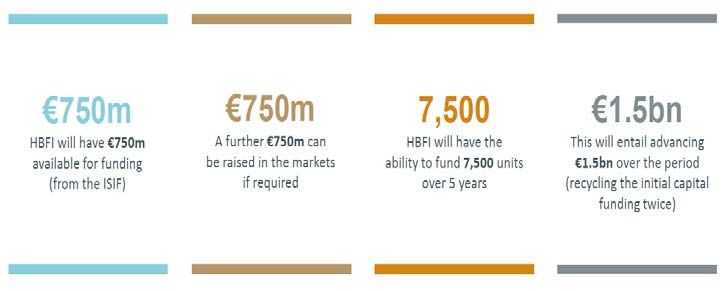
A Track Record of Delivery
         Introduction
   State Bank Investments
         NAMA / HBFI
        Credit Unions
             IBRC
      Financial Advisory

 A number of significant milestones have been achieved:
                       •    Recapitalisation, restructuring and deleveraging was undertaken across the sector
                       •    Elimination of promissory notes programme, ELA and liquidation of IBRC
                       •    Sale of Bank of Ireland CoCos (€1bn) and Preference Shares (€2bn)
      2010             •    State disposal of Irish Life for €1.3bn
       to              •    Establishment of NAMA
      2014             •    Troika programme commitments met and programme exited
                       • PTSB raised €525m of capital to address stress test shortfall, while the State retained a 75% stake
                       • AIB capital reorganisation returned €1.6bn to the State
      2015
                       • AIB CoCo redemption of €1.6bn
                       • IBRC paid first interim dividend of 25% to all admitted creditors
      2016
                       •    AIB resumed dividend repayment: €250m and Initial Public Offering (IPO) raised €3.4bn for the State (the second largest IPO globally in 2017)
                       •    Completion of ReBo activity: 82 mergers concluded, involving 156 individual credit unions with total assets in excess of €6.7bn
                       •    NAMA repaid 100% of its senior debt
      2017             •    IBRC paid second interim dividend of 25% to all admitted unsecured creditors

                       •    BOI announced the re‐commencement of dividends
                       •    Eligible Liability Guarantee (ELG) eliminated
                       •    PTSB completed the sale of Project Glas and Project Glenbeigh. This saw its NPL ratio reduce to 10%, from 26% at the start of the year
                       •    Launched an intra‐Departmental working group on virtual currencies & blockchain technology
      2018
                       •    IBRC paid final dividend of 50% to all admitted creditors
       018             •    Anglo Irish Bank assessor appointed pursuant to the Anglo Irish Bank Corporation Act 2009

                     Body
                     • HomeLevel        One Ireland (HBFI) officially launched in January 2019 to finance housing construction
                              Building Finance
                     • Hosted the first Government services blockchain hackathon in the Trinity Innovation Centre in January 2019
      2019           Body    Level
                     • Permanent   TSBTwo
                                        exited its restructuring plan

                           Body
                     • Ongoing        Level
                                efforts          Three
                                        to address   the numerous challenges posed by Covid‐19 to the Irish banking sector and the wider economy
                     • NAMA redeemed final debt and equity obligations and commenced return of surplus to the State ‐ first €2bn returned to Exchequer in
      2020
                       June 2020Body Level Four
                     • Final report of the Anglo Irish Bank Assessor published in April 2020
                                    Body Level
                     • Finance(Miscellaneous              Five
                                                Provisions) Act 2020 and Credit Union Restructuring Board (Dissolution) Act 2020 completed December 2020
                       • Bureau membership of OECD Committee on Financial Markets

4 An Roinn Airgeadais | Department of Finance
Section 1:   Introduction
Section 2:   State Bank Investments
Section 3:   NAMA / HBFI
Section 4:   Credit Unions
Section 5:   IBRC
Section 6:   Financial Advisory
Introduction
State Bank Investments
NAMA / HBFI
State Bank Investments:
Credit Unions
IBRC
Core objective is to return banks to private ownership
Financial Advisory
How we look at the State’s bank investments:
• Irish State still “owns”: c. 42% of the combined assets of AIB/BOI/PTSB (translates to 36% of assets of five retail banks)
• c. 50% of the combined market value of AIB/BOI/PTSB
1 2 3
Value For Taxpayers Monetise through sales & Rational Investor
income
Government policy is not to hold these Disposals since Summer 2017 hampered by State priority is to engage with the market
investments long term and, subject to numerous factors including poor markets. in a sensible, orderly and professional
market conditions, is willing to exit in a In times of depressed valuations, income manner
manner that generates value for the return in dividends and return of any
taxpayer excess capital becomes very important.
Multiple considerations to take into account:
Government authorisation
State Exit
Investor appetite and market conditions
Body Level One
Valuation
Body Level Two
Irish economy Body Level Three
Global economy
Body Level Four
Body Level Five
Financial performance
6 An Roinn Airgeadais | Department of FinanceIntroduction
State Bank Investments State Bank Investments
NAMA / HBFI
Credit Unions
IBRC
Overview – strong financial performance in recent years
Financial Advisory
pre-Covid-19
Commentary The State holds investments in three Irish banks:
2013 March 2021
The state has reduced its
ownership in all three banks 85% 29% 86% 25%
99.9% 99.9%
since 2013
75%
71%
In the years leading up to the
Covid19 pandemic we saw
strong capital generation to 15% 14%
support growth and payouts
while helping to withstand
% State % Privately
regulatory headwinds Owned Owned
Impact of Covid‐19 saw a
huge swing from profits in 2020 FY Highlights
2019 to significant losses in AIB recorded an underlying loss of BOI announced an underlying
PTSB recorded an underlying loss of
2020. However, the strong €716m for FY 2020, with a return to loss of €374m for 2020 versus a
€103m for 2020 versus a profit of
capital and liquidity positions a profit of €93m in H2. The FY result profit of €758m in 2019.
€74m in 2019. As with the other
going into the crisis positions was largely a result of the Covid19 Encouragingly, however, the
banks, this outturn was dominated
them to deal with the ECL charge of €1.46bn.
by the impact of Covid‐19 with PTSB bank returned to an underlying
challenges arising and to The bank successfully issued €625m profit in H2. The 2020 financial
booking an impairment charge of
support a recovering of AT1 in June 2020, highlighting performance was dominated by
economy. €155m.
the strong support that AIB has the impact of Covid‐19 which was
within credit markets with a nine Notwithstanding this, capital and reflected, in particular, in the
The impairment charge liquidity positions remained strong
booked by the Irish banks times oversubscribed order book. impairment charge of €1.1bn.
leaving the bank well positioned to
was significantly ahead of For FY 2020, the banks capital Notwithstanding this, capital and
support the recovering economy.
international peers reflecting position remained robust with a liquidity positions remained
the requirement to use reported fully loaded CET1 ratio at Although new lending was down strong with market confidence
Body Level One
historical data in the 15.6%, well in excess of minimum 15% y‐o‐y, H2 saw a strong recovery being demonstrated with the
impairment models and requirements. with mortgage drawdowns up 40% successful execution of an AT1
Body Level Two
Ireland’s more severe
experience during the last New lending of €9.2bn was down on the first half of the year. issuance of €675m in H1.
25% y‐o‐y. H2 recovered somewhat Management also commented on
crisis.
Body Level Three
and was 9% ahead of H1 (€4.4bn). the continued momentum into the In addition, H2 saw a significant
increase in new lending which
first two months of 2021.
Department as shareholder 66k (€4bn) of retail payment breaks
keen to see any surplus Body Level Fourgranted, 88% of
were originally Payment break experience has
was up c. 30% on the first half of
the year.
capital returned as soon as
possible. Bodywhich
Level
Covid
have returned to full pre
terms. Five
proven to be more favourable than
originally thought with 90% of Payment break experience has
customers not expected to require been positive with 97% of
further forbearance measures. expired breaks returning to pre‐
Covid terms.
7 An Roinn Airgeadais | Department of FinanceIntroduction
State Bank Investments
NAMA / HBFI
State Bank Investments
Credit Unions
IBRC
Transformational change in underlying financial metrics of State
bank investments between 2010 and 2020 even with Covid-19
Financial Advisory
Commentary State bank investments: change in selected metrics (2010 to 2020)
Transformational
change across all
three State bank AIB BOI PTSB
investments
between 2010 and
2020 Metric €bn/% Year 2020 €bn/% Year 2020 €bn/% Year 2020
Underlying
Although the three profit/(loss) before (€10.4bn) 2010 (€0.7bn) (€3.5bn) 2010 (€0.4bn) (€1bn) 2012 (€103m)
banks recorded tax
losses for FY2020
due to Covid19, in
the years preceding NIM 1.03% 2011 1.94% 1.25% 2012 2.00% 0.72% 2013 1.73%
the pandemic all
reported a strong
recovery in all New lending1 €7bn 2013 €9.2bn €6.6bn 2013 €13.3bn €0.1bn 2012 €1.4bn
covered metrics
including:
profitability, capital, NPL / €29bn/ €4.3bn/ €18bn/ 2013 €4.5bn/ €8.6bn/ €1.1bn/
2013 2013
new lending NPL Ratio2 35% 7.3% 18% (June) 5.7% 28% 7.6%
volumes, Loan to
Deposit Ratios, and Loan to deposit ratio 165% 2010 69% 175% 2010 86% 227% 2011 79%
non‐performing
loans
Monetary authority
€31bn 2011 Nil €33bn 2010 €1.9bn €19.5bn 2011 Nil
Body Level One
funding
Body Level Two
Fully loaded CET1 3
4.0% 2010 15.6% 6.3% 2013 13.4% 11.3% 2013 15.1%
Body Level Three
EU Restructuring
Entered 2011 Exited Entered 2010 Exited Entered 2015 Exited
Body
Plan
Level Four
Body Level Five
1.New lending ‐ BOI & AIB did not disclose pre‐2013. BOI H1 2020 includes €1.3bn of RCF
drawdown by Corporate customers.
2. 2018 values reflect the Non‐Performing Exposure (NPE) balance for AIB and BOI, and the
NPL Balance for PTSB
8 An Roinn Airgeadais | Department of Finance 3. .BOI 2013 excludes the preference shares.State bank investments: improved risk profile
Introduction
State Bank Investments
NAMA / HBFI
Credit Unions
IBRC
Financial Advisory
Commentary AIB Non-Performing Exposures (NPEs) Bank of Ireland Non-Performing Exposures (NPEs) Drivers
(€bn) (€bn) of Falling
37% 40%
Significant reduction €35.0
35% NPEs
in Non‐Performing €30.0 35% 11%
Exposures across all €10.0 12%
€30.7
three State Bank 26% 30%
€25.0 €9.4 10%
€26.2 €8.0 8%
Investments. c.86% 22% 25%
reduction in AIB and c. €20.0 8%
20% 6% Loan
16% €6.0 5.7%
87% for PTSB €15.0 €18.0 €6.5 Treatment
6%
between 2013 and 15% 4.3%
€14.1 10% €4.0 €5.0
2020. Bank of Ireland €10.0 7.3% 10%
€4.5 4%
€10.2 5.3%
meanwhile reduced €2.0
€3.5
€5.0 5% 2%
NPEs by c. 52% €6.1 €4.3
€3.3
between 2016 and €0.0 -86% 0% €0.0 -52%
0%
2020. 2013 2014 2015 2016 2017 2018 2019 2020 2016 2017 2018 2019 2020 Portfolio
A combination of BOI (NPEs) NPE Ratio % Sales
AIB (NPEs) NPE Ratio %
rising property prices,
a growing economy, Permanent TSB - Non-Performing Loans (NPLs) Combined 3 Banks Non-Performing Exposures
and measures taken (€bn)
(€bn)
by Irish banks to €35.0 20%
address non‐ €10.0 27% 30%
26% 17%
26% 26% 26% €29.3 18% Improved
performing loans have €9.0 €30.0 borrower
all contributed to the €8.0
25% 16% repayment
€8.6 €5.8 14%
decline in balances. €8.3
€25.0 capabilities
€7.0 14%
€22.0
Due to the impact of 20%
€6.0 €6.6 12%
the Covid19 pandemic €20.0
€9.4 €5.3
there was someBody Level
increase in NPEs
€5.0 One €5.8
€5.3
15%
€15.0
8% 10%
€4.0 10% €12.8 6.5% 8%
€6.5
across all the banks
Body Level €3.0
Two 6.7%
7.6% 10%
€10.0
€1.7
5.0%
€7.9
€9.9
6%
Improved
Collateral
€5.0 €1.1
€1.1
Body
€2.0 Level Three
5% €5.0
€14.1
€10.2 €3.5
€4.5 4%
€1.0 €1.7 €6.1 2%
Body
€0.0
Level Four-87% €1.1 €1.1
0% €0.0 -66%
€3.3 €4.3
0%
2013 2014 2015 2016 2017 2018 2019 2020 2016 2017 2018 2019 2020
NPE = NPL + eligible forborne loans + other
exposures
Body Level Five
NPL = Impaired + debtors deemed AIB (NPEs) BOI (NPEs)
unlikely to pay PTSB (NPL) NPE Ratio %
PTSB (NPL) NPE Ratio % (Implied)
9 An Roinn Airgeadais | Department of Finance 1. Company Accounts / Central Bank
of Ireland / DoF Analysis.State Bank Investments: capital, liquidity & funding (1/2)
Introduction
State Bank Investments
NAMA / HBFI
Credit Unions
IBRC
Financial Advisory
From too little funding to too much
Commentary Falling Loan to Deposit Ratios % (2012 – 2020)1 Household deleveraging (€bn)2
200%
€250 250%
Reduced loan to
191%
deposit ratios (LTDs)
€200 200%
across all three State 150%
bank investments as
151%
€150 150%
138%
households and
125%
123%
businesses deleverage. 100%
115%
114%
€100 100%
111%
110%
108%
106%
104%
Provides capacity for
100%
100%
100%
99%
97%
95%
95%
93%
93%
91%
90%
additional lending
86%
85%
€50 50%
79%
69%
A combination of 50%
falling household €0 0%
2003 Q2
2004 Q2
2005 Q2
2006 Q2
2007 Q2
2008 Q2
2009 Q2
2010 Q2
2011 Q2
2012 Q2
2013 Q2
2014 Q2
2015 Q2
2016 Q2
2017 Q2
2018 Q2
2019 Q2
2020 Q2
liabilities and
increasing asset values 0%
has led to aggregate 2012 2013 2014 2015 2016 2017 2018 2019 2020
AIB BOI PTSB Household Debt (€ billion) Debt to Disposable Income(%)
nominal household net
worth exceeding pre‐ Household Deposits
crisis levels Net Stable Funding Ratio % (2015 – 2020)1,3 Liquidity Coverage Ratio % (2015 – 2020)1,4
Quality of funding 180%
remains high, 300%
significantly exceeding 160%
160%
the Basel III net stable 140%
276%
250%
148%
funding ratio minimum
138%
138%
120%
131%
130%
requirements (100%)
129%
127%
125%
123%
122%
200%
120%
120%
119%
114%
Min. 100%
111%
193%
105%
150%
170%
80%
92%
Body Level One
166%
165%
160%
157%
153%
153%
138%
136%
136%
60%
132%
128%
128%
Min. 100%
Body Level
40% Two
116%
113%
108%
50%
Body
20% Level Three
0%
Body2015
Level2016
Four2017 2018 2019 2020
0%
2015 2016 2017 2018 2019 2020
Body Level
AIB Five BOI PTSB AIB BOI PTSB
1. Published financial accounts & Pillar III disclosures
2. Central Bank of Ireland: Quarterly Financial Accounts
3. Net Stable Funding Ratio (NSFR) seeks to calculate the proportion of long‐term assets which are funded by long‐term, stable funding. The NSFR limits
overreliance on short‐term wholesale funding. Soruce: Annual accounts & Pillar 3 Disclosures
10 An Roinn Airgeadais | Department of Finance 4. The LCR is calculated by dividing a bank's stock of high‐quality liquid assets by its total net cash outflows over a 30‐day stress periodState Bank Investments: capital, liquidity & funding (2/2)
Introduction
State Bank Investments
NAMA / HBFI
Credit Unions
IBRC Crisis impacted RWAs mean leverage ratios show true capitalisation
Financial Advisory
Commentary Core Equity Tier 1 Capital ratios % (2020)1,2 Total Regulatory Capital ratios % (2020)1,2
State bank 20.0% 30.0%
investments now well
18.9%
25.0%
18.1%
capitalised relative to
15.0%
23.9%
EU peers on a fully
15.6%
20.0%
15.1%
14.9%
loaded basis
21.0%
20.8%
19.2%
13.4%
18.2%
18.0%
RWAs partly 10.0%
15.0%
responsible for the
relatively high levels 10.0%
of capitalisation at 5.0%
Irish banks 5.0%
Recent research has 0.0%
shown that that risk 0.0% Total capital % (Transitional) Total capital % (Fully loaded)
weighted assets for CET1 (Transitional) CET1 (Fully loaded)
Irish residential AIB BoI PTSB AIB BoI PTSB
mortgages are c. 3x of
the European median
and amongst the
Core Equity Tier 1 Capital Ratios by Country Leverage Ratios by Country
highest in Europe.4 (Fully Loaded: Q3 2020)2,3 (Fully Loaded: Q3 2020)2,3
25% 10.00% Basel III Leverage Ratio Rule:
Leverage ratios offer
the best look through Tier 1 Capital
9.00% ≥ 3%
view on Irish capital 20%
Total Exposure
levels 8.00%
21%
7.00%
18%
18%
17%
17%
15% 6.00%
Body Level One
16%
15%
15%
15%
14%
14%
14%
5.00%
12%
Body Level
10% Two 12%
4.00%
3.00%
Body
5%
Level Three
2.00%
Body Level Four 1.00%
0% 0.00%
Body Level Five
LU DK IE NL BE GB DE FR EU AT IT PT GR ES IE GR PT AT BE LU IT EU ES FR GB DE NL DK
1. Published annual reports
2. “Transitional” refers to the transitional Basel III required for CET1 ratios which came into effect Jan‐14. “Fully loaded” refers to the actual Basel III basis for CET1 ratios.
11 An Roinn Airgeadais | Department of Finance 3. EBA Dashboard (Includes 3 domestic Irish banks plus Ulster Bank, DEPFA & Citibank)
4. “Risk Weighted Assets in Ireland” Department of Finance: https://assets.gov.ie/6836/664f5174ebd34f7e938aea654bed6757.pdf
BFFI: https://bpfi.ie/wp‐content/uploads/2021/02/Final‐BPFI‐RWA‐Report.pdfIntroduction
State Bank Investments State Bank Investments:
NAMA / HBFI
Credit Unions
IBRC
Expected value attributable to taxpayers
Financial Advisory
Reduction in bank valuations has impacted on €29.4bn investment (€bn)1,2,3,4: Value of State’s Shareholding (Mar 2021)
(€bn) €3.7bn
€0.6bn
€0.4bn
€35.0
€31.1 Total €4.7bn
€29.9
€30.0 €29.4bn State Investment €28.8
€27.2 €26.3
€25.5
€25.0 €23.1 €23.8
€23.2
€23.8bn market value of €10.6 €7.1 Market value of State
€6.0
State investments + €11.6 €3.7 holdings
€3.2
€20.0 realised cash €17.7 €13.9
(€4.7bn Un‐realised)
(as at Mar‐21)
€13.3
€14.3 €11.6
€15.0
€12.6 €12.6 €12.6 €12.6 €12.6
€10.0 €9.2 Cash Realised
€7.4 (€19.2bn)
€8.0
€5.0 €5.0
€7.7
€5.0 €0.5
€0.5 €5.4 €5.7 €6.0 €6.0 €6.3 €6.6 €6.6 €6.6
€4.2 €5.0
€2.8
€0.0 Body Level One
2009‐2011
2012
2013
2014
2015
2016
2017
2018
2019
2020
Mar‐21
Body Level Two
Body Level Three
Body Level Four
Fees and Income (accumulated) Disposals
Body Level Five (accumulated) AIB Valuation BOI Valuation PTSB Valuation
1. Disposals comprise sale/redemption of debt instruments, AIB and PTSB IPOs, and the sale of Irish Life.
2. Fees and income comprise interest coupons, recap fees, and CIFS/ELG fees.
12 An Roinn Airgeadais | Department of Finance 3. Bank valuations based on ISE closing prices, May‐20.
4. The result of AIB IPO reflected above does not include value of Government owned warrants.State Bank Investments
Introduction
State Bank Investments
NAMA / HBFI
Credit Unions
IBRC €3.4bn1 IPO of AIB
Financial Advisory
Key Offering Statistics Transaction Highlights
• Largest listing in EMEA and second largest worldwide in 2017. Largest IPO in the UK
Pricing Date 22‐Jun‐17 since Glencore in 20112
Official List of the Irish Stock Exchange (Primary • Second largest European Bank IPO since 20072
Listing Listing) and London Stock Exchange Main Market • More than 250 investors in the allocated order book
(Premium Listing) • Top 50 allocations accounted for c.75% of the order book
• Quality of allocation: more than 30% of the order book received zero allocation
Offer Price €4.40
Offer Size €3,433.7m (incl. greenshoe) Allocation Sovereign
Allocation Hedge Wealth
by fund type:
by geography: Funds
Residual Shareholding c.71.25% RoW Funds
31% UK 23% 12%
Retail Offer 10% of base offering 35% Long
Ireland Only
Implied Market Cap €11,943m
2% US Funds
Lock‐Up 180 days for Minister and AIB France 25% 66%
8%
AIB Valuation & Redemption (€bn)3 AIB State Aid Repayments (€bn)
(€bn) €20.75bn €20.7 (€bn)
€20.0 €12.0
€16.8
€17.7 €17.4 €10.1 €10.3 €10.6 €10.6
€16.6
€10.0
€15.0 €13.9 €10.1 €13.8 €14.3
€4.6 €6.4 €8.0
€12.1 €6.4
Body€2.0
Level One
€2.3
€10.6
€10.3
€6.0
€10.0 €4.6
€7.3 Body Level Two
€8.1
€10.6 €10.6
€4.0
€1.2 €1.7 €2.3
Body Level
€11.7 €12.3 €11.3 Three
€10.6 €1.7 €2.0
€5.0 €10 €2.0 €1.2
€0.6
€6.1 €6.4
Body Level Four €7.1 €6.0
€3.2 €3.7 €0.0
€0.2
€0.0
2011
Body Level Five
2012 2013 2014 2015 2016 2017 2018 2019 2020 Mar '21
2009 2010 2011 2012 2013 2014 2015 2016 2017 2018 2019 2020
ELG Fees Interest Payments
Valuation Cumulative Repayments State Aid Injected Capital Redemptions Dividends
1. No valuation ascribed to state warrants
13 An Roinn Airgeadais | Department of Finance 2. Bloomberg
3. Valuation as of March 2021Introduction
State Bank Investments
NAMA / HBFI
State Bank Investments:
Credit Unions
IBRC
Banks trading at a large discount to book value
Financial Advisory
Commentary % Change in Listed Share Prices (Jan 2018 – Mar 2021)1
120%
European bank shares
have been under 100%
pressure for quite a
while. However, they 80%
have rebounded strongly
since the lows of last year 60%
including those in 40%
Ireland.
The EuroStoxx Bank 20%
Index is trading at 0.7x 0%
book value (from a low of
02-Jan-18
02-Feb-18
02-Mar-18
02-Apr-18
02-May-18
02-Jun-18
02-Aug-19
02-Sep-19
02-Oct-19
02-Jul-18
02-Aug-18
02-Sep-18
02-Oct-18
02-Nov-18
02-Dec-18
02-Jan-19
02-Feb-19
02-Mar-19
02-Apr-19
02-May-19
02-Jun-19
02-Jul-19
02-Nov-19
02-Dec-19
02-Jan-20
02-Feb-20
02-Mar-20
02-Apr-20
02-May-20
02-Jun-20
02-Jul-20
02-Aug-20
02-Sep-20
02-Oct-20
02-Nov-20
02-Dec-20
02-Jan-21
02-Feb-21
02-Mar-21
0.4x in 2020) with the
Irish banks at 0.4x – 0.6x
(low of 0.2x in 2020).
The relative performance
of the Irish banks is due AIB BOI PTSB EuroStoxx Banks
to a variety of factors
including tough Price to Book Ratios (Jan 2018 – Mar 2021)2
regulatory capital (x)
requirements and an
1.20
inquiry relating to tracker
mortgages that resulted 1.00 P/B = 1.0x
in the banks incurring
related costs. 0.80
Body Level
0.60 One
0.40
Body Level Two
0.20
Body0.00Level Three
02-Jan-18
02-Feb-18
02-Mar-18
02-Apr-18
02-May-18
02-Jun-18
02-Apr-20
02-Jul-18
02-Aug-18
02-Sep-18
02-Oct-18
02-Nov-18
02-Dec-18
02-Jan-19
02-Feb-19
02-Mar-19
02-Apr-19
02-May-19
02-Jun-19
02-Jul-19
02-Aug-19
02-Sep-19
02-Oct-19
02-Nov-19
02-Dec-19
02-Jan-20
02-Feb-20
02-Mar-20
02-May-20
02-Jun-20
02-Jul-20
02-Aug-20
02-Sep-20
02-Oct-20
02-Nov-20
02-Dec-20
02-Jan-21
02-Feb-21
02-Mar-21
Body Level Four
Body Level Five
AIB BOI PTSB EuroStoxx Banks
14 An Roinn Airgeadais | Department of Finance 1. Source: Based to 100 as of January 2018. Bloomberg Mar‐2021
2. Bloomberg Mar 2021. The EuroStoxx Bank Index tracks the share price performance of the European banking sectorIrish Banking Sector Overview (1/2):
Introduction
State Bank Investments
NAMA / HBFI
Credit Unions
IBRC Ireland compares favourably against European peers…
Financial Advisory
Commentary % Reduction in NPE ratio: Q1 2016 – Q3 20201 Cost/income ratios Q3 2020 (%)1
IE 73% 90%
According to the EBA,
Irish banks reduced PT 72%
80%
their combined Non‐ AT 69%
78%
IT 68% 70%
Performing Exposure
73%
70%
DE
68%
ratio more than any 57% 60%
66%
65%
65%
65%
63%
61%
comparable country ES 52%
59%
59%
EU 50%
between March 2016 51%
52%
and September 2020 BE 48% 40%
41%
(‐73%). DK 47% 30%
GB 43%
Ongoing cost FR 42% 20%
management, and GR 38% 10%
strong net interest NL 28%
margins, helped Irish 0%
banks reduce cost to 0% 25% 50% 75% GR ES NL PT GB AT EU BE IE LU DK IT FR DE
income ratios to the
European average.
Net interest margins Q3 2020 (%)1 CET1 fully loaded Q3 2020 (%)1
Irish banking sector 3.00% 25%
well capitalised relative
to European peers.
2.50%
2.62%
20%
21%
18%
2.00%
18%
2.12%
17%
17%
Body Level One 15%
16%
15%
15%
15%
1.77%
1.76%
14%
14%
14%
1.50%
Body Level Two
1.56%
12%
1.46%
12%
10%
1.33%
1.31%
1.27%
Body
1.00% Level Three
1.13%
1.08%
0.99%
0.94%
Body Level Four
0.82%
5%
0.50%
Body Level Five
0.00% 0%
GR ES IE AT PT NL EU BE IT GB FR DE LU DK LU DK IE NL BE GB DE FR EU AT IT PT GR ES
15 An Roinn Airgeadais | Department of Finance Sources:
1. EBA Dashboard (Includes 3 domestic Irish banks plus Ulster Bank, DEPFA & Citibank)Introduction
State Bank Investments Irish Banking Sector Overview (2/2):
… returns on assets affected by early recognition of
NAMA / HBFI
Credit Unions
IBRC
Financial Advisory
Covid19 related impacts1
Commentary Return on Equity Q3 2020 (%)
8.00%
Early recognition of
Covid19 related losses 5.80%
resulting in higher ECL 6.00%
4.40% 4.30%
charge in 2020 for the 3.80% 3.60% 3.48%
Irish banks vs the 4.00% 3.10% 2.80% 2.50%
sector more generally
2.00% 1.44%
was a driver of lower 1.00%
ROEs.
0.00%
Higher net interest
LU AT FR IT BE DK NL GB EU DE PT GR ES IE
margins need to be
seen in the context of (2.00%)
the highest equity
requirements in (4.00%) (3.10%) (3.40%)
Western Europe (4.50%)
(6.00%)
RWAs at Irish banks
very high relative to
European averages. Return on Assets Q3 2020 (%)
As such, leverage is a 0.6%
useful barometer of
the true capital 0.39%
strength of the banks. 0.4% 0.37%
0.29% 0.27% 0.26%
0.18% 0.18% 0.17% 0.16%
0.2%
Body Level One 0.09% 0.08%
Body Level
0.0%
Two
LU AT IT FR BE DK NL GB EU PT DE ES GR IE
Body
(0.2%)Level Three
(0.20%)
Body Level Four
(0.4%) (0.32%)
Body Level Five
(0.6%) (0.54%)
16 An Roinn Airgeadais | Department of Finance Sources:
1. EBA Interactive DashboardIntroduction
State Bank Investments Irish Banking Sector 2021 Outlook:
… Banks are well positioned to support the recovery
NAMA / HBFI
Credit Unions
IBRC
Financial Advisory
The membership of the Banking & Payments Federation Ireland (BPFI) have delivered a range of
measures and supports in response to Covid -19.
Focus is on delivering fair,
practical and sustainable Customers Employees Communities
solutions for Mortgages, SME
and Personal loans… C22k payment breaks approved for
Over 7,000 of c. 9,500 staff are working 99% of branch network kept open all through
mortgage customers, equating to c. €3bn,
remotely using remote, secure controlled the pandemic to serve the community
89% now returned to regular repayments.
services. This has been achieved with
Partnered with Trinity College Dublin by
66k payment breaks granted in Retail minimal operational disruption.
pledging €2.4 million to the dedicated AIB
Banking– for both mortgage and SME
Implemented multiple‐location Treasury COVID‐19 Research Laboratories Hub at the
customers totalling €4.3bn. As of end FY
teams as a contingency to ensure the University to accelerate the college's
2020 88% had rolled off returning to capital
smooth operation of payments and money immunology project to tackle Covid19
and interest repayments
transmission systems
Making up to €2 million available to
To protect customer credit profile, as agreed
community investment partners Food‐Cloud
with the Central Bank of Ireland, payment
and Soar, as well as a number of local
breaks are not adversely reported on Central
charities that provide critical services
Credit Register
Of the c. 100k payment breaks originally 70% staff working from home; prior rollout Temporarily closed smaller branches
granted across the bank’s Irish and UK of Agile working supported increased reflecting reduced footfall; enabling staff to
businesses, 94% have now rolled off. capacity and ways of working be reallocated to services most in demand,
and to support social distancing
In terms of value, Irish payment breaks had Staff supports include mental and physical
reduced from 18% to 5% with the UK wellbeing app, 24/7 health support line, Donated €1 million in emergency funding for
reducing from 15% to 3%. and COVID‐19 communications hub communities with urgent needs, with 13
projects fast‐tracked
The bank highlighted that the significant Supports in place for staff required to
Body Level One
majority who had come off payment provide childcare or family support ‘Cocooning’ support for older customers and
breaks had resumed paying principal and those in vulnerable situations – to access
Body Level Two
interest. cash
Body
TheLevel Three
bank originally granted 10.7k payment
breaks for mortgage customers, 90% of which
Operationally resilient with over 1,200 All 76 branches remain open to meet
colleagues working remotely. customer needs
Body Level
had rolled off by FY.Four
In value terms, mortgage
payment breaks had reduced from 10% of the Priority banking in branch and over the
portfolio to 1%. phone for our elderly and vulnerable
Body Level Five customers
The bank commented that the majority of
customers coming off payment breaks had
resumed principal and interest payment.
17 An Roinn Airgeadais | Department of FinanceSection 1: Introduction Section 2: State Bank Investments Section 3: NAMA / HBFI Section 4: Credit Unions Section 5: IBRC Section 6: Financial Advisory
Introduction
State Bank Investments
NAMA / HBFI
NAMA Objectives & Residential Delivery
Credit Unions
IBRC
Financial Advisory
Objective Achievements to date
1
Repay 100% senior debt by year end 2017 Senior and subordinated debt fully repaid
and all sub‐debt by March 2020 and first €2bn of surplus returned in June NAMA seeks to
2020 make a positive
social and economic
Facilitate delivery of key Grade A office All of the sites NAMA originally had an
2 contribution across
space in the Dublin Docklands Strategic interest in are either completed, under the broad range of
Development Zones (SDZ) construction, received planning, or have been its activities, subject
sold with planning permission to the primacy of its
commercial
Facilitate delivery of up to 20,000 residential From 2014 to end 2020, NAMA has directly
3 mandate and often
units by end 2020 funded or facilitated the construction of
complementing it.
12,450 new residential units in Ireland. In
excess of 2,500 homes have been delivered
for social housing use by NAMA
NAMA – Residential Delivery
The number of housing units delivered directly by NAMA’s residential delivery programme since 2014 totalled 12,450 by end 2020. A
further 6,550 units have been delivered on former NAMA‐secured sites which benefitted from NAMA asset management and/or
funding.
Therefore, a total of 19,000 homes have been delivered or facilitated nationwide through NAMA funding.
NAMA’s currentBody Level
residential One
pipeline is in excess of 20,000 additional units comprising:
Body Levelunits
6,400 construction‐ready Two
(under construction or with planning permission)
7,800 units currently
Body Level
in the planningThree
system (applications lodged or being prepared)
8,400 units in the pre‐planning and feasibility stage, or with long term potential.
Body Level Four
NAMA has delivered 2,614 residential units from its secured portfolio to local authorities or approved housing bodies for social
Body Level Five
housing purposes across Ireland.
19 An Roinn Airgeadais | Department of Finance 1. https://www.gov.ie/en/publication/41970e-nama-section-227-review-2014-2018/Introduction
State Bank Investments
NAMA / HBFI
NAMA’s Phased Disposal Strategies
Credit Unions
IBRC
Financial Advisory
NAMA: Timeline of Events
2010 ‐ 2013 2014 2015/2016 2017/2018 2019/2020
• Strategic focus on UK • Improving market • In 2015, two‐thirds of • Few large portfolio • Publication of Section
disposals during 2010 conditions, increased disposals were in sales remain in 227 Review in 2019
– 2013. UK market had institutional investor Ireland ‐ strong pipeline outlining NAMA’s
remained appetite ‐ NAMA took domestic and • End‐2017 carrying wind‐down strategy
comparatively buoyant strategic decision to international investor
value of NAMA’s loan • Redemption of €1.1bn
steadily increase the appetite
• 73% UK sales: London portfolio was €3.7bn – remaining sub‐debt in
volume of available
assets accounted for • Total NAMA sales down to €2.4bn by end March 2020
supply from 2013
60% of total NAMA proceeds: €8.5bn in of September 2018
onwards • Repayment of private
sales proceeds, rest of 2015 ‐ increase of
• Majority of portfolio investors and delivery
Britain ‐ 13% • Step change seen in €0.7bn on 2014
relates to residential of €4bn surplus
• Irish assets, by total NAMA sales • 2016 total NAMA sales delivery and Dublin
proceeds: €7.8bn in • The first €2bn of
contrast, accounted for proceeds of €5.1bn ‐ Docklands SDZ
2014 ‐ increase of expected €4bn surplus
just 16% of total sales 64% or €3.3bn programmes –
€4.1bn on 2013 transferred to the
proceeds in the same generated from the increased focus from Exchequer in June
period • Of the €7.8bn, 44% or sale of Irish assets 2017 onwards 2020.
€3.7bn generated from
• By end‐2012 Body
NAMALevel One
the sale of Irish
• Cumulative Irish sales • Increased its projected • Further €1bn to
had sold less than at €14.4bn at YE 2016 lifetime surplus to transfer in 2021
Body properties
€1bn in Ireland – a Level Two €3.5bn
deliberate action
Body Level Three
Body Level Four
Body Level Five
20 An Roinn Airgeadais | Department of FinanceIntroduction
State Bank Investments
NAMA / HBFI
NAMA:
Credit Unions
IBRC Surplus Generation
Financial Advisory
NAMA Funding Structure 2015 – September 2020 (€bn)1: Commentary
(€bn) NAMA held just over €2.4bn of retained
earnings attributable to shareholders at end of
€11.6
Sept 2020.
€12.0 €0.1
This follows the transfer of the first €2bn of
€1.6
surplus to the Exchequer in June.
€10.0
€1.6 Final debt redeemed (€1.1bn) in March 2020
€8.0 €0.3 and private investors repaid in June 2020.
€8.1
It is currently estimated that the residual cash
€6.0 surplus of €1.7bn (excluding NARPS) will be
c.€2.4bn (as at end‐
Sept 2020) of retained
paid to the Exchequer during 2021 and 2022
earnings attributable with €1 billion to be returned this year.
€4.0 €8.1 €0.2
to shareholder
It is likely that COVID‐19 will have some impact
€1.6 on the timing and amount of forecasted
€2.0 €0.8
payments beyond 2020 however NAMA
€2.4 forecasts that it will deliver a total surplus of €4
€2.00
€0.0 Body Level One billion to the Exchequer subject to market
2015 Decrease in Suboardinated Increase in Surplus Repaid
Senior Bond Jun-20 conditions.
Body Level
Redemption
Two
other liabilities Debt
Redemption
Retained
Earnings
Body Level Three
Government Guaranteed Senior Bonds Other Liabilities €2 billion of surplus
Subordinated Bonds Retained Earnings funds repaid in June
Non-Controlling Interests Body Level Four 2020
Body Level Five
Source:
1. NAMA Q2 Report 2020
21 An Roinn Airgeadais | Department of FinanceIntroduction
State Bank Investments
NAMA / HBFI
Home Building Finance Ireland (‘HBFI’)
Credit Unions
IBRC
Financial Advisory
Overview
Home Building Finance Ireland (“HBFI”) was announced as part of Budget 2018 to increase the availability of debt funding to commercially viable
residential development projects in the State.
HBFI has been established to provide senior debt funding on a commercial basis to small and medium size residential development projects (circa
€2m to €35m) throughout the Irish State.
The Home Building Finance Ireland Act was commenced on 5 December 2018 and HBFI was formally launched in January 2019. HBFI has an
independent board and is wholly owned by the Minister for Finance.
In May 2020, in response to COVID‐19, HBFI launched a series of new measures to extend its presence throughout the housebuilding finance
market to support the resumption of construction activity.
Further information in relation to HBFI and its application process can be found at https://www.hbfi.ie.
HBFI Funding Latest Update
To end 2020, HBFI has approved lending facilities worth
€395 million which can facilitate the construction of over
1,800 new homes across 17 counties.
The average facility size to date is €12m
During 2020 HBFI announced the following new
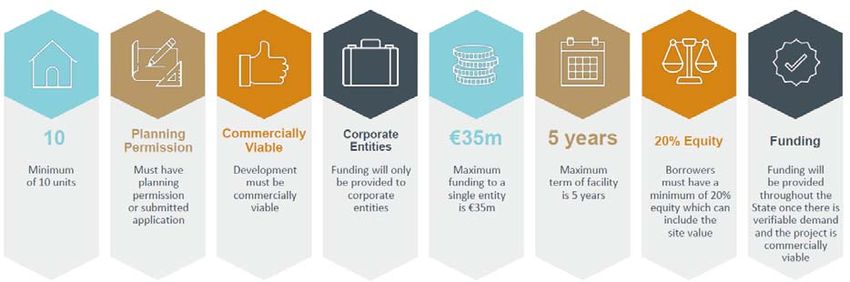
products;
HBFI Indicative Lending Criteria Provide new “step‐in” funding for house builders where
funding from banks may not be available to enable them to
Body Level One commence new housing developments
Body Level Two Allow a bigger range of housebuilders (both large and small)
to access HBFI’s €750m funding
Body Level Three Fund major apartment developments for the first time
Body Level Four EIF supported small development product with 50% guarantee
broadening the scope and availability of this product
Body Level Five
Social Housing Product with reduced fees specifically for
housing developments being delivered to AHBs and Local
Authorities
22 An Roinn Airgeadais | Department of FinanceSection 1: Introduction Section 2: State Bank Investments Section 3: NAMA / HBFI Section 4: Credit Unions Section 5: IBRC Section 6: Financial Advisory
Introduction
State Bank Investments
NAMA / HBFI
Credit Union stakeholders
Credit Unions
IBRC
Financial Advisory
Key Stakeholders Sector Overview1
Members Credit Unions 228 registered credit unions in the Republic of Ireland serve the needs of 3.4
million members 1
The role of Minister for Finance is to ensure that the legal framework for credit
unions is appropriate.
The Registrar of Credit Unions at the Central Bank of Ireland is the independent
Minister For regulator for credit unions in Ireland.
Registrar of The main representative bodies are:
Finance Credit Unions ILCU (creditunion.ie) ‐ > 300 credit union's affiliated to League in the
Republic of Ireland and Northern Ireland.
CUDA (cuda.ie) – represents 16 credit unions and also provides affinity
membership for 29 additional credit unions.
Irish League of
ILCU
Credit Unions
Average Savings
CUMA (cuma.ie) – represents credit union managers in Ireland.
Average New Loan
NSF (nsf.ie) ‐ supports board oversight committees in the Republic of
€3,400
Ireland and supervisory committees in Northern Ireland.
CUAC is a statutory body providing advice to the Minister for Finance on credit
union matters.
Recent Actions
CUAC published a report in February 2020 which examined the role of the
Body Level One Director and set out a number of recommendations for consideration. It also
issued a Review of the Credit Union Sector to the Minister in 2020.
CUACBody Level Two The Central Bank published revised lending regulations applicable from 1 January
CREDIT UNION ADVISORY 2020 and technical changes to investment regulations applicable from 1 January
COMMITTEEBody Level Three 2021.
Body Level Four Credit unions were designated as an ‘essential service’ under the Government
issued public health guidelines in response to COVID‐19. Legislation was enacted
Body Level Five to allow credit unions to convene virtual AGMs.
Work has commenced on a review of the policy framework for credit unions, a
Programme for Government commitment.
Source:
24 An Roinn Airgeadais | Department of Finance 1. As of September 2020 (Central Bank – Financial Conditions Report)Introduction
State Bank Investments
NAMA / HBFI
Credit Unions: background
Credit Unions
IBRC
Financial Advisory
The Sector in Numbers
Total assets have grown from €14bn in 2011 to €19.4bn as at 2020. 62 credit unions with over €100 million in assets control 64% of sector assets (having risen
from 41% of sector assets in 2015).
Despite the pandemic, loan balances were effectively flat, from €5.11bn in 2019 to €5.09bn in 2020. Loan To Asset (LTA) ratio fell from 28% to 26%, primarily as a
result of continuing growth in member savings, exacerbated by the pandemic
Reserves averaged 15.9% in 2020, falling from 16.5% in September 2019
The average sector return on assets has fallen from 1.4% in 2015 to 0.4% in 2020 primarily due to falling investment yields and rising overheads
%
€18 0.6
€16
€16 €15
€15
€14 0.5
€14 €13
€13 €13 €12 €13 €12 €13
€12 €12 €12 €12
€12 0.4
€10
0.3
€8 €7 €7
€7 €7
€6
€6 €5.1 €5.1
€6 €5 €4.8 0.2
€4 €4.1 €4.5
€4.0 €3.9
€4
Body Level One 0.1
€2
Body Level Two
€0 0
2006 Body2008
2007 Level2009
Three2010 2011 2012 2013 2014 2015 2016 2017 2018 2019 2020
Body LevelLoans
Savings (€bn) Four(€bn) Reg Cap (%) Arrears (%) Loans to Total Assets (%)
Bodyof Level
These figures include the impact COVID‐19Five
up to September 2020 only. It impacted the majority of credit unions through increased arrears,
reduced/flat lending, rising savings and increased overheads and will continue to impact through the the year to September 2021.
25 An Roinn Airgeadais | Department of FinanceSection 1: Introduction Section 2: State Bank Investments Section 3: NAMA / HBFI Section 4: Credit Unions Section 5: IBRC Section 6: Financial Advisory
Introduction
  State Bank Investments
        NAMA / HBFI        IBRC: Overview
       Credit Unions
            IBRC
     Financial Advisory

 Overview
  Established:              •   July 2011 following the merger of Anglo Irish Bank and Irish Nationwide Building Society
  Purpose:                  •   To manage the orderly wind down of the merged entity
  Government Support:       •   Total invested in IBRC (Dec‐2010): €34.7bn
  Progress to date:         •   IBRC was placed in special liquidation in February 2013
                            •   Loans with a par value of €21.7bn have been prepared, brought to the market and sold
                            •   Liquidation generated €17.1bn of cash inflows to date
                            •   All admitted unsecured creditors have been paid 100% of the principal that was owed to them at the date of liquidation.

  IBRC: Timeline of Events
                  2009                  2010                    2011                     2013                 2014/2015               2016‐2020
   •Following             •€30.6bn additional •Majority of           •Following           •Liquidation        •All admitted
    consultation with      capital injections in deposits held in     discussions          generated €16.5bn unsecured
    Central Bank and       the form of           Anglo Irish Bank     between Irish        of cash inflows to  creditors and
    Department of          promissory notes      and INBS are         Authorities and the date                 subordinated
    Finance, the ‘Anglo •Brings total            merged to form       ECB, the IBRC       •Allows for payment creditors have
    Irish Bank             invested to           Irish Bank           promissory notes     of €14.7bn to       been paid 100% of
    Corporation Act        €34.7bn across        Resolution           are exchanged  for   IBRC’s creditors,   what they were
    2009’ was passed       Anglo and INBS        Corporation  (IBRC)  long‐term            including full      owed at the date of
    to take Anglo Irish                                               government bond      repayment of        the liquidation.
    Bank into public                                                 •Improves Ireland’s €12.9bn of debt      •The State has
    ownership Body Level One                                          debt profile and     owed to NAMA        received the full
   •€4bn in ordinary                                                  decreases near                           amount owed as
                Body
    shares invested  in Level Two                                     team borrowing                           the owner of the
    Anglo Irish Bank Body Level Three                                 requirements                             Preference Shares.
    and €100m in Irish                                               •IBRC placed into                        •Assessor appointed
    Nationwide (INBS)       Body Level Four                           liquidation                              pursuant to the
                                                                                                               Anglo Irish Bank
                                Body Level Five                                                                Corporation Act
                                                                                                               2009 with his final
                                                                                                               report published in
27 An Roinn Airgeadais | Department of Finance                                                                 April 2020.
Introduction
State Bank Investments IBRC Progress Update Report
NAMA / HBFI
Credit Unions
IBRC
Financial Advisory
Sales Processes
• The IBRC loan portfolio was supported by collateral based in 22 different
Sales process by numbers jurisdictions worldwide
€21,700,000,000
• Strong interest from a variety of financial and strategic buyers and funders,
with US private equity houses and hedge funds being key participants across
each of the portfolios.
OF LOANS PREPARED AND BROUGHT TO MARKET
Project Evergreen
LOANS CONSISTED OF OVER
Project Pebble Project Sand/Pearl Irish originated Corporate
64
US CRE, UK hotels and UK Irish originated Residential Loans
15,900
& Ireland Shopping Centres Mortgages ■ Ireland (93%)
■ Ireland/UK (84%) ■ Ireland (100%) ■ UK (7%)
■ US (15%)
LOAN SALES PROCESSES CONDUCTED DIFFERENT BORROWER GROUPS ■ World: other (1%) Project Salt
UK originated CRE Loans
■ Germany (60%)
■ UK (30%)
22 >130,000 355 ■ Poland (7%)
■ Europe: other (3%)
Collateral was based LETTERS ISSUED TO BORROWERS INTERESTED PARTIES Project Amber /
in 22 different jurisdictions AND GUARANTORS ACROSS 13
COUNTRIES Amethyst Project Stone
Corporate and CRE loans Irish originated CRE Loans
174 755,000 ■ UK (78%) ■ Ireland (46%)
■ Ireland (22%) ■ United Kingdom (33%)
■ Continental Europe (18%)
Project Quartz
Project Rock ■ Other (3%)
DOCUMENTS WERE REVIEWED AND Irish originated CRE loans
NON DISCLOSURE AGREEMENTS (“NDAS”)
UPLOADED TO VIRTUAL DATA ROOMS UK originated Commercial ■ Ireland (97%)
SIGNED WITH INTERESTED PARTIES
(“VDRS”) Real Estate (“CRE”) Loans
■ UK (1%)
Body Level One ■ UK (89%)
■ Other (2%)
3,500
■ US (7%)
Body Level Two 241
100%
OF THE LOAN BOOK
■ Germany (3%)
■ Europe: Other (1%)
PROPERTY VALUATIONS INDIVIDUAL BIDS WERE RECEIVED
WERE OBTAINED Body Level Three
ACROSS 6 PORTFOLIOS TRANSACTED
Body Level Four
Body Level Five
Source:
28 An Roinn Airgeadais | Department of Finance 1. IBRC Progress Update ReportIntroduction
State Bank Investments
NAMA / HBFI
IBRC Liquidation Update
Credit Unions
IBRC
Financial Advisory
Liquidation update
The most recent special liquidation progress update report was published in June 2020 giving a
Recent
Developments
comprehensive overview of the work completed to date. It is available on the Department of Finance
website www.finance.gov.ie.
Asset realization workstream largely complete. At this stage, loans with a par value of €21.7bn have
been prepared, brought to the market and sold
All admitted unsecured creditors and subordinated creditors have been paid 100% of what they were
owed at the date of the liquidation. This has involved the review and adjudication of more than 3,000
individual creditor claims.
The State has received the full amount owed as unsecured creditor and owner of the Preference Shares
along with associated interest payments (total of €1.6 billion to date). Further funds are due to return
to the Exchequer as remaining assets are sold .
In 2018, an assessor was appointed pursuant to the Anglo Irish Bank Corporation Act 2009 to determine
the fair and reasonable aggregate value of the transferred shares and extinguished rights and the
consequent amount of compensation (if any) that may be payable to the previous shareholders. The
final report of the assessor was published on the Department of Finance website in April 2020 which
concludes that no compensation is payable to former shareholders of any class or to former rights
holders.
As a result of Covid‐19, the expected timeline for completion of the liquidation has been extended to
end‐2022 (from end‐2021) which allows for delays in court proceedings and asses realization strategies.
Ongoing
Body
Level One
Continued management and resolution of c. 40 legal cases
Tasks Body
Level Two
Completion of the creditor adjudication process
Body
Management
LevelofThree
the remaining loan book of c. €3.4bn
Realisation of all remaining assets
Body Level Four
Body Level Five
29 An Roinn Airgeadais | Department of FinanceSection 1: Introduction Section 2: State Bank Investments Section 3: NAMA / HBFI Section 4: Credit Unions Section 5: IBRC Section 6: Financial Advisory
Introduction
State Bank Investments
NAMA / HBFI
Financial Advisory
Credit Unions
IBRC
Analysis, insight and building connections
Financial Advisory
Financial Advisory
Key objectives
Objective Insight Building
Analysis Connections
About The Financial Advisory team provides insight and analysis into emerging technologies and financial
services, while helping to build connections between academia, public bodies, and private institutions
Blockchain & Coordinate and manage the technical expertise re Blockchain and Crypto‐Assets by
Crypto‐Assets leading on briefings and providing technical support to other divisions.
Ireland: Regular engagement with ecosystem via the ‘Blockchain Ireland’ initiative
EU: Leading the EU Commission Market in Crypto Assets Regulation proposal
negotiations
GLOBAL:
Body Level ‐OneOECD: member of the Committee for Financial Markets; member of the Ad
Hoc Experts Group on Digital Finance
Body Level Two
‐ WEF: member of the Digital Currency Governance Consortium
Ongoing engagement via participation in webinars, roundtables and conferences
Body Level Three
Analysis & Body Level
Continuous Four
research into developments in the financial services sector and nascent technologies.
Insight Examples: Decentralised Finance; Crypto assets travel rule vis a vis tax requirements; application of
Body Level Five
stablecoins to cross border cash disbursements
31 An Roinn Airgeadais | Department of FinanceContacts
Head of Shareholding and Financial Advisory Division
Des Carville
Email: des.carville@finance.gov.ie
Phone: +353 1 604 5326
Shareholding and Financial Advisory Division Contacts
AIB, BOI & PTSB Credit Unions
Scott Rankin (Deputy Head) Brian Corr
Email: scott.rankin@finance.gov.ie Email: brian.corr@finance.gov.ie
Phone: +353 1 604 5469 Phone: +353 1 604 5064
Financial Advisory NAMA, IBRC & HBFI
Mai Santamaria Gary Hynds
Email: mai.santamaria@finance.gov.ie Email: gary.hynds@finance.gov.ie
Phone: +353 761007728 Phone: +35316045308
Department of Finance Press Office
Aidan Murphy
Email: pressoffice@finance.gov.ie
Phone: +353 1 604 5531
32 An Roinn Airgeadais | Department of Financewww.gov.ie
You can also read


