Shinzo Abe and Japan's Strategic Reset - The Rise of the Kantei and Why It Matters to the UK Integrated Review Dr Alessio Patalano Foreword by Rt ...
←
→
Page content transcription
If your browser does not render page correctly, please read the page content below
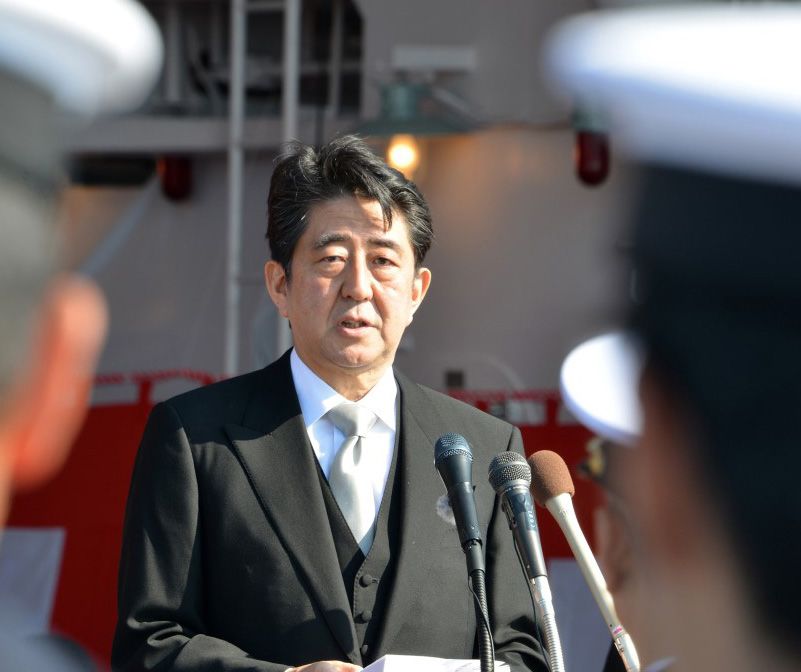
Shinzo Abe and
Japan’s Strategic
Reset
The Rise of the Kantei and Why It Matters to
the UK Integrated Review
Dr Alessio Patalano
Foreword by Rt Hon Jeremy Hunt MP
Introduction by Nobukatsu Kanehara
Photo Credit: Courtesy of Japan Ministry of Defence
Shinzo Abe and Japan’s
Strategic Reset
The Rise of the Kantei and Why It Matters to
the UK Integrated Review
Dr Alessio Patalano
Foreword by Rt Hon Jeremy Hunt MP
Introduction by Nobukatsu Kanehara

Policy Exchange is the UK’s leading think tank. We are an independent, non-partisan educational charity whose mission is to develop
and promote new policy ideas that will deliver better public services, a stronger society and a more dynamic economy.

Policy Exchange is committed to an evidence-based approach to policy development and retains copyright and full editorial control
over all its written research. We work in partnership with academics and other experts and commission major studies involving
thorough empirical research of alternative policy outcomes. We believe that the policy experience of other countries offers important
lessons for government in the UK. We also believe that government has much to learn from business and the voluntary sector.

Registered charity no: 1096300.

Trustees
Diana Berry, Alexander Downer, Pamela Dow, Andrew Feldman, David Harding, Patricia Hodgson, Greta Jones, Edward Lee, Charlotte
Metcalf, David Ord, Roger Orf, Andrew Roberts, George Robinson, Robert Rosenkranz, William Salomon, Peter Wall, Simon Wolfson,
Nigel Wright.
Shinzo Abe and Japan’s Strategic Reset

                                 About the Author

                                 Dr Alessio Patalano is a Senior Fellow of the Britain in the World
                                 Programme, Policy Exchange, and Reader in East Asian Warfare & Security
                                 at the Department of War Studies, King’s College London (KCL). At KCL,
                                 he is the Director of the King’s Japan Programme, specialising in Japanese
                                 military history and strategy, defence issues in East Asia, and maritime
                                 security issues in the East and South China Seas.

2   |   policyexchange.org.uk
© Policy Exchange 2020
Published by
Policy Exchange, 8 – 10 Great George Street, Westminster, London SW1P 3AE
www.policyexchange.org.uk
ISBN: 978-1-913459-38-3
policyexchange.org.uk | 3Shinzo Abe and Japan’s Strategic Reset
Contents
About the Author 2
Foreword: The Invisible Chain Linking the World’s Democracies 5
Introduction: Reflecting on the ‘Abe Years’ 7
Overview: Man on a Mission 9
Step 1 – Centralising Power: Abe’s Kantei 9
Step 2 – Expanding the Politically Possible:
The National Security Council 11
Step 3- The Making of a Worldview: The Free and Open Indo-Pacific
Initiative 13
Conclusions: The ideologue mugged by reality? 15
4 | policyexchange.org.ukForeword: The Invisible Chain
Linking the World’s Democracies
By Rt Hon Jeremy Hunt MP
Britain stands today more than at any other time in recent memory at a
crossroads. As the country continues the process to complete its exit from
the European Union, it has also embarked on the crafting of a new role in
international affairs. The links the UK forges over the coming months will
offer an important indication of the country’s future trajectory.
It is perhaps no coincidence that very recently Britain signed its very
first post-Brexit trade agreement with Japan. As two seafaring nations with
export-oriented economies, with deep historical, cultural, and economic
ties, Britain and Japan stand united by the sea that delivers growth and
prosperity in the contemporary world. As two mature democracies with
clear stakes in the stability of the international order, Britain and Japan are
also close defence and security partners. Both countries invest in bilateral
and multilateral diplomacy to ensure that value-informed foreign policy
agendas drive the development of international relations.
I visited Japan for the first time in 1990 to learn the Japanese language.
For the following two years I travelled across this welcoming country,
experienced the hospitality of its people, and discovered its rich culture.
The value of this experience informed my work as Foreign Secretary in
more recent times, becoming in 2018 the first UK Minister to deliver
remarks in Japanese. During my tenure as a Foreign Secretary, I had the
opportunity to work closely with my Japanese counterparts, building
on solid foundations to advance a bilateral ‘strategic partnership’, which
included greater cooperation on information sharing, and a hotline
between our two governments.
Shinzo Abe’s signature foreign policy vision for a ‘Free and Open Indo-
Pacific’, or FOIP, always struck me as the embodiment of what Britain
and Japan stand for: free trade, democratic societies, the rule of law, and
respect for human rights. This is why as a Foreign Secretary I supported
Japan’s initiative, and the work that the Royal Navy has done together
with Japan and our other allies to give substance and depth to Britain’s
commitment to a stable regional order. During my tenure, I observed how
the vision promoted by FOIP enabled Abe’s Japan to regain a central place
in international affairs. Crucially, it propelled the country’s convening
power in new multilateral organisations, from Trans-Pacific Partnership,
to the Quadrilateral Initiative. Through FOIP, Japan was acting as an
‘invisible chain’ linking open and liberal societies – a role I have argued
for Britain as a Foreign Secretary.
policyexchange.org.uk | 5Shinzo Abe and Japan’s Strategic Reset
This is also why I was very pleased to read Dr Patalano’s thought-
provoking paper. Among the many essays reviewing Prime Minister Abe’s
legacy, this is the first to reflect upon why Shinzo Abe’s legacy matters to
Britain. In this respect, this is a refreshing and timely essay which should
be read widely across Whitehall. It reminds us of the aim of any integrated
review to promote structural reforms to enhance government action and
to increase synergies among departments. The establishment of Japan’s
National Security Council achieved just that. It similarly highlights the
crucial role that a specific worldview has in propelling structural reforms
into inspired policies. Prime Minister Abe’s Free and Open Indo-Pacific
initiative sought to offer such a worldview. In so doing, it offered Japanese
foreign policy action what I would hope the integrated review will offer
Britain: a strong statement about what world order is about and, through
that, a powerful tool to exercise influence and define the country’s role
in it.
6 | policyexchange.org.ukIntroduction: Reflecting on the
‘Abe Years’
Nobukatsu Kanehara
Professor of Law, Doshisha University
Deputy Chief Cabinet Secretary to Prime Minister Shinzo Abe from 2012 to 2019, and
Deputy Secretary-General of the National Security Secretariat from 2013 to 2019
Dr Alessio Patalano, Associate Professor at the Department of War Studies,
Kings’ College London, has written a succinct and excellent review of the
achievements by Mr. Shinzo Abe, Prime Minister of Japan (2012-2020).
Mr. Abe was the first leader representing the aspirations of the post-
Cold War generation of Japanese people. Many Japanese wanted a leader
who could make Japan proud again – not in a revisionist way – but as a
leader of the emerging liberal international order in Asia. His appearance
was long overdue.
In Europe, with events like Brexit, as well as in the United States, with
slogans such as “America First”, unilateralism seems to be undermining
the foundations of the international liberal order. But in Asia, we are still
in a phase of “creation” of such an order. Since the 1980s, many Asian
nations have started to become more prosperous, to be fully industrialised,
and then a wave of democratization followed suit. In 1986, the Philippines
tore down dictatorship and opted for democracy; in 1987, the Republic
of Korea turned into a democracy too. Many ASEAN nations followed that
pathway. In turn, Taiwan became a democracy under the strong leadership
of the president Lee Donghui.
Prime Minister Abe understood this new trend in Asia and sought to
lead the region by offering a worldview that could secure and promote
this emerging new trend.
First, from a security perspective, he secured the commitment of the
United States as an anchor of the regional stability. He similarly continued
to consolidate friendships with Europe – including with key organisations
like the European Union and NATO, Australia and ASEAN nations. He
reached out to India with a clear understanding of its strategic weight in
the future.
Second, from a prosperity perspective, he took a leading role to lay
down the core work to establish unprecedented Mega Free Trade zones,
by promoting the adoption of the Trans-Pacific Partnership Agreement
after US unilateral withdrawal and the Japan-EU Economic Partnership
Agreement. The purpose was to enhance regional and global economic
integration through market force.
Today, to achieve the promise of a liberal order in Asia, the biggest
policyexchange.org.uk | 7Shinzo Abe and Japan’s Strategic Reset
challenge is posed by China. China is rapidly rising on the back of an
increasing authoritarian “tilt”. China seems to be breaking away from the
liberal order that the West helped to create.
Can the liberal powers committed to the stability of the international
order still engage China? The answer is “yes,” only if they stand united.
These like-minded actors – sharing a belief in the importance of open
societies and liberal economies – should not include only Japan, the
United States and Europe but also new dynamic democratic realities in
Asia, from Australia to India.
The international order that Prime Minister Abe endeavoured to
nurture and protect is in desperate need of strong leadership to remain
united. It is not a type of leadership that can rely on a single powerful
nation, the United States. Leadership should come also from all liberal
nations on earth, starting from the United Kingdom and other European
nations. Japan has stood up under Abe’s premiership and it is ready to lead
together with other close partners. I hope this essay helps leaders in the
United Kingdom in conducting the reforms that will facilitate the country
to renew its global leadership role and find new ways to do so standing
together with Japan.
8 | policyexchange.org.ukOverview: Man on a Mission
On Friday 28 August 2020 Japan’s longest serving Prime Minster, Shinzo
Abe, announced that due to deteriorating health conditions he had to step
down. During his tenure, Abe has arguably conducted the most significant
strategic reset of Japanese foreign and security policy since the 1950s.1
This paper reviews how Abe brought about such changes and why
these matter to the UK. Experts have already started to examine different
aspects of Abe’s policy reforms, their shortcomings, and their impact in
the foreseeable future.2 This paper benefits from this literature – which
includes fair criticisms of Abe’s reforms but it also agrees that their most
significant legacy rests on a strengthened international outlook. Yet, the
paper seeks to draw specific attention to why and how Abe’s Japan should
be a case of particular relevance to the UK.
For this reason, this paper stipulates that the specific material and
ideational reforms that Abe introduced empowering the Japanese
government with more effective tools for the practice of statecraft are
perhaps the most consequential for the UK. When Abe came to power
in 2012, Sino-Japanese relations had just entered an all-time low;
he also inherited a sluggish economy and a weakened international
reputation.3 Committed to reboot the country’s international standing,
Abe implemented a series of interlocked reforms across different areas of
government that were intended to create a more seamless, cohesive, and 1. This paper builds upon the findings presented
in Giulio Pugliese, Alessio Patalano,
indeed ‘integrated’ foreign and security policy. ‘Diplomatic and Security Practice under
Abe Shinzo: The Case for Realpolitik Japan’,
The paper further argues that Abe achieved this result in three steps: Australian Journal of International Affairs,
2020, https://www.tandfonline.com/doi/abs/
he centralised the Japanese decision-making system around the Prime 10.1080/10357718.2020.1781790.
Minister’s office (Kantei); he expanded the realm of the ‘politically
2. Michael Auslin, ‘The Abe Era Ends, Cheering
possible’ in foreign and security affairs; and he injected Japanese foreign China, Concerning Washington’, Foreign
and security policy with a worldview focused on the Indo-Pacific region. Policy, 28 August 2020, https://foreignpolicy.
com/2020/08/28/abe-japan-resignation-
These pillars were symbiotically connected and constantly in dialogue united-states-ally/; Zack Cooper and Jeffrey
W. Hornung, ‘Abe’s Resignation Could Leave
with each other – with adjustments implemented as international events Japan Less Secure – and Destibilize its
U.S. Alliance’, The Rand Blog, 08 September
evolved. The first pillar was instrumental for the other two to work; yet, no 2020, https://www.rand.org/blog/2020/09/
centralisation of power would have produced successful policies without abes-resignation-could-leave-japan-less-
secure-and.html; Editorial Board,
the ideational and behavioural changes implied in the second and third ‘What’s at Stake for Shinzo Abe’s Successor?’,
The New York Times, 02 September 2020,
pillars. Abe took power to the Prime Minister’s office and used it to shake https://www.nytimes.com/2020/09/02/
bureaucracy out of established patterns of behaviour. The paper finally opinion/shinzo-abe-japan.html;
Harris, ‘Shinzo Abe Will Be a Tough Act
Tobias
reviews how lasting these reforms are expected to be as a new Prime to Follow’, Foreign Affairs, 22 September
2020, https://www.foreignaffairs.com/
Minster takes on at the helm of the government. articles/japan/2020-09-22/shinzo-abe-will-
be-tough-act-follow; Robert Ward, ‘Abe
Resignation: A Full In-Tray for His Successor’,
Step 1 – Centralising Power: Abe’s Kantei IISS, 28 August 2020, https://www.iiss.
org/blogs/analysis/2020/08/abe-shinzo-
Under Abe, the Kantei became the command centre for the design of, and resignation-japan-prime-minister-successor.
influence on, foreign and security policy.4 The Prime Minister did so by 3. Martin Fackler, ‘Ex-Premier is Chosen to
Govern Japan Again’, New York Times, 26
exercising top-down leadership that replaced the traditional consensus- December 2012.
based policy process linking political, bureaucratic, and business elites.5 4. Harukata Takenaka, ‘Expansion of the
Prime Minister’s Power in the Japanese
Politically, Chief Cabinet Secretary (CCS) Suga Yoshihide, a close associate Parliamentary System: Transformation of
Japanese Politics and Institutional Reforms’,
of Abe’s, delivered the government’s grasp on the ruling party. He Asian Survey, Vol 59:5, 2019, 844-869.
manoeuvred the government into a position of control by making the most 5. For an early assessment of the centralising
process of Japanese foreign policy, see Giulio
of the combined effect of media appealing initiatives (Abe maintained Pugliese, ‘Kantei Diplomacy? Japan’s Hybrid
Leadership in Foreign and Security Policy’,
The Pacific Review, Vol. 30, 2017:2, 152-168.
policyexchange.org.uk | 9Shinzo Abe and Japan’s Strategic Reset
high approval rates throughout the majority of his second tenure) and
appropriately timed snap elections. This granted the government a high
degree of influence over the political platforms of both the LDP and its
coalition partner, Komeito.
Abe also formalised the subordination of the civil service to the
government’s leadership in policy-making. In 2014, he created the Cabinet
Bureau of Personnel Affairs, with the Deputy CCS Kato Katsunobu, another
close aide, serving as its director general.6 This new body was tasked to
oversee the appointment of about 600 elite bureaucrats at ministries and
government agencies, including vice ministers and director generals. This
reform ensured that key government policies and directives percolated
through the rank and file of the Japanese bureaucracy and were implemented
accordingly. The effect of this reform was further amplified by the fact that
key government advisors like Abe’s Chief Executive Secretary Imai Takaya
remained in power for longer than senior bureaucracy empowering them
with a stronger ‘institutional memory’ on specific issues.7
Kantei reforms were conducted alongside the seizing of the narrative
of Japan’s economic direction of travel in two ways. First, Abe established
a more direct link between economic policy and foreign and security
policies – highlighting the need for these to be closely coordinated in the
service of national security. His trademark economic strategy known as
‘Abenomics’ drew in fact upon an ideological resonance with the Meiji
era slogan ‘rich country, strong army’. Second, Abenomics proposed an
ambitious ‘come back’ through the ‘three arrows’ of a generous monetary
easing from the Bank of Japan, a significant fiscal stimulus through
government spending, and structural reforms.8 The goal was to present
Japan as a dynamic economic counterweight to China and partly reduce
reliance on the United States on security. The first two arrows started
to be implemented in the first weeks of government. Initial enthusiasm
for Abenomics had a positive effect on the sluggish Japanese economy,
and subsequent announcements related to the ‘arrows’ became a tool the
6. Reiji Yoshida, ‘Abe Moves to Boost Control of government mobilised to maintain popular support for its wider foreign
Bureaucrats’, The Japan Times, 27 May 2014. policy agendas.
7. ‘Abe Names Close Aides to Key Security
Posts, Raising Concerns’, The Asahi Shimbun, This centralisation of economic and national security narratives gave
24 September 2019.
the Abe government the possibility to adjust in a timely way to fast-
8. James McBride and Beina Xu, ‘Abenomics
and the Japanese Economy’, Council on Foreign evolving geopolitical circumstances. In September 2012, Sino-Japanese
Relations, 23 March 2018.
relations had taken a negative turn in relations to the dispute over the
9. Robin Harding, ‘China Slowdown is the
Latest Threat to Abenomics’, Financial Japanese controlled-Senkaku islands, claimed by China under the name
Times, 27 August 2015, https://www.ft.com/
content/2dd2e8a0-4b99-11e5-9b5d- Diaoyu. The implementation of the first two arrows had the effect to partly
89a026fda5c9; Mure Dickie and Kathrin
Hille, ‘Japan Risks China’s Wrath over
insulate the Japanese economy from the Chinese economic slowdown by
Senkakus’, Financial Times, 10 September 2015, and the risk of retaliatory behaviour of the government in Beijing.9
2012, https://www.ft.com/content/
babbfa2a-fb2b-11e1-87ae-00144feabdc0. This, in turn, established the Kantei’s reputation as a key power player
Also, on supply chains, cf. Mathieu Duchâtel,
‘Resilience, Not Decoupling: Critical Supply
vis-à-vis the business community, traditionally more inclined towards a
Chains in China-Japan Relations’, Institut conciliatory China policy. Abe’s leadership role in resurrecting the Trans-
Montaigne Blog, 28 August 2020, https://
w w w. i n s t i t u t m o n t a i g n e . o r g /e n / b l o g / Pacific Partnership and in concluding a free trade agreement with the
resilience-not-decoupling-critical-supply-
chains-china-japan-relations. European Union further consolidated the Kantei’s central policy role.10
10. Peter Landers, ‘Japan, The Original Trade
Villain, Now Casts Itself as the Hero’, The Wall
Street Journal, 09 March 2018.
10 | policyexchange.org.ukStep 2 – Expanding the Politically Possible: The National
Security Council
For Japan to regain prominence in international affairs, Abe needed to
transform how elites conceived the realm of the politically possible in
foreign and security policy. He achieved that by establishing Japan’s first
National Security Council (NSC), including a National Security Secretariat
(NSS), and by fostering deeper synergies between the Ministry of Foreign
Affairs (MOFA) and the Ministry of Defence (JMoD). Inaugurated in 2013,
the NSC embodied Abe’s aspiration to achieve a ‘whole-of-government’
approach to policy action as well as crisis management.11 In 2014, the
NSS started operating with some 67 officials from MOFA, JMoD, the Self-
Defence Forces (JSDF), the National Police Agency (NPA), and members
of the Cabinet Intelligence and Research Office (CIRO). Subsequently,
officials from the Ministry of Economy, Trade, and Industry (METI) joined
the NSS as well.12 The top three jobs including a Secretary General and
two Deputy Secretary Generals of the NSS were entrusted by government
appointment to two diplomats and one official from the JMoD. Senior
diplomat Shotaro Yachi became the first Secretary of the NSS, and the
first two Deputies were Nobukatsu Kanehara and Nobushige Takamizawa,
from MOFA and JMoD respectively.13 Crucially, this reform meant that
for the first time since the end of World War II, uniformed and civilian
officials worked at the heart of government inside the NSS on matters of
national security.
The NSS was essential for the NSC to be more than just a crisis-
management body. Dedicated staffing was needed in order to make the 11. For a brief and comprehensive summary
NSS the laboratory for the ideas informing Japan’s mid- and long-term of the NSC and NSS functions, cf. Adam
P. Liff, ‘Japan’s National Security Council
strategic planning as well as the driving force behind policy action taken at Five’, Brookings, 04 December 2018,
https://www.brookings.edu/blog/order-
by the NSC. This was no easy task as it became apparent during the process from-chaos/2018/12/04/japans-national-
security-council-at-five/.
for the adoption of Japan’s first National Security Strategy. Whilst the NSC
12. Author’s interview with NSS official, Tokyo
was in the driving seat, MOFA and the JMoD remained heavily involved in August 2017. ‘NSC Jimukyoku, Nanoka
Hossoku, Shodai Kyokuchou ni Taniuchi Shi’
the drafting of the initial document. The challenge for the NSS to manage Nippon Keizai Shimbun, 06 January 2014.
the daily business of government and strategic planning, including the 13. In September 2019, Shigeru Kitamura, the
head of CIRO replaced Yachi as Secretary
capacity to integrate intelligence in long-term analysis, was not lost on General of the NSS. In Japan, the Secretary
senior officials from key ministries.14 The activities of the NSC grew General of the NSS is often referred to as
‘National Security Advisor’, however his
considerably and rather quickly. In 2016, the NSC met 48 times, and in role is different from the parliamentary
appointment with the same name. ‘Kitamura
2017 some 46 times.15 The NSS empowered the NSC to define both the to Replace Yachi as Abe’s Nat’l Security
Adviser: Gov’t’, Kyodo News, 11 September
terms of Kantei’s powers (through the National Security Strategy) and 2019, https://english.kyodonews.net/
the ways in which the government would act and respond (through the news/2019/09/85e702ab10c3-breaking-
news-kitamura-to-replace-yachi-as-abes-
National Security Council) to international affairs. natl-security-adviser-govt.html. For an
organisational chart of the Kantei including
Greater MOFA-JMoD synergy was achieved by a renewed defence the NSC structure, cf. https://www.cas.go.jp/
engagement agenda for JMoD, coordinated with MOFA action at the NSS jp/gaiyou/index.html (Japanese language
only).
level. This became particularly evident in light of the positive effect created 14. Author’s interview with senior JMoD official,
by the Japanese participation to the disaster relief operations in the aftermath Tokyo, August 2018.
15. Liff, ‘Japan’s National Security Council at
of the 2013 disaster in the Philippines.16 The 2014 National Defense Five’, op. cit..
Programme Guidelines (NDPG) gave a first indication of a more robust 16. Alessio Patalano, ‘Beyond the Gunboats:
Rethinking Naval Diplomacy and
defence engagement programme aimed at enhancing presence, building Humanitarian Assistance Disaster Relief in
East Asia’, RUSI Journal, Vol. 160, 2015:2, 32-
39.
policyexchange.org.uk | 11Shinzo Abe and Japan’s Strategic Reset
primarily on longstanding naval diplomatic initiatives across Southeast Asia
and the Indian Ocean. The 2018 NDPG confirmed and further expanded
this approach. In particular, Abe’s decision to focus on engagement in the
troubled waters of the South China Sea to support and reassure local state
actors, and an enhanced leadership role in the counter-piracy operation in
the Indian Ocean – with the Japanese navy (Japan Maritime Self-Defence
Force) taking command of the international Combined Task Force-151
in 2015 – represented a tailored way to underwrite Japan’s commitment
to Indo-Pacific security and international order.17In September of the
same year, the enactment of new security legislation that enabled a more
‘seamless response’ to any security situation helped to consolidate, albeit
with limits to the Japanese operational spectrum of activity, the ascent of
a more pro-active behaviour.18
By prioritising the main efforts of defence engagement the Abe
government expanded the realm of the politically possible. The expansion
of Chinese military might – especially its capacity to project power at sea
in the Indian and Pacific oceans – was raising wider regional awareness
over the centrality of sea-lanes and sea cables to regional stability,
connectivity, and prosperity. This trend, combined with the emergence
of maritime disputes and challenges to the established US-led maritime
‘order’, prompted the Abe government to centre the bulk of its efforts on
naval activities.19 These directly fed into the image that Japan wanted to
project: an engaging and pro-active security actor seeking to maintain the
international status quo. Port calls, regular visits and exercises represented
the building blocks to establish new, or reinforce existing, partnerships,
with notable examples in Vietnam, the Philippines, and Australia.20
Capacity building programmes with countries like Sri Lanka, on the other
hand, contributed to build influence with key emerging states. Crucially,
Japanese activities were pursued in coordination with close allies – notably
the United States, empowering Japan with a convening power that further
enhanced the country’s influence. To ensure that defence engagement
produced maximum effect, the Japanese government increased the
number of defence attaches, from 49 in 36 Embassies in 2012, to 58 in
17. Alessio Patalano, ‘Japan as a Maritime
40 embassies and two government missions by 2015.21
Power: Deterrence, Diplomacy, and The NSS enabled the Abe government to assess how different levers
Maritime Security’ in Mary M. McCarthy
(ed.), The Handbook of Japanese Foreign Policy of statecraft should be mobilised in alignment with the requirements of
(Routledge, 2018), 155-172.
national security. One of the most interesting developments in this respect
18. Hitoshi Nasu, ‘Japan’s 2015 Security
Legislation: Challenges to its Implementation concerned the more recent establishment of an economic unit – designed
under International Law’, International Law
Studies, Vol. 92, U.S. Naval War College, 2016. to engage with the issue of ‘predatory economics’.22 This development
19. Alessio Patalano, ‘Commitment by Presence: was designed to protect cutting edge technologies, financial and industrial
Naval Diplomacy and Japanese Defense
Engagement in Southeast Asia’ in Jeff investments, and intellectual property (including forced technology
Kingston and James Brown (eds.), Japan’s
Foreign Relations in Asia (Routledge, 2018),
transfers), as well as enhancing economic engagement within the Indo-
100-113. Pacific and with multilateral groupings such as the D-10 (G7 plus India,
20. Ibid., 107-111.
Australia, and South Korea). Abe’s structural reforms had been essential
21. Data in JMoD, Japan Defense Focus, 2013:41;
JMoD, Japan Defense Focus, 2015:62. for this additional geo-economic dimension of national security to be
22. Titli Basu, ‘Securing Japan from Chinese pursued in a coordinated fashion across departments of government.
“Predatory Economics”, The Diplomat, 17 July
2020, https://thediplomat.com/2020/07/
securing-japan-from-chinese-predatory-
economics/.
12 | policyexchange.org.ukStep 3- The Making of a Worldview: The Free and Open
Indo-Pacific Initiative
These structural reforms were coupled with, and reinforced through, the
development of a worldview that explained Japan’s role in international
affairs. Formally announced in 2016, Tokyo’s ‘Free and Open Indo-Pacific’
(FOIP) initiative represented the ultimate manifestation of a political
project that had started in 2006. FOIP included elements of geopolitical
anxiety vis-à-vis the need to propose alternative visions to China’s Belt and
Road Initiative.23 Yet, it was an attempt to propose a specific worldview
that Abe developed over time, and that he distilled in three key speeches:
the 2007 ‘Confluence of the Two Seas’, delivered in India; the 2013 ‘The
Bounty of the Open Seas’ intervention delivered in Jakarta, and Abe’s
keynote at TICAD in 2016.
Abe’s FOIP was a powerful statement about how Japan sees the world.
In it, the future rested on Africa and how Asia sought to ‘connect’ to it
to shape economic and social development. FOIP has three pillars, the
first being about ‘connectivity’ and the prosperity that it creates.24 This
was understood both as physical connectivity, promoting infrastructural
projects – from ports to roads, and railways; and as ideational connectivity,
facilitating people-to-people exchanges and institutional and cross-
boundaries links. FOIP’s second and third pillars unfolded from the first.
The second pillar was about values – in particular, respect for the rule
of law, liberal economies, and open societies. Under Abe’s premiership,
the stability of the maritime order (including the values of freedom of
navigation and over flight) and of ‘rule of law’, the normative frameworks
governing both the management of the oceans and approaches to dispute
resolution, represented a clear example of this second pillar. Abe articulated
its essence in a keynote address at the Shangri-La Dialogue in 2014.25
The third pillar was about security. Prosperity is informed by values and
depends on security, and security in the Indo-Pacific related to the stability
resulting from capacity and capability building, as well as by enhanced
coordination in preventing and addressing disaster relief.
FOIP placed the Indo-Pacific at the heart of Japan’s worldview. Yet, Abe
also used it also to link regional matters to global trends and strengthen
relationships beyond the region’s border, especially with Europe. In 2014, 23. Yuichi Hosoya, ‘FOIP 2.0: The Evolution of
Abe planted the seeds of this approach when he highlighted that Europe Japan’s Free and Open Indo-Pacific Strategy’,
Asia-Pacific Review, Vol. 26, 2019:1, 18-28.
was a powerful partner in a ‘diplomacy that takes a panoramic perspective 24. For a formal overview of FOIP, see https://
of the world map’.26 He connected the notion of a ‘proactive Japan’ www.mofa.go.jp/files/000430632.pdf.
25. Shinzo Abe, ‘Keynote Address, 13th
defending the rule of law and international order to the security debates IISS Asian Security Summit “Shangri-La
taking place in NATO – concerned at the time with Russian actions in Dialogue”’, Ministry of Foreign Affairs, 30
Amy 2014, https://www.mofa.go.jp/fp/nsp/
Eastern Europe. He also linked Japan-Europe cooperation to connectivity page18e_000087.html.
initiatives, a key element in FOIP’s broader agenda. In 2019, Japan and the 26. Ministry of Foreign Affairs, ‘A Powerful
Partner in Diplomacy that Takes a Panoramic
EU launched a connectivity partnership that was consistent with the EU’s Perspective on the World Map’, 09 May
2014, https://www.mofa.go.jp/erp/ep/
own connectivity strategy of strengthening links to Asia and altogether sent page22e_000373.html.
a strong signal of viable alternatives to China’s Belt and Road Initiative.27 27. Michito Tsuruoka, ‘Abe Shinzo’s Legacy
in Japan-Europe Relations’, The Diplomat,
FOIP’s ideational construct propelled and guided changes in a more 14 September 2020, https://thediplomat.
com/2020/09/shinzo-abes-legacy-in-japan-
europe-relations/.
policyexchange.org.uk | 13Shinzo Abe and Japan’s Strategic Reset
markedly strategic direction as far as Japan’s very significant foreign aid
program was concerned. The ideological framework behind FOIP was
informed by the logic of power politics (including the need to provide an
alternative to Chinese growing economic influence) but it also embodied
the prime minister’s belief that Japan needed to empower emerging realities
that were to play a central role in the future of the Indo-Pacific region, such
as India. The power for change of the ideational construct behind FOIP
has favoured and has been accompanied by a series of initiatives, from the
2015 revision of Japan’s ODA charter (to support “national interests”), to
the adoption of a Partnership in High Quality Infrastructure (to emphasise
high quality projects) and to increased support for the Asian Development
Bank. Within this context, Japan’s engagement with Sri Lanka provides an
excellent window into the multi-faceted opportunities created by the ideas
enshrined in FOIP. In 2018, Tokyo offered two coast guard patrol vessels
and infrastructure assistance for developing the Colombo and Trincomalee
ports, a sharp contrast to China’s appropriation of the Hambantota port.28
FOIP created the opportunity for Abe’s Japan to think about how
to amplify and explain Japanese policies to a wider audience, and the
result was a stronger approach to public diplomacy and strategic
communications.29 Indeed, in retrospect, Abe’s Japan has been quite
successful at understanding the importance of a vision and a set of ideas,
in enhancing the country’s communication power with international and
domestic audiences. It also dedicated specific resources to it. For example,
the government’s public diplomacy budget was increased to facilitate the
establishment of Japan Chairs at important think tanks like the Hudson
Institute and the International Institute for Strategic Studies. The appeal
of FOIP’s ideals provides a tangible measure of Japan’s successes: its
positive, value-informed, prosperity-focused narrative and geographic
contextualisation have gained currency among research specialists,
journalists, and policymakers alike. However, given the wide area that
FOIP covers, Japanese resources remain relatively stretched – opening
the door for greater opportunities for cooperation with other partners,
especially in the Indian Ocean region.30 Still, in FOIP, Abe’s Japan had the
ideas of a regional order that enabled policy to produce effect.
28. Japan International Cooperation Agency,
‘JICA Boost Sri Lanka’s Maritime Capability
via provision of two FPVs to Sri Lanka Coast
Guard’, 30 August 2018, https://www.jica.
go.jp/srilanka/english/office/topics/180830.
html.
29. Chiyuki Aoi, “Japan’s Strategic
Communications: Its Significance as a Political
Tool”, Defence Strategic Communications, Vol.
3, 2017, 71-102.
30. Michito Tsuruoka, ‘Competing Visions of
Japan’s International Engagement: Japan
First vs Global Japan’, The International
Spectator, Vol. 55, 2020:1, 34-47;
Michito Tsuruoka, ‘Japan’s Indo-Pacific
Engagement: The Rational and Challenges’,
ISPI Online, 04 June 2018, https://www.
ispionline.it/en/pubblicazione/japans-
indo-pacific-engagement-rationale-and-
challenges-20691.
14 | policyexchange.org.ukConclusions: The ideologue
mugged by reality?
When he ascended to the helm of the Japanese government for a second
time in 2012, many international observers regarded Shinzo Abe as
an ideologue with revisionist views about history. Yet, his ideology,
whilst driving an ambition to bring Japan back from a marginal role
in international affairs, did not prevent him from enacting a pragmatic
strategic reset that placed Japan at the centre of the Indo-Pacific dynamics
and a positive narrative about its future. He achieved that in three ways.
He re-centered the sources of Japanese political power around the Kantei.
He created a command centre in the NSC to deliver clear instructions and
a strong sense of priorities to the primary levers of power. Last but by
no means least, he operated these reforms in light of a clear worldview
which he articulated in the FOIP initiative. This worldview took practical
shape in a series of tailored public diplomacy and security initiatives that
maximised visibility and presence throughout the Indo-Pacific.
Abe took into account the geopolitical circumstances of the time, shaped
in East Asia’s case by a fast-rising China. This meant that the ideational
elements of Abe’s reforms had to be pursued in a strategic fashion. His
personal views as a conservative politician, in particular, did not prevent
FOIP from presenting a coherent and positive aspirational worldview
that placed Japan at the centre of narratives about the international order
and regional stability and prosperity. In this regard, Abe’s maritime
focus became the point where themes about connectivity, stability, and
values, intersected. Significantly, as the Trump administration started to
pressure allies ‘to do more’, Abe’s FOIP became the framework through
which Japan could increase both national prestige and respond to alliance
management requirements. Thus, Abe’s success was that as his reforms
were implemented, he became an ideologue mugged by reality to the
benefit of his country’s international profile and influence.
Yoshihide Suga, a close associate of Abe’s, has gained support from
within a majority of influential factions of the ruling party, and has now
taken on the mantle of Japan’s new Prime Minister. He will serve the
remainder of Abe’s term as party leader until September 2021.31 In many
respects, Abe’s political agenda will continue to inform the new Suga
government’s political platform. Given the impact of Covid-19 on the
Japanese economy, the main focus is likely to be on economic matters 31. ‘Suga Announces LDP Leadership Bid, Vows
to Continue Abenomics’, Kyodo News, 02
and some measure of stability in international affairs. Beyond September September 2020.
2021, however, Abe’s reforms will become vulnerable to the risk of
policyexchange.org.uk | 15Shinzo Abe and Japan’s Strategic Reset
political stasis generated by internal factionalism within the ruling party,
as it was the case before Abe came into power in 2012.32 Consolidating the
coordinating and policy-setting role of the NSC – with the strengthening
of its guiding role in key areas like cyber, technology and economics – will
be a crucial step towards ensuring that government reforms will withstand
the test of time and Japanese partisan politics. Since Prime Minister Suga
has been closely involved in the mechanics of the rise of Kantei and the
NSC it is reasonable to expect that he will seek to continue to consolidate
the new policy-making system.
The case of Japan’s strategic reset under Abe matters to the UK because
it offers insights into what the building blocks of a successful integrated
review may look like. In this regard, Japanese reforms – taken collectively
– highlight five important lessons:
First, a government needs to have a sense of ownership of the
expected security landscape behind a major policy review. The case of
Japan strongly suggests that a worldview in which values and ambitions
are grounded in the geopolitical realities of the time is essential to set
priorities, and allocate resources to meet them. In Japan’s case, FOIP was
never fully formalised in key government policy and strategic documents.
Indeed, since its appearance the National Security Strategy (published
in 2013) has never been updated to articulate how FOIP relates to the
country’s national strategy. This lack of formalisation meant that the
government could adapt its content as circumstances evolved. Yet, the
Kantei made sure that the Japanese civil service was fully aware of the
priorities in it, the values informing it, and how it related to the objectives
presented in the National Security Strategy.
Second, clear government guidance – and adequate means to deliver
it – needs to be matched with ways to coordinate across departments
to ensure that policy implementation is mobilized to maximum effect.
The case of Abe’s Japan is an example of how the centralization of policy
functions around the Kantei required the establishment of additional
moving parts – most notably the creation of the NSS to support the NSC –
to ensure that the design and implementation of policy would be possible.
Third, and closely related to the previous point, both soft and hard
power need to inform diplomatic action. Put differently, there is no
replacement for a degree of military power for a country that is planning to
reinvigorate its international profile, as a ‘pro-active’ contributor shaping
international security. The balance between soft and hard power may
differ depending on specific political and geographic circumstances – but
they work symbiotically to inform credibility and produce influence. This
is especially true in a geopolitical contest of state-on-state competition,
one in which there is no replacement for the credibility delivered by hard
capabilities. In the Indo-Pacific security context, a sustainable presence
was Japan’s baseline for enhanced credibility.
Fourth, the Japanese case strongly indicates the importance of a
continuous form of military presence in key areas of strategic interest.
32. James L. Schoff, ‘Abe’s Resignation is an This, especially if designed to work with partners and allies, and if aptly
Unexpected Test’, Carnegie Endowment for
International Peace, 03 September 2020.
16 | policyexchange.org.ukapplied to substantiate a specific worldview, is the most effective way
to amplify the wider effects of foreign policy. Japan’s contributions to
the counterpiracy initiatives in the Gulf of Aden were a relatively tailored
contribution that nonetheless offered new opportunities to develop ties
with the wider Indian Ocean region, a space of critical significance to the
FOIP initiative.
Last, but by no means least, geo-economics is increasingly understood
in Japan as a national security matter. Indeed, Japanese elites seem to
be regarding this subject as something that requires greater cooperation
with partners the world over to be fully addressed. As Japan stood at the
frontline of Chinese economic retaliation since the early 2010s, under Abe
the Japanese government has progressively sought to counter its economic
dependence on China - especially on supply chains - by pursuing a mix of
diversification and enhanced resilience.33 In this regard, one of the most
underexplored legacies of Abe’s reforms may very well be the opportunity
to pave the way for an understanding of national security in Japan that
might favour an expanded agenda in UK-Japan cooperation that the
integrated review may wish to fully explore.
33. Duchâtel, ‘Resilience, Not Decoupling:
Critical Supply Chains in China-Japan
Relations’, op. cit..
policyexchange.org.uk | 17Shinzo Abe and Japan’s Strategic Reset reviews the strategic reset implemented by
Prime Minister Shinzo Abe during his second tenure as a Prime Minister
(2012-20) in light of the UK integrated review process. It argues that Abe’s
success in re-engineering Japan’s international profile and influence was
the result of three core inter-related initiatives: he centralised the Japanese
strategy and decision-making system around the Prime Minister’s office
(Kantei); he expanded the realm of the ‘politically possible’ in foreign and
security affairs by enhancing the coordination among key tools of statecraft;
and he injected Japanese foreign and security policy with a worldview
focused on the Indo-Pacific region. In particular, the paper explores how
the importance of Abe’s centralisation of power cannot be disentangled
from the fundamental ideational and behavioural changes implied in the
second and third initiatives. Abe took power to the Prime Minister’s office
and used it to shake bureaucracy out of established patterns of behaviour,
offering a vision which made new policy – a reset - possible.
£10.00
ISBN:978-1-913459-38-3
Policy Exchange
8 – 10 Great George Street
Westminster
London SW1P 3AE
www.policyexchange.org.ukYou can also read


