Skerries Community College - OPTION SUBJECTS FOR LEAVING CERTIFICATE 2022-2024 - Skerries ...
←
→
Page content transcription
If your browser does not render page correctly, please read the page content below
SENIOR CYCLE SUBJECT CHOICE 2022 - 2024

Skerries Community College

                            OPTION

                          SUBJECTS

                               FOR

               LEAVING CERTIFICATE

                         2022-2024

                            Skerries, Co. Dublin
                   Tel. 01-8490011 Fax: 01-8490012
  Email: info@skerriescc.ie      Web: www.skerriescommunitycollege.ie

                                                                        1
SENIOR CYCLE SUBJECT CHOICE 2022 - 2024
Subject Choice for the Leaving Certificate 2022 – 2024
“Two roads diverged in a wood, and I -
I took the one less travelled by,
And that has made all the difference” - Robert Frost
Fifth Year marks a major transition point in a student’s school life; they have successfully completed
their junior years in post primary school and now they are embarking on the final stretch of this
particular path. Students with their parents / guardians are asked now to make choices and decisions
that will impact the next stage of this exciting journey. These choices relate to the particular subjects
they will study for their final two years of school, while at the same time making choices in relation to
third level colleges and what careers they would like to pursue in the future.
Whatever choices are made at this point, it is important to remember that these decisions will directly
impact a student’s future third level college and career path. It is unwise to give an unduly strong
weighting to future careers at this stage of a student’s education, as they may change their mind
numerous times before filling out the CAO form in 6th year. What is important, however, is that
students make informed decisions regarding their subject choices, making ones that will afford them
options at a later date.
The Leaving Certificate is a general education and the desirability of a balanced education cannot be
overstressed. To facilitate this process, both students and parents/guardians are encouraged to meet
with the school’s Guidance Counsellor and/or subject teachers to engage in open discussion. If still
unsure, talk to students who are presently studying the subjects in which they have an interest. Look
up past papers and consult text books.
As the majority of people will change career directions several times in the course of their working
lives, it is not recommended that students limit themselves to one discipline only, when selecting their
subjects at this early stage unless they are 100% sure about what career path they wish to pursue.
Very few 15-16 year olds are in this position. Remember students are more likely to excel in a subject
they like. This will enhance their chances of achieving a high standard of results and of opening up
more choices to them at a later period.
When choosing subject options, students are well advised to give serious consideration to the
following questions:
What subjects am I interested in?
Which subjects do I have an aptitude for?
What are the subjects that I feel naturally drawn to?
Which subjects are essential requirements for college courses which I might be interested in?
2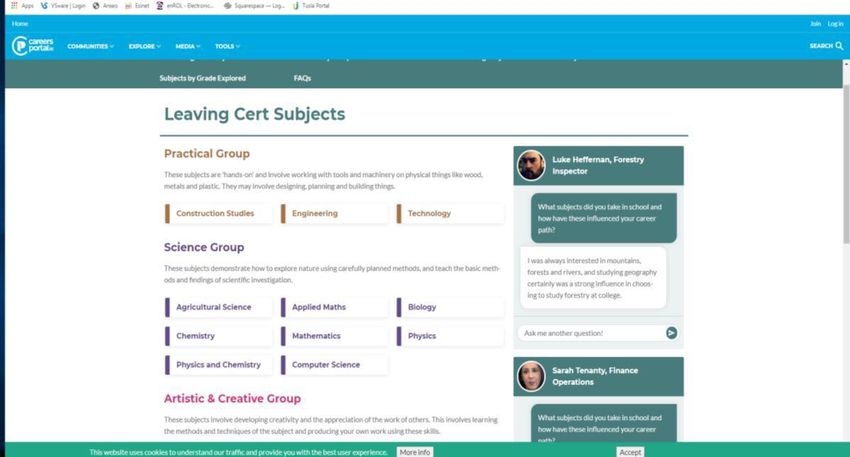
SENIOR CYCLE SUBJECT CHOICE 2022 - 2024
There are Seven Groups to choose from:
When it comes to actually picking the subjects you will see that students take 7 subjects which they
will study for the Leaving Certificate Examination. Of these 7 subjects, 3 of them are mandatory; these
include Irish (except when exempted by Dept. of Education), English and Maths. This leaves a student
with 4 wise decisions to make with your help!
The subjects are grouped under 7 headings:
Language group: French, German and Spanish – A foreign language is necessary for most
courses in NUI colleges, along with other Institutes of Education.
Science Group: Biology, Physics, Chemistry and Applied Maths– A science subject is necessary
for many careers such as Engineering, Medicine and Science etc. On occasion two science
subjects may be required for certain medical or paramedical courses.
Business Studies Group: Accounting, Business and Economics – In order to do a Business
course in college it is not necessary to have done a business subject for the Leaving Certificate.
Practical / Applied Science Group: Construction Studies, Engineering, Technology,
Humanities: History, Geography, French, Spanish, Home Economics.
Artistic Group: Art, Music, Design & Communication Graphics.
Social Science Group: Home Economics and Religious Education
What are the best subjects for high grades in Leaving Cert?
Students or their parents/guardians sometimes ask for a list of the subjects they should take in order
to get the best possible results in the Leaving Certificate. The answer to this is that it depends on the
student. If a student is a very practical and hands-on person, then subjects such as Construction
Studies, Home Economics, Engineering, Technology, Design and Communication Graphics or Art,
depending on their aptitude and interest, may be considered. If a student is a strong reader and enjoys
factual information then subjects like History and Geography could be a good choice; in the case of
Physics, Economics or Chemistry these subjects might suit the student who has a good analytical and
mathematical mindset.
Decisions should be based with the individual student in mind, considering such things as their
personality, their strengths and abilities and their personal areas of interest – what makes them tick?
These are the things that will help a student to pick subjects that will help them grow and develop; to
flourish in their learning environment.
From a careers perspective and with third level colleges in mind, it is important to remember that each
college has their own specific matriculation requirements – in terms of the subjects a student must
have in order to gain entry into a particular college.
For this reason to give students the best possible chance in the future it would be advisable that all
students choose at least one Science subject and one language – French, German or Spanish for their
Leaving Cert.
3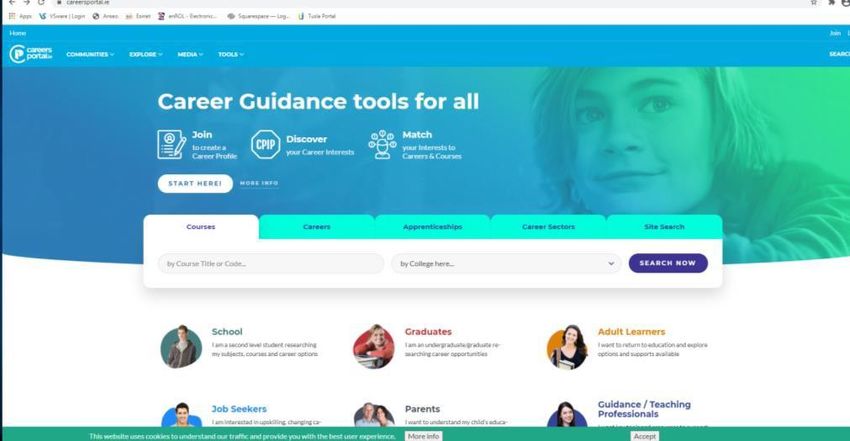
SENIOR CYCLE SUBJECT CHOICE 2022 - 2024
Remember:
It is impossible to pursue any Science course or Science related course in Third Level unless
one has at least one Science subject to Leaving Certificate Level.
Honours Maths is necessary for most degree courses in Engineering.
A European Language is necessary for many University degree courses.
Points for all 3rd level courses are scored on six highest grades obtained in one sitting of the
Leaving Certificate.
When deciding your subject options never pick a subject believing that it is easy.
Never pick a subject because your friends are doing that subject; your future career path may
be totally different to your friends; do not hesitate to ask for advice.
Subject Choice should not depend on what teacher is teaching a certain subject at Leaving
Certificate Level.
Talk to your teachers, past pupils or even students in 5th and 6th year who are currently
studying the subjects that interest you; older brothers and sisters and parents can also help
to make informed decisions on subject choice.
Always, always get your information through Research, Research and more Research!
4
SENIOR CYCLE SUBJECT CHOICE 2022 - 2024
Accounting Subject Group: Business
Facts:
Accounting is a business studies option within the Leaving Certificate programme. It provides a
valuable foundation for all business functions. It is concerned with the preparation, recording,
extraction, presentation and analysis of financial information for the purpose of making economic
decisions.
What Accounting involves:
It involves the recording of financial information; the presentation of this financial information and
then the interpretation and uses of this data. It requires the use of logic and direct thinking.
Accounting gives a clear picture of the state of affairs and prospects for a business enterprise.
What do you study?
The course is divided into ten main sections:
The Conceptual framework of Accounting Specialised Accounting
The Regulatory framework of Accounting Incomplete Records
Accounting Records Cash Flow Statements
Sole Traders Analysis & Interpretation of Financial
Company Accounting Statements
Management Accounting
How do students benefit by studying Accounting?
The study of Accounting helps students to learn how to:
To collect information
To record and analyse information
To think logically and clearly
To understand the importance of financial information for good decision-making. This can
be for shareholders, creditors, employers, employees, customers or members of a
voluntary organisation.
While at the same time students will learn about the relationship between accounting and other
areas of business.
Possible Career links:
The study of Accounting is valuable foundation for all business functions, especially such areas as
Accounting, Banking, Hotel Management, Hospital Administration, Teaching, Auctioneering, and
Advertising.
5
SENIOR CYCLE SUBJECT CHOICE 2022 - 2024

Applied Mathematics                                                    Subject Group: Science

Facts:

Applied Maths is the study of practical applications of mathematics in the real world and physical
problems.
It is very well suited to the student who is taking higher-level maths and physics.
The new course, which has started in September 2021, will also involve a project worth 20% of
your final grade.

Who is it suitable for?

This subject is highly recommended for students considering a career in any area of
Engineering, Science, Information Technology, Business, Finance, Architecture or Education.
Those who are studying Leaving Cert higher level Maths. It is also valuable to those who are
studying Physics, due to some overlap of content.

What are the advantages of doing Applied Mathematics as a subject?

    1. There is an overlap between some parts of the Leaving Cert Physics course and the
       Applied Maths course e.g. Linear Motion, Newton’s Laws, Circular Motion. It will also help
       students to develop a deeper understanding of these topics in Physics.
    2. As there is a high Mathematical content in the course it will also give students a better
       understanding of some parts of the Higher Maths course, especially Trigonometry,
       Calculus and Vectors.
    3. If a student is considering studying any kind of engineering in college, Applied Maths is
       very important – all engineering students have to study Applied Maths in their first year in
       college and this would provide a valuable head start if you have the Leaving Cert course
       done.

Possible Career links:

It is typically associated with engineering and physics, but also finds use in economics, finance,
business, environmental studies and even chemistry and medicine.

                                                                                                     6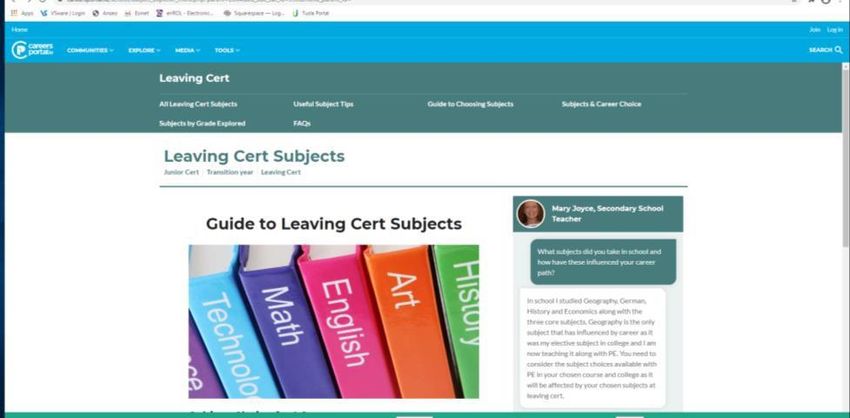
SENIOR CYCLE SUBJECT CHOICE 2022 - 2024
Art Subject Group: Artistic
Facts:
If choosing this subject, it is desirable to have taken Art to Junior Cert level as it will continue to
build on the skills and techniques which were learnt in the Junior cycle.
What Art involves:
Art involves the study of Art History, Art Appreciation, Art Craft work and Design.
What do you study?
You learn:
Drawing using a variety of media
Painting
Three-dimension work in clay and mixed media
Printing
Study of Early Irish and European Art
Analysing and evaluating modern design and architecture
Coursework
This accounts for 50% of the overall mark. It is carried out over 10 weeks between Christmas and
Easter in 6th Year. A minimum of 30 hours of classroom contact is provided for the delivery of the
coursework component over the ten-week period.
How do students benefit by studying Art?
The study of Art helps students to develop their own creativity.
This should lead them to better appreciation of their environment.
It also provides training in decision-making and lateral thinking.
Possible Career links:
Career in Art History, Archaeology, Architecture, Animation, Design, Painting or Sculpture, Display,
Graphic Design, Craftwork, Dress Design, Interior Design, Teaching, Product Design, Stage or Set
Design...
7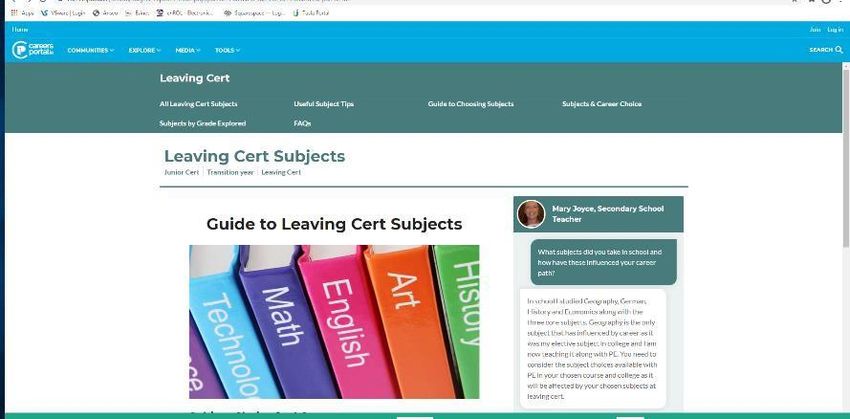
SENIOR CYCLE SUBJECT CHOICE 2022 - 2024

Biology                                                                Subject Group: Science

Facts:

Biology is the study of living organisms. Students undertake 24 mandatory experiments, the
details of which they record in their laboratory book. During the course students are encouraged
to question and research material and to apply their biological knowledge to everyday life.

What do you study?

The course is divided into three units
 Unit 1: Biology – the study of life
                 1. the scientific method
                 2. the characteristics of
                     life
                 3. nutrition
                 4. general principles of
                     ecology
                 5. a study of the
                     ecosystem

Unit 2: The Cell
                1.   Cell structure
                2.   Cell metabolism ( respiration – photosynthesis)
                3.   Cell continuity ( Mitosis – Meiosis)
                4.   Cell diversity (Tissues – Organs – systems)
                5.   Genetics

Unit 3: The Organism
               1. diversity of organisms (micro-organisms – flowering plant – animals
               2. plant systems – human systems
                   (circulatory system – root & shoot system)
               3. Transport and Nutrition in plants and animals
               4. Breathing systems and excretion in plants and animals

How do students benefit from studying Biology?

Students develop a better understanding of many of the biological issues which impact on our
daily lives.
Students gain adequate knowledge for making informed judgements on biological issues.
This is a core subject in a number of third level courses.

Possible Career links:

Medicine, Dentistry, Veterinary Science, Nursing and Paramedical professions, Pharmacy,
Biotechnology, Product Research, Zoology, Botany, Marine Biology, Sports Science, Scientific
Journalism, Teaching, Horticulture, Physiotherapy, Food Science, Physiotherapy, Food Science,
Environmental Science, Genetic Engineering, Forensics, Equine Science, Homeopathic Medicine,
Massage Therapy, Beauty Industry...

                                                                                                   8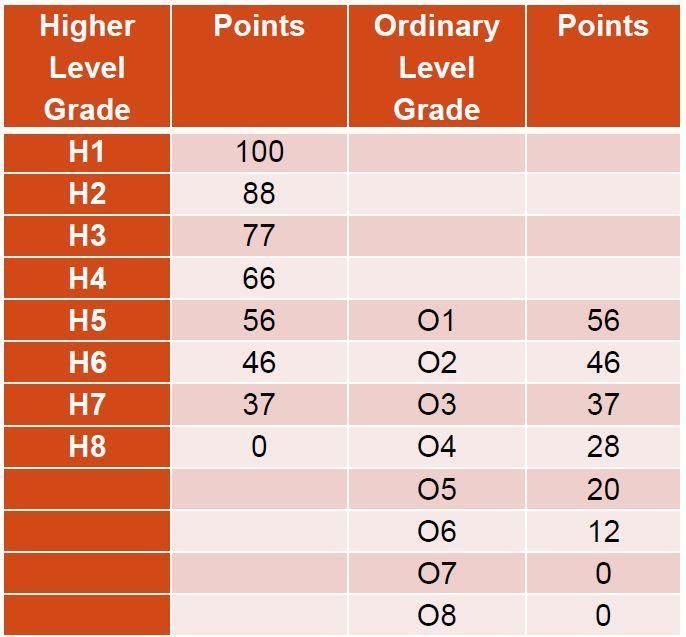
SENIOR CYCLE SUBJECT CHOICE 2022 - 2024

Business                                                             Subject Group: Business

Facts:

This subject is concerned with understanding the environment in which business operates in
Ireland and in the wider world. It equips students with a positive view of enterprise and its
applications in the business environment in both public and private sectors.

What do you study?

There are 7 core units covering the following topics:
Introduction to People in Business; Enterprise; Managing 1 & 2 ; Business in action; Domestic
Environment and International Environment.

How do students benefit from studying Business?

Students learn how to make informed business decisions.
They learn to understand the structure and management of business and to use established
commercial principles and knowledge.
Students will understand and appreciate ethics in business.
They will practice Communication, Literacy, Numeracy and Problem Solving Skills.
And finally those studying this subject will be able to understand and discuss current affairs as
they relate to business.

Possible Career links:

This is an invaluable foundation to any business related career and the study of Finance and
Management makes it a very relevant subject to enhance any career choice.
It would also be very a great asset to anyone interested in setting up their own business.

                                                                                                    9
SENIOR CYCLE SUBJECT CHOICE 2022 - 2024
Chemistry Subject Group: Science
Facts:
Chemistry exists everywhere not just in laboratories but in every living thing on land and sea and
in our bodies. It is often described as ‘the central science’ containing a lot of formulas. So, if you
enjoyed Junior Cert Science and you have done well in this and Maths you should be a good
candidate for Leaving Cert Chemistry.
What do you study?
Some of the topics are:
The Periodic Table
Bonding
History of Chemistry and Scientists
The Use of Chemistry Techniques in
everyday life
Water Chemistry
Acids and Bases
How do students benefit from studying Chemistry?
Students develop skills in laboratory procedures and techniques.
They learn how to take safety precautions in this environment.
Students develop the abilities to assess the uses and limitations of procedures.
They develop skills in observation, analysis, evaluation, communication and problem solving.
This is a subject which is a core element to many third level courses
Chemistry is also an area where the prospect of employment is increasing. Many of the new
industries entering Ireland are involved in Chemistry and as such need trained and qualified
chemists.
Possible Career links:
Medicine; Dentistry; Veterinary Science; Physiotherapy; Nursing; Pharmacy and Medical
Laboratory Technology; Engineering...
10SENIOR CYCLE SUBJECT CHOICE 2022 - 2024
Construction Studies Subject Group: Practical
Facts:
Construction studies introduce students to the knowledge and skills associated with construction
technology and construction materials and practices. This is achieved through bother theoretical
study and integrated practical projects which provide a basis for the thorough exploration of
materials and processes.
If choosing this subject it is desirable to have studied Materials Technology (Wood) or Technology
to Junior Cert level – however a well-motivated and interested student will not be refused a place.
What do you study?
The course is essentially about the study of buildings and the built environment. The theoretical
part of the course examines all parts of a building from the planning stages right through to
completion. The course is studied under the following main headings:
Planning and Design Windows and Doors
Drawings and Documents Stairs
Site Preliminaries and Foundations Plastering and Painting
Walls, Partitions Plumbing and Heating
Floors, Roofs Services
Fireplaces Drainage
How do students benefit from studying Construction Studies?
Students develop manual skills and problem solving skills.
They acquire skills that will remain with them and useful to them throughout their life; and
students will improve their skills of observation and criticism.
Possible Career links:
Architecture, Auctioneering, Bricklaying, Building Management, Carpentry, Civil and Structural
Engineering, Environmental Design, Interior Design, Painting and Decorating, Site Management,
Town Planning, Insurance, Claims Assessment, Electronics, Electrical Engineering...
11SENIOR CYCLE SUBJECT CHOICE 2022 - 2024
Design & Communication Graphics Subject Group: Artistic
Facts:
Design and communication Graphics (DCG) has taken the place of technical drawing for the
Leaving Certificate and provides students with the opportunity for visualising and comprehending
information presented verbally or graphically.
Problem solving and creative thinking skills are developed through the analysis and solution of
both 2 and 3 dimensional graphics. Graphics and design are communicated using freehand
sketching skills, traditional draughting equipment and CAD (Computer Aided Design program).
This subject follows on from Tech Graphics or Technology at Junior Cert level.
Although it is not an essential subject for either architecture or engineering it is regarded as a
useful asset if students were thinking of a technical course.
What do you study?
There are two parts to this course a compulsory section and then optional modules.
The compulsory section is based on Plane and Descriptive Geometry which carries on from Junior
Cert Technical Graphics which involves Sketching, Shading and the use of colour; and would be
similar to material covered in Junior Cert Art. It also includes the use of ICT (Information and
Communications Technology) and Digital Media such as scanners and digital cameras.
The optional modules section of the course contains 5 choices, from which students must choose
2 to answer a question on in the Leaving Cert: 1. Dynamic Mechanisms, 2. Structural Forms, 3.
Assemblies, 4. Surface Geometry and 5. Geologic
Students will also produce a project on a design topic, which will be presented on paper and in
digital format. This will account for 40% of the entire exam.
How do students benefit from studying Construction Studies?
Students will become proficient in the use of Graphics as a language of communication. They will
be able to produce a design folder as used in Third Level Institutes and in the work place.
Possible Career links:
DCG is a core element of many 3rd level options including Engineering, Construction and
Architecture and knowledge of this subject will greatly enhance a student’s ability in any 3rd level
engineering based programme.
12SENIOR CYCLE SUBJECT CHOICE 2022 - 2024
Economics Subject Group: Business
Facts:
Economics is regarded as the most practical business subject and is the study of how people
manage limited resources such as money to meet their goals. By understanding the reasons why
people spend their money in certain ways, economics can try to introduce incentives to change
their behaviour.
Each day the media keeps us in touch with a wide range of economic issues, such as
unemployment, inflation, job creation, the EU, the Euro, Third World issues, taxation, interest
rates and even government economic policies...
Economics studies show how scarce resources are best distributed to satisfy infinite needs and
wants.
What do you study?
This subject is divided into two main sections:
1. Microeconomics – where you study economic decisions at the level of the individual
consumer or household, the individual producer and the individual supplier of goods and
services.
2. Macroeconomics – where you study economic decisions at the level of governments and
whole communities. This involves you in the student in the study of topics such as
employment, inflation, investment, growth and international trade.
How do students benefit from studying Economics?
Students learn to understand the economic environment in which we live.
Students will understand media reports on economic issues and have a better grasp of
current affairs.
Students will learn how to collect, analyse and interpret information and this in turn will
hone skills in clear and logic thinking.
Students will be able to evaluate the complex information about markets, e.g. financial
markets and what they have to offer the consumer.
Possible Career links:
All business courses require an Economics content so having this subject is an advantage.
It is also useful for careers in Banking, Insurance, Finance and Marketing.
13SENIOR CYCLE SUBJECT CHOICE 2022 - 2024
Engineering Subject Group: Practical
Facts:
Engineering carries on from Junior Cycle Technology or Engineering. It promotes an educational
understanding of the materials and a knowledge of the processes associated with mechanical engineering.
This is achieved through the development of skills and initiative in the planning, developing and realisation of
technological projects in a safe manner.
What do you study?
There is an emphasis on practical skills in Leaving Certificate Engineering and students will aim to perfect their
use of hand and machine tools to produce accurate components for use in mechanisms and machines. This
will be examined in May of 6th Year and where 25% of total marks can be achieved.
Design based project work will also form a major component and students will design and make projects
containing mechanisms and electronics. A wide variety of processes such as hand tools, machines, welding,
and CAD/CAM etc. may be used in the manufacturing of projects. These will be examined as a part of your
overall grade and is worth 25% of total marks. The project runs from October to March in 6th Year.
The theory behind these processes used will then be covered in the theory section of the course.
The theory covers such things as:
• Manufacturing processes, Drilling, Milling, Grinding and Lathe Machines
• Theory of cutting Materials
• Material Properties and Material Testing
• The joining of Materials – Threading, Soldering, Brazing and Welding
• Production and Manufacture of Plastics and Metals
• Material Science, Pneumatics, Electronics and Mechanisms
• Honours students cover a prescribed topic particular to their year.
Theory will be examined in a final exam and is worth 50% of total marks.
How do students benefit from studying Engineering?
The design project which students will undertake involves the skills used in Third Level Institutes. It also
provides a good grounding for anyone interested in pursuing this type of career when they finish school.
Possible Career links:
Engineering while not directly required for any courses in the
CAO, is very useful for the following careers: Mechanic, Panel
Beater, Welder, Plumber, Electronic and Mechanical
Engineering, Architecture and Design.
14SENIOR CYCLE SUBJECT CHOICE 2022 - 2024
French / Spanish / German Subject Group: Humanities
Facts:
It would be strongly recommended that all students should take another language in addition to
English and Irish. By eliminating a third language from your subject options you greatly reduce the
number of third level colleges which you can apply to in 6th year.
The colleges of the National University of Ireland require a pass in a third language for entry into a
large number of their courses. These colleges are NUI Maynooth, Dublin, Galway and Cork and a
range of associated constituent colleges, all of which are listed on the NUI website at nui.ie
In recent years, NUI have dropped their third language requirement for both their engineering and
science programmes. UCD has also dropped it for their agricultural programmes. It has never been
a requirement for Nursing at NUI colleges.
It is however necessary for arts, human sciences, law, social science, commerce, medicine and
health sciences and some other degrees. A third language is also a requirement for entry into the
cadetship in the army or the air corps.
If choosing any of these languages, it is essential that students have studied for the Junior
Certificate.
What do you study?
There are four sections in the Leaving Cert Course:
Aural – Listening to the language on CD
Oral – Speaking the chosen language
Reading
Writing
How do students benefit from studying a Continental Language?
Students become proficient in a third language, which enables them to communicate with people
in French, Spanish and German speaking countries. They develop an understanding of these
different cultures and an appreciation for their language of choice.
Possible Career links:
Translator, Au Pair, Telesales, Catering, Diplomatic Service, Tourism & Travel, Work for
International Organisations, Work within the European Union, Work with Aid Agencies, Work
within the Fashion Industry, Teaching...
15SENIOR CYCLE SUBJECT CHOICE 2022 - 2024
Geography Subject Group: Humanities
Facts:
Geography is the study of people, their environment and the interaction between the two. The
course follows on from the Junior Cert syllabus, and covers very similar topics (such as rocks, soils,
oceans, population movements, map-reading, and economic activities) in a lot more detail.
It is also worth noting that this subject is accepted in Trinity College Dublin as a science subject for
entry into both the science and pharmacy faculty.
What do you study?
Students learn about the following key topics:
Mapping and aerial photography skills
The physical landscape, such as rivers, sea, ice, volcanoes, earthquakes and other
natural phenomena
Environmental issues are discussed e.g. acid rain, pollution, desertification, global
warming.
Levels of economic development within certain regions and countries of the world e.g.
developed and developing countries
Human geography which examines the relationships between people and their
natural environment
Geo-ecology which examines soils and biomes in two contrasting regions
Geographical investigations where students apply their knowledge of physical
geography to a local area in a project based study. This field work component
accounts for 20% of the Leaving Certificate and is submitted by April in 6th year
How do students benefit from studying Geography?
Students broaden their knowledge of the world in which we live
Students learn to relate current events with topics within the syllabus
Students learn to develop links between geography and other subjects
Students learn to express themselves in a clear and logic manner
Possible Career links:
Geography is a very useful subject for those who wish to follow a career in Town Planning,
Surveying, Environmental Science and Politics.
Other career links include: Civil Engineering, Construction, Architecture, Meteorology, Mineralogy,
Agricultural Science, Research, Journalism, Tourism, Marine Service, Flying, Mining and
Exploration...
16SENIOR CYCLE SUBJECT CHOICE 2022 - 2024
History Subject Group: Humanities
What Kind of Student Might History Suit?
Students who enjoy and appreciate history and would like to improve their knowledge.
Students who are willing to work hard and commit time to reading and research. It can be a
demanding subject.
Students who have strong English language skills and can write essays well.
Students aiming to improve their self-discipline and research skills.
Course Overview: History is a good all-round education. It is crucial when studying History to pay attention
to the evidence presented, and to keep in mind factors such as bias and propaganda. Students are encouraged
to consider the validity of different interpretations of evidence to develop a more balanced and grounded
judgement. The course is quite large and requires constant attention throughout the year. Research skills such
as drawing on a wide variety of sources of evidence (such as maps, public records, political cartoons, and
memoirs) are developed throughout the course. When writing, students are taught to produce focused,
logical, and supported arguments.
Course Content: In Skerries Community College we study the Later Modern course, 1815-1993 There are six
topics from Irish history and six from the history of Europe and the wider world. Students will study two topics
from Irish history and two from the history of Europe and the wider world from the selected field of study.
Two topics will be prescribed for documents-based study: one from the Early Modern field of study and one
from the Later Modern field of study.
Exam Structure: The exam will last 2 hours 50 minutes and pupils will answer the Documents based study
and three essays (one from each topic studied). Ordinary level students follow an identical course, with a
different emphasis in the way questions are asked on exam papers. Assessment consists of two components: A
written examination paper (80%) and A research study report (20%) submitted around Easter before the June
exam.
Career Possibilities
Current Affairs
Journalism
Local and National Radio and TV
Archaeology
Museum curators
Archivists
Historians
Law
Teaching
Town Planning
Architecture
Politics
Economics
SociologyG
17SENIOR CYCLE SUBJECT CHOICE 2022 - 2024
Home Economics Subject Group: Social
Facts:
Home Economics at Leaving Cert level examines the way in which individuals and families manage
their resources to meet physical, emotional, intellectual, social and economic needs. The course is
assessed through both a written exam and a practical assessment. The practical cookery classes
are recorded in a special journal which is examined by the Department of Education and Science;
and this journal accounts for 20% of the overall Home Economics Grade
What do you study?
Food Studies - 45% Choose one from electives
Nutrients
Special Diets Home Design and Management- 20%
Food Industry and New methods of Food Housing and provision of House
Processing Interior Design
Legislation in Relation to Food Energy Efficiency in the Home
Insulation
Ventilation
Lighting
Textiles Fashion and Design — 20%
Current Fashion Trends
Textile Science
Evaluation of Garment Design
Textile Industry
Resource Management and Consumers Studies- 25%
Money Management Social Studies — 20%
Housing The Family and Social Change
Electrical Appliances Education
Consumer Studies Work
Reconciling Work and Family
Social Studies - 10% Leisure
The family Unemployment
Marriage Poverty
Family Law Government response to Social Problems
How do students benefit from studying Home Economics?
Home Economics is an excellent preparation for life skills in general
Students learn the skills of making wise decisions and good choices when shopping,
budgeting and cooking.
Students will learn about the science and application of good nutrition.
Students will gain insight into the food industry, along with the clothing and textile
industry.
Students will learn how to understand all the systems and services we have in our homes.
Possible Career Links:
Teaching, Dietetics, Catering and Tourism Industry, Child-Care, Social Studies, Food
Demonstration, Nutrition, Fashion Design, Interior Design....
18SENIOR CYCLE SUBJECT CHOICE 2022 - 2024
Music Subject Group: Artistic
Facts:
The Leaving Certificate Music course is designed to provide a progression from the Junior
Certificate Music course. The course is aimed at students who wish to continue to develop a
deeper knowledge, understanding and critical appreciation of music.
What do you study?
Like Junior Certificate Music, Leaving Certificate Music places great emphasis in learning through
experience; the experience of listening, composing and performing. Students study Music
Technology which involves inputting and editing music. Listening is 25%, Composition is 25%, and
Performance is 50% of the Leaving Certificate course. Students listen to classical and modern set
works; and they learn how to harmonise and compose melodies.
How do students benefit from studying Music?
Music students will have the opportunity to develop their own performance skills as a soloist and
/ or as part of a music ensemble. All Music students are strongly encouraged to continue to
participate in the School Choir, the School Orchestra, School Musical and all the Music events that
occur throughout the academic year.
Students grow in confidence in their own musical abilities and learn to share their gifts with those
around them.
Possible Career links:
Music Industry, Music Education, Sound Engineering, Music Therapy, Singing, Musician, Music
Technology and Conductor.
Note:
Students choosing Music as a Leaving Certificate subject should have attained a good standard in
Junior Certificate Music, and can play at least one instrument to a good standard. Otherwise only
students who have a background in music performance and music theory will be considered for
Leaving Certificate Music.
19SENIOR CYCLE SUBJECT CHOICE 2022 - 2024
Physics Subject Group: Science
Facts:
The study of Physics is undoubtedly relevant to society today. It is about finding out and
understanding what lies behind every day phenomena. Physics deals with the laws and forces
which govern natural phenomena such as energy, atoms, radioactivity, electricity and magnetism.
What do you study?
Physics has a strong maths element (though it can be taken comfortably with ordinary level
maths) and requires the learning off of many formulae. Students must maintain a laboratory book
as there are 24 mandatory experiments, four of which are examined on the Leaving Cert paper.
The Leaving Cert physics course follows directly from Junior Cert Science and covers more topics
in greater depth.
Topics studied include mechanics, optics, heat, light, electricity, magnetism, sound, atomic and
nuclear physics and electronics.
At Leaving Cert level Physics involves more practical work which makes the theory come alive.
How do students benefit from studying Physics?
Students develop experimental and investigative skills.
It is a subject that requires planning, implementation, analysing evidence and drawing conclusions
and evaluating evidence and procedures all skills that are important for everyday life.
Students have the opportunity to draw on existing knowledge to show understanding of the
responsible use of Physics in society.
Possible Career links:
Physics is particularly relevant to Engineering and Technology courses, Computer Science,
Astronomy, Physicist, Biophysicist, Biomedical Science courses; Medical related courses such as
Doctor, Dentist, Radiographer, Physiotherapist, Pharmacist, Nurse, Scientific Lab Technician, and
Scientific Researcher.
It would also be an important subject for Pilots, Meteorologist, the Naval Service and Marine
Radio Operators.
20SENIOR CYCLE SUBJECT CHOICE 2022 - 2024
Religious Education Subject Group: Social
Are you interested in studying Religious Education for the Leaving Cert as an additional
exam subject?'
Facts:
Religious education in the Leaving Certificate programme calls for the exploration of issues such as
meaning and value, the nature of morality, the development of diversity and belief, the principles of
a just society, and the implications of scientific progress. It has a particular role to play in the
curriculum in the promotion of tolerance and mutual understanding.
Why Study Religious Education
It seeks to develop in students the skills needed to engage in meaningful dialogue with those of
other or of no religious traditions.
The RE syllabus supports the development of the inquiry, thinking, and problem solving skills central
to the Leaving Cert
What kind of student would Religious Education suit?
Religious Education suits the student with an enquiring mind. A student who is interested in history,
current affairs, travel and culture and debating the meaning of life.
The syllabus offers extensive choices and areas of study, e.g. Christianity, world cultures, moral
decision making, religion and gender, issues of justice and peace, religion and science, etc.
It seeks to develop in students the skills needed to engage in meaningful dialogue with those of
other or of no religious traditions.
Religious Education is a relatively new subject for the Leaving Cert. (It was first examined in 2005).
Since then many students throughout the country have taken this option to build on their
experience of Religious Education at Junior Cert, even though it is not necessary to have taken the
exam at Junior Cert to succeed at Leaving Cert.
The RE syllabus supports the development of the inquiry, thinking and problem solving skills central
to the Leaving Cert.
The course aims to explore issues such as meaning and value, the nature of morality, the
development and diversity of belief, the principles of a just society, and the implications of scientific
progress.
Students’ personal faith commitment and/or affiliation to a particular religious grouping are not
subject to assessment.
What do you Study?
The subject consists of one core obligatory section, 'The Search for Meaning and Values' and a
choice of two other core sections from a list of three:
Christianity: origins and contemporary expressions,
World Religions, and
Moral Decision Making.
There is one optional section also from a list of six which gives the students the opportunity to
explore a topic of their own liking.
An exciting feature of this subject is the coursework element, which is like an extended essay on a
topic supplied by the DES which accounts for 20% of the marks in the final exam. This means that in
effect, students will have one fifth of the examination covered before they begin the Leaving Cert
itself.
Possible future courses/career areas: Arts, Law, Journalism, Education, Teaching, Theology,
Philosophy, Religious Vocations, Social Work and Career Guidance among others.
21SENIOR CYCLE SUBJECT CHOICE 2022 - 2024
Technology Subject Group: Practical
Facts:
Leaving Certificate Technology provides students with knowledge and skills
associated with technology education. Students apply their knowledge and skills
creatively in a design-based approach to solving everyday technological
problems, mindful of the impact on natural resources and on the environment.
What do you study?
Practical coursework will take the format of design-based projects, where
students are presented with a brief or problem to be solved. Research and Project Management is also
emphasised during the design stage and students will be expected to produce a folio for each project made.
Students will learn to use common hand and machine tools for processing a variety of materials including
metals, plastics, and wood. They will also learn to use CAD/CAM equipment where they can design
components using Computer Aided Design (CAD) and manufacture them using either the Laser Cutting or 3D
printing.
Programming using a programable circuit board (usually Micro-bit) will also be introduced and is expected to
be used in the students Leaving Certificate project in 6th year.
Theory consists of core studies where students learn about a variety of topics in relation to technology, while
two options will be studied in greater detail. These are listed below.
Core Content: Options Content:
Energy, Electricity & Electronics Materials Technology
Structures and Mechanisms Information and Communication
ICT (Computer Studies) Technology
The Process of Design
Project and Quality Management
Materials and Production
Communications and Graphic Media
The Leaving Certificate Exam in June will be worth 50% of the full marks and the project consisting of an
Artefact and Portfolio on a given prescribed topic will amount for the other 50%.
How do students benefit from studying Technology?
The process of your project work involves a skill that is used widely in Third Level Institutes and in the
workplace. The course is very broad, and the topics covered serve as a good introduction to a number of
different careers or areas of study at third level.
Possible Career links:
Electronics, Engineering, Computing and Programming, Design, Manufacturing, Project Management.
Note: If choosing this subject, it is an advantage, but not essential, to have studied Junior Cycle Applied
Technology, Wood Technology or Graphics.
22SENIOR CYCLE SUBJECT CHOICE 2022 - 2024
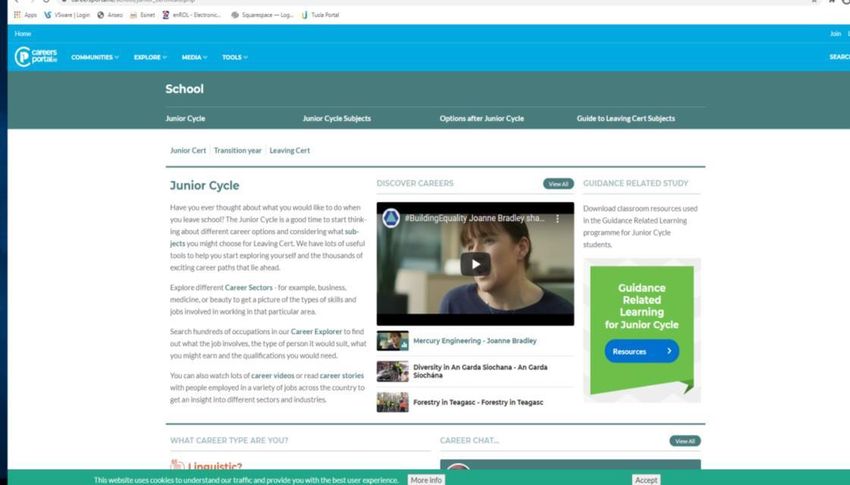
Guidelines on how to use Careers Portal to study in detail your
children’s subjects’ options for the Leaving Certificate 2024
Log on to: www.careersportal.ie
Click on the School icon:
Click on the Junior Cycle box:
23SENIOR CYCLE SUBJECT CHOICE 2022 - 2024
Click on Guide to Leaving Cert Subjects:
You have now reached the page titled ‘Guide to Leaving Cert Subject Choices.’
Click on All Leaving Cert Subjects
24SENIOR CYCLE SUBJECT CHOICE 2022 - 2024
This will provide you with a link option to review every subject in detail. It will also provide
information pertaining to the subject’s importance in relation to third level colleges and future
career paths.
Click on the subject you want information on e.g. Gaeilge- Irish
Click on the tabs on the left-hand side for information which you will find on
these pages:
25SENIOR CYCLE SUBJECT CHOICE 2022 - 2024
Useful Websites
Topic Web Address Description
Subject Content www.ncca.ie Gives outline of all Leaving
Certificate Subjects
Matriculation Regulations www.nui.ie Minimum academic entry
Career Planning www.careerdirections.ie Provides descriptors on a
range of careers with
information on progression
Course Searching www.qualifax.ie Provides an A to Z of
courses in Ireland
Course Search and Career www.careersportal.ie Resources, video clips and
Paths lots of information
pertaining to careers and
courses
Progression Routes www.fetac.ie Resources for advising on
progression form level 5
courses
Grants www.studentfinance.ie Information on grants and
funding
HEAR and DARE Scheme www.accesscollege.ie Access schemes to improve
access to third level
education for students from
disadvantaged backgrounds
or for students with
disabilities.
CAO www.cao.ie The Central Applications
Office (CAO) processes
applications for
undergraduate courses in
Irish Higher Education
Institutions.
UCAS www.ucas.ac.uk The college application
system for the UK
26SENIOR CYCLE SUBJECT CHOICE 2022 - 2024
Grades and Common Points Scale for Leaving Certificate 2021
Bonus Points for Maths
25 Bonus points will be added to the points score for Leaving Certificate Higher Level Maths.
Students achieving a grade H6 or higher will have 25 Bonus Points added to their total score
for Honours Maths - the grade itself does not change.
No bonus points are given for H7 in Honours Maths, or for any Ordinary Level Maths grade.
NOTE: The 25 Bonus points for Honours Maths are not counted unless Maths (following the addition
of the bonus points) is included in the top six subjects counted for the purpose of calculating CAO
points.
27SENIOR CYCLE SUBJECT CHOICE 2022 - 2024
Notes
28You can also read


