SolidFlow 2.0 Solid mass fl ow measurement - EN - SWR engineering
←
→
Page content transcription
If your browser does not render page correctly, please read the page content below
EN

                      SolidFlow 2.0
                      Solid mass flow measurement
Product Information

                            SWR engineering Messtechnik GmbH PART OF THE ENVEA GROUP
Use
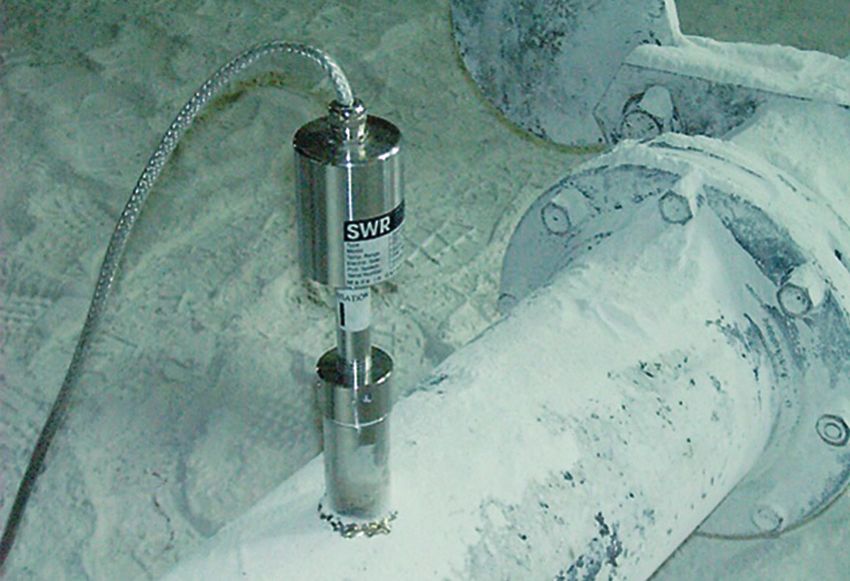
SolidFlow 2.0 has been specially developed for
measuring solid volumes conveyed through pipelines.
SolidFlow 2.0 is used for online measuring:
• all types of dust, powder, granulates, etc.
• with particle sizes between 1 nm and 10 mm
• which are conveyed pneumatically
• or in free fall after mechanical conveyor systems

SolidFlow 2.0 is extremely easy to install and has a wear-
resistant design.
SolidFlow 2.0 is the latest generation of microwave-based
measuring systems for measuring the flow of solids.
Based on our many years of expertise, SWR has devel-
oped a second generation version of this sensor.
SolidFlow 2.0 is a reliable sensor which eliminates the dis-
advantages encountered in current technologies available
on the market.

                                                                                                            f≠f0

Function
The SolidFlow 2.0 sensor uses the latest microwave tech-
nology. The sensor is used exclusively in metal pipelines.
The special integration of microwave technology creates
the measurement field together with the metal pipeline.
The microwave radiation in the pipeline is reflected by the
                                                               Amplitude
                                                                 Amplitude

solid particles and received by the sensor.
The frequency and amplitude of the received signals are
analysed.
The sensor works like a particle counter, counting the
quantity of flowing particles per unit of time. The frequen-
                                                                             0   90                   200
cy-selected evaluation system ensures that only flowing                             Frequency
                                                                                 Doppler Frequency fD

particles are measured while deposits are suppressed.
SolidFlow 2.0 features active stratification compensation
which compensates measurement errors caused by strati-
fication, in particular while materials are being pneumati-
cally conveyed.                                                                         Spectrum during
                                                                                        stratification
Based on new processing technology, the measurement
signal is converted into its frequency spectrum which is
                                                                 Amplitude
                                                               Amplitude

used to detect the material's flow pattern. The sensor is
calibrated during installation by entering the reference
quantity and pressing a button.
The illustrations show two frequency spectra for different
flow conditions with similar mass flows. A software algo-
rithm ensures that the measuring result is correct even                             Frequency
                                                                                 Doppler Frequency fD

with different flow conditions.

2
System
A complete measuring point consists of the following
                                                                                              Sensor                                      C-Box                                    Transmitter
components:

• Transmitter in the DIN Rail housing or field housing

• Sensor mount for welding to the pipe
                                                                                                                                                 max. 300 m                                       or

• Sensor (union nut, spacer rings, sealing ring for adjust-
  ing to the wall thickness)

• Installation instructions
                                                                                                                                                                              DIN rail transmitter
• Teflon sleeve (depend on application)

• C1- or C3-Box (optional)

Applications – Practical Examples
• Compounding plant
                                                                                                                                              500 kg/h
Mixtures are created using the sandwich technique with
a weighing container. The existing weighing device was                    1                       1                       1
                                                                                                                                                                               M                 Exhauster

not designed for dosing small quantities of additional
components, which meant that measured doses could not
be reproduced.                                                                                            Rotary value

                                                                                                                                                                      2                                Balance

Benefits:

                                                                                                                                             3
SolidFlow 2.0 enables the dosing of additional com-
ponents to be reproduced and better balancing of the
                                                                    1   different types of malt (0,3 – 1 mm Ø)       2   Mixer        3    DN 50 stainless steel

quantities used.

• Fuel delivery
                                                                                                                                   1,5 t/h
In a boiler, dust is conveyed as fuel to the combustion
chamber. As there is no information about the distribu-                                          Fuel (-dust)

tion of fuel quantities in the different supply lines, setting
optimum combustion is not always possible
                                                                 Compressed
                                                                        gas

Benefits:                                                                         1
                                                                                                                                                                                   2

                                                                                                                                                            3

Each supply line is monitored by a SolidFlow 2.0 system,                                                                         approx. 1.5 t/h
                                                                                                                                 Granulation approx. 1 m

and the supply of fuel quantities is regulated in each
individual supply line. This enables accurate and uni-              Fluid-Gas (N2)               1    Pressure bin   2   Combustion chamber          3     DN 50 steel pipe            Primary fuel

form distribution of fuel quantities which is an essential
requirement for optimum combustion.

3
• Quantity balancing
                                                                   10 t/h
The supply of materials to the grinding system is subject
to significant fluctuations.

Benefits:                                                          1
                                                                                                 to the mill
                                                                                                                                      2

With SolidFlow 2.0, the progress of the mass flow can be
measured and documented.                                                                                                              for further processing

If necessary, adjustments can be made.                                                       40 m DN 150
                                                                                             riser,

By measuring the coarse grain between the grinding                                           granulation
                                                                                             approx. 5 – 10 m
                                                                                                                             1   Lime hopper

system and the mill, the grinding quality can also be                                                                        2   Classifier

monitored.

• Free-fall application
                                                                                                                 300 kg/h
A belt weigher records the amount of cement conveyed.
This measurement is used as a guide value when meter-
                                                                   Iron-II-Sulphate hopper
ing the addition of iron(II) sulphate.
This must be metered with a proportion of 0.2 … 0.3 %.

Benefits:

With SolidFlow 2.0, the actual value of the metered iron(II)
sulphate is recorded and regulated by adjusting the screw
                                                                                                     DN 150 sheet metal pipe
conveyor's speed.                                                                                                                   Granulation 40 – 60 m

The result is uniform product quality.

• Granulate dosing system
                                                                       400 kg/batch
The existing dosing tank is too inaccurate, that means the
plant can only operate intermittently.
                                                                                                                                                    M
Benefits:

SolidFlow 2.0 enables transparent monitoring of the con-                                                                                      3
                                                               1
veyed quantities and the process can be turned into one                                      2
                                                                                                               Granulation
continuous operation.                                                                                          100 m

                                                                                                                             1   Granulation hopper

                                                                                                                             2   Proportioning weigher (no longer necessary)
                                                                                                                  4
                                                                                                                             3   Mixing chamber

                                                                                                                             4   DN 50 steel pipe

4
Mounting and installation
To install the sensor, the installation location must be de-
termined according to the required inlet and outlet areas.
With pipe diameters larger than 200 mm, 2 or 3 sensors
are used per measuring point and the sensors are ar-
ranged at angles of 90° or 120° to each other.

In free-fall applications (for example after screw conveyors
or rotary feeders), an infeed section (drop height) of at

                                                                                                                 10 x DN
                                                                                             8 x DN

                                                                                                                                      8 x DN
least 300 mm is ideal.

                                                                    3 x DN
The sensor socket is welded on at the specified installation
location. After this, a 20 mm-borehole is drilled through

                                                                                                                 10 x DN (min. 1 m)
the sensor bracket and through the pipe wall.

                                                                                             8 x DN (min. 1 m)

                                                                                                                                      8 x DN (min. 1 m)
The sensor is then adjusted to the wall thickness, inserted
and fixed with the aid of union nuts. Done!

                                                                    5 x DN       DN
         Hopper
                                 300

                                  1                                          2                                                                            3
                                                                                                                      A
                                                                     B
                                                        A

                                                                                                                                            B

Commissioning
Commissioning of the measurement takes place via the           The menu language can be freely selected, German,
evaluation unit. The field housing provides a convenient,      English and French are available.
menu-driven entry of the parameters on the touch display.
An analogue output with 4 ... 20 mA, a changeover relay         When using the DIN Rail transmitter, the parameters are
contact as well as a pulse output (open collector) are         entered via the SWR software.
available for the evaluation of the sensor signals.

5
Technical data

Sensor
Housing                         Stainless steel 1.4571
                                IP 65, DustEx zone 20 or
Protection category
                                GasEx zone 1 (optional)
                                Front end of sensor: -20… +80 °C
Operating temperature           Optional:          -20 … +200 °C
                                Sensor electronic:    0 … +60 °C
Max. working pressure           1 bar, optional 10 bar                                             271
Working frequency               K-Band 24.125 GHz, ±100 MHz
Transmitting power              Max. 5 mW
Weight                          1.3 kg
Dimensions                      Ø 60, Ø 20, L 271 mm
Accuracy                        ± 2 … 5 % in calibrated range
                                                                                                                        78

                         certificated
                         according to ATEX

Transmitter (DIN Rail)                                               Transmitter (field housing)
                                                                                                         110 / 230 V AC 50 Hz
Power supply                     24 V DC ±10 %                       Power supply
                                                                                                         (optional 24 V DC)
Power consumption                20 W / 24 VA                        Power consumption                   20 W / 24 VA
Protection type                  IP 40 to EN 60 529                  Protection type                     IP 65 to EN 60 529/10.91
Ambient operating temperature    -10 … +45 °C                        Ambient operating temperature       -10 … +45 °C
Dimensions                       23 x 90 x 118 mm (W x H x D)        Dimensions                          258 x 237 x 174 mm (W x H x D)
Weight                           Approx. 172 g                       Weight                              Approx. 2.5 kg
DIN rail fastening               DIN 60715 TH35                      Cable screw connectors              3 x M20 (4,5 - 13 mm Ø)
Connection terminals cable                                           Connection terminals cable
                                 0.2-2.5 mm2 [AWG 24-14]                                                 0.2-2.5 mm2 [AWG 24-14]
cross-section                                                        cross-section
                                 1 x 4 … 20 mA (0 … 20 mA),                                              3 x 4 … 20 mA (0 … 20 mA),
Current output                                                       Current output
                                 load < 500 Ω                                                            load < 500 Ω
Interface                        RS 485 (ModBus RTU) / USB           Interface                           RS 485 (ModBus RTU) / USB
Pulse output                     Open collector - max. 30 V, 20 mA   Pulse output                        Open collector - max. 30 V, 20 mA
                                 Max. rated load:                                                        Max. rated load:
                                 250 V AC                                                                250 V AC
                                 Max. peak current:                                                      Max. peak current:
                                 6A                                                                      6A
                                 Max. rated load 230 V AC:                                               Max. rated load 230 V AC:
Relay contact                                                        Relay contact
                                 250 VA                                                                  250 VA
                                 Max. breaking capacity DC1:                                             Max. breaking capacity DC1:
                                 3/110/220 V: 3/0.35/0.2 A                                               3/110/220 V: 3/0.35/0.2 A
                                 Min. switching load:                                                    Min. switching load:
                                 500 mW (10 V / 5 mA)                                                    500 mW (10 V / 5 mA)
Data backup                      Flash memory                        Data backup                         Flash memory

                                SWR engineering Messtechnik GmbH
                                                                                                                                             (All rights reserved.)

                                Gutedelstraße 31 · 79418 Schliengen (Germany)
                                Fon +49 7635 827248-0 · Fax +49 7635 827248-48 · www.swr-engineering.com
                                PART OF THE ENVEA GROUP

6		                                                                                                                          EN 26/02/2019

You can also read


