Spotlight Tokyo office supply through 2020 - February 2017 Savills World Research Japan
←
→
Page content transcription
If your browser does not render page correctly, please read the page content below
Savills World Research
                                       Japan

Spotlight
Tokyo office supply
through 2020          February 2017

                          savills.com.jp/research
Spotlight | Tokyo office supply through 2020 February 2017
Savills World Research
Spotlight
Japan
Spotlight
Tokyo office supply
through 2020 February 2017
Tokyo office supply
through 2020 savills.com.jp/research
“Tokyo’s CBD expects a glut of high-quality
supply to come online through 2020. This rapid SUMMARY
increase in NRA may soften rental levels over
the short to medium term, but it will also breathe From 2017 through 2020, Tokyo’s Central 5
Wards (C5W) are expected to add approximately
new life into some of the city’s most up-and- 800,000 tsubo of rentable office space, increasing
total stock by approximately 11% excluding
coming districts. Capital values, infrastructure demolitions.
quality, and district image should all increase
71% of the new supply is located in three
as Tokyo’s already modern office market grows submarkets: Marunouchi & Otemachi (27%),
even more state-of-the-art.” Toranomon, Roppongi & Akasaka (22%), and
Shinagawa & Shibaura (23%).
Large supply ahead completions are expected past 2020 This influx of new supply will likely soften rental
A series of rapid, large-scale when Tokyo holds the Olympics, but levels over the short to medium term. Average
completions from 2017 through because such projects are subject vacancy in the C5W will likely weaken to near 5%,
2020 are expected to add significant to significant change, this report will but should remain stronger than it was after the
supply to central Tokyo’s office focus on 2017-2020 supply. financial crisis and the Tohoku earthquake.
market. On average, approximately
200,000 tsubo1 should come This supply is not spread evenly Much of this supply is arriving as part of
online each year. The influx totals throughout the C5W. It will enormous, premium-grade, mixed-use, integrated
approximately 11% of the Tokyo be primarily located in three redevelopment projects. Over the long term,
CBD’s current NRA, though ongoing distinct submarkets: Otemachi & these projects could drastically revitalise their
demolitions will result in a smaller Marunouchi, Shinagawa & Shibaura, surrounding districts, much like how Mori's
net impact. Note that additional large and Toranomon, Roppongi, & Roppongi Hills development influenced northwest
Akasaka. Together, these three Minato.
1 1 tsubo = 3.305785 sq m
GRAPH 1
Tokyo C5W rent, vacancy and supply* relationship,
submarkets account for over
2001–2020F 600,000 tsubo, or about 70% of the
60,000
Rent Forecast rent Vacancy
10% total increase. The concentrated
Forecast
nature of the supply increase helps
50,000 8%
demonstrate how much of the NRA is
JPY / tsubo / month
40,000 6% coming through individual, large-scale
projects.
Vacancy
30,000 4%
20,000 2%
Shinjuku, by contrast, is expecting
only minimal new supply. Shibuya
10,000 0% is expecting moderate new supply,
450
Supply but because Shibuya’s office stock
400
is relatively small compared to
Thousand tsubo NRA
350
300 those of other wards it is expecting
250 the largest increase in percentage
200
terms. Shibuya’s NRA could grow
150
100 almost 20% over the next four years.
50 Shibuya is uniquely well-positioned
0 to absorb its supply, however,
because the district is seeing high
* For the purposes of this report, “supply” refers to upcoming office NRA in the central five wards with a floor demand especially from software and
plate of 100+ tsubo. Actual NRA is used when possible; for projects that have only published GFA, NRA is tech companies seeking to relocate
estimated at 60% of GFA. Actual NRA is likely to differ from this estimate.
Source: Miki Shoji, NLI Research Institute, Savills Research & Consultancy
or expand.
savills.com.jp/research 02
Spotlight | Tokyo office supply through 2020                                                                                                                                 February 2017

The difference in % increases             GRAPH 2
between Shinjuku and Shibuya is so        Expected supply in Tokyo’s CBD by ward, 2017–2020
great that Shibuya’s share of C5W
office stock is set to grow from 8% to
                                                                                                            Chiyoda    Chuo       Minato       Shinjuku        Shibuya
9% by 2020, while Shinjuku could fall                            300
from 13% to 12%.

                                                                 250
Further breaking down the C5W into
submarkets, we can see that a plurality   Thousand tsubo NRA

of projects are concentrated in the                              200

Marunouchi & Otemachi area. This
submarket is traditionally Tokyo’s most                          150
expensive office district and continues
to see intense redevelopment activity.
                                                                 100
Marunouchi & Otemachi will receive
approximately 235,000 tsubo of NRA
through 2020, or 27% of the C5W’s                                50

total new supply. Major developments
in the area include Mitsui Fudosan’s                              0
                                                                               2017                         2018                  2019                       2020
OH-1 development, a 108,000 tsubo
GFA, twin-tower, multipurpose facility    Source: Miki Shoji, Savills Research & Consultancy
housing a hotel and conference
                                          GRAPH 3
hall, and NTT Urban Development’s
Otemachi Nichome project, another         Expected stock increases in Tokyo’s CBD by ward
twin-tower facility of similar scope.     (%), 2017–2020
Major developments are scheduled
to extend as far as 2027, when                                   20%

Mitsubishi Estate expects to complete                            18%
the main tower of its 200,000 tsubo
                                                                 16%
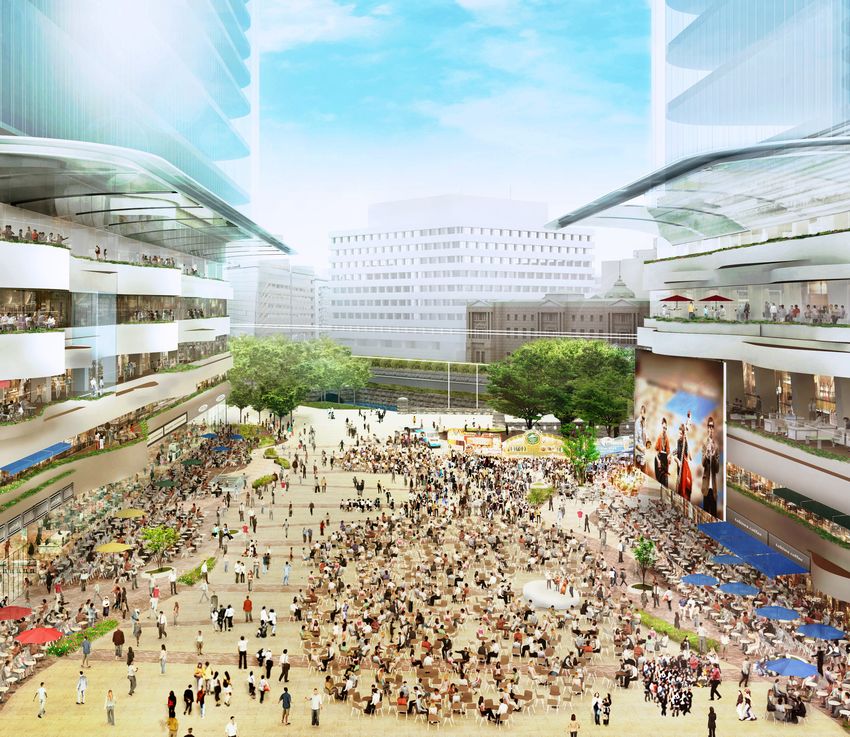
GFA Tokiwabashi project (cover
image). Though the supply increase                               14%
                                          % increase 2017-2020

in Marunouchi & Otemachi is large,                               12%
the area is dominated by ultra-
                                                                 10%
prime assets and well-connected
developers, which should help                                     8%
mitigate risk. Owner/developers such
                                                                  6%
as Mitsubishi and Mitsui have some
power to reshuffle existing tenants to                            4%

maintain operational stability.                                   2%

                                                                  0%
The Shinagawa & Shibaura submarket                                         Chiyoda                   Chuo             Minato             Shinjuku            Shibuya
and the Toranomon, Roppongi &
Akasaka submarket, both primarily         Source: Miki Shoji, Savills Research & Consultancy
located in Minato Ward, are not far
                                          GRAPH 4
behind. Shinagawa & Shibaura will
add 196,000 tsubo NRA through 2020,       Expected supply in Tokyo’s CBD by submarket,
primarily comprised of buildings in the   2017–2020
Tamachi and Shibaura areas. Major                                                                                          2017      2018           2019       2020
projects include the 87,000 tsubo
GFA twin-tower TGMM Shibaura                                           Marunouchi & Otemachi

development, led by Tokyo Gas,
                                                                        Shinagawa & Shibaura
Mitsui, and Mitsubishi.
                                                Toranomon, Roppongi & Akasaka
Toranomon, Roppongi & Akasaka
will add 188,000 tsubo of NRA
                                                                             Shibuya & Ebisu
through 2020, concentrated mainly
in Toranomon. The district has seen                                       Nihonbashi & Yaesu
extensive redevelopment over the past
few years, notably through Toranomon                                    Akihabara & Iidabashi
Hills Mori Tower, which now
commands rents on par with those in                                                   Shinjuku
Otemachi. Upcoming developments
                                                                                                 0             50         100         150              200             250
include Toranomon Trust Tower,                                                                                           Thousand tsubo NRA
a 64,000 tsubo GFA mixed-use
                                          Source: Savills Research & Consultancy
skyscraper containing a hotel and

                                                                                                                                                           savills.com.jp/research    03
Spotlight | Tokyo office supply through 2020 February 2017
TABLE 1
Selected redevelopment projects in Tokyo
Name Location GFA (Tsubo) Completion*
Tokiwabashi District Redevelopment Otemachi 200,000 2027
Toranomon-Azabudai District Redevelopment Toranomon 196,000 2022
Yaesu Nichome Central Area Redevelopment Yaesu 115,000 2022
OH-1 Project Otemachi 108,000 2020
Otemachi Nichome Project Otemachi 107,000 2018
TGMM Shibaura Project Shibaura 87,000 2019
Toranomon Trust Tower Toranomon 64,000 2019
Sakuragaoka District Redevelopment Shibuya 56,000 2020
Shibuya Station District Redevelopment Shibuya 55,000 2020
Takeshiba District Redevelopment Hamamatsucho 55,000 2020
Toranomon 2-10 Project Toranomon 33,000 2019
*Final expected completion date. Some projects will partially complete earlier.
Source: Public disclosures, Savills Research & Consultancy
residences, and the Toranomon GRAPH 5
2-10 Project, which will transform the Grade A vacancy rates in the C5W, 2009–2016
site of the Okura Hotel into a 55,000
tsubo GFA mixed-use facility. Farther
Chiyoda Chuo Minato Shinjuku Shibuya C5W Grade A vacancy rate
ahead, Mori Building recently released 20%
details for its upcoming 196,000 tsubo Due to the
GFA Toranomon-Azabudai District completion of
Shinjuku Eastside
project, the centrepiece of which is Square
15%
an enormous 65-storey mixed-use
skyscraper. The building will contain
an international school, an “expat-
10%
oriented” supermarket, and a 1,000 sq
m penthouse apartment, rumoured to Due to the
completion
be the largest of its type in Tokyo. At of Kyobashi
5%
330 metres the tower will be Japan’s Edogrand
tallest office building when completed
in 2022, just two metres shy of Tokyo
0%
Tower. Q4 Q1 Q2 Q3 Q4 Q1 Q2 Q3 Q4 Q1 Q2 Q3 Q4 Q1 Q2 Q3 Q4 Q1 Q2 Q3 Q4 Q1 Q2 Q3 Q4 Q1 Q2 Q3 Q4
09 2010 2011 2012 2013 2014 2015 2016
Of the areas covered in this report, the
Minato Ward submarkets are perhaps Source: Savills Research & Consultancy
most vulnerable to rental impact from
rapid, large completions. New offices GFA each. Shibuya has become a market analysts, the majority of which
in these areas should work to preferred location for Tokyo's fast- forecasted rents flattening by year-end
secure large anchor tenants quickly. growing IT companies. Shibuya's 2017. Vacancy is likely to rise off of
office submarket is currently so its current tight levels, and it may take
The Shibuya & Ebisu submarket tight, however, that companies are time for the market to absorb these
is expecting fewer large projects scattered as far as Ebisu, Meguro, and new assets depending on economic
than the top three areas, but its Roppongi. New supply may enable conditions.
relatively small size means that its relocation closer to central Shibuya.
redevelopments could have a larger Savills Research & Consultancy
impact on the local district. Major Rent and vacancy forecasts office rents [Graph 1] as
projects include Tokyu Fudosan’s impact primarily a function of GDP growth
Sakuragaoka District Redevelopment Market observers are understandably and expected vacancy rates, as well
project and the Shibuya Station concerned about this large volume of as other variables such as demand
District Redevelopment project, both upcoming supply. In January, Nikkei for workers and market sentiment
of which are expected to complete in Real Estate published the results (as measured for instance by capital
2020 and contain about 55,000 tsubo of its semi-annual survey of office market movements). All variables
savills.com.jp/research 04Spotlight | Tokyo office supply through 2020 February 2017
have demonstrated strong statistical GRAPH 6
relationships with office rental Office stock in the 23W by size and age, 2016
movements over the past 15 years.
Using these inputs, we expect average
office rents to increase slightly in Small scale* (47%) Large scale+ (53%)
2017, but then remain flat or possibly
even decrease marginally in 2018 and
35+ years
2019. The Abe administration’s plan 0-19 years
19%
35+ years 19%
to increase the national consumption 26%
tax rate from 8% to 10% in 2019 may
also soften economic conditions and
0-19
subsequently rental levels. Because years
the space coming on the market is 50%
typically of very high quality, however,
this new supply should ultimately raise 20-34 years
Tokyo’s potential rents and bolster the 31%
city’s competitiveness. 20-34 years
55%
Vacancy should see a similar softening
and subsequent recovery. Offices are * GFA 300-5,000 tsubo +
GFA 5,000+ tsubo
already close to maximum capacity
Source: Xymax, Savills Research & Consultancy
in the C5W, with Grade A vacancy
reaching an inflection point of 1.6%
in 2016. This is not a sustainable This less competitive stock is nearing they were in the year 2000. The
rate – under such tight conditions, the end of its useful life and should project’s success has brought other
tenants have trouble relocating, and gradually be taken off the market as landmark developments to the area,
businesses can’t expand – so new redevelopment continues. not least of which is the 170,000
supply is in many ways a welcome tsubo GFA Tokyo Midtown project,
relief for Tokyo. The rapid pace of Neighbourhood which opened in 2007. Between its
completions will likely loosen vacancy revitalisation affluent “three-A” residential districts
over the short term. Vacancy in the Though fundamentals may soften in of Azabu, Aoyama, and Akasaka,
C5W already rose slightly to 1.9% the short term, the long-term impact its luxury shopping areas, and its
in the fourth quarter of 2016 on the of these redevelopment projects prime office space, northwestern
back of large completions, notably should be positive. The projects Minato has rapidly become one of
Kyobashi Edogrand, which opened will do far more than simply provide Tokyo’s most fashionable and diverse
with significant vacancy. additional office space. They will build submarkets.
and grow state-of-the-art, integrated
Large tenants have slowed pre-leasing communities around Tokyo’s CBD. We expect many of the projects
in the latter half of 2016, preferring These projects should ultimately raise highlighted in this report to have
instead to see completed facilities land values, bolster local infrastructure, similar long-term impacts on their
before committing. It is possible and further strengthen Tokyo’s surrounding neighborhoods. A
that more buildings will open with competitiveness on the world stage. transformation is already underway
vacancies over the coming years. in Toranomon, where Mori opened
Demand for prime assets in the We consider Mori Building’s Roppongi Toranomon Hills Mori Tower in 2014.
C5W is still very high, however, Hills redevelopment project and its Future development plans include
as demonstrated by Tokyo’s ever- impact on the surrounding area to be an entirely new metro station – the
tightening occupancy trends and a relevant case study. Constructed first in 30 years – along Tokyo’s
a steady inflow of population from from 2000 to 2003, Roppongi Hills is a Hibiya Line, and additional office and
outlying areas. Furthermore, Tokyo’s multipurpose facility that now occupies residential towers. Land values in
very gradual rental growth since 12 hectares of land in Tokyo’s CBD. Toranomon jumped approximately
the crisis now offers it downside The area was previously characterised 20% from 2014 through 2016.
protection. Rents are currently still 35- by detached houses and small JR East also intends to open a
40% below their pre-crisis peaks and apartments. In addition to constructing new station in Shinagawa on the
unlikely to soften significantly even a 230,000 tsubo GFA mixed-use facility Yamanote Line in order to improve
during this period of heavy supply. containing a high-end movie theatre, a accessibility between Shinagawa
penthouse museum, public exhibition and Osaki stations. Commencing
The addition of new supply to the space, and green areas, Mori Building operations in 2020, the station will be
market should also be partially also improved access by opening the first new stop added to Tokyo’s
mitigated by increased removal of roads and pedestrian walks both above central loop line in almost 50 years.
ageing assets from stock. Xymax Real and below ground and added direct
Estate Institute estimates that 19% connections to local subway stations. Such continuous improvement
of Tokyo’s large-scale stock in the should spur rental growth and
23 wards and 26% of its small-scale Now, land values above the Roppongi increase capital values over the long
stock is now more than 35 years old. metro station are 70% higher than term.
savills.com.jp/research 05Spotlight | Tokyo office supply through 2020 February 2017
OUTLOOK
The prospects for the market
Tokyo’s CBD is about to are concentrated in the Marunouchi Tokyo’s overall competitiveness as a
experience an influx of new office & Otemachi, Shinagawa & Shibaura, regional headquarters for multinational
supply not often seen since the and Toranomon, Roppongi & Akasaka corporations.
early 2000s. The volume of NRA submarkets, meaning that impact is
coming online through 2020 will likely to vary by area. Shinjuku is for In the end, economic conditions
likely soften rents and vacancy example scheduled to see almost no – specifically, demand from large
over the short to medium term, significant expansion. corporations – will determine office
but demand factors and the market equilibrium. Ongoing evolution
decommissioning of old stock The high quality and mixed-use nature in global economic prospects and the
could lead to steady absorption. of upcoming supply should bring new business cycle will impact absorption.
Gradual, slow rental growth since energy to surrounding areas. These
the crisis means that overall new facilities should ultimately drive
downside risk is somewhat up district rents and capital values
limited. Furthermore, new projects over the long term, as well as increase
Please contact us for further information
Savills Japan Savills Research
Christian Mancini Tetsuya Kaneko Simon Smith
CEO, Asia Pacific Director, Head of Research Senior Director
(excl. Greater China) & Consultancy, Japan Asia Pacific
+81 3 6777 5150 +81 3 6777 5192 +852 2842 4573
cmancini@savills.co.jp tkaneko@savills.co.jp ssmith@savills.com.hk
Savills plc
Savills is a leading global real estate service provider listed on the London Stock Exchange. The company established in 1855, has a rich heritage with unrivalled growth. It is a company
that leads rather than follows, and now has over 700 offices and associates throughout the Americas, Europe, Asia Pacific, Africa and the Middle East.
This report is for general informative purposes only. It may not be published, reproduced or quoted in part or in whole, nor may it be used as a basis for any contract, prospectus,
agreement or other document without prior consent. Whilst every effort has been made to ensure its accuracy, Savills accepts no liability whatsoever for any direct or consequential loss
arising from its use. The content is strictly copyright and reproduction of the whole or part of it in any form is prohibited without written permission from Savills Research.
savills.com.jp/research 06You can also read


