ST. FRANCIS XAVIER UNIVERSITY - GROUP RRIF/LIF - MYSTFX
←
→
Page content transcription
If your browser does not render page correctly, please read the page content below

St. Francis Xavier University
Group RRIF/LIF

There’s a lot to consider when you’re planning to retire.
        Whether you’re a few years away from retirement or it’s
        just around the corner, this guide can help you understand
        the steps you can take to make the transition, as well as
        how Sun Life Financial can help along the way.

        This guide is designed to help you:
        Define your retirement lifestyle................................................................................. Page 3
        Assess your retirement income needs..................................................................... Page 5
        Identify your sources of retirement income......................................................... Page 7
        Manage retirement risks................................................................................................Page 12
        Take action...........................................................................................................................Page 15
        The St. Francis Xavier University Group RRIF/LIF............................................. Page 16
                        Investment options....................................................................................... Page 16
                        Plan information.............................................................................................. Page 18
                        Access your plan............................................................................................. Page 19
        Appendix:
                        Glossary of retirement income options...............................................Page 21
                        Retirement resources checklist...............................................................Page 22
                        Annual expenses and retirement income worksheet...................Page 24

        As you read through this guide, make sure to write down any questions you
        have in the Notes section at the back. When you’re finished reading don’t
        hesitate to connect with one of our licensed Retirement Consultants1; they
        can provide guidance on your retirement income options and investments
        that may be suitable for you.
        Your options include converting your savings to a retirement income product,
        and one way to do so is by transferring them to the St. Francis Xavier University
        Group RRIF/LIF. You can enrol over the phone, and you keep your existing
        mysunlife.ca access. Advantages of enrolling include ongoing support from
        Retirement Consultants and competitive management fees.
        Our Retirement Consultants are available any business day from 8 a.m. to
        6 p.m. ET. Call 1-866-224-3906 (select option 1).

>                                                        Let’s get started – it’s time to
                                                        define your retirement lifestyle

        1
            Registered as Financial Security Advisors in the province of Quebec (this applies to all uses of the term Retirement Consultant in this brochure).

2   >   S t . F r a n c i s X a v i e r U n i v e r s i t y G r o u p R R I F/ L I F
Defining your retirement lifestyle
Have you thought about what your retirement might look like? It’s important to
define your expectations clearly, since knowing what is important to you will help
you create a plan that meets your needs.

Consider these questions:

>   What’s important to you?
>   What will you do in retirement?
>   How will your income needs change throughout retirement?
If you have a spouse or partner, it’s a good idea to sit down together as you think about your options.

What’s important to you?
Retirement means different things to different people. It could mean more leisure time, more time with friends
and family, or the chance to start something new.
Dividing your needs, wants and dreams into categories will help you define what retirement means to you and
allow you to more effectively plan for it.

    1   Your needs
What will you need for basic
day-to-day living? Will this
                                   >                  2       Your wants
                                                  What do you want to do?
                                                  How will you spend your time?
                                                                                                  >            3      Your dreams
                                                                                                             What do you dream of doing?

change over time?                                                                                            Think about: Will you take
                                                  Think about: Will you travel,                              special trips, buy a vacation
Think about: Where will                           learn a new hobby or start a                               home or plan a wedding,
you live? Will your needs for                     new career? Will you work                                  special anniversary celebration
health care, transportation and                   part-time or volunteer?                                    or event?
lifestyle change as you age?

                                                               DREAMS

                                                                 WANTS

                                                                  NEEDS

                        S t . F r a n c i s X a v i e r U n i v e r s i t y G r o u p R R I F/ L I F   > Defining   your retirement lifestyle   >   3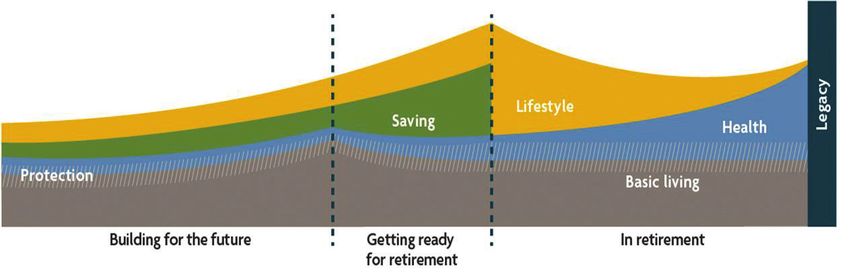
What will you do in retirement?
        Making the most of retirement is about more than having enough money. Rather than focusing on retiring from
        something, consider what you’ll retire to. For example, will you retire to a new career? Or a new hobby? What will
        make you happy? Without a full-time job to go to, you’ll have a lot of time to do other things. Some people say
        they will golf or travel – these activities may take a couple of days a week, or a month out of a year. Consider:

        >   What will you do the rest of the time?
        >   Will your ideas or priorities change over the years?
        >   If you have a spouse, does he or she have the same ideas and priorities?
        Retirement can span many years – 25, 30 or more. You’ve already started thinking about your needs, wants and
        dreams. Remember to take into account how your needs will change along with your age, health, family, the cost
        of living and market fluctuations.

        How will your income needs change throughout retirement?
        As the chart below shows, while some costs tend to diminish in later years, such as spending on clothing and
        transportation, other costs increase, such as spending on health care. Budgeting for health care should be a key
        part of your financial plan, taking into account needs in retirement that are not covered by government and
        employer-paid plans.

        Your changing needs

            Basic living – money for food,  Saving – money that you set aside                                         Health – money to cover health
            clothing, shelter and anything  regularly for your future needs                                           expenses that typically emerge as
            that’s non-negotiable for you 		                                                                          you age
            Protection – money for insurance                            Lifestyle– money for the things               Legacy – money to leave behind
            solutions to protect your income                            you want to do and to cover                   for the next generation or a charity
            and family                                                  personal or household expenses
    Needs

                                                                                              Time

4   >   S t . F r a n c i s X a v i e r U n i v e r s i t y G r o u p R R I F/ L I F   >   Defining your retirement lifestyle
Assessing your retirement income needs
What will your needs, wants and dreams cost?
Now that you have thought about what your ideal retirement might
look like, it’s also important to understand what this could cost.
While most retirees only need 50-70% of their pre-retirement
income to live comfortably, if you plan to have an active retirement,
                                                                                                               >         What can you do today?
                                                                                                                         1. Complete the Annual Expenses
                                                                                                                            and Retirement Income Sources
                                                                                                                            Worksheet on page 24 of this
you may need as much as 100% of your pre-retirement income.                                                                 brochure to help you look at your
                                                                                                                            expenses today and how you think
                                                                                                                            they’ll change in retirement.
How to make your money last longer?
By transferring in savings you have with other financial institutions,                                                   2. You can then work through
you can take full advantage of your St. Francis Xavier University                                                           the Retirement Planner tool,
Group RRIF/LIF, including access to Retirement Consultants,                                                                 which will enable you to set
the ability to manage your investments online and a variety                                                                 a retirement income goal and
of investment options.                                                                                                      learn of ways to achieve that
Additionally, as a plan member, you benefit from management fees                                                            goal. Access the tool by signing
that can be noticeably lower than fees on similar funds with the                                                            into mysunlife.ca and going to
top five Canadian banks2.                                                                                                   my financial centre > my money
                                                                                                                            tools.

Lower management fees means more of your money stays invested.
This can mean higher retirement income or your money lasting longer.
While your rates of return fluctuate beyond your control, you can counter that impact by investing in funds
with lower management fees.

Look at how much money a 0.50% reduction in fees (ignoring any withdrawals) can save you over the
long term!

                                                                       Balance in
                                                                     your account3
                                                                                                                Additional growth
                                                                                                                   in savings
       Years             Single lump-sum                                                                             0.50% reduction in
                                                             1.50% fee                  2.00% fee
     invested                amount                                                                                  management fees

           15                  $100,000                       $167,535                   $155,797                            $11,738
          25                   $100,000                       $236,325                   $209,378                            $26,947
          35                   $100,000                       $333,360                   $281,387                            $51,973

2
    Based on market research conducted by Sun Life Financial on publicly listed management fees for funds offered by the top five Canadian banks through financial advisors or
    their branch network, as of February 2015. The savings amount represents average management fees compared across similar asset categories (excluding Money Market and
    Bond asset categories). Fund management fees are subject to change. The fees vary based on each person’s individual portfolio mix and the funds selected. Please speak to
    a Retirement Consultant for details.
3
    Assumes a 5% investment growth rate and an annual contribution made at the beginning of each year over a defined term. This chart is for illustrative purposes only. It is not
    intended to predict or project investment results. Contributions are subject to personal contribution limits.

                                S t . F r a n c i s X a v i e r U n i v e r s i t y G r o u p R R I F/ L I F   > Assessing        your retirement income needs                       >5
Where will your retirement income come from?
        The chart below shows the different sources of retirement income and
        when they typically become available.
        Your retirement income may come from various sources:
                                                                                                                         >            Take note
                                                                                                                                      Most retirement income sources
                                                                                                                                      are taxable. If you draw too much
                                                                                                                                      income, it may affect your Old
                                                                                                                                      Age Security payments. Talk
        >       Workplace plans and personal savings                                                                                  to our Retirement Consultants
        >       Defined Benefit or Defined Contribution Pension Plans                                                                 about income splitting with a
                                                                                                                                      spouse, and about supplementing
        >       Government retirement income programs such as Canada Pension Plan
                                                                                                                                      your lifestyle with tax efficient
                (CPP), Quebec Pension Plan (QPP), Old Age Security, and Guaranteed
                Income Supplement (if applicable)                                                                                     non-registered income sources,
                                                                                                                                      such as life annuities. See the
        >       Annuities you have purchased
                                                                                                                                      following section for a summary
                                                                                                                                      of income options.

               Earliest company pension may Earliest CPP/                              Earliest Old                  Latest registered “savings” plans
               be available (may be available QPP is                                   Age Security                  must be converted to retirement
               earlier in some jurisdictions) available                                is available                  “income” plans (except TFSAs)

                                                               Average
                    Age 55                           60 61     retirement age          65                           71

                           Your personal savings
                                          Work part-time

                                                     Employer pension (defined contribution)

                                                               RRSP converted to income
                                                                      Annuities (may be registered or non-registered)

                                                                                                      Savings converted to income for life
                                                           Reduced CPP/QPP                                   Canada/Quebec Pension Plan (for life)
                                                                                                             Old Age Security (for life)

                       Workplace plans and                                   Savings converted                                 Government programs
                       personal savings                                      to income

             Consider today’s life expectancy
             The average life expectancies of Canadians at age 65 in 2011 were 83 years for men and 86 years for women. In
             comparison, the corresponding figures in 1961 were 79 years and 81 years, respectively.
             Source: Stats Canada, The Daily, Sept. 25, 2013

             You may be surprised to know
             Government programs are only designed to replace a portion of your income during your retirement years. For
             example, CPP is designed to replace about 25% of your average pre-retirement employment earnings up to a
             maximum amount.4

        4
            Changes to the Canada Pension Plan, http://www.servicecanada.gc.ca/eng/services/pensions/cpp/publications/changes.shtml

6   >   S t . F r a n c i s X a v i e r U n i v e r s i t y G r o u p R R I F/ L I F   > Assessing    your retirement income needs
Identifying your sources of income
How do personal savings convert to income at retirement?
When you want to begin spending the money you’ve saved, you typically have to “convert” that money into an
income account or stream of some kind. In fact, you must convert your registered savings plans by December 31st
of the year you turn 71, although you don’t need to start drawing an income until the following year. Non-Registered
Savings Plans, Employee Profit Sharing Plans and Tax-Free Savings Accounts are not subject to any age or withdrawal
limits, and may be kept invested and/or converted to cash and/or annuities.
If you’re a member of an employer-sponsored Defined Benefit Pension Plan (DBPP)5, you’ll need to make a request
to start receiving your pension. Your HR department will be able to tell you when you are eligible to make the
request, your timing options for retirement, and your DBPP payment options.
Each type of savings plan gives you different options for how you can turn it into income. We’ve listed the
different savings plans, and their corresponding income options on the following page.

5
    A DBPP pays a set pension based on a formula that generally considers age and length of service.

                                       S t . F r a n c i s X a v i e r U n i v e r s i t y G r o u p R R I F/ L I F   > Identifying   your sources of income   >7
What are the different retirement income options available to you?
The “Money in” boxes on the left of the following table represent your retirement savings. Each type of savings plan
has a corresponding retirement income product (the middle boxes). Your savings are transferred into these products
at retirement6. On the right, the “Money out” boxes explain how you are able to receive income from these products
throughout your retirement.
Retirement income options
Money in
>
>
From an RRSP
From a Defined-Contribution
> Registered Retirement Income Fund (RRIF)
>
>
Assets held in an account much like an RRSP
Tax deferred
> Money out
> Must withdraw a minimum % amount
annually based on your age or your
spouse’s age
Registered Pension Plan (RPP)
(non-locked-in assets) > You make all investment decisions
> No maximum withdrawal limit
>
> >
Withdrawals are taxable as income
Money in Life Income Fund (LIF)6 Money out
> From a Locked-In RRSP > Assets held in an account much like an RRSP > Like a RRIF, must withdraw a minimum %
amount annually based on your age
> From a Locked-In Retirement > Tax deferred
and, in most cases, your spouse’s age
Account (LIRA)
> You make all investment decisions
> There is a maximum withdrawal limit,
> From a Registered Pension
> Not available in all jurisdictions, in some cases which changes each year based on
Plan (RPP) (locked-in assets) other income options may be available (see your age and a formula prescribed by
page 21). In most pension jurisdictions, a LIF the applicable pension legislation
may be held for life; in Newfoundland, it must
> Withdrawals are taxable as income
> >
be converted to an annuity at age 80
Money in Annuities Money out
> From any source, both > Purchased from a life insurance company > Payments typically paid monthly and
registered (for example: for a lump-sum amount are generally guaranteed for life
Registered Pension Plan, RRSP,
DPSP) and non-registered > Provides guaranteed payments for life, or for > If annuity purchased with registered
a defined period, depending on the source of savings (except TFSA), then payments
(for example: Employee Profit the funds used to purchase the annuity and are fully taxable as income
Sharing Plan - EPSP, Tax Free the type of annuity purchased
Savings Account - TFSA, > If annuity purchased with non-registered
Non-registered Savings Plan - > For a cost, can add enhancements such as savings, then only a portion of annuity
NREG/personal savings) inflation protection, guaranteed number of payments are taxable
years of payment, payments to a spouse after
your death
> Investment decisions are made by the life
> >
insurance company
Money in Defined Benefit Pension Plan (DBPP) Money out
> From regular contributions > If applicable; may apply to you if you were a > Regular pension payments from
made by your employer member of a DBPP with a previous employer the plan, generally guaranteed
and/or yourself for life, taxable as income
> Provides payments for life, based on a
pre-determined formula that may take > Commuted value7 as cash (less any
into account your age, salary and/or applicable income taxes): if you leave
years of service your employer before age 55, if the
amount in the plan is not significant,
> Tax deferred
or if certain other conditions for
> Investment decisions are made by the unlocking are met
plan sponsor
> Commuted value7 as a transfer to
another registered plan
6
There are unlocking provisions in certain pension jurisdictions, so you may have different income options in certain situations. For details, contact a Retirement Consultant.
7
The commuted value is the lump-sum payout of the existing value of your DBPP and is based on several factors (including long-term interest rates and mortality rates). If you have
contributed to your DBPP for a short period of time, or if the amount that’s been put in your plan is not significant, you may want to consider transferring the commuted value. If
you would like to consider this option, a Retirement Consultant can explain what’s involved and answer your questions about transferring DBPP assets.
8 > S t . F r a n c i s X a v i e r U n i v e r s i t y G r o u p R R I F/ L I F > Identifying your sources of income
Advantages and disadvantages of registered income solutions and annuities
For registered savings, your retirement income decision generally comes down to a choice between a registered
income solution8, an annuity, or some combination of these two options. The appropriate combination for you
will be based on the proportion of variable versus guaranteed income you wish to have.
To help you make your decision, here’s a snapshot of the advantages and disadvantages of the two main retirement
income options (please also see the Glossary on page 21). It is your responsibility to take advantage of the
information and tools made available to you to help you make your investment or income decisions.

                             Registered income solutions                                            Annuities
    Advantages               > Extremely flexible – can take income as                              > Consistent, stable income for life
                                 needed (subject to minimum withdrawal                                 guaranteed by insurer (you assume no
                                 requirements, and maximum withdrawal                                  market risk)
                                 limits for LIFs, LRIFs and RLIFs)
                                                                                                    > Joint annuity is a convenient way to
                             >   Potential for investment growth through                               guarantee financial security and lifetime
                                 a diversified investment strategy                                     income of spouse
                             > Payments can continue to your spouse in > No investment management decisions
                               the event of your death
                                                                        > Savings are not taxed at time of
                             > Can convert to an annuity at any time if   annuity purchase but annuity payments
                                 greater security is desired later in life                             from registered assets are taxed as you
                                                                                                       receive them
                             > Savings and investment income remain
                                 tax deferred until withdrawn                                       > Payments can be indexed for inflation
                                                                                                       (if you select this option)
                             > Potential for capital to be left to the
                                 estate or beneficiary to leave a legacy
    Disadvantages            > Need time and knowledge or help to                                   > May leave nothing for your estate, as
                                 manage your investments                                               most annuity payments end upon death
                                                                                                       with no residual value (unless you die
                             > You assume all market risk; poor returns                                during the guarantee period, if applicable)
                                 could mean less retirement income
                             > Cannot guarantee income for life, cannot > No flexibility in varying income from
                                                                          year to year
                                 mitigate inflation risk; you assume
                                 longevity, market, and inflation risk                              > The purchase of an annuity is irreversible

8
    See Glossary on page 21
    RRIF = Registered Retirement Income Fund                        Consider delaying conversion of registered savings until age 71
    LIF = Life Income Fund                                          Just because you’re retiring, that doesn’t mean you have to convert
    LRIF = Locked-in Retirement Income Fund                         your registered savings into retirement income right away. You
    PRIF = Prescribed Retirement Income Fund
                                                                    have until the end of the year in which you reach age 71 to convert
    RLIF = Restricted Life Income Fund
                                                                    your registered savings into a registered income solution, purchase
                                                                    an annuity, or make a cash withdrawal9.
                                                                    Because you can make withdrawals9 from RRSPs at any time –
                                                                    without any minimum or maximum restrictions – maintaining
                                                                    your savings in an RRSP until age 71 can provide you with optimum
                                                                    retirement income flexibility while continuing to maintain the
                                                                    benefits of tax-sheltered savings.
                                                                    9
                                                                        Cash withdrawals from a locked-in RRSP are generally not permitted due to
                                                                        pension legislation.

                             S t . F r a n c i s X a v i e r U n i v e r s i t y G r o u p R R I F/ L I F   > Identifying    your sources of income   >9
Required minimum withdrawals from registered income solutions
         The minimum amount you must withdraw from RRIFs, LIFs, LRIFs, PRIFs, and RLIFs is dependent on your age and
         is expressed as a percentage of the value of your plan assets at the beginning of each year.
         Remember – while the minimum amount is the same for all five plans, LIFs, LRIFs and RLIFs also have maximum
         withdrawal requirements that are calculated using different formulas.
         Contact one of our Retirement Consultants for more information.

         More about…government retirement income programs
         There are three key government retirement income programs you’ll want to familiarize yourself with:
         > Canada Pension Plan (CPP)/Quebec Pension Plan (QPP)
         > Old Age Security (OAS)
         > Guaranteed Income Supplement (GIS)
         Here are some key facts on government retirement income programs. While we make every effort to keep
         this information current, the government does occasionally change certain provisions. It’s always best to
         confirm facts with government publications and/or websites.

                                CPP/QPP                                                  OAS                                        GIS
           What is it?          A monthly payment to retirees                            A monthly payment to eligible              A supplement to OAS
                                who contributed to CPP/QPP in                            Canadians aged 65 or older. It is          for lower-income
                                their working years. It is taxable                       taxable income.                            seniors. Not subject to
                                income.                                                                                             income tax.
           Who                  You must have worked, made at                            You must be 65 years or older and have     Lower-income seniors,
           qualifies?           least one valid contribution, and                        lived in Canada for a specified number     65 years and older,
                                be at least 60 years old.                                of years to qualify. Benefits are income   may apply. An income
                                                                                         tested; some or all of your monthly        threshold applies.
                                                                                         payment may be subject to a clawback
                                                                                         if your annual taxable income is above
                                                                                         a specified threshold.
           When do              You must apply to receive                                You must apply to receive OAS payments. Based on your income,
           payments             payments. Normal retirement age                          you may also qualify for GIS. Payments begin one month after the
           start?               is 65 years old, but you can start                       normal retirement age of 65. (Note: If you were born on or after
                                receiving your CPP/QPP earlier                           April 1, 1958, you may have to wait until age 67 to start receiving
                                or later than age 65. Deferring                          OAS/GIS.) You can defer starting OAS for up to five years after
                                the start of CPP/QPP payments                            you become eligible, providing you with a higher monthly payment.
                                can provide you with a higher
                                monthly payment. Please visit
                                servicecanada.gc.ca or
                                rrq.gouv.gc.ca to find out
                                how your benefit payments
                                are affected by your age and
                                other factors.

10   >    S t . F r a n c i s X a v i e r U n i v e r s i t y G r o u p R R I F/ L I F   >   Identifying your sources of income
CPP/QPP OAS GIS
How do You should apply at least six You should apply at least six months You can apply online at
you apply? months before you would like before you would like payments to servicecanada.gc.ca,
CPP/QPP payments to start. You start. You can print forms at and you can re-apply
can print CPP forms online at servicecanada.gc.ca. through annual income
servicecanada.gc.ca and QPP tax returns.
forms at rrq.gouv.qc.ca.
How much Benefit payments vary, Benefit payments vary, depending on Benefit payments vary
are the depending on how long you’ve how long you have lived in Canada and based on income levels.
benefits? worked, your age and the upon your annual taxable income.
adjustment for inflation from
year to year. For example:
> You may qualify for full OAS if you
have lived in Canada for 40 years
since you were age 18.
> If you have lived in Canada for
10 years, you may qualify for 25%
of the maximum OAS payment.
Ten years’ residency (after turning 18)
is the minimum to be eligible
for OAS.
> Depending on your annual taxable
income, there may be a government
clawback of all or some of the
OAS payment. Consult the Old Age
Security (OAS) clawback calculator
for an estimate of your monthly OAS
payment. Access the calculator by
signing into mysunlife.ca and going
to my financial centre > my money
tools.
Is the Yes Yes No
benefit
payment
taxable?
About pensions and taxable income
If you have a TFSA or non-registered savings, you may be able to withdraw a combination of taxable and non-taxable
income to minimize your taxes and maximize your income-tested government benefits like OAS. A Sun Life Financial
Retirement Consultant or Advisor can explain how your total income from all sources may impact your income-tested
benefits, so you can determine what makes sense for your personal situation. For personalized, holistic tax planning,
you may wish to consult an accountant or tax specialist.
> Important resource
Refer to the Annual Expenses and Retirement Income Worksheet on page 24 of this booklet. It will help you
list your income sources and the amounts from each and calculate your potential retirement income.
S t . F r a n c i s X a v i e r U n i v e r s i t y G r o u p R R I F/ L I F > Identifying your sources of income > 11Managing retirement risks
It’s no surprise that when markets fluctuate, you may feel uncertain about several aspects of your retirement:
> Will I outlive my savings?
> Will market downturns affect my retirement lifestyle and level of retirement income?
> How will inflation affect my retirement lifestyle?
In your pre-retirement years, there are three significant risks that could impact your retirement income and
retirement lifestyle:
> Risk 1
Longevity Risk
With longer life
> Risk 2
Market Risk
Market declines just before
> Risk 3
Inflation Risk
Over time, inflation
expectancies, you run or after retirement can will reduce the buying
the risk of outliving significantly reduce the power of your retirement
your savings. money available to you income dollars.
in retirement.
> Risk 1
Longevity Risk
The longer you live, the greater your chances of outliving your money. As we’ve
discussed, life expectancy has never been higher.
Despite the strong possibility of living into your 80s or 90s, many people
underestimate their lifespan and risk outliving their assets. With your health
and comfort at stake, it’s not a risk worth taking – especially as medical
advances continue to extend life expectancies even further.
> Risk 2
Market Risk
When you are nearing retirement, market volatility can pose a significant threat
to your retirement savings, since you don’t have many years to recoup any losses
that may occur.
A sizeable market downturn as you get closer to retirement can impact your
portfolio and your potential retirement income. With the immediate need for
drawing an income, there’s no time for your investments to recover.
In the crucial years leading up to, and just after, retirement, the interaction
between your rate of withdrawal and the sequence of returns can have a
dramatic impact on how long you’ll be able to draw income from your
portfolio. Unfortunately, you can’t predict how the markets will perform.
12 > S t . F r a n c i s X a v i e r U n i v e r s i t y G r o u p R R I F/ L I F > Managing retirement risks> Risk 2
Market Risk
(continued)
Here’s an example. Let’s say three people each have a $100,000 portfolio at age 65 and
they each withdraw $750 per month.
They all invest their portfolio differently:
Person A earns 7% in each of the first three years.
Person B has returns of 7%, -13% and 27% in the first three years.
Person C has returns of -13%, 7% and 27% in the first three years.
>
Each person averages a 7% return over three years, but the sequence of returns is quite
different.
Important
resource
Here’s the question.
Find out the impact If this sequence of three-year returns repeats indefinitely, which person runs out of
of a withdrawal money first?
today on your future
retirement savings by
using the Withdrawal 30
calculator. 25
+27 +27
20
Percentage of return
Access the tool
by signing into 15
your account at 10
mysunlife.ca and going 5
+7 +7 +7 +7 +7
to my financial centre 0
> my money tools. -5
-10 -13 -13
-15
Person A Person B Person C
The correct answer is Person C.
The age when assets will be depleted:
Person A Age 87
Person B Age 83
Person C Age 81
That means Person C will run out of money a full 6 years before Person A. As you can see,
despite the fact that the three-year average return is 7% for each sequence, the order of
returns has a dramatic effect on how quickly retirement assets are depleted.
S t . F r a n c i s X a v i e r U n i v e r s i t y G r o u p R R I F/ L I F > Managing retirement risks > 13> Risk 3
Inflation Risk
Inflation rates are currently at historical lows, but even at 2% inflation, for example,
the purchasing power of a dollar is reduced by more than 30% after 20 years.
At 4% inflation (which is the average inflation rate over the past 50 years)10 your
buying power is reduced by almost 55% after 20 years.
>
With so many Canadians living 20 to 30 years or more in retirement, inflation
will have a dramatic impact on your spending power during this time period.
Important
resource What $1 will buy in 20 years:
To see how your
expenses could
increase over time
due to inflation, use
the Bank of Canada
Inflation Calculator,
found at http://
www.bankofcanada.ca/
rates/related/
inflation-calculator/.
1% inflation – $0.82 2% inflation – $0.67 4% inflation – $0.45
There are solutions to help deal with the effects of inflation. In fact, just 1 in 5 Canadians
Whether you’ve had a financial plan in the past or not, it’s a (22%) have a written financial
good idea to build one now. Sound advice, a long-term vision and
plan. Only 51% of those with
contingency plans are important to safeguarding the retirement
lifestyle you’ve worked hard for. a written financial plan say
it covers personal insurance
(e.g. personal health, critical
What can you do to manage risk? illness, etc.).
> Work with a Sun Life Financial Retirement Consultant
or Advisor. Of those with a written financial
> Diversify your investments; investing only in Guaranteed plan, 73% say they are “very
Income Certificates (GICs) may not keep up with inflation. satisfied” or “somewhat satisfied”
with how much they are saving
> Consider guaranteed retirement income solutions to
for retirement. Only 36% of those
protect you from market fluctuations.
without a plan say the same.
> Put a power of attorney in place to protect yourself in the event
that you are unable to make financial decisions on your own. Source: Ipsos Reid 2015 Sun Life Canadian
Unretirement Index
> Consider the types of insurance you need in retirement,
and find out whether you can extend your workplace
health benefits following retirement, either through
your employer or through your benefits provider.
By speaking with an Advisor you can decide which income solution, or combination of solutions, would best suit
your personal situation. An Advisor can help you identify risks and create a financial plan for you to manage them.
10
http://www.bankofcanada.ca/rates/related/inflation-calculator/
14 > S t . F r a n c i s X a v i e r U n i v e r s i t y G r o u p R R I F/ L I F > Managing retirement risksTaking action on your retirement plan
Now that you have reached this point in the guide, you probably have a better understanding of your retirement
income needs and options. You’ve helped yourself take the first step in building a plan that fits your retirement.
Now, it’s time to take action.
Sun Life Financial’s Client Solutions Centre offers group plan members free, ongoing, one-on-one telephone support to
provide plan guidance and information on available options. Our team of licensed Retirement Consultants can assist
you in determining the retirement income solution suitable for you (RIF/LIF and/or annuity), and in setting this up.
Our Retirement Consultants are available by phone to discuss:
> Retirement income planning for assets accumulated through your workplace plan(s), including a review of your
risk tolerance and your investment strategy
> Gaining additional savings through consolidation of assets (including commuted values from a Defined Benefit
Pension Plan)
> How government programs and your own workplace retirement savings plan work with your financial picture
> Insurance solutions to protect you and your family’s financial future
> Options for spousal assets
Our Retirement Consultants can also connect you with a Sun Life Financial Advisor who can meet with you in person
for a more in-depth discussion on building and protecting your savings.
In addition to the services provided by Retirement Consultants, a Sun Life Advisor can also help you to:
> Assess your current situation by examining your finances holistically, including tax and estate considerations
> Set achievable financial goals, identify opportunities and develop a realistic plan to meet those goals
> Put your plan into action and monitor its progress
> Revise your plan to accommodate changes in your goals
Next steps
1. Consult the CRA and RRQ websites for information on government programs: cra.gc.ca and rrq.gouv.qc.ca.
2. Refer to online tools and resources in the Retirement section of mysunlife.ca/Choices. Access additional tools
by signing into your account at mysunlife.ca/Choices and going to my financial centre > my money tools.
3. Follow the steps in the Retirement Resources Checklist on page 22 of this booklet:
> Revisit your retirement savings to make sure you are on track
> Make sure you have a financial plan and estate plan in place
> Understand what you need to do with your employer
> Ask your employer or benefits provider if you can extend your benefits coverage in retirement
> Understand what you need to do with your government benefits.
4. Complete the Annual Expenses and Retirement Income Worksheet on page 24 of this booklet.
5. Call one of our Retirement Consultants at 1-866-224-3906 (select option 1) any business day from
8 a.m. to 6 p.m. ET. They can help you make informed decisions about your retirement savings
options or provide you with a referral to a Sun Life Financial Advisor.
> Learn more about the
St. Francis Xavier University Group RRIF/LIF
and the investment options it provides.
>>>
S t . F r a n c i s X a v i e r U n i v e r s i t y G r o u p R R I F/ L I F > Ta k i n g action on your retirement plan > 15The St. Francis Xavier University
Group RRIF/LIF
You may continue to enjoy convenience, peace of mind, and many advantages similar to those of your
workplace plan through the St. Francis Xavier University Group RRIF/LIF. You can also have confidence in
continuing your relationship with a provider that 1 in 5 Canadians trust with their lifetime financial security.
As a plan member you benefit from:
1. Well-managed investment choices
St. Francis Xavier University sponsors a Group RRIF/LIF that offers many of the same high-quality investment
options available through the Retirement Plan for Teaching, Administration, and Other Employees of St. Francis
Xavier University, plus some additional options, at negotiated low fees.
2. Lower fund management fees
As a member of the St. Francis Xavier University Group RRIF/LIF, you will benefit from paying lower fees that would
generally not be available to you as an individual investor at a mutual fund company or other financial institution.
Lower fees, an important benefit of belonging to this group plan, can have a large impact on the costs you incur in
your retirement income plan, and can help you keep more money where it belongs – in your account. Please see
page 5 for more information on why lower fees are an important benefit of the plan.
3. Ability to consolidate outside assets
To allow you to take full advantage of the attractive fees and features offered, assets held at other financial
institutions may be brought into the St. Francis Xavier University Group RRIF/LIF.
4. Spousal access to the plan
Spouses of St. Francis Xavier University retirees who have a Spousal RRSP through the Saint Francis Xavier
University Group Retirement Savings Plan have access to the Group RRIF/LIF, and may bring in assets held
at other financial institutions.
5. Ongoing support and objective guidance
You have unlimited access to confidential one-on-one guidance through Sun Life’s licensed Retirement
Consultants, or we can match you with a Sun Life Financial Advisor who can help you create or review
your financial plan.
6. Convenience
Review and manage your savings online at mysunlife.ca.
Plan options and eligibility
When the time comes to convert retirement savings to retirement income, members of the Retirement Plan for
Teaching, Administration, and Other Employees of St. Francis Xavier University have the following options:
> A RRIF/LIF with Sun Life Financial;
> A RRIF/LIF with another financial institution; and/or
> An annuity with Sun Life Financial or another insurer.
16 > S t . F r a n c i s X a v i e r U n i v e r s i t y G r o u p R R I F/ L I FInvestment options
St. Francis Xavier University Human Resources has selected high-quality funds with the needs of retirees in mind,
and has provided funds that will be similar to those currently offered through the Retirement Plan for Teaching,
Administration, and Other Employees of St. Francis Xavier University.
The funds available in the St. Francis Xavier University Group RRIF/LIF and their fund management fees (FMFs) are
shown below.
Asset class Funds available through the plan 11 FMFs12
Guaranteed SLA 5 Year Guaranteed Interest Account N/A
Money market Sun Life Financial Money Market Segregated Fund 0.49%
Bond (fixed income) PH&N Bond Segregated Fund 0.90%
TDAM Canadian Bond Index Segregated Fund 0.65%
Balanced Fiera Sceptre Balanced Core Pooled Segregated Fund 0.83%
PH&N Balanced Segregated Fund 0.90%
Canadian equity Fiera Sceptre Canadian Equity Pooled Segregated Fund 0.88%
PH&N Canadian Equity Plus Pension Segregated Fund 0.92%
Foreign equity PH&N Global Equity Segregated Fund 1.31%
PH&N U.S. Equity Segregated Fund 0.92%
Some of the funds offered under the plan may not be available to non-residents. Please talk to a Sun Life Retirement Consultant for more information.
11
Fund Management Fees (FMFs) are expressed as an annual percentage of dollars invested; FMFs as at July 31, 2015. Returns reported will be net of fees and taxes.
12
The FMFs displayed in this document do not include applicable sales tax. However, these taxes are charged to your account. FMFs include, but are not limited
to investment management fees, fund operating expenses and charges for administration and services.
Guaranteed Interest Account (GIA) rates available for higher balances:
The rates that St. Francis Xavier University and Sun Life have negotiated are very competitive. However, rate
enhancements may be available for members considering investing $1 million or more in guaranteed funds.
Please speak to a Sun Life Retirement Consultant for details.
Deposit Insurance Coverage
All deposits to GIAs from Sun Life Assurance (SLA) are eligible for insurance through Assuris. Assuris insurance coverage
for registered assets is aggregated, and coverage for all the assets held in trust/non-registered is aggregated.
Assuris does not permit the disclosure of their exact coverage amounts; however this information is available on
the Assuris website at www.assuris.ca.
S t . F r a n c i s X a v i e r U n i v e r s i t y G r o u p R R I F/ L I F > Investment Options > 17Plan information
Payment schedule
The St. Francis Xavier University Group RRIF/LIF offers flexibility in the frequency, order of depletion (use of
investments for payments) and deposit options for income payments:
Frequency Monthly, Quarterly, Semi-annually or Annually
Date 1st, 15th or last business day of the month.
Level You can specify the amount that you want to be paid.*
Indexed You can specify the rate at which your payments will be indexed each year.*
Interest You will be paid the interest earned on your guaranteed funds since your last payment date.
Any difference required to meet the minimum will be paid from the principal.
Minimum You will be paid the minimum amount set by the Income Tax Act. The minimum amount can be
based on your age, or your spouse’s age.**
Maximum For LIF, Locked-in Retirement Income Fund (LRIF) or Restricted Life Income Fund (RLIF) only, you can
choose to take the maximum allowable amount set by pension regulations.***
*
Any payment amount selected is subject to a statutory minimum. As well, there is a statutory maximum for LIF, LRIF and RLIF.
**
Minimum amount based on your spouse’s age is not available for any pension assets that originated in New Brunswick.
***
LRIF is only available for pension assets that originated in Manitoba and Newfoundland, RLIF is only available for assets that originated in a pension under
federal jurisdiction.
Payment options
Payments must fall within the permitted minimum and maximum limits established by law. Sun Life Retirement
Consultants can assist in determining the appropriate level of income payments, within legislated limits. The level
of payments selected will take effect on the date the RRIF/LIF is established with Sun Life. Payment frequency
can be made on a monthly, quarterly, semi-annual or annual basis.
Payments may be made by Electronic Funds Transfer (EFT) directly to a Canadian bank account, or via cheque.
For non-resident Canadians
Non-resident Canadians are eligible to join, however an attorney acting under a Power of Attorney (POA), who is
a resident of Canada, is required for non-resident Canadians to enrol in the plan. The POA is for one-time limited
use only, to enrol into the RRIF/LIF. The process is simple and does not require a notary or lawyer signature.
If you are a non-resident and wish to grant a third-party access to your account for information or transactional
purposes, you must complete the Transaction Authorization and Access to Personal Information form, available
through a Retirement Consultant.
Non-resident Canadians may also receive payments at the frequencies and through the methods noted above. A
Canadian bank account is required to receive payment by EFT.
Investment funds used for payments
Investments must be sold to create the cash for the payments you receive. You may deplete your investment
funds in a specified order, according to specified percentages or evenly across all funds – you choose!
Additional payments to you
Need additional funds? You can request a lump sum payment at any time, at no extra charge, subject to the
maximums set out in the LIF and withholding tax.
18 > S t . F r a n c i s X a v i e r U n i v e r s i t y G r o u p R R I F/ L I F > Plan informationTax withheld
You can request that tax be withheld on a withdrawal from your RRIF/LIF over and above the required amount.
The full amount that you withdraw, including additional lump-sum payments, must be included as income for
the year and will be subject to taxation. Income Tax regulations require that tax be withheld from your payment
if it exceeds the required minimum amount. You will receive a tax slip at the beginning of each year that shows
the amount that you were paid in the previous year. You can also view your tax slips online when you sign in to
mysunlife.ca and go to my financial centre > requests > tax slips and RRSP info. Please note – tax implications
for non-residents differ from those that apply to Canadian residents; please consult a tax expert for guidance
on non-resident tax matters.
Fees
Fund management fees include the operating expenses for both the segregated fund and the underlying fund.
They also include the fees for the professional investment managers of the underlying funds. Fees will be taken
out of investment returns prior to your account being updated to the latest market value.
Withdrawal fees: There is a $100 fee for transfers out of a RRIF/LIF.
Members of the St. Francis Xavier University Group RRIF/LIF will find more details on fees by signing in to
mysunlife.ca and going to my financial centre > accounts > account fees.
Market Value Adjustment (MVA)
When a deposit to a guaranteed interest account (GIA) is withdrawn prior to maturity, for any reason other than
death or disability, the withdrawal will be calculated at market value (MV). If interest rates have changed since
the time of the original deposit, the withdrawal amount will be adjusted to reflect the deposit’s market value.
This change is referred to as a market value adjustment (MVA).
To determine the market value (MV) of the deposit payable, the following process is employed. The value of the
deposit, plus compound interest, would be projected to the original maturity date using the original guaranteed
interest rate. This value would then be discounted back to the date of the withdrawal using the then current
market rate (without adjustment) on a GIA deposit of the same term as the original deposit.
Regular payments determined by your payment schedule will not be subject to MVA. However, lump sum payments
and/or withdrawals from a GIA prior to maturity may be.
Leaving the St. Francis Xavier University Group RRIF/LIF
You have several options if you wish to transfer out of the plan. You can:
> Transfer to another RIF, LIF, LRIF, PRIF or RLIF (where permitted by pension legislation)
> Convert to an annuity with Sun Life Financial or another provider; and/or
> Receive a lump-sum cash payment for non-locked-in funds (withholding taxes may apply)
Benefits paid upon your death
In the event of your death while you are still a plan member, your RIF assets will be paid to your designated
beneficiary as a lump-sum cash payment or to your estate if no beneficiary has been designated.
If you have a LIF, pension legislation may require that your spouse or common-law partner be entitled to the
death benefit, regardless of your designated beneficiary.
If your spouse or common-law partner, dependent child or grandchild is entitled to the death benefit, he/she
will also have the option to transfer this benefit to him/herself on a tax-deferred basis.
S t . F r a n c i s X a v i e r U n i v e r s i t y G r o u p R R I F/ L I F > Plan information > 19Access your plan
Once you have enrolled in the St. Francis Xavier University Group RRIF/LIF you will receive a welcome letter
that includes your account number and instructions on how to get your access ID and password registered
to sign in to mysunlife.ca.
Phone
Plan information and guidance – 1-866-224-3906 (select option 1), 8 a.m. - 6 p.m. (ET)
Online
You’ll find helpful information, additional products and services and tools to manage your account at
mysunlife.ca. If you don’t have an access ID and password, go to mysunlife.ca and click on the “Register now”
link. You’ll need your plan member account number and your date of birth. Your account number is located
in the welcome letter.
Mobile app
The my Sun Life Mobile app makes it possible to access your account on the go, and:
1. Check your balances
2. View your most recent plan activity
3. Try some financial planning tools
The my Sun Life Mobile app is available free of charge to plan members through BlackBerry App World, Apple
App Store and Google Play. To learn more, visit sunlife.ca/mobile.
For the my Sun Life Mobile web app go to m.mysunlife.ca.
Tablet and laptop users can continue to access the full website experience at mysunlife.ca.
20 > S t . F r a n c i s X a v i e r U n i v e r s i t y G r o u p R R I F/ L I F > Access your planAppendix
Glossary of retirement income options
Registered Retirement Income Fund (RRIF)
A RRIF provides you with income during your retirement years. A RRIF is like a continuation of a Registered
Retirement Savings Plan whereby the funds remain tax-sheltered and you continue to choose how those funds
are invested. The main difference is that instead of putting money in (contributing as is done with an RRSP), the
RRIF is designed to pay money out.
With a RRIF you must withdraw a minimum amount each year (except for the year of purchase). There is no
maximum limit on the amount that can be withdrawn but if you make significant withdrawals, your funds may
not last as long as you originally intended.
Life Income Fund (LIF) and Locked-in Retirement Income Fund (LRIF)
These products provide income from money that was originally in an employer-sponsored pension plan. If you
have money from a locked-in RRSP, Locked-In Retirement Account (LIRA) or pension plan, you can choose to put
your assets into a LIF or, if available, LRIF. Locked-in assets are usually assets that were originally earned while you
were employed and continue to be subject to pension legislation.
The tax-sheltered money invested in a LIF can provide regular income and is held in an account similar to an RRSP.
You make all of the investment decisions and a LIF can be held for life, or it can be converted to an annuity. A LIF
is creditor-protected, meaning creditors cannot access LIF funds in the event of insolvency or bankruptcy. A spouse
or pension partner may be deemed the beneficiary on a LIF if they have not waived this privilege. Like a RRIF,
there are minimum withdrawal requirements based on your age, but there are also maximum withdrawal limits.
Withdrawals are taxable as income. Pension jurisdictions regulate the maximum annual withdrawal amount.
LIFs are available in every pension jurisdiction, except Prince Edward Island where there is no pension legislation.
LRIFs are only available in Manitoba and Newfoundland.
Prescribed Retirement Income Fund (PRIF)
PRIFs are similar to regular Registered Retirement Income Funds (RRIFs), with the exception that a PRIF may
be creditor-protected, meaning creditors may not be able to access PRIF funds in the event of insolvency or
bankruptcy, and, like Locked-in Retirement Income Funds (LRIFs), you can only transfer locked-in retirement funds
into a PRIF. A spouse or pension partner may be deemed the beneficiary on a PRIF if they have not waived this
privilege. PRIFs do not have a maximum annual withdrawal amount. PRIFs are currently only available in Manitoba
and Saskatchewan.
Restricted Life Income Fund (RLIF)
Similar to a Life Income Fund (LIF), however, a RLIF annuitant may on a one-time basis unlock 50% of the funds.
RLIFs are available only for PBSA (Pension Benefits Standard Act) federally-regulated pension plans.
Annuities
Annuities can provide you with monthly payments for the rest of your life, at a set term or a set number of payments.
There are no tax implications at the time of purchase. If you purchase an annuity using your registered savings,
then your payments are fully taxed. If you purchase an annuity using your non-registered savings, only a portion
of the annuity (the interest) is taxable.
S t . F r a n c i s X a v i e r U n i v e r s i t y G r o u p R R I F/ L I F > Glossary of retirement income options > 21Retirement resources checklist
Your quality of life in retirement depends on the planning you do today.
Saving money for your future should have a place on your financial priority
list. This checklist can help you understand the steps you could take today
to reach your retirement dreams tomorrow.
> Making debt disappear
While you can’t wave a magic
wand to make debt disappear,
it’s uncanny how a focused
1. Define your retirement lifestyle. effort to reduce debt works.
Using the notes page in this guide, make a list of lifestyle priorities And it pays to make it a priority,
for your retirement, taking into consideration: as the debt you currently carry
as an income-earner may
> What will you do with the time you used to spend at work? prove to be less affordable
> Will your ideas or priorities change over the years? during retirement.
> If you have a spouse, does he or she have the same ideas Tackle the debt with the highest
and priorities?
interest rate first – for example,
credit card balances. If you don’t
2. Do a financial check-up to understand what your retirement might cost.
have the money to pay a
Record your spending habits and consider how they will change in lump-sum, increasing your
retirement. monthly payments can make
> Complete the Annual Expense and Retirement Income a significant difference.
Sources Worksheet. A similar tool is available online at Aim for as clean a slate as possible
mysunlife.ca. when you retire. Without that
> Use the Bank of Canada Inflation Calculator, found at steady paycheque, you may
http://www.bankofcanada.ca/rates/related/inflation-calculator/, need more of your savings for
to see how your expenses could increase over time due to day-to-day living than you realize.
inflation. to see how your expenses could increase over time
due to inflation.
> Begin to eliminate or reduce debt. See the sidebar for more information on this step.
List your sources of retirement income and the amount of income from each.
> The Annual Expense and Retirement Income Sources Worksheet will help. Remember to include
all sources of income (government benefits, employer-sponsored plans, personal savings, etc.).
Consult online or paper retirement planning tools, such as:
> Sun Life Financial’s Retirement planner at mysunlife.ca (sign into your account to access the tool).
3. Consider working with a Sun Life Financial Retirement Consultant or an advisor to put a financial plan
in place.
> Our Retirement Consultants are available any business day from 8 a.m. to 6 p.m. ET.
Call 1-866-224-3906 (select option 1).
22 > S t . F r a n c i s X a v i e r U n i v e r s i t y G r o u p R R I F/ L I F > Retirement resources checklistAre you retirement ready?
Once you have completed steps 1-3 you should have a better idea if you are you on the right track to reaching
the retirement you envisioned.
No – What do I do?
Are you on track?
I’ve saved more than
I expected.
Yes – I’m right where
I thought I should be.
> Protecting what you’ve built
Building a retirement income
plan is key to enjoying the
retirement you want, however
it’s important to protect what
you’ve built using insurance
coverage that fits your needs.
Don’t panic. Excellent. Make a Great. Keep up the
Work through the note to consider good work!
Retirement planner tax implications of
by signing into extra savings.
mysunlife.ca.
Speak with a Sun Life
Financial Retirement
Consultant or Advisor.
S t . F r a n c i s X a v i e r U n i v e r s i t y G r o u p R R I F/ L I F > Annual expenses and retirement income worksheet > 23Annual expenses and
retirement income worksheet
Annual expenses worksheet
What will my expenses be at retirement? Fill this out by adjusting your current expenses to reflect the changes
inherent to retirement (reduction of transportation costs, your health and/or the need for emergency funds).
Please enter the expenses you expect to have in
retirement thinking comparatively to what you
spend today.
Current age:
Planned retirement age:
Basic expenses
Accommodations Current Monthly Retirement Monthly
Mortgage/rent: $ $
Utilities (heat, electricity): $ $
Property taxes: $ $
Phone/cable/internet: $ $
Maintenance repairs: $ $
Insurance (home): $ $
Living expenses Current Monthly Retirement Monthly
Groceries: $ $
Clothing: $ $
Clothing costs may decrease Dependent/family care: $ $
as your emphasis shifts from
Personal care (Hairstylist, etc.): $ $
business attire to casual wear.
Emergency funds: $ $
Health Current Monthly Retirement Monthly
Insurance (life and health): $ $
Check to see whether the health Prescriptions: $ $
benefits you received from your Dentist/Chiropractor/Optometrist/etc.: $ $
last employer will continue to
you and a non-working spouse
in retirement. Transportation Current Monthly Retirement Monthly
Car payment/lease: $ $
If you own two vehicles, consider Car insurance/registration: $ $
whether you’ll continue to need Fuel/maintenance: $ $
both in retirement.
Public transportation: $ $
24 > S t . F r a n c i s X a v i e r U n i v e r s i t y G r o u p R R I F/ L I F > Annual expenses and retirement income worksheetAnnual expenses worksheet (continued)
Basic expenses
Other/emergency/debt Current Monthly Retirement Monthly
$ $
Discretionary
Current Monthly Retirement Monthly
Dining out: $ $
Movies/theatre: $ $
Budget for travel, hobbies, Newspaper/magazines/books: $ $
and other leisure activities if
Sports activities/hobbies: $ $
they’ll be an important part
of your retirement lifestyle. Travel/vacation: $ $
Further education: $ $
An emergency fund can Donations/gifts: $ $
cover unexpected and
Other/emergency funds: $ $
occasional expenses.
Keep in mind that expenses will change as you age. There are different phases to retirement. Early on, you will spend more
on leisure but that will decrease as you slow down and your priorities change.
Retirement income sources worksheet
Please list your annual income from guaranteed sources, and your lump-sum savings. If you have a spouse, please list their
income and savings information as well.
Self Spouse Total
Annual guaranteed income
Canada/Quebec pension plan
Old age security
Defined benefits pension
Annuity payments
Total annual guaranteed income
Self Spouse Total
Lump sum savings
RRSP(s)
Defined contribution pension plan
Deferred profit sharing plan
Other registered plan (RRIF/LIF/LRIF)
Non-registered savings
TFSA
Total lump sum savings
S t . F r a n c i s X a v i e r U n i v e r s i t y G r o u p R R I F/ L I F > Annual expenses and retirement income worksheet > 25You can also read


