St. Vincent & the Grenadines: La Soufrière Volcano - ReliefWeb
←
→
Page content transcription
If your browser does not render page correctly, please read the page content below
St. Vincent & the Grenadines: La Soufrière Volcano
Report No. 03
As of 17 September 2021
This report is produced by the United Nations Sub-Regional Team (UNST) f or Barbados and the Eastern Caribbean, in
collaboration with humanitarian partners. It is issued by the Office of the Resident Coordinator with the support of the United
Nations Office for the Coordination of Humanitarian Affairs (OCHA).

HIGHLIGHTS

•   An additional USD 200,000 has been raised under
    the UN Global Funding Appeal f or Saint Vincent
    and the Grenadines. The appeal now stands at
    USD 11.3 million, and this total includes funds
    repurposed and mobilised by UN agencies, as well
    as pipeline funding.

•   COVID-19 continues to be pervasive, and between
    August and September 2021, it has been
    conf irmed by the Ministry of Health & the
    Environment the identification of the COVID-19
    Delta, Mu, and Gamma variants.

•   The Post Disaster Needs Assessment (PDNA)
    draf t report has been presented to the Government
    of Saint Vincent and the Grenadines for review and
    validation.

•   The Alert Level has changed to YELLOW.

SIT UATION OVERVIEW
People sheltered due to the April volcano eruption have been cleared to return to their homes. The Government has lowered
their Volcanic Alert level for the La Soufrière volcano from ORANGE to YELLOW five months after the volcano’s April 2021
eruption that prompted the UN in Barbados to launch a USD 29 million appeal. With the downgraded alert, residents who
had evacuated from areas surrounding the volcano are now allowed to return to their homes, with the shelter population

              United Nations House • Marine Gardens • Christ Church • Barbados • Tel: 246 467 -6000 • Email: rco.bb@one.un.org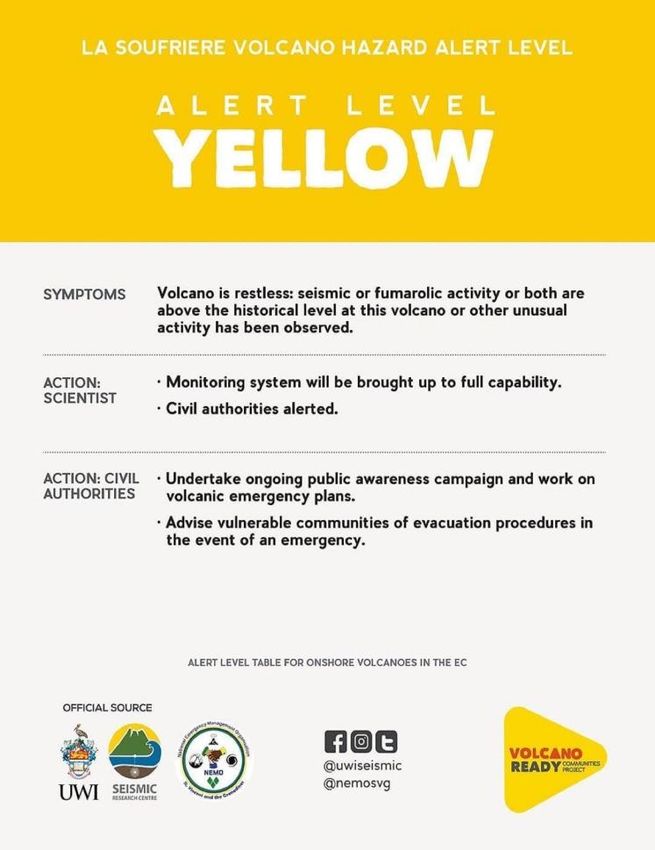
Country Report No. 03 | 2

last reported to be at around 393 in 19 shelters 1. The National Emergency Management Organisation (NEMO) indicates
that while the La Soufriere’s activity levels have declined over the past three months, the volcano is still restless and
exhibiting seismic and/or fumarolic activity above historical levels before the April eruption. Lahars and heavy steaming and
degassing will persist for some time during high rains, presenting an added threat ahead of the peak of the 2021 hurricane
season.

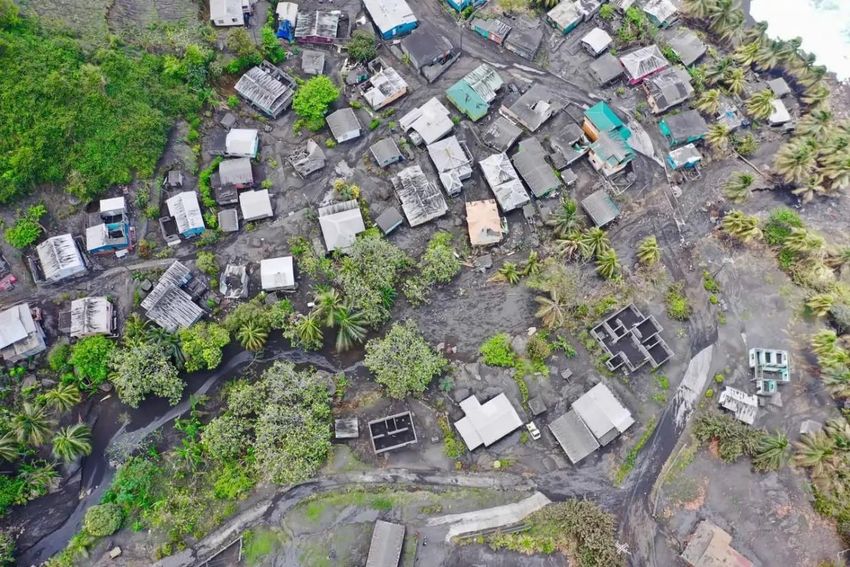
                        Aerial view of houses in the red zone damaged by the La Soufriere volcanic ash. Photo credit: Kerry Kerr.

UN HUMANITARIAN AND RECOVERY RESPONSE
       Early Recovery
Needs:
• Cleaning and clearing of ash and debris.

Response:
•      Post Disaster Needs Assessment (PDNA) draft report has been presented to the Government of Saint Vincent and
       the Grenadines for review and validation.
•      The second phase of the ash removal programme will commence in September/October 2021. To date, work teams
       have cleaned the compounds of at least nine schools, including drains, footpaths, open areas, churches, and other
       critical infrastructure removing approximately 15,000 cubic yards of ash.

Gaps & Constraints:
• National ash management plan to be articulated by the Government as this determines the medium to long term
   strategy for the ash.

      Education

Needs:
• Teaching-learning support for the preparation of exams.
• Support for exam preparation of displaced children and children whose schools were being used as shelters.

1
    https://caribbean.loopnews.com/content/svg-less-400-volcano-evacuees-emergency-shelters

                  United Nations House • Marine Gardens • Christ Church • Barbados • Tel: 246 467 -6000 • Email: rco.bb@one.un.org
Country Report No. 03 | 3
• The recovery of education for children who missed out on their education and did not perform well in the exams.
• Support the refurbishment of schools that were used as shelters.
• Ensure that schools are fully functional in return areas.
Response:
• In collaboration with UNICEF, the Ministry of Education (MoE) has initiated an Education Recovery programme for
children at the primary and secondary levels who lag in their studies due to school closures. This three-week Summer
Bridging programme is part of the Recovery of Learning and Motivation and Psychosocial Support (ROLES)
programme. National diagnostic assessments were completed at the end of July and analysed to determine specific
f ocus areas. This initiative is designed to help bridge knowledge and skills for children due to school closures and
provide support for children's well-being and social-emotional and mental health. Approximately 2,000 children were
enrolled in the programme, which formally commenced on August 30. Further disaggregation of data will be
conf irmed in the following report, but 51% should be female.
Gaps & Constraints:
• A f ormal assessment of schools in the return areas is yet to be undertaken so that schools can open safely.
Food Security, Cash, Livelihoods, and Agriculture
Needs:
• Loss of assets and livelihoods (crops, livestock, and fisheries). 3,538
• Continued support to evacuees to ensure food and other basic needs.
• Ongoing adverse socio-economic impacts of the COVID-19 pandemic compound the
situation.
The number of households
Response: registered under the Soufriere
• The World Food Programme (WFP), in partnership with the Ministry of National Relief Grant.
Mobilisation, Social Development, Family, Gender Affairs, Youth, Housing and
Inf ormal Human Settlements (MoNM), is implementing the Soufriere Relief Grant to assist vulnerable households
af f ected by the volcanic eruption. The programme provides monthly cash transfers to evacuees staying in private
homes, displaced health workers, and other vulnerable populations. People in public shelters received a payment
under the f irst round of payments and will be enrolled in the monthly cash transfers as they leave the shelters.
• The f irst round of distributions was completed in July 2021, and the second payment round is currently underway,
with those in private homes having already received assistance. Two further payment rounds are planned for
September and October 2021. Plans are underway for WFP to provide additional assistance to Soufriere Relief Grant
benef iciaries in the form of vouchers following the fourth round of cash transfers.
• As of September 6, payments totalling USD 1.4 million have been sent to 3,538 households registered under the
programme, reaching an estimated 19,273 individuals. Beneficiaries received payment notifications and codes via
SMS and collected their payments through money transfer agents located across the island.
• WFP and the MoNM conducted an initial round of post-distribution monitoring between 21-30 July to assess
benef iciaries' experiences and satisfaction with the assistance received, identif ied potential challenges, and analysed
the programme's impact. An additional round of post-distribution monitoring is planned for October.
• WFP, in collaboration with MoNM, undertook a verification and needs assessment with 5,768 households between
May 5 and June 30. This data - including information on household composition and vulnerabilities - are being
incorporated into the Post Disaster Needs Assessment. WFP is also preparing a report for the Government with an in-
depth analysis of this data.
• UNICEF continues to support the MoNM to provide cash-based support to selected affected households through the
social protection system. During this reporting period, the following was achieved:
− 500 households were identified under the Family Support Grant and received the first of their three-
monthly payments. The remaining two payments will be made in the third week of September and
October, respectively. This piloted the use of electronic payment through the Bank of Saint Vincent, and
the national Cabinet subsequently approved this system for future social assistance programmes.
− MoNM conducted training for facilitators who will cascade similar workshops on life skills to rebuild
livelihoods and deliver hygiene messages. These Family Life Education trainings will start in September.
One member of each beneficiary household will be required to participate in these trainings that will be
organised over a period of 8 weeks and will cover five districts.
United Nations House • Marine Gardens • Christ Church • Barbados • Tel: 246 467 -6000 • Email: rco.bb@one.un.orgCountry Report No. 03 | 4
− UNICEF and partners will also roll out a La Soufriere Relief Grant for those families that require support
beyond the emergency period. It will cover 500 households that will receive cash support in the form of a
transition grant through the national social protection system. Beneficiary households will be identified in
the next period, and they will also be required to participate in similar training.
• Food and Agriculture Organization of the United Nations (FAO) is preparing to assist with soil analysis to support crop
re-establishment planning.
Gaps & Constraints:
• Financial resources for cash transfers and food distributions.
• Gaps in additional information on damage and recovery needs.
• Capacity constraints in the public service.
Health
Needs:
• Improve Health Information Services with respect to Supply Chain Management.
• Support HEOC and coordination of health support.
• Support surveillance data collection.
• Further needs will be identified once the rapid SRH assessment of shelters is completed.
Response:
• Pan American Health Organisation (PAHO) collaborated with the Ministry of Health (MoH) to adapt and develop ten
educational, social media cards. These cards aim to educate community members, visiting select social media sites
on the preparation and consumption of healthy foods.
• PAHO and MoH are finalising contracts for WASH interventions in 20 selected health care facilities and is working on
a Mental Health and Psychosocial Support (MHPSS) jingle.
• PAHO, together with the Caribbean Public Health Agency (CARPHA), finished Surveillance/Early Warning and Rapid
Response in a box training.
• PAHO purchased dialysis machines for the Modern Medical Centre in Georgetown, delivered 3x noncommunicable
diseases (NCD) kits.
• PAHO purchased a vehicle for the MoH Planning department to support retrofitting and maintenance of health care
f acilities.
• PAHO Air Quality Monitoring sensors will be placed between 17-24 September 2021 at 5 locations.
• PAHO supported cleaning of the Chateaubelair Smart Hospital in the Orange zone on the leeward side of the island
• The World Food Programme (WFP) is supporting PAHO logistics and providing food vouchers and cash transfers to
displaced health care workers and vulnerable groups.
Gaps & Constraints:
• Heightened risk of COVID-19 transmissions.
Logistics
Needs:
Coordination of supply and distribution of relief items. 1,170,000
Response:
• WFP continues to support the government-led response through its logistics capacity KG
and expertise to strengthen the existing relief management systems. WFP’s technical
Relief cargo has been
assistance and mobilisation of logistics assets and equipment complement its direct
received and recorded in the
assistance to affected populations through cash transfers. CLS.
• The CDEMA Logistics System (CLS), an online system developed by WFP with
CDEMA, was launched in Saint Vincent and the Grenadines shortly after the eruption to register, track and give
visibility to available assets and relief items delivered to affected populations. The WFP provides ongoing support to
NEMO in managing the system and helps determine actual relief stock on hand.
• The CLS currently has 100 registered CLS users and 12 registered warehouse sites. In total, 945 service request
f orms have been approved through the CLS to dispatch requested assets to requesting partners. WFP continues
United Nations House • Marine Gardens • Christ Church • Barbados • Tel: 246 467 -6000 • Email: rco.bb@one.un.orgCountry Report No. 03 | 5
training national CLS staff to strengthen capacities around general logistics functions, including training for shelter
managers on the use of digital scanning for the receipt of stock.
• WFP continues supporting the receipt and dispatch of relief goods to affected populations, facilitated, and tracked in
the CLS. As of September 8, 1.17 million kg in relief cargo have been received and recorded in the CLS, and 577.340
kilograms have been dispatched through the CLS to 80 dispatch locations to assist evacuees. With the dismantling of
the central Arnos Vale Logistics Hub, WFP is supporting NEMO in methods for removing Mobile Storage Units and
relocating emergency stocks to alternate government facilities, which will provide an opportunity for additional stock
checks. As part of the transitioning process, WFP is also preparing the handover of critical logistics assets to NEMO
based on the needs identified by the Government.
Protection
Needs:
• Saf e spaces/centres for children, women, and vulnerable people.
• Child protection and violence prevention and response services. 2,000
• Active engagement and capacity building of shelter managers to mitigate Gender-
Based Violence (GBV) risks.
• Ensure women and girls are included in decision-making and encouraging women-
led support groups. The number of children and
• Strengthen the child protection systems in areas of return. youth who received academic
and psychosocial support
through the ROLES
Response:
programme.
• Child Protection and Well-being Coordination Team, whose participants represent
UNICEF, MoNM Child Development Division, Ministry of Education and Health, IFRC, the national SVG Red Cross,
IsraAid, Adult Education, Early Childhood Education, and the National Library Association, are actively engaging in
meetings to evaluate ways that child protection and violence prevention response services can be advanced through
collaborative programming and messaging.
• UNICEF continues to support Child-Friendly Spaces (CFS), which expanded from shelters into schools and
community locations as families transitioned back into their villages. MHPSS were brought into 21 spaces where 526
f amilies could easily access services.
• With the support of UNICEF, the MoNM partnered with the MoE to provide 1,300 children entering 6th grade and 700
youth entering Form 5 across 45 schools with academic and psychosocial support through the ROLES programme
(Recovery of Learning and Emotional Psychosocial Supports).
• UNICEF and the national authorities continued to support five unaccompanied and separated children that were
placed in family-based or suitable alternative care.
• UNICEF supported the draft digitised documents for Child Protection Referral Pathways, Case Management
Assessment, Service Plan, Case Monitoring, and unaccompanied asylum-seeking children (UASC) Reporting Forms.
• UNFPA and the Gender Affairs Division launched the GBV and SRH Emergency Shelter Guidelines on September 1,
2021. The guide will support shelter managers and coordinators, health care providers, Ministries of Health (MoH),
National Gender Machinery (NGM), Disaster Management and Humanitarian Coordination bodies to reduce the risks
of gender-based violence (GBV) and integrate essential actions to provide sexual and reproductive health (SRH) and
GBV response services in emergency shelters.
• UNFPA and the Gender Affairs Division will be conducting training on GBV Case Management for GBV stakeholders
in the coming weeks.
Water, Sanitation, and Hygiene
Needs:
• Rehabilitation and maintenance of facilities that were used as shelters, especially the schools.
• Promotion of hygiene awareness and messaging for all affected persons.
• There is an ongoing need for cleaning kits for environmental health in returnee communities.
• Essential lifesaving and risk-associated COVID-19 and hygiene awareness campaigns and messages, including
menstrual hygiene management.
• Drainage around WASH facilities given the forecasted increase in storms.
• There is a need to support the national authorities to improve the WASH access in areas of return.
United Nations House • Marine Gardens • Christ Church • Barbados • Tel: 246 467 -6000 • Email: rco.bb@one.un.orgCountry Report No. 03 | 6
Response:
• As the displaced return to their homes and begin cleaning up , UNICEF and partners assess the WASH needs in these
communities.
• In partnership with CARITAS and as coordinated through the public health institute, assistance is planned for these
most vulnerable households in return areas.
• In September, in partnership with the MoNM, UNICEF will support the first cash support payment to vulnerable
households affected by the crisis. The MoNM is supporting the agreements for the payment methodology and will
identify the list of beneficiaries.
• Critical hygiene and hurricane preparedness messages were finalised between CARITAS, UNICEF, and the Public
Health Authority and will be disseminated in September. PAHO team has completed the update to the health care
f acilities database for WASH. MoH Team identification of priorities for WASH (and backup power) interventions
remains outstanding.
• PAHO is set to begin conducting WASH interventions identified by MoH in consultation with PAHO WASH experts in
20 health f acilities located throughout Saint Vincent and the Grenadines as part of the grant awards from ECHO,
USAID and PAHO.
Gaps & Constraints:
• To improve the WASH access in schools and health facilities in areas of return.
FUNDING APPEAL
For more inf ormation on making a contribution to the UN Funding Appeal, please visit UN Barbados and the Eastern
Caribbean website here or contact Tia Browne, Development Coordination Officer, Partnerships and Development Finance,
with the Resident Coordinator Office via email: tia.browne@un.org or mobile +1 (246) 832-6107.
For further information, please contact:
Carol Sanchez, Humanitarian Affairs Officer, sanchez21@un.org, Tel: +1 (246) 467-6111, Cell +1 (246) 832-6111
Randy Warner, Information Management Assistant, randy.warner@un.org, Tel: +1 (246) 467-6113, Cell +1 (246) 836-6113
For more information, please visit Caribbean Disaster Emergency Management Agency - CDEMA National Emergency Management Organization -
The University of the West Indies Seismic Research Centre (uwiseismic.com) PAHO Situation Reports
United Nations House • Marine Gardens • Christ Church • Barbados • Tel: 246 467 -6000 • Email: rco.bb@one.un.orgYou can also read


