Star Power: The Effect of Angelina Jolie's Personal Story of BRCA1 Mutation on Testing Rates among Commercially Insured Women
←
→
Page content transcription
If your browser does not render page correctly, please read the page content below
February 2015

Insight on the Issues
Star Power: The Effect of Angelina
Jolie’s Personal Story of BRCA1
Mutation on Testing Rates among
Commercially Insured Women
Lina Walker                                             Pamela Morin
AARP Public Policy Institute                            Optum Labs

Following Angelina Jolie’s May 2013 New York Times op-ed about her double mastectomy
after testing positive for a BRCA1 gene mutation, BRCA testing rates among women ages 35
and older enrolled in a large U.S. health insurance carrier increased. The increase was higher
among women who had no personal history of breast, ovarian, or pancreatic cancer—women
with the same profile as Angelina Jolie—than women with a cancer diagnosis. It was also
higher for white and Hispanic women, compared with blacks and Asians. Although we cannot
verify that Jolie’s story was the only cause of the increase, our results strongly suggest that it
was likely the main contributor to increased BRCA testing rates.

On May 14, 2013, Angelina Jolie published an               cancer have dropped from 87 percent to under
opinion piece in the New York Times describing             5 percent. I can tell my children that they don’t
her decision to undergo a prophylactic (preventive)        need to fear they will lose me to breast cancer.
double mastectomy after testing positive for a          Given her iconic celebrity status, coverage of her
mutation in the BRCA1 gene. Jolie did not have a        personal story was immediate, widespread, and
diagnosis of breast cancer at that time, but revealed   lasted several months. Since Jolie’s announcement,
that her mother had died of ovarian cancer at age       research and media reports have described
56. In her article, she wrote:1                         sizable increases in the number of people seeking
   I have a “ faulty” gene, BRCA1, which sharply        information about mastectomies and BRCA testing.
   increases my risk of developing breast cancer        This has been referred to as the “Angelina Jolie”
   and ovarian cancer. My doctors estimated that        effect. However, it is not known whether increased
   I had an 87 percent risk of breast cancer and a      information seeking and awareness of the BRCA
   50 percent risk of ovarian cancer.                   mutations led to an increase in genetic testing for
She also wrote:                                         breast cancer mutations in the United States. The
                                                        purpose of this paper is to determine if BRCA
   I wanted to write this to tell other women           genetic testing rates increased among commercially
   that the decision to have a mastectomy was           insured women in the United States after Jolie’s
   not easy. But it is one I am very happy that         story. To do so, we compared the number and rates
   I made. My chances of developing breast              of service claims for BRCA1 and BRCA2 tests in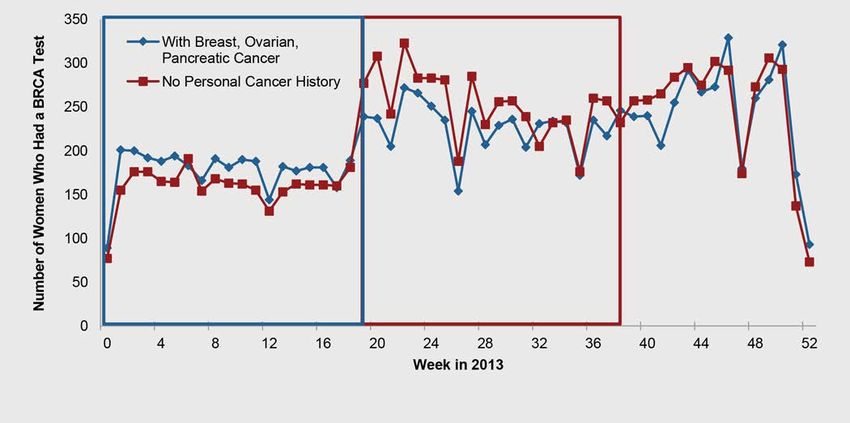
February 2015

2013 for women ages 35 and older from a large               referrals increased by 50 percent to as much as
commercial health insurance carrier, before and             250 percent compared with the prior year.10
after her announcement.
                                                            Did BRCA Testing Rates in the United States
Reaction Following Angelina Jolie’s Story                   Increase?
Jolie’s announcement was unique in the extent of            Jolie’s story and the extensive media coverage that
media coverage that followed. She first published           followed appears to have increased information
her story in the New York Times, which had the              seeking and inquiries about BRCA testing. What
second-largest circulation in the United States at          remains unanswered is whether, in the United
that time, at almost 1.9 million.2 Not surprisingly,        States, more women were getting the BRCA
her story lit up the social and entertainment media         genetic test after Jolie’s story. The above-referenced
outlets. She was on the cover of People magazine            Canadian and United Kingdom studies noted
for 2 consecutive weeks (May 15, the day after her          increases in the number of BRCA testing, along
announcement, and May 22) and on the cover of               with increased referrals. The United States, however,
Time magazine after that (May 27).3 More notable            has a vastly different health insurance coverage
was the coverage by elite newspapers in the United          system from Canada and the United Kingdom,
States, United Kingdom, and Canada.4 These papers           where coverage is government-sponsored and
featured her story prominently in the news section          universal. In the United States, coverage is primarily
of their papers—rather than the entertainment               through private insurance plans for people ages
section—and continued coverage of her story for a           64 and younger and through Medicare, a public
month.5                                                     insurance program, for people ages 65 and older.
The surge in the number of people seeking                   The cost of the BRCA test can range from $300 to
information about BRCA testing and mastectomies             $5,000.11 Insurance coverage rules dictate whether
following her story was remarkable. On the                  these costs would be covered for women seeking
day of her announcement, there were nearly                  the test, which would likely influence the number of
30,000 Wikipedia searches for BRCA1, compared               women getting the BRCA test.
with just under 800 searches the day before.6 The           An increase in BRCA testing rates in the United
National Cancer Institute’s fact sheet on preventive        States would require some combination, or all, of
mastectomy had over 69,000 page views that                  the following: (a) more women requesting the test
day, a nearly 800-fold increase compared with               from their physicians, (b) more physicians ordering
a week earlier (only 87 views). Similarly, its fact         the test for more women, and (c) insurance plans
sheet on genetic testing had a 31-fold increase in          approving more tests. If insurance plans did not
page views.7 Anecdotal reports and surveys also             relax or expand their criteria for BRCA testing
suggest an increase in the number of inquiries and          during the period of study, then an increase
appointments for genetic testing at cancer centers or       in BRCA testing rates could be due to Jolie’s
oncologists in the United States.8                          announcement. More importantly, it could also
Similar reactions were noted outside the United             suggest that the women getting the test are those
States. For example, researchers at Sunnybrook              who meet the risk profile and are appropriately
Odette Cancer Center in Toronto, Canada, observed           receiving the test, which would be a positive
a doubling of the number of women referred to the           outcome.
center for genetic testing in the 6-month period            We find evidence that BRCA testing increased
after the announcement, compared with the same              immediately after Jolie’s announcement among
period the prior year. Referrals went from 487 to           insured women from a large commercial health
over 900.9 In another study in the United Kingdom,          insurance carrier. The timing of the increase
researchers documented a large increase in referrals        suggests that it was largely due to Jolie’s
to breast cancer family history clinics that lasted         announcement and not due to changes in insurance
several months. Between May through October,                coverage policy. We detail our findings in the

                                                        2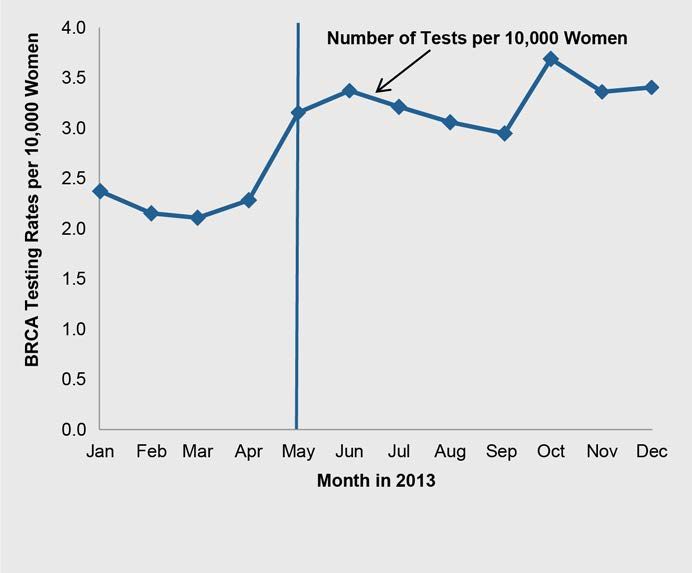
February 2015

sections below and discuss             and beyond. However, two other events at that time, described below,
limitations in the data that           could also have contributed to increased testing rates.13 It is important
prevent us from attributing the        to note that neither of these two events had the same intensity or
increase exclusively to her story.     scope of media coverage as Jolie’s story.
                                       First, the U.S. Prevention Services Task Force (USPSTF) issued
Findings from Patterns in the
Data
                                       draft recommendations for BRCA counseling and testing on April
To address our question, we            3, 2013.14 The draft recommendation clarified that testing for high-
use data from the Optum Labs           risk women qualifies as a preventive service with a B rating.15,16 If
database, which includes claims        adopted, under the Affordable Care Act, this clarification meant that
from a large health insurance          insured women would no longer have to pay any cost sharing for
carrier.12 The study sample            obtaining that test. The USPSTF finalized its recommendations in
includes over 6.5 million health       December 2013. Previous work by the Agency for Healthcare Research
insurance claims in 2013 for           and Quality suggests that health plans have moderate knowledge of
women ages 35 and older                newly released final USPSTF recommendations.17 The extent to which
enrolled with this insurance           draft recommendations could have changed practice standards and
carrier. Our results and               testing rates is likely small, potentially not at all. Nonetheless, for
discussion applies to this carrier’s   completeness, we include the release of the draft recommendation as a
enrolled population and not the        potential explanation for the increase in May and beyond.
U.S. insured population (see           Second, around the same time, the U.S. Supreme Court heard the case
Appendix A for more detail).           of Association for Molecular Pathology et al. v. Myriad Genetics, Inc.,
Figure 1 below shows the               et al. Myriad Genetics had patented the BRCA1 and BRCA2 genes and,
proportion of insured women            at that point, had exercised a monopoly over BRCA testing for breast
ages 35 and older who had a
BRCA test for each month from          Figure 1
January through December               BRCA Testing Rates Increased in May 2013 and Stayed Elevated
2013 (more precisely, it shows
monthly BRCA testing rates, per
10,000 women).
From January through April
2013, between 2 and 2.5 of every
10,000 insured women ages
35 and older received a BRCA
test. However, in May 2013, the
month of Jolie’s announcement,
that rate increased to over 3 of
every 10,000 women (about a
40 percent increase) and stayed
at an elevated level for the rest of
the year.

Possible Explanations for the
Increase in BRCA Testing Rates
Jolie’s story was published on
May 14, the second Tuesday that
                                         Source: Based on 2013 claims data from Optum Labs for women ages 35 and
month. Potentially, her story            older.
could have increased rates in May

                                                         3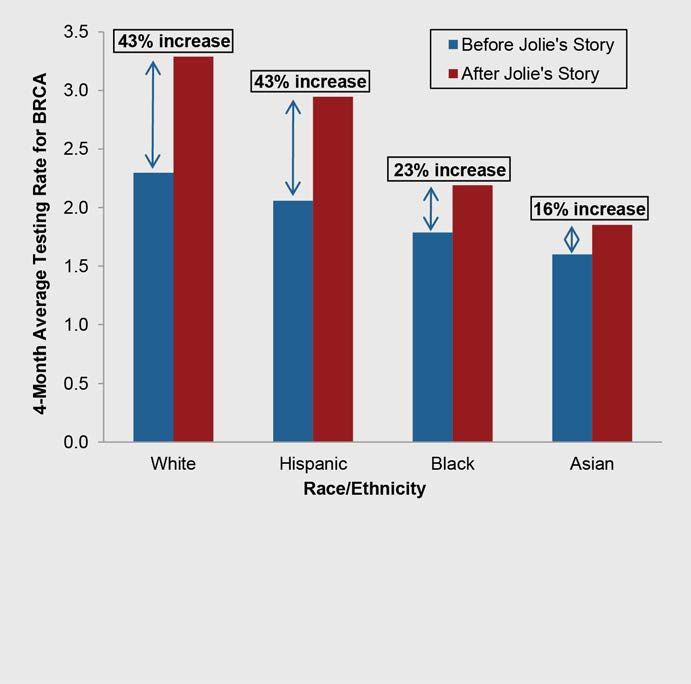
February 2015

and ovarian cancer in the United States. The case                Which Explanation Had More Influence on
was significant because it could affect future gene              Testing Rates?
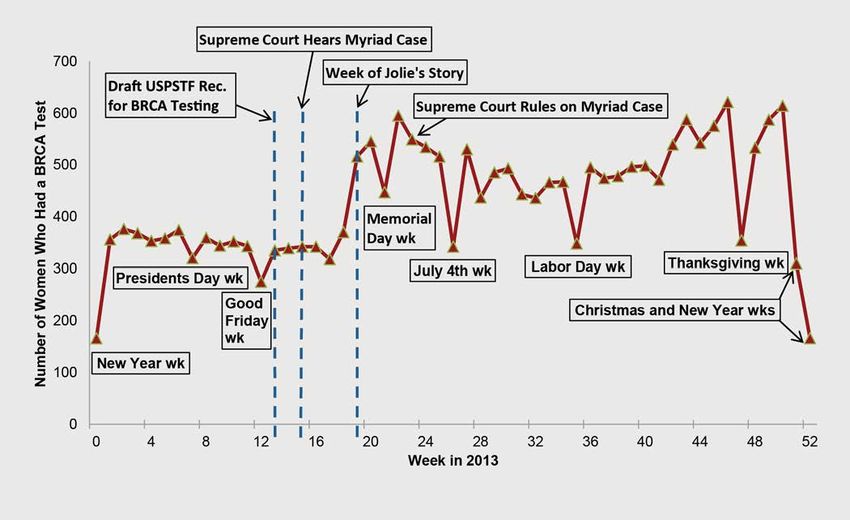
patents, scientific research, and, potentially, BRCA             To isolate more precisely the timing of the uptick in
testing costs. The Supreme Court heard the case on               May and to parse out these competing explanations,
April 14, 2013, and the court ruled on June 13, 2013.            we looked at the weekly counts of BRCA tests in
Conceivably, news and coverage of the case (which                2013 (figure 2). We present counts instead of rates
was concentrated among the scientific and genetic-               because of data limitations.19 The vertical lines in the
testing community) could have resulted in increased              figure indicate the week in which the news event
testing rates in May or later.18                                 occurred. A few patterns emerge from the data.
Earlier, we noted that BRCA testing rates could                  First, the number of BRCA tests each week fluctuates
also increase if insurance coverage policy changed               over the course of the year; however, there are some
during this period. The insurance carrier whose                  obvious dips in the weekly counts that coincide with
data we used modified its coverage policy and                    major U.S. holidays, such as the New Year, Good
waived cost sharing for BRCA testing for high-                   Friday, Memorial Day, Independence Day, Labor
risk women to conform to the new USPSTF                          Day, to name a few. We highlighted these dips and
recommendations in October 2013. The changes                     corresponding holidays in figure 2.
occurred 5½ months after Jolie’s story, however.                 Second, prior to the week of Jolie’s story
They are unlikely to have affected rates from May                (weeks 1–19), the number of tests each week
through September.                                               was relatively stable and hovered around 350
                                                                 (excluding the dip that coincides with the week

Figure 2
Number of BRCA Tests Increased the Week of Angelina Jolie’s Stor y

  Source: Based on 2013 claims data from Optum Labs for women ages 35 and older.

                                                             4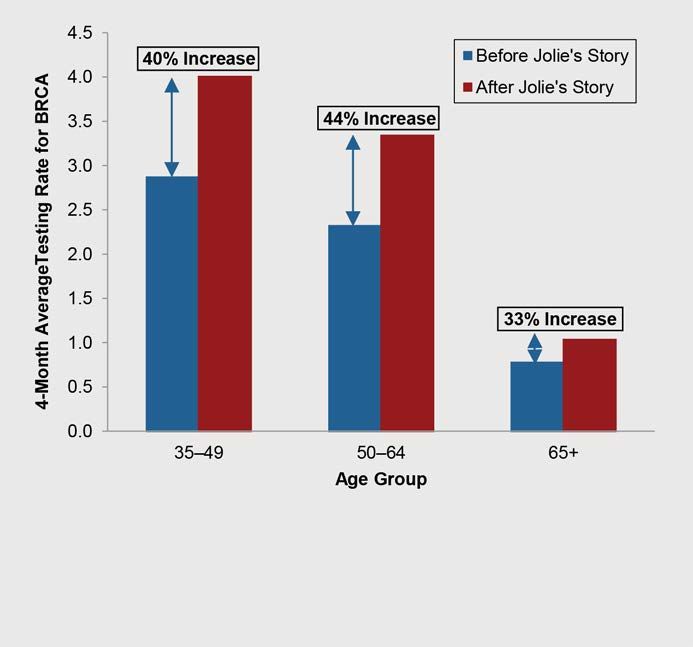
February 2015

of Good Friday). Beginning with the week of her                  Who Is Getting the BRCA Test?
story (week 20), the number of weekly BRCA tests
jumped and hovered around 500 (again, excluding                  By Cancer Diagnosis
the dips that coincide with major holiday weeks).                To further refine our analysis, we next examined
In fact, between weeks 19 and 20, BRCA testing                   characteristics of women who received the test.
increased from 370 to 516, a 40 percent increase.                Physicians recommend BRCA testing as a means to
Third, the data do not reveal any similar increase               identify treatment options for women with a cancer
the week when the USPSTF issued its draft                        diagnosis. In addition, it is also recommended for
recommendations or the weeks of the Supreme                      certain women with no personal cancer history but
Court hearing of and ruling on the Myriad case.                  whose family history increases their cancer risk.21
                                                                 Figure 3 shows weekly BRCA testing counts for two
No doubt, any and all of these events might have                 groups of women. The blue line represents women
contributed to the spike in testing in week 20. It               who had a diagnosis of breast, ovarian, or pancreatic
may take time to schedule a doctor’s appointment                 cancer, and the red line represents women with
or a blood draw, for instance, which could delay the             no personal history of cancer—women similar in
effects of the USPSTF draft recommendation or the                profile to Jolie’s situation.22
Supreme Court case. Nevertheless, the fact that the
increase occurred the week of Jolie’s story, with the            We focus our discussion on the two boxed areas in
extensive publicity surrounding it, suggests that the            figure 3 (blue and red), which span weeks 1 through
impact of her story may have had more to do with                 39. Week 20 is the week of Jolie’s announcement.
the increase than these other less-covered and less-             We limit the discussion to periods before week 40
known news events.20                                             (which is the first week of October). The insurance
                                                                 carrier waived cost sharing for BRCA testing
                                                                 starting October 1, 2013. This change may have
                                                                 increased testing rates from October and beyond

Figure 3
BRCA Testing Increased More among Women with No Cancer Diagnosis af ter Jolie’s Stor y

  Source: Based on 2013 claims data from Optum Labs for women ages 35 and older.

                                                             5
February 2015

and could confound our analysis       race/ethnicity (figure 5).25 We observed an increase for all racial/ethnic
of the “Angelina Jolie” effect.23     groups; however, the largest increase was among white and Hispanic
Comparing the number of tests         women. After Jolie’s story, BRCA testing rates increased by over
in the blue-boxed area to those       40 percent for these two groups; nearly twice and three times higher
in the red-boxed area, three          than among black and Asian women, respectively.26
interesting points emerge. First,     Summary of Results
prior to Jolie’s story (blue box),    Did Jolie’s story increase BRCA testing among commercially insured
women with a cancer diagnosis         women in the United States? In our sample of women enrolled in a
had more tests than women             large insurance carrier, we observed an immediate increase in BRCA
without. Second, during the           testing rates after Jolie’s announcement that lasted at least 4 months.
week of her story (week 20),          Overall, rates increased by about 40 percent. Potentially, other events
testing for both groups of women      may also have influenced BRCA testing rates, but the patterns in the
increased, but the increase among     data are highly suggestive that her story was a major contributor.
women without a personal cancer
history—women who mirrored            In addition, we observed that women who mirrored Jolie’s profile—
Angelina Jolie’s profile—was          those who did not have a personal history of cancer—responded
nearly twice that of women with       more to her story than women with a cancer diagnosis. In addition,
a cancer diagnosis (53 percent        white and Hispanic women were also more likely to respond to her
versus 26 percent). Third, after
Jolie’s story (red box), there were
consistently more women without       Figure 4
a personal cancer history getting     After Jolie’s Stor y, BRCA Testing Rates Increased More for
tested for BRCA than women            Women 64 and Younger than for Women 65 and Older
with cancer. This is a reversal of
trend compared with the weeks
before Jolie’s story.

By Age Group
Figure 4 compares testing rates
of our sample women by age
groups (35–49, 50–64, and 65-
plus). It reports testing rates for
the four months before and after
May 2013.24 Overall, younger
women are more likely to get
tested for BRCA mutations than
older women. In addition, we see
that, after Jolie’s story, testing
rates increased for women in all
age groups, but the increase was
higher for women 64 years of
age and younger than for women
ages 65 and older.                      Source: Based on 2013 claims data from Optum Labs for women ages 35 and
                                        older.
By Race/Ethnicity                       Data excludes May 2013 claims because Jolie’s story was released in the middle of
Next, we examined whether the           that month
reaction to Jolie’s story varied by

                                                         6
February 2015
story compared with blacks and Figure 5
Asians, as were women ages 64 After Jolie’s Stor y, BRCA Testing Increased More for Whites
and younger. and Hispanics than for Blacks and Asians
Discussion
Prior to Jolie’s story, most
women were likely unfamiliar
with the BRCA1 and BRCA2
genes. Because of her story,
more women now know that a
woman with a harmful mutated
copy of one of these genes has
a significantly higher risk of
developing breast and ovarian
cancer during her lifetime.
Raising awareness about the risk
associated with these harmful
mutations is certainly beneficial.
It facilitates conversations
between high-risk women and
their doctors about testing and
preventive measures and allows
patients to make informed Source: Based on 2013 claims data from Optum Labs for women ages 35 and
decisions about next steps. Taking older. About two-thirds of the sample did not have any race/ethnicity data. We
preventive steps could save lives did not attempt to input race and ethnicity for missing values
or, at the very least, significantly
reduce a person’s cancer risk. Data excludes May 2013 claims because Jolie’s story was released in the middle of
Either of these outcomes would that month.
be a public benefit. Based on
patterns in our data, Jolie’s story ethnicity and can be as low as under 1 percent for Asians and as high
may have provided that benefit. as 10 percent among Ashkenazi Jewish women.28 The odds are even
However, alongside the message lower for ovarian cancer.
of elevated risk was also the Jolie’s story may not have elevated understanding of the overall risk of
message that only a small cancer with the faulty BRCA mutation. A survey fielded a month after
proportion of women is at risk her story noted that less than 10 percent of respondents accurately
of having a harmful BRCA estimated Jolie’s risk of developing breast cancer, relative to someone
mutation. Of the 12 percent of without the BRCA mutation.29 In addition, content analysis of elite
women likely to develop breast newspaper coverage of her story indicated that only a third of the
cancer during their lifetimes, stories mentioned the rarity of the harmful BRCA mutation in the
only 5–10 percent is attributable general population.30
to harmful BRCA mutations.27
Based on these numbers, less BRCA testing is neither appropriate nor recommended for all women.
than 1.2 percent of all women Jolie’s superstardom drove many women to inquire about the test,
will have a harmful BRCA which is fine, but it would be both costly and detrimental if women
mutation that significantly were unnecessarily tested or chose prophylactic surgery as a result of
elevates their risk for breast misinformation about their risk factor. Among U.S. insurance carriers,
cancer. Prevalence rates vary by coverage for BRCA testing typically requires meeting insurance
7February 2015
coverage requirements—thus, even if someone and older who had a service claim for BRCA1 and
requests a test, insurance may not pay for it. Paying BRCA2 testing. The data include actual date of
out-of-pocket for the full cost of the test may deter service for the claim, which would be the date
some unnecessary testing. the blood sample was drawn. We used Current
The media is rife with stories and opinions about Procedural Terminology (CPT) codes 81211–81217 to
the public benefit or harm of Jolie’s announcement.31 capture BRCA testing claims in 2013.
It is difficult to weigh the benefit of additional The data also include basic demographic
information against the costs and consequences information, such as age, race and ethnicity, type
of potentially unnecessary testing. However, of insurance coverage, whether the individual had
there may be opportunities to leverage this a cancer diagnosis, and the type of cancer. We
“learning” window—to use instances of celebrity used the codes 183.2–183.4, V16.41, and V50.42 for
announcements to educate consumers. ovarian cancer; 174.1–174.6, 174.8, 174.9, 233.0, V16.3,
We observed a substantial increase in information V50.41, and V84.01 for breast cancer; and 157.1–
seeking from public sources (such as the National 157.9, V10.09, and V16.0 for pancreatic cancer.
Cancer Institute) for BRCA testing after Jolie’s op- We restricted our analysis to calendar year 2013 for
ed piece. However, the scale was much smaller for the reason explained below.
increased inquiries and appointments at genetic Prior to 2013, BRCA tests could be billed under the
counseling centers, referrals to cancer centers (in Healthcare Common Procedure Coding System
Canada and the United Kingdom), and testing for (HCPCS) codes S3818–S3823 or using molecular
our sample of insured women. Potentially, genetic pathology services codes from the 83890–83914
counseling and consults with doctors and other code series. However, these molecular pathology
clinicians are crucial interaction points to help services codes did not identify the specific genetic
consumers make better-informed decisions. test. Consequently, many genetic test providers
engaged in a common practice known as “code
Appendix A stacking,” which involved using a series of codes,
83890–83914, to describe the testing process. Code
The Data stacking, however, made it difficult for health plans
This study was conducted using the Optum Labs to know what exactly was being tested and what
database.32 The retrospective administrative claims they were reimbursing, since the stacking codes did
data used in this study included medical claims and not indicate the specific analysis being tested.33 As
eligibility information from a large national U.S. such, the American Medical Association defined
health insurance plan. Individuals covered by this new CPT codes for molecular diagnostic testing that
health plan, about 28.2 million (51 percent female) would specifically identify the tests performed. The
in 2013, are geographically diverse across the new CPT codes were effective January 2012. These
United States, with greatest representation in the are codes 81211–81217 for BRCA testing.
South and Midwest U.S. Census regions. The health Further, starting April 1, 2012, the HCPCS codes
insurance plan provides fully insured coverage for listed above were deleted and no longer in use.
professional (e.g., physician), facility (e.g., hospital), Although the new 2012 CPT codes were supposed to
and outpatient prescription medication services. All replace the 83890–83914 code series, issues regarding
study data were accessed using techniques that are the reimbursement using the new codes led many
in compliance with the Health Insurance Portability providers and payers to continue reporting the
and Accountability Act (HIPAA) of 1996, and no 83890–83914 codes in 2012. Starting 2013, the 83890–
identifiable protected health information was 83914 codes were deleted and no longer in use.34
extracted during the course of the study.
Thus, for our study, using the new 2012 CPT codes
For this study, we analyzed the proportion of in 2013 would capture all BRCA claims submitted to
women enrolled with this health carrier ages 35 the health plan in 2013. If we wanted to extend our
8February 2015
analysis to 2012, we would need to capture BRCA 2. Personal history of ovarian cancer; or
tests billed under the new and since-deleted codes.
3. At least one close blood relative with
Even using a combination of HCPCS, the 83890–
breast cancer diagnosed at age 50 or
83914 code series, and new 2012 CPT codes, we
younger; or
would likely undercount the number of BRCA tests
in 2012 since we do not know exactly how genetic 4. At least two close blood relatives
test providers were stacking their codes to optimize on the same side of the family with
billing. breast cancer at any age; or
Appendix B 5. At least one close blood relative with
ovarian cancer at any age; or
USPSTF Final Recommendations for BRCA1/2
Screening and Testing, Issued December 201335
6. At least two close blood relatives
The task force recommends that primary care on the same side of the family with
providers screen women who have family members pancreatic or prostate (Gleason score
with breast, ovarian, tubal, or peritoneal cancer ≥7) cancer at any age; or
with one of several screening tools designed to 7. Close male blood relative with breast
identify a family history that may be associated cancer; or
with an increased risk for potential harmful
8. At least one close blood relative that
mutations in breast cancer susceptibility genes
has a BRCA1 or BRCA2 mutation; or
(BRCA1 and BRCA2). Women who screen positive
should receive genetic counseling and, if indicated 9. Ashkenazi Jewish or ethnic groups
after counseling, BRCA testing. Grade B associated with founder mutations;
testing for Ashkenazi Jewish
Appendix C founder-specific mutations should be
performed first
Coverage Criteria for the Health Insurance
Carrier from the Optum Labs Database 36 D. Triple negative breast cancer diagnosed
at age 60 or younger
BRCA Testing Criteria II. BRCA1 and BRCA2 testing is proven and
I. BRCA1 and BRCA2 testing is proven and medically necessary for women with a
medically necessary for women with a personal history of ovarian cancer.
personal history of breast cancer in the III. BRCA1 and BRCA2 testing is proven and
following situations: medically necessary for women and men
A. Breast cancer diagnosed at age 45 or with a personal history of pancreatic cancer
younger with or without family history; at any age and at least two close blood
or relatives on the same side of the family with
breast, ovarian, pancreatic, and/or prostate
B. Breast cancer diagnosed at age 50 or (Gleason score ≥7) cancer at any age. If the
younger with: person is of Ashkenazi Jewish ancestry, only
1. At least one close blood relative with one additional affected relative is needed.
breast cancer at any age; or IV. BRCA1 and BRCA2 testing is proven and
2. An unknown or limited family history medically necessary for men with a personal
history of prostate (Gleason score ≥7) cancer
C. Breast cancer diagnosed at any age with: at any age and at least two close blood
1. Two breast primary cancers, when relatives on the same side of the family with
first breast cancer diagnosis occurred breast, ovarian, pancreatic, and/or prostate
prior to age 50; or (Gleason score ≥7) cancer at any age.
9February 2015
V. BRCA1 and BRCA2 testing is proven and medically necessary 1 Jolie’s op-ed is available at:
http://www.nytimes.com/2013/05/14/opinion/my-
for men with a personal history of breast cancer. medical-choice.html/?_r=0.
2 Circulation numbers for March 2013 from
VI. BRCA1 and BRCA2 screening tests are proven and medically http://www.poynter.org/news/mediawire/211994/
necessary for men and women without a personal history new-york-times-passes-usa-today-in-daily-
circulation/.
of breast or ovarian cancer with at least one of the following
3 Dina, L.G., Borzekowski, Y.G., Smith, K.C., Erby,
familial risk factors: L.H., and Roter, D. L. “The Angelina Effect:
Immediate Reach, Grasp, and Impact of Going
A. At least one first- or second-degree blood relative meeting Public,” Genetics in Medicine, Vol. 16, No. 7, July
2014.
any of the above criteria (I–V); or
4 Kamenova, K., Reshef, A., and Caufield, T.
B. At least one third-degree blood relative with breast cancer “Angelina Jolie’s Faulty Gene: Newspaper
Coverage of a Celebrity’s Preventive Bilateral
and/or ovarian cancer who has at least two close blood Mastectomy in Canada, the United States, and
the United Kingdom,” Genetics in Medicine,
relatives with breast cancer (at least one with breast cancer Vol. 16, No. 7, July 2014. The authors defined
at age 50 or younger) and/or ovarian cancer; or “elite” newspapers as papers with broadsheet
format, tendency to include more text and longer
articles, focus on “hard news,” intended for a
C. A known BRCA1/BRCA2 mutation in the family (defined as more educated audience, and higher quality of
first-, second-, or third-degree relative) journalism/high level of ethical practice. These
newspapers included The Times of London
(United Kingdom), the Wall Street Journal
Note: National Comprehensive Cancer Network (NCCN) (United States), and the Globe and Mail (Canada),
guidelines state that significant limitations of interpreting test to name a few.
results for an unaffected individual should be discussed. Testing 5 Coverage was more extensive the first three days
but was ongoing for the month that the study
of unaffected individuals should be considered only when an tracked coverage.
appropriate affected family member is unavailable for testing. 6 Available at: http://stats.grok.se/en/201305/
Clinical judgment should be used to determine if the patient has BRCA1.
reasonable likelihood of a mutation (NCCN, 2014). 7 Juthe, R., Zaharchuk, A., and Wang, C. “Celebrity
Disclosures and Information Seeking: The Case
VII. BRCA1 and/or BRCA2 testing is unproven and not medically of Angelina Jolie,” Genetics in Medicine, October
23, 2014.
necessary for all other indications including (1) screening 8 Morgan, M. The Angelina Jolie Effect:
of breast or ovarian cancers for individuals not listed in the Assessing the Impact of a Celebrity’s Story
proven indications above or (2) for risk assessment of other on Cancer Genetic Counseling. Available
at:http://bir.brandeis.edu/handle/10192/27243.
cancers. Also refer to: http://www.usatoday.com/
story/news/nation/2013/05/15/jolie-genetics-
Further evidence is needed to establish the clinical utility of counseling/2163783/.
testing in other populations. 9 Raphael J., Verma S., Hewitt P., and Eisen A.
“The Impact of Angelina Jolie’s Story on Genetic
Referral and Testing at an Academic Cancer
Centre.” Presented at: Presscast in advance
Additional Information of the American Society of Clinical Oncology’s
Note: If there are no living family members with breast or ovarian 2014 Breast Cancer Symposium, September 2,
2014. Abstract 44. Poster at 2014 Breast Cancer
cancer, consider testing family members affected with cancers thought Symposium, available at:
http://meetinglibrary.asco.org/content/99286.
to be associated with BRCA1/BRCA2, prostate (Gleason score ≥7) and
10 Gareth, D., Evans, R., Barwell, J., Eccles, D.M.,
pancreatic cancers, and melanoma. Collins, A., Izatt, L., Jacobs, C., Donaldson, A.,
Brady, A.F., Cuthbert, A., Harrison, R., Thomas,
Acknowledgments S., Howell, A., the FH02 Study Group, RGC
teams, Miedzybrodzka, Z., and Murray, A. “The
The authors would like to acknowledge the invaluable comments Angelina Jolie Effect: How High Celebrity Profile
and input from Elizabeth Carter, Joyce Dubow, Linda Flowers, Frank Can Have a Major Impact on Provision of Cancer
Related Services,” Breast Cancer Research, Vol.
Lobeck, Leigh Purvis, Don Redfoot, and seminar participants at the 16, No. 5, 2014, pp. 442-447.
AARP Public Policy Institute. In addition, we are grateful to Olivia 11 Available at: http://www.breastcancer.org/
Dean and Veralrose Hylton for their excellent research assistance. symptoms/testing/genetic/facility_cost.
12 See Appendix A for more information about the
data and rationale for the period over which we
examined BRCA testing rates.
13 We conducted an extensive Internet search to
identify any BRCA-related news events at or
10before the time of Jolie’s story that potentially 23 Numerous studies show that consumers are 34 Available at: http://www.psapath.com/NewsAnd
could have contributed to higher awareness of price-sensitive and consume more health care Information/PSAAlert2013CPTChanges/tabid/
BRCA testing or plausibly motivated higher BRCA services when prices are lower (or eliminated, as 290/Default.aspx.
testing rates. the case was in this instance). The most notable is
the RAND health insurance experiment: Manning, 35 Available at:
14 Created in 1984, the USPSTF is an independent W.G., Newhouse, J.P., Duan, N., Keeler, E.B., and http://www.uspreventiveservicestaskforce.org/
group of national experts in prevention Leibowitz, A. “Health Insurance and the Demand Page/Document/RecommendationStatementFinal/
and medicine that makes evidence-based for Medical Care: Evidence from a Randomized brca-related-cancer-risk-assessment-genetic-
recommendations about clinical preventive Experiment,” The American Economic Review, counseling-and-genetic-testing.
services such as screenings, counseling services, Vol. 77, No. 3, June 1987, pp. 251–277. In fact, in
or preventive medications. 36 Available at:
our data, we observe an upward trend in BRCA
https://www.unitedhealthcareonline.com/
testing rates starting in October in figure 1 and in
15 According to the USPSTF, a grade of “B” is ccmcontent/ProviderII/UHC/en-US/Assets/
week 40 in figure 2.
defined as: “The USPSTF recommends the ProviderStaticFiles/ProviderStaticFilesPdf/
service. There is a high certainty that the net 24 We exclude May 2013 because it is an incomplete ToolsandResources/PoliciesandProtocols/
benefit is moderate of there is moderate certainty month, in that Jolie’s announcement was in the MedicalPolicies/MedicalPolicies/Genetic_
that the net benefit is moderate to substantial.” middle of the month. Testing_HBOC_Syndrome.pdf.
16 The USPSTF previously issued recommendations 25 About a third of the sampled women did not
regarding BRCA counseling in 2005, but the have any race and ethnicity information. We are
language was ambiguous with regard to BRCA unable to ascertain whether the missing data are
testing. “High-risk women” is defined as women randomly assigned—that is, whether the data are
with no personal history of cancer but who have a missing in equal proportion across all racial/ethnic
family history of cancer. See Appendix B for more groups or whether they tend to be missing more
details of the USPSTF recommendations. for one group. We did not attempt to impute race/
ethnicity data where missing.
17 Alycia Infante, et al., Evaluation of the
U.S. Prevention Services Task Force 26 This ordering aligns with risk factors by
Recommendations for Clinical Preventive ethnic groups. John E.M., Miron A., Gong
Services, Agency for Healthcare Research and G., et al. “Prevalence of Pathogenic BRCA1
Quality, No. 08-M011-EF, December 2007. Mutation Carriers in Five U.S. Racial/Ethnic
Groups,” JAMA, Vol. 298, No. 24, 2007, pp.
18 National Public Radio coverage of the Myriad case
2869–2876.
before the Supreme Court on April 15, 2013:
http://www.npr.org/blogs/health/2013/04/15/ 27 Available at: http://www.cancer.gov/cancertopics/
177035299/supreme-court-asks-can-human- factsheet/Risk/BRCA.
genes-be-patented.
28 See the following site for prevalence rates of
19 The data give actual dates of service. However, BRCA1/2 mutations among women with breast
health insurance enrollment data are available cancer, by ethnic groups, adapted from National Insight on the Issues 100, February 2015
only by month. Consequently, we do not have Cancer Institute materials: http://ww5.komen.org/
the granularity required to identify whether an BreastCancer/InheritedGeneticMutations.html. © AARP PUBLIC POLICY INSTITUTE
individual was enrolled in a particular week during
the month, which is necessary to construct weekly 29 Dina et al., 2014. 601 E Street, NW
rates. Washington DC 20049
30 Kamenova et al., 2014.
20 Despite our extensive Internet search of news Follow us on Twitter @AARPPolicy
events around this time, there may have been 31 For instance, see the May 27 issue of the Times
other stories we did not identify that also magazine article “The Angelina Effect” and Jeff on facebook.com/AARPPolicy
contributed to increased testing rates. Nisker, “A Public Health Education Initiative for www.aarp.org/ppi
Women with a Family History of Breast/Ovarian
21 Per the USPSTF recommendations. Cancer: Why Did It Take Angelina Jolie?” Journal For more reports from the Public Policy
of Obstetrics and Gynaecology Canada, Vol. 35,
22 We include women with pancreatic cancer, in Institute, visit http://www.aarp.org/ppi/.
No. 8, 2013, pp. 689–691.
addition to those with breast and ovarian cancer,
because these women are indicated (appropriate) 32 Wallace P.J., Shah, D.T., et al. “Optum Labs:
for BRCA testing according to the carrier’s Building a Novel Node in the Learning Health Care
coverage policy. See Appendix C. The group of System,” Health Affairs, Vol. 33, No. 7, 2014, pp.
women with no personal history of cancer includes 1187–1194.
those with a family history and those without. Our
data do not contain family history information to 33 Available at: http://www.hayesinc.com/hayes/
allow us to define a group with family history. blog/blog-are-you-ready-for-new-cpt-codes-for-
molecular-tests/.
AARP’s Public Policy Institute conducted this study using the Optum Labs database. The retrospective administrative claims data utilized in
this study include medical claims and eligibility information from a large national U.S. health insurance plan. Individuals covered by this health
plan, about 28.2 million (51 percent female) in 2013, are geographically diverse across the United States, with greatest representation in the
South and Midwest U.S. Census regions. The health insurance plan provides fully insured coverage for professional (e.g., physician), facility
(e.g., hospital), and outpatient prescription medication services. All study data were accessed using techniques that are in compliance with the
Health Insurance Portability and Accountability Act (HIPAA) of 1996, and no identifiable protected health information was extracted during the
course of the study.
11You can also read


