STRANGLED BUDGETS, SILENCED DISSENT - THE HUMAN COST OF AUSTERITY MEASURES IN CHAD
←
→
Page content transcription
If your browser does not render page correctly, please read the page content below
STRANGLED BUDGETS,
SILENCED DISSENT
THE HUMAN COST OF AUSTERITY MEASURES IN CHAD
Amnesty International is a global movement of more
than 7 million people who campaign for a world where
human rights are enjoyed by all.
Our vision is for every person to enjoy all the rights
enshrined in the Universal Declaration of Human Rights
and other international human rights standards.
We are independent of any government, political
ideology, economic interest or religion and are funded
mainly by our membership and public donations..

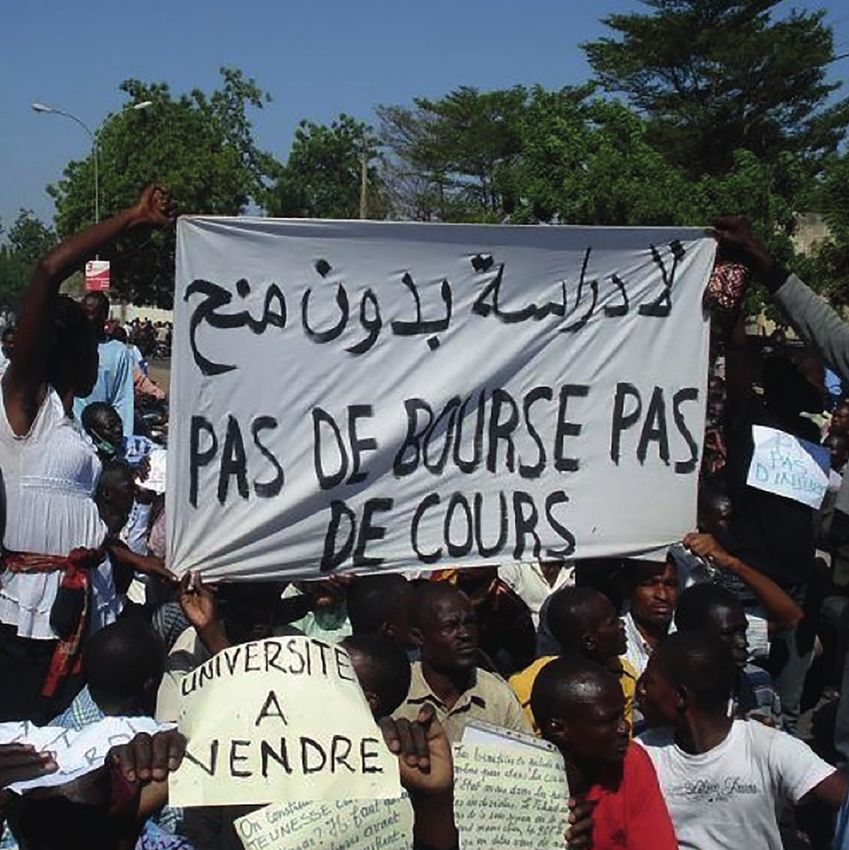
© AMNESTY INTERNATIONAL 2018                                                        Cover photo: Students protest against the cancellation of university scholarships,
EXCEPT WHERE OTHERWISE NOTED, CONTENT IN THIS DOCUMENT IS LICENSED UNDER A          N’Djamena. ©Private.
CREATIVE COMMONS (ATTRIBUTION, NON-COMMERCIAL, NO DERIVATIVES, INTERNATIONAL 4.0)
LICENCE.
HTTPS://CREATIVECOMMONS.ORG/LICENSES/BY-NC-ND/4.0/LEGALCODE
FOR MORE INFORMATION PLEASE VISIT THE PERMISSIONS PAGE ON OUR WEBSITE: WWW.
AMNESTY.ORG
WHERE MATERIAL IS ATTRIBUTED TO A COPYRIGHT OWNER OTHER THAN AMNESTY
INTERNATIONAL THIS
MATERIAL IS NOT SUBJECT TO THE CREATIVE COMMONS LICENCE.
FIRST PUBLISHED IN 2018
BY AMNESTY INTERNATIONAL LTD
PETER BENENSON HOUSE, 1 EASTON STREET
LONDON WC1X 0DW, UK

Index: AFR 20/8203/2018
Original language: English

amnesty.org
CONTENTS

EXECUTIVE SUMMARY                                                             6

METHODOLOGY                                                                  10
SCOPE                                                                        10
RESEARCH                                                                     10
ACKNOWLEGMENTS                                                               11
1. BACKGROUND                                                                12
1.1 A REPRESSIVE CONTEXT                                                     12
1.2 ECONOMIC CRISIS, AUSTERITY MEASURES AND PUBLIC DISCONTENT                13
CONTINUED ECONOMIC CRISIS AND AUSTERITY MEASURES                             13
INCREASED STRIKES AND PROTESTS                                               15
2. CONTINUOUS REPRESSION                                                     17
2.1 CONTINUED BAN ON PROTESTS                                                17
2.2 USE OF EXCESSIVE FORCE AND ARBITRARY ARRESTS OF STUDENT PROTESTERS       20
2.3 PERSECUTION OF INDIVIDUAL ACTIVISTS                                      23
3. IMPACT OF AUSTERITY MEASURES AND THE ROOTS OF DISCONTENT                  25
3.1 CHAD’S ECONOMIC, SOCIAL AND CULTURAL RIGHTS OBLIGATIONS AND AUSTERITY    27
3.2 THE RIGHT TO HEALTH                                                      29
AUSTERITY MEASURES IN THE HEALTH SECTOR                                      31
IMPACT OF THE AUSTERITY MEASURES ON ACCESS TO HEALTH CARE                    34
3.3 THE RIGHT TO EDUCATION                                                   41
IMPACT OF AUSTERITY MEASURES ON EDUCATION                                    42
4. THE ROLE OF INTERNATIONAL DONORS AND INTERNATIONAL FINANCIAL ASSISTANCE   49
5. CONCLUSION AND RECOMMENDATIONS                                            53
RECOMMENDATIONS                                                              53
TO THE CHADIAN GOVERNMENT                                                    53
TO THE INTERNATIONAL COMMUNITY                                               55
TO DONORS AND INTERNATIONAL FINANCIAL INSTITUTIONS                           55

ANNEXES                                                                      56

STRANGLED BUDGETS, SILENT DISSENT
THE HUMAN COST OF CHAD’S AUSTERITY MEASURES                                   3
Amnesty International
GLOSSARY

 WORD                                   DESCRIPTION

 ACHPR                                  African Commission on Human and Peoples’ Rights
 ADO                                    Alliance democratique de l’opposition

 AFDB                                   African Development Bank

 ANS                                    Agence National de Sécurité
                                        National Security Agency

 BEAC                                   Banque des états de l’Afrique centrale
 CAMOJET                                Collectif des associations et mouvements des jeunes du Tchad
                                        Joint Youth Associations and Movements of Chad

 CCPOD                                  Cadre de concertation des partis politiques de l’opposition démocratique

 CNOU                                   Centre National des Œuvres Universitaires

 CESCR                                  Committee on Economic, Social and Cultural Rights

 CSP                                    Commissariat de sécurité publique

 CTDDH                                  Convention Tchadienne pour la défense des droits humains
                                        Chadian Convention for Human Rights

 CGT                                    Confédération Générale du Travail
                                        General Confederation of Labour

 COPRAT                                 Coalition de l’opposition politique pour le redressement et de l’alternance
                                        au Tchad
 CPA                                    Centrale Pharmaceutique d’Achats
                                        Central Pharmaceutical Procurement Agency

 CPOMO                                  Coalition des partis politiques de l’opposition modérée

 ECF                                    Extended Credit Facility

 EU                                     European Union

 ESCR                                   Economic, Social and Cultural Rights

 ICCPR                                  International Covenant on Civil and Political Rights

 ICESCR                                 International Covenant on Economic, Social and Cultural Rights

STRANGLED BUDGETS, SILENT DISSENT
THE HUMAN COST OF CHAD’S AUSTERITY MEASURES                                                                           4
Amnesty International
WORD                                   DESCRIPTION

 IFI                                    International Financial Institutions

 IMF                                    International Monetary Fund

 IRPP                                   Impôt sur le revenu des personnes physiques
                                        Personal Income Tax System

 PRA                                    Pharmacie Regionale d’Approvisionnement
                                        Purchasing Procurement Agency

 STTL                                   Société de Transport Tchadien du Logone

 TROTHECED                              Troupe théâtrale du centre Dombao

 UN                                     United Nations

 UNET                                   Union Nationale des Etudiants du Tchad
                                        Chadian National Students’ Union
 UPR                                    Universal Periodic Review

STRANGLED BUDGETS, SILENT DISSENT
THE HUMAN COST OF CHAD’S AUSTERITY MEASURES                                           5
Amnesty International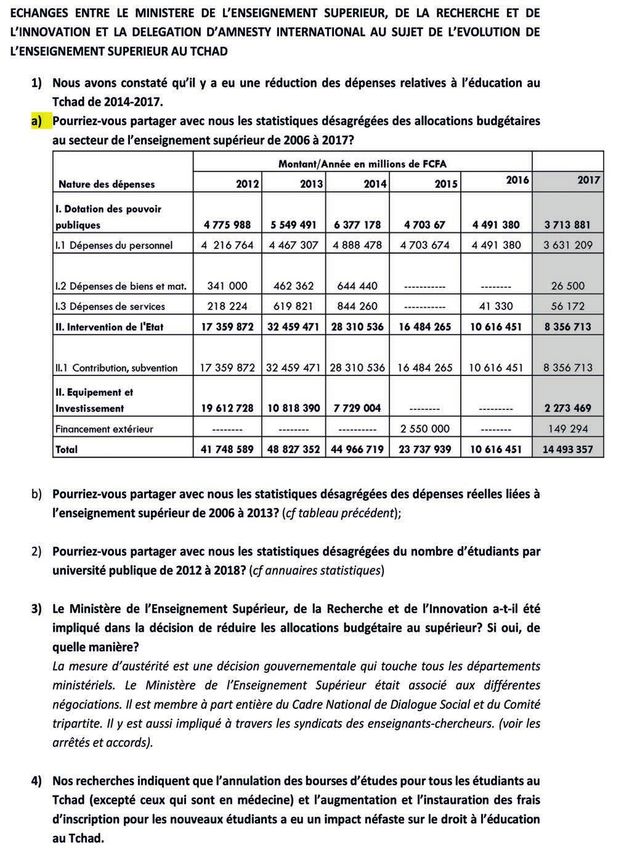
EXECUTIVE SUMMARY

Chad continues to be stuck in a cycle of recession, austerity, protests and repression that has gripped
the country since at least 2015. Indiscriminate austerity measures are implemented in ways that flout the
economic, social and cultural rights of the Chadian population, in violation with international standards that
govern the implementation of austerity measures. As this report details, the provision of health and education
services have been disproportionately affected. This situation is compounded by the repressive stance that
the authorities deploy towards critics and dissenters.
In September 2017, Amnesty International published a report that highlighted the growing repression of
human rights defenders, journalists, activists and civil society organizations since the 2015 presidential
elections and introduction of austerity measures in response to an economic crisis. It outlined how repressive
laws were used against those expressing dissent, and how the security forces including the National
Security Agency (ANS) committed arbitrary arrests, incommunicado detention and even torture in their
implementation.
This report details how the situation has continued to deteriorate since, with indiscriminate austerity
measures threatening people’s livelihoods and their realization of economic, social and cultural rights
including through general spending cuts including the reduction of public servant salaries and benefits,
reduction of spending across sectors including in health and education, a hiring freeze of public workers,
the cancellation of scholarships for some public university students, increased and new university fees and
increased and new taxes. These measures have led to discontent and protests.
Chad's economic situation has been severe and provides a challenging context in which to respect, protect
and fulfil economic, social and cultural rights. However, Chad continues to have clear obligations under
international human rights law, not least the International Covenant on Economic, Social and Cultural
Rights (ICESCR) and the African Charter on Human and Peoples’ Rights (ACHPR) to which it is a state
party. Even in times of economic crisis, Chad has an obligation to avoid retrogressive measures, and if they
are necessary, ensure they are developed and implemented in line with human rights obligations. This
includes protecting the minimum core content of economic, social and cultural rights, which include free
primary education for all children, access to essential drugs, and affordable maternal and child health care.
Furthermore, the authorities should prioritize revenue raising options through effectively preventing and
combating tax evasion and corruption, before measures with retrogressive impact on economic and social
rights are implemented.
Between January 2018 and March 2018, dozens of protests against austerity measures and their
consequences took place across main Chadian cities. In N’Djamena alone, Amnesty International
documented at least 12 protests, including four peaceful protests organized by civil society organizations
and opposition parties. In a growing number of cases, anti-austerity protests have been organized by
university and school students who have criticized the cancellation of scholarships for all students except
those in medical and national vocational schools, increased and new university registration fees and
closure of schools due to a public workers’ strike. In all but one of these protests, security forces used tear
gas to disperse crowds and beat protesters, injuring dozens of them. While in some cases, a minority of
protesters may have committed acts of violence, security forces must still react proportionately, using only
the minimum force necessary to contain the situation and re-establish public order. In doing so, they must
differentiate between those who are acting violently and those who are not. If only a minority of protesters
acts violently, it contravenes the principle of proportionality and minimum use of force if security forces use
force against protesters generally. Nor is it legitimate to disperse a protest simply because some protesters
are committing acts of violence

STRANGLED BUDGETS, SILENT DISSENT
THE HUMAN COST OF CHAD’S AUSTERITY MEASURES                                                                       6
Amnesty International
During these protests, at least 150 people including students were arrested on charges varying from rebellion,
unlawful gathering and public disorder – many, but not all, for protesting peacefully. Later at least 42
were sentenced to prison terms ranging from one month to four months. Some of the people arrested and
interviewed by Amnesty International said that they were not participating in the protests but running errands
when they were arrested. During some of these protests, the Public Prosecutor of N’Djamena told Amnesty
International: “It was a mess, people were taken [arrested] anywhere.”
The authorities continue to cite “security” concerns to justify the blanket ban on peaceful protests and punish
those who participate in them. In February 2018, the government suspended 10 political parties for organizing
a peaceful demonstration banned by the authorities. Since mid-March 2018, access to some social media
has been restricted. An agent from AIRTEL, a private telecommunications company in Chad, told Amnesty
International that the restriction of access to WhatsApp and Facebook was ordered by the authorities, while
Chadian authorities said that the restrictions are most likely caused by a technical problem.
The Chadian police and the ANS have continued to target individuals who have criticized austerity measures
or supported anti-austerity actions. For example, Vicky Regbassi, a Chadian comedian, was arrested on 6
February 2018 after the publishing of a Facebook message in which he called on all authorities including the
government, and military to resign and support actions undertaken by civil society organizations and trade
unions against austerity measures. He was charged with incitement to tribal hatred and public disorder and
if convicted, could face at least six months imprisonment. Alain Didah Kemba, spokesperson of the youth
movement IYINA, was also arrested on 19 February 2018 after a police commander had alleged seeing him
with a bottle of gasoline and about to burn a pile of tyres. Alain has denied this allegation. While in detention, he
was not allowed regular access to his lawyer and family and he was beaten on the soles of his feet and joints by
police officers and their superior and he was forced to move from one room to another with his legs tied up to
his hands behind his back. He was released on bail four days later for health reasons and within a week of his
arrest all charges against him were dropped. No investigations were carried out into the allegations of torture
and other ill-treatment Vicky and Alain were subjected to.
The primary reason for these protests has been economic. Since 2015, Chad has faced a severe economic
crisis mainly linked to the sharp fall in the price of crude oil, exacerbated by the lack of economic
diversification, including financial pressures emanating from the country’s military commitments in the face of
multiple security threats, hosting over 449,000 refugees, an oil-backed loan of more than US$ 1 billion from an
Anglo–Swiss multinational commodity trading and mining company, Glencore, and the longstanding and major
problems of tax evasion and corruption.
In response, the government implemented severe austerity measures and obtained both financial and
development assistance and loans from international financial institutions (IFIs) and country donors. Although
country donors and IFIs were not directly involved in the design and implementation of austerity measures,
their support was in some cases conditional, including to spending cuts, and they have not put in place
adequate safeguards to protect social spending and economically vulnerable populations, which have
contributed to retrogressive austerity measures that do not comply with human rights criteria. Further, Amnesty
International is not aware of any human rights impact assessment of austerity measures conducted by the
government or any support from country donors and IFIs to conduct such assessment. For instance, while the
IMF has approved a second Extended Credit Facilitation (ECF) for Chad in 2017 to “help stabilize the fiscal
position, support a sustainable balance of payments position and help rebuild the regional international reserve
pool”, it has conditioned it, including to spending cuts, restructuring of the debt with Glencore, broadening of
the tax base, and strengthening of tax and customs administrations. Although the IMF set “floors”, including
for poverty reducing social spending, and Chadian government officials told Amnesty International that social
spending was protected from cuts compared to other sectors, this report shows that the “floor for poverty
reducing social spending” was insufficient and inadequate and the cuts including in health and education
had a retrogressive effect which further limited access to social service especially for economically vulnerable
groups. In addition, both the IMF and Chadian authorities failed to evaluate the human rights impact of
austerity measures including non-floor spending such as the reduction of the wage bill.
The impact of the austerity measures on the right to education has been significant and has been a major
source of discontent and protest. Between 2014 and 2016, the national education spending was cut by 20.9%
and scholarships for many public university students were cancelled with no targeted scholarships put in place
for poor students. In addition, university registration fees were increased for new students and students who re-
register are now forced to pay registration fees by themselves while before it was subsidized by the government.
Most students interviewed by Amnesty International and especially those from the rural areas said their living
conditions have deteriorated with some of them unable to pay rent following the abolition of scholarships.

STRANGLED BUDGETS, SILENT DISSENT
THE HUMAN COST OF CHAD’S AUSTERITY MEASURES                                                                        7
Amnesty International
Similarly, the public health budget was cut by over 50% between 2013 and 2017 with serious consequences
for a system that already suffered from structural weaknesses and long-term underinvestment. Some of
the most basic services needed by the most socially and economically vulnerable people have been cut.
For instance, the free emergency health care programme budget was cut by 70%, leaving thousands
of Chadians with virtually no access to health care including emergency care and essential drugs. This
was accompanied by a reduction in the number of emergencies covered by the emergency health care
programme from 45 categories to only five, and the authorities did not put in place any targeted programmes
to ensure that marginalized groups still get access to the categories that were removed. This means that
people now have to pay for at least 40 categories of emergencies including malaria (except for pregnant
women and children below 5 years old), and pulmonary infection, which were provided free before. While
officials from the Ministry of Public Health said that this reform was necessary for the general efficiency of
the health system in the long term and ensure that efforts protect vulnerable groups, including pregnant
women and children below 5 years old, this measure has resulted in additional costs related to health care
and no alternative programme targeting socially and economically vulnerable people was put in place to
mitigate the impact of the reduction of the free emergency health care programme on vulnerable groups.
Many patients who cannot afford these new costs told Amnesty International that they have to seek support
from families and friends and in an increasing number of cases, patients prefer to self-medicate and go to
hospital only when their health condition deteriorates enormously.
Chad faced recurrent drug shortages even before the economic crisis, but since 2015 the situation has
worsened with health facilities lacking even essential drugs such as painkillers, because the government
failed to pay a debt of between XAF 10 billion (US$ 18.8million) to XAF 15 billion (US$ 28.2million) to its
drug suppliers who have requested a payment of half the debt before additional drug supplies are delivered.
Health workers are forced to prescribe expensive speciality drugs available only in private pharmacies, while
patients seeking cheaper alternatives, resort to buying drugs from unregulated and illegal street traders
despite the health risks.
The primary responsibility for respecting, protecting, promoting and fulfilling the human rights of Chad's
population lies with the Chadian government, which should assess and review its economic and austerity
strategy and budget allocations as well as its response to peaceful dissent. The international community,
however, also has an obligation to help Chad meet its own economic and social rights obligations, including
particularly safeguarding the rights of vulnerable populations. In addition, the Committee on Economic,
Social and Cultural Rights (CESCR) has stressed that when exercising powers delegated to them by their
member states, IFIs – IMF amongst them - should refrain from adopting measures that would result in
human rights violations and they have the obligation to “ensure that the protection of the most basic
economic, social and cultural rights is, to the maximum extent possible, built into programmes and policies
aimed at promoting adjustment” including when programmes involving austerity measures are introduced
and are expected to have significant human rights impacts.
Given the strong link between the economic crisis and austerity measures, and protests and repression,
there is a clear and urgent need for serious reform ahead of Chad’s Universal Periodic Review (UPR) and
the legislative elections, to ensure that individuals are able to express themselves freely and without fear and
enjoy their rights to livelihoods, health and education. Measures that the Chadian authorities should take
include:
   •      Amend Ordinance No. 45/62 on public meetings and Decree No. 193/62 regulating protests in
          public places to ensure they meet international and regional human rights standards on the rights to
          freedom of expression, association and peaceful assembly;

   •      Immediately allow access to all currently blocked websites, and refrain from impermissibly restricting
          access to the internet and messaging applications such as Facebook and WhatsApp;

   •      Refrain from denying authorizations for peaceful protests and from arbitrarily arresting and detaining
          people who exercise their rights to freedom of expression and peaceful assembly;

   •      Urgently conduct a human rights impact assessment on how budget cuts and austerity measures,
          including those documented in this report and the hiring freezes and tax increases, have impacted
          the rights to health and education in Chad and make the results of this assessment public;

   •      Urgently address the deteriorations of access to and affordability of the right to health and education,
          in particular:`

STRANGLED BUDGETS, SILENT DISSENT
THE HUMAN COST OF CHAD’S AUSTERITY MEASURES                                                                        8
Amnesty International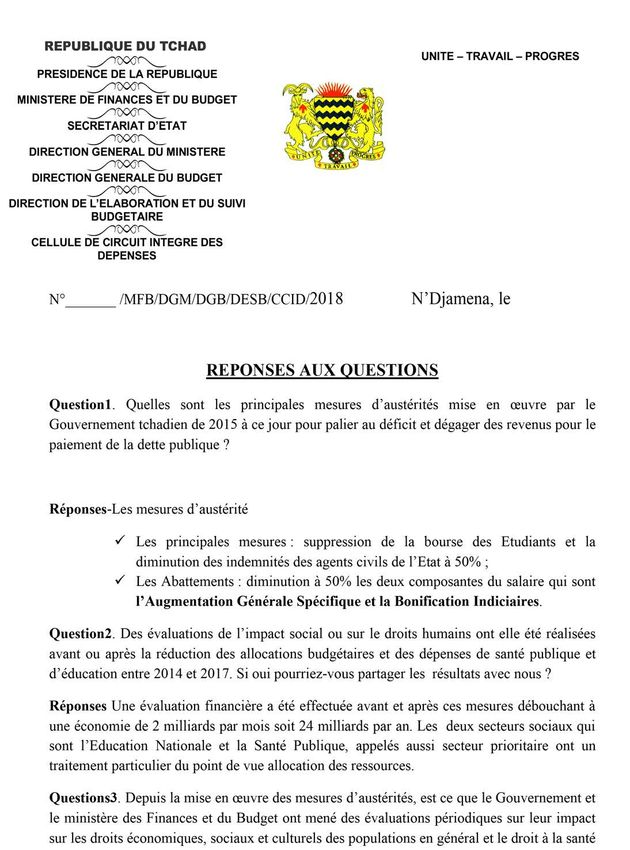
o    Prioritize the health budget, to ensure that, at a minimum, basic health services are accessible,
            affordable, and of good quality, including emergency health care, prenatal and postnatal care and
            emergency transport;
       o    Take urgent action to reduce shortages of essential drugs in health facilities;
       o    Gradually restore coverage to the medical emergencies that were removed from the free emergency
            health care programme; and until this is possible, put in place targeted measures to ensure that
            vulnerable groups have access to necessary and basic health care;
       o    Accelerate the identification of students who are most impacted by the cancellation of scholarships
            and the introduction of new university fees and put in place low-cost and targeted programmes to
            assist them;
       o    Introduce scholarships for poorer students as initially planned by the Ministry and Centre National
            des Œuvres Universitaires (CNOU).
   •       Urgently explore alternative options for how the budget deficit can be improved by increasing
           revenues, for example through effectively addressing tax evasion and corruption; and prioritize such
           alternatives over cutting services.

Amnesty International also urges the international community, including Chad’s financial and technical
partners, to consider increasing their financial and technical support to Chad to ensure the country fulfils its
economic, social and cultural rights obligations. In particular:
   •       Conduct human rights impact assessments on any economic reform programmes proposed to Chad
           and those suggested by the Chadian government in this time of crisis, and make modifications to the
           programmes based on the findings of the assessments;

   •       Ensure that targets for fiscal consolidation do not undermine the ability of the government of Chad to
           fulfil economic, social and cultural rights obligations including in the health and education sectors;

   •       Provide additional financial and technical assistance to Chad to conduct human rights impact
           assessments including by assisting Chad with relevant indicators, benchmarking and disaggregated
           data to assist with decision making;

   •       Provide additional financial and technical assistance to Chad to support the realizations of the
           rights to health and education, and in particular ensure that people in Chad are able to access the
           minimum core components of the right to health, including antenatal care, postnatal care, all basic
           drugs, as well as emergency health care; access to free primary education for all children; and
           targeted support for university students, especially economically vulnerable ones, to ensure they are
           not further impacted by austerity measures.

More detailed recommendations are featured at the end of this report.

STRANGLED BUDGETS, SILENT DISSENT
THE HUMAN COST OF CHAD’S AUSTERITY MEASURES                                                                         9
Amnesty International
METHODOLOGY

SCOPE
This report is based on field research carried out in Chad and comprehensive desk research between March
2017 and May 2018. It builds on Amnesty International’s report Between repression and recession. The
rising cost of dissent in Chad, published in September 2017, which documented human rights violations by
the Chadian authorities and security forces between 2015 and 2017. The current research was prompted by
an increased correlation between the government’s response to an economic crisis and social unrest.
This report reveals how austerity measures have reduced the enjoyment of economic and social rights in
Chad, with a particular focus on the rights to health and education. It also documents the human rights
violations committed by the government in repressing voices and protests that have opposed these austerity
measures.

RESEARCH
During the three field missions carried out for this report between November 2017 and May 2018, Amnesty
International delegates visited N’Djamena, Massakory, Massaguet, Dourbali, Doba, Moundou, Bongor and
Sarh. During these missions, they conducted at least 176 interviews:
    •     Individual or small-group interviews with 20 Chadians who were either seeking or had sought
          health care through the public health system, and their families and carers; and 26 Chadian public
          university students.

    •     Individual or small-group interviews with 52 Chadian health workers including doctors, nurses, and
          nursing assistants. All health workers interviewed had worked in the public health system before and
          after the economic crisis and austerity measures.

    •     Individual interviews with 56 public health experts, education experts, human rights activists, trade
          union representatives, non-profit service providers, budget analysis experts, and academics working
          on public health and education issues, for background and context on the impact of austerity
          measures on the health and education systems in Chad, and to confirm information that emerged
          from the other qualitative interviews.

    •     Interviews with at least 22 government officials 1 to share the preliminary findings and seek
          responses. The responses received from the authorities and their technical staff have been
          incorporated in this report while full written responses from the Chadian authorities have been
          included in the annex.

1
  Government officials included the Minister of Territorial Administration, Public Security and Local Governance and his Secretary General,
Director General of the National Police, Director of Intelligence, Director of Public Security, Vice Director of the National Police and
Spokesperson of the National Police, Minister of Justice, Human Rights Director at the Ministry of Justice, General Director of the Ministry
of Justice, Secretary General of the Ministry of Public Health, Director General of the Ministry of Public Health, two project Coordinators at
the Ministry of Public Health, Director of Budget of the Ministry of Public Health, Director of Budget of the Ministry of Finance and Budget,
Secretary General of the Ministry of Higher Education, Research and Innovation and the Director General of the Ministry, Director of CNOU,
Secretary General of the Ministry of National Education and Civics Promotion, the President of the High Council of Communications, Head
of Legal Department of the High Council of Communications and the Public Prosecutor of N’Djamena.

STRANGLED BUDGETS, SILENT DISSENT
THE HUMAN COST OF CHAD’S AUSTERITY MEASURES                                                                                                 10
Amnesty International
Amnesty International has also shared its key findings and a list of questions with Chad’s financial and technical partners including the IMF, World Bank, AfDB and EU. At the time of publishing this report, we received responses from the World Bank and the European Union Delegation to the Republic of Chad. Amnesty International delegates also visited 32 health facilities including public regional hospitals, district hospitals and health centres. Delegates also visited private and catholic health structures and the Toukra campus of the University of N’Djamena. This report is also based on extensive desk research including: (a) examining austerity measures introduced since 2015; (b) examining the changes in public health and education spending between 2013 (before the advent of the economic crisis) and 2017 (date of the last published data, at the time of writing this report) to assess the extent of the cuts and their impact on the rights to health and education; (c) analysing a broad range of health and education systems indicators in this period, to assess changes, if any; (d) analysing health and education related laws and policies, as well as reviewing changes introduced after the economic crisis in the public health and education systems; (e) reviewing secondary literature, including governmental and non-governmental studies to understand barriers to accessing health care and education in Chad even before the economic crisis and subsequent austerity measures and (f) analysing court files related to the cases of people arrested during protests between February 2017 and March 2018. The conclusions in this report were drawn from quantitative data and secondary literature. While a lack of recent data made it hard to fully assess the impact of Chad’s austerity measures on key health and education indicators, we used qualitative interviews to supplement these conclusions. While official statistics are likely to underrepresent reality based on what we were told by people in the field, we used figures provided by the Chadian ministries of health, education and finance as well as data from the World Bank, IMF, OECD, UNESCO, UNICEF and WHO whenever data from the Chadian government was not available or inaccessible. ACKNOWLEGMENTS Amnesty International thanks the patients, university students and human rights activists for sharing their stories with us; and health and education experts for their invaluable expertise and perspectives. Amnesty International also appreciates the availability of the Chadian authorities. The information and documents they provided were key in finalizing this report and ensuring that the government’s reaction is reflected in it. Amnesty International also thanks the World Bank and the EU and all the diplomatic representations in Chad for their collaboration. STRANGLED BUDGETS, SILENT DISSENT THE HUMAN COST OF CHAD’S AUSTERITY MEASURES 11 Amnesty International
1. BACKGROUND

1.1 A REPRESSIVE CONTEXT
In September 2017, Amnesty International published a report, Between repression and recession: The rising
cost of dissent in Chad, that outlined the scale of human rights violations committed by Chadian authorities
and security forces against individuals and organizations who spoke out or protested against the government
in the context of the 2015 presidential elections as well as the subsequent imposition of austerity measures
in response to a serious economic crisis.2 Violations included bans on peaceful protests, the excessive use of
force by security forces on unarmed protesters, the implementation of repressive laws to prosecute human
rights activists and journalists, impermissible restrictions on the right to freedom of association and the right
to organize, the intimidation and surveillance of activists and journalists, and online censorship. The report
also highlighted the central role played by the National Security Agency (ANS) in most cases of arbitrary
arrests and detention of human rights activists.

Through this report, and in numerous communications with authorities since 2017, Amnesty International
recommended repealing and amending repressive legislation, ending practices like arbitrary detention and
torture, reforming the ANS, and investigating the human rights violations documented.

Since publication, there have been a few examples where progress has been made. In September 2017,
the Appeal Court of Moundou overturned a prison sentence given to journalist Sylver Beindé Bassandé
for contempt of court, although maintained a fine.3 Further, in April 2018, the online activist Tadjadine
Mahadine Babouri known as Mahadine – detained since his September 2016 arrest after he had criticized
the alleged misuse of public funds on a Facebook video post - was released from prison and all charges
against him were dropped.4

Yet most of Amnesty International’s recommendations have not been addressed. Restrictive laws regulating
public gatherings (Ordinance 45/62 and Decree No. 193/620), associations (Ordinance No. 27/62) and
the right to strike (law No. 032/PR/2016)5 remain in force. Individuals and organizations continue to be
subjected to prosecution, harassment and threats related to the exercise of their rights to freedom of
expression, peaceful assembly and association. Websites and blogs critical of the government that have been
blocked by the authorities and documented in Amnesty International’s report continued to be inaccessible
within Chad.6 The ANS has not been reformed, and security forces continue the practice of detaining and
interrogating people in unofficial detention facilities. Meanwhile, the main source of contestation and social
discord – the imposition of severe austerity measures – remains.
2
  Amnesty International, Between Recession and repression. The rising cost of dissent in Chad (Index: AFR 20/7045/2017).
3
  Sylver Beindé Bassandé was initially sentenced to two years in prison and fined XAF 100,000 (US$ 188) by the High Court of Moundou
for complicity in contempt of court and undermining judicial authority in June 2017. He had been charged after airing a radio interview with
a municipal councilor, who had criticized judges after having been convicted with two other councilors in a separate proceeding. The Court
of Appeal reduced the verdict by sentencing him for complicity in defamation and fined him XAF 100,000 (US$ 188).
4
  Mahadine Tadjadine Babouri was originally charged with undermining the constitutional order, threatening territorial integrity and national
security, and collaborating with an insurrection movement. In March, the judge reduced the charges to defamation and during the trial, he
dropped all the charges against him because there was no sufficient evidence against him.
5
  Article 15 of the Law No. 032/PR/2016 modifying law No. 008/PR/2007 of 09 May 2007 on the right to strike in public services, “Days not
worked due to strikes are not remunerated. Salaries for days not worked shall be borne by the trade unions which initiated the strike unless
the reason for the strike results from a general delay in payment of wages and up to three (3) days’ strike in the same month. At the expiry
of this period, the salaries of the unpaid days shall be paid by the unions which initiated the strike.”
6
  The list includes amongst others: tchadonline.com, magazine-charilogone.over-blog.com, tchadhanana.info, makaila.fr, east-side.chad.
overblog.com/tag/tchadenligne,alwihdainfo.com, nouvelessor.over-blog.com, juliette.abandokwe.over-blog.com, zoomtchad.com and
tchadoscopie.overblog.com.

STRANGLED BUDGETS, SILENT DISSENT
THE HUMAN COST OF CHAD’S AUSTERITY MEASURES                                                                                               12
Amnesty International
1.2 ECONOMIC CRISIS, AUSTERITY MEASURES AND
PUBLIC DISCONTENT
CONTINUED ECONOMIC CRISIS AND AUSTERITY MEASURES
The Chadian economy has continued to deteriorate since 2015. The crisis was triggered by a major drop
in the international price of oil, on which the economy is heavily dependent, and a lack of economic
diversification7 but also compounded by other factors, including financial pressures emanating from the
country’s military commitments in the face of multiple security threats, hosting over 450,900 refugees from
neighbouring countries,8 an oil-backed loan of more than US$ 1 billion from an Anglo–Swiss multinational
commodity trading and mining company, Glencore,9 and the longstanding and major problems of tax
evasion10 and corruption in Chad.11

With the average annual price of a barrel of Chadian crude oil falling from US$ 103.9 in 201312 to US$
36.2 in 2016 and US$ 49.4 in 2017,13 the size of Chad’s economy and the government’s revenues also fell
significantly. While in 2014 Chad’s Gross National Income (GNI) grew by 3.8%, this slowed to just 0.5%
in 2015, before shrinking by 8.9% in 2016.14 In response, the state budget was drastically reduced from
XAF 1,631 billion (US$ 3.06 billion) in 2014 to XAF 937 billion (US$ 1.76 billion) in 2017. Even with this
reduction of more than 40% in the state budget, Chad faced a forecasted deficit of more than XAF 496 billion
(US$ 932 million) in its 2018 budget year. 15 This situation has undermined Chad’s ability to maintain even
the weak progress realized over the past decade, in terms of economic, social and cultural rights.16

             “From 2001 to 2006, there was no progress. No impact of the oil revenue was visible. It is only from
             2010 that things started to improve, especially in terms of infrastructure. However, the oil money was
             used for prestigious health projects instead of useful ones. And everyone wanted a slice of the cake.”
             Health expert from the Ministry of Public Health.17
Prior to the recent economic crisis, Chad had enjoyed years of economic growth – albeit unevenly distributed
- following the exploitation of oil. Although the country’s GNI per capita, at current rates, grew from US$ 190
in 2002 to US$ 720 in 2016,18 the authorities failed to prioritize social sectors which were poorly funded
compared to other sectors such as defence which was prioritized under the rationale of mounting security
risks.19
7
  IMF Report No. 16/364, p.16, www.imf.org/external/pubs/ft/scr/2016/cr16364.pdf and IMF Staff Completes Mission to Chad, April 2017,
www.imf.org/en/News/Articles/2017/04/07/pr17123-chad-imf-staff-completes-mission.
8
  As of 31 May 2018 and according to OCHA, https://www.unocha.org/chad.
9
  According to the IMF Country Report No. 17/246, Chad contracted a first loan of US$ 300 million loan with Glencore in 2013, which was
increased by US$ 300 million. In 2014, the country contracted another US$ 1.356 billion loan to purchase Chevron’s 25% share in the
Doba consortium. In December 2015, following the collapse of oil prices, Chad consolidated and rescheduled the two loans with a value of
US$1.448 billion, subjected to the imposition of fees which increased the net value of the loan. And at end-2016, this debt stood at US$
1.369 billion. From the agreement between the Chadian government and Glencore, the loan is serviced through direct deduction from the
proceed of government-oil cargoes sold by Glencore - contracted to sell government-owned oil. The IMF report also mentions that “Based on
information from the authorities, in 2016, out of US$ 271 million oil sales revenue (after accounting for operating and transportation costs),
debt service to Glencore was $231 million which left only US$ 40 million to the treasury.”
10
   EU, Orientations après l’atelier national sur l’évaluation des dépenses fiscales et la réforme de l’IRPP, p. 6, May 2017.
11
   Chad ranked 165 out of 180 in Transparency International’s Corruption perceptions index 2017. According to the 2016-2017 World
Economic Forum’s Global Competitiveness Index, corruption is one of the most problematic factors for doing business in Chad, www.reports.
weforum.org/africa-competitiveness-report-2017/files/2017/05/Chad.pdf.
12
   IMF Country Report No. 16/364, November 2016, www.imf.org/external/pubs/ft/scr/2016/cr16364.pdf. The price of the Chadian crude oil
barrel = Brent price minus quality discount.
13
   IMF Country Report of 30 March 2018. The 2017 figure is a projection that reflects the agreement in principal to restructure the Glencore debt.
14
   World Bank Database.
15
   According to Chad Finance laws. Due to inflation, we have used the exchange rate as of 17 April 2018, US$ 1 = XAF530.602 and 1 XAF =
US$ 0.00188 in this report.
16
   IMF Country Report No.17/246, p.4, August 2017.
17
   Interview, N’Djamena, November 2017.
18
   World Bank data base, GNI per capita, Atlas method, current US$.
19
   According to the World Bank database, between 1999 and 2013, investment in the Chadian military sector increased 30-fold from XAF 12.9
billion (US$ 24 million) to XAF 359 billion (US$ 674 million), representing an increase in proportion of GDP spent on the military from 1.4% to
5.6%. There has, however, been a reduction in subsequent years. While government total expenditure on education as % of GDP decreased

STRANGLED BUDGETS, SILENT DISSENT
THE HUMAN COST OF CHAD’S AUSTERITY MEASURES                                                                                                   13
Amnesty International
According to UNICEF, for instance, between 2004 and 2010, the health share fell from 6.6% to 5.6%
and the education share of Chad’s national budget dropped from 15.4% to 7%, although in gross terms,
allocations to social sectors have increased. This is reflected in the 194% increase in the budget of six key
social sectors between 2002 and 2010. However, during the same period external financing fell by about
38%, partially offsetting the increase.20 From 2010, the government initiated major investment projects and
mainly on infrastructure such as specialized health care institutions,21 hospitals, health centres, schools and
universities.22 While this infrastructure was needed, most of the projects were poorly resourced, and while
specialized health care is important it should not undermine the development of primary health care.23
According to the IMF, Chad’s poor performance across development indicators is linked to significant problems
in how oil resources were invested over the past several years24 and field visits conducted by the World Bank
in October 2009 showed that many of the health and education infrastructure projects constructed with oil
resources stood empty.25 Amnesty International delegates witnessed the continuation of this trend during field
visits in 2017 in different regions. For instance, health workers from the Bébédja district hospital, which was
built in 2014 and should provide health care for more than 173,000 people and serve as a referral centre for
16 health centres, told Amnesty International that the government did not provide the district hospital with any
equipment for the two surgery rooms and it continues to lack even the most basic equipment today. According
to them, only the sanitary delegation provided the hospital with 44 beds and the Mayor office gave XAF
500,000 (US$ 940) to buy drugs and start a pharmacy. A health worker from the district hospital told Amnesty
International delegates: “Later, the hospital was able to afford a few blood pressure monitors. Our colleagues
from other hospitals also gave us some old medical materials they stopped using. Some of which we had to fix
because they were non-functional. The Chief Doctor brought the two printers the hospital uses.” According to
health workers, even for births without complications the district hospital has to refer patients to health centres,
while for complicated deliveries, women go to a hospital run by the Catholic Church, Saint Joseph – the only
facility able to perform C-sections in the region - where they pay between XAF 40,000 to XAF 80,000 (US$
75 to US$ 150)26 which represents between two-third of the monthly minimum wage in Chad to more than
one-third of it - 27 for something that should have been free and available at the district hospital. These fees are
unaffordable for most people in a country where 38.4% of the population lives on less than US$ 1.90 a day.28
On the left, a surgery room equipped by health workers from the Bébédja district hospital with medical equipment and material they received from their
colleagues from other hospitals and without any support from the authorities. On the right, the second surgery room, which is empty. According to health
workers from the hospital, both rooms were delivered empty, Bébédja district hospital, Logone Oriental Prefecture.
©Amnesty International
from 3.2 to 2.9. And the domestic general government health expenditure as % of GDP decreased from 2.6 in 2000 (data from 1999 was
not available) to 1.9 in 2013.
20
UNICEF, E/ICEF/2011/P/L.22, 13 April 2011, www.unicef.org/about/execboard/files/2011-PL22-ODS-Chad-English.pdf.
21
For instance, in the Hospital de la Renaissance is a specialty hospital located in N’Djamena. It was inaugurated in November 2013 and
costed XAF 34 billion (US$ 63.92 million). The hospital aims according to the President of the state to reduce the number of health related
evacuation and allow the populations to get quality treatment for even the most complicated health conditions in Chad, www.presidence.
td/fr-news-810-_Lrsquo_HOPITAL_DE_LA_RENAISSANCE_POUR_STOPPER_LES_EVACUATIONS_SANITAIRES_.html and www.
hopitalrenaissance-tchad.com/.
In addition, there is the Hopital Mere-Enfant based in N’Djamena, was inaugurated in November 2010 and costed XAF19 billion (US$35.72
million). The hospital provides specialized health care for women and children, www.sante-tchad.org/L-hopital-de-la-mere-et-de-l-enfant-
est-inaugure-ce-28-novembre-2010-par-le-Chef-de-l-Etat_a82.html.
22
According to the Chadian National Health Policy, 2016-2030, while the efforts made by the government, over recent years, to improve
infrastructure and endowments of medical and technical equipment throughout the country are recommendable, these efforts are not in
line with the standards.
23
WHO, The World Health Report 2008. Primary Health Care, 2008, p.11, www.who.int/whr/2008/whr08_en.pdf.
24
IMF Country Report No. 16/275, p.39 and 40, www.imf.org/~/media/Files/Countries/ResRep/TCD/2016-8-chad-si-3-public-investment-
efficiency.ashx.
25
IMF Country Report No, 16/275, p. 41, www.imf.org/external/pubs/ft/scr/2016/cr16275.pdf.
26
Interviews, Bébédja, Chad, November 2017.
27
The monthly minimum wage in Chad XAF 60,000 (US$ 112.8).
28
World Bank database, Poverty headcount ratio at $1.90 a day (2011 PPP) (% of population).
STRANGLED BUDGETS, SILENT DISSENT
THE HUMAN COST OF CHAD’S AUSTERITY MEASURES 14
Amnesty InternationalDespite these investments, Chad made limited progress in strengthening a range of development indicators
for reasons set out below, and the country ranked 186th out of 188 countries in the 2016 Human
Development Index (HDI), even though it had a significantly larger GNI than countries much higher in the
HDI.29 In 2016, Chad’s under-5 mortality rate of 127 deaths per 1,000 live births, was almost twice the
average for Sub-Saharan Africa, and higher than the only two countries – Central African Republic and Niger
– below it on the HDI.30
In response to the economic crisis, the authorities have undertaken drastic cuts across all sectors including
primary and secondary education, tertiary education and health.31 They have also increased taxes on
both income and consumption goods and services which has led to an increase in the prices of basic
commodities,32 disproportionately impacting people who are economically vulnerable.33
INCREASED STRIKES AND PROTESTS
“Social unrest is affecting all social classes; civil servants through increases in income tax, students
through the abolition of university scholarships, traders and transporters through the increase of tax on
fuel, households through the rise in food prices. In addition to this, the government’s ban on peaceful
protest is perceived by the population as an unfair measure to muzzle them. This has important
consequences including the exacerbation of social tension.”
A Chadian human rights lawyer. 34
After a few months of relative calm, widespread protests and strikes resumed across the country in January
2018. Amnesty International documented, in N’Djamena alone, at least 12 protests including eight organized
by university and high school students. A total of 45 days of strike35 took place in all public sectors across the
country between January and March of 2018 against new austerity measures including the reduction of pub-
lic servants’ bonuses – which were spared until January 2018. In March 2018, the government and unions
reached an agreement which included the payment of the salaries of the month of February 2018 to all pub-
lic workers, the application of a three-month moratorium (February, March and April 2018) by the banking
institutions on the loans contracted by the agents of the state with these institutions, the suspension of the
current census of the agents of the state, the suspension of the strike and resumption of work after the effec-
tive payment of all the agents of the state as well as the continuation of the dialogue between the two stake-
holders. On 19 May the strike was suspended and the next day public workers resumed work. However, on
28 May, unions re-conducted the strike because the government failed to fulfil its part of the agreement. At
the time of publishing this report – June 2018 - the strike was still ongoing. All leaders of trade unions and
university students interviewed by Amnesty International said the protests were driven by the impact of new
austerity measures introduced respectively in January 2018 and at the beginning of the 2017-18 academic
year, on top of those already introduced in previous years.36
The government’s decision in 2016 to freeze recruitment into the civil service for the next three years has
led to widespread youth protests across the country. For example, in the report Between repression and
recession: The rising costs of dissent in Chad, Amnesty International documented how authorities banned
peaceful protests organized by the youth group CAMOJET in February 2016, and how security forces used
excessive force to disperse protesters.37
29
Some of these countries include: Mozambique, Sierra Leone, South Sudan, Burundi, Guinea-Bissau, Ethiopia, Zimbabwe, Rwanda, Haiti,
and Uganda.
30
According to the Human Development Report 2016, Human Development for Everyone, Chad scored 0.396 only slightly above Niger
(0.353) and Central African Republic (0.352), despite boasting GNI per capita income that was US$ 1,991, more than two times and three
times as high Niger (US$ 889) and Central African Republic (US$ 587), www.hdr.undp.org/en/2016-report.
31
IMF, ‘Attachment I. Memorandum of Economic and Financial Policies’, Country Report No. 18/108, para 1, p.35, April 2018. http://www.
imf.org/~/media/Files/Publications/CR/2018/cr18108.ashx.
32
Chadian 2018 Finance Law.
33
Interviews, Chad, between March 2017 and May 2018.
34
Letter from a human rights lawyer to the Minister of Territorial Administration, Public security and Good Governance, 2 February 2018.
35
According to interviews with leaders of trade unions in April 2018, most public servants were on strike from 30 January to 15 March
2018. Others joined the strike a few days after and some resumed work a few days after the 15 March 2018.
36
Interviews, Chad, March 2017.
37
Amnesty International, Between Recession and repression. The rising cost of dissent in Chad (Index: AFR 20/7045/2017).
STRANGLED BUDGETS, SILENT DISSENT
THE HUMAN COST OF CHAD’S AUSTERITY MEASURES 15
Amnesty InternationalYoung people interviewed by Amnesty International at that time said that they believe the recruitment freeze impeded their chances to obtain a job38 because the government is the main source of formal sector employment in urban areas.39 Later, in October 2016, most public servants across all sectors (including primary and secondary education, tertiary education and health) and in main cities including N’Djamena, Abeche, Sarh and Moundou went on strike following the imposition of new austerity measures which increasingly became the main driver of social unrest. Trade unions organized strikes to both claim the payment of four months’ salary arrears and protest against the decision to reduce public servants’ benefits by 50%. To this, the government reacted with a new law restricting the right to strike.40 Trade unions agreed to end the strike action after negotiations with the government which led to among others, the payment of salary arrears with the support of donors41 and the creation in March 2017 of a tripartite committee42 composed of state actors and union leaders to discuss the law on the right to strike43 and the law reducing benefits of public servants by 50%.44 38 Interviews, Chad, between March 2017 and March 2018. 39 IMF Country Report No.16/246, Chad. Request for the three-year arrangement under the extended credit facility and cancellation of the current arrangement, p.18, 19 June 2017, www.imf.org/external/pubs/ft/scr/2016/cr16275.pdf. International Trade Union Confederation (ITUC), International recognized core labour standards in Chad. Report from the WTO General Council Review of the Trade Policies of Chad, January 2007, p.3, www.ituc-csi.org/IMG/pdf/English_TPR_Chad_final.pdf. 40 Under the new law No. 032/PR/2016, the Government is no longer responsible for remunerating government workers for unpaid strike days but instead decrees that trade unions themselves must pay workers for the days they go on strike. 41 Interview, Chad, between February and August 2017. 42 Ministerial Ordinance No.1061/PR/PM/2017 on the creation of a Tripartite Technical Committee for Study and Reflection on the Modalities for the Establishment of a Sustainable Social Peace and Nomination of its Members, www.cnds-tchad.org/images/documents/ARRETE%20 COMITE%20TECHNIQUE%20NEGOC..pdf. 43 Law No. 032/PR/2016 of 31 December 2016 on the right to strike. 44 Law No. 008 on the Regulation of the Exercise of the Right to Strike in public services and Decree No. 187/PR/PM/MFB/2016 of October 31, 2016. STRANGLED BUDGETS, SILENT DISSENT THE HUMAN COST OF CHAD’S AUSTERITY MEASURES 16 Amnesty International
2. CONTINUOUS
 REPRESSION

2.1 CONTINUED BAN ON PROTESTS
              “We are stuck if not, we are going back to the worst. Political parties cannot organize meetings
              except in their own offices and with a limited number of people. Associations are no longer allowed [to
              demonstrate].”
              A Chadian lawyer who has worked on human rights violations both under the regime of former President Hissène Habré
              and current Predisent Idriss Déby Itno. 45

In September 2017, Amnesty International reported on how the Chadian authorities had systematically
banned protests criticizing the government. Four platforms and movements – comprising at least 65
associations – and two other organizations told Amnesty International that they had never received an
authorization to organize a peaceful protest since they were created between 2014 and 2016. Other
organizations including the Chadian National Students’ Union (Union Nationale des Etudiants Tchadiens,
UNET) and three trade union organizations also stated that they had not been granted such authorization
since 2008.46
Since January 2018, this trend has continued, and even hardened, with the authorities threatening to
suspend and dissolve political parties and civil society organizations that do not obey the ban on protests.
The authorities continued to cite “security” concerns to justify the blanket ban on peaceful protests and
punish those who engage in them, using the same repressive laws such as Ordinance No. 45/62 on public
meetings and Decree No. 193/620 regulating protests in public places. In a new development, however,
the state asked telecom companies including AIRTEL and TIGO to send SMS messages to their customers
warning them that protests have been banned, in order to deter participation.

                                      Text message sent by telecoms companies to their customers following an order from Chadian authorities and warning
                                      customers that the 25 January 2018 protest was banned.
                                      ©Amnesty International

45
     Interview, N’Djamena, February 2018.
46
     Amnesty International, Between Recession and repression. The rising cost of dissent in Chad (Index: AFR 20/7045/2017).

STRANGLED BUDGETS, SILENT DISSENT
THE HUMAN COST OF CHAD’S AUSTERITY MEASURES                                                                                                                17
Amnesty International
Although the Chadian Constitution recognizes the right to freedom of peaceful assembly,47 in May 2018,
the Chadian Minister of Territorial Administration, Public Security and Local Governance told Amnesty
International delegates that the number of denied authorizations to peaceful protests equals the number of
requests to peaceful protests. According to him, all protests present a risk of security and public disorder. He
said that organizers of protests do not have any control over participants in their protests, which can quickly
degenerate especially when troublemakers are present. Furthermore, he said that he considers all public
protests to be disorderly because they occur on public roads and disturb traffic. He said that protests should
instead take place in an enclosed space.48
The same Minister added that Chadians do not have a culture of protests and protests have never
solved and cannot solve problems. He further told Amnesty International that Chad is a country that has
experienced instability and insecurity and he will not allow anyone to destabilize the peace and security “so
dearly acquired”.49
While the International Covenant on Civil and Political Rights (ICCPR)50 and the African Charter on Human
and Peoples’ Rights (ACHPR)51 - Chad is a state party to both - stipulate that the exercise of the right to
peaceful assembly may be subject to restrictions on certain prescribed grounds, they made it clear that
the restrictions must not jeopardize the essence of the right itself. Both instruments say that permissible
restrictions include national security or public safety, public order, protection of public health or morals/
ethics, and protection of the rights and freedoms of others. Article 21 of the ICCPR further establishes that
restrictions must be necessary and proportionate.52
Chadian authorities have also restricted access to social media sites before and during demonstrations to
prevent protesters from organizing. For instance, from midnight before a planned peaceful demonstration
by civil society organizations on 25 January 2018, access to social media sites was restricted until the
following day. Access to social media sites (mainly Facebook and WhatsApp) was also restricted since mid-
March 2018 and accessible only through a VPN.53 An AIRTEL agent told Amnesty International delegates
that the authorities ordered them to restrict access to Facebook and WhatsApp for security reasons.54 The
Minister of Territorial Administration, Public Security and Local Governance told Amnesty International
delegates that access to social media sites has not been restricted by the government but rather because
telecommunications companies are most likely facing a technical problem.55
AT LEAST FIVE PROTESTERS ARRESTED FOR TAKING PART IN AN ANTI-AUSTERITY PROTEST,
FEBRUARY 2018
On 8 February, during an anti-austerity protest organized by the Chadian Collective of Civil Society
Organizations (Collectif Tchadien des Organisations de la Société Civile, CDOSC), at least 12 people
including four minors were arrested by police officers and charged with rebellion, unlawful gathering
and public disorder. The minors were released the same day after a few hours in detention. Six of the
people arrested were released after spending between five and 15 days in detention on the grounds that
evidence was insufficient to sentence them. Two protesters were sentenced to one month in detention.
Both had stated that they joined the protest because the government forgot the youth while one of the
minors said that he protested because he has not been able to go to school for two weeks due to the
teachers’ strike against austerity measure56
47
Article 28 of the Chadian Constitution promulgated in 2018.
48
Interview with the Minister of Territorial Administration, Public Security and Local Governance, N’Djamena, May 2018.
49
Interview with the Minister of Territorial Administration, Public Security and Local Governance, N’Djamena, May 2018.
50
Articles 21 and 22 (2) of the ICCPR, www.ohchr.org/Documents/ProfessionalInterest/ccpr.pdf.
51
Article 11 of the ACHPR, www.achpr.org/instruments/achpr/.
52
According to the mandate, the right to assembly is an essential element of the right to participation in any democratic dispensation and
restrictions imposed on this right must be closely scrutinized with respect to their necessity and reasonableness (A/61/312, para.56).
53
Interviews, Chad, between January 2018 and April 2018.
54
Interview with the Minister of Territorial Administration, Public Security and Local Governance, N’Djamena, May 2018.
55
Interview with the Minister of Territorial Administration, Public Security and Local Governance, N’Djamena, May 2018.
56
Court files and interviews, N’Djamena, May 2018.
STRANGLED BUDGETS, SILENT DISSENT
THE HUMAN COST OF CHAD’S AUSTERITY MEASURES 18
Amnesty InternationalYou can also read


