Strategic Plan - STANLEY BAY SCHOOL 2019 2021
←
→
Page content transcription
If your browser does not render page correctly, please read the page content below
STANLEY BAY SCHOOL

      Strategic Plan
          2019 – 2021

   Those who do their best do well
  Ko era e mau te wehi ka hari te ora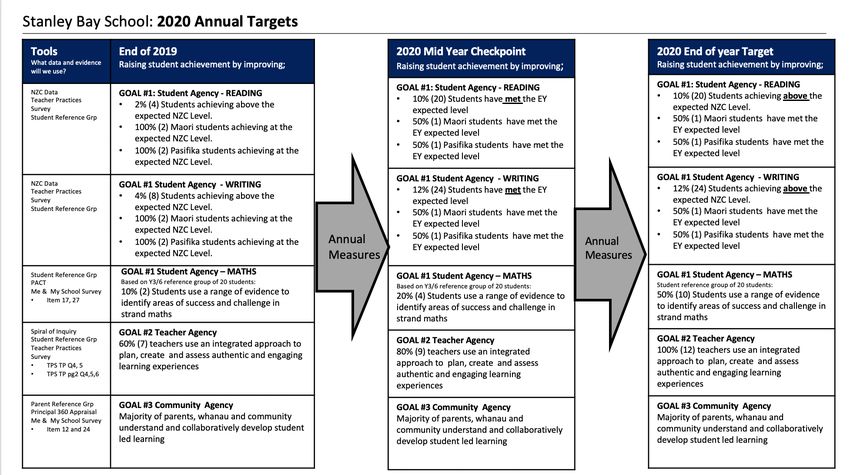
________________________________________________________________________________

Vision Statement
Growing confident, creative, curious learners who are connected to the community and wider
world
________________________________________________________________________________

Our Values
We value learners who demonstrate:

                       Respect                Resilience             Integrity

________________________________________________________________________________

Our Graduate Profile
This means that when students leave Stanley Bay they are:

Confident (Kaikorero)
Positive in their own identity and are reflective, resilient learners who are motivated to excel. They
are confident in their abilities, which enable them to take risks and be innovators.

Creative (Auahatanga)
Able to create something from personal feelings and experiences to reflect who they are and their
place in the world. They are able to express themselves openly and without judgement.

Critical Thinkers (whaiwhakaaro)
Critical thinkers who make informed decisions. They are active seekers, users and creators of
knowledge.

Connected (Nga hononga)
Effective communicators who are able to relate well to others. They are digitally literate and can
effectively use a range of communication tools to participate in a wide range of life experiences,
which connect them to their community, to their environment and to the world.

________________________________________________________________________________

                                                                                                     -2-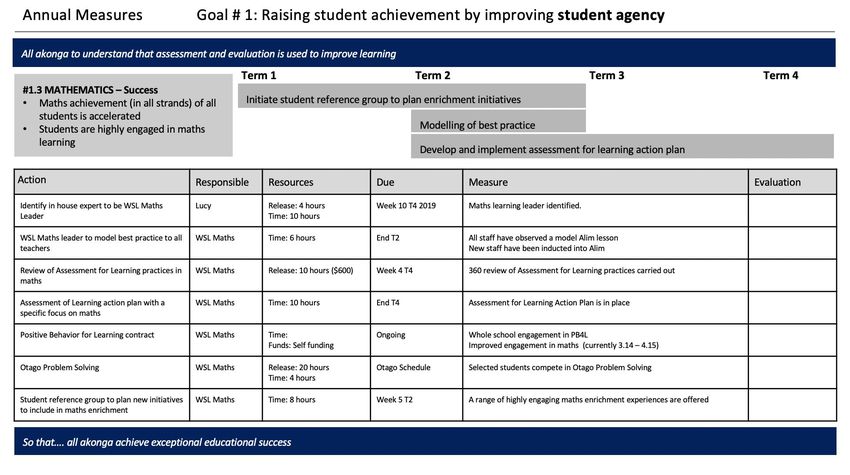
A Guide to Our Strategic Plan
Background
Who Are We?
This is background information about the
school, what we stand for and what we value.

     Plan on a Page
     What are our long term goals?
     This is a one page summary of the strategic goals
     and measures of success from 2019 to 2021.

          Strategic Goals
          What do we hope to achieve from 2019 to 2021?
          These are our long term goals and what we will
          acheive in the next 3 years.

               Annual Targets
               How will we measure our success?
               These are the targets we have set ourselves to
               accelerate student acheivement.

                    Annual Measures
                    What is happening in 2020?
                    This is what action we will take and the initiatives
                    we will implement to achieve the annual goals.

                                                                           -3-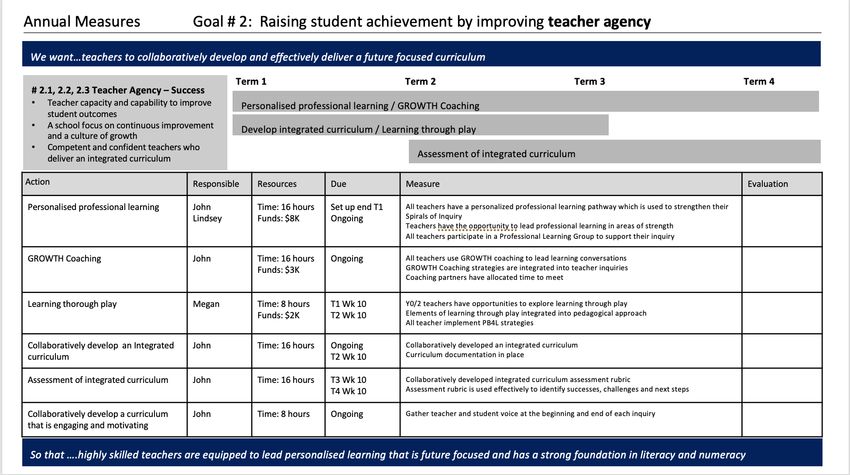
Background
  Who Are We?
  This is background information about the school, what we stand for and
  what we value.

Information about the school
Stanley Bay is a high performing co-educational school situated in Devonport on
 Auckland’s North Shore. The school was built in 1909 and originally consisted of six classrooms,
a further eight classrooms have been added over time and the facilities modernised to provide a future
focused learning environment.

The school population reflects the local community, with many students being the third generation to attend
the school. The ethnic make up is as follows:

NZ Maori        3%               NZ European      75%              Pasifika 2%
Asian           8%               Other            12%

What we stand for
    •   Inclusion
    •   Collaboration (Kahui Ako)
    •   Connections

Inclusion
We want all students to experience success regardless of their gender, ethnicity, skills or abilities. One factor
in the success of all our students is providing personalised learning opportunities that enable students to
learn through contexts that are relevant and allow them to explore their unique heritage. By providing a
localised curriculum all students can celebrate their identity, language and talents.

We recognise New Zealand’s bicultural heritage, and value the unique position of Maori in New Zealand
society. The school acknowledges the unique position of Maori through the provision of Te Reo and Tikanga
Maori and employs a fluent speaker of Maori to provide whole school instruction in Te Reo and kapa haka.
School occasions observe tikanga and the kaupapa of the school and community.

Success of Maori is a National Education Priority; we strive to improve outcomes for all students with a
deliberate focus on meeting the needs of Maori students. We do this by integrating elements of student
identity, language and culture into the curriculum and school culture.

Support from parents, whanau, hapu, iwi and the community will assist Maori to achieve
educational success. District hui have established a community perspective to support Maori
students. Stanley Bay School recognises that Tapuika (Te Arawa), and Tauranga Moana/Maataatua
iwi have an interest in our children and will participate and contribute to their education.

In accordance with the views of iwi kainga and tangata whenua we recognise that Te Reo and tikanga are
taonga.

                                                                                                             -4-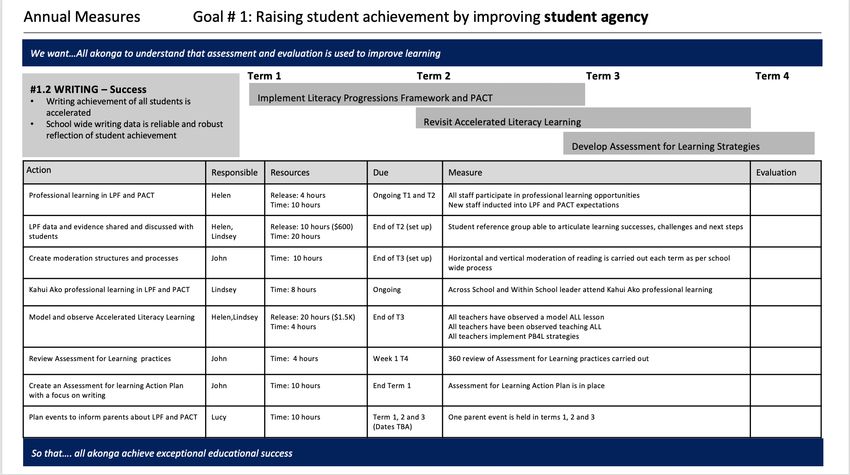
Collaboration
The Devonport Community of Learning (Kahui Ako) is a government initiative that commenced in 2016. Nine
schools from primary to high school joined together with the purpose of collaboratively raising achievement
for students in our local area and sharing expertise in teaching practice. Kahui Ako is a strong community and
has worked closely and is now in a unique position to build learner focused relationships to collaboratively
and collectively grow a culture of inquiry, which will result in;

    •   A common language of learning.
    •   Leadership and teaching strategies that are effective for engaging and accelerating the learning of all
        students with a focus on Maori, Pasifika and boys.
    •   Improved well-being /hauora of all learners and staff.
    •   Robust transition process from ECE to primary, Belmont Intermediate and onto Takapuna Grammar.
    •   Community goals that shape all Kahui Ako schools’ priorities.
    •   Effective collaboration between Kahui Ako schools

Further information can be found on the Kahui Ako website.

Connections
In a globally connected world, we need to prepare our learners to not only take advantage of all that this
offers but encourage them to question, investigate and act as global citizens. We support and encourage our
learners to become locally and globally connected and see it as an important part of their educational future.
Through a powerful emphasis on inquiry learning students have the opportunity to explore themes of local
and global significance and develop their own world view.

What we value
    •   Student Agency
    •   Teacher Agency
    •   Community Agency

Student Agency
Students take an active role in their own education. We provide opportunities to build leadership capacity,
challenge students in their learning and encourage them to take responsibility to lead their own learning.
This is student agency.

Teacher Agency
Teachers have high expectations of the students and themselves. They foster a love of learning and are
committed to continuous improvement of their practice. They are encouraged to take responsible risks and
innovate in the delivery of the curriculum. Collaboration amongst teachers facilitates open and often
challenging conversations, which encourages critical thinking and development of best practice. This is
teacher agency.

Community Agency
We value a strong collaborative relationship between home and school. At Stanley Bay those partnerships
focus on learning, this goes beyond simple relationships between teachers, leaders and family to a position
of shared professional accountability in a spirit of reciprocity.

At Stanley Bay we want parents to be actively involved in their child’s learning and believe that by working in
together we will achieve the best possible outcomes for the child. This is community agency

                                                                                                           -5-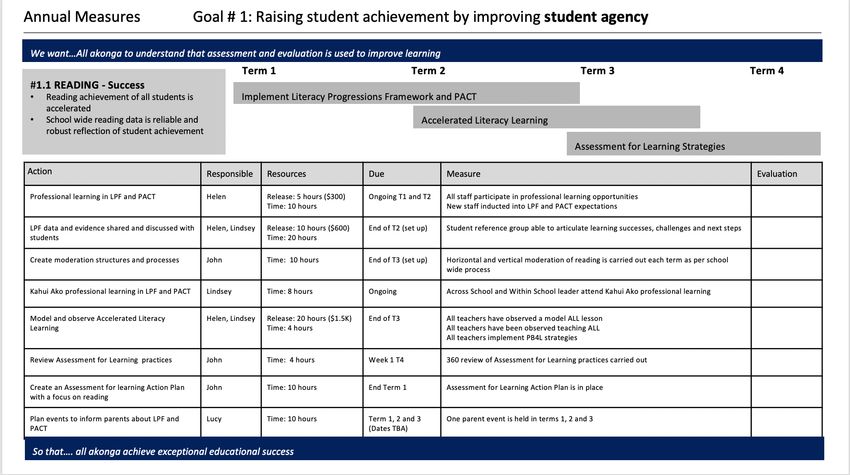
Plan on a Page
What are our long term goals?
This is a one page summary of the strategic goals and measures of success
from 2019 to 2021.

                                                                            -6-
Strategic Goals What do we hope to achieve from 2019 to 2021? These are our long term goals and what we will achieve in the next 3 years.
Strategic Goal #1: Raising student achievement by improving student agency
                       Strategic Goals                                                                                     Success                                               Initiatives
                       2019                           2020                           2021                            We will see…                     So that…                   To achieve this, we will…
1.1 Reading            Students understand that       Students are able to use a     Students confidently and        Students, teachers and           Reading achievement of     2020
                       there are many sources of      range of data and evidence     accurately use a range of       parents working                  all students is            •   Implement LPF
Tools:                 evidence and data that can     to identify their successes,   data and evidence to lead       collaboratively with the         accelerated                •   Initiate Positive Behavior for
•    Literacy          be used to help them to        challenges and next steps in   their own learning and          Literacy Progression                                            Learning (PB4L)
     Progression       identify their successes and   reading.                       communicate this to peers,      Framework to inform              School wide reading data   •   Implement PACT
     Framework (LPF)   challenges                                                    teachers and parents.           teaching and learning in         is a reliable and robust   •   Host parent information
•    PACT                                                                                                            reading                          reflection of student          evenings
•    Student Ref                                                                                                                                      achievement                2021
                                                                                                                                                                                 •   Revisit Accelerated Literacy
1.2 Writing            Students understand that       Students are able to use a     Students confidently and        Students, teachers and           Writing achievement of         Learning (ALL)
                       there are many sources of      range of data and evidence     accurately use a range of       parents working                  all students is
                                                                                                                                                                                 •   Develop systems to implement
Tools:                 evidence and data that can     to identify their successes,   data and evidence to lead       collaboratively with the         accelerated
                                                                                                                                                                                     personalised professional
•    LPF               be used to help them to        challenges and next steps in   their own learning and          Literacy Progression
                                                                                                                                                                                     learning
•    PACT              identify their successes and   writing.                       communicate this to peers,      Framework to inform              School wide writing data
                                                                                                                                                                                 •   Implement Assessment for
•    Student Ref       challenges                                                    teachers and parents.           teaching and learning in         is a reliable and robust
                                                                                                                                                                                     Learning (AFL) strategies
                                                                                                                     writing                          reflection of student
                                                                                                                                                      achievement
1.3 Mathematics        Students are able to use a     Students and teachers          Students are engaged and        Student that are highly          Maths achievement (in      2020
                       range of evidence to           confidently use a range of     motivated in strand maths,      engaged and motivated in         all strands) of all        •    Initiate PB4L
Tools:                 identify areas of success      evidence to collaboratively    can articulate their learning   maths programs that are          students is accelerated    •    Otago Problem Solving
•    PACT                                                                                                            incorporate a variety of real-                              •    Develop Maths Enrichment
                       and challenge in strand        plan relevant and authentic    needs and transfer this
•    Student Ref                                                                                                     life number and strand                                      2021
                       maths.                         strand maths learning          knowledge to ‘number’                                            Student are highly
•    Observation                                                                                                     maths learning experiences.
                                                                                                                                                      engaged in maths           •    Revisit Accelerated Learning in
                                                                                                                                                      learning                        Maths (ALim)
                                                                                                                                                                                 •    Implement Assessment for
                                                                                                                                                                                      Learning (AFL) strategies
                                                                                                                                                                           Refer to annual plan targets and measures

                                                                                                                                                                                                           2
Strategic Goal #2: Raising student achievement by improving teacher agency
Strategic Goals Success Initiatives
2019 2020 2021 We will see… So that… To achieve this, we will…
2.1 Inquire Teachers will enhance their Teachers will ‘take action’ to Teachers will use a range of Teachers using the Spiral of There is a focus on school 2020
inquiry by: improve their practice by: data and evidence to Inquiry as a reflective tool to improvement by building • GROWTH Coaching strategies
Tools: • Using student feedback • Continuously/spontane continuously seek to continuously seek teacher capacity and • Systems seamlessly link
• Teacher on their practice ously seeking feedback improve their practice. improvement and inquire capability to improve teacher inquires to
Practices • Engaging with from coaching partners into future focused student outcomes. performance management
Survey (TPS), literature and research and students pedagogy • Initiate Positive Behavior for
Pg4 • Modelling and Learning (PB4L)
observing next practice 2021
within the school and • Personalised professional
Kahui Ako learning
2.2 Coach Teachers use GROWTH Teachers use GROWTH Teachers use GROWTH Teachers seamlessly use There is a school wide focus 2020
coaching structure to share Coaching as a ‘way of Coaching learning to GROWTH Coaching on continuous improvement • GROWTH Coaching
Tools: new learning and support working’, it is embedded develop student coaching strategies to reflect on and and a culture of ‘growth • Induction documentation to
• GROWTH colleagues to implement and sustainable. groups take action to continuously mindset’ identify GROWTH Coaching
Coaching innovative teaching improve their practice expectations
Rubric strategies 2021
• Initiate Student GROWTH
Coaching
2.3 Integrate Teachers use an integrated All teachers will use a All teachers will consistently Teachers consistently using Teachers are competent and 2020
pedagogy to create learning consistent pedagogical plan and assess integrated the SBS Integrated confident to deliver an • Y0/2 to explore learning
Tools: that is engaging approach to create learning to ensure that Curriculum model to deliver integrated curriculum that through play
• TPS TP Pg1 Qu integrated learning students are challenged in high quality learning requires risk and innovation • Stanley Bay Integrated
4,5,6 Teachers explore the experiences that are contexts that are relevant programs that are relevant Curriculum Assessment Rubric
• Self integration of the Digital engaging and relevant and engaging. and engaging The Digital Curriculum is 2021
assessment Curriculum into a range of purposefully integrated into • Design the local curriculum the
rubric curriculum context All teachers purposefully All teachers seamlessly Teachers are planning, all aspects of teaching and Digital Curriculum
integrate the Digital integrate the Digital teaching and assessing the learning
Curriculum into some areas Curriculum into all areas of Digital Curriculum
of teaching and learning teaching and learning
Refer to annual plan targets and measures
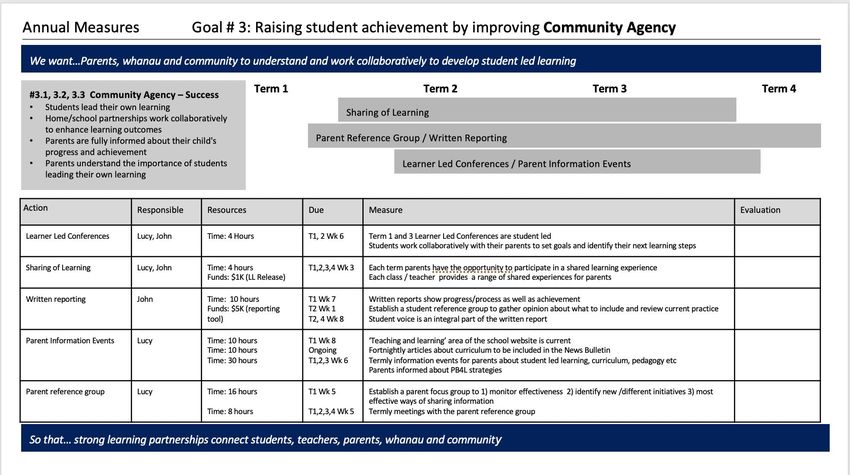
3Strategic Goal #3: Raising student achievement by improving Community Agency
Strategic Goals Success Initiatives
Baseline /2019 2020 2021 We will see… So that… To achieve this, we will…
3.1 Lead Students take an active role Students work Students are confident and Students are able to lead a Students are confident and 2020
in sharing their learning with collaboratively with teacher capable of working learning conversation with capable of lead their own • Develop Learner Led
parents and parents to set goals and collaboratively with teacher their teacher and parents learning now and in the Conferences
Tools:
identify next steps and parents to lead their future • Refine written reporting
• Me and My School own learning 2021
Survey (MMS)
• Provide regular informal
Item 12
sharing of learning
experiences
3.2 Develop Teachers create Teachers provide multiple Teachers use shared Students, parents and Partnership between home 2020
opportunities to share opportunities for students to learning opportunities to teachers are engaged in and school are focused on • Develop Learner Led
learning with parents share learning with their develop strong learning learning events which working collaboratively to Conferences
Tools:
parents eg. Seesaw, Dojo, partnerships between school enhance learning • Provide a range of
• TPS TP 2
invitational learning days and home outcomes opportunities for parents
to engage in learning
3.3 Engage Parents support effective Parents understand learning Parents are actively involved Parents understand the Parents recognise and 2020
learning focused focused relationships in creating and maintaining elements of an effective understand the importance • Plan for regular parent
relationships learning focused learning focused relationship of students leading their information evenings
relationships own learning
• Initiate a Parent
Parents are fully informed Reference Group
about their child’s progress • Develop existing
and achievement communication
platforms e.g. Hail, App,
website
• Initiate Positive Behavior
for Learning (PB4L)
Refer to annual plan targets and measures
4Annual Targets
How will we measure our success?
These are the targets we have set ourselves to accelerate student
achievement.
56
Annual Measures
What happening in 2020?
This is what action we will take and the initiatives we will implement to
achieve the annual goals.

                                                                            7
8
9
10
11
12
13
You can also read


