STUDENT HANDBOOK 2021/22 - School of Engineering and the Built Environment - GSTM
←
→
Page content transcription
If your browser does not render page correctly, please read the page content below

School of Engineering and the Built Environment

 STUDENT
 HANDBOOK 2021/22

Effective date: 22 December 2020
Version: 2.4
GSTM-SS-007

                                            © Global School of Technology and Management Pte Ltd
1
CONTENTS

Section 1:                                           Section 5
Message by Director International Partnership   2    Student Resources                   15
Welcome                                         3    BCU Resources                       15
About CEBE & SEBE                               4    Birmingham City University          15
                                                     Network
Section 2:                                           Moodle                              15
Getting Started                                 5    Library Resources                   15
Induction & Enrolment                           5    Library and Information Literacy    15
Campus Information                              5    Skills
Your Key Contacts                               6    My Assignment Planner (MAP)         15

Section 3:                                           Section 6
Your Programmes                                 7    About GSTM                          16
Programme Specification                         7    GSTM Resources                      19
Programme Timetable                             7    Course Information                  20
Learning and Teaching Methods                   7    Pre-Departure Information           21
Language of Delivery and Assessment             7    Enrolment Policy                    23
                                                     Teaching & Learning                 24
Section 4:                                           Refund Policy                       25
Assessment Information                          8    Course Transfer Policy              27
How you will be assessed                        8    Withdrawal Policy                   28
Assessment Regulations, Policies &              8    Deferment Policy                    29
Procedures                                           Course Transfer Procedures          30
Maximum Registration Periods                    9    Withdrawal Procedure                32
Assignment Submission                           9    Deferment Procedures                33
Extenuating Circumstances/ Mitigating           9    Student Code of Conduct             34
Circumstances and Extension to Deadline         9    Examples of Offences                35
Late Submission                                 9    Attendance Policy                   36
Re-assessment                                   10   Student Support                     38
Academic Misconduct                             10   Student Complaint/ Grievance        42
Assessment Results and Examination Boards       11   Procedure
Marking, Feedback and the External Examiner     12   Appeal Policy                       43
Grading Criteria                                12
Error in the Conduct of an Assessment or an     12   Section 7
Examination Board                                    Graduations Condition of entry to   45
Interruption of Studies                         12   Graduation
Transfer                                        13   Getting Involved                    46
Withdrawal and Termination                      13   Frequently Asked Questions          47
Classification of Honours Degree                13
Classification of Postgraduate Programme        13
Certificate and Transcripts                     14
Rescinding Awards                               14
Concerns and Complaints                         14
2
Message by Associate Dean
International

Dear Student,

A very warm welcome to you from all the team here at Birmingham City University (BCU) in
Birmingham, UK and all the staff at our collaborative partners at GSTM, Singapore. I hope you
have an enjoyable and rewarding experience on your chosen programme of study.

We are proud to have been working with GSTM since 2013 to provide exciting opportunities for
students to study our programmes in the beautiful city of Singapore. Many of these
programmes are recognised by professional bodies and we take great effort to ensure all
programmes are designed to meet your future career needs and to equip you with key skills,
attributes and understanding to allow you to prosper in your chosen profession. Our close links
to big-name companies and organisations help to ensure our programmes are at the cutting
edge of the discipline and remain highly relevant to their needs.

Many of the teaching staff at GSTM come from and maintain their links with industry, ensuring
you are given an insight into the latest thinking. We are constantly looking for new ways to
enhance the learning experience, with inspiring visiting lecturers and learning environments that
are designed to replicate the workplaces you aim to enter.

We are also committed to delivering high quality learning opportunities and were delighted
when GSTM were awarded the EduTrust Certification by the Committee for Private Education
(CPE). This prestigious award is given to institutions in recognition of their commitment to
maintaining an excellent level of performance and in providing high-quality education standards
and welfare for their students. So, you can be assured that you will experience the best
possible education that satisfies the UK and Singaporean quality benchmarks and standards.

On behalf of the entire BCU team, I wish you every success with your studies and hope you
have an enjoyable and inspiring experience with us. Remember, you are BCU!

Professor David Proverbs
Associate Dean International
Faculty of Computing, Engineering and the Built Environment
Email: David.Proverbs@bcu.ac.uk
3
 Welcome

Welcome to Birmingham City University. You are          Our Vision
now part of one of the largest Universities in the
United Kingdom that attracts students from all          To be the leading university for creative and
backgrounds from across the region, the country         professional practice inspired by innovation and
and the rest of the world. With 25,000 students from    enquiry
80 countries, Birmingham City University is a
university with an international outlook.               Our Mission

The University also works in partnership with other     To transform the prospects of individuals, employers
higher education institutions and organisations not     and society through excellence in practice-based
only in the United Kingdom but in countries             education, research and knowledge exchange
throughout the world. These partnerships provide
opportunities for students to study at a centre local   Our Values
to them on a programme that leads to an award of
the University.

You too are studying for a Birmingham City
University award through one of our partnerships.
Throughout this Handbook we will refer to the place
where you are studying i.e. Global School of
Technology and Management, as either the ‘partner
organisation’ or as GSTM.

This Handbook is one of several important
documents that you will receive during your time
as a Birmingham City University student. We urge
you to read this Handbook and to keep it as a
reference tool for the duration of your studies

4
About CEBE & SEBE

 The Faculty of Computing, Engineering and the                School of Engineering & the Built Environment
 Built Environment (CEBE)                                     (SEBE)

 CEBE comprises of two schools that, together, are able       We        are       a      recognised leader      in
 to respond dynamically to the multiple modern                education, training and business          solutions,
 technological challenges posed by fast-paced industries.     offering a wide range of courses that benefit from
 Their shared vision is to create a powerful centre of        active engagement with regional, national and
 technological              excellence and innovation,        international industry - giving students the best
 to educate to the highest quality in technologies and        possible introduction to modern engineering.
 engineering and equip students with the technical skills
 to contribute to the workplace as well as to the wider       Our high-quality programmes combined with industry
 industry.                                                    engagement have earned the School accreditation by
                                                              world-leading professional bodies, such as
 Our close links to industry allow students to become         the Institution of Engineering and Technology and
 involved in the latest research or make a real               the Institution of Mechanical Engineers (IMechE).
 contribution to business.                                    Well-equipped laboratories enhance our students'
                                                              educational experience, providing a bridge between
 We also offer international links that allow us to explore   theoretical learning and hands-on teaching to prepare
 further the emerging technologies, which are crucial         them for a career in industry.
 for knowledge-sharing. They also offer opportunities for
 overseas exchange.                                           Our courses are tailored to meet the needs of
                                                              employers through partnerships with professional
 Students can find out what to expect from life at the        bodies and industry. For example, each new
 university and how they can contribute by viewing            programme is approved, or existing programmes re-
 our student partnership agreement.                           approved, by a panel that includes a representative
                                                              from a relevant industry or professional body.
 Through     a     vast      choice   of accredited
 courses supported by more than 300 staff, plus               About the University Policy and Procedures, please
 vigorous research activities, CEBE has gained a              visit       http://www.bcu.ac.uk/about-us/corporate-
 reputation as the West Midlands' chief hub of                information/policies-and-procedures
 knowledge, technology and skills-transfer into
 industry.
5
Getting Started

Induction & Enrolment
Global School of Technology and Management                    Your enrolment forms will be sent to Birmingham City
(‘GSTM’) will arrange a Welcome Orientation Session           University so that we can then enroll you as a student
which will be followed by an induction session.               of the University. Once we have set up an electronic
Attendance is compulsory for all new students.                record for you on our database, you are required to
                                                              complete an online enrolment for confirmation of your
Welcome Orientation Sessions will provide you with            registration as BCU student. Once you completed this
important information about your programme including          process, you will be issued with a unique identification
the learning, teaching and assessment methods that            number, a Birmingham City University Network ID and
will be used and what will be expected of you. You will       password, and a personal Birmingham City University
receive an introduction to your institution, the facilities   email account. This email address will be used by the
and the learning resources as well as meeting the             University to communicate useful and official
members of the teaching and support staff and your            information. You will also need your password to make
fellow students                                               use of and to access the online learning facilities on
                                                              the University’s intranet (called iCity) and Moodle.
You will also be required to enroll as a student of GSTM
as well as Birmingham City University (‘the University’).
In order to enrol, you will need to provide the following:    The amount of fees due will be recorded on your
    • Original certificate or official results notification   Standard Student Contract and you will be expected to
         of all qualifications that are listed on your        pay or make arrangements to pay at enrolment. It is a
         application form;                                    condition of enrolment that you accept full
    • Original NRIC or passport;                              responsibility for the payment of all programme fees
    • Completion of application form                          and any other fees that you incur while registered as a
    • Payment for your fees as stipulated in Standard         student on the programme.
         Student Contract or a sponsor letter confirming
         payment.

Once your application is approved by Birmingham City
                                                              Campus Information
University (BCU), you will receive the following
                                                              GSTM is located at 420 North Bridge Road, North
documents from GSTM:                                          Bridge Centre, #02-06 Singapore 188727. All
    • Offer letter,                                           programmes offered at GSTM is registered with
    • Advisory Note                                           Singapore Committee Private Education (Reg No:
    • Standard Student Contract                               201007405K). Please visit the Official CPE website at
                                                              www.ssg.gov.sg/cpe/pei.html for details.
As part of the enrolment process, GSTM will complete
an enrolment form from BCU. The information is                Most classes will be conducted at this location, but,
including details of your legal name, home and term           where necessary, classes may be held in other
time addresses and all previous qualifications. Other         locations. Students should refer to their respective
personal details will be required for statistical purposes.   timetable for the location of classes.
6
Your Key Contacts

Purpose (s)                    Contact Persons           Contact Details
Student Support Services       Ms Aida                   Tel: (65) 64239618
Academic / Examinations        Ms Joanne                 HP: (65) 81890101
                               Ms Alyssia (Link Tutor)   Email: info@gstm.edu.sg

Fees Payment and Enquiries     Ms. Grace                 Tel: (65) 64239618
                               Ms. Liza                  HP: (65) 81890101
                                                         Email: info@gstm.edu.sg

Course Enquiries / Marketing
                               Mr Gavin                  Tel: (65) 64239580 /64239590
                               Ms. Liza                  HP: (65) 97204769
                               Ms. Alyssia               Email: info@gstm.edu.sg

Corporate Marketing            Ms. Liza                  Tel: (65) 64239580 / 64239590
                               Mr. Linus                 Email: info@gstm.edu.sg
                               Ms. Alyssia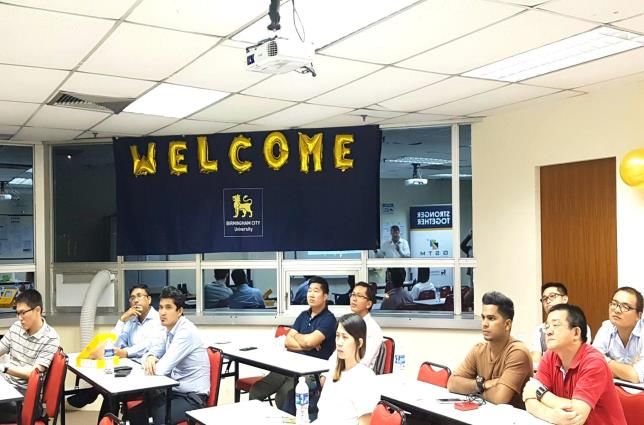
7
Your Programme

Programme Specification                                    Learning               and           Teaching
Every course offered by the University has a               Methods
programme specification. A programme specification is
a concise description of the knowledge, understanding      Key concepts will be introduced through lectures and
and skills you should have gained on successful            will be explored further during seminars, workshops,
completion of the programme as well as information         lectures from visiting speakers, in-class and forum
about how you will be taught and how you will be           debates and through self-directed/independent study.
assessed (for example by written examination or            Case studies are used to explore concepts applied to
coursework assignment).                                    real-world scenarios. Experiential learning is
                                                           encouraged via project-based assignments.
The programme specification for your course can be
found at www.bcu.ac.uk/courses or www.gstm.edu.sg          Analysis, synthesis and evaluation are developed as
                                                           themes throughout the programme. Information and
                                                           discussion forums will be available on Moodle (see
                                                           Section 5: Resources) for participants to provide a
                                                           support network to complement lectures, seminars
Programme Timetable                                        and workshops.

                                                           One of the key aspects of higher education study is
                                                           self-directed/independent learning and you will be
A timetable will be issued to you during your induction.
                                                           expected to undertake a lot of work outside of your
The timetable will include your assessment deadlines.
                                                           timetabled lectures and seminars. Don’t rely on your
                                                           lecture notes for all the information you’ll need for an
                                                           assessment. It is important that you do some
                                                           independent research, for example, by reading
Student Portal Account                                     through some of the additional textbooks suggested
                                                           by your teaching team.
You will receive a Student Portal Account via email for
the User ID and Password from GSTM.                        Language   of                  Delivery           and
You can log in to your Student Portal Account for          Assessment
programme timetable.
                                                           All of your programme will be taught and assessed
                                                           through the medium of English. English language
                                                           support sessions will be made available to any student
                                                           seeking supplementary support. More information
                                                           about the language support sessions is available from
                                                           your Programme Director or tutor.
Assessment                                                                                                                          8

Information                                                  Key features
                                                             1. Number of assessment opportunities

                                                             You will have two assessment opportunities for each module. If, at the
                                                             first assessment attempt, you fail a module or an item of assessment in a
                                                             module you will have one opportunity to be re-assessed. And If you fail
                                                             the re-assessment attempt in a core module, you will be withdrawn from
How you will be assessed?                                    the course.

                                                              If you fail to submit work for re-assessment in a core module, you will fail
A wide variety of assessment approaches are used             the module and be withdrawn from the course. Please note that if there is
throughout the programme. These include structured           something outside your control that is affecting your ability to complete an
tasks, presentations, practical work, academic writing       assessment you can ask the University for an extension or to take the
                                                             assessment at a later date, by making a claim under the University’s
(articles, business reports and academic papers),            Extenuating Circumstances procedure. Click here for further information
individual or group projects and examinations. Your          at                      https://icity.bcu.ac.uk/Student-Affairs/Appeals-and-
lecturer will issue you with assessment briefs that          Resolutions/Extenuating-Circumstances-Procedure
contain the specific details of individual assessments.
                                                             If you fail an optional module, you can choose to substitute an alternative
The assessment briefs are changed annually and               optional module if one is available after failure at the first attempt or failure
therefore cannot be published in the Handbook. More          at the re-assessment attempt. You will have two assessment attempts at
detailed information about how a particular module will      the new optional module. However, if you fail the re-assessment attempt
be assessed can be found in the module specifications.       in the new module, you will be deemed to have failed and no further
                                                             optional modules can be taken in its place.

Assessment     Regulations,                                  2. The pass mark for a module

                                                             The pass mark for a module with one item of assessment is 40% for
Policies & Procedures                                        undergraduate course and 50% for postgraduate course . In modules
                                                             where there is more than one item of assessment, a pass mark will be
                                                             awarded where the overall weighted average of the marks achieved for
The University has a series of regulations, policies and     the items of assessment is 40% or more for undergraduate and 50% or
procedures that govern your academic experience and          more for postgraduate.
all members of staff and all students are required to
observe these during their time at the University. It is     3. Non-discretionary compensated credit
therefore important that you familiarise yourself with       Compensation is automatically applied at each stage of study at the level
these regulations, policies and procedures. You can          of the module for a marginal fail of up to 40 credits provided the stage
find the full set of University regulations, policies and    mean has been achieved, on the basis that a strong performance by a
procedures           on         the       iCity        at:   student in one part of the curriculum may be used as the basis for the
                                                             award of credit in respect of a marginal fail elsewhere. Compensation can
https://icity.bcu.ac.uk/Quality-Enhancement-and-             be applied to both core and optional modules where the following criteria
Inclusion/Quality-Assurance-and-                             are met.
Enhancement/Academic-Regulations
                                                             Where a student has not achieved the credit requirement for progression
                                                             or award but has met the following criteria, then up to 40 credits will
It is important that you familiarise yourself with the       automatically be granted by compensation provided that the remaining
Academic Regulations: Assessment, Progression and            credits in the stage meet the pass threshold:
Award. You can find the full version of Academic
                                                             (i)    a stage mean of 40% for an undergraduate course, with the
Regulations: Assessment, Progression and Award at                   exception of integrated Master’s courses where the stage mean
iCity.                                                              requirement in the final stage is 50%, or a stage mean of 50% for a
                                                                    postgraduate course (excluding the research project/dissertation);
The way in which your work is assessed is covered by         (ii)   a marginal fail on the module/s (35-39% for undergraduate modules
                                                                    or 45-49% for a level 7 module). Compensation cannot be applied to
the University’s Assessment Regulations. The                        awards consisting of fewer than 120 credits.
regulations include information about:
• modules, levels of modules and the credits which           The regulations for your course are the Assessment Regulations Third
                                                             Version (2020). You’ll receive information about the University’s
    attach to them;                                          regulations from your programme team, and if your programme is
• requirements for passing modules;                          governed by Standard University Regulations, you can access them along
• requirements for progression to the next level of          with other useful policies and procedures, on the Academic Regulations
                                                             and Policies page on iCity.
    your course;
• how to achieve an award with Commendation or               You may be asked for a ‘username’ and ‘password’, which is just your
    Distinction and how degree classifications are           University network ID and password. Under ‘username’, you’ll need to
                                                             type: STUDENTS\ before adding in your University network ID. Once
    calculated;                                              you’ve added in your details, a SharePoint page will open up: Click on the
• what happens if you fail a module.                         ‘Academic Regulations and Policies’ folder to access our standard
                                                             regulations.
Assessment                                                                                                      9

Information                                                Extenuating Circumstances/Mitigating
                                                           Circumstances and Extension to
                                                           Deadline
                                                           If you can’t submit an assignment or attend an exam for
Maximum                        Registration                valid reasons beyond your control (for example, if you are
                                                           ill) you can apply under the University’s procedures for the
Periods                                                    consideration of exceptional circumstances for either:
                                                           •     A deferral (which means that you will take the
For Top-up Degrees, the maximum registration                     assessment at the next available opportunity); OR
period is three years.                                     •     A coursework extension of 10 working days to the
                                                                 coursework deadline
For Master of Science, the maximum registration
period is five years.                                      You must make sure you submit your request, with
                                                           evidence (i.e. a doctor’s note if you are ill), at least 7
Extensions of registration periods require the approval    working days before the exam/assessment deadline. The
of the Director of Academic Services in consultation       full    procedures      are   available    on    iCity  at
with academic staff. When previous study is no longer      https://icity.bcu.ac.uk/Student-Affairs/Appeals-and-
current, students may be required to take current          Resolutions/Extenuating-Circumstances-Procedure
versions of the nearest equivalent modules.
                                                           Late Submission
Assignment Submission                                      Students are responsible for submitting coursework on
                                                           time and in the way specified in Module Guides. Marks for
You will be submitting several pieces of coursework
                                                           assessments submitted:
work over the academic year and it is important that you
                                                           1. Up to 1 hour late = no penalty
keep the following in mind:
                                                           2. 1 –24 hours late = reduced by 5%
• Prepare your work so that your assignment is ready       3. 24 hours – 5 working days = reduced by 10%
   in advance of the submission date (see My               4. More than 5 working days = not marked – 0% recorded
   Assignment Planner in Section 5: Resources for
   help with planning your assignment);                    If you do not have exceptional circumstances but submit
• Each assignment must be submitted with a                 your first attempt of an assessment after the published
   standard cover sheet showing your name, full            deadline, the maximum mark you can be awarded will be
   student number and programme of study, module           the pass mark for the module, provided you submit your
   title and the name of your tutor. You will be given a   work no more than 5 working days after the published
   receipt on submission of your coursework;               deadline.
• Collect several cover sheets from the office at the
   start of the term so you can complete one before        Work submitted more than 5 working days after the
   you hand in your work;                                  published deadline will be given a mark of zero and you
• Ensure that your assignment is ready for                 will be deemed to have failed an attempt at the
   submission when it is handed in i.e. the work is        assessment. Where you submit a reassessment attempt
   secured in the file and the cover sheet has been        after the published deadline you will be deemed to have
   completed;                                              failed the re-assessment and the coursework will be
• All coursework is due by 5pm on the day of               returned to you unmarked.
   submission; any work submitted after this deadline
   will be regarded as a late submission and will be       If you have longer term problems which you think are likely
   subject to the appropriate penalty (see below Late      to last more than three weeks, you should ask your
   Submission);                                            personal tutor whether you should apply to withdraw
• Only submit complete assignments. You cannot             temporarily from the course – this is called ‘taking an
   submit missing sections after the submission date.      interruption of studies’. Further information is available in
   If you wish to add to an assignment that has been       Frequently Asked Questions Section.
   handed in and the submission date has not yet
   passed, you must provide a copy of your receipt.
   Your work will be returned, and you must then
   resubmit it.
Assessment 10
Information
Some examples of academic misconduct are included
Re-Assessment below, but the list is not exhaustive and cheating in
assessed work may take other forms:
If you have not passed a module at the first attempt, you
may be eligible for re-assessment. If you do re-sit a Cheating in examinations:
module without extenuating circumstances, your mark • Attempting to access confidential information
will be capped at the pass mark i.e. the maximum mark before an examination, including trying to get sight
that you can achieve will be the pass mark (this is of the examination paper before it is published;
usually 40% for Undergraduate and 50% for • Taking or attempting to take unauthorised material,
Postgraduate). including blank paper, electronic devices and
mobile phones, into an examination room;
Students who fail modules are permitted a second • Communicating or attempting to communicate in
attempt at each failed assessment, provided this can be any way with another candidate or any other person
completed within their maximum registration period. (other than the invigilator) during an examination;
• Copying, or trying to copy, the work of another
Reassessments submitted after the deadline will be student;
given a mark of zero. Students may not be reassessed • Allowing or assisting another student to copy;
on modules they have passed. • Impersonation – taking an assessment on behalf of,
or pretending to be, another student, or allowing
Reassessments must be attempted on the next another person to take an assessment on behalf of
occasion the assessment takes place unless an a student;
interruption of study has been granted. Marks for • Attempting to remove script books, including blank
modules that include reassessments are capped at script books, from an examination room.
40%. When reassessment results in a lower mark, the
original mark is used. Cheating in relation to other forms of assessed
work – including:
Students who do not attend a reassessment event or
miss a coursework deadline will fail the assessment Plagiarism: This is the submission of an item of
unless a deferral or extension is granted. assessment, which all or in part, contains work
produced by another person (s) in such a way that it
If reassessment using the same methods as the initial could be assumed to be the student’s own work.
assessment is not practicable, the Examination Board Plagiarism also includes a lack of ‘in-text’ referencing.
will make special arrangements for re-assessment. Information on avoiding plagiarism can be found on the
Centre for Academic Success web pages Centre.
Academic Misconduct Collusion: This is where there has been improper
collaboration (or working together) in the production of
Academic Misconduct is often referred to as ‘cheating’ a piece of work, which is then submitted as entirely the
or ‘plagiarism’ and can take a variety of forms and work of an individual. It is important to note that except
although it may be intentional or unintentional, the where written instructions state that work for
University takes allegations of academic misconduct assessment may be produced jointly and submitted as
very seriously. Cheating is considered a disciplinary the work of more than one student, (often referred to as
offence if a student attempts to gain or helps someone ‘group work’), students must not collaborate with other
else to gain an unfair advantage over other students. students to produce a piece of work jointly.
Students who are suspected of cheating will have to Furthermore, students should not copy or share another
attend a formal hearing to explain their case, and if student’s work, lend their work to another student or
found guilty of cheating the penalties can be severe, allow another student to copy their work.
including the removal of academic credit or even your
permanent expulsion from the University.Assessment 11
Information
Falsification of data or artefacts: This is where In coursework:
students invent data or change their material in order to • Don’t pass off someone else’s work as your own.
support an argument. Examples of such behaviour This is plagiarism and is viewed very seriously by
include inventing false responses to questionnaires and the University;
interviews and amending test results/figures. • Acknowledge all sources that you have used in your
assignment or project. For advice on referencing
Duplication: This is the submission of a piece of work contact the Centre for Academic Success;
in whole or in part that has already been submitted for • Use quotation marks if you are using the exact
assessment elsewhere, including concurrent words of another person;
submissions. To find out how you can avoid allegations • Don’t submit a piece of work that has already been
of cheating, it is strongly suggested that you visit our submitted in whole or in part for an assessment
assessment guide, available at: elsewhere. This is called duplication and, like
https://icity.bcu.ac.uk/Academic-Registry/Information- plagiarism, is viewed very seriously by the
forStudents/Assessment/Avoiding- University;
• Check with your course team whether you can work
with others on your coursework, and if so, be sure
Allegations-of-Cheating about what you should be doing on your own;
• Don’t allow others to copy your work, or lend your
To help you understand how to reference correctly, work to other students;
please seek advice from your tutors or familiarise • Don’t make up data to prove your point.
yourself with information on avoiding plagiarism
provided by the University at:
http://library.bcu.ac.uk/learner/writingguides/1.12.htm Assessment Results and
Examination Boards
Here are a few simple principles to follow to avoid
allegations of cheating: At the end of your academic year and when you have
completed all of your assessments, an Examination
In exams: Board meeting will be held. The Board is made up of
• Don’t attempt to see the paper before it is staff from your institution, the University as well as the
published; External Examiner (see below).
• Don’t ask another student for help during the exam
or copy another student’s work; The purpose of the meeting is to endorse the marks
• Don’t let another student copy your work; awarded to assessment. It is only after the Examination
• Don’t take unauthorised materials into the exam Board has confirmed your marks that you will receive
room; confirmation of your results.
• Make sure you know what equipment/materials you
can use in the exam (i.e. calculator) and make sure
the permitted materials are clear of your additional
notes and other recorded information.Assessment 12
Information
Marking, Feedback and the Grading criteria
External Examiner Statements of grading criteria for each of the
assessment criteria describe performance associated
When you hand in your work or sit an exam, your work with the assessment criteria. The grading criteria are
will be marked as quickly as possible by the teaching the basis upon which marks are accorded. Grading
team. Their marking will then be moderated within the criteria for each module assessment are provided in the
Department or Faculty, to ensure that marks have been relevant assignment briefs.
awarded fairly. Marking is carried out anonymously,
wherever possible, so don’t worry, personal feelings are
never taken into account when your work is being
Error in the Conduct of an
graded. To make sure that you are assessed fairly in Assessment or an Examination
relation to other students on the same course and to
ensure the quality and standards of our courses are Board
comparable to similar courses in other Universities, the
University employs an External Examiner. An External If you consider that there has been an error or
Examiner is a qualified subject specialist who works in irregularity in an assessment, or at an examination
a UK university other than Birmingham City University. board, you may submit a claim under the “Procedure for
External examiners won’t be marking your work, but considering Claims of Error in the conduct of
they will see a sample of assessed work to check the Assessment Processes”. To submit a claim you should
appropriateness of the standards and the marks complete a form called “Academic Appeal Form” which
awarded. is available on iCity at https://icity.bcu.ac.uk/Student-
Affairs/Appeals-and-Resolutions/Extenuating-
The External Examiner will visit your centre at least Circumstances-Procedure
once a year and you will have the opportunity to talk to
them about your experience – good and bad! - on the Procedure
programme. Following the visit, the External Examiner
will write a report that tells the University about the good If you wish to make a claim, you must submit your
practices at your centre and of any concerns they might academic appeal within 20 working days of the decision
have. External Examiner reports are made available to that you are questioning being published or received If,
students and you can request a copy from your for good reason, you cannot submit a claim within this
Programme Director. You’ll get feedback on your timescale you should speak to your Tutor or
assessments, so make sure you go and collect your Programme Director. If you are still not happy with our
work once it’s been marked. Feedback is really useful response to your academic appeal, you can ask for a
as it includes the markers’ constructive comments on review. You shall complete the “Academic Review
your assessment, including aspects of your work that Form” which is available on iCity at
could be improved, and it can also provide guidance https://icity.bcu.ac.uk/Student-Affairs/Appeals-and-
and advice for future assessments. Please note that Resolutions/Extenuating-Circumstances-Procedure
when you collect your work, you will receive an
indication of how well you have done in your This stage should be completed within 20 working days
assessment and you may receive a mark for the work. of us receiving the request for a review and we will give
However, remember that the mark is only indicative and you our decision in writing.
is subject to change. You will receive the final mark after
the meeting of the Examination Board.Assessment 13
Information
Borderline for Degree
Interruption of Studies
Classification
Students may apply for permission to interrupt their Rounding of marks may result in a grand mean mark
studies for between 20 working days and one academic coming close to but below a degree classification
year. This requires the approval of the Director of boundary. Students falling within a borderline area of
Academic Services. See the Student Withdrawal and one percent below each classification boundary as
Interruption of Studies Policy for more details. Students follows will be eligible for reclassification:
who interrupt withdraw from all current modules and • 69-70 Boundary for 2:1/1st and for postgraduate
may not attend classes or submit work for assessment. merit/distinction
Existing assessment marks (including failures) are • 59-60 Boundary for 2:2/2:1 and for postgraduate
carried forward when the modules are resumed. pass/merit
Students who fail to resume their studies at the time • 49-50 Boundary for 3rd/2:2 and for postgraduate
agreed with the University will have their registration borderline fail
terminated. • 39-40 Borderline fail for undergraduate
Programme Transfers Classification of Honours
Degrees
Students may apply to transfer between programmes. Classification of Mark Honours
This requires the approval of the Programme Directors Classification
of both the old and new programmes, who will take First Class 70% or above
account of the availability of places, admissions criteria, Second Class Honours 60 – 69 %
ability to transfer credit, maximum registration periods Division I
and timing. Second Class Honours 50 – 59%
Division II
Withdrawal and Termination Third Class 40 – 49%
Students have the right to withdraw at any time. Those Classification of Postgraduate
considering this should seek advice as soon as possible
from the appropriate academic staff and student Programmes
support services. See the Student Withdrawal and For the master programmes, modules are assessed
Interruption of Studies policy for more details. The independently of each other. A mark, or in some cases
University may terminate a student’s registration due to a pass/fail, is given for each module and credit is
assessment failure, failure to engage, exclusion, failure awarded to students who pass. The pass mark for
to complete re-enrolment, breach of visa conditions or assessments where marks are awarded is 50%.
breach of regulations.
After withdrawal or termination: The pass mark for modules is a weighted average of
• students are not permitted to attend teaching 50% across all assessments in the module. To qualify
sessions or take assessments; for awards, students need the following credits:
• Library and network access are withdrawn; Award Minimum Credit Needed
• there may be a tuition fee liability. Postgraduate 60 credits of which at least 40
Certificate must be at level 7
Assessments submitted before termination or Postgraduate 120 credits of which at least 100
withdrawal will be considered by Examination Boards in Diploma must be at level 7
the normal way and may contribute to the granting of an Master’s Degree 180 credits of which at least 160
Exit Award. must be at level 7Assessment 14
Information
Aegrotat Awards
In term of commendation and distinction:
• The award of Postgraduate Certificate is not available An Aegrotat undergraduate degree is a degree that may
with Commendation or Distinction. be awarded where a student has achieved 60 credits in the
• The award of Postgraduate Diploma with final stage and is unable to complete their studies in the
Commendation will be made to students who satisfy foreseeable future because of serious illness or other valid
the requirements for the award and achieve an overall cause. A student achieving 60 credits in the final stage
average mark of 60 – 69% in the 120 credits required may be eligible for an Aegrotat degree on the credit
achieved and/or on work completed to that date. The
for the award.
Aegrotat degree will be reserved for those circumstances
• The award of Postgraduate Diploma with Distinction in which the PAB recognises higher level academic
will be made to students who satisfy the requirements achievement, subject to the approval of the Deputy Vice
for the award and achieve an overall average mark of Chancellor (Academic) following a recommendation from
70% or above in the 120 credits required for award. the PAB. An undergraduate Aegrotat degree may be an
• The award of Master’s Degree with Commendation unclassified honours or an Ordinary degree (without
honours). Alternatively, a Diploma/Certificate of Higher
will be made to students who satisfy the requirements
Education may be awarded.
for the award and achieve an overall average mark of
60 - 69% in the 180 credits required for award. A postgraduate Aegrotat degree may be awarded at
• The award of Master’s Degree with Distinction will be Master’s, Diploma or Certificate level depending on the
made to students who satisfy the requirements for the credit achieved, subject to the approval of the Deputy Vice
award and achieve an overall average mark of 70% or Chancellor (Academic) following a recommendation from
above in the 180 credits required for award. the PAB. A postgraduate Aegrotat may be classified where
academic performance at the higher level has been
• Where a student has been admitted with academic
demonstrated.
credit, eligibility for an award with Commendation or
Distinction will be based solely upon the marks An Aegrotat degree does not provide eligibility for
achieved in the modules the student was required to registration with a Professional Statutory and/or
complete on the programme in order to qualify for the Regulatory Body (PSRB).
award.
Revocation of an award of the University
• Where students have more than the required number
of credits, their best marks will be used up to the The University may, on the recommendation of the Vice
number of credits required for the award. Chancellor as Chair of Academic Board, revoke an award
if it is discovered at any time and proved to the satisfaction
The classification award for Postgraduate: of the University that there is good cause to do so. Good
cause may include (but is not limited to) the following:
Award Less Than Greater Than • Discovery, subsequent to the conferment of an award,
Distinction Not applicable 70% threshold plus of academic misconduct in work submitted for the
50% of credit at 70 qualification;
or above • Discovery, subsequent to the conferment of an award
Merit 70% plus 50% 60% threshold plus that it was obtained by fraud and/or deception.
of credit at 70 or 50% of credit at 60
above or above The revocation of any award which also carries
Pass 60% plus 50% 50% professional registration/recognition will be reported to the
of credit at 60 or appropriate professional body.
above
Concerns and Complaints
Certificates and Transcripts
The University is committed to valuing and learning from
Certificates and Transcripts are issued to all students who concerns and complaints. See the Concerns and
pass all modules and receive awards. Complaints Procedure for more details15
BCU Resources
Birmingham City University Library Resources
Network As a student of the University you have access to a
range of resources and learning support from the
The Information and Communications Technology team University’s Library and Learning Resources Team.
is responsible for the data network, email and access to You will have access to an extensive range of electronic
the Internet. To be able to access these you require a information sources. You will again need your network
Network ID and password. These will be issued to you ID and password to access the resources which are
before or soon after you enrol. When you have access available at: https://icity.bcu.ac.uk/Library-and-
to the network you will have a personal email address Learning-Resources/ElectronicResources
(account) available to you. This email address will be
used by the University to communicate useful and
official information. You will also need your password to Library and Information
make use of and access the online learning facilities,
including Moodle (see below). Literacy Skills
You can access this email address from anywhere on A wide range of study guides is available giving advice
the internet at http://owa.bcu.ac.uk . You should check on academic writing, study skills, math and statistics,
this email account on a frequent basis. and grammar. These are available at the following link:
http://library.bcu.ac.uk/learner/Guide%20Index.htm
Moodle
My Assignment Planner
Moodle is a Virtual Learning Environment for all
University students and staff and is a great place to look
(MAP)
for information to help you with your programme. Not
only are there useful links to key resources and Being faced with your first assignment at University can
websites, but it also brings together different forms of e- be a daunting task. The University has put together an
learning to enhance your learning experience. This on-line easy step by step guide to help you plan your
includes quizzes, forums that enable you to ask tutors assignment. There are 11 straightforward steps to
questions or to share experiences with fellow students follow, which will allow you to plan your time effectively.
as well as glossaries to explain complex terms. Other This is available at the following link:
features include blogs which are personal spaces that http://library.bcu.ac.uk/MAP2/freecalc-mail/
allow you to reflect upon your own learning privately;
Wikis which allow you to work collaboratively with other
students and workshops which allow students to review
each other’s work.
Most modules are supported by Moodle; this means
that Moodle will provide access to all sorts of resources
such as lecture notes, PowerPoint presentations and,
where available, video lectures and multimedia
scenarios. Moodle is available 24 hours a day, 365 days
a year and from anywhere in the world. You can access
Moodle through the main Moodle website (link
below).You will need your network ID and password to
log-in to Moodle: http://moodle.bcu.ac.uk16
About GSTM
Global School of Technology and Management Quality Assurance
(GSTM) established in July 2007, in Singapore.
GSTM is a dynamic, modern learner centre Committee Private Education (CPE)
provider dedicated to provide quality programmes CPE governs private education in Singapore is
that are academically stimulating and rewarding charged with ensuring academic standards and
careers in the building, construction and the built quality of service to students. All programmes
environment industry and in the ever-changing offered by GSTM is registered with CPE (Reg no.:
world economy. There are currently more than 300 201007405K).
students studying at GSTM, with students from
The CPE was appointed by SkillsFuture Singapore
Singapore, Malaysia, China, Myanmar, India and
(SSG) Board in October 2016 to carry out its
other Asia Pacific region countries. All
fucntions and power relating to private education
programmes are registered wit Committee for under the Private Education Act. The CPE is
Private Education Singapore (Reg No. charged with ensuring academic standards and
201007405K). quality of service to students in the provate
education sector in Singapore are world-class.
GSTM has recently attained EduTrust 4 Years
certification on 10 May 2018 (Certification no: For further information, please visit the
EDU-2-2114). SkillsFuture (SSG) website or direct your enquirer
to the SSG One Class Centre at 67855785
GSTM Organisation Structure can be found at
http://gstm.edu.sg/ Enhanced Registration Framework
Vision (ERF)
We strive to be the leading construction and ERF sets the minimum standards that all Private
management education provider locally and Education Institutions (PEIs) must meet through
globally the mandatory registration requirements.
Mission
To provide learners with continuous lifelong
EduTrust Certification
The EduTrust Certification Scheme (EduTrust) is a
learning and enhance their knowledge and
performance paving the way for career quality assurance scheme administered by CPE for
opportunity/advancement to meet the industrial Private Education Institutions in Singapore. GSTM is
needs and expectation. proud to be awarded the EduTrust 4 Years Award.
Values
We prepare our learners to excel in their
respective fields from a holistic learning
environment.
Culture
For more details about the EduTrust Certification
G – Go the extra mile for learners Scheme or Private Education in Singapore, please visit
S – Serving learners is our priority
website of Committee for Private Education
T –Treat learners as our vital stakeholders
(CPE): www.ssg.gov.sg/cpe/pei.html
M – Meet learners’ needs17
About GSTM
Privacy Policy
Management of GSTM At GSTM, we understand that your privacy is important and
The manager of GSTM is Linus Wang Ann Ning we endeavour to protect your personal information. We
hope that this Policy helps you to understand how we
handle and use any personal data after collection.
• GSTM compiles this information into a statistical
Academic Board aggregate and uses this information for internal
GSTM Academic Board is set up to govern its business and administrative purposes which includes
academic quality and excellence. The Academic Board improving our products and service offerings and
responsibilities include: enhancing our customer service level.
1. Developing policies and procedures to ensure • GSTM will use your personal data from time to time to
academic quality and rigour such as: send you notices about special information, new
programmes, and other similar information.
a. Ensuring that the content and duration of the
modules or subjects, as well as the entry and • GSTM will not reveal customer information to any
graduation requirements, of the course are external organisation unless required by law.
appropriate • GSTM does not sell, trade or rent your personal
b. Approving the deployment of teachers based information to others.
on the requirements stipulated by the CPE • GSTM understands and respects the privacy of
2. Facilitating the PEI to implement and comply with individuals. Personal information is collected with your
the policies and procedures developed consent. The purpose for collecting this information
3. Reviewing at least once a year, the academic varies depending upon your request and will include: o
policies and procedures helping us to improve our service to you;
o processing your application and/or registration
and/or enquiry;
Examination Board o informing you of upcoming events;
GSTM Examination Board is set up to govern its o updating your records in our databases;
assessment quality and excellence. The Examination o monitoring and maintaining a copy of your
Board is in-charge of the development of examination record of academic achievement (including all
and assessment procedures, such as to develop and information arising from investigations of
facilitate the implementation of procedures to: misconduct);
1. Ensure the security of examination and answer o planning the provision of educational courses;
scripts.
o monitoring and enhancing the provision of
2. Ensure the proper conduct of examinations and
educational courses;
assessments.
o purposes incidental to each or all of the
3. Define and ensure the proper discharge of duties above.
and responsibilities of invigilators and markers.
4. Conduct moderation of examination and • While the supply of the information by you is voluntary,
if you cannot provide or do not wish to provide the
assessment marks.
information sought, GSTM may be unable to meet the
5. Handle appeals from students with regards to purposes for which the information was collected.
examination or assessment matters
• Although every reasonable effort has been made to
6. Reviewing at least once a year, the examination
ensure that all personal information will be so
policies and procedures protected, GSTM cannot be responsible for any
unauthorised use or misuse of such information and
Members of the Academic & Examination Board can from risks which are inherent in all internet
be found at http://gstm.edu.sg communications.
• GSTM reserves the right to change this Policy with or
without notice from time to time.18
About GSTM
Service Quality & Standard
“GSTM provides timely and courteous customer service in advocating quality service standards to its student”.
Type of Request / Service Response and processing time
Receive, acknowledge and process to update Student Personal Within 3 working days
Particular (e.g. Contact details) in Student Management System
Receive and acknowledge of feedback/ complaint Within 3 working days
Receive, acknowledge and process of email enquiries Within 3 working days
Receive, acknowledge and process of refund application Within 7 working days
Receive, acknowledge and process of Course Completion Letter Within 7 working days
application
Receive, acknowledge and process of confirm enrolment letter Within 7 working days
form application
Receive, acknowledge and process of verification of Award Within 7 working days
Letter application
Receive, acknowledge and process of certification letter Within 7 working days
application
Receive, acknowledge and process of NS Deferment Letter Within 7 working days
application
Receive, acknowledge and process of Replacement of Lost Within 7 working days
Student Card application
Receive, acknowledge and process of Leave of Absence Within 7 working days
Application
Receive, acknowledge and process of change of Payment Plan Within 7 working days
application
Receive, acknowledge and process of course deferment Within 7 working days
application
Replacement of certificate or transcript Requests for replacement award / degree certificates /
transcripts must be made through the University’s
Academic Services Department at
https://www.bcu.ac.uk/alumni/keep-intouch/contact-
us/certificates-and-transcripts
Email: certificates@bcu.ac.uk
Telephone: +44 (0)121 331 7777
Receive, acknowledge and process Dispute Resolution from the Within 21 working days
day of feedback/complaint received
Receive, acknowledge and process of Course Transfer / Within 4 weeks
Withdrawal/Deferment application
Receive, acknowledge and process of Examination Results Within 4 weeks
Appeal
Details & Operating Hours:
Nearest MRT Service: Nearby BUS Service: Operating Hours:
EW12 / T14 Bugis MRT Station (Exit C) & Middle Road – 56; Beach Road Monday – Sunday 10.30 am to 7.30
NS25 – 57, 100, 107 pm
EW13 City Hall MRT Station (Exit A) North Bridge Road – 7, 32, 51, 63, 80, 145, Public Holidays Closed
175, 197
Main Staff Contact:
Type of services Contact number
• Student Support & Services Tel: (65) 64239618
• Academic / Examination HP: (65) 81890101
• Fees Payment & Enquiries
• Course Enquiries/ Marketing Tel: (65) 64239580/90 HP: (65)97204769
• Corporate Marketing HP: (65) 8339852819
GSTM Resources
Classroom
Three fully equipped classrooms with free WIFI, Computers and
Projectors
Name of Classroom Floor Areas Seating
(SQM) Capacity
Classroom 1 23.3 15
Classroom 2 23.3 15
Classroom 3 24 16
Classroom 4 15.8 10
Classroom 5 44.2 29
Resource Room 13.55 9
All of classroom space is 1.5 square metres for every student.
Five fully equipped classrooms with free WIFI, Computers
and Projectors. A resource room equipped with computers,
WIFI, and laboratory equipment (e.g. to support the
student’s learning. Students also can assess to the pantry,
library collections and resources.
All classroom is also with Closed Circuit Television (CCTV)
security systems monitoring for GSTM to deter crime and
vandalism and to assist in the protection, safety and
wellbeing of the students, staffs, visitor and GSTM property
and its associate equipment such as portable aircon,
projector, computer, chair, table, and etc. especially after
working hour, e.g. 7:30pm. Access to the CCTV system must
be restricted to authorised personnel only. i.e. CEO, Deputy
CEO and Head of Academic.
Discussion & Meeting Room
The computer can be used by all students. Students also may
book this discussion room, classroom or meeting room for
group discussion with Student Support/Services staffs.
Wireless Internet Connection
Wireless internet is available in our school. Please approach our
staff if you would like to know the User ID and Password.
Water Dispensers
We have installed hot and cold-water dispensers in classroom. You
are welcome to use these facilities. Please bring your own water
bottle if you wish to make use of this facility. We seek your
cooperation to keep water dispensers’ stations clean at all times.
GSTM Library
GSTM has a library in Room 03-12. The list of books available for
borrowing is published in Student Portal. Students may approach
our Student Support/Services staff for the borrowing services.
National Library
The National Library Singapore is conveniently located near to
Wisma Alsagoff.20
Course Information
Course Schedule Admission Procedure
The course schedule is available at Student Portal. Please log in
to your Student Portal for details. For course intake, please write Select the course of your choice
an email to info@gstm.edu.sg
International students should be aware that they are only able
to undertake full time programs and must not take part in any Receive Pre-course counselling by
form of employment while residing in Singapore on a student Education Consultant / Recruitment Agent
pass
For more information, visit: www.ica.gov.sg
Submit your application form, supporting
Course Information documents and applicant ion fees. The
For more information, visit http://gstm.edu.sg/maincourse- application is subjected to BCU’s approval.
listing.php
*If rejected, applicant will receive
Approved
rejection letter.
Course Application Procedures Receive offer letter, PEI Advisory Note and
Standard PEI Student Contract
During application, the applicants will be advised by the
International Local
Education Consultant/ Recruitment Agents (refer to the List of
Students Students
Approved Agent at https://gstm.edu.sg/page.php?name=about-
us) on the appropriate course to apply in, and rules and Return signed letter of Return signed Letter of
regulations while studying at GSTM. All students must fill in the Offer, PEI Advisory Note Offer, PEI Advisory Note
relevant information in the GSTM Application Form and any and Standard Student and Standard Student
other forms required by the Singapore Government (where Contract and requested Contract and pay the first
applicable). documents for student pass Instalments of tuition fees
application and others fee stipulated
Application form can be downloaded from
http://gstm.edu.sg/student-information
Students should pay particular attention to ensure that all Submit your student pass
required documents are attached to the application form and application to Immigration
that the application form is accompanied by the prescribed for approval
application fee.
Each application form must be completed and submitted Receive the in-principle
together with supporting documents. The application process approval form. Pay the first
generally takes up to 1 month and includes the following stages instalment of tuition fees
• Application received and checked for completeness and other fees stipulated in
• Application assessed Student Contract. Arrange
• Letter of offer and student contract sent to student • accommodation and airport
• Student signs contract collection.
• Application for student pass*
• Approval in principle received from Immigration and
Checkpoints Authority and forwarded to student* Arrive in Singapore, report
to GSTM, have medical
checkup and complete
On receipt of their approval in principal letter students should immigration formalities
make arrangements to arrive at the GSTM prior to the reporting
date advised in the correspondence accompanying their
immigration approval in principle document.
Attend orientation and confirm enrolment with GSTM and BCU
*Applicable to international students.
Start classes and enjoy the lesson at GSTMYou can also read


