Assessment of Stress Related Issues and Coping Mechanisms among College Students
←
→
Page content transcription
If your browser does not render page correctly, please read the page content below
Minnesota State University, Mankato
                                                                             Cornerstone: A Collection of
                                                                          Scholarly and Creative Works for
                                                                               Minnesota State University,
                                                                                                 Mankato
All Theses, Dissertations, and Other Capstone
                                                                                Theses, Dissertations, and Other Capstone Projects
Projects

2018

Assessment of Stress Related Issues and Coping
Mechanisms among College Students
Emeka Okoro
Minnesota State University, Mankato

Follow this and additional works at: https://cornerstone.lib.mnsu.edu/etds
   Part of the Educational Psychology Commons, Higher Education Commons, and the Mental and
Social Health Commons

Recommended Citation
Okoro, Emeka, "Assessment of Stress Related Issues and Coping Mechanisms among College Students" (2018). All Theses,
Dissertations, and Other Capstone Projects. 825.
https://cornerstone.lib.mnsu.edu/etds/825

This Thesis is brought to you for free and open access by the Theses, Dissertations, and Other Capstone Projects at Cornerstone: A Collection of
Scholarly and Creative Works for Minnesota State University, Mankato. It has been accepted for inclusion in All Theses, Dissertations, and Other
Capstone Projects by an authorized administrator of Cornerstone: A Collection of Scholarly and Creative Works for Minnesota State University,
Mankato.
i
Assessment of Stress Related Issues & Coping Mechanisms among
College Students
By
Emeka Okoro
A Thesis Submitted in Partial Fulfillment of the
Requirements for the Degree of
Master of Science
In
Community Health Education
Minnesota State University, Mankato
Mankato, Minnesota
July 2018ii
Date: 07/19/2018
Assessment of Stress Related Issues and Coping Mechanisms among College Students
Emeka Okoro
This thesis has been examined and approved by the following members of the student’s
committee.
_________________________________
Dr. Mark Windschitl, Chairperson
___________________________________
Dr. Marge Murray-Davis, Committee Member
___________________________________
Dr. Johnson Afolayan, Committee Memberiii
Acknowledgements.
I first and foremost appreciate the Almighty God for His guidance, wisdom, strength and
divine favor available all through for me on the successful completion of this work.
My sincere appreciation and thanks to my committee members Dr. Windschitl, Dr.
Murray-Davis and Dr. Afolayan for their endless and tireless efforts in ensuring the best
possible outcome for this project. I would also like to thank Dr. Visker for his positive
attitude and encouragement at the times when I was frustrated when conducting this
project.
I am also very grateful to my beloved parents and siblings for their daily prayers and
encouragement, for continually pushing me and reassuring me that all the hard work and
effort would reap positive rewards. A special recognition to Dr. Afolayan who provided a
maximum source of inspiration for me throughout this work, his advice and support
strengthened me.
Once again, I would like to thank God for his love and sustenance, finally bringing me to
the end of my journey by obtaining a master’s degree. The road was filled with
challenges and setbacks that could have stopped me, but The Lord always made a way for
me. Thank you, Jesus.iv
Abstract
Assessment of Stress Related Issues and Coping Mechanisms among College Students
Emeka Okoro. Minnesota State University, Mankato, 2018
The purpose of this research was to identify frequency of stressors and evaluate
current levels of stress of undergraduate students. This study also analyzed and identified
coping strategies implemented by college students. Two surveys were used in this study.
The University Stress Scale developed by Stallman (2009) was used to identify perceived
stressors and measure stress levels of participants. Brief Cope Inventory developed by
Carver (1997) was used to assess coping strategies.
SPSS was used for data analysis and computation of scores.
Academic/coursework demands was the highest perceived stressor among sampled
undergraduates. Procrastination, study/life balance, finances and money problems were
also identified to have caused significant stress over the past month. The most common
coping strategy among the study sample was active coping. Denial was the least common
strategy used. Overall, female students were more likely stressed than male students.
Recommendations for further research include conducting this study among a broader
scope of students including graduate students and inclusive of more racial groups.v
Table of Contents
Chapter One: Introduction
Introduction ......................................................................................................................................1
Statement of Problem .......................................................................................................................3
Need for the Study ...........................................................................................................................4
Research Questions ..........................................................................................................................5
Limitations ......................................................................................................................................6
Delimitations ....................................................................................................................................6
Assumptions.....................................................................................................................................6
Definition of Terms..........................................................................................................................7
Chapter Two: Literature Review
Introduction ......................................................................................................................................8
Definition of stress? .........................................................................................................................8
Perceived stress ................................................................................................................................9
Detrimental impacts of stress .........................................................................................................11
Depression......................................................................................................................................11
Anxiety...........................................................................................................................................12
Insomnia .........................................................................................................................................12
Substance use .................................................................................................................................14
Negative impacts of stress .............................................................................................................14
Impact of stress on academics........................................................................................................15
Impact of stress on socially ............................................................................................................15
Major sources of stressors ..............................................................................................................16
Academic stress .............................................................................................................................16
Non-Academic stress .....................................................................................................................17
Relationship stressor ......................................................................................................................17
Financial stressor ...........................................................................................................................18vi Unhealthy eating habit ...................................................................................................................20 Employment ...................................................................................................................................21 Environment factors .......................................................................................................................21 Parental pressures...........................................................................................................................22 Coping mechanisms .......................................................................................................................22 Physical activity .............................................................................................................................23 Meditation ......................................................................................................................................24 Health Belief Model .......................................................................................................................25 Chapter Three: Research Methodology Introduction ....................................................................................................................................27 Research Questions ........................................................................................................................27 Research Design.............................................................................................................................27 Instrumentation ..............................................................................................................................29 The University Stress Scale ...........................................................................................................29 Brief COPE Inventory....................................................................................................................30 Data Collection ..............................................................................................................................32 Data Processing and Analysis ........................................................................................................32 Summary ........................................................................................................................................34 Chapter Four: Results Introduction ....................................................................................................................................35 Demographic Information of the Sample ......................................................................................35 Research Questions and Results ....................................................................................................37 Chapter Five: Discussion Introduction ....................................................................................................................................45 Discussion and Conclusion ............................................................................................................45 Recommendations ..........................................................................................................................47
vii

References ......................................................................................................................................49
Appendixes

        Appendix A Survey...............................................................................................................69
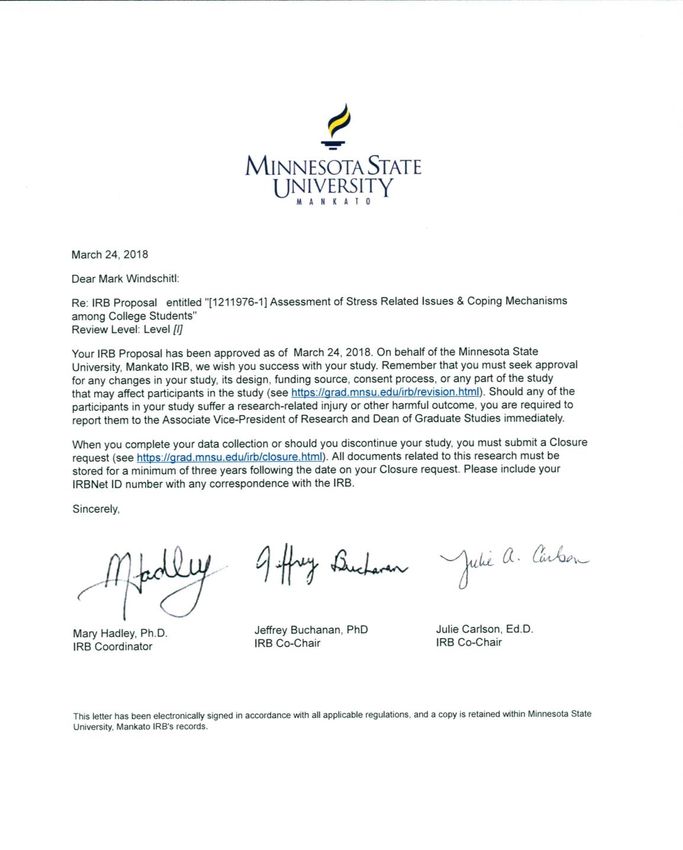
        Appendix B IRB Approval ...................................................................................................73
        Appendix C Informed Consent .............................................................................................74
viii
List of Tables and Figures
Table 4.1 Demographic Information..............................................................................................36
Table 4.2 Frequencies (n), Percentages (%) of Stressors...............................................................38
Table 4.3 Frequencies (Mean & Standard Deviation) of Coping Strategies .................................40
Table 4.4 Frequencies (n), Percentages (%) based on Gender for Coping Strategies ...................41
Table 4.5 Mean & Standard Deviation of Extend Scores ..............................................................43
Table 4.6 Frequency of Extend Scores based on Gender ..............................................................43
Figure 1: Female Stress Levels ......................................................................................................44
Figure 2: Male Stress Levels..........................................................................................................441
Chapter One- Introduction
Introduction
Stress contributes to health problems worldwide. Its presence is felt at home,
office, industry, and academic environments. Stress is regularly experienced by all
individuals regardless of age, culture, or geographic location. Although the effects of
stress on an individual are not always harmful, daily hassles and major life events can
significantly impede a person’s optimal functioning (Kaufman, 2007).
College has been found to be stressful for many young adults enrolled (Pierceall
& Keim, 2007). Students' psychological discomfort is reflected in several ways including
depression, anxiety, stress, and sleeping disorders (Petrov, Lichstein, & Baldwin, 2014).
The transition to college from high school tests young adults to live independently,
handle finances, maintain academic standards and integrity, and adjust to a new social
life. It also provides an opportunity to modify existing roles (for example, son or
daughter) and to adopt new roles (for example, college student).
Millennials (ages 18-33 years) as a generational group have the highest levels of
stress of any other age group, with 39% reporting that their stress has increased in the last
year (American Psychological Association, 2013). During this transitional process,
college students establish a foundation for future life goals (Salmela-Aro, Aunola, &
Nurmi, 2007). Stress during this life transition may be particularly salient when
considering academic achievement. Currently, 25% of college students drop out after2
their first year, and only slightly more than half of the students attending 4-year
institutions complete their baccalaureate degrees within 6 years of their first enrollment
(National Center for Educational Statistics, 2008).
Stress among undergraduate and graduate students is multifactorial, arising from
both academic and non-academic factors, including socio-cultural, environmental, and
psychological attributes (Brand & Schoonheim-Klein, 2009). Psychosocial stress is high
among freshmen, women, and international students because of the adjustment they must
make in their social, academic, and cultural lives in a new environment, having left all
previous support persons such as parents, siblings, and high school friends (Seyedfatemi,
Tafreshi, & Hagani, 2007). College students are faced with loneliness, anxiety,
depression, and disorientation. Also, previous studies have shown that poor coping
strategies and variations in personality types may contribute to additional stress in certain
individuals, leading to a negative pattern of behavior, development of psychosomatic
symptoms, and decreased academic performance (Busari, 2011).
Psychosocial, individual, and physical stressors are also encountered often in an
academic environment. Individual variables that can influence one's response to stress
include age, sex, physical-ability status, lifestyle (smoking and alcohol-drinking habits),
ethnicity, adiposity, and genetic predisposition. Previous studies have shown that
variability in students' maturity (such as the complete development of the prefrontal
cortex, which is the area of the brain responsible for decision making) is related to greater
variability in their strategies for coping with stress (Kagan, & Baird, 2004). Also,
physical stress imposed on the body includes poor study posture and sitting on chairs3
improperly in overcrowded classes, which could produce muscle strain and joint
imbalance, and soft-tissue stresses. This could become habitual, leading to more chronic,
recurring pain and episodes of pain (Ekpenyong, Daniel, & Aribo, 2013).
Statement of Problem
Stress is a significant risk factor for the development and growth of numerous
physiological and psychological problems (Muscatell & Eisenberger, 2012). In the
United States, there are approximately 90 million visits to outpatient departments yearly,
which averages at 30 visits per 100 people (Hing, Hall, Ashman, & Xu, 2010). Stress has
also been linked to all the major leading physical causes of death (Cohen, Janicki-
Deverts, & Miller, 2007).
College life for many students can be both challenging and exciting. Students are
placed into rigorous academic curriculum while at the same time trying to establish who
they are socially, mentally, financially and often geographically (Lynch, Gander, Kohls,
Kudielka, & Walach, 2010). As a result, students experience increased levels of stress
and anxiety, making them a vulnerable population (Lynch, et al., 2010). Due to this
enormous pressure, students may develop anxiety disorders, which may inhibit their
performance level mentally, emotionally, socially and academically (Lynch et al., 2010).
Research has been conducted to review the relationship between stress and
academic performance of students and it has been found that stress affects the academic
performances of students in great manner (Choi, Abbott, Arthur, & Hill, 2007).4
According to Oman, et al., study (as cited in ACHA, 2006), one-third (32%) of the nearly
50,000 students surveyed at 74 U.S. campuses revealed stress was the most commonly
identified impediment to academic performance. With these on record, more research
focus should be placed on college students who are still in transition to college and
ongoing in their academics.
As more research is conducted to investigate stress and stressors affecting college
students including more effective means of coping, this research is expected to make a
valued contribution by gathering a deeper understanding on identifying stress related
issues and coping among college students.
Need for the Study
This study is needed because it is often heard and seen of college students to
complain of being stressed during the academic year, a lot of students are used to
handling stress by themselves, implementing various coping mechanisms, some
unhealthy to regain control. This topic is important to the health education discipline
because it will identify healthy behaviors that can be implemented for college students to
address stress related issues. It will also improve health educators’ knowledge of college
students stress, effects of stress on behaviors and provide adequate resources to address
such issues.
Recent research has indicated that the effects of stress on college students are
substantial. An American College Health Association survey of more than 16,000 college
students found that 33.7% reported that stress interfered with their academic5
performance, as evidenced by missing classes, receiving lower grades, or dropping
courses (Chiauzzi, Brevard, Thurn, Decembrele, & Lord, 2008). Stress has been shown to
play a tremendous role in students’ decision-making regarding remaining in school or
not. Stress has been linked to increased attrition as well as problems with academic
performance (Chiauzzi, et al., 2008). Stress is also related to sleep difficulties, psychiatric
disorders, substance abuse, and high-risk behaviors, and it takes on an important role in a
student’s decisions regarding staying in school (Chiauzzi et al., 2008). It has been shown
that the level of stress for college students has been increasing in recent years and the use
of medication has increased fivefold (Schwartz, 2006).
Research shows that academic stress leads to poor performance which may in turn
affect career aspirations of college students. However, many students do not seek help for
the problems they are experiencing, mainly due to a having a lack of time to do so and
the stigma attached to counselling (Eisenberg, Golberstein, & Gollust, 2007). Given the
above situation, identifying various stressors, and the impact of stress on academic
performances of students would be helpful to health educators when providing
psychological support and counseling to affected students while the different coping
mechanisms explored will provide information for corrective measures to be applied
when faced with stress.
Research Questions
Three research questions were analyzed in this study. These questions include:
a. What are the frequencies of common stressors as perceived by college students at
a large midwestern university?6
b. What are the stress-reducing coping strategies commonly used by male and
female college students?
c. What are the current stress levels of college students at a large midwestern
university?
Limitations
a. Participants may display social desirability by responding to survey questions in a
way that makes them seem more favorable.
b. Participants may have decided to be hesitant due to the sensitive nature of the
topic or fear of being victimized. Participants may feel reluctant to share their
challenges even though they remain anonymous
c. Due to time constraints, a study was not conducted to compare the stress level of
students in various undergraduate programs.
d. The survey instrument used to measure stress had its pilot tests on students in
Australia while this current research is focused on students in USA.
Delimitations
a. Data was collected with primary focus on undergraduate students at a large Mid-
western university.
b. Both domestic and international students were included in the study sample.
Assumptions
a. Participants understood questions listed on the survey and answered honestly.
b. Participants understood directions on how to complete the survey.7
c. Participants are representative of students in the university and other students.
Definition of Terms
a. Coping: An activity we do to seek and apply solutions to stressful situations or
problems that emerge because of our stressors.
b. Coping Mechanism: Methods by which administrators cope with stress
encountered because of the school environment and the resulting areas of
responsibility (Queen & Queen, 2004).
c. Stress: The American Psychological Association (2013) described stress as the
pattern of specific and nonspecific responses an organism makes to stimulus
events that disturb its equilibrium and tax or exceed its ability to cope.
d. Stressors: A stressor is anything that causes the release of stress hormones. There
are two types of stressors which include Physiological (physical) stressors and
psychological stressors (Center for Studies on Human Stress, n.d).8
Chapter Two- Literature Review
Introduction
The purpose of this research is to identify frequency of stressors, evaluate current
levels of stress and identify coping strategies implemented by sampled Minnesota
University, Mankato undergraduate students. In this chapter, literature reviews on impact
of stress, major sources of stress will address the importance of research of stress and
coping among college students. In addition, this chapter will address subtopics including
types of stress, perceived stress, and symptoms of stress and health belief model.
Definition of Stress
Marksberry (2011), defined stress as a condition or feeling experienced when a
person perceives that the demands placed on them exceed the resources the individual has
available.
According to Feldman (2008), stress is the physical and emotional adaptive
response to an external situation that results in physical, psychological and behavioral
deviations. Examples include financial difficulties, health issues, conflict with friends, all
carry force or pressure on person's body, mind and spirit. Some of the pressure may arise
from the environment but most often comes from within a person's head in the form of
regret, discouragement, low confidence, worry, and anxiousness.
Pargman (2006) described stress as “an uncertain reaction to external and internal
factors” meaning a negative or positive reaction to environmental stimuli (p. 5). It is how
the whole of your body relate to changes and strange situations that present itself. During9
this period, vital signs such as pulse rate, blood pressure, body temperature and breathing
rate in the body react speedily (American Heart Association, 2017) and several hormonal
responses are at peak (Ranabir, & Reetu, 2011).
Stress is a serious problem in college student populations across the United States
(Knöll & Moar, 2011). Students' psychological distress is reflected in several ways
including depression, anxiety, stress, and sleeping disorders (Boulard, Quertemont,
Gauthier & Born, 2012).
Perceived Stress
In college years, young adults are responsible for their health, academics, and
financial situation. According to the American College Health Association's National
College Health Assessment (2010), stress, sleep disturbances, anxiety, and depression are
among the top five threats to academic performance among college students.
A study by Pierceall and Keim, (2007) showed 75% of the college students
perceive stress at a moderate level, and 12% had a high level of stress. One study found
that one in three undergraduate college students display clinical levels of distress
(Bewick, Gill, Mulhearn, Barkham, & Hill, 2008). Universities are important settings in
which mental health concerns such as depression must be addressed given that
approximately half of young adults attend post-secondary education.
Most college freshmen that have moved away from home, including international
students will experience a separation (physically and emotionally) from their parents,
possibly reducing their interaction and support from family and friends. Given these
factors, university students are a special group of people that are enduring a critical10
transitory period in which they are going from adolescence to adulthood and can be one
of the most stressful times in a person’s life (Buchanan, 2012). The transition into a post-
secondary school has been reported to be associated with appetite disturbance,
concentration problems and depression (Lee, Olson, Locke, Michelson & Odes, 2009).
Homesickness is a direct byproduct of this transition that affects university students,
mainly freshmen (Thurber and Walton, 2012), and is therefore an important focus for
universities consideration.
Several research studies have demonstrated high prevalence of stress among
university students (Britz & Pappas, 2010; Gan, Nasir, Zalilah & Hazizi, 2011; Stallman,
2010). In a review of studies in stress among university students globally showed among
Malaysian university students, stress was observed among 36% of the respondents (Gan
et al., 2011). Another study reported that 43% of Hong Kong students were suffering
from academic stress (Wong, Cheung, Chan, Ma & Wa Tang, 2006). However, a much
higher prevalence of stress was observed among students in western countries and in
other Middle Eastern countries, including 70% in Jordan (Abu-Ghazaleh, Rajab &
Sonbol, 2011), 83.9% in Australia (Stallman, 2010) and furthermore, in Singapore, about
50% of university students accounted elevated stress (Zain, Chan & Ho, 2007).
Stress related to racial or ethnic minority status has been examined primarily with
African Americans (Greer, Laseter & Asiamah, 2009; Hunter & Joseph, 2010), but a
growing amount of research has begun examining race-related or minority status stress
with Asian Americans (Iwamoto & Liu, 2010), and ethnic minorities in general (Franklin,
Boyd-Franklin & Kelly, 2006).11
Detrimental impacts of stress
Depression
Kring, Davison, Neale, & Johnson (2010) states “Depression is an emotional state
marked by great sadness and apprehension, feeling of worthlessness and guilt,
withdrawal from others, loss of sleep, appetite and sexual desire, loss of interest and
pleasure in usual activities”.
Depression is considered as multi-problematic that leads to impairment in inter-
personal, social, and occupational functioning and is often among college students
(Farabaugh et al., 2012; Ibrahim, Kelly, Adams & Glazebrook, 2013). Depression among
college students is common and consequential as adverse outcomes include increased
rates of substance use, comorbid with psychiatric conditions such as anxiety, and suicide
(Garlow et al., 2008). University students are at expanded danger of depression owing to
the pressure and stress they encounter (Ghaedi, Kosnin, & Mislan, 2014). A survey from
the American College Health Association (ACHA, 2012) found that of the 17,000 college
students participating, 25% reported they experienced depression three to eight times in
the past 12 months.
Considering prior studies, the prevalence of depression among college students
varies largely across settings, depending on cultural backgrounds and study instruments
(Ibrahim et al., 2013). Several studies have found that the rates of depression ranges from
7.6% to 22% among American and Indian young adults (Roberts, Glod, Kim &
Hounchell, 2010; Sidana et al., 2012) and from 3.7% to 14.8% among Chinese college12
students (Jin et al., 2009). These findings have prompted an awareness of how severely
college students endure stress during their academic years (ACHA, 2012).
Anxiety
Common symptoms that characterize anxiety are excessive worrying include
exaggerated worries and expectations of negative outcomes in unknown situations that
typify anxiety are often accompanied by physical symptoms. These include muscle
tension, headaches, stomach cramps, and frequent urination. The 2015 National College
Assessment Survey revealed that within the last 12 months, stress (30%) and anxiety
(21.9%) were the two biggest factors that affected students’ academic performance
negatively ACHA, 2015).
Holm, Hofmann, Sperth, & Funke (2009) carried out a study in University of
Heidelberg to indicate which disorders and psychological problems were more often
occur in students who counseled a psychotherapeutic center. Around 60- 65% of the
students experienced clinically relevant psychological disorders. Exam anxiety was the
most widespread issue in student population
Insomnia
The American National Commission of Sleep Disorders Research (NCSDR) defines
insomnia as “a chronic or acute sleep disorder characterized by a complaint of difficulty
initiating, and/or maintaining sleep, and/or a subjective complaint of poor sleep quality
that result in daytime impairment and subjective report of impairment (NSDR, 2011).
Studies conducted in the United States (Gaultney, 2010) and Hong Kong (Wong &13
Fielding, 2011) report approximately 70 million and 2.2 million people complain from
symptoms of insomnia respectively.
A systematic review of 7 studies by Jiang et al. (2015) shows that the prevalence of
insomnia among university students is ranging from 9.4% to 38.2%. Furthermore, 32.5%
to 62.3% university students in Nigeria, Libya, and Egypt suffered from insomnia
(Ibrahim & Abouelezz, 2012, James, Omoaregba & Igberase, 2011, Taher, Samud,
Ratinmy & Seabe, 2012). In addition, people with insomnia symptoms in the general
population are also at a higher risk for developing depression, anxiety, substance abuse or
dependence, suicide, and cardiovascular disease (Taylor et al., 2011). At least 3 days a
week, 60% of students report that they are dragging, tired, or sleepy (ACHA, 2012).
Indeed, in spite of the fact adults are recommended to sleep 7 to 9 hours per day,
college students rest less than typical resting hours (Brick, Seely & Palermo, 2010). The
social environment, busy class schedule, change in sleeping environment, experiencing
noise at night, and participating in night party alter the sleep quality and cause academic
failure as a result (Eslami, 2012; Ogbolu, Aina, Famuyiwa & Erinfolami, 2012). College
students experience predictable, stressful life events during the school year that can lead
to sleep deprivation and further endanger their wellbeing. Most students may sense the
stress derived from school work; however, they may not realize that sleep deprivation is
also a stressor in addition to their daily life stress, and altogether could have negative
impacts on their physical and mental health (Lee, Wuertz, Rogers, & Chen, 2013).14
Substance use
Substance use occurs when a person’s use of alcohol or another substance (drug)
leads to health problems. This disorder is also called substance abuse. Many who develop
a substance use problem have depression, attention deficit disorder, and anxiety. Many
people who are vulnerable to depression or anxiety use tobacco because they expect
smoking to relieve negative affect (Morrell, Cohen, & McChargue, 2010). Because of
peer pressure and accessibility of substances (alcohol, drugs, tobacco such as cigarettes),
substance abuse by students is inevitable.
A comprehensive research study by Boehm, Lei, Lloyd & Prichard, (2016)
demonstrated that tobacco use, and depression/anxiety disorders are both independently
associated with more sleep problems in college students, and those students with
depression/anxiety are more likely to use tobacco, a behavior that likely exacerbates their
sleep problems. In their study, 56% daily tobacco users with depression and anxiety
reported that sleep problems negatively impacted their academic performances, revealing
daily tobacco use was associated with increased academic problems caused by sleep
problems.
Negative impact of stress
Impact of stress on Academics
The academic performance of university students presently is defined in terms of
success or failure of course units, number of courses failed or passed (Goldfinch &
Hughes, 2007), and the quality of the grades obtained in terms of the Grade Point15
Average (GPA) or Cumulative Grade Point Average (CGPA) (Bernold, Spurlin, &
Anson, 2007). College students who are stressed out may produce low grades, lethargic
attitude to school work and may skip classes often. Most times, college work involves
thinking and brainstorming which may be cumbersome, a student affected by stress may
have difficult thinking, easily misunderstanding things, confusion and constantly having a
negative attitude towards school. Furthermore, previous studies revealed continual
evidence regarding stress in college students affecting cognitive processing,
concentration and problem solving. These effects decrease an individual’s academic
performance, learning ability and retention (Goff, 2011).
Impact of stress socially
College is a time for social interactions, building friendships and relationships, host
of parties and events. Social relations are at its peak during college years, boosted with
the use of mobile technology and social media applications. When students get stressed,
there is a visible sign of frustration, snap at friends and family, or feel annoyed by the
minutest things. Stress can also affect emotional intelligence. Emotions serve as part of
our regulatory system – when functioning appropriately they assist us to carefully
evaluate impacts on ourselves and others. When they’re shut off, we make more
dangerous choices. Emotions assist decision-making (Freedman, 2013).16
Major sources of stressors
Stress is multidimensional and complex, induced by certain factors. In this
research, stressors will be grouped in two phases: i) Academic (ii) Non-academic Stress
etiology of stress is complex and varies across environments.
Academic stress
College students are individuals who manage an extensive variety of academic,
individual and social difficulties. In this way academic stress is considered as one of the
most predominant risk factors in university students (Waghachavare, Dhumale, Kadam,
& Gore, 2013). College students face very demanding circumstances during the pursuit of
their college degree. Furthermore, the following were identified to be associated to
academic stress based on studies: academic workload, attending lectures (Agolla &
Ongori, 2009), examinations, school curriculum and inadequate learning materials (Shah,
Hasan, Malik, & Sreeramareddy, 2010), subject-related projects (Conner, Pope, &
Galloway, 2010). Additionally, high expectations and demands of teachers and parents
may lead to enormous stress. Financial difficulties and worry of future career are also
stress inducers (Mazumdar, Gogoi, Buragohain, & Haloi, 2012). According to Feld
(2011), significant stressors encountered by students include high individual and external
expectations, and stressful surroundings as well as academic motivators such as academic
tasks, ranks and college recognition.
In the view of Ekpenyong, Davis, Akpan, & Daniel, (2011), students report the
greatest sources of academic stress to be taking and studying for examinations with17
respect to grade competition and mastery of a large amount of information in a small
amount of time. Symptoms of stress can be examined in students during examinations. A
study by Sarid, Anson, Yaari, & Margalith, (2004) reported that stress induced by
examinations keeps increasing during preparation, peaks during the exam, and declines
after the test is over.
An overview of the existing literature also shows some other indications of stress
like feeling anxious, gazing into space, working too fast but wrongly, working very
slowly but properly, postponing assignments, depression over past failures, and
procrastination in studies and feeling helpless over an uncertain future. Some
physiological indications can also be observed like increased respiration and heartbeats,
heightened muscle tension, blood pressure and gastric discomfort (Parson, 2008).
Non- Academic Stress
Most college students are at the point in their lives where they make certain choices,
begin new experiences, meet new people and face fresh challenges as they seek to
develop and progress in life. Bernstein et al. (2008) defined the sources of stress as every
circumstance or event that threatens to disrupt people’s daily functioning and causes them
to adjust.
Relationship Stressor
Many individuals begin serious dating relationships during what has been termed
“emerging adulthood.” Emerging adulthood is a phase of development in which youths
actively pursue physical and psychological independence and autonomy from their family18
while concurrently maintaining emotional and material support needed for adjustment
and well-being (Arnett, 2007). Relationship stress experienced by college students
include trust issues, unfaithfulness, insecurity and relationship abuse. The transition from
leaving high school to entering college may be a time of increased vulnerability, given
that youths entering college often must navigate increasingly adult roles, take on new
academic and economic responsibilities, and forge new social networks (Aquilino, 2006;
Laursen, & Collins, 2009). Relationship problems were listed as the third leading source
of stress according to the ACHA (2012).
A study by Petroff (2008) found a negative correlation between stress and
relationships. The findings reveal that if a couple is happy and share a healthy
relationship, stress is decreased. On the contrary, stress increases when a relationship
faces difficulties.
Financial Stressor
College students may become frustrated when bills are overdue, threat of account
going to collection and racking up debt through loans and credit card debt. Credit cards
have become readily available and could be gotten by a single click and filling an
application on the internet. Previous research showed that debt and financial problems of
adolescents and young adults in Western countries have increased over time (Betti,
Dourmashkin, Rossi, & Ping Yin, 2007). With rising college costs, young adults have
become vulnerable to borrowing and become a risk of becoming in debt, in the last
decade, student loans have increased together with tuition fees (National Center of
Education Statistics, 2010).19
Financial debt has been found to affect young adults mentally with damaging
consequences. A research by Dwyer, McCloud, & Hudson (2011), in a sample of young
adults found some evidence to suggest that credit card debt has negative consequences on
a sense of mastery and the level of self-esteem over time, possibly because financial
stress adds up as young people age. Furthermore, a survey focusing specifically on
financial stress found that four of the five most common stressors among students related
to their personal finances (Trombitas, 2012). First-year students more often experienced
‘’extreme stress’’ related to the cost of education and living than other students. A third
of students reported that finances negatively influenced their academic performance.
Additionally, one out five students reduced the number of courses they enrolled in due to
their finances.
A credit card debt over $1,000 is considered risky for college students and has
been linked with unhealthy behaviors such as declined mental and physical health (Berg
et al. 2010), high stress levels, low financial well-being (Nelson, Lust, Story, & Ehlinger,
2008) abusing drugs and alcohol (Berg et al. 2010). According to Kozubik, Kozubikova
& Rybicka’s study (as cited in Sallie Mae, 2009), this trend is alarming because 84 % of
students have a minimum of one credit card, and half of the students hold four or more
cards with an average total credit card debt of $3,170. Even more alarming is a pattern
which shows that more cards bring more debt, and more debt brings more cards
(Norvilitis, & MacLean 2010).
Tuition and accommodation costs are one of the most important considerations
college students make during the search for schools. Tuition fees and affordability could20
be a deal-breaker for students and parents before enrollment and during their academic
journey. One potential source of financial stress for college students is tuition costs.
Tuition and fees at colleges and universities continue to rise more rapidly than the
rate of inflation. Bousquet (2008) noted that, during the 1960s, a student could have
worked 15 hours a week at minimum wage during school and 40 hours a week during the
summer to pay his or her public university education. According to the American College
Health Association (2012), financial problems is listed as the second leading source of
stress in USA. With college tuition fees on the rise and lack of scholarships, many
university students are buried in debt (Banu, Deb, Vardhan & Rao, 2015)
Unhealthy Eating Habit
According to the Physicians Committee for Responsible Medicine (2015), unhealthy
eating habits have the tendency to increase a student’s level of stress. Diets that can
induce stress include food high in fat, sugar, caffeine and refined starches. It is
encouraged that a healthy diet with provision of fruits, vegetables and low-fat food will
be efficient for a student (Kessler, 2016). High perceived stress has been associated with
worse diet quality (Fowles, Stang, Bryant & Kim, 2012) greater intake of snack foods
and lower intake of fruit (El Ansari, Adetunji, & Oskrochi, 2014).
A study by Ahmed, Radhwan, Azmi, & Beajan (2014) examined degree and the
relationship between dietary practices and academic stress among students in University
of Kuwait. Moderate level of stress was experienced by 43% of university students, in
that with a little more 44% were females and 40.9% were males. Moreover, academically
stressed female students were vulnerable to eat more snacks, high cholesterol foods and21
beverages than without stressed females. Contrast findings were showed in male students
that type of food consumption was not coupled with academic stress. Gan, Nasir, Zalilah,
& Hazizi (2011). highlighted the presence of unhealthy eating behaviors and inadequate
nutrient intake among university students.
Employment
Many college campuses offer on-campus job positions for students to make extra
income during their period of studies. It is also common to find students working flexible
hours, depending on their schedule or trying to make financial ends meet. While working
during school is encouraged and legal, a demanding routine and schedule at work can be
detrimental to students. Students may find themselves leaving work and heading straight
to the library to complete assignments, read for a quiz or contribute to online coursework.
This added weight of demands may increase stress levels, lead to confusion and
consequently lead to fatigue. It is encouraged that students plan a schedule to
accommodate both work and school commitments adequately while making provisions to
rest and refresh themselves.
Environment Factor
The environment can play a major role in making students stressed. International
students tend to pass through an acclimatization stage where they deal with culture
shocks, weather differences including high temperatures and sweltering temperatures and
political climates. News, policies and tensions in the society can make students worried
for their future and may cause them to lose their focus. In the United States, immigration
decisions and announcements are triggers that could unsettle students, prompting the22
university community to send emails to assure students of a safe and conducive
environment for study.
Adverse academic environmental factors such as poor lighting, extreme temperature,
and noise can also increase the risk of injury and subsequent development of
musculoskeletal disorders. Physical stress imposed on the body includes poor study
posture and sitting on chairs improperly in overcrowded classes, which could produce
muscle strain and joint imbalance. This could become habitual, leading to more chronic,
recurring pain and episodes of pain (Ekpenyong, Daniel, & Aribo, 2013).
Parental Pressures
Parental pressures and teachers’ expectations have been revealed to be associated
with stress around the time of examinations or about choosing academic study or a future
career. For example, students who joined dentistry due to parental pressure, with
associated fear of facing parents after failure, described greater stress than those who
joined of their accord (Tangade, Mathur, Gupta, & Chaudhary, 2011). The
recommendation is parents need to be counseled against forcing their children to join an
educational program, not of their choice (Tangade et al., 2011)
Coping Mechanisms
Coping is recognized as a key variable in the process of minimizing, reducing or
tolerating stress (Gustems-Carnicer & Calderon, 2013) and among college students,
coping has been found to be a strong predictor of academic success (Barrows, Dunn, &
Lloyd, 2013). Coping refers to the thoughts and behaviors people use to manage the
internal and external demands of stressful events (Folkman, 2010). Numerous coping23
strategies have been identified in previous research studies and include both healthy and
unhealthy approaches such as positive methods including seeking social
support (Timmins, Corroon, Byrne, & Mooney, 2011; Pabiton, 2007) or using leisure
activities (Mapfumo, Chitsiko, & Chireshe, 2012) while others use maladaptive strategies
(e.g. escape/avoidance) to manage stress (Chao, 2012).
Coping refers to the thoughts and actions people use to manage distress (emotion-
focused coping), manage the problem causing the distress (problem-focused coping), and
sustain positive well-being (meaning-focused coping). Emotion-focused coping includes
strategies such as distancing, humor, and seeking social support that are generally
considered adaptive, and strategies such as escape-avoidance, day dreaming, and blaming
others that are generally considered maladaptive. Problem-focused coping includes
strategies such as information gathering, seeking advice, drawing on previous experience,
negotiating, and problem solving (Folkman, 2013)
Physical Activity
Researchers have documented the benefits of regular physical activity for a healthy
life. Regular physical activity reduces the risk of hypertension, heart disease, diabetes,
and some cancers (Allender, Hutchinson, & Foster, 2008). College students between the
ages of 18 and 25 have the lowest amount of regular physical activity compared with
other adults. On average, they engage in less than the recommended daily 30 min of
moderate to vigorous exercise (Centers for Disease Control and Prevention, 2010). Some
of the documented techniques for relieving stress include physical activity (Hegberg, &
Tone, 2015) and progressive muscle relaxation (Chen et al., 2009; Smith, 2007). Often24
when stressed, individuals take a defensive posture via standing, crouching, or bending
over a desk for an extended period. To help relieve physical tension, stretching exercises
target stressed posture and positioning (Smith, 2007).
Meditation
Meditation is described as a tool that involves concentrating on one single thought
and involves having a passive attitude (Wallace, 2007). This procedure aids in
minimizing stress by enabling a cool focus on one simple task at a time. Mindfulness is
defined as awareness and focused attention, absence of elaborative thought, and
nonjudgmental acceptance (Carmody, & Baer, 2008). Mindfulness provides a strong
solution to the common causes of daily stress such as time pressure, agitation, distraction
and interpersonal conflicts. (Clinic Community Health Centre, 2010).
Among college students, many pursue healthy coping methods to decrease stress:
effective time management, social support, positive reappraisal, and engagement in
leisure activities (Rayle, & Chung, 2008). Effective application of time management
skills can be linked with academic achievement (Pehlivan, 2013; Al Khatib, 2014; and
Tanrıöğen, & Işcan, 2009), stress reduction (Tanrıöğen, & Işcan, 2009; Wahat et al,
2012), increased creativity (Yaghoobi et al, 2014) self-efficiency (Terry, & Doolittle,
2008) and satisfaction of students (Kebriaei, Sabahi, & Saeedi, 2014). A good example is,
some productive study methods emphasize starting assignments well before due dates,
breaking down large tasks into small ones, and having a timetable for reading on a
regular schedule to maximize productivity in a timely manner.25
Emotional support has been proven to be an effective stress management technique
since individuals increase instrumental help, emotional support, or social diversion such
as venting to family and friends (Kahn, & Garrison, 2009). Another common technique
among college students is leisure satisfaction which is defined as the positive feeling of
contentment one perceives because of meeting personal needs through leisure activities
and has an inverse relationship between perceived academic stress (Balduf, 2009).
Another strategy for coping is spirituality which provides a cognitive framework for
reducing stress among college students (Ridnour, & Hammermeister, 2008). Religious
methods and other spiritual endeavors as coping strategies when encountering physical
and mental difficulties in life are widely recognized (Cruz, et al., 2016; Wachholtz, &
Sambamoorthi, 2011). Spirituality and religion are the most accessible and readily
available resources to help in coping with stressful life events (Cruz, et al., 2016).
Furthermore, spiritual coping can enhance feelings of wholeness and a state of
equilibrium, promoting good health (Hawthorne, Youngblut, & Brooten, 2011).
Health Belief Model
Health Belief Model (HBM) is a model that assists in explanation of decisions made
by people with regards to personal health status. This research will utilize the Health
Belief Model (HBM), which is a theoretical framework used to explain, predict, and
influence various health behaviors (Glanz, & Rimer, 2005). The Health Belief Model is
made up pf six constructs: Perceived susceptibility, perceived severity, perceived
benefits, perceived barriers, cues to action and self-efficacy.26
The HBM is based on an understanding that the students will take a health-related
action to minimize the stress level (for instance exercise regularly) if they feel that stress
can indeed be avoided in school, positively expect that by observing the suggested action
plan will result in reducing stress and believe that they can take a recommended health
action successfully such as exercising regularly, comfortably, and with confidence.27
Chapter Three- Research Methodology
This chapter describes the research design, instrumentation, data collection
procedures, and subjects are described along with processing, and data analysis.
Sufficient detail will be included in the presentation of methodology so that replication of
this study would be possible. The study also examined if a relationship existed between
variables regarding gender and coping strategies implemented by the students.
Research Questions
Three research questions were analyzed in this study. These questions include:
a. What are the frequencies of common stressors as perceived by college students at
a large midwestern university?
b. What are the stress-reducing coping strategies commonly used by male and
female college students?
c. What are the current stress levels of college students at a large midwestern
university?
Research Design
A descriptive research design will be used to collect quantitative data using a survey
from a sample of university students between the ages of 18 and 25 years at a large
midwestern university during the spring semester of 2018. Quantitative design is
appropriate when knowledge and facts are measurable. An advantage of using a
descriptive research design is it answers to the questions of who, what, when, where, and
how associated with a research problem. It is also advantageous for its approach of
collecting large amount of data for detailed analysis. (Labaree, 2017). Furthermore,28
descriptive research can provide a representation of what is happening at a specific time
(Stangor, 2012). A descriptive research design was selected because the research
questions are descriptive in nature and it also describes perceived stress, coping
mechanisms, stressors and stress levels presently in the sample for this study.
A cross-sectional design was chosen due to the limited time for the study and
collection of data and the limited budget for this study. Furthermore, a cross-sectional
design entails collecting data at one point in time and it focuses on studying and drawing
inferences from existing differences between people or subjects (Labaree, 2017). The
advantage of using cross-sectional design research is it can use data from many subjects,
it is not geographically bound. (Labaree, 2017).
In this study, convenience sampling of 350 students will be used. Sample size was
calculated with a population size of 15000, margin of error of 5% and confidence level of
95%. Participants were undergraduate students enrolled at Minnesota State University,
Mankato. A convenience sampling was used for this study because of the limited budget,
time frame and easy availability to recruit subjects.
The study will be administered to undergraduate students enrolled in general
education classes. General education classes were chosen because they offered diverse
sample (race), age differences and convenient access. For this study, there was no
selection criterion, both international and domestic students in Minnesota State
University, Mankato were included, also in other to have balance gender equality both
male and female will be considered in this study.You can also read


