STUDENT ORGANIZATIONS - Interschool Governing Board (IGB) - Columbia ...
←
→
Page content transcription
If your browser does not render page correctly, please read the page content below
a guide to resources for student organizations
Interschool Governing Board (IGB)

   STUDENT ORGANIZATIONS

                                          ing
                                      dvis
                                u  pA
                       y     Gro
                t e d b dent
             sen Stu
          pre ce of
           Offi
table of contents
Advising Office
Community Development 5
Office of Student Group Advising Mission 5
Office of Student Group Advising Staff 5
The Advisor/Student Group Relationship 6
When to Visit Your Advisor 6
Advising Structure Flow Chart 7
Student Governance
Columbia College Student Coucil 8
Engineering Student Council 8
General Studies Student Council 8
Barnard College Student Government Association 8
Activities Board at Columbia 8
Club Sports Governing Board 8
Community Impact 8
InterGreek Council 9
Student Governing Board 9
Interschool Governing Board 9
Interschool Governing Board (IGB)
IGB Overview 10
IGB Guidelines 11
Allocation Requests 11
Alcohol 11
Allocation 11
Appeals 11
Banners 11
Charitable Contributions 11
Communication 11
Debt 11
Fundraising 11
Movie Events 11
Partisan Activity 11
Programming During Breaks 11
Reimbursements 11
Spending without an Advisor’s Signature 11
T-shirts & Uniforms 11
Transfer Payments and Co-sponsorships 11
Travel 11
Unused Funds 12
Websites 12
Leadership Programs
Club Recharge 13
Head Start: Fundamentals of Financial Management 13
Leadership Evolution and Development 13
Emerging Leaders Program 13
Advance 13
2University Event Managment Policies
table of contents
Venue Managers 15
Event Sponsorship 15
Student Groups 15
Event Classifications 15
Space Application Requirements 16
Event Review 16
Guest Lists 16
Partisan Political Campaign Activities 16
Insurance 17
Commercial Filming, News, Documentaries, and 17
Student Filming
Special Policies Applicable to Outdoor Space 18
Commercial Vendors and Nonaffiliates 20
Reserving Space
Lerner Hall 21
Academic Classrooms and Outdoor Space 22
Earl Hall and St. Paul’s Chapel 23
Intercultural Resource Center 24
Kraft Center for Jewish Life 26
Barnard College Scheduling 27
Affiliated or Alternative Space Options
Teachers College 29
Miller Theatre 29
Jewish Theological Seminary 29
Union Theological Seminary 30
Broadway Presbyterian 30
Riverside Church 30
Casa Italiana 30
World Room at the School of Journalism 30
Low Rotunda 30
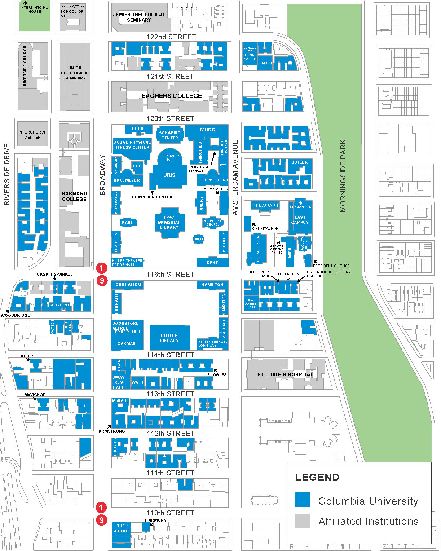
Campus Map 31
Events
Lerner Tech 32
Furniture Requests 32
Outdoor Sound Policy 32
Ticket Ordering for Events 32
Facilities/Special Events 32
Campus Audio and Visual 32
University Catering 32
Kosher Options 32
Ordering Bulk Metro Cards 33
Outdoor BBQ with Grills 33
Public Safety and Event Reviews 33
Unloading Vehicles on College Walk 33
Risk Management 33
Parking Around Campus 34
Local Area Hotels for Speakers and Guests 34
New York City Department of Parks and Recreation Permits 34
NYPD Parade Permits 34
Movie Policy 35
Copyrighted Material 36
University Licensing Guidelines 36
Games of Chance 37
3table of contents
Alcoholic Beverages and University Policies 37
Alcohol Policy Amendment for Recurring Parties (Fall 09) 41
Campus Press Policy 42
Contracts, Honoraria & Letters of Intent 42
Partisan Activity 43
Travel
General Travel Policy 44
International Travel 44
Medical and Travel Insurance Requirements 44
University Transportation Office 44
Car Rentals and Rental Insurance Requirements 44
Communications and Marketing
Email, Mailing Lists (Listserves) and Websites 45
Guarding Your Personal Privacy 46
Use University Name, Images and Logos 46
Lerner Hall Mailboxes 46
Flyering and Chalking 46
Publication Advertising Policy 47
Fundraising
Gift Accounts 48
Corporate Sponsorships 48
Fundraising for Charity 48
Games of Chance Fundraisers 48
Partisan Activity 48
Funding Opportunities
IGB Appeals 49
CCSC Co-sponsorship Fund 49
Engineering Student Council Co-sponsorship 49
GSSC Co-sponsorship 49
SGA Co-sponsorship Fund 49
Diversity Initiative Grant (DIG) 49
The President’s and Provost’s Student Initiative Fund 50
Office of the University Chaplain Co-sponsorship Fund 50
IGB Co-sponsorship 50
Student Group Co-sponsorships 50
Sponsorship with Other Schools 50
Corporate Sponsorship 50
Fundraising 50
Games of Chance 50
Kraft Family Fund for Intercultural and Interfaith Awareness 51
The Gatsby Charitable Foundation Fund– CUArts 51
Frequently Asked Questions
F.A.Q.s 52
4Community Development Office Of Student Group Advising (OSGA)
advising office
THE COMMUNITY DEVELOPMENT TEAM OSGA Mission
The Community Development team works to fos- The Office of Student Group Advising (OSGA)
ter a vibrant and welcoming undergraduate com- works to enhance the undergraduate educational
munity through organizational advising, leader- experience by fostering a dynamic and enriching
ship development, advocacy, diversity education University community and supporting responsible
and community programming. The team includes student governance and co-curricular activities.
the Office Residential Programs, Student Devel- Through advising, the office encourages critical
opment & Activities, the Office of Student Group thinking and the free exchange of ideas by all the
Advising and the Office of Multicultural Affairs. student organizations it supports. OSGA provides
programming in leadership skills, program devel-
The Community Development team works with
opment, and organizational management to all
student organizations to provide them with a
undergraduate student organizations recognized
seamless advising experience and support for
by SGB and IGB, and assist students in their de-
their organizational goals. The team also works
velopment as individuals, community members,
to build the skills of students in leadership and
and leaders.
civic engagement. In addition, the Student Affairs
Central Business Office (SACBO) services staff OSGA is committed to supporting the program-
provides support and advising to organization ming of our faith-based, spiritual, political, activist
treasurers and governing bodies in managing and humanitarian student organizations to en-
funds by providing monthly account statements, courage open inter religious and political dialogue
treasurers’ newsletters and other services. at Columbia University’s Morningside Campus.
The Office of Student Group Advising is particu-
larly mindful of the centrality of academic pro-
grams at Colum bia, and seeks to help students
successfully integrate co-curricular activities into
their overall educational and professional goals.
Office Of Student Group Advising Staff
Todd M. Smith
Associate Dean of Student Affairs,
Advisor to Interschool Governing Board (SGB)
212-854-4323
ts2488@columbia.edu
*Jason L. Anthony
Associate Director
212-854-1371
jla2108@columbia.edu
*Walter G. Rodríguez
Associate Director
212-854-1196
wr2174@columbia.edu
*Darren Gallant
Graduate Assistant
212-854-4196
darrengallant@gmail.com
*Student Group Advisors
5The Advisor/Student Group Relationship
Expectations for Student Groups Expectations for Advisors
advising office
Clearly communicate to your student affairs Advise student groups on organizing the logistics
advisor plans for all club events and meetings associated with group activities, such as travel,
club events and meeting planning.
Be knowledgable and follow all University policies
and procedures. Clearly communicate University policies,
procedures, and structures.
Communicate your organization’s needs to your
advisor. If you need help; ask for it. Clearly identify your role and expectations as
an advisor with student groups. Communicate
Communicate to your advisor any relationship or
services that the advising office provides.
partnership with any University department or
outside organization. Advocate on behalf of the student group and
facilitate communication with other University
Visit your advisor often to assist in building a
resources, key staff members, and stakeholders
relationship. Come and celebrate your successes
(including other student groups).
with your advisor!
Share responsibility for building the relationship
Foster an environment in which your advisor feels
with the student group.
respected and valued. Get to know your advisor
outside of “just a signature.” Foster environments in which students feel
respected and valued, and convey concern for
Again, if you need help, ask for it. If you feel that
their welfare.
you are already knowledgeable on an area of
advisement, communicate this to your advisor. Assess what level of advising is necessary for
each particular group or program.
Reflect on the greater impact your organization
and your events have on the greater University Assess institutional impact of group events/
community. Communicate any concerns to your services and communicate appropriate
advisor. information to supervisor.
Seek the expertise of your advisor! Your advisor Utilize knowledge of best-practices, the group
possesses knowledge about many student process and basic student development theories
organization and leadership issues. to assist guiding student organizations.
Plan your student group events and meetings Help student groups adhere to their stated goals
around the stated goals within your constitution/ found within their constitution/mission statement.
mission statement.
Help student groups manage their student
Manage your student organization’s budget and accounts, including approving purchases,
account. Clearly communicate group purchases monitoring group budgets, and helping groups
and expenditures to your advisor. understand the various policies and procedures
required to operate within the University financial
system.
When To Visit Your Advisor
Still wondering about when to visit your advisor? Come see your advisor when:
• You are trying to plan an event
• You have questions about your organization’s budget allocation
• You are having difficulty navigating the Columbia system or are unsure of the rules
• You are planning an event where alcohol may be served
• You organization wants to rent a car
• You are handling large sums of money for your organization
• You are planning a big event that requires speakers/artists to sign contracts
• You want to celebrate a successful event
•Y
ou are experiencing a conflict within your group and are looking for assistance with mediation or
simply someone to discuss your concerns with
*When in doubt, we encourage you to drop by to see your advisor or, at the very least, send him or her an email
6advising structure flow chart for igb
Interschool Governing Board (IGB)
Advisor:
Todd M. Smith
Associate Dean of Student Affairs
Office of Student Group Advising
Advisor Advisor
Jason L. Anthony Walter G. Rodríguez
Associate Director Associate Director
Office of Student Group Advising Office of Student Group Advising
Graduate Assistant
Darren Gallant
Office of Student Group Advising
7Columbia College Student Council Activities Board at Columbia
student councils and governing boards
student governance
www.columbia.edu/cu/ccsc/ www.columbia.edu/cu/abc/
The Columbia College Student Council is elected The ABC is part of Columbia’s student government
by students of Columbia College to serve as that is responsible for funding over 150 student
their primary representative, advocate, and groups on campus. ABC organizations have a broad
liaison to the Columbia University community, range of functions that include: pre-professional,
including its administration, faculty, alumni and academic, competition, cultural, special interest,
students, as well as to the public. The CCSC is performance, publication, media, performing arts
charged with gathering and expressing student and large scale events. The ABC board oversees
opinion, actively representing student views, and provides support to its student organizations
appropriately addressing student concerns, and operates under the Student Development and
ensuring that college students are fully apprised Activities office.
of all information of impact to their undergraduate
experience, responsibly and equitably distributing Club Sports Governing Board
student activity fees, and working with other www.columbia.edu/cu/csgb/
student groups to program college wide events The Club Sports Governing Board oversees
designed to foster cohesiveness within the entire approximately 40 clubs that are organized on
undergraduate population. recreational, instructional and competitive levels,
and have activities ranging from informal play to
Engineering Student Council regular practice or instruction, to intercollegiate
www.cuengineering.com and tournament competition. The Club Sports
The Engineering Student Council is elected by Governing Board is overseen by the Club Sports
students of the Fu Foundation School of Engineering Office, Columbia Athletics.
and Applied Science, while the Executive Board
is selected by current council members. The Community Impact
Engineering Student Council strives to represent www.columbia.edu/cu/ci
the interests of the Engineering Students and that Community Impact is an independent nonprofit
of the University as a whole, to improve student organization dedicated to serving disadvantaged
life, responsibly and equitably distribute student people in the Harlem, Washington Heights, and
activity fees and to foster communication amongst Morningside Heights communities. Community
students, faculty and administrators, and alumni Impact strives to provide high quality programs,
throughout Columbia University. advance the public good, and foster meaningful
volunteer opportunities for students, faculty, and
General Studies Student Council staff of Columbia University. CI provides food,
www.gslounge.com clothing, shelter, education, job training, and
The General Studies Student Council is elected companionship for residents in its surrounding
each year by the students of General Studies to communities. CI consists of a dedicated corps
serve as their principle advocates and to meet of more than 950 Columbia University student
the needs of a diverse undergraduate population volunteers participating in 25 community service
comprised of software developers, ballet dancers, programs, which serve more than 16,000 people
business leaders, veterans of the military, artists, each year. Community Impact has partnerships
and athletes. The GSSC pursues academic, with more than 100 community organizations
political, social and administrative initiatives to and agencies who do service work in the Harlem,
serve this student body, recognizing their non- Washington Heights, and Morningside Heights
traditional background and their individual needs. communities, including service organizations,
The GSSC further acts as the primary advocate for social service offices, religious institutions, senior
and liaison between the student body, the General centers and schools. Many of these organizations
Studies administration and Columbia University at refer their clients to Community Impact’s programs
large. and work collaboratively to positively influence
residents’ lives.
Barnard College Student
Government Association
http://eclipse.barnard.columbia.edu/%7Esga/
The officers of the Student Government
Association are elected each spring by the students
of Barnard College. The SGA serves as the primary
liaison between students and the administration,
represents student views and advises on policy
issues, and coordinates committees of faculty,
administrators, and students. As both a student
council and governing board, the SGA works in
collaboration with student groups to enhance
campus life, affect change, instill a sense of
Barnard pride and promote community.
8InterGreek Council
student councils and governing boards (cont’d)
student governance
www.columbiagreeks.info
The InterGreek Council is the governing body for
the Fraternity & Sorority community comprised
of 33 diverse, nationally affiliated chapters. The
InterGreek Council serves as the umbrella
group for three sub-councils that serve specific
constituency groups; the InterFraternity Council,
Multicultural Greek Council and the Panhellenic
Council. All fraternity & sorority members share
in service, scholastic, philanthropic, cultural, and
leadership experiences while also participating in
self-governance. Under the auspices of the Office
of Residential Programs, the fraternity & sorority
system provides housing for hundreds of students
and is a vital component of Columbia’s residential
experience.
Student Governing Board
www.columbia.edu/cu/sgb/
The SGB represents and serves the needs
of Columbia University student organizations
whose concerns are religious, spiritual, political,
humanitarian, ideological and activist in nature. The
SGB is dedicated to the principle of community
self-governance, and believes that students’
needs are best evoked, defined and articulated by
the students themselves. The Student Governing
Board with the help of the Office of Student
Group Advising oversees and provides support to
its student organizations.
Interschool Governing Board
www.columbia.edu/cu/igb
The Interschool Governing Board (IGB) was initiated
by the Student Affairs Committee of the Columbia
University Senate in direct response to the specific
student concerns and expressed needs of student
groups whose composition and mission do not
fall under the immediate jurisdiction of previously
existing governing boards or individual school
councils for recognition and funding by Columbia.
The mission of the Interschool Governing Board
(IGB) is to represent and serve the needs
of Columbia University student interschool
organizations whose membership and mission is
interschool in nature and includes a combination of
graduate, undergraduate and professional school
students who do not fall under the immediate
jurisdiction of other governing boards or individual
school councils.
9Interschool Governing Board Overview
interschool governing board (IGB)
The Interschool Governing Board (IGB) was initi-
ated by the Student Affairs Committee of the
Columbia University Senate in direct response
to the specific student concerns and expressed
needs of student groups whose composition and
mission do not fall under the immediate jurisdic-
tion of already existing governing boards or indi-
vidual school councils for recognition and funding
by Columbia.
The mission of the Interschool Governing Board
(IGB) is to represent and serve the needs of Co-
lumbia University student interschool organiza-
tions whose membership and mission is inter-
school in nature and includes a combination of
graduate and undergraduate professional schools,
groups and students who do not fall under the
immediate jurisdiction of other governing boards
or individual school councils. IGB is dedicated to
overseeing and supporting such student organiza-
tions in their efforts to bridge the gaps between
various students and academic disciplines on the
Columbia University campus. IGB hopes to cre-
ate a dynamic sense of community that is widely
recognized within the Columbia Student body by
facilitating multi-disciplinary, multi-interest, multi-
student/faculty community building, programming
and dialogue.
IGB will report to the Senate regarding the state of
affairs involving interschool activities and program-
ming and operates under the Office of Student
Group Advising.
10Guidelines Fundraising
interschool governing board guidelines
Below are our guidelines. Please read and review IGB is not willing to serve as guarantor for a
them and abide by them when programming group’s fundraising efforts where there are ex-
events and managing your student organization. penses associated with the fundraiser that exceed
The guidelines are as follows: their allocation. Please meet with your advisor &
SACBO representative before initiating any fund-
Allocation request raising campaigns to ensure compliance with poli-
Currently-recognized IGB groups should submit a cies and procedures of the University.
budget proposal to the Executive Board with a pro-
posed budget and request for allocations towards Movie Events
the end of spring semester. Dates and forms for For events with movie screenings, please refer
submission will be provided by the IGB at that to the Student Affair’s movie policy. All copyright
time. The IGB will review the budget requests and costs need to be paid.
set up a time for you to meet with the board.
Partisan Activity
A representative(s) (preferably President or Trea- A group cannot use its allocation to actively en-
surer, but otherwise a board member) of the stu- gage in lobbying for legislation pending in any gov-
dent group will make a short presentation to IGB ernmental body. A group cannot use its allocation
in April and present their budget proposal and to actively be involved in the campaign of any per-
request. This will be followed by a question and son running for office.
answer period from the IGB about the proposal
and request. IGB will vote on the proposals and Programming During Breaks
requests following the presentations. Summer: No part of a group’s allocation can be
used for summer events. Reimbursements will
Alcohol
not normally be granted for summer activities.
Spending on alcohol from the IGB allocation shall
be restricted to 20% of the allocated budget. Any- Winter: There will be no programming over Win-
thing higher than that amount will have to come ter Break except on a case-by-case basis. Groups
from the group’s own funding sources. that want to have programming over Winter Break
must inform their advisor before the end of fall
Allocation semester
The growth of a group’s allocation is not guaran-
teed, nor is the fulfillment of the year’s planned Reimbursements
programming an entitlement to an increase in All reimbursements must be submitted within 30
budget. days of the event.
Appeals Spending without an advisor’s
Student groups may appeal for additional alloca- signature
tions over the course of the year, and these shall Groups have the latitude to spend up to $50.00 of
be reviewed on a case by case basis. Please email their approved budget without an advisors signa-
the IGB to request a meeting and have your pro- ture for routine expenses such as food and sup-
posal ready to present to the board. plies. However the proper receipts and documen-
tation must be turned into the advising office for
Banners processing.
No funding for banners is given. Groups should
use their revenue for such an expense. T-shirts & Uniforms
IGB allocations cannot be spent on T-shirts or simi-
Charitable contributions lar souvenirs/giveaways by the organization for
Groups may not use any part of their allocation as members of the group
a contribution to a charitable organization.
Transfer Payments and
Communication Co-sponsorships
IGB executive officers will need at least two No club should pay another club for services. Any
weeks notice before they can meet with any stu- co-sponsorship needs to be explained fully in
dent group. This policy may be waived in case of the voucher. The following information must be
an emergency. included:
Debt Which group the co-sponsorship is going to, and
If a group spends more than their allocation, they The exact details as to what the co-sponsorship
will have to payback the overdraft. This can be money will be used for.
done by either fundraising to cover the cost or
subtracting the debt from their allocation for the Travel
following year. Allocations for travel of group members shall be
limited, and shall be reviewed for approval on a
case by case basis. Speak with your advisor be-
fore you make travel plans.
11Unused funds
interschool governing board guidelines
Any unused funds at the end of the spring semes-
ter will roll over to the next academic year. Please
note that the any unused funds will be taken into
consideration when making future allocations to
the group.
Websites
No allocated funding may be used for the main-
tenance or creation of outside websites since
groups can use Columbia’s server.
12Club Recharge Emerging Leaders Program
Club Recharge, formerly known as Basic Training, Target Group: CC/SEAS First and Second-Year
training and leadership development
leadership programs
takes place at the beginning of each academic Students
year and is an opportunity for your organization to
The Emerging Leaders Program (ELP) is an interac-
gather information about all the things you need
tive training program for first and second year un-
to know in order to have a successful and produc-
dergraduate students. The goal is to create a per-
tive year.
sonal development laboratory where participants
During Club Recharge we provide you with infor- can grow in their leadership competence through
mation about event management, understanding a range of modalities, such as individual reflection,
the roles of your SDA, OMA, and OSGA advisors group experiences, developmental tools and in-
and ABC/SGB/IGB representatives, fiscal manage- formation resources. The ELP is designed to help
ment, and understanding the governing boards aspiring leaders navigate the challenge of student
and its policies and procedures. leadership at Columbia and beyond. The program
It is highly recommended that presidents and trea- contributes to a lifelong pursuit of leadership de-
surers of all ABC, IGB and SGB recognized stu- velopment and accomplishment. For more infor-
dent clubs and organizations have at least one ex- mation, visit www.emergingleaders.info.
ecutive board member present at Club Recharge.
ADVANCE!
Not attending can result in your clubs’ inability to
Target Group: CC/SEAS Juniors and Seniors
spend money. It is also highly recommended that
you bring an additional executive board member ADVANCE! is a initiative through the Office of
because they will attain very valuable information Student Development and Activities in partner-
regarding the management of your organization’s ship with other University offices, geared towards
budget. Attending Club Recharge will result in your enhancing leadership development opportuni-
organization being well-equipped with the knowl- ties for 3rd and 4th year students. ADVANCE!
edge and skills needed to achieve organizational is focused on extensively preparing students for
goals and make the most out of the school year leadership roles at the onset of their careers and
while avoiding some unnecessary road blocks civic involvement. ADVANCE! capitalizes on the
leadership experiences students have cultivated
Head Start: Fundamentals of Financial as undergraduates in student organizations and
Management (formerly known as Treasurer’s student government, within their classrooms and
Training) residence halls, as athletes and interns, and as
Head Start: Fundamentals of Financial Manage- community volunteers, etc.
ment is a workshop series designed to promote
Students approach leadership development
fiscal responsibility and management amongst
through diverse learning modalities that chal-
the student organizations and leaders. The
lenge them to transition leadership theory into
Student Affairs Central Business Office (SACBO)
practice. A particular feature of the program is
requires all group treasurers to undergo financial/
matching participants with professional worksite
treasurer’s training. This training consists of an
placements throughout New York City. Students
online general overview of university policies and
are given the opportunity to lead important proj-
procedures followed by a knowledge assess-
ects with meaningful outcomes. This realistic
ment, combined with a series of concentrated
experience, combined with peer support, creates
workshop focused on topics/areas relevant to
a significant advantage for Columbia students
student group activity Through this training and
generally unavailable to most others entering
workshop series, student leaders will become
graduate school and/or the workforce. Our AD-
acquainted with the financial process, how to
VANCE! graduates have a decisive edge over
complete paperwork/forms in a timely and proper
the competition through this integrated approach
fashion, and how to budget and manage their
to leadership development. The intertwining
accounts more effectively.
of different aspects of the undergraduate experi-
Leadership Evolution and Development
ence – the educational, professional and social –
(LEAD)
creates the polished academic, capable of surviv-
Leadership Evolution and Development are the
ing and excelling in whatever leadership challenge
collective offerings of leadership programs and
they may come upon. For more information, visit
opportunities of Student Development and Activi-
www.advanceleadership.info.
ties (SDA), the Office of Student Group Advising
(OSGA), the Office of Residential Programs, and
the Office of Multicultural Affairs (OMA), along
with partners across the University. They provide
leadership development opportunities, skill-honing
workshops, and community building programs to
students interested in cultivating their abilities and
campus connections to fully discover their leader-
ship potential. Students may choose from a large
selection of the various tracks depending on their
needs and interests: Emerging Leaders Track, Cur-
rent Leaders Track, Constituency Leaders Track,
and Action and Engagement Track. For more in- 13
formation and important application deadlines,
visit our website: www.studentaffairs.columbia.
edu/sda/leadership/.The following section will de-
reserving space
tail space reservation policies
and procedures throughout
the university. Please note that
space reservation policies vary
greatly depending on the space
that you would like to reserve.
Student organizations may only
reserve spaces after 5pm during
the week and anytime during
the weekend unless otherwise
specified. Any special requests
must be approved by your orga-
nizational advisor.
14The University Event Management staff in Lerner event. Finally, student events are held primarily
Hall oversees and coordinates event manage- for the Columbia University community.
for Student Groups
University Event Management Policies
ment policies on the Morningside campus. In
addition, University Event Management is Event Classification
responsible for scheduling all space within Lerner
Hall, Low Library, residence hall lounges, and For purposes of determining necessary levels
all outdoor space on the Morningside campus. of planning and support, events are classified
The Lerner Hall staff conducts periodic work- as Standard or Special Events. The classification
shops on event management policies, University of an event is dependent upon variables such
alcohol policies and procedures, and barbecue as type of event (meeting, performance, exhibit,
training. To arrange to participate in training, call etc.), attendance projections, speakers or per-
the University Event Management Office at formers, level of advertising, and safety consider-
212-854-5800 or e-mail lernerhall@columbia.edu. ations. A space use request is completed to help
Visit www.columbia.edu/cu/lernerhall for more identify the participants and sponsors of an event
information. and to assist in determining the level of support
necessary to hold the event. The request should
Venue Managers be filed as early as possible. For Special Events,
10 business days’ notice is required. The dead-
Campus locations where events are held gener- lines listed below are the latest times at which
ally fall under the responsibility of venue or site requests may be submitted. The adviser will
managers who oversee meeting/event locations send notification to the University Event Manage-
for schools, departments, or administrative of- ment Office at Lerner Hall at the time that the
fices. Some examples of locations managed in group or organization applies for space to hold a
this way are Lerner Hall, Faculty House, Miller Special Event. The event level will be determined
Theatre, Earl Hall, St. Paul’s Chapel, Kellogg Cen- following the Event Review (described below).
ter, Low Library, and Philosophy Lounge. Venue
managers are responsible for their spaces and Standard Events include events that do not meet
determine or oversee the local policies or prereq- the criteria for a Special Event. These events
uisites for use of their spaces. can include meetings and similar programs,
performances, lectures, etc. Space Requests
Event Sponsorship and all service requests must be completed and
submitted no later than 10 business days before
The sponsor of an event must be a recognized the requested date of the event. If the deadline
University group or organization. The sponsor is specified by the facility/location that is being
the primary planner and contact for the event requested is more than 10 business days in ad-
and accepts full responsibility for all stages of vance of the proposed event, then that deadline
planning and execution of the event. In addition, will apply. At the time of the reservation dead-
the sponsoring organization must have a strong line, all requests for technical, setup, and other
presence at the event and, when necessary, services must also be submitted.
have a valid University account number or have
approved access to a valid University account Special Events include those events that meet
number and take fiscal responsibility for event the following criteria:
costs. The sponsoring organization or group must
be the sole source of event advertising and must • presence of press/media (invited or
have its name on all such advertising. For co- otherwise)
sponsored events, both groups and organizations • advertised beyond Columbia’s campus
must qualify as described above. Co-sponsorship • high attendance/capacity
of an event with those not affiliated with the Uni- • presence of alcohol
versity will be considered under the nonaffiliate • potential for significant disruption
policy (see Part II: Access to University Facilities • security concerns on the part of the
by nonaffiliates). Event sponsors may not trans- recognized student group, advisers or
fer a reservation to another organization, nor may guest.
space reserved for an approved program be used
for another purpose. The presence of one of these criteria may not
necessarily elevate the event to a Special Event
Student Groups status, however, these factors should be consid-
ered cumulatively.
Student groups or organizations should begin the
process of event planning and space reservation For a Special Event, space and service applica-
through their respective student affairs offices. tion must be completed and submitted no later
The organization’s adviser must approve the than 10 business days before the requested date
space request for all Special Events (described of the event, and the Event Review must be
below). Advisers must also approve requests for completed at least 10 business days before the
any Standard Events that may incur expenses date of the event. Special consideration will be
such as Technical Services, University Proctors, made for events that fall within the 10-business-
Public Safety, etc. A University account number day requirement.
must be provided and approved by the adviser in 15
anticipation of possible costs associated with theSuch consideration is made on a case-by-case officers from the sponsoring group’s school and
for Student Groups
University Event Management Policies
basis and must be requested by the appropriate other University officers will evaluate and deter-
advising office. If the deadline specified by the mine the needs of the event. These requirements
facility/location that is being requested is more will be discussed with the sponsoring organization.
than 10 business days in advance of the proposed All issues and arrangements must be resolved 5
event, then that deadline will apply. At the time of business days in advance of the event.
the reservation deadline, all requests for technical,
setup, and other services must also be submit- Space Requests for Special Events must be com-
ted. peted and all information provided to the appropri-
ate school officer and the venue manager 10 busi-
Space Application Requirements ness days before the proposed date of the event
in order for the review to be conducted. If agree-
ment about safety and security arrangements for
Applicants will be requested to fill in various sec- a Special Event cannot be reached by 5 business
tions of the application form depending upon the days before the proposed date of the event, ap-
classification of their events. The sponsoring orga- proval for the event on that date may not be grant-
nization must provide all the requested informa- ed and all holds on the space may be released.
tion in a timely and accurate manner to the venue Special consideration will be made for events that
manager, and for student groups, to the appropri- fall within the 10-business-day requirement. Such
ate school activities officer. Any changes in the de- consideration is made on a case-by-case basis and
tails of the event that occur after the safety review must be requested by the appropriate advising of-
is completed must be conveyed to the person fice.
who originally received the application. The venue
manager or the sponsoring organization’s school Guest Lists
may cancel or withdraw approval for an event if
agreements are not followed or safety and secu- Recognized student groups sponsoring a campus
rity conditions change after the Event Review is event may invite guests who are unaffiliated with
conducted. the University to the event. The student group
must compile a guest list of those individuals who
Event Review have been invited to the event exclusively by the
student group; the list will include a reasonable
An Event Review may be requested by the spon- number of guests in accordance with the size of
soring group’s advising office or officers from the the event. The guest list must be submitted to
sponsoring group’s school. Events that have any the sponsoring group’s advising office for review
of the following criteria may necessitate an Event and approval no later than 2 business days before
Review: the event. Once the guest list is submitted, it is
considered final and no additional names may be
• presence of press/media (invited or oth added. All persons named on the guest list must
erwise) be known to the student group and specifically in-
vited by the student group.
• advertised beyond Columbia’s campus
Speakers and performers may submit a limited
• high attendance/capacity
guest list of individuals personally known to the
• serving of alcohol speaker or performer. This list must be submitted
to the sponsoring group’s advising office for re-
• potential for significant disruption view and approval no later than 72 hours prior to
the event.
• security concerns on the part of the reorginzed
student group, advisers or guest. The conduct of all guests is bound by University
Rules and the student group may be held respon-
An Event Review is required for all Special Events. sible for the behavior of their invited guests. The
This review is arranged by the appropriate advis- University reserves the right to manage the event
ing office or officers from the sponsoring group’s in accordance with University Event Management
school and includes members of the University policies.
administration (University Event Management,
Office of Communications and Public Affairs, Of- Partisan Political Campaign Activities on Cam-
fice of Public Safety, Office of the Provost, Facili- pus or at Campus Facilities
ties, etc.) that may be required to provide support
for the event.
Because of its nonprofit status, the University is
This process normally takes 5 business days and strictly prohibited from participating or interven-
it must be completed 10 business days prior to ing in any political campaign on behalf of or in op-
the event. Special consideration will be made position to any candidate for public office. As a
for events that fall within the 10-business-day re- result, the use of the campus or campus facilities
quirement. Such consideration is made on a case- for partisan political campaign activities is strictly
by-case basis and must be requested by the ap- regulated.
propriate advising office. During the Event Review, 16Those planning, sponsoring, or hosting any event with established limits. Occupancy capacities for
for Student Groups
University Event Management Policies
that may constitute a partisan political campaign specific venues will be discussed and resolved as
activity must check with the General Counsel’s part of the space reservation/ event management
Office. (Also, see: Policy on Partisan Political Ac- process. The sponsoring organization is responsi-
tivity.) ble for taking positive actions to ensure that occu-
pancy limits are observed throughout the course
Insurance of the event.
If an event is income-producing for the sponsor- Fire Safety
ing organization, or involves ticket sales to the
general public, the University will determine if the All events must adhere to the University’s Fire
sponsoring organization must purchase insurance Safety Policy. An event can be interrupted or pos-
to cover any claims or suits that could result from sibly canceled or terminated should fire safety
the conduct of the event and the level of insur- violations exist. Event venues must have clearly
ance necessary. The cost of such insurance will identified fire exits and occupancy limits must be
be borne by the sponsoring organization. If an enforced. Should a fire alarm sound, house lights
event is cosponsored with a nonaffiliated orga- will be turned up, if necessary, and all participants
nization that will receive income from the event, will be instructed to leave the area or to respond
the University will require that the nonaffiliated as directed by fire safety or fire department per-
organization provide evidence of insurance for the sonnel.
event.
Alcohol Service
Advertising
All events where alcohol will be served must
Event advertising, both on and off campus, may comply with state laws and University policies
not be done before copy is approved by the host applying to the sale and/or distribution of alcohol.
venue manager and where relevant, the student Please consult Policies on Alcohol and Drugs for
activities adviser or appropriate dean. When an additional information.
event requires admission by ticket, or if there is
an attendance limit, all advertising must describe Disability Services
these requirements. If an event is sold out, the
sponsoring organization must make a good faith During event planning, help with access needs for
effort to publicize that information. If admission re- persons with disabilities can be obtained from the
quires an ID, copy must include which IDs will be Office of Disability Services, eighth floor of Lerner
accepted stating “Valid ID card from (insert names Hall, 212-854-2388/2378 (Voice/ TDD). ACCESS/
of invited schools or organizations) or Columbia COLUMBIA, an accessibility map outlining Colum-
University required for admission to event.” The bia’s Morningside campus buildings and facilities,
sponsoring organization must be the sole source is also available at Disability Services.
of event advertising and its name must appear on
all advertising. Advertising indicating that a Colum- Commercial Filming, News, Documentaries,
bia University school or department is sponsoring and Student Filming
the event must receive written consent of the ap-
propriate University dean or designated school of-
Commercial films are defined as all feature films,
ficer. University policies and state laws covering
commercials, still photography ads, and any other
the distribution or sale of alcohol at an event will
profit-making film/photography ventures. All pro-
apply to all advertising copy. Please consult Poli-
duction companies wishing to scout locations on
cies on Alcohol and Drugs for additional informa-
campus are to be directed to University Event
tion.
Management in Lerner Hall. They, in turn, will
Noise Control review the request, forward it to proper depart-
ments for approval, and, once approvals have
The City Noise Control Code addresses unreason- been received, make appropriate arrangements.
able noise, meaning any excessive or unusually University Event Management must ensure that
loud sound that disturbs the peace, comfort, or the Office of Communications and Public Affairs
repose of a reasonable person. During the plan- and General Counsel approve the premise/genre
ning of an event, potential sound levels, espe- of the shoot; permission from the Building Man-
cially where amplified sound is involved, will be ager and appropriate Deans have been procured;
reviewed with the sponsors in order to address contracts have been signed; and insurance certifi-
provisions of the code. cates are on file before final filming arrangements
are made. Hourly rates are charged for all types of
Occupancy Limits commercial work. The academic and event calen-
dar may prohibit commercial filming during certain
Columbia University regulates occupancy limits times of the year.
on the number of persons who can be in a space
during each event to ensure the safety of all in
attendance. Ticket sales will be restricted to the
appropriate capacity limit to ensure compliance 17All news media, documentary, and film interview table radio, professional sound equipment, novice
for Student Groups
University Event Management Policies
requests are handled through the Office of Com- sound equipment, and any single instrument with
munications and Public Affairs in 304 Low Library, an amplifier.
212-854-5573, which keeps University Event Man-
agement informed. The Office of Communica- Barbecues
tions and Public Affairs advises whether approved
requests should be handled as a nonchargeable or Revson Plaza, Ancell Plaza, Low Plaza, Van Am
commercial venture. Quad, Wien Courtyard, Pupin Courtyard, and the
paved area between Butler Library and the Sundi-
Columbia film students interested in filming on al are acceptable locations for barbecues if proper
campus must initiate a letter documenting all the application and approval processes are followed.
particulars and reasons for filming and then for- Barbecues can be held only in these approved lo-
ward it to the appropriate Venue/Building Manager cations.
or Dean for approval of space usage. The request
letter and approval will then be forwarded to both Campus barbecues must adhere to New York City
University Event Management and the Office of Fire Department code and University regulations.
Communications and Public Affairs so that proper Student Group Barbecues require adviser ap-
parties can be notified. Columbia students are not proval, scheduling and service coordination with
charged for using University space. University Event Management and Facilities, and
adherence to fire safety codes. Grills cannot be
Commercial film, hard news, documentaries, and used indoors, on lawns, on building roofs, or at
student film requests can be refused for reasons any other campus location. Grills must be kept at
of time constraints if made later than 10 business least 10 feet from any structure. Match-light coals
days prior to requested schedule. are the only charcoal approved for use; lighter flu-
id and propane barbecues are not permitted. Grill
SPECIAL POLICIES APPLICABLE TO OUTDOOR kits must be ordered from ACE Rentals via UEM
SPACE and Facilities. Coals must be fully extinguished
and cool prior to disposal in a bag or coal bin. Dis-
Outdoor space is available between the first Mon- posal bags and coal bins are to be placed on hard-
day following April 21 through the first Monday surfaced areas, not on the lawns.
after October 21.
A 2 ½-gallon pressurized water extinguisher, a 16-
Outdoor space on the Morningside campus is quart pail of water, or a charged water hose must
reserved through University Event Management be on site for each barbecue unit used. Student
in Alfred Lerner Hall. This University’s Event Man- groups will be charged a discharge fee if the wa-
agement Policy governs access and use, and ter extinguisher has been used and a fire report
applies to all users of outdoor space including has not been submitted. To avoid this fee, the fire
student, faculty, and administrative groups, sea- extinguisher must be returned either in sealed
sonal programs, as well as community groups and condition or, if used in the case of an actual fire,
neighborhood schools. Space Use Applications along with a fire report submitted to Public Safety.
may be obtained from Lerner’s seventh floor or Additional guidelines may apply to barbecues de-
printed from Lerner Hall’s Web site at www.co- pending on the specific location.
lumbia.edu/cu/lernerhall.
Balloons/Banners
Completed applications must be submitted to Uni-
versity Event Management in Lerner Hall. Dead- Event organizer must make a request to Univer-
lines for the application for outdoor space are the sity Event Management giving exact locations for
same as for indoor events. A Special Events Ser- display and the wording, if any, on items; Univer-
vice Request Form, available from Lerner’s sev- sity Event Management will confirm that there are
enth floor, must be used to request services such no conflicts with events in surrounding locations
as tables, chairs, electrical support, clean-up, etc. being held on same date(s) and will put the event
Completed Service Requests must be returned reservation into EMS. University Event Manage-
to Columbia University Facilities Campus Opera- ment must be advised of the request and approve
tions in EB-66 Lerner Hall C Level no fewer than before balloons/banners are placed on campus.
10 business days before the event.
UEM will let Public Safety, Campus Operations
Amplification (Grounds and Events Administration) know of the
dates/times balloons and/or banners will be dis-
Amplification will not be approved during time pe- played so that no one removes them prematurely.
riods in which it may disrupt the workday, classes,
or other events. Amplification is not approved dur- The requestor puts balloons around campus and
ing reading periods or exam periods. New York City then removes both the balloons and all string (usu-
noise codes prohibit amplification after 10 p.m. ally on the same day, since they deflate during the
University policy prohibits excessive noise amplifi- night) or banners on walls as requested—using
cation during business hours, although exceptions only tape that is removable and will not leave a
for limited amplification may be made between 12 residue; the banners will be removed each eve-
noon and 2 p.m. Amplification includes, but is not ning. 18
limited to, any speaker more powerful than a por-Note: Banners cannot be attached to any lawn • Usage of fields must comply with asso-
for Student Groups
University Event Management Policies
posts/chains and/or lampposts. ciated signage: Hamilton and Furnald Lawns are
used for quiet activities, while South Fields East
The Grounds Department will charge the event or- and West are governed by a flag system. Van Am
ganizer if they are required to remove any/all bal- Quad Lawns are used for passive recreation only.
loons, string, tape, or banners left after the event. Cleats are prohibited on all lawns.
Chalking * It is suggested that Pupin, Havemeyer,
Revson, Ancel, Uris, Schermerhorn, Avery, Dodge,
The use of chalk on Morningside Campus lawns, Kent, or Low Plazas be reserved as a backup to
pavers, and hardscapes is prohibited. cover this occurrence.
Candles Field Use Restoration Costs
The use of candles on Morningside Campus lawns, Damages to lawns will be billed to the event or-
pavers, and hardscapes is prohibited. ganizer. These damages may force closure and
cancellation of other future planned events.
Pets
Lawn/Paver Protocols
No pets are allowed on campus.
The following activities are not permitted on cam-
Field Use pus lawns or pavers:
Field Use must comply with the following guide- • swinging/sitting on lawn posts/chains
lines:
• using a lawn for any purpose when it has
• All fields are subject to unscheduled been closed by ranged fencing or has a red flag
closure as a result of precipitation or flooding, posted
puddling, unanticipated excessive wear, and/or
emergency repairs. Fields will remain closed for • organized sports on any lawn
12 hours after rain occurs. When this happens,
the event organizer is responsible for locating al- • water guns, balloons, dunk tanks, and/or
ternate venues.* wading pools in close proximity or on any grass
surface
• Cleat shoes or participation in activities
destructive to the ground is not permitted (e.g, • adhering bulletins and notices on flag-
football, rugby, soccer, and other contact sports). poles, lampposts, terrace/building walls, and lawn
posts and chains
• Pools, water games, and dunk tanks are
not permitted on lawns; if use is approved, they • using carriages, bikes, and strollers on
are restricted to pavers, walkways, and plazas lawns
where a drain is in close proximity.
Tenting, Furnishings, Games, Heaters, Etc.
• Math Lawn is separated into two areas—
ML North and ML South. Only one of the two • All tenting must be ordered through ei-
fields can be reserved each day. ther University Event Management or the Outdoor
Space Events Venue Manager (Columbia Univer-
• With the exception of Commencement sity Facilities Campus Operations’ Grounds Man-
Week and Alumni Weekend, Furnald Lawn is re- ager.)
stricted to passive use only (e.g, lounging).
• Propane heaters brought on campus
• South Field is separated into two areas— must follow NYC Fire Department guidelines.
SF East and SF West. With the exception of Com-
mencement Week, only one of the two fields can • South Field, Weston II Lawn, and Hamil-
be reserved each day. South Field use is governed ton Lawn are the lawns where tents may be erect-
by a flag system. Flags are located at the corners ed. It is strongly suggested that groups requesting
of the fields; a green flag permits walking, sitting, tented space consider hardscape sites (e.g., Low
and sports such as throwing a ball or tossing a Plaza) for their tents. Costs to repair lawn areas
Frisbee; a red flag prohibits all access to the field beneath tents are often quite high when com-
on which the flag is located. pared to a tented hardscape site.
• To return lower campus to its pristine • Tents may not be erected on College
condition before the start of each fall semester, Walk Lawns, Van Am Quad Lawns, Math Lawn,
South Fields East and West, Furnald Lawn, and Lewisohn Lawn, Earl Lawns, Uris Lawns, Buell/
Hamilton Lawn are closed from the last week of Philosophy Lawn, and Kent Lawn due to the irriga-
July until the last week in August. tion system’s close proximity to the lawn surface
in these spaces.
19• After tents, inflatables, and/or games
for Student Groups
University Event Management Policies
with flooring are removed from a lawn, it will be
closed for 7 days in order to allow ample time for
lawn recovery.
• Tents on lawns may be up for no longer
than 48 hours.
• Event decking is mandatory on pathways
to, and beneath, all tented events.
• Tent flooring, stages, and risers can re-
main on lawns for no more than 24 hours.
• Inflatables are to be installed and dis-
mantled on the same day as they are scheduled to
be used. Inflatables are approved for use only for
South Lawns with prior approval from University
Event Management and Facilities. Event decking
is required beneath all inflatables.
• Inflatables and games with flooring can
remain on lawns for no more than 8 hours.
• Tents, stakes, spikes, posts, and sport
nets must be installed with Grounds Staff supervi-
sion to protect the lawns’ irrigation systems.
• Tables and chairs will be delivered/
dropped off on walkways nearest lawns where an
event is scheduled prior to setup and broken down
and stored on the same walkway until picked up/
removed.
• A representative of the sponsor of the
event must be on site during installation of tents,
games, and setup of tables and chairs to ensure
proper placement.
Event planners are responsible for all material and
labor necessary to return the reserved space to its
original condition after lawn usage. Any requests
requiring a tent to be enclosed on all four sides
and/or heating will incur additional fees covering
NYC Building and Work permits (approximately
$5,000).
Commercial Vendors and Nonaffiliates
Commercial vendors and nonaffiliates are prohib-
ited on campus grounds unless sponsored by a
recognized student organization or a University
department or office. In order to obtain space ap-
proval, there must be a strong nexus between the
vendor’s theme and the student organization or
University department/office wishing to hold the
event at the University and the educational and
research mission of the University or its standing
as a member of the community. A representative
of the sponsor must be present at all times dur-
ing setup and the event itself. Commercial vendor
and nonaffiliate events that are more extensive
than simple tabling will be required to obtain in-
surance coverage appropriate to the nature of the
event.
20You can also read


