STUDY ABROAD INFORMATION BOOKLET ERASMUS & EUROPEAN EXCHANGES - Department of English Studies - Uni Trier
←
→
Page content transcription
If your browser does not render page correctly, please read the page content below

Department of English Studies

STUDY ABROAD
INFORMATION BOOKLET
ERASMUS & EUROPEAN EXCHANGES

Last updated: 28 January 2020
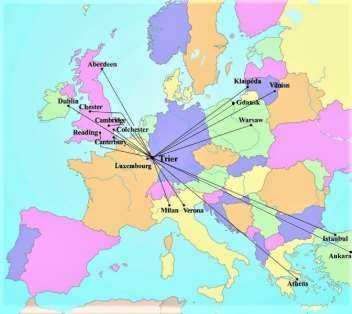
Study Abroad Europe                                Department of English Studies

CONTENTS

 A Year as an Exchange Student: Really Worth It?                         3

     10+1 Reasons to Become an ERASMUS Student                           4

     ERASMUS Facts and Figures                                           5

     ERASMUS and Brexit                                                  5

 Things to Consider

     Before Applying                                                     6

     Before Departure                                                    9

 Other FAQs                                                              11

 The Application Procedure                                               12

     Application Documents                                               13

 Where can I go?                                                         14

     Current Partner Institutions                                        15

            Aberdeen
            Ankara
            Athens
            Cambridge
            Canterbury
            Chester
            Colchester
            Dublin
            Gdansk
            Istanbul
            Klaipeda
            Luxembourg
            Milan
            Reading
            Verona
            Vilnius
            Warsaw
3    Study Abroad Europe                                       Department of English Studies

    A Year as an Exchange Student: Worth It?

    The answer to this question is an overwhelming "YES"!

    Trying to decide whether to spend a semester/year studying abroad is something many
    students spend a lot of time pondering. Yes, it's true that the application and accreditation
    processes may involve quite a lot of formalities, and other areas of your life will need attention
    too, e.g. securing enough money, renting out your flat/ room, and finding someone to look
    after your hamsters!

    Still, the benefits of spending even just one semester abroad are definitely worth it,
    particularly for language students! The chances are you'll come back a different person, with
    broadened horizons and a new perspective. You will learn to be self-sufficient and handle
    problems and obstacles on your own. Moreover, you will meet new people from all around
    the world, perfect your foreign language skills and see interesting, new places. It’s also a great
    achievement to add to your CV, not only for the language aspect.

    A lot of students are worried about 'losing time' in their studies. But you should know that it
    is usually possible to get most of the courses you take abroad accredited as some that are
    required for your degree programme in Trier, so you probably won't 'lose' as much time as
    you think. Having said that, a study abroad exchange lasts for a maximum of 10 months –
    which is really not that long a time in the grand scheme of things. Many students do not
    complete their degree in the recommended period of time anyway, and spending a year
    abroad is a very valuable way to spend time as a student, so the concern of finishing your
    degree just a few months later than perhaps originally planned is not really a big problem.
4 Study Abroad Europe Department of English Studies
10+1 Reasons to Become an ERASMUS Student
1. You can study at one of 2000+ universities for free!
2. You will meet people from around the world (and
have places to stay when you them visit later!)
3. You will improve your language skills (and might even
learn a new one)
4. You will be exposed to different ways of thinking
(and become more critical yourself)
5. Your grades might improve upon your return
6. Your chances of getting a job improve
7. You will have the chance to travel a foreign country
and get to know all of its facets
8. You are given an ERASMUS grant to enable you to
study abroad
9. You will find out more about yourself
10. You will experience the “Union” in “European Union”
11. You will never forget this time of your life!5 Study Abroad Europe Department of English Studies
ERASMUS – Facts and Figures
At the end of the 15th century, a young scholar from Holland went off on a 30-year ‘study
abroad’ trip through France, Italy, Great Britain and Switzerland – and inspired many other
scholars and students to do the same. Around 500 years later, the EU took the name of this
scholar as the title of its ERASMUS programme – “European Region Action Scheme for the
Mobility of University Students." This is one of the most popular and well-known Europe-wide
programmes which allow scholars and students to travel and study abroad until today.
Nowadays, over 2000 universities participate in the ERASMUS programme and the number of
participating students is also increasing beyond the borders of the EU. In 1987/88, a total of
649 students at German universities used the programme to spend some time studying in
another European country. In 2009/10, the figure was around 29,000. The financing that is
made available for the scheme has also been increased, and for 2014-2020 the sum was
around 14.7 billion Euros!
In 2014, the EU set up a new generation: ERASMUS+. It gives the participants the
opportunity to go on a funded exchange in each academic cycle (BA; MA; PhD) and includes
possibilities for studying, training and gaining work experience abroad.
At a time when tuition fees in many European countries are increasing beyond recognition,
participating in the ERASMUS scheme, which does not require students to pay the tuition fees
at their host university, makes studying in these countries easily affordable to a far larger
group of students. As an ERASMUS student, you are freed from this financial obligation, but
can still benefit from expert teaching and international exchange at our partner institutions.
ERASMUS and Brexit
The uncertainties surrounding the UK’s exit
from the EU unfortunately also impact on
ERASMUS exchanges to UK universities. As yet,
it is unclear whether the UK will voluntarily
continue its participation in ERASMUS, though
many scholars and institutions are campaigning
for this to be the case.6 Study Abroad Europe Department of English Studies
At the moment, it looks likely that the UK will continue to participate in the ERASMUS+
programme for the academic year 2020/21. Even if this should turn out not to be the case,
many of our partner institutions in the UK have confirmed that they wish to continue the
partnership under the same conditions (i.e. still no tuition fees for exchange students). This
means that you should apply for an exchange year/semester at our UK partner universities as
usual, following the procedure explained in this booklet.
If the UK does not continue to participate in the ERASMUS programme, you will then still be
able to go on your exchange year/semester, but you will not be able to receive ERASMUS
funding. Instead, once you have been selected as an exchange student for a UK partner
university, you will need to apply for a scholarship from the DAAD PROMOS programme. These
applications are a little more detailed than those for ERASMUS, and there are set deadlines
throughout the year that you need to watch out for. If this becomes relevant, you will be given
more information in your acceptance letter, and both Dr Kraft and Mrs Maas will be happy to
support your PROMOS application. You should not let this deter you from applying for an
exchange with a UK partner university.
You can find out more about the current status of the ERASMUS programme in the UK on
these webpages:
https://www.britishcouncil.de/en/study-uk/eu-exit
https://ec.europa.eu/programmes/erasmus-plus/about/brexit
Things to Consider Before Applying
How long can I stay?
Usually, an exchange will last for one academic year - normally September to June. In some
cases, it is possible to go for just one semester, but this must be agreed with the partner
institution, and those students applying for the whole academic year will usually be given
priority. Note, too, that the term dates at our partner universities (especially in the UK and
Ireland) may make it impossible to stay for only one of our semesters. In some cases, staying
abroad for just one ‘term’ means that you’re only there for around 11 weeks, which is not as
conducive to your learning as staying for a “whole year” (=usually around 8-9 months).7 Study Abroad Europe Department of English Studies
How do I choose where to go?
Personal preferences always play a big role in such decisions. Some students value the touristic
or weather aspects of the town/country they are visiting, others want to go to a particular
place they’ve always dreamt of living in. As a student of English, your preferences are probably
with English-speaking countries. Yet other partner institutions may offer courses in English
that are closer to your interests and abilities. For students in the BA/MA programmes, the
country itself does not need to have English as a main language, so you can choose universities
or institutions in other countries according to your interests, other subject(s), and/or other
language skills. For BEd/MEd students a three-month stay in an English-speaking country is
obligatory. Nonetheless, you may decide to spend your three months in an English-speaking
country at another time, and enjoy the international exchange and adventure of attending
one of our other partner universities.
You should be honest with yourself about the kind of place you are likely to feel comfortable
and happy living in. Although the exchange lasts 'only' one year, you won't be able to make
the most of it if you are unhappy living in that area. For this purpose, this booklet includes
some information on our partner institutions. You can also check the universities' websites
which often include information about 'life' beyond the academic side of things.
If there are particular universities that interest you, you can contact the International Office
to ask for the reports written by previous students who went there on an exchange. These can
help you find out more about the academic and extracurricular activities, as well as the
location and surroundings of the university.
Language Skills and Tests
Studying in a foreign country requires good language skills. Most of the Department of English
Studies’ partner institutions teach in English, yet some basic language skills in the country’s
main language may also be helpful. In those countries that teach in English but are not English-
speaking, online language courses in the local language (OLS, erasmusplusols.eu/de/) are
offered to help you acquire day-to-day language competence.
If you study English and are applying to study at a university in an English-speaking country,
or an international university where you will be attending courses taught in English, you do8 Study Abroad Europe Department of English Studies
not need to take any language test. If a Sprachzeugnis is required for your application, a
Sprachpraxis teacher can complete it for you.
There are two exceptions to this rule:
- Students without EU citizenship may need a visa to study abroad and the requirements
for most visas include an officially recognised language test such as IELTS or TOEFL. This
may also apply to students going to study in the UK after Brexit.
- The University of Cambridge requires you to pass their own language test or one of the
following: IELTS with a minimum overall grade of 7.0, Cambridge Certificate in Advanced
English at grade A, Cambridge Certificate of Proficiency in English at grade B, or TOEFL iBT
minimum overall score of 100 with 25 in each element. We recommend you take
advantage of one of the latter options. Talk to Mrs Maas before applying.
Students who do not study English but would still like to apply for one of our partner
institutions, will be required to do Trier University`s language test. Please enquire at the
International Office or Sprachenzentrum for more information. Note that these tests are held
on fixed dates throughout the semester, so make sure you inform yourself in good time!
Financing Your Year Abroad
The costs of living in many European countries are at least equal to those in Trier. Especially
in the UK and Ireland, they might even be higher. Additionally, you will also have to travel to
your host university and might want to travel around the country. Of course, this can be
financially challenging, yet this aspect should not keep you from applying.
All participants in the ERASMUS+ exchange programme are entitled to a monthly allowance
of around €200-300. The amount is not dependent on your financial background. Instead,
ERASMUS+ sorts the host countries in categories according to their costs of living. Thus, you
will receive a higher allowance for Ireland than for Poland, for example. If Brexit means that
the UK leaves the ERAMUS programme, you would be eligible for a DAAD PROMOS scholarship
instead, which pays a similar amount of financial support to exchange students. Of course, this
allowance alone may not be enough to live on, but combined with the money you would spend
if you were living in Trier, it should cover your basic expenses.9 Study Abroad Europe Department of English Studies
These stipends can also be combined with BAföG payments: even if you do not normally
receive BAföG, there is an extra Auslands-BAföG you may be entitled to, which can
cover your health insurance and accommodation costs. You can also get a one-off payment of
up to €250 to cover your travel costs to and from your host university, which usually does not
need to be paid back. For more information, see the BAföG website:
https://www.bafög.de/de/auslandsfoerderung-384.php
Things to Consider Before Departure
Once you have been selected to be an exchange student at one of your partner universities
(usually around the end of March), you need to take care of a few things and arrangements.
For one thing, your bank account should allow you to visit ATMs as well as make payments.
Furthermore, you should arrange your accommodation before your departure. The university
facts listed below will give you a first impression of your options. Most importantly, though,
you need to take care of some academic matters at your home university before you leave.
ECTS and Learning Agreement
ECTS is the European Credit Transfer System, created by the European Commission. It aims to
standardise and unify academic systems across the European Union. The basic assumption is
that completing classes earns you credits/points, which are the reflection of the hours of work
you put into studying. Typically, exchange students are expected to earn about 25-30 ECTS
points per semester. To give you some idea of how much work earns you how many points, a
typical sprachpraktische Übung here in the Department of English Studies of Trier University
would earn you 4-5 ECTS points. Writing term-papers or sitting exams as well as attending
weekly lessons, possibly also giving a presentation, means that you can usually earn up to
about 10 points per seminar. Always speak to the individual teacher of the classes you are
taking abroad to check the requirements and the available points.
Additionally, you need to prepare a Learning Agreement prior to your departure. Here you list
the classes you intend to take while you are at your host university as well as the classes you
would like them to be accredited as in Trier. Most universities publish the classes/modules
they offer online so you can have a look at what options you have. Mrs Maas can also help
you to find appropriate classes. The classes may change from year to year but the learning10 Study Abroad Europe Department of English Studies
agreement will still help you to achieve the necessary number of ECTS points and guarantees
your work counts towards your degree in Trier. The Learning Agreement must be signed by
your ERASMUS Coordinator or Studienberater in Trier as well as by the Coordinator abroad so
that accrediting the classes you have taken abroad will be easier. If you need to make
amendments to your Learning Agreement after you arrive at your host university, there is
another form for this which also needs to be signed by the coordinators at both universities.
What classes should I take?
The goal is international academic exchange, and not simply another way to collect your
certificates or credit points! Find out about experts in your fields of study who teach at our
partner universities, find out about the specialisms offered in the various departments. Most
universities will offer you new possibilities and fields of study you have not yet encountered
and that will further your academic interests nonetheless. For example, Scottish and Irish
universities often offer classes in Gaelic or Scottish/Irish literature/linguistics. Once you have
some ideas, you can discuss your choices with Mrs Maas.
Accreditation
Basically, the classes you take at your exchange university can be accredited here in Trier, as
long as they are roughly comparable. For example, a seminar in English linguistics is usually
easy to recognise as such. Generally, the Department of English Studies, recognises the value
of having spent time abroad and attending various classes in English, and we are generous
with our accrediting! Still, each individual case will necessarily be handled as such. Your
Learning Agreement includes a section for the accreditation of your work. Before you leave,
you agree which classes will be accredited upon your return. This way you know in advance
how your studies will continue after your year abroad.
Officially, the head of department in the Department of English Studies signs the paperwork
to accredit your classes. In practice, though, the Department’s Studienberater or Mrs Maas
should be your first port of call. Print out the relevant documents from the Dean’s homepage
and bring them, along with your transcript and all your certificates and work from the foreign
university, when you talk to one of them in their office hours. Further information can be
found on the webpage of the FB II Dean’s Office.11 Study Abroad Europe Department of English Studies
What happens if I want to/have to drop out of the programme?
If necessary, it is possible to drop out of an exchange at any time, for example due to illness.
However, if you are considering not taking your spot, or leaving early, for any reason, you
should contact Ms Freihoff (IO) to see if dropping out is unavoidable or how going on the
exchange can still be made possible for you. If you really must drop out of the exchange, you
should let Ms Freihoff know as soon as is possible so that your spot can be reallocated to
another student. Please note that in extreme cases you may be asked to pay back any financial
help you have received, if you do not stay for the duration of your planned exchange.
Other FAQs
Can I write my Bachelor’s/ Master’s thesis during my exchange year?
The possibility of writing your Bachelor’s/ Master’s thesis at a partner institution depends on
various factors. If your advisor at Trier University agrees to your plan, you have overcome the
first obstacle. You should be aware, though, that you might still have to take the full workload
at your host university in addition to writing your thesis – please discuss this with Mrs Maas
when you compose your Learning Agreement. At some universities modules exist that aim at
completing a thesis. If you are considering taking this option, you should, however, talk to
your host university about your possibilities of taking this course before you make further
arrangements.
Can I do an internship whilst on an exchange?
If you wish to gain some work experience alongside studying at your host university, you can
find part-time work or a work experience placement that fits in around your lecture schedule.
Please ensure that your work or internship does not have a negative impact on the academic
side of things – having completed a placement cannot make up for not achieving the ECTS
credit points agreed on in your learning agreement.
If you are planning to complete an internship or work placement in a European country before
or after your time as an exchange student, and you find a placement lasting at least 90 days,
you can apply for funding at the a.i.m. rpl office. For more information about funding for work
experience placements, please contact the IO or see here: http://www.erasmuspraktika.de/12 Study Abroad Europe Department of English Studies
The Application Procedure
It is recommended that you start planning your year abroad about one or one and a half years
in advance. This will help you to organize yourself, prepare the required application
documents and arrange a Learning Agreement with your ERASMUS coordinator. For most
English students, preparation should start in your 3rd semester to go in the 5th semester.
The application deadline is in March for students wishing to go on the exchange in the
following academic year. Prior to that, there are informative talks and Q&A sessions for all
students who are interested (usually in January). You should take advantage of these, since
you can sort out queries and problems then.
Below is a list of documents you will need to submit as your application. Once you send your
application to the International Office, it is forwarded to the departmental coordinator who
reads and compares all the applications, and may ask some candidates to attend an interview
(In the Department of English Studies, this is Mrs Maas). In general, the decisions are based
on proof of suitability for studying abroad. Alongside grades from previous classes and exams
you have taken in Trier, evidence that you will make the most of your stay abroad and that
you are well informed about the university/ies you are applying for is also taken into
consideration.
Remember that the 'goal' of the any exchange programme is to encourage international
cooperation in the academic arena – so even if you have previously not been a "straight A"
student, or if you feel that your language is not yet perfect, you should emphasise what you
can bring to the international exchange as an individual. It will be particularly useful for you
to have informed yourself about the university and the classes offered there that interest you.
Make your application specific to your person, purpose and university!
Ask yourself: what particular strengths do you have? What interests will you be able to follow
in the country you're applying for? What career aims might this exchange help you to fulfil?
What previous experience do you have that show that you are prepared for a challenge and
excited about really making the most of your time in that country and/or at that university?
These are the kinds of things that make applicants stand out from the others, and make them
more likely to be chosen for the exchange!13 Study Abroad Europe Department of English Studies
Application Documents
To apply to study abroad at one of our European partner universities, you need to complete
and submit the following documents and forms to the IO before the application deadline. For
more details, and downloads of the relevant documents, please see the IO’s webpage:
http://ins-ausland-downloads.uni-trier.de/
1. Programmliste Anglistik
This is where you list all the universities you would like to apply for. To increase your
chances of being offered a place as an exchange student, we recommend that you pick a
first, second and third choice of partner institution. Please submit two copies.
2. Online Application Form (Bewerbungsformular)
This is where you fill in your personal and contact details. Please submit two copies. Please
read the tips here before you complete your application: https://www.uni-
trier.de/fileadmin/international/international/3_Outgoings/Students/0_ERASMUS/2019
_20/Bewerbungshinweise.pdf
3. CV (written in English!)
Your CV should be no longer than 1-2 pages. Please include details on your extracurricular
activities and degree progress – especially if you have changed universities or subjects.
4. Application Letter (written in English!)
Please present reasons why you would make a good candidate for the exchange and why
you are applying for to study abroad at this particular choice of partner institution (please
focus on your first choice, if you list more than one priority). You should highlight what
you can bring to the programme as an individual (see above – The Application), as well as
what interests you about your choice of exchange. Do not write more than two pages.
5. List of Previously Completed Modules (print out from PORTA)14 Study Abroad Europe Department of English Studies
Where can I go?
Some other subjects at Trier University also have partner institutions in English-speaking
countries. If you study one of these subjects alongside English, you can also go to an English-
speaking country through one of their exchanges. Whether or not your exchange university is
an exchange partner of Trier University’s Department of English Studies, we will be happy to
accredit any relevant courses you complete whilst abroad.
If you are interested in spending an exchange year at a university which is not (yet) one of our
partners, please talk to Mrs Maas. We can always contact the university to enquire about
setting up a new agreement. If your university of choice is not interested in having Trier
University as a new partner, you may still be able to study there and receive DAAD or PROMOS
funding – Ms Janina Kröner (IO) is the person to ask about this.
Previous Applicants and Participants
2013/14 2014/15 2015/16 2016/17 2017/18 2018/19 2019/20
Available Spots 17 24 30 26 27 27 30
Applicants 18 34 26 24 15 26 23
ERASMUS students 13 23 17 18 13 20 1815 Study Abroad Europe Department of English Studies
Current Partner Institutions
Student Duration of Bachelor’s Master’s Staff**
Places Stay
Greece Athens 2 or 5 months or x x x
1 10 months
Ireland Dublin City 2 10 months x x
University
Dublin Trinity 2 10 months x x
College
Italy Milan 1 10 months x
(Università
Cattolica)
Verona 2 5 months x x x
Lithuania Klaipeda 2 or 5 months or x x
1 10 months
Vilnius 3 10 months x x x
Luxembourg Luxembourg 2 or 5 months or x x
1 10 months
Poland Gdansk 2 or 5 months or x x x
1 10 months
Warsaw 1 5 months x x
Turkey Ankara 1 10 months x
Istanbul 2 10 months x x
UK Aberdeen 2 or 5 months or x x*
1 10 months
Cambridge 1 10 months x x*
(Cambridge
University)
Cambridge 1 5 months x x x
(Anglia Ruskin)
Canterbury 2 10 months x x*
(U. of Kent)
Chester 4 10 months x x* x
Colchester 2 or 5 months or x x* x
(U. of Essex) 1 10 months
Reading 1 10 months x x*
* These universities accept Master’s students if they take undergraduate courses which can, however, be
accredited as Master’s level classes in Trier. Please check with Mrs Maas before you take the classes! For this to
be possible, you must be enrolled as a Master’s student in Trier for the time you are abroad. ** Members of staff
can also go to the University of Sussex, UK.16 Study Abroad Europe Department of English Studies
ABERDEEN
University of Aberdeen, United Kingdom
http://www.abdn.ac.uk/
http://www.abdn.ac.uk/erasmus/
City:
Located in the Northeast of the UK, Aberdeen is not only the third largest city in Scotland but
also close to the sea. It has a population of about 217,150 and can trace its origins to 580 A.D.
University:
Like the city itself, the University of Aberdeen is one of the oldest
in the UK. It was founded in 1495 which accounts for the
university’s typical old buildings. Today, around 14,000 students
are enrolled in the manifold degree programmes offered. Among
its alumni are popular Britons like Thomas Reid and Joanne K.
Rowling. Our agreement is with the School of Language and
Literature but students may choose 50% of their classes from other departments.
The academic year is split into two semesters. The first usually begins in September and ends
at Christmas; the second one begins in January and ends with the examination period in May.
Stays for one semester (winter) are possible, though not recommended.
You are not required to take a language test for your application at Aberdeen. However, your
level of English must be high enough for you to be able to follow the courses. If you wish to
take Level 3 classes, you must take a diagnostic test.
Courses:
Focus on: Gaelic lessons, Irish and Scottish Studies. Courses might include:
- States of Mind: Contemporary Irish and Scottish Writing
- History of Language in the British Isles
- Language: Variation and Change
Housing:
The University of Aberdeen offers accommodation in halls of residence on campus as well as
in Hillhead Halls, about 20 minutes from campus. Rents range from £89 to £160 per week and
are subject to availability. Application is possible after you receive your ERASMUS package.
Additionally, the student association advertises private accommodation in and around
Aberdeen.
Useful Links:
http://www.abdn.ac.uk/accommodation/choosing_accommodation/
https://www.abdn.ac.uk/registry/courses/undergraduate17 Study Abroad Europe Department of English Studies
ANKARA
TED University, Turkey
https://www.tedu.edu.tr/en
https://ipo.tedu.edu.tr/en/ipo/erasmus
City:
Ankara is the capital of Turkey and its second largest city
with a population of approx. 4,590,000. It lies about 200km
south of the Black Sea and is a very historical city with many
influences from different time periods which can be
discovered in its architecture. In the summer the average
temperature is about 24° C; in the winter the temperature
drops to an average of 0° C.
University:
The TED University (TEDU) was founded by the Turkish Education Association – Higher
Education Foundation in 2009. Therefore, it is considered as a young and dynamic university
which consists of five faculties: Architecture, Arts and Science with the Department of English
Language and Literature, Economics and Administrative Sciences, Engineering and Education.
Courses:
- Survey of English Literature
- Introduction to Cultural Studies
- 19th Century English and American Poetry
- Gender Studies
- Advanced Writing
Housing:
The University provides modern accommodation opportunities to all students. Breakfast and
dinner are included in the dorm fee and each room has its own bathroom. The price ranges
from approx. 1,750€ (10 months, female quad. room) to 3,000€ (10 months, for a single
female room. Housing for males is usually priced higher.)
Useful Links:
https://ipo.tedu.edu.tr/en/ipo/dormitories
https://ipo.tedu.edu.tr/en/ipo/residence-permit-018 Study Abroad Europe Department of English Studies
ATHENS
National and Kapodistrian University of Athens, Greece
http://en.uoa.gr/
http://en.interel.uoa.gr/erasmus.html
City:
Athens is one of the oldest cities in the world which accounts for
its many historical and cultural sights. The city is surrounded by
mountain ranges and the Mediterranean Sea. In the summer the
average temperature is 27.5°C; in winter the temperature drops
to an average of 9°C.
University:
The National and Kapodistrian University of Athens attracts about 4,100 foreign students each
year which gives it a highly international air. The Faculty of Philosophy, including modern
language studies, is located on the main campus in Ilissia, a neighbourhood of Athens. About
2,000 students are enrolled in the Faculty of English Language and Literature.
The academic year consists of two semesters. The first begins toward the end of September,
the second in February.
The Faculty of English Language and Literature teaches all of its classes in English. Most
courses in other subjects at the University of Athens are taught in Greek. It is possible to take
Greek language classes free of charge which are worth 6 ECTS.
Courses:
Courses are offered in literary and cultural studies and in theoretical and applied linguistics.
Courses might include:
- Contemporary Anglophone Theatre
- Canadian Literature
- Theory and Criticism of Literature
- Translation Theory
- English and Digital Literacies
Housing:
The ERASMUS Student Network Athens (ESN KAPA Athens) provides lists and contact details
of possible accommodation in Athens. Rents start at about €250/month for a shared flat and
€300/month for a single apartment.
Useful Links:
http://en.enl.uoa.gr/undergraduatestudies/courses.html
http://www.esnkapa.org/athvens/19 Study Abroad Europe Department of English Studies
CAMBRIDGE
Anglia Ruskin University, Cambridge
http://www.anglia.ac.uk/
http://www.anglia.ac.uk/international/study-abroad
City:
Cambridge is known for its famous universities and beautiful buildings. The city is well
connected with the London and the rest of the country.
University:
Anglia Ruskin University was founded in 1858. It ranks amongst the best universities in the UK
and has a reputation for excellence.
The University is placed in near the Mill Pond in Cambridge, making it a very green campus,
similar to ours in Trier. There are currently around 40 000 students enrolled at Anglia Ruskin.
Anglia has been classified as encouraging “world-leading” research in various areas of study.
For students of English it might be of importance to know that two of the aforementioned
areas include English Literature and Cultural studies.
The academic year is split into two semesters: September-January, January-April. Please note
that only one semester stays are possible at Anglia Ruskin.
Courses:
Courses are offered in literary and cultural studies and in theoretical and applied linguistics as
well as English Language Teaching. The university also offers as a range of language classes
should you feel the need to improve your skills.
Courses might include:
- Drama and English Literature
- English Language and English Language Teaching
- History and English Literature
Housing:
Prices from halls are from approximately £90-£160 per week.
Useful Links:
http://www.anglia.ac.uk/international/europe
https://www.anglia.ac.uk/student-life/accommodation20 Study Abroad Europe Department of English Studies
CAMBRIDGE
University of Cambridge, United Kingdom
http://www.cam.ac.uk/
http://www.cam.ac.uk/international-students
City:
Cambridge is located about 80km north of London in East Anglia. Some 20% of the city’s
population are students which makes Cambridge a thorough university city.
University:
Cambridge is one the very best universities in the UK, and ranks among the top universities
worldwide. Founded in 1209, it is also one of the UK’s oldest universities. The module
structure in Cambridge is slightly different from other universities: Teaching is done in lectures
and very small tutorials called 'supervisions' (with 1-3 students and a lecturer) and involves a
lot of reading outside of class.
It is rather difficult to combine your studies of literature and linguistics, as these are taught by
different faculties. But you can ask your academic supervisor in Cambridge to help you out
and see whether it is possible for you to combine these courses of study.
The academic year is split into three terms: October-December, January-March and April-
June. This division of terms means single-semester stays in Cambridge are not possible.
Your level of English and academic performance must be very high to attend Cambridge. See
the language test section for further information. Please contact Mrs Maas before applying.
Courses:
A range of professors, teaching fellows and guest lecturers cover almost every aspect of
English studies. Courses might include:
- English Literature and its Contexts 1300-1550
- Practical Criticism and Critical Practice
- Historical Linguistics
- Psychology of Language Processing and Learning
Housing:
The University of Cambridge offers housing in its colleges with rent from £655 per month.
Alternatively, the accommodation office lists available private accommodation. It is advisable
to check accommodation possibilities well in advance.
Useful Links:
http://www.english.cam.ac.uk/ http://www.mml.cam.ac.uk/dtal/
http://www.accommodation.cam.ac.uk/21 Study Abroad Europe Department of English Studies
CANTERBURY
University of Kent, United Kingdom
http://www.kent.ac.uk/
http://www.kent.ac.uk/courses/short-term/erasmus/index.html
City:
Located in the heart of Kent, Canterbury is one of Britain’s historic cities. In fact, it is similar
to Trier in terms of its Roman sights which are partially part of the UNESCO World Heritage.
The city’s a population is about 44,000 and is portrayed in Chaucer’s Canterbury Tales.
University:
The University consists of different schools. The Faculty
of Humanities comprises the School of English as well as
the School of European Culture and Languages. Our
exchange is with the School of European Culture and
Languages, so you must take most of your classes there.
You are allowed to take one ‘wild module’ class from
another subject, e.g. School of English, or whatever your
second-degree subject is.
The academic year is split into three terms: October-December, January-April and May-June.
One term stays in Canterbury are possible, though not recommended.
You are not required to take a language test for your application at Kent. However, your level
of English must be high so you are able to follow the courses
Courses:
The SECL offers a broad variety of courses in different aspects of Linguistics and Comparative
Literature, as well as foreign languages (German, French, etc). Courses include:
- Comparative Literature and English Linguistics in the Classroom
- English Language in the Media
- History of British English
Housing:
The University of Kent has multiple halls of residence. The rent ranges from about £4,000 to
£6,300 for one academic year. It is also possible to arrange off-campus accommodation.
Useful Links:
http://www.kent.ac.uk/courses/modulecatalogue/humanities.html
http://www.kent.ac.uk/accommodation/22 Study Abroad Europe Department of English Studies
CHESTER
University of Chester, United Kingdom
http://www.chester.ac.uk/
http://www.chester.ac.uk/international
City:
Chester is one of the UK’s oldest cities and can be traced back more than 2000 years. It is close
to the Welsh border in the Northwest of England and has about 70,000 inhabitants. Thus, it is
fairly similar to Trier, however Chester counts Daniel Craig among its famous sons.
University:
The University of Chester was established as the teaching college of the University of Liverpool
but was expanded into a university with seven distinct faculties in 2005. Thus, it is one of the
UK’s youngest universities, but has some 15,000 students by now.
The English Department offers courses in literature,
linguistics (‘language’) and creative writing, and is
recognized for its excellence in research. Places for
Erasmus students in English Dept. classes are limited, but
students can be flexible in choosing courses from other
departments (e.g. German, Education), and may be able
to work as a German tutor.
The academic year consists of two semesters. The first starts at the end of September, the
second one in January. One semester stays in Chester are not possible.
You are not required to take a language test for your application at Chester. However, your
level of English must be high so you are able to follow the courses.
Courses:
Choosing between the Languages, English, and Education Depts, courses might include:
- Victorian Literature
- Translation Techniques and Application (Ger/Eng)
- Language Acquisition
- Pedagogy Policy and Practice
Housing:
International and exchange students staying for a full academic year are guaranteed
accommodation. Rents are £90 for standard and £130 for en-suite rooms per week.
Useful Links:
https://www1.chester.ac.uk/international
http://www.chester.ac.uk/campus-life/accommodation23 Study Abroad Europe Department of English Studies
COLCHESTER
University of Essex, United Kingdom
http://www.essex.ac.uk/
http://www.essex.ac.uk/international/
City:
Colchester lies to the northeast of London on the North Sea. It has a population of about
110,000 and is said to be built at the same location as legendary Camelot.
University:
Colchester is home to one of the three campuses of the University of Essex. About 9,000
students are enrolled in one of the sixteen faculties. In the 2009 Student Satisfaction Surveys
they scored 94% on acquiring knowledge and understanding, 93% on quality of supervision,
90% on course organisation, and 88% on resources. Erasmus students can take courses from
any Department based at the Colchester campus, as long as these are labelled as available to
exchange students and the students fulfil the prerequisite requirements.
The academic year is split into three terms beginning in October and ending with the
examination period in June. Note that some courses run for the whole academic year and are
not open to students staying in Colchester for just one semester.
You are not required to take a language test for your application at Colchester, but your level
of English must be high for you to follow the courses. EFL courses can be taken for ECTS credits
at the University.
Courses:
Alongside traditional literature and linguistics courses, teaching areas include TEFL and Film
Studies. Courses might include:
- Film and Propaganda
- Arthurian Literature
- English Novels and their Settings
- Second Language Learning
- Grammatical Change in the History of English
Housing:
The University of Essex offers accommodation in seven different facilities. Rents range from
£3,000 to £5,000 per year. It is possible to be accommodated for only one term at slightly
higher rates.
Useful Links:
http://www.essex.ac.uk/modules/Default.aspx
http://www.essex.ac.uk/studyabroad/ http://www.essex.ac.uk/accommodation/24 Study Abroad Europe Department of English Studies
DUBLIN
Dublin City University, Republic of Ireland
http://www.dcu.ie/
hhttp://www.dcu.ie/international/index.shtml
City:
Ireland’s capital is on the river Liffy, close to the Irish Sea. The city has a population of 530,000
and is visited by thousands of tourists annually. Alongside English, Gaelic is common in the city
area. Due to the city’s compact size, it is possible to visit the main sights on foot.
University:
Dublin City University is Dublin’s youngest university.
Founded in 1980, it now houses around 12,000 students
in its four faculties. In the QS, Dublin City University
ranked among the top 50 universities worldwide. The
Faculty of Humanities comprises both the Department of
English Studies and the School of Applied Language and
Intercultural Studies (SALIS).
The academic year consists of two semesters. The first beings in October and ends in
December, the second begins in February and ends in May. One semester stays in Dublin are
possible, though not recommended.
You are not required to take a language test for your application at Dublin. However, your
level of English must be high so you are able to follow the courses.
Courses:
Course include literary studies as well as linguistics and translation studies. Many foreign
students are interested in Irish literature and language. Courses might include:
- Postcolonial Writing
- Introduction to Translation Studies
- International Business Communication
Housing:
Dublin City University provides on-campus accommodation for around €4,100 per academic
year. You should apply as quickly as possible. The international office also provides internet
links for off-campus accommodation.
Useful Links:
http://www.dcu.ie/salis/index.shtml https://www.spd.dcu.ie/site/english/index.shtml
http://www.dcuaccommodation.ie/25 Study Abroad Europe Department of English Studies
DUBLIN
Trinity College Dublin, Republic of Ireland
http://www.tcd.ie/
http://www.tcd.ie/international/
City:
Ireland’s capital is on the river Liffy, close to the Irish Sea. The city has a population of 530,000
and is visited by thousands of tourists annually. Alongside English, Gaelic is common in the city
area. Due to the city’s compact size, it is possible to visit the main sights on foot.
University:
Trinity College Dublin is Ireland’s oldest and most renowned university. Its Long Room houses
the Book of Kells and the world’s oldest harp, and is also a main tourist attraction. Founded in
1592, it now houses three faculties. The Faculty of Arts, Humanities and Social Sciences houses
the School of English which ranked 3rd in Europe and 14th in the World in the QS World
University Rankings 2012, and also includes the School of Languages, Literatures and Cultural
Studies which focuses on Irish and Gaelic Studies.
The academic year consists of three terms. The first two begin in October and January
respectively and are taught, the third one begins in April and encompasses the examination
period.
You are not required to take a language test for your application at Dublin. However, your
level of English must be high so you are able to follow the courses. Moreover, it is possible to
take courses in the Irish language.
Courses:
Students should take mainly language/linguistics classes, but may also choose a couple of
literature classes depending on availability. You can also take courses on Irish literature and
language. Courses might include:
- Applied Linguistics of English Language Teaching
- Technology, Language and Communication
- Anglo-Saxon Identity
- Northern Irish Literature and the Troubles
Housing:
Most incoming students are accommodated in Trinity Hall, although Trinity College Dublin
does not reserve rooms for ERASMUS students. Rents are between €150-€250 per week.
Useful Links:
http://www.tcd.ie/English/ https://www.tcd.ie/students/orientation/visiting-exchange/
http://www.tcd.ie/accommodation/
https://www.tcd.ie/English/international/visiting/26 Study Abroad Europe Department of English Studies
GDANSK
University of Gdansk, Poland
https://en.ug.edu.pl/
https://en.ug.edu.pl/incoming_students/erasmus
City:
Gdansk is considered to be one of the most beautiful cities in Poland right next to the Baltic
Sea. The city has a population of 460,000 and is visited by hundreds of tourists each year due
to its history and magnificent architecture. Gdansk with nearby Sopot and Gdynia are often
referred to as a Tricity. Its position on the seaside has made Gdansk an important port city.
The living costs are relatively low compared to other European cities.
University:
The University of Gdansk is the largest
educational institution in the Pomerania region.
There are eleven faculties with almost thirty-
three thousand students. Around 150 Erasmus
students from all over Europe go to the
University each term and taking advantage of the
possibility to study abroad.
Courses:
The faculty of English and American Studies (IEAS) offers a rich variety of courses for exchange
students. These take place at both BA and MA levels. They range from Practical Language
courses, American Studies with Culture, Media and Communication Specialization to English
Language with Teacher Specialization and also Translation Studies. Courses might include:
- History of American Literature
- American Culture in the 21st Century
- Descriptive Grammar: Syntax, Phonetics, Semantics
- English Teaching Methodology
- Adaption: Literature, Cinema and New Media
Housing:
The university has a wide range of accommodation in its student dormitories. Monthly costs
of accommodation vary from dormitory to dormitory but is in the range of 300-500 zl (70-
120€) per month.
Useful Links:
https://fil.ug.edu.pl/wydzial/instytuty_i_katedry/instytut_anglistyki_i_amerykanistyki/progr
am_erasmus/incoming
https://en.ug.edu.pl/study/study_guide/accomodations27 Study Abroad Europe Department of English Studies
ISTANBUL
Istanbul Kültür Üniversitesi, Turkey
https://legacy.iku.edu.tr/ENG/index.php
https://uib.iku.edu.tr/en/exchange-programs/student-mobility-outgoing/incoming
City:
Istanbul is Turkey’s cultural, financial and
economic centre. It is located on the Bosporus
and connects Europe and Asia. The city has a
population of about 13.5 million and is the most
densely populated one in Turkey. It is culturally
diverse with representations of Muslim, Christian,
Jewish and other denominations.
University:
Istanbul Kültür Üniversitesi was founded in 1997 and is one of Turkey’s youngest universities.
The Department of English Language and Literature was established two years later. Currently
the University has some 7,000 students and focuses on both theoretical as well as practical
training of its students. Incoming exchange students from Trier are permitted to take any
courses within the Dept. of English Language and Literature, which include language-based,
translation-based, and literature-based classes
The academic year begins in September and ends in May. It is split into two semesters which
both end with an examination period.
It is not necessary to have Turkish language knowledge; however, it is advisable to take a
Turkish EILC course. Within the Faculty of English Language and Literature, the vast majority
of courses are held in English.
Courses:
Emphasis tends to be on the linguistic features of literary and cultural texts, as well as the
historical and culture-specific aspects of language. Courses might include:
- Popular Culture - The Romantic Hero
- Western Culture and Civilization - Language and Culture
Housing:
The University runs two residences, separate for male and female students. It is possible to
arrange private accommodation. In any case, contact the European and International Centre.
Useful Links:
https://legacy.iku.edu.tr/ENG/3/283718/student-residences.html28 Study Abroad Europe Department of English Studies
KLAIPEDA
LCC International University Klaipeda, Lithuania
http://www.lcc.lt/
http://www.lcc.lt/erasmus-incoming-students
City:
Klaipeda is located about 300km from Lithuania’s capital Vilnius. It is the most important
harbour city in Lithuania and has some 180,000 inhabitants. Its diverse cultural history,
especially in terms of German-Lithuanian relations, make it unique.
University:
LCC International University was founded in 1991 as a joint
Canadian and American foundation. Following an American-style
liberal arts programme, and with 60% international lecturers, it
focuses on International Business Administration, English
Language and Literature, Psychology and Theology, and also has a
Master’s programme in TESOL. Around 600 students are currently
enrolled at the University, half of whom are international.
The academic year consists of two semesters. The first begins in September and ends in
December, the second one begins in January and ends in May. Each semester is followed by
an examination period.
You can take any class taught in English unless it is a higher-level class in a subject you have
not studied before. Although most classes are taught in English, you are recommended to take
an EILC course in Lithuanian which is free of charge and worth 6 ECTS.
Courses:
Courses focus on translation & interpreting, English language and literature, and interesting
perspectives on TESOL. Courses might include:
- Language Acquisition
- Introduction to Translation and Interpretation
- It is also possible to take related courses in Psychology, Theology and Business
Administration
Housing:
The University has two dormitories with a variety of rooms. Rents range from €318 to €650
per semester.
Useful Links:
http://www.lcc.lt/english
https://www.lcc.lt/home/study-abroad/cie/erasmus-2/erasmus-incoming-students/29 Study Abroad Europe Department of English Studies
LUXEMBOURG
Université du Luxembourg, Luxembourg City
http://wwwen.uni.lu/
http://wwwen.uni.lu/international
City:
The capital of Luxembourg is a city rich in culture and history, place in the middle of the
continent. It is home to the European Court of Justice and many other EU institutions. The
city has a population of roughly 104,000 habitants.
University:
The University of Luxembourg was founded in 2003 and
is our neighbour’s only public university. Situated in the
middle of the country, the university has close links to
the European Institutions in Luxembourg as well as the
banking quarters. It is likely to be one of the most
multilingual places of study in Europe. This university
offers great international research opportunities to its students as well as vocational courses
and a variety of doctoral programmes.
The academic year is split into two semesters: September-February, February-September.
One semester stays in Luxembourg are possible.
You are not required to take a language test before applying here. However, your level of
English must be high enough for you to be able to follow the courses.
Courses:
University of Luxembourg offers a whole range of subject areas; from Communication and
Economic Studies over Biomedicine and International Security to the Humanities with
Literature and Languages. The Humanities department has a long list of interesting classes for
interdisciplinary studies.
Courses may include:
- Language, Society and Power
- Comparative Literature
- Linguistics in the Real World
Housing:
Prices at university accommodation range from approximately 360€ to 600 € per month.
Useful Links:
http://wwwen.uni.lu/international/courses_taught_in_english30 Study Abroad Europe Department of English Studies
MILAN
Università Cattolica de Sacro Cuore, Italy
https://www.ucsc.it/
http://www.ucscinternational.it/academics
City:
Situated in Northern Italy, Milan is the country’s major cultural and fashion centre. It is also
one of the main university cities and its historic sights attract many tourists each year.
University:
The Università Cattolica de Sacro Cuore is Europe’s largest
private university. It has about 42,000 students and 5 campuses.
It has 14 faculties of which the Faculty of Arts and Philosophy
and the Faculty of Modern Languages offer courses with an
international focus. The University, thus, offers interdisciplinary
courses that aim at providing students with thorough and broad
academic capabilities.
The academic year is split into two semesters. Depending on the Curriculum they vary slightly.
Generally, the academic year starts in September and ends May/July. Each semester is
followed by an examination period.
The University’s International Curriculum is taught in English and is aimed at foreign students.
Nevertheless, courses in the Academic Curriculum might be taught in Italian and require
knowledge of the Italian language. It is possible to take Italian classes for a fee in Milan which
are worth between 3 and 8 ECTS.
Courses:
The University offers courses in Humanities which combine different fields of literary,
philosophical and cultural studies. Linguistics courses focus on various modern languages. The
international curriculum contains classes in fields like International Relations and Italian
Culture.
Housing:
The Università Cattolica de Sacro Cuore does not guarantee accommodation for exchange
students in its halls of residence. Instead they advise you to seek private accommodation. The
ESN Milano offers help. The costs of accommodation range between €2,700 and €3,900 per
semester.
Useful Links:
http://www.ucscinternational.it/student-services-at-cattolica/students-services-in-milan-campus31 Study Abroad Europe Department of English Studies
READING
University of Reading, United Kingdom
http://www.reading.ac.uk/
http://www.reading.ac.uk/study/international/
City:
Reading can trace its origins back to 800 AD. It is about an
hour’s drive from both London and Oxford. The name derives
from the Old English word “read” meaning “red”.
University:
The University of Reading ranks among the top 1% of the world’s universities. Some 11,000
students of 141 nationalities are enrolled in their degree programmes. The University was
founded in 1892 and has four campuses. The School of English Language and Literature is
located on Whiteknights Campus, the University’s main location. You can take any class in the
language section, however classes in linguistics are subject to availability, and classes in
literature may not exceed 20 ECTS.
The academic year consists of three terms. Classes begin in October, January and April
respectively.
You are not required to take a language test for your application at Reading. However, your
level of English must be high so for you to be able to follow the courses.
Courses:
English Language and Applied Linguistics focuses on all fields of Linguistics including language
teaching, corpus linguistics and gender and linguistics. English Literature focuses on all fields
of literary studies. Courses might include:
- Core Issues in English Language Teaching
- Language and Gender
- Nineteenth-Century American Fiction
- From Troy to Camelot: Medieval Romance
Housing:
You can apply for accommodation in the University’s halls of residence. Rents range from £130
to £170 per week and might be catered. The Reading University Student Union can also assist
you in finding private accommodation.
Useful Links:
http://www.reading.ac.uk/english-literature/ell-home.aspx
http://www.reading.ac.uk/english-language-and-applied-linguistics/
http://www.reading.ac.uk/life/life-accommodation.aspxYou can also read


