STUDY OF IMMINENT INTERACTIONS BETWEEN SARS-COV-2 (COVID-19), AIR QUALITY DUE TO SAHARAN DUST AND URBAN AEROSOLS, AND SOCIAL-ENVIRONMENTAL FACTORS ...
←
→
Page content transcription
If your browser does not render page correctly, please read the page content below
Study of Imminent Interactions between SARS-CoV-2
  (COVID-19), Air Quality due to Saharan Dust and Urban
Aerosols, and Social-Environmental Factors in Puerto Rico in
summer 2020: Proxies of Health Risks in Small Island States
                  in the Caribbean Region
                             Pablo A. Mendez Lazaro (PI)
                              pablo.mendez1@upr.edu
                         Environmental Health Department
                          Graduate School of Public Health
                  University of Puerto Rico-Medical Sciences Campus
                                September 21st, 2020
Core Team members

                                        Pablo A. Méndez-Lázaro, Ph.D.                           Daniel Otis, PhD
Ana Patricia Ortiz, PhD

                                                                    Digna Rueda-Roa, Ph.D.

                            Cynthia M. Pérez-Cardona, Ph.D.

                                                              Benjamin Bolaños, Ph.D.
Frank Muller-Karger, Ph.D                                                                    David de Angel MD
New Collaborators and Partners:

Dr. Erick Suárez has a PhD in Medical Statistics from the London School of Hygiene and Tropical
Medicine (LSHTM). He has been professor of Biostatistics for the last 31 years at the School of Public
Health of the Medical Sciences Campus-University of Puerto Rico. Last year, he was appointed an
elected member of the International Statistical Institute (ISI).

Dr. Claudia de Napoli: European Centre for Medium‐Range Weather Forecasts, Reading, UK
(Copernicus). University of Reading (UK), School of Agriculture, Policy and Development.

Dr. Sergio Caporali. Professor School of Public Health of the Medical Sciences Campus-University of
Puerto Rico. Industrial Hygiene

Dr. Enid García. Director of the Endowed Health Services Research Center School of Medicine,
University of Puerto Rico Medical Sciences Campus),

Risks of COVID-19 and Environmental Factors
       Interactions:
• SARS-CoV-2 is responsible for the present COVID-19
  pandemic increasing the risk of mortality due to severe
  respiratory illness and cardiac injury.

• This novel virus is particularly concerning in lower and
  middle-income countries also exposed to powerful
  natural hazards and high risk for emergence of other
  pathogens potentially leading to disproportionately
  higher mortality.
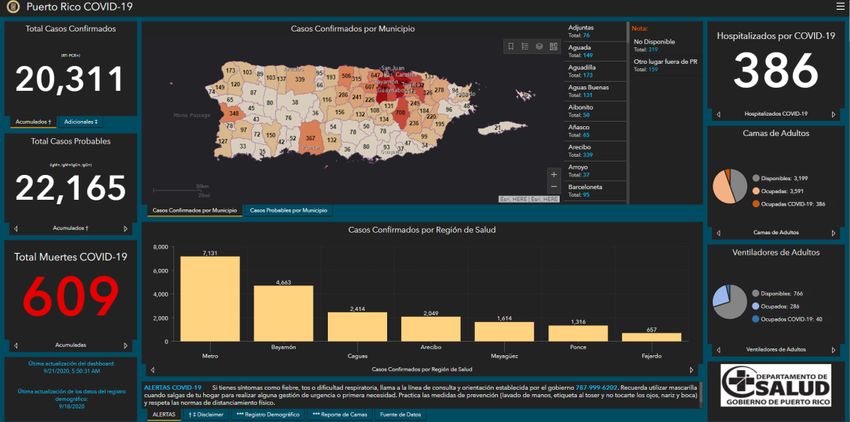
                                                              https://experience.arcgis.com/experience/852c30ea3baa48278
                                                              175c13c211728e0/
• March 2, 2020 first reported COVID-19 cases in the
  Caribbean Region

• March 13, 2020 first reported COVID-19 cases in Puerto
  Rico

• March 15, 2020 the Government of Puerto Rico
  established a lockdown order and strict social distancing
  measures
Project summary
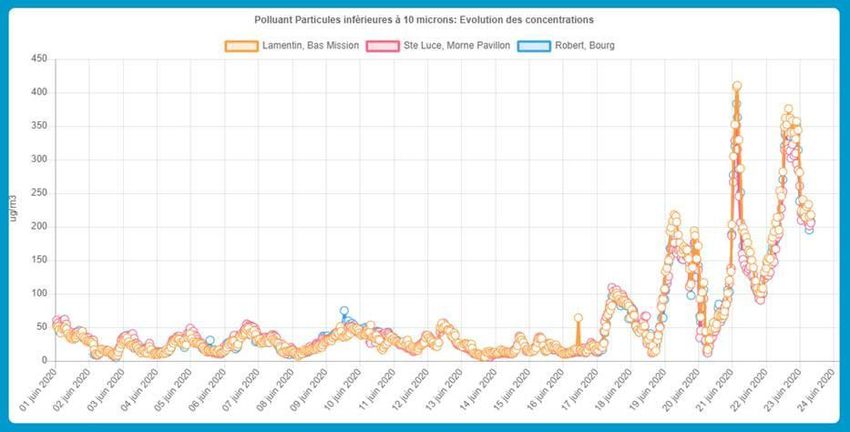
• The goal of the proposed work is     • We hypothesize that:
  to better understand interactions
  between COVID-19, Saharan dust,        • African Dust events contribute to
  and environmental factors (air           an excess number of COVID-19
  temperature, sea surface                 deaths in Puerto Rico.
  temperature, wind, precipitation)
  in Puerto Rico as a proxy for the      • African Dust events, interacting
  Caribbean Region, using state of         with COVID-19 cases, will affect
  the art Earth Observation Data and       morbidity and mortality in Puerto
  public health records.                   Rico.
Research Questions
• RQ1. Can African dust intrusion be
  considered a co-factor of COVID-19’s
  impact on risk of morbidity and
  mortality in Puerto Rico?

• RQ2. What are the main factors
  including, social determinants of
  health, that contribute to air quality
  and COVID-19 vulnerability?

• RQ3. How can climate, air quality, and
  COVID-19 information be translated
  into action to increase resiliency of
  our communities?
Risks of COVID-19 and Environmental Factors
Interactions:
• Microorganisms in airborne particulate      .
  matters (PM) or dust can be linked to
  infectious diseases

• Transmission via the inhalation of small,
  exhaled respiratory air droplets seems to
  be especially effective (Guangbo et al.,
  2020; Service, 2020). (March-2020)

• A question is whether the health impacts
  of an interaction between the seasonal
  African dust outbreaks that occur every
  year in the Caribbean between May and
  August will have significant impacts on
  health and mortality due to the 2020
  COVID-19 pandemic

Risks of COVID-19 and Environmental Factors
    Interactions:
• Public Health Approach: Two
                                     Satellite Sensors
                                     Sensor/Platform           Data Availability   Potential Use                                   Institution
                                                                                   Characterize the magnitude and variability of
                                     MODIS/Terra &             2000 – present
  interesting trends would be          Aqua                    2002 – present
                                                                                   aerosol and dust optical depth (AOD and
                                                                                   DOD).
                                                                                                                                   NASA

                                     CALIOP/CALIPSO            2006 – present      5-km atmospheric profiles to characterize       NASA
  whether the number of people                                                     vertical structure of dust and aerosol.

                                                               2012 – present
  getting tested spikes and/or the   VIIRS-SNPP

                                     Goddard Earth Observing   Up to 14-day
                                                                                   Aerosol / dust optical depth (AOD / DOD)

                                                                                   Modelled forecasts of atmospheric dust and
                                                                                                                                   NASA

                                                                                                                                   NASA

  number of positive cases spike.    System Model (GEOS-FP)
                                     SENTINEL 5-P
                                     (TROPOMI)
                                                               forecasts
                                                               2017 – present
                                                                                   aerosol loading
                                                                                   Aerosol / dust optical depth (AOD / DOD),
                                                                                   aerosol index (AI), Aerosol Layer Height
                                                                                                                                   ESA

• We will use short-term
                                                                                   (ALH)
                                     Copernicus Atmosphere     2017 – present      Data and forecasts of aerosol / dust optical    ESA
                                     Monitoring Service                            depth (AOD / DOD)

  measures of health data at the     (CAMS)

  community level in prospective     to evaluate the occurrence and magnitude of events, and the
                                     amplitude and period of relevant cycles including evaluating
  and retrospective studies of       any shift in phase between parameters.
  medical services.
                                     We will also explore the use of NOAA GOES-R and VIIRS data
                                     and ESA/Copernicus aerosol measurements.
Risks of COVID-19 and Environmental Factors
Interactions:
• Medical Records and Quantitative Analysis:             • Memorandums of Understanding with The
  After statistical analysis (GAM) integrating             Puerto Rico Association of Primary Health
  data from Earth observing satellites,                    Care Providers (ASPPR, Spanish acronym).
  environmental data, public health data and
  the afore-mentioned diagnoses, a better
  characterization of any associations found will        • ASPPR is a non-profit organization funded by
  be sought by examining health records.                   the US Department of Health and Human
                                                           Services (HHS) to support the Primary Health
                                                           Care Centers of Puerto Rico that are financed
• Specific variables will include:                         with funds from Section 330 of the Federal
    • severity of illness                                  Public Health Law.
    • specific type of illness, where applicable,
    • number of medications specific to the conditions
    • type of medications and degree of symptom          • These are composed by 22 organizations
      control                                              located in areas of high need of health
    • Adherence to treatment will also be examined         services and are distributed in 85 primary
                                                           care clinics across 67 municipalities of Puerto
                                                           Rico.
Work-plan
Gracias!

                Pablo Méndez-Lázaro PhD

            Environmental Health Department
            Graduate School of Public Health
               University of Puerto Rico

           Medical Sciences Campus

           pablo.mendez1@upr.edu
You can also read


