SUBJECT CHOICES SENIOR SCHOOL - MACKAY CHRISTIAN COLLEGE - Mackay ...
←
→
Page content transcription
If your browser does not render page correctly, please read the page content below
2021
       M A C K AY C H R I S T I A N C O L L E G E

       SENIOR SCHOOL

       SUBJECT
       CHOICES
         a place where you belong
CONTENTS
       A Message from the College Principal		 4
       Our Mission & Values		 5
       A Message from Head of Senior School		 6
2021   Senior Expectations		 7
       Thinking About My Options		 8

       Year 10 in 2021		9
       Our Values Subject: CLEAR		 10
       Year 10		 11
       Year 10 Subjects		 12
       21st Century Skills Framework		 17

       Year 11 General Subjects		18
       English		19
       General Mathematics		 20
       Mathematical Methods		 21
       Specialist Mathematics		 22
       Physics		23
       Chemistry		24
       Biology		25
       Agricultural Science		 26
       Legal Studies		 27
       Modern History		 28
       Geography		29
       Physical Education		 30
       Drama		31
       Music		32
       Film, TV & New Media		 33
       Design		34

P2
Year 11 & 12 Applied Subjects		35
Essential Mathematics		 36
Essential English		 37
Sport & Recreation		 38
Visual Arts in Practice		 39
Hospitality Practices		 40
Industrial Graphics Skills		 41
Early Childhood Studies		 42
Business Studies		 43
Building & Construction Skills		 44
Information and Communication Technology (ICT)   45
Certif icate II in Healt Support Services &
Community Services 					46
Certif icate III in Health Services Assistance   47

Vocational Learning Certificates		48
Trade Training Centre		 49
CPC10111 Cert I in Construction		 50
MEM20413 Cert II in Engineering Pathways		 51

Planning your future		52
Employability Skills Framework		 53

Appendix		54
1.1 MEM20413 Competencies		 55
HLT23215 & CHC22015 Competencies		 56
HLT33115 Competencies 		 57
Queensland Certificate of Education (QCE) 		 58
Australian Tertiary Admission Rank (ATAR) 		 60
HLTAID003 Course Outline 		 61
Make Your Decision 		 63

                                                      P3
A MESSAGE FROM THE

                                                         COLLEGE
                                                         PRINCIPAL
                                                         Welcome to Senior School at Mackay Christian
                                                         College. The subject selection process is an
                                                         opportunity for students to take control of what
                                                         they learn in the school context as well as being
                                                         an opportunity to prepare a future career path
                                                         and to hone skills and talents for the future. At
                                                         MCC we believe the best way to assist students
                                                         and parents is to provide as much information as
                                                         possible to allow students (and parents) to make
                                                         wise, informed decisions.

The information provided in this book is designed to help parents and students gather the information
they need to make the best decisions about what subjects to study to achieve their desired pathway.
No matter what subjects students choose and the pathway they pursue Mackay Christian College is
committed to help every student have the very best opportunity to ‘become all God wants them to be’.
We believe all children can learn.

The Queensland Certificate of Education (QCE) adds another dimension for the consideration of parents
and students when making subject choices. The QCE provides a certified qualification intended to give
potential employers a clearer indication of a student’s capabilities. It is not only important to think about
whether the prerequisites for university degrees have been covered, or whether you will even qualify for an
OP score, or eventually an ATAR, you must also give thought to what will meet the requirements for a QCE.
While every student who does any recognised Senior subjects will be issued with a Senior Statement, only
students who satisfy the requirements for a QCE will receive a QCE Certificate.

In this booklet we have included all of the information you need to make the best decision for your
future. However, if you are not sure of anything please ask the appropriate staff member. The choices you
make are very important. This process determines which subjects will be offered and it is important it is
completed on time. It is possible for students to make changes to their choices after the due date and at
the start of the new school year but this can only happen where the timetable and class numbers allow.

May God bless you as you prepare for the future.

Dr Barclie Gallogray
College Principal

P4
Vision Statement
Mackay Christian College exists to foster and develop the God
given potential of each member of the college community, both
students and staff, to permit them the possibility of fulfilling
their personal Christian destiny.

Mission
Statement
Mackay Christian College is a college community which consists
of students, parents and staff working together to develop each
child’s potential in a wide range of learning situations. Emphasis
is placed on positive, critical thinking skills and caring, respectful
attitudes.

We believe that the education process is a continuous one from
Pre-Prep to Year 12 and beyond and we are committed to the
education of the whole person - personally, socially, cognitively,
and spiritually. We believe that each member of the college
community is entitled to a safe, secure, welcoming and loving
environment to allow for the development of individual potential.

At Mackay Christian College we aim to provide a quality learning
environment within which students will be encouraged to
develop an ongoing personal revelation of Christ in their lives. We
recognise the significance of the example and witness of staff,
of a curriculum framework based on Biblical Christian thinking,
and of the standing of our college within our community. High
academic standards, good professional relationship, Godly
discipline and high levels of home-school communication with
families are all part of the college’s mission.

                                                                         P5
A MESSAGE FROM THE

HEAD OF SENIOR SCHOOL
Senior School at Mackay Christian College is about       Our goal continues to be to provide opportunity
growing students to meet the challenges of the           for students to build and demonstrate these skills
future. We remain focused on providing the best          through a variety of Senior schooling options
opportunities for young people to prepare for life,      and extra-curricular activities while maintaining
work and study beyond school.                            a strong focus on the core skills of English and
                                                         Mathematics supported by a cross curricular
We seek to bring a balance of support and                approach to mastering a range of IT Platforms.
challenge to equip students academically, socially
and emotionally to confidently face the challenges       As Head of Senior School I am excited to work
their individual pathways will provide as they seek      with the whole dedicated MCC team to bring all
to fulfil God’s plan for their lives.                    our effort to work with parents and families to
                                                         encourage students to test and stretch themselves
There is a lot of talk in education about 21st           to ‘Become all God wants them to be.’
Century Skills – critical thinking, creative thinking,
communication, collaboration and teamwork,               Looking forward to working with you.
personal and social skills, and, ICT skills. At Mackay
Christian College these things have for a long           Yours in Christ’s service,
time been part of our Vision of a Learner. For the
last 15 years we have been striving to support and       Peter Hopper
encourage students to become “self-directed;             Head of Senior School
strategic producers; responsive communicators;
creative reflective investigators; empathetic servant
leaders and resilient problem solvers.”

P6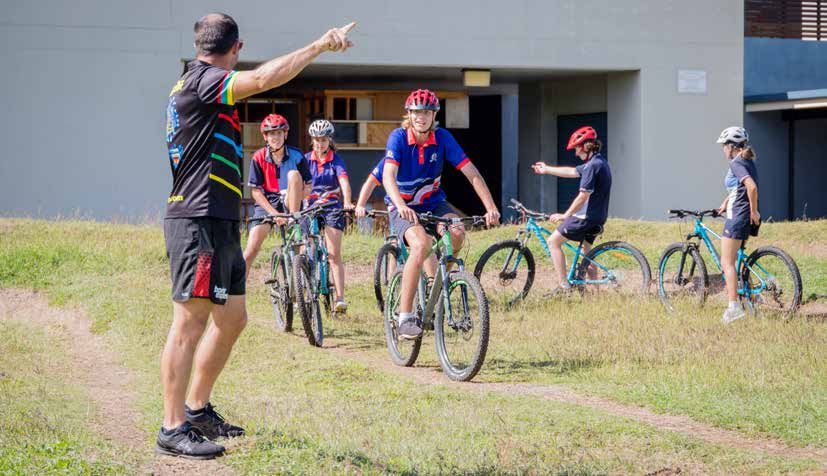
SENIOR
EXPECTATIONS
 The Senior years of school are exciting
     and students can expect many
 opportunities during these three years
 to further grow and develop their gifts
 and talents as leaders and role models
        in the college community.

Our staff desire to build relationships and foster this growth
into young adulthood through the classroom, camping &
sports programs, chapel, and extra curricular activities.

Students are taught study skills and are often given greater
independence in their learning activities.

With this greater independence also comes greater
responsibility, and a whole range of new expectations apply
to the students.

Homework: Senior students may be expected to do up to two
and a half hours of homework per night.

Independent Study: Students are encouraged to become
independent learners. This is a key skill which they will
need to develop both for tertiary education and to become
independent workers in the workplace. This is fostered by
the approach which we have adopted in the college whereby
the students are encouraged to assume the responsibility for
their own learning.

Skill Areas: Senior education is a place of acquisition of
new skills. For instance, Modern History and Geography
foster research and referencing skills whilst Biology and
Mathematical Methods focus on process skills. These areas
are indeed great challenges for the students.

Behaviour: A higher adult standard of behaviour and attitude
is expected from Year 10s, 11s and 12s, particularly since they
now become examples to members of the Middle and Junior
Schools. Any students who are not regularly submitting work,
not participating in class, or demonstrating a generally non-
cooperative attitude may be asked to justify their continued
enrolment in the college.
                                                                  P7
THINKING ABOUT MY OPTIONS
Question:                                                    TAFE Certificate.
Should I stay at school or leave?                            Students may wish to undertake a TAFE Certificate in
                                                             Year 11 and 12. This is possible through the Vocational
        I am aiming for... (tick one or more)                Education and Training in Schools (VETiS) Program
                                                             where students can study a certificate at TAFE one day
         Queensland Certificate of Education (QCE)           per week while continuing their studies at MCC. TAFE
         Australian Tertiary Admissions Rank (ATAR) 		       Certificates also add to the credits required for a student
                                                             to achieve a QCE. Some certificate costs are covered by
         and Tertiary Entrance
                                                             the Queensland Government’s VET Investment Budget
         TAFE Certificate
                                                             and some are full fee paying certificates. For more
         School Based Apprenticeship or Traineeship          information, please contact CQUniversity or visit their
         Full time Apprenticeship or Traineeship             website: www.cqu.edu.au.
         Continue at school until I get a job
                                                             School Based Apprenticeship or Traineeship (SAT).
The Queensland Certificate of Education (QCE) is             Students in Year 11 and 12 may start their apprenticeship
Queensland’s senior secondary school qualification           or traineeship while they are at school. A SAT will impact
issued to eligible students when they meet all the           on the student’s timetable as they generally are required
requirements, either at the completion of Year 12 or after   to attend paid work or training one day per week during
they have left school. To achieve a QCE, students must       school hours. Students and parents are required to sign
achieve the set amount of learning, at the set standard,     the necessary paperwork with a registered Apprenticeship
in a set pattern, while meeting the literacy and numeracy    Agency and enter into a training agreement with a
requirements. Students must achieve 20 credits from          Registered Training Organisation.
contributing courses of study, including Queensland
Curriculum Assessment Authority (QCAA) developed             Full time Apprenticeship or Traineeship.
subjects, Vocational Education and Training (VET)            Students may wish to leave school if they are offered a full
qualifications or other recognised studies.                  time apprenticeship or traineeship.

Refer to Appendix                                            Continue at school until I get a job.
                                                             The Youth Participation in Education and Training Act
For more information, please visit the QCAA website:         2003 which came into effect in 2006 states that students
https://www.qcaa.qld.edu.au/downloads/senior/snr_new_        must remain in school until they finish Year 10 or turn 16,
assess_te_qce_factsheet_requirements.pdf                     whichever comes first. Students who have completed
                                                             Year 10 or are 16 must stay in education and training for
Australian Tertiary Admissions Rank (ATAR) and               a further 2 years or until they have gained their QCE, a
Tertiary Entrance.                                           Certificate III in a vocational qualification, have turned
The ATAR replaced the Overall Position (OP) in 2020.         17 or are working a minimum of 25 hours per week.
Eligible students are awarded an ATAR between 0.00           Students need to be earning or learning.
and 99.95 with increments of 0.05. ATARs below 30 are
reported as ‘30.00 or less’. The ATAR is calculated by the   Please note: It is common for students to have part time
Queensland Tertiary Admissions Centre (QTAC) based on        jobs while they complete their senior studies. The Child
either:                                                      Employment Act 2006 states that during a school week,
                                                             a school-aged child can work a maximum of 12 hours per
a.      The student’s best five General                      week. During a non-school school week a school-aged
        (currently Authority) subject results OR             child can work a maximum of 38 hours per week. While
b.      The student’s best results in a combination 		       it is a positive experience for students to have a part time
        of four General subjects plus one Applied 		         job and earn money, it can impact on their senior studies,
        subject or Certificate III or above                  extra-curricular activities and family time. Balance and
                                                             time management are important. Senior studies are an
Eligibility for an ATAR requires satisfactory completion     investment of time in a student’s future.
of a QCAA English Subject (either English or Essential
English).                                                    Refer to Appendix

Refer to Appendix

P8
YEAR 10
IN 2021

          P9
OUR VALUES
      SUBJECT: CLEAR
      “Educating the mind without educating
          the heart is no education at all.”
                     - Aristotle -

      In Year 10 CLEAR, students explore their own interests, gifting
      and talents with a focus on setting goals, investigating career
      opportunities and pathways, and serving others. Embedded
      in the CLEAR program is the QCAA (Queensland Curriculum
      and Assessment Authority) Career Options short course.

      Students will earn 1 QCE (Queensland Certificate of Education)
      point upon achieving a C result or better upon completion of
      this course.

      During CLEAR students develop their own SET (Senior
      Education and Training) plan. This helps students to:

      •   structure their learning around your abilities, interests
          and ambitions
      •   think about their education, training and career options
          after Year 12
      •   set and achieve learning goals in Years 11 and 12, and
          beyond
      •   include flexible and coordinated pathway options in your
          course of senior study
      •   communicate with their parents/carers or teachers/
          careers counsellors about their post-school plans

      In CLEAR, students also examine social and ethical issues and
      engage in a service project. This is an opportunity for students
      to demonstrate empathy and respond in an appropriate and
      practical way to serve others.

P10
Year 10
Mackay Christian College is commited to preparing all students for pathways after school, and implementing
new learning opportunities created by the new system of Senior Schooling that commenced in 2019.
Year 10 will be a significant start to this phase of learning with an emphasis on the types and styles of
learning that will be required to ensure success.
Students entering Senior School, wanting to pursue a university pathway, will need to ensure they qualify
for an ATAR to gain entrance to a university course. As part of this preparation, students in Year 10 are
given an opportunity to experience subjects that are closely aligned with Senior syllabuses to ensure that
students are well equipped to make good choices for Year 11 and 12. Due to the nature of the new system it
is very likely that subject changes throughout this learning phase will be very limited and therefore good
choices at the start are essential.
P11YEAR 10 SUBJECTS ENGLISH Year 10 English is a full year course that integrates the related strands of language, literature and literacy. It builds on the concepts, skills and processes developed in earlier years through increasingly complex and sophisticated texts. It lays the foundation for the compulsory study of English in Year 11 and 12. Short Course in Literacy Literacy is a short course suited to students who are interested in pathways beyond school that lead to vocational education and/or work. A course of study in Literacy may establish a basis for further education and employment in the fields of trade, industry, business and community services. Students will learn within a practical context related to general employment and successful participation in society, drawing on the literacy used by various professional and industry groups. Students will earn 1 QCE (Queensland Certificate of Education) point upon achieving a C result or better upon completion of this course. MATHEMATICS Students will be placed in Mathematics classes based upon their Year 9 Maths results. Year 10 Maths courses are given the relevant preparatory name to match Senior syllabuses. The three preparatory courses are: • Prep Mathematical Methods • Prep General Mathematics • Prep Mathematics Students wishing to undertake Specialist Maths in Year 11 & 12 will need to undertake Prep Mathematical Methods and achieve well in this course. HUMANITIES Humanities enables students to develop the capacity to question, and think creatively whilst fostering their curiosity and imagination. Students will choose three Humanities courses from the four course options (Civics, History, Geography and Business). We will have 3 rotations throughout the year with each course being a third of the year in duration. These courses allow students to experience some of the elements and expectations of the Humanities courses (Legal Studies, Modern History, Geography and Business) offered in Year 11 & 12 and further develop the appropriate knowledge and skills bases necessary to be successful in these domains. P12
HEALTH &
PHYSICAL
EDUCATION
During the year, students can choose to take one or more Health and
Physical Education (HPE) subject from the following courses:

•   Health and Physical Education
•   Adventure Challenge

Year 10 Health and Physical Education provides students with the
opportunity to explore topics and physical activities that promote
health, participation and performance in physical activity. This subject
is designed to prepare students for Senior Physical Education.

ADVENTURE
CHALLENGE
Year 10 Adventure Challenge focuses on physical activities designed
to challenge students physiologically, behaviourally and socially in
diverse contexts and environments. It is expected that students will
participate in movement challenges (as individuals and in teams or
groups), recreational activities and navigational challenges in natural
and outdoor settings.

Access to specialised college facilities, equipment and relevant
teacher expertise will engage students in activities such as mountain
biking, trail running and kayaking.

HOME
ECONOMICS
Students will study the production, processing, consumption,
marketing of food, and the nature of food, human nutrition, through
a problem solving process. The focus of this specialist area is on the
wellbeing of individuals, families and communities. Students will
improve their cooking skills and increase their confidence in the
kitchen while preparing healthy nutritional meals.

Students considering studying Hospitality Practices as part of their
Senior pathways should consider this subject.

                                                                           P13
SCIENCE
Students will be placed in Year 10 Science classes based upon their
Year 9 Science results and intended career pathway.
Throughout the year, students will study different areas of Science in
3 rotation blocks. These are as follows:
Rotation A: Biology (Extension), Biology (Core),
General Science
Rotation B: Chemistry (Extension), Chemistry (Core),
General Science
Rotation C: Physics (Extension), Physics (Core),
General Science
The extension courses are designed to provide students with an
excellent foundation for the study of Senior Science subjects in Year
11 and 12.
BIOLOGY
Biology is the science about life. Students will learn about various
topics such as reproduction, genetics, diseases and global systems
such as weather and biodiversity. Students wanting to pursue a
career in health or primary teaching should consider Biology as one
of their choices.
CHEMISTRY
Chemistry looks at how things work and interact. In Year 10 students
will learn more about atomic structure and why this is important,
the periodic table, how and why chemicals interact and react, and
equations to solve real life problems. Students wanting to study any
science or have a career in health upon completing school should
consider Chemistry as one of their choices.
PHYSICS
Physics is the study of matter and energy. Students in Physics will
learn more about motion, forces & energy and could include topics
such as robotics or flights. Students wanting to pursue engineering
or science should consider Physics as one of their choices.
P14VISUAL ARTS
Visual Arts explores a range of 2D, 3D and digital media in the
development of minor and major works. Students will gain knowledge
and understanding by analysing, interpreting and responding to
concepts in artworks. They also learn about and use knowledge, skills,
techniques, processes, materials and technologies to explore art
practices and make artworks that communicate ideas and intentions.
This subject will prepare students to undertake Visual Art in Practice
or Design subjects in Year 11 and 12.
MULTIMEDIA
Multimedia seeks to encourage and challenge students to be
resilient problem solvers and creative, reflective producers of digital
media content. This subject aims to bring together many digital
technologies available to us, to investigate real world applications of
digital and print media through the problem-solving process.
Students participating in this subject will focus on the following
areas: Graphic Design and Design Principles, Gaming and Interactive
Media, Digital Storytelling in different forms, Photography, Image
Manipulation, and Video and Audio production skills.
DRAMA
Drama is an exciting course that develops students’ performance and
theoretical skills and gives students opportunities to explore their role
within an ensemble and to study the stages of technical production.
Students will study performance expression and design elements
within a variety of artistic styles. Students will have an opportunity to
explore the expressive capacity of their voice and physical movement
to create dramatic meaning for an audience. This course will prepare
students for the study of Drama in Year 11 & 12.
MUSIC
Students will have the opportunity to develop their skills in
performance, composition and their understanding of music
elements in preparation for music in Year 11 & 12.
This is achieved through exploring a variety of music styles and
techniques, focussing on the music of Australia. This course also
allows students the opportunity to develop their potential in their
preferred area of musical expertise when performing and composing.
P15INDUSTRIAL TECHNOLOGY Students will use and test their imagination in Industrial Technology. This subject provides the opportunity to create solutions through design using Computer Aided Drafting (CAD) and Computer Aided Manufacturing (CAM) and then utilise a range of materials, tools, machines and processes to produce quality outcomes. Students undertaking this course may be considering the Trade Training Centre as part of their Senior Learning Pathway. Woodwork • In Woodwork, students work on traditional furnishing projects Students gain a good understanding of woodworking joints and Computer Aided Drawing. Metalwork • In Metalwork, students work on a toolbox project and learn about sheet metal fabrication and the importance of accuracy and detail in creating plans and drawings. DESIGN TECHNOLOGY Students will design, fabricate and test ideas that use new technology. They will use the knowledge and skills to create model vehicles for the F1 in the Schools Technology challenge and see what it takes to succeed in these industries. Students use Computer Aided Manufacturing (CAM) and learn the fundamentals of hydraulics and electronics. Students will create and design robots that are scaled versions of robots capable of performing complex tasks. Students also have the opportunity to create and participate in a catapult challenge. They will learn about coding a pocket sized computer to control a motor and lights, then add electronic circuits for bling. Design Technology will prepere students to undertake the study of Design in Year 11 & 12 and also supports learning in Physics AGRICULTURE Students will investigate solutions to feeding a growing population in the classroom and learn practical, transferable skills in the agriculture centre at school. This subject provides the opportunity for students to experience animal husbandry with goats, horses, cattle and chickens. Agriculture in Year 10 will prepare students for Senior Agriculture Science. Agriculture will support learning in Science, Maths and other practical subjects. Students may choose Agriculture due to interest or if they are pursuing a career in the agricultural, science, environmental or animal sector. P16
21ST CENTURY
SKILLS FRAMEWORK

                      - Analytical thinking
                      - Problem solving
                      - Decision making
  Critical Thinking   - Reasoning
                      - Reflecting and evaluating
                      - Intellectual flexibility

                      - Innovation
                      - Initiative and enterprise
                      - Curiosity and imagination
 Creative Thinking    - Creativity
                      - Generating and applying new ideas
                      - Identifying alternatives
                      - Seeing and making new links

                      - Effective oral and written communication
  Communication       - Using language, symbols and texts
                      - Communicating ideas effectively with diverse audiences

                      - Relating to others (interacting with others)
  Collaboration &     - Recognising and using diverse perspectives
    Teamwork          - Participating and contributing
                      - Community connections

                      - Adaptability/flexibility
                      - Management (self, career, time, planning and organising)
  Personal & Social   - Character (resilience, mindfulness, open and fair-mindedness,
                        self-awareness
       Skills         - Leadership
                      - Citizenship
                      - Cultural awareness

                      - Operations and concepts
                      - Accessing and analysing information
      ICT Skills      - Being productive users of technology
                      - Digital citizenship

                                                                                        P17
YEAR 11 & 12 GENERAL SUBJECTS P18
ENGLISH

The subject English focuses on the study of both literary   •     Empathy for others and appreciation of different
texts and non-literary texts, developing students as              perspectives through studying a range of literary and
independent, innovative and creative learners and                 non-literary texts from diverse cultures and periods,
thinkers who appreciate the aesthetic use of language,            including Australian texts by Aboriginal writers and/
analyse perspectives and evidence, and challenge ideas            or Torres Strait Islander writers.
and interpretations through the analysis and creation of
varied texts.                                               A course of study in English promotes open-mindedness,
                                                            imagination, critical awareness and intellectual flexibility
Students have opportunities to engage with language
and texts through a range of teaching and learning          These skills prepare students for local and global
experiences to foster:                                      citizenship, and for lifelong learning across a wide range
•  Skills to communicate effectively in Standard            of contexts.
   Australian English for the purposes of responding to
   and creating literary texts and nonliterary texts
•  Skills to make choices about generic structures,
   language, textual features and technologies for
   participating actively in literary analysis and the
                                                                Career Opportunities:
   creation of texts in a range of modes, mediums and
                                                                • Writing
   forms, for a variety of purposes and audiences
                                                                • Journalism
•  Enjoyment & appreciation of literary and non-literary
                                                                • Librarian
   texts for the aesthetic use of language & style
                                                                • Marketing
•  Creative thinking and imagination, by exploring how
                                                                • Law
   literary and non-literary texts shape perceptions of
                                                                • Social Work
   the world and enable us to enter the worlds of others
                                                                • Travel
•  Critical exploration of ways in which literary and
                                                                • Public Relations
   non-literary texts may reflect or challenge social and
                                                                • Film & Television
   cultural ways of thinking and influence audiences

                                                                                                                   P19
MATHEMATICAL
METHODS
Students who undertake Mathematical Methods will Mathematical Methods is a General subject suited to
see the connections between mathematics and other students who are interested in pathways beyond school
areas of the curriculum and apply their mathematical that lead to tertiary studies, vocational education or work.
skills to real-world problems, becoming critical thinkers,
innovators and problem-solvers. Through solving Students who study Mathematical Methods in Year
problems and developing models, they will appreciate 11 should have achieved at least a C standard in Prep
that mathematics and statistics are dynamic tools that Mathematical Methods in Year 10. To be successful in
are critically important in the 21st century. Mathematical Methods, students will need to consistently
work hard over the duration of the course.
The major domains of mathematics in Mathematical
Methods are:
• Algebra
• Functions, relations and their graphs
• Calculus
• Statistics
Career Opportunities:
• Natural and physical sciences, especially
Topics are developed systematically, with increasing levels
of sophistication, complexity and connection, and build physics and chemistry
on algebra, functions and their graphs, and probability • Mathematics and science education
from the P–10 Australian Curriculum. Calculus is essential • Medical and health sciences including human
for developing an understanding of the physical world. biology, biomedical science, nanoscience and
The domain Statistics is used to describe and analyse forensics
phenomena involving uncertainty and variation. Both • Engineering including chemical, civil, electrical
are the basis for developing effective models of the and mechanical engineering
world and solving complex and abstract mathematical • Avionics, communications and mining
problems. The ability to translate written, numerical, • Computer science including electronics and
algebraic, symbolic and graphical information from one
software design
representation to another is a vital part of learning in
• Psychology and business
Mathematical Methods.
P20GENERAL
MATHEMATICS
General Mathematics is designed for students who want
to extend their mathematical skills beyond Year 10 but
whose future studies or employment pathways do not
require calculus. It incorporates a practical approach that
equips learners for their needs as future citizens.
Students in Year 11 and 12 study:
• Money, measurement and relation
• Applied trigonometry, algebra, matrices and
univariate data
• Bivariate data, sequences and change, and Earth
geometry
• Investing and networking
Students develop their ability to do the following:
• Investigate patterns, order, generality and Career Pathways
uncertainty
• Explore problems and solve through observation, • Business, e.g., trades, nursing, tourism and
reflection and logical reasoning hospitality
• Use critical and creative thinking • Commerce, e.g., administrative roles
• Use a concise system of communication, with • Education
written, symbolic, spoken and visual components • Finance
• Take initiative and promote curiosity in an • IT
increasingly complex and data-driven world • Social science
• The creative industries
P21SPECIALIST
MATHEMATICS
Students study this subject through the Brisbane School Students will develop the ability to do the following:
of Distance Education (BSDE) with the assistance of a
MCC Teacher/Mentor. Regular submission of work is • Solve abstract and real life problems by applying
required. It is a consistent and demanding workload but knowledge and understanding to new and
there are substantial rewards for those students who are unfamiliar situations
prepared to embrace this challenge. • Use technology to perform mathematical
procedures accurately and efficiently
In Year 11 & 12, students study: • Communicate mathematical understanding in a
range of formats
• Combinations, vectors and proof
• Complex numbers, trigonometry, functions and Students who study Specialist Mathematics in Year 11
matrices should have achieved at least a C+ standard in Prep
• Mathematical induction and further vectors, Mathematical Methods in Year 10.
matrices and complex numbers
• Further calculus and statistical inference
Career Opportunities:
• Engineering
• Aviation
• Medicine and Health Sciences
• Education
• Mathematician
• Computer Science
• Economics
P22PHYSICS
Physics provides opportunities for students to engage • Understanding of the ways in which models and
with the classical and modern understandings of the theories are refined, and new models and theories
universe. are developed in physics
• How physics knowledge is used in a wide range of
In Year 11 and 12, students learn about: contexts and informs personal, local and global issues
• Investigative skills, including the design and conduct
• Fundamental concepts of thermodynamics, of investigations to explore phenomena and solve
electricity and nuclear processes problems, the collection and analysis of qualitative
• Concepts and theories that predict and describe and quantitative data, and the interpretation of
the linear motion of objects. They will explore how evidence
scientists explain some phenomena using an • Ability to use accurate and precise measurement,
understanding of waves valid and reliable evidence, and skepticism and
• The concept of gravitational and electromagnetic intellectual rigour to evaluate claims
fields, and the relevant forces associated with them • Ability to communicate physics understanding,
• Modern physics theories and models that, despite findings, arguments and conclusions using
being counterintuitive, are fundamental to our appropriate representations, modes and genres
understanding of many common observable
phenomena
Physics aims to develop students’: Career Opportunities:
• Appreciation of the wonder of physics and the • Accelerator Operator
• Applications Engineer
significant contribution physics has made to
• Data Analyst
contemporary society
• Design Engineer
• Understanding that diverse natural phenomena may
• Physics Teacher
be explained, analysed and predicted using concepts,
• IT Consultant
models and theories that provide a reliable basis for • Lab Technician
action • Laser Engineer/Optical Engineer
• Understanding of the ways in which matter and • Research Associate
energy interact in physical systems across a range of • IT Developer/Systems Analyst
scales
P23CHEMISTRY
Chemistry is the study of materials and their properties
and structure.
Students in Year 11 & 12 study:
• Atomic theory, chemical bonding and the structure
and properties of elements and compounds
• Intermolecular forces, gases, aqueous solutions,
acidity and rates of reaction
• Equilibrium processes and redox reactions
• Organic chemistry, synthesis and design
Studying Chemistry will develop student’s ability to do
the following:
• Describe and explain chemistry concepts and
phenomena
• Conduct investigations, and to collect and analyse
data, and interpret evidence
• Critically evaluate arguments and claims in order to Career Opportunities:
solve problems and generate informed, responsible
and ethical conclusions • Research, forensic or environmental scientist
• Communicate chemical understanding and findings • Engineering
to a range of audiences • Health Science - medicine, pharmacy, allied
health
• Education
• Veterinary Science
P24BIOLOGY
Biology provides opportunities for students to engage and how biological knowledge influences society in
with living systems. local, regional and global contexts
• Ability to plan and carry out fieldwork, laboratory
In Year 11 and 12, students: and other research investigations, including the
collection and analysis of qualitative and quantitative
• Develop their understanding of cells and multicellular data and the interpretation of evidence
organisms • Ability to use sound, evidence-based arguments
• Engage with the concept of maintaining the internal creatively and analytically when evaluating claims
environment and applying biological knowledge
• Study biodiversity and the interconnectedness of life • Ability to communicate biological understanding,
• Concepts of heredity and the continuity of life findings, arguments and conclusions using
appropriate representations, modes and genres.
Biology aims to develop students’:
• Sense of wonder and curiosity about life
• Respect for all living things and the environment
• Understanding of how biological systems interact Career Opportunities
and are interrelated, the flow of matter and energy
through and between these systems, and the • Life Scientist
processes by which they persist and change • Anatomist
• Understanding of major biological concepts, theories • Physiologist
and models related to biological systems at all scales, • Biochemist
from subcellular processes to ecosystem dynamics • Biotechnologist
• Appreciation of how biological knowledge has • Botanist
developed over time and continues to develop, how • Marine Biologist
scientists use biology in a wide range of applications, • Microbiologist
• Zoologist
P25AGRICULTURAL
SCIENCE
Australian and global agriculture is calling for more • Understanding that Agricultural Science knowledge
enthusiastic young scientists who are passionate about is used in a variety of contexts and is influenced by
farming and the people who do it. Agricultural Science social, economic, cultural and ethical considerations
is a subject choice that enables students to be part • Ability to conduct a variety of field, research and
of improving how we working agriculture. It will suit laboratory investigations involving collection and
students who are interested in doing a highly practical analysis of qualitative and quantitative data, and
senior science subject as it provides a solid foundation of interpretation of evidence
practical skills and knowledge that will support students • Ability to critically evaluate Agricultural Science
in various career paths. concepts, interpretations, claims and conclusions,
with reference to evidence
In Year 11 and 12, students explores: • Ability to communicate understandings and
justify findings and conclusions related to
• Crop and animal production agricultural production systems, using appropriate
• Agri-business representations, modes and genres.
• Innovation in agriculture
• The environmental sector
• Physical resource management.
Career Opportunities
Agricultural Science aims to develop students’:
• Agronomist
• Interest in Agricultural Science and their appreciation
• Environmental Scientist
of how interdisciplinary knowledge can be used to
• Veterinary Science
understand contemporary issues in food and fibre
production • Farm Manager
• Understanding and appreciation of agriculture as a • Conservation
complex and innovative system, and how it relates to • Agribusiness Professional
sustainable production decisions now and into the • Horticulture
future • Fisheries and Aquaculture
• Education
P26LEGAL STUDIES
Legal Studies focuses on enhancing students An understanding of legal processes and concepts enables
understanding of the interaction between society and citizens to be better informed and able to constructively
the discipline of law. Students study the legal system and question and contribute to the improvement of laws and
how it regulates activities and aims to protect the rights legal processes. This is important as the law is dynamic
of individuals, while balancing these with obligations and evolving, based on values, customs and norms
and responsibilities. The primary skills of inquiry, critical that are challenged by technology, society and global
thinking, problem-solving and reasoning empower Legal influences.
Studies students to make informed and ethical decisions
and recommendations. These are critical skills that allow
students to think strategically in the 21st century.
In Year 11 and 12, students study:
• Legal foundations, the criminal investigation Career Opportunities
process, criminal trial process and punishment and
sentencing Legal Studies is invaluable in helping students prepare
for tertiary study and opens doors to employment in
• Civil law foundations, contractual obligations,
such diverse areas as:
negligence and duty of care
• Governance in Australia and law reform within a • Law Firms
dynamic society • Police Service
• Human rights, the effectiveness of international law, • Government Organisations
• Court System
and human rights in an Australian context
• Journalism
• Social Planning
• Social Welfare
• Criminology
• Justice Studies
• Politics
P27MODERN HISTORY
“The more you know about the past, the better prepared Modern History benefits students as it enables them to
you are for the future”- Theodore Roosevelt thrive in a dynamic, globalised and knowledge-based
world. Through Modern History, students acquire an
Modern History at Mackay Christian College has two intellectual toolkit consisting of 21st Century skills.
main aims:
This ensures students of Modern History gain a range
• First, Modern History seeks to have students gain of transferable skills that will help them forge their own
historical knowledge and understanding about pathways to personal and professional success, as well
some of the main forces that have contributed to the as become empathetic and critically-literate citizens
development of the Modern World; who are equipped to embrace a multicultural, pluralistic,
• Second, Modern History aims to have students think inclusive, democratic, compassionate and sustainable
historically and form a historical consciousness in future.
relation to these same forces.
Both aims complement and build on the learning
covered in the Australian Curriculum: 7–10 History. The
first aim is achieved through the thematic organisation
Career Opportunities:
of Modern History around four of the forces that have • Historian / Museum Attendant
helped to shape the Modern World: ideas, movements, • Museum attendant
national experiences and international experiences. • Librarian
• Law clerk
The second aim is achieved through the rigorous • Writer
application of historical concepts and historical skills • Parliamentarian
across the syllabus. To fulfil both aims, Modern History • Tour guide
uses a model of inquiry learning. • Teacher
• Journalist
• Business / Economist
P28GEOGRAPHY
In Geography, students engage in a range of learning
experiences that develop their geographical skills
and thinking through the exploration of geographical
challenges and their effects on people, places and
the environment. Students are exposed to a variety
of contemporary problems and challenges affecting
people and places across the globe, at a range of scales.
These challenges include responding to risk in hazard
zones, planning sustainable places, managing land cover
transformations and planning for population change.
This course of study enables students to appreciate
and promote a more sustainable way of life. Through Career Opportunities:
analysing and applying geographical knowledge,
students develop an understanding of the complexities • Urban and environmental design
involved in sustainable planning and management • Planning and management
practices. Geography aims to encourage students to • Biological and environmental science
become informed and adaptable so they develop the skills • Conservation and land management
required to interpret global concerns and make genuine • Emergency response and hazard management
and creative contributions to society. It contributes to • Oceanography
their development as global citizens who recognise the • Surveying
challenges of sustainability and the implications for their • Global security
own and others’ lives. • Economics
• Business, law
Students will learn skills acquired through understanding • Engineering
and using spatial technologies. • Architecture
• Information technology, and science
P29PHYSICAL
EDUCATION
The knowledge, understanding and skills taught
through Physical Education enable students to explore
and enhance their own and others’ health and physical
activity in diverse and changing contexts
In Year 11 and 12, students study:
• Motor Learning, functional anatomy and
biomechanics integrated with volleyball and track &
field
• Sport psychology, equity and golf
• Tactical awareness integrated with touch football
and ethics & integrity
• Energy, fitness and training integrated with
triathlon
Students in Physical Education learn through an inquiry
Career Opportunities:
approach that explicitly involves the integration of body
and movement concepts with biophysical, sociocultural
• Exercise science
and psychological concepts and principles to enable the
• Biomechanics
development of a physically educated student.
• Psychology
• Teaching
• Sport journalism
• Sport marketing and management
• Sport promotion
• Sport development and coaching
P30DRAMA
Drama is an exciting course that develops students’
performance and theoretical skills. It gives students
opportunities to explore their role within an ensemble
and study the design elements of technical production.
Students engage in learning experiences that develop
the 21st Century skills of critical and creative thinking, Career Opportunities
communication, collaboration and teamwork.
• Arts administration and management, e.g. artist
manager, arts administrator, booking agent,
In Year 11 and 12, students study:
copyright/royalties manager, tour manager, venue
manager, events and festivals manager/producer,
• How drama promotes shared understanding of the
arts and cultural advisor/administrator
human experience • Communication, e.g. writer, communication
• How drama is shaped to reflect the lived experience strategist, arts editor, blogger/vlogger
• How to use drama to challenge our understanding • Creative industries, e.g. professional performer,
of humanity actor, director, dramaturge, independent artist,
• How to transform dramatic practice artistic director, costume designer, producer,
rehearsal director, theatre technician, stage
Drama engages students in creative meaning-making manager, dialect coach, radio presenter
processes and involves them using a range of artistic skills • Education, e.g. educator in schools, corporate,
as they make and respond to dramatic works. They study private studios, community, universities and
professional drama company education programs
a range of forms, styles and their conventions in a variety
• Public relations, e.g. campaign manager, publicist,
of inherited traditions, current practice and emerging
creative director
trends. Students will have an opportunity to explore the
• Research, e.g. researcher and academic, journalist/
expressive capacity of their voice and physical movement critic
to create dramatic meaning for an audience. • Science and technology, e.g. drama health
professional with further specialised training in
areas of medicine, health, therapy.
P31MUSIC
Music is a unique art form that uses sound and silence It is particularly beneficial for students in senior years
as a means of personal expression. It allows for the to have proficiency in an instrument or voice and basic
expression of the intellect, imagination and emotion, and theory knowledge and understanding.
the exploration of values.
In Year 11 and 12, students study:
• Designs: understanding of the different ways music
Career Opportunities:
can be designed to communicate meaning
• Identities: exploration of the ways music can express • Arts administration and management, e.g. artist
cultural, social and political identities on both a global manager, arts administrator, booking agent,
scale and local context copyright/royalties manager, music accountant,
• Innovations: exploration of innovative practices in orchestra manager, production music manager,
music both pre and post 1950 record producer, studio manager, tour manager,
• Narratives: understanding of the ways music can venue manager
effectively communicate a story and evoke an • Communication, e.g. music copyist, music editor,
emotional response in an audience music librarian, print music manager, sound
archivist
Studying Music will enable students to do the following: • Education, e.g. arts educator, instrumental
teacher, studio teacher, university music
• Develop musicianship through the making of music academic
• Creative industries, e.g. backing musician,
(composition and performance) and responding to
composer, conductor, creative entrepreneur,
music (musicology)
instrument repairer, music director, performer,
• Resolve and realise music ideas to convey meaning presenter, recording engineer, repetiteur, stage
and/or emotion to an audience manager
• Critically evaluate music through the synthesis of • Public relations, e.g. creative director, music
analytical information to justify a viewpoint lawyer, music merchandiser
• Develop the capacity for working independently and • Science and technology, e.g. music therapist,
collaboratively and for flexible thinking and doing music video clip director, new media artist,
producer, programmer, sound designer
P32FILM, TV &
NEW MEDIA
Film, Television & New Media uses an inquiry learning
model, developing critical thinking skills and creative
capabilities through the exploration of five key concepts
that operate in the contexts of production and use. The
key concepts of technologies, representations, audiences,
institutions and languages are drawn from a range of
contemporary media theories and practices. Students
will creatively apply Film, Television and New Media
key concepts to individually and collaboratively make
moving-image media products, and will investigate and
respond to moving-image media content and production
contexts.
In Year 11 and 12, students will:
Career Opportunities:
• Develop knowledge and skills in creative thinking,
communication, collaboration, planning, critical • Advertising, art director, brand specialist and
analysis and digital and ethical citizenship graphic artist
• Develop the necessary critical and creative skills • Film and Television, storyboard artist, producer
and camera operator
to reflect on and appreciate Australian and global
• Public Relations, publicist, creative director and
cultures and make sense of what they see and
campaign manager
experience, providing highly transferrable flexible
• Creative industries eg. animator, photographer,
thinking and communication skills. game developer and screenwriter
• Education
• Writer, journalist, blogger/vlogger and web
content designer
• Graphic designer, set designer or stage designer
P33DESIGN
The Design subject focuses on the application of design In studying Design, students will learn about:
thinking to envisage creative products, services and
environments in response to human needs, wants and • Design in practice
opportunities. Designing is a complex and sophisticated • commercial design
form of problem-solving that uses divergent and • Human-centred design
convergent thinking strategies that can be practised and • Sustainable design
improved. Designers are separated from the constraints
of production processes to allow them to appreciate and
exploit new innovative ideas.
Students will develop valuable 21st Century skills in critical
thinking, creative thinking, communication, collaboration
and teamwork, personal and social skills, and information
& communication technology (ICT) skills. Collaboration,
teamwork and communication are crucial skills needed
to work in design teams and liaise with stakeholders. The
design thinking students learn is broadly applicable to
a range of professions and equips students with highly
Career Opportunities:
transferrable, future-focused thinking skills relevant to a
global context.
• Architecture
• Digital Media Design
• Fashion Design
• Graphic Design
• Industrial Design
• Interior Design
• Landscape Architecture
P34YEAR
11 & 12
APPLIED
SUBJECTS
P35ESSENTIAL
MATHEMATICS
Students undertaking this subject, will further develop It also contains statistic topics that will equip students
21st Century skills as critical and creative thinkers, for the ever-increasing demands of the information age
innovators and problem-solvers in an ever-changing equipping them with knowledge & applying formulae to
world. spreadsheets for efficiency.
They develop their ability to take initiative and promote General Mathematics is designed for students who want
curiosity in an increasingly complex and datadriven world. to extend their mathematical skills beyond Year 10 but
Learning reinforces prior knowledge and continues to whose future studies or employment pathways do not
develop key mathematical ideas, including: require calculus. It incorporates a practical approach
• rates and percentages that equips learners for their needs as future citizens,
• concepts from financial mathematics preparing them for tertiary studies, vocational education
• linear and non-linear expressions or work in a complex and rapidly changing world.
• sequences
• the use of matrices and networks to model and solve Emphasis is placed on the mastery of content, ensuring
authentic problems key concepts or procedures are learnt fully. This assists
• the use of trigonometry to find solutions to practical students to make connections between related concepts
problems and adapt what they already know to new and unfamiliar
• the exploration of real-world phenomena in statistics. situations.
Topics are developed systematically, with increasing
levels of complexity and connection as skills in patterns,
order and generality and uncertainty are investigated.
Problems are explored and solved through observation, Career Opportunities:
reflection and logical reasoning using a concise
communication system involving written, symbolic, • Cashier
spoken and visual components.
• Data entry clerk
A real-life application of the finance topic assists students • Sales assistant
to become literate consumers of investments, loans & • Importer and Exporter
superannuation products at varying complexities. • Bank officer
P36ESSENTIAL
ENGLISH
The subject Essential English develops and refines • Creative and imaginative thinking to explore their
students’ understanding of language, literature and own world and the worlds of others
literacy to enable them to interact confidently and • Active and critical interaction with a range of texts,
effectively with others in everyday, community and social and an awareness of how the language they engage
contexts. The subject encourages students to recognise with positions them and others
language and texts as relevant in their lives now and in • Empathy for others and appreciation of different
the future and enables them to understand, accept or perspectives through a study of a range of texts
challenge the values and attitudes in these texts. from diverse cultures, including Australian texts by
Aboriginal and/or Torres Strait Islander writers
Students have opportunities to engage with language • Enjoyment of contemporary literary and non-literary
and texts through a range of teaching and learning texts, including digital texts.
experiences to foster:
• Skills to communicate confidently and effectively
in Standard Australian English in a variety of
contemporary contexts and social situations,
including everyday social, community, further
education and work-related contexts
• Skills to choose generic structures, language,
language features and technologies to best convey
Career Opportunities:
meaning
• Skills to read for meaning and purpose, and to use, • Administration assistant
critique and appreciate a range of contemporary • Education aide
literary and non-literary texts • Writer
• Effective use of language to produce texts for a • Law clerk
variety of purposes and audiences • Transcription typist
• Tour guide
P37You can also read


