Tūranganui a Kiwa Gisborne Community of Learning - Three Communities, Many Pathways - Education.govt.nz
←
→
Page content transcription
If your browser does not render page correctly, please read the page content below
Tūranganui a Kiwa

Gisborne Community of Learning

  Taha Whanau Kāhui Ako ID: 99083

                       Poverty Bay First to see the light.

     Three Communities,
       Many Pathways
                                                             1
Taha Whanau Kāhui Ako

Contents

Introduction ........................................................................................................................................... 3
Our vision................................................................................................................................................ 3
Our Aspirations ...................................................................................................................................... 5
The Data informing our Achievement Challenges ............................................................................... 7
   Student demographic and achievement data .................................................................................. 8
Taha Whanau Achievement Challenges ............................................................................................. 10
Our Approach to achieving agreed targets ........................................................................................ 13
   Introduction ..................................................................................................................................... 13
   Collaborative Impact........................................................................................................................ 13
   Evaluation and evaluative capability............................................................................................... 15
   Professional learning ....................................................................................................................... 16
   Monitoring and reporting................................................................................................................ 16
Our Organisation and Structure .......................................................................................................... 17
Appendices ........................................................................................................................................... 18
Appendix 1: Demographic data for Tūranganui-a-Kiwa (Gisborne) Kāhui Ako................................. 19
Appendix 2: Provisional school leaver data ........................................................................................ 20
Appendix 3: Resource Teacher Learning and Behaviour (RTLB) Referral Data ............................... 21
Appendix 4: Taha Whanau Primary School Target percentages and number of students to shift in
order to meet targets, by school (2016 – 2020) ................................................................................. 23
Appendix 5: Taha Whanau Lytton High School Student Achievement data and proposed targets25

                                                                                                                                                          2
Taha Whanau Kāhui Ako
Introduction
Although this Achievement Challenge document is focused on the Taha Whanau Kāhui Ako, or
Community of Learning, the Tūranganui-A-Kiwa Kāhui Ako is made up of three Communities of
Learning – Taha Tinana, Taha Hinengaro and Taha Whanau - working as ONE collective to address
the achievement of learners, initially across the Gisborne region’s primary, intermediate, and
secondary schools, and over time including the early childhood and tertiary sectors.
The content of this document includes the collective Tūranganui-A-Kiwa Kāhui Ako vision,
aspirations, approach to improvement, and our organisation and structure. More explicitly,
however, it also includes the student demographic and achievement data for the Taha Whanau
Kāhui Ako, and the targets that have been agreed by the schools in the community of learning as
a focus for improvement. Similar documents have been produced and are available for Taha
Hinengaro and Taha Tinana.
Our vision
Our agreed vision is:
Mā te ako ngātahi, ka tūtuki ngātahi
Learning together, achieving together
We collectively understand that learning as a collaborative experience is dynamic and
diverse with opportunities for growth and challenge.
We have agreed to encounter one another with aroha, manaaki and awhina.
We expect to work as individuals learning from others and helping them too.
Each is expected to bring opportunity to tautoko others and build pathways for learning, achieving
for purposeful lifelong work. This is us, Tūranganui A Kiwa learners!
Ko te ako ngātahi he mea akiaki, he mea rerenga kē kia whai wā hei tipu, hei rea, hei takitū.
Kia tūtaki tātou ka meatia te aroha, te manaakitanga me te āwhina, tētahi ki tētahi.
Mā ia o tātou e kawe ngā mahi kia whai hua rātou me mātou anō ra hoki.
Mā tēnā e tautoko i tēnā kia para tōtika te huarahi mo ngā mahi akoranga kia tūtuki ngā
koronga.
“Ko mātou ēnā, ngā akonga o Tūranga-Nui-a-Kiwa.”
3Taha Whanau Kāhui Ako
We believe that: all students can learn to their full potential; student learning will be enhanced by
national, global and multicultural perspectives; graduates will possess the knowledge and skills
that will assure their proficiency in literacy, numeracy, problem solving and digital technologies.
They will be responsible citizens, lifelong learners and will be prepared for expanding their life
horizons, thereby contributing to a better global society.
Within our Kāhui Ako we are committed to exploring what it means for us as educators – within
schools, between schools, and between schools and our communities of learners, their families
and the wider community - to work collaboratively to collect and use evidence to plan, activate
agreed plans, and to monitor and evaluate the outcomes and impact of a collective efficacy on
learner progress and achievement.
In our Kāhui Ako, coherence of practices and transitions within and across schools are more
important to us than ever before. So too is a readiness to recognise the strengths that our
communities can offer as partners who take a shared responsibility for accelerating all learners’
progress and achievement.
Together we are determined to be stronger and in doing so, to have a greater impact on the
outcomes of all learners.
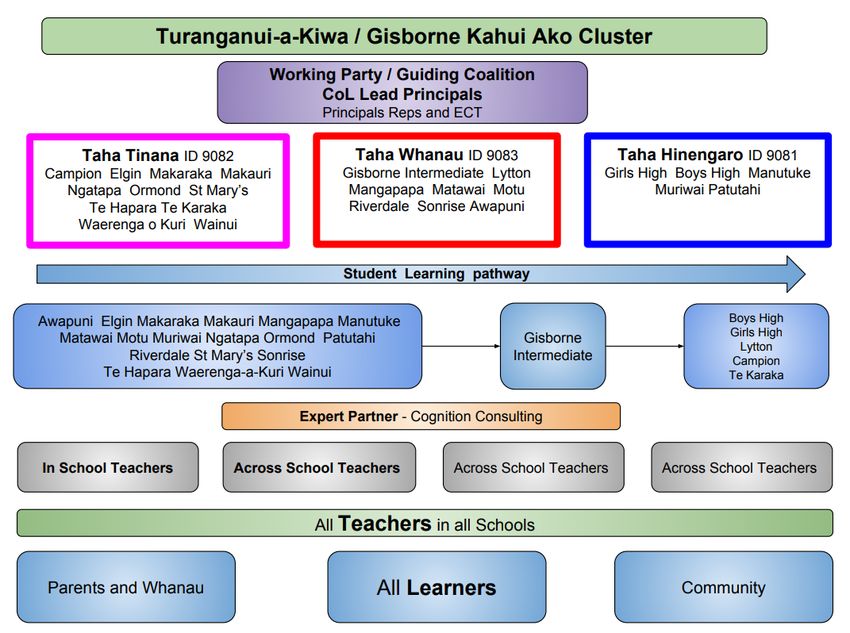
The following profile (Figure 1) of our Kāhui Ako has been designed by the collective to represent
who we are:
Figure 1: Tūranganui a Kiwa Kāhui Ako Profile
4Taha Whanau Kāhui Ako
Our Aspirations
Collaboratively, our schools and boards of trustees’ leaders’, have defined our aspirations for
working collectively as comprising four key elements:
The mindframes1 that will underpin our growing capabilities or collective efficacy
Our organisational and human capabilities that we will seek to further develop
The essential professional learning we will seek to provide within, between and across
the Kāhui Ako
The evidence we will collect to demonstrate progress towards the outcomes we are
seeking to achieve.
1
For a definition and explanation of mindframes please refer to: Hattie, j. Visible Learning for Teachers.
Routledge, 2012, pgs. 149-170.
5Taha Whanau Kāhui Ako
These are clarified in Figure 2:
•We will work collaboratively and
•We will aspire to develop positive collectively to develop:
relationships based on trust •a coherent aspiration and vision,
•We will value inclusivity and the •a collective knowledge and
voices of all stakeholders - familes, understanding of the theory and
the community, students, teacher and practice of what works for all
leaders learners
•We will value ourselves as change •the personal qualities and
agents, engage in dialogue and not competencies of our students,
monologue, and focused on talk teachers and school leaders
about learning
•a collective commitment to
•We will collect and activate evidence activating our learning and
as feedback to our selves and to improving our practice.
inform our learning, progress and
outcomes
•We will embrace challenge and Mindframes Capabilities
engage students in the challenges of
learning
•We seek to develop a common
language of learning across the
Kāhui Ako.
Professional
Outcomes
Learning
•We will value the collection and use •We will seek to synergise our learning
of evidence to inform planning, and develop a common pathway of
learning and assessment of learning within and across our
progress, outcomes and impact schools
•We will seek to improve all students •We will focus on our learning
life chances to support an improved relationships between our leaders,
and stronger community teachers, students, and famuilies
•We will set targets for excellence •We will transform our schools
and equity for all learners. curriculum, and approaches to
pedagogy
•We will take the opportunities of
sharing effective practice and valuing
external expertise where we have
unmet needs.
Figure 2: Tūranganui a Kiwa Kāhui Ako Cluster Aspirations
To activate our aspirations, we have agreed to:
“Learn together and take responsibility for developing trust focused on excellence and
equity”
“Develop a thriving community where our students can excel to their full potential
contributing to a healthy society”
“Collectively take responsibility for, and share expertise to achieve improved student
outcomes and a stronger community”
“Further develop relational trust, a common voice, and collaboration to transform attitudes,
assessment and pedagogy to improve achievement and outcomes with equity”
6Taha Whanau Kāhui Ako
“Collectively support a common pathway of learning priorities focused on success for all
learners and teachers across our region”
“Focus is on learning with, from, and for each other”
“Seek to improve life chances of ALL students through a collective responsibility”
“Collaborate to build a high achieving inclusive community”.
The Data informing our Achievement Challenges
The Tūranganui a Kiwa Kāhui Ako Cluster has identified four data sets that will be required to
assist us in the processes of:
agreeing our successes, challenges and targets related to student achievement
identifying and agreeing the likely causes and opportunities- mindframes and capability -
associated with achieving excellence and equity for all learners
analysing and identifying the professional learning, and its impact, already underway in
schools and across the collective – a precursor for making decisions on what to build on,
what to discontinue, and to identify any gaps in the current provision
better understanding the collective knowledge, understanding, capability and activation of
high quality and reliable evidence to determine, needs and to monitor, and assess outcomes
and impact.
The following figure (Figure 3) provides an overview of the data we have collected, and are in the
process of refining, to deepen our knowledge and understanding of our Achievement Challenges,
mindframes and capability, professional learning needs, and the evaluation methods that will be
required to assess our progress and impact:
Student demographics and
achievement data
Collective aspirations,
challenges, targets, learning
and evaluation plans
Mindframes School and Collective School and collective
professional learning assessment/evaluation
Stakeholder Capability commitments capability
Figure 3: Tūranganui a Kiwa Kāhui Ako Data Requirements
7Taha Whanau Kāhui Ako
As at the time of submitting this Achievement Challenges document, the Kāhui Ako has collected
and analysed – individual schools and the collective - our demographic and achievement data,
and baseline mindframes. Capability assessments have been undertaken of a representative
sample of 12 schools and the work to complete an aggregate report of our collective Kāhui Ako
capability will be completed prior to the end of term three. In term four 2017 processes are being
established to:
Collate our professional learning needs – individual schools and the collective – and current
commitments
Design a robust evaluation programme to assess our progress and impact towards
mindframes and capability goals, as well as our progress towards achievement targets.
Student demographic and achievement data
Student/school demographic and achievement data (Appendices 1, 2, and 3) for the Tūranganui-
A-Kiwa Kāhui Ako has been used by the collective of three Kāhui Ako to clarify the overall
performance and trends across Gisborne.
Points we have noted from the data are:
Māori and Pasifika National Achievement data is a significant issue. Within these groupings,
we have also identified gender differences.
Students’ requiring additional learning and behaviour support represent a significant number
of our students. The RTLB referral data gives a glimpse of gender differences for those
students with serious learning, behaviour or transition challenges and year level differences
which is valuable information to deepen our understanding about student readiness for
learning at school.
The following tables provide board of trustees and principal initial responses to three key
questions posed at a leadership symposium facilitated in May 2017:
1. Where does the data indicate that we are successful?
2. Where does the data indicate we need to improve?
3. What are our suggested targets as a collective?
Table 1: Where does the regional data indicate that we are successful?
Level or type Gender Ethnicity Clarification
of Education
Early Years Participation and attendance
Māori Medium Female Not Identified 80.0% of students attending Kura are
achieving expectations in reading
Primary and Female Not Identified Girls overall stay longer and are more
Secondary successful than boys.
Schooling
Primary/middle Reading Not Identified 73.2% of all students are achieving
Schooling successfully
8Taha Whanau Kāhui Ako
Writing Not Identified 67.2% of all students are achieving
successfully
75.8% of Year 1 students are achieving
expectations
Mathematics Not Identified 69.6% of all students are achieving
successfully
80.7% of Year 1 students are achieving
expectations
NCEA Male and Not identified Equitable outcomes
Female Students that stay longer in school are
achieving at a higher level
Both 18-year-old Male and Female student
achievement is close to the Government
goals
Not identified 90.1% of students qualify at NCEA Level 1
Table 2: Where does the regional data indicate we need to improve?
Level or type Gender Ethnicity Clarification
of Education
Overall Not Not Identified The collective data has worsened between
Identified 2012 and 2016
Primary/middle Not Pacific Students Pasific Students are not performing as well
Schooling Identified as other ethnicities in National Standards
Not Not Identified Year 8 students are achieving below
Identified expectations
Males Not Identified Male reading is down 4% in the last five years
(Years 1-8)
Males and Māori Māori are not meeting expectations in
Females reading, writing and mathematics (Years 1-8)
Reading is down 1% in the last five years
Writing has increased 1% in the past five years
(Years 1-8)
Males Not Identified Males are not staying at school for as long as
Females (Ys 1-8)
Māori The cohort is 12% below Pākeha Females in
reading
The cohort is between 13% and 20% below
Pākeha Females in writing
NCEA Males and Not Identified Male: 35% of male student leavers
Females achieve NCEA Level 3 compared with 39%
for all leavers in the COL and 53% of all
leavers nationally.
9Taha Whanau Kāhui Ako
67% of student leavers who are Maori
achieve NCEA Level 2 and 29% achieve
NCEA Level 3 compared with 75% of all
students in the COL achieving NCEA Level
2 and 39% achieving level 3. 79% of all
student leavers achieve NCEA Level 2
nationally.
Table 3: Our suggested targets for improvement
Overall Changed community, whanau attitudes to education
To engage all students so they want to learn
To exceed National Goals
No students falling through the gaps
To improve all students’ achievement – across all levels/types of schooling
and across all ethnicities
Every child can read, write and achieve at mathematics
Share exemplars of excellence across the collective
Meet Government and Ministry targets
Behaviour Reduce the percentage of Māori Male referrals to RTLB
NCEA Improve percentage of students achieving NCEA Level 2 & NCEA Level 3
Following a May symposium, attended by all three Kāhui Ako, Principals and Board of Trustees
members, the Lead Principals held further discussion with instructional leaders of two Year O to
6 schools, (Awapuni Decile 3, 75% Māori and Te Hapara Decile 2, 70% Māori) representative of the
Kāhui Ako deciles and ethnicities, and providing for 600 students.
Analysis of those discussions highlights two hunches.
Hunch 1: There are large differences in boys’ achievement at all levels. This trend matches a
national trend so an assumption can be made this persists across all Kāhui Ako
schools. Variability among boys is larger than that of girls. National data also shows large
variability among boys and among girls. This National data on how the genders learn is not
related to attributes of being a boy or a girl but might vary in this region. The effect size between
boys and girls is 0.15 in favour of boys (Hattie p 90). What is different about our Kāhui Ako data?
Hunch 2: There is evidence that Years 3 & 4 cohorts hit barriers to learning that impact on further
learning and achievement. What are the issues here?
Taha Whanau Achievement Challenges
Based on the collective discussions, the Tūranganui-A-Kiwa Kāhui Ako Lead Principals have
subsequently worked with the Taha Whanau Kāhui Ako schools to further clarify the current
positioning of the schools, and to agree on explicit targets for the focus of professional learning
within the wider collective.
Six achievement challenges are proposed:
Table 4: Our Achievement Challenges
ACHIEVEMENT WRITING
10Taha Whanau Kāhui Ako
CHALLENGE 1 In 2016, there were 1,643 students that completed the national standard for writing in our
community of learning. 1,037 (63%) of students were at or above the national standard for
writing.
By 2020, we propose to increase the percentage of students achieving the national standard
to 81% (1,331 out of 1,643 students). To meet this target, we will need to shift 294 students
(assuming the same number of total students).
948 of the students in 2016 were Māori, and 540 (57%) were at or above the national
standard. We aim to shift 190 Māori students by 2020, so that 77% (730 out of 948)
are achieving the national standard.
838 of the students in 2016 were boys, and 443 (53%) were at or above the national
standard. We aim to shift 169 male students by 2020, so that 73% (612 out of 838) are
achieving the national standard.
ACHIEVEMENT READING
CHALLENGE 2 In 2016, there were 1,643 students that completed the national standard for reading in our
community of learning. 1,186 (72%) of students were at or above the national standard for
reading.
By 2020, we propose to increase the percentage of students achieving the national standard
to 82% (1,348 out of 1,643 students). To meet this target, we will need to shift 162 students
(assuming the same number of total students).
948 of the students in 2016 were Māori, and 623 (66%) were at or above the national
standard. We aim to shift 145 Māori students by 2020, so that 81% (768 out of 948)
are achieving the national standard.
838 of the students in 2016 were boys, and 555 (66%) were at or above the national
standard. We aim to shift 124 male students by 2020, so that 81% (679 out of 838) are
achieving the national standard.
ACHIEVEMENT MATHS
CHALLENGE 3 In 2016, there were 1,642 students that completed the national standard for maths in our
community of learning. 1,089 (66%) of students were at or above the national standard for
mathematics.
By 2020, we propose to increase the percentage of students achieving the national standard
to 81% (1,330 out of 1,642 students). To meet this target, we will need to shift 241 students
(assuming the same number of total students).
948 of the students in 2016 were Māori, and 567 (60%) were at or above the national
standard. We aim to shift 191 Māori students by 2020, so that 80% (758 out of 948)
are achieving the national standard.
838 of the students in 2016 were boys, and 546 (65%) were at or above the national
standard. We aim to shift 133 male students by 2020, so that 81% (679 out of 838) are
achieving the national standard.
ACHIEVEMENT NCEA LEVEL 2
CHALLENGE 4 Of the 195 students in our community of learning that left school in 2016 (no matter what
age,) 115 or 59% left with NCEA Level 2.
11Taha Whanau Kāhui Ako
By 2020, we propose to increase the percentage of school leavers with NCEA Level 2 to 75%
(147 out of 195 students, a shift of 32 students). Of these students 113 will be Māori school
leavers (an increase of 27 students), 80 will be female school leavers (an increase of 19
students) and 67 will be male school leavers (an increase of 13 students).
ACHIEVEMENT NCEA LEVEL 3 AND TERTIARY
CHALLENGE 5 Of the 195 students in our community of learning that left school in 2016 (no matter what
age,) 40 or 21% left with NCEA Level 3.
By 2020, we propose to increase the percentage of school leavers with NCEA Level 3 to 40%
(78 out of 195 students, a shift of 38 students). Of these students 60 will be Māori school
leavers (an increase of 34 students), 43 will be female school leavers (an increase of 16
students) and 36 will be male school leavers (an increase of 23 students).
ACHIEVEMENT PROGRESS OF STUDENTS REQUIRING LEARNING SUPPORT
CHALLENGE 6 RTLB REFERRAL DATA
RTLB referrals identify a deeper trend with students not ready for learning as an outcome of
behaviour issues. It is assumed that these students are at-risk of underachieving.
RTLB referrals show a significant gender difference with 72.5% being male. When matched to
the high Māori referrals it can be inferred that Māori boys are a significant group of
concern. Referrals peak at Years 3, 4 & 5 drops off then peaks marginally in Year 9.
RTLB REASONS FOR REFERRALS
Learning: 78 students- 22.9%. Behaviour: 19 students- 5.6%. Transition:
2 students: 0.6%
Learning & Behaviour: 84 students- 24.7%
Learning, Behaviour & Transition: 141 students - 41.5%
ETHNICITIES OF REFERRALS
NZ European: 39 students- 18% Maori: 169 students- 77.9% Pasifika:
2 students- 0.9%
NUMBER OF REFERRALS by GENDER
Male: 153 students- 72.5% Female: 58 students- 27.5%
Our Target
By 2019 referrals will reflect a reducing trend for Years 3 to 5 Maori Boy
Appendix 4 provides the specific data and targets for the primary schools making up the Kāhui
Ako.
Appendix 5 provides the specific data and targets for Lytton High School. Lytton High School has
further clarified their data and targets in the school Charter and Annual Plan.
12Taha Whanau Kāhui Ako
Our Approach to achieving agreed targets
Introduction
Over three years the learning and improvement programme to be developed collaboratively with
the three Kāhui Ako participants will be expected to contribute to Gisborne, Tūranganui a Kiwa,
and New Zealand’s long-term knowledge capital and performance through teaching and
leadership learning, skills and values development, technology adaption, and institutional and
methodological innovation that will ultimately contribute to our regional and country’s economic
strength.
We propose a programme design that will:
address our agreed targets
be significant in scale and impact
build on and spread identified strengths whilst also overcoming identified specific problems
and addressing evidence proven current needs
create future opportunity for learners and the region
be supported by high quality and reliable evidence and analysis
represent the characteristics from quality research of successful and enduring school
improvement
reflect high quality management and governance
be inclusive of realistic and achievable short, medium and longer term targets focused on
achieving Government goals.
In the design process, we will seek alignment with the Government, IES Communities of Learning
(Kāhui Ako) strategy, maximising the value of Government resourcing and support, with
participating schools’ contributions, and contributions from regional business and community
sectors such as the Eastland Community Trust.
Collaborative Impact
Having attended and participated in Cognition Education Limited (Cognition) Collaborative
Impact Symposium in February 2017, it is our intention to activate the research proven, evidence-
informed, wrap-around framework for educational improvement that was presented and
discussed at the Symposium, that allows all stakeholders to actively collaborate. It works to grow
local capability and collective efficacy, equipping participating education systems and providers
with the knowledge and skills necessary to maximise all student’s progress and achievement.
Our Collaborative Impact Programme (CIP) will be informed by the work of Professor John Hattie
(Visible Learning), Emeritus Professor Russell Bishop (Relationships-based Learning), and other
credible international researchers, who have a deep understanding of what it takes to accelerate
student progress and achievement. It will also be informed by the stakeholders in our students’
lives who have expectations about valued outcomes.
Core to our collaborative impact will be ‘The Learning System’, which engages the commitment
of all key stakeholders within our educational ecosystem and its constituent organisations, from
teachers, to learners, to parents. In a continuous cycle, collectivism and sharing will determine
13Taha Whanau Kāhui Ako
the pathway as stakeholders move through the steps of assessment of needs, scoping, initiation,
implementation, monitoring, assessment of impact, and reporting.
Figure 4: The Collaborative Impact Programme: Learning System Source: Cognition Education
Our learning system will reflect the research that shows that the stronger a relationship is
between a learner and their educator, the greater the impact is on their progress and
achievement. We understand the relationships between all influencers on learners have been
proven by reputable international research, to amplify these gains. (Source Cognition Education,
Hattie, Bishop)
An overall programme, and local leadership and effectiveness teams or Guiding Coalition2,
comprising representatives from each stakeholder groups, has been established to clarify the
learning needs of the students and educators within the Kāhui Ako, to develop a shared vision,
determine expected outcomes and targets, oversee professional learning design and ongoing
evaluation.
Within school and across school facilitators will be recruited, coached and mentored to spread
and embed new practices and improved outcomes as well as lead professional learning and
evaluation programmes/methods to ensure sustainability over time.
Our Tūranganui a Kiwa Kāhui Ako will take all key stakeholders on a journey of 3-5 years of
iterative impact cycles. Global evidence shows it takes 5 years to successfully transfer the
capability required to deliver and sustain learner gains.
2
Currently referred to as the Kāhui Ako Steering Group
14Taha Whanau Kāhui Ako
1. Capability Assessment
Assessment of network
and school capability.
6. Impact Assessment 2. Scoping
Network and schools Goals and targets,
review of the impact on Professional learning and
student learning. evaluation design
5. Monitoring and 3. Initiation
reporting Clarification of individual
Data on inputs, outputs school needs and
and outcomes collected establishment of agreed
and reported plans
4. Implementation
Network, school plans
implemented
Figure 5: The Collaborative Impact Programme Impact Cycle
Each impact cycle will comprise six iterative steps: capability assessment, scoping, initiation,
implementation, monitoring and reporting, and impact assessment. Impact cycles will be
designed to be unique to Tūranganui a Kiwa Cluster learning system needs, as we seek to grow
local capability, enabling our Kāhui Ako participants and communities to lead their own learning.
Evaluation and evaluative capability
The evidence we have, and are, collecting on mindframes and school capability will assist us to
determine baseline beliefs/values and capability for learner and learning organisations success.
Mid and long term indicators of impact will also be identified. Over the duration of each
programme, we will support all stakeholders to develop the evaluative capability to select, use
and analyse robust tools and methods to analyse progress and impact for, and of, each impact
cycle.
The tools and methods the Kāhui Ako are expecting to include:
Support for analysing school assessment readiness, the acceleration of learner progress
and achievement, and the excellence achieved
The mindframes survey tool to assess the changes/improvement of attitudes, beliefs and
mindframes of instructional leaders and teachers
A survey tool to assess student beliefs
15Taha Whanau Kāhui Ako
A focus group tool to collect the ‘voices’ of students, families, teachers and leaders
related to the learning experiences of students within the education system, and what
can be introduced to improve those experiences
The school capability assessment tool to assess the changes/improvement of school
capability
Classroom observation tools to support the identification of teaching needs, growth in
teaching capability, and the impact of teaching on the learning of students.
Professional learning
A range of professional learning options and responses will be introduced as needed and agreed
to support the learning system vision and values, knowledge and understanding, personal
qualities and professional practice. Each intervention will be designed to address collective Kāhui
Ako needs, as well as the needs of individual educational providers and the people within those
organisations.
These will include learning support to ensure:
high quality instructional leadership throughout each of the participating organisations and
across the participant learning systems
learning contexts reflect the voices of students, their families, and the research proven
relationships that maximise the progress and achievement of Māori, marginalised and all
learners
pedagogical qualities and practices in classrooms are aligned with the research proven
strategies that also maximise progress and achievement
access to Ministry of Education resourcing through the national professional development
pool for continued curriculum expertise growth.
Monitoring and reporting
Concurrent with the introduction of Step 3 (Initiation) and Step 4 (Implementation) the Guiding
Coalition will put in place formal processes for monitoring and reporting on the learning
programme implemented. Regular monitoring will allow for:
systematic review of the implementation of planned learning activities
examination of progress towards the achievement of aspirations, vision and our agreed
targets
identification of any opportunities that may be emerging that will hasten the achievement
of aspirations, vision and targets
checking to identify any challenges that may delay or minimise the achievement of
aspirations vision and targets
opportunity to adapt and amend the Kāhui Ako professional learning and evaluation plans,
within an impact cycle and between impact cycles, to support achievement of short-term,
medium-term and longer-term aspirations, vision and targets.
16Taha Whanau Kāhui Ako
Our Organisation and Structure
Kāhui Ako Guiding Coalition
Lead Principals x 3
Advice
Feedback Support
Evaluation Professional
External Learning Taha Tinana Taha Whanau Taha Hinengaro
experts and experts and
Kāhui Ako Kāhui Ako
network network
leader leader
Lead Principal Lead Principal Lead Principal
Within and Within and Within and
between school between school between school
facilitators facilitators facilitators
Programme Advisory Up to 8 schools
Up to 11 schools Up to 7 schools
Team Advice and other
and other and other
and learning learning
learning
o Expert Partners support providers each
providers each providers each
o Professor John Hattie with a with a
with a
o Professor Russell Stewardship Stewardship
Stewardship
Bishop Group (SG) Group (SG)
Group (SG)
o Ministry of Education
Professional Professional Professional
representation
learning – face to learning – face to learning – face to
o Eastland Community
Evaluation face and online face and online face and online
Trust
data
o Iwi representatives Needs analysis Needs analysis Needs analysis
and evaluation and evaluation and evaluation
Figure 5: Operations structure
Internal Expertise
Internal expertise has been provisionally identified and will be dedicated to undertaking PLD as
needs emerge. Examples of internal expertise includes Lead Principals, possible Across & Within
School Leaders, Middle Leaders and Guiding Coalition Members. Our commitment includes the
use of identified local capability wherever possible and appropriate to the needs of the Kāhui Ako
plans, strategies, goals and actions.
External expertise will be engaged as needed to expand and deepen local expertise, and to co-
lead and lead independently further iterations of the evaluative methods. We expect to reduce
17Taha Whanau Kāhui Ako
dependence, and increase our interdependence over time to ensure sustainability of the Kāhui
Ako model. The accredited providers engaged will be asked to commit to growing local capability
to lead future Kāhui Ako PLD.
External expertise is engaged in these processes which undertake to expand and deepen local
expertise to co-lead and lead independently further iterations of the evaluative methods – to
reduce dependence, increase interdependence, and ensure sustainability of the Kāhui Ako
model. The accredited providers engaged will be asked to commit to growing local capability to
lead future Kāhui Ako PLD.
Appendices
Appendix 1 Demographic Data for Tūranganui-a-Kiwa (Gisborne) Kāhui Ako Cluster
Appendix 2 Provisional Secondary School Leaver Data: Tūranganui-a-Kiwa (Gisborne)
Kāhui Ako
Appendix 3 RTLB Referral Data: Transitions, Learning and Behaviour
Appendix 4 Taha Whanau Primary School Level Student Achievement Data and
proposed targets
Appendix 5 Taha Whanau Lytton High School Student Achievement Data and
proposed targets
18Taha Whanau Kāhui Ako
Appendix 1: Demographic data for Tūranganui-a-Kiwa (Gisborne) Kāhui Ako
School Details Total Roll Gender Total Roll by Ethnicity (Level 1 & Prioritised)
ID No. School Name School Type Decile Entitlement staffing (1 July 2016) Male Female Maori Pasifika Asian MELAA Other Euro IFP
2544 Awapuni School Contributing 3 12.9 287 152 135 202 4 7 0 1 73 0
211 Campion College Secondary (Yr 7-15) 6 34.6 515 253 262 141 13 27 4 0 330 0
2550 Cobham School Contributing 1 2.5 42 26 16 35 3 0 0 0 4 0
2555 Elgin School Contributing 1 2.6 73 38 35 70 3 0 0 0 0 0
209 Gisborne Boys' High School Secondary (Yr 9-15) 3 49.4 824 824 0 534 29 7 4 11 230 9
210 Gisborne Girls' High School Secondary (Yr 9-15) 3 49.4 706 6 700 406 21 12 1 2 260 4
2566 Gisborne Intermediate Intermediate 4 27.3 599 299 300 309 16 12 3 1 258 0
208 Lytton High School Secondary (Yr 9-15) 3 42.4 714 345 369 546 11 3 5 4 145 0
2593 Makaraka School Contributing 5 5.9 119 64 55 45 0 2 0 0 72 0
2595 Makauri School Contributing 8 8.3 174 90 84 27 0 7 0 1 139 0
2597 Mangapapa School Contributing 5 22.2 523 255 268 248 4 13 8 0 250 0
2602 Manutuke School Full Primary 3 6.6 115 55 60 113 0 0 0 0 2 0
2611 Matawai School Full Primary 5 2.7 59 31 28 24 0 0 0 0 35 0
2616 Motu School Full Primary 6 1.3 15 11 4 6 0 0 0 2 7 0
2617 Muriwai School Full Primary 1 2.5 36 18 18 34 0 0 0 0 2 0
2621 Ngatapa School Full Primary 5 1.3 13 8 5 8 0 0 0 0 5 0
2631 Ormond School Contributing 7 4.8 89 50 39 40 0 1 0 0 48 0
2643 Patutahi School Full Primary 1 1.3 21 11 10 13 0 0 0 6 2 0
2664 Rere School Full Primary 8 2.3 23 13 10 7 0 0 0 0 16 0
2667 Riverdale School Contributing 1 8.3 176 91 85 167 1 0 0 0 8 0
1149 Sonrise Christian School Composite (Yr 1-15) 5 5.1 78 46 32 41 2 2 0 0 33 0
2680 St Mary's Catholic School Contributing 5 9.6 196 87 109 62 13 31 6 0 84 0
2692 Te Hapara School Contributing 2 15.7 342 173 169 246 24 9 2 0 61 0
624 Te Karaka Area School Composite (Yr 1-15) 2 12.1 138 60 78 132 0 0 0 0 6 0
2712 Waerenga-O-Kuri School Full Primary 8 2.5 35 18 17 4 0 0 0 2 29 0
2721 Wainui Beach School Contributing 7 10.8 235 120 115 79 0 9 7 5 135 0
Appendices 2-5 have been redacted
19You can also read


