Tamil Nadu-National TB Elimination Program - Best Practices followed during the COVID 19 Pandemic - Tamil Nadu-National Tb Elimination Program ...
←
→
Page content transcription
If your browser does not render page correctly, please read the page content below
Tamil Nadu- National Tb Elimination Program

Tamil Nadu- National TB Elimination Program

     Best Practices followed during the
            COVID 19 Pandemic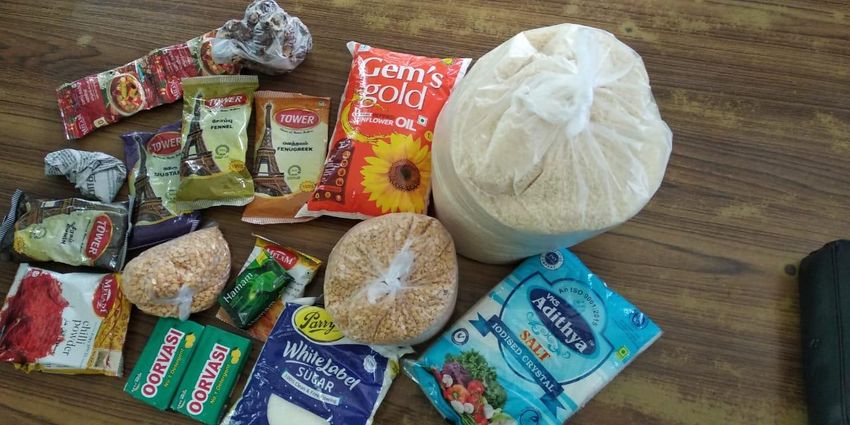
Tamil Nadu- National Tb Elimination Program

 Amidst the following measures taken in Tamil Nadu for COVID 19
Pandemic , that includes geographic quarantine, social distancing
measures, enhanced active surveillance, testing all suspected cases,
isolation of cases, home quarantine of contacts, advocacy and social
mobilization to follow preventive public health measures, Tuberculosis
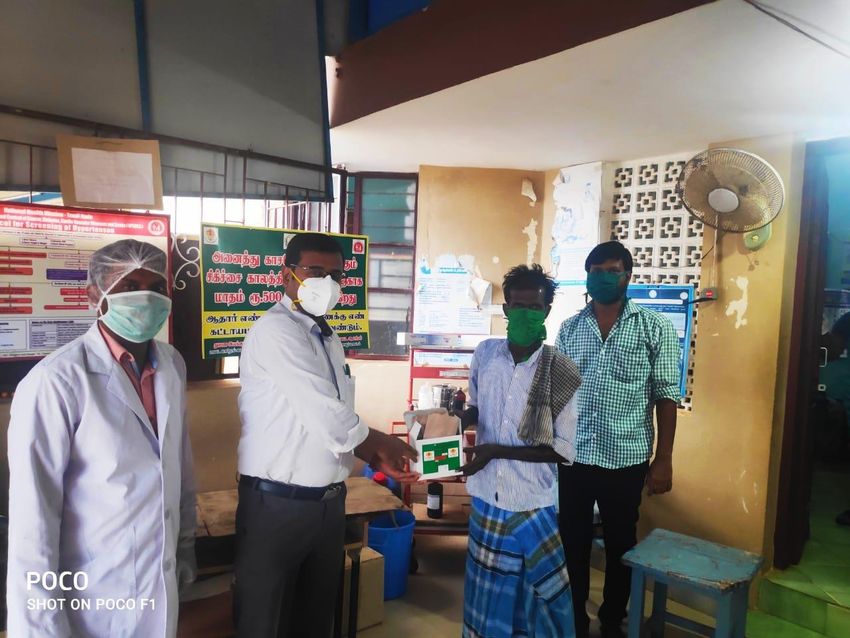
patients were supplied with 2 months course of ATT to tide over the lock
down period.
     Therefore, with foresight, all efforts were maximized for addressing
any potential bottlenecks and maintaining standards. The following
measures were taken to ensure receipt of full course of ATT for 2 months.

  1. Circular was issued on 26/03/2020 on ATT distribution at the
     doorstep of TB patients.
  2. In accordance with the directives from the Central TB Division,
     MoHFW, distribution of drug to all patients was initiated.
  3. Regular reviews at the state levels to discuss the achievements,
     challenges and good practices were conducted.
  4. Protocols for district level telephonic monitoring of NTEP service
     delivery, with a special focus on drug availability with patients, were
     developed at the state level. Districts were instructed to contact a
     specified number of patients and interview them telephonically
     based on a structured questionnaire.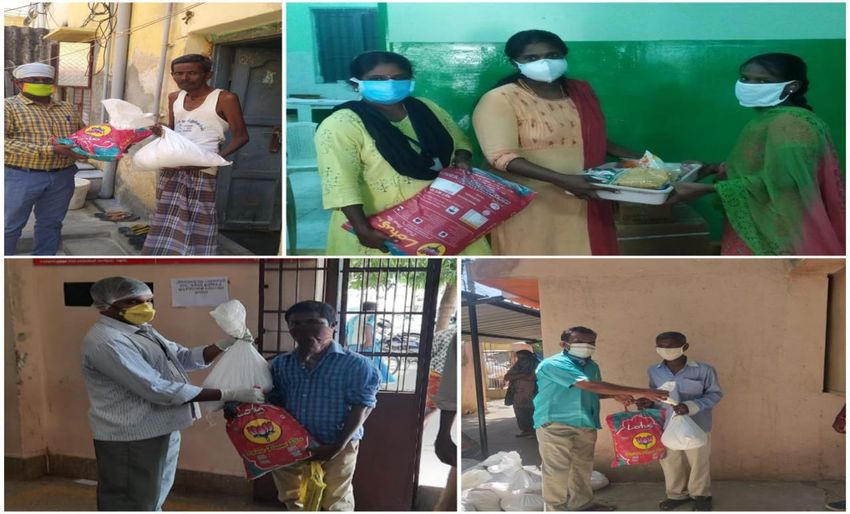
Tamil Nadu- National Tb Elimination Program

  5. Some of the District teams led by the District Tuberculosis Officers
     did commendable work in proactively facilitating the following
     actions:
        a. Several instances of inter-district drug distribution in cases of
           patients stuck in non-current districts,
        b. Instances of inter-state co-ordination for drug distribution for
           patients stuck in non-current states,
        c. Transport of misdirected drug boxes between states,
        d. Instances of drug supply for co-morbidities such as HIV and
           diabetes through expert consultation with physicians,
        e. Instances of DR-TB patients finding it difficult to access
           injections were dealt with proper linkages with nearby
           healthcare facilities.
        f. State Drug Store Chennai transferred DRTB drug tranches as
           requested by STO Andaman and Nicobar Islands by Sea.
  6. Drug distribution efforts were coupled with follow-up sputum
     collection and IEC activities.
  7. MD NHM and JD TB monitored district wise drug distribution for TB
     patient via VC.

UDST and Follow up culture for Tuberculosis during lockdown
Key challenges faced in sample transport for UDST and Follow up
Smear/culture:

  1. Complete non-availability of transport facilities for sample transfer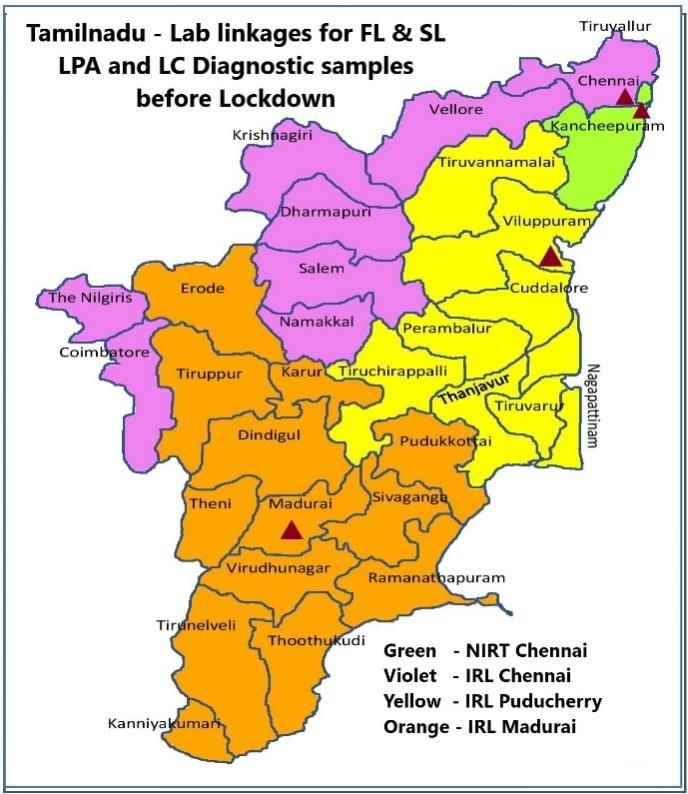
Tamil Nadu- National Tb Elimination Program

  2. Non availability of Courier/postal services in all the districts
  3. Difficulty for patients to reach health facilities to give sample
  4. Difficulty in reaching Pondicherry IRL due to lockdown situation

Solutions for sample transport for UDST and Follow up Smear/culture:
The discussion was facilitated between the districts by JD TB from state
and everyone were asked to come up with solution to tackle the challenges
faced. The following solution was then arrived at by achieving consensus
among districts:

  • The district TB officer’s vehicles or STS vehicles were being used for
     sample transfer within districts
  • For transfer of sample to IRL certain key districts were identified as
     places to pool the sample from the neighboring districts. A hired
     vehicle/ Government vehicle is arranged with a pass to transfer the
     sample to IRL
  • In order to collect sample from patients, every district should have
     the line list of their patients and those due for Follow up
     smear/culture will be identified and home collection of sample will
     be done by the corresponding STS in his vehicle.
  • As Pondicherry IRL was difficult to reach samples were redistributed
     between Madurai and Chennai IRL.
  • Extraordinary effort was put up by the districts and state in ensuring
     uninterrupted TB diagnostic services even during Lockdown.
     Approximately 74 % of pulmonary TB patient samples were sent to
     respective IRL for FL-LPA testing.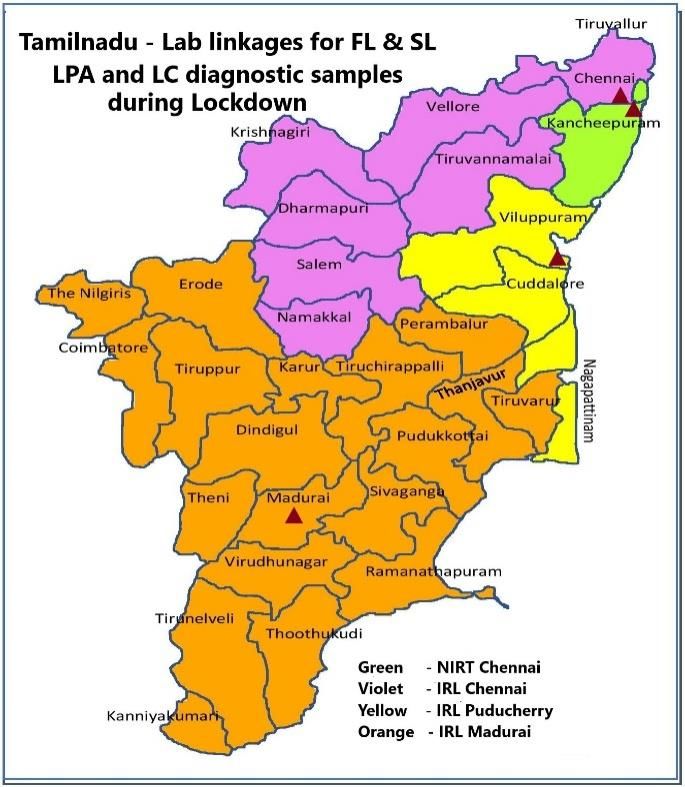
Tamil Nadu- National Tb Elimination Program

   • As discussed with the DTO’s during video conference the Lab
      linkages for FL & SL LPA and Liquid culture samples were re-
      arranged assessing the feasibility of transport.

Lab linkages for FL & SL LPA and LC diagnostic samples before and after lockdown:

NOTE ON STATE MONITORING OF TB SERVICES IN TAMILNADU

The distribution of districts for monitoring of TB services during the
lockdown was made between the Joint Director, WHO-NTEP Consultants
and the Medical Officers of the State TB-Cell.
Tamil Nadu- National Tb Elimination Program

    An online training session was conducted for the team on 06-04-2020 and
    instructions were given for conducting the telephonic interview, as per the
    protocol circulated.
    The interview questionnaire (ANNEXURE 1) covered the following
    domains:
•   Symptom      complex:   Relief   of   initial   symptoms/complaints    and
    symptoms/signs related to Adverse Drug Reactions.
•   Drug availability: Proxy measure of the continuation of drug distribution
    and availability of drugs with patients
•   Drug intake by patient & IPT provision: correctness of prescription
    practices was monitored, and continuity of contact tracing activities was
    monitored.
•   IEC activities: Patient’s knowledge about cough etiquette and its related
    practices and the availability of contact number of HV/STS for
    information/assistance was monitored.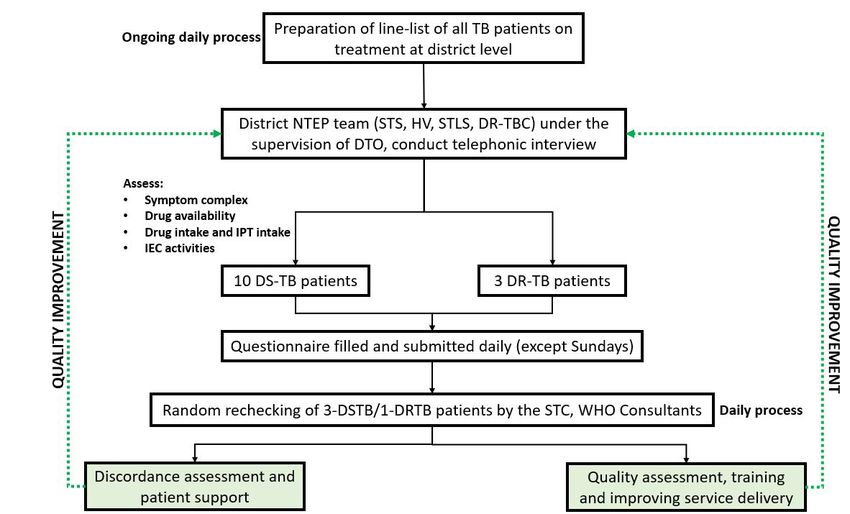
Tamil Nadu- National Tb Elimination Program

Methodology-

OVERVIEW:
The monitoring activities at the state level started from 08-04-2020 and all
the staff were requested to fill the google form created for the monitoring
purpose, during their telephonic interview with the patient.
The data collected from 08-04-2020 to 02-05-2020 has been analysed
(ANNEXURE 1) by WHO-NTEP consultants and the progress report is
presented here:
        1. On the whole, 343 DS-TB patients and 115 DR-TB patients were
           interviewed by the State-level team over the period of 22 days.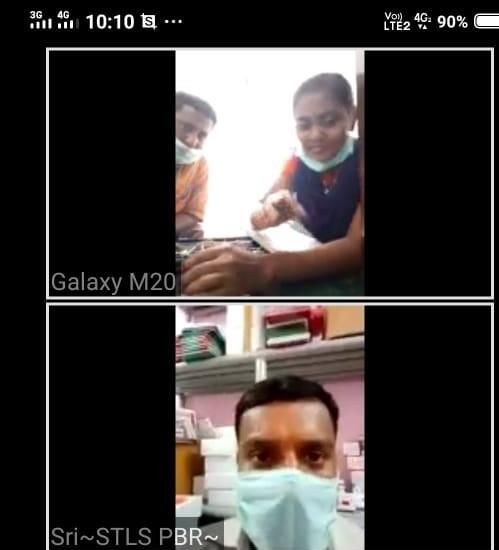
Tamil Nadu- National Tb Elimination Program

           From 25-04-2020 to 02-05-2020 (third period), 112 DS-TB and 37
           DR-TB patients were interviewed. The data was described for
           two groups of patients – those contacted from 08-04-2020 to 02-
           05-2020 and those contacted from 25-04-2020 to 02-05-2020.
        2. Among the DS-TB patients (both in IP and CP phase):
a.   Around 80.3% of those interviewed in the third period said they are
relieved of the initial complaints which they presented to the hospital with.
Overall this proportion was 82.5%.
b.   Overall around 74% said they had drugs for a minimum of 3 weeks
while around 10.5% had stocks for a week or less. Among those contacted
in the third periodperiod, these proportions were 69% and 10.7%
respectively. No patients reported drug stockouts.
c.   Overall nearly 93% of the patients were aware of and were able to
describe measures to maintain cough hygiene. This proportion was 100% in
the current study period.
d.   Over the 22 days, around 80.5% of patients reported that they had the
contact number of at least one programme staff for assistance/support. For
the third period, this proportion was 76%.
e.   Around 15.5% of all patients reported symptoms suggestive of
adverse drug reactions and the same was communicated to respective
district NTEP staff and actions taken. For patients interviewed in the
current period, this proportion was 16%.
Among the DR-TB patients:
Tamil Nadu- National Tb Elimination Program
a. Nearly92% of those interviewed in the third period said they are
relieved of the initial complaints which they presented to the
hospital with. Overall this proportion was 81.7%.
b. Overall 76.5% said they had drugs for a minimum of 3 weeks
while around 13% had stocks for a week or less. Among those
contacted in the second half period, these proportions were 70%
and 10.8% respectively. No patients reported drug stockouts.
c. Over the 22 days, nearly 94% of the patients were aware of and
were able to describe measures to maintain cough hygiene. This
proportion was around 94.6% in the current study period.
d. Overall around 91.3% of patients reported that they had the
contact number of at least one programme staff for
assistance/support. For the third period, this proportion was
83.8%.
e. 31.3% of all patients reported symptoms suggestive of adverse
drug reactions and the same was communicated to respective
district NTEP staff and actions taken. For patients interviewed in
the current period, this proportion was 35%.
Challenges faced:
• Delays in updating the quality check excel sheets at the district level.
Diversion of staff from NTEP to COVID-19 response was one of the
potential problems.
• Movement for work and connectivity with patients: Certain patients -
working on a daily basis had gone to other districts for work and gotTamil Nadu- National Tb Elimination Program
stuck due to the lockdown. However, the DTOs of corresponding
districts were contacted and drugs provided.
• Wrong entry of phone numbers in Nikshay, not able to reach the
patients even after repeated phone calls.
• Multiple entries of the same patient to fill the daily list.
• Incomplete/incorrect data entry in Nikshay especially with respect to
IPT prophylaxis and co-morbidities.
• Due to existing technical problems in PFMS many patients contacted
and complained regarding NPY payments.
Limitations:
• This was done at the state level using a random sample among the
forms submitted by the district on their telephonic monitoring.
• The completeness of data from districts were poor.
• Some patients were at the end of their treatment so the variable
reflecting drug stock in hand of the patient should be interpreted
with caution.
Strengths:
• Frequent monitoring by the state has given districts a sense of
accountability and hence improvement in quality of treatment
services was noted.
• This kind of random telephonic checks can be scaled up in future to
improve overall quality of care for all TB patients.
• In this unprecedented difficult situation, a phone call by concerned
authorities makes the patient more involved with the programme
and improves the trust.Tamil Nadu- National Tb Elimination Program
• Many districts have shown extraordinary potential and have taken
prompt action as soon as an issue was raised by the state.
ANNEXURE 2
QUESTIONNAIRE FOR DRUG SENSITIVE TB PATIENTS
EPISODE ID:
1.How do you feel physically and have the initial symptoms been relieved?
1.Yes 2.No
If no, what symptoms persists?
i. Cough 1.Yes 2.No
ii. Haemoptysis 1.Yes 2.No
iii. Fever 1.Yes 2.No
iv. Loss of weight and/or appetite 1.Yes 2.No
v. Night sweats 1.Yes 2.No
vi. Difficulty in breathing 1.Yes 2.No
vii. Others: Specify _________
2. Are you suffering from or have you ever suffered from any symptoms or signs
suggestive of any adverse drug reaction? 1.Yes 2.No
If yes,
i. Jaundice 1.Yes 2.No
ii. Orange discoloration of urine, saliva, tears 1.Yes 2.No
iii. Nausea/vomiting/diarrhoea/loss of appetite/dyspepsia 1.Yes 2.No
iv. Mood changes 1.Yes 2.No
v. Difficulty in vision 1.Yes 2.NoTamil Nadu- National Tb Elimination Program vi. Tingling and number in hands or feet 1.Yes 2.No vii. Rashes 1.Yes 2.No viii. Joint pain/myalgia 1.Yes 2.No ix. Dizziness/breathlessness/palpitation 1.Yes 2.No x.Others: Specify ___________ 3. Are you taking medicines daily? 1.Yes 2.No 4. If yes how many tablets do you take per day? 4.1 If no, why? 5. What is mode of treatment support? 1. SELF CONSUMPTION 2. FAMILY TREATMENT SUPPORTER 3. HEALTH WORKER 4. COMMUNITY MEMBER 6. For how many days do you have the drugs with you now? 7. When was the last contact with a healthcare provider personal/telephonically? a.
Tamil Nadu- National Tb Elimination Program

1. How do you feel physically and have the initial symptoms been relieved?

If no, what symptoms persists?

i. Cough                                                1.Yes 2.No

ii. Haemoptysis                                          1.Yes 2.No

iii. Fever                                             1.Yes 2.No

iv. Loss of weight and/or appetite                         1.Yes 2.No

v. Night sweats                                          1.Yes 2.No

vi. Difficulty in breathing                               1.Yes 2.No

vii. Others: Specify _________

2. Are you suffering from or have you ever suffered from any symptoms or signs
suggestive of any adverse drug reaction?               1.Yes 2.No

If yes,

Specify

3. Are you taking medicines daily?                         1.Yes 2.No

4. Who is your treatment supporter?                       1.Yes 2.No

5. For how many days do you have the drugs with you now? 1.Yes 2.No

6. When was the last contact with a healthcare provider personal/telephonically?
Tamil Nadu- National Tb Elimination Program

12. If the patient is on all-oral longer regimen (first 6 months):

Do you have the plastic container for Bedaquiline with you?          1.Yes 2.No

Good Practices.

The telephonic monitoring by the District TB Officers and DTC Staff
brought to light many a patient’s woes and they were addressed
immediately by the district NTEP Staff.

Patients and their family members were given food rations by partnering
with charitable organisations.
Tamil Nadu- National Tb Elimination Program

Video conference review conducted by DTO’s within districts.
Tamil Nadu- National Tb Elimination Program

Uninterrupted TB Services - Initiation of H-Monopoly Treatment
You can also read


