Te Tauihu Connecting Top of the South - DRAFT - Marlborough ...
←
→
Page content transcription
If your browser does not render page correctly, please read the page content below
DRAFT                      REGIONAL PUBLIC
                           TRANSPORT PLAN
                           2021 - 2027

Connecting Top of the South
Te Tauihu

FOR PUBLIC TRANSPORT IN
THE MARLBOROUGH DISTRICT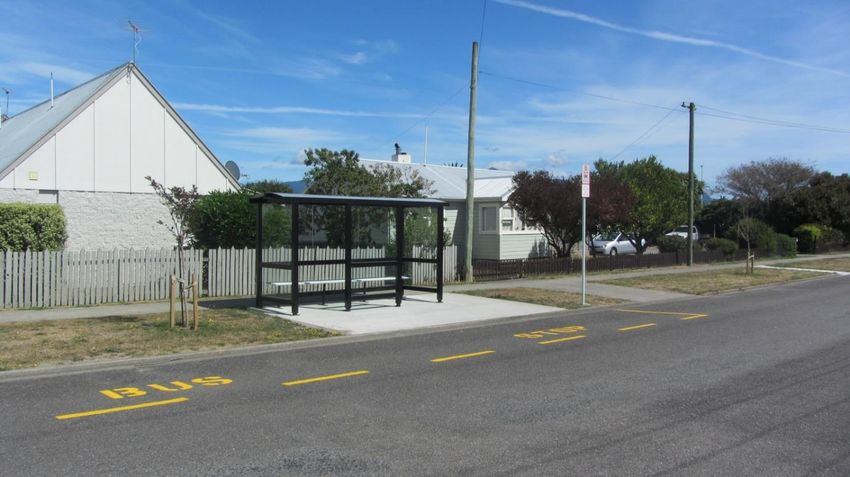
Introduction
The Land Transport Management Act 2003, and Land Transport Management Act
Amendment Act 2013 (LTMA) states that the purpose of a Regional Public Transport
Plan (RPTP) is to provide:
A means for encouraging Council and public transport operators to work
together in developing public transport services and infrastructure; and
An instrument in engaging with the public in the region on the design and
operation of the public transport network; and
A statement of:
o The public transport services that are integral to the public transport
network; and
o The policies and procedures that apply to those services; and
o The information and infrastructure that support those services.
The Marlborough RPTP focuses primarily on services contracted or provided by the
Marlborough District Council (Council). This plan is aligned with the government’s
priorities described in the Government Policy Statement on Land Transport (GPS
2021), as noted below:
Transport Outcomes Framework – A transport system that improves wellbeing
and liveability
o Strong alignment with ‘Inclusive Access’ - Enabling all people to
participate in society through access to social and economic
opportunities, such as work, educations, and healthcare.
o Strong alignment with ‘Economic Prosperity’ – Supporting economic
activity via local, regional, and international connections, with efficient
movements of people and products.
o General alignment with ‘Environmental Sustainability’ – Transitioning
to net zero carbon emissions, and maintaining or improving
biodiversity, water quality, and air quality, and
o Indirect alignment with ‘Healthy and Safe People’ – Protecting people
from transport-related injuries and harmful pollution, and making active
travel an attractive option.
Strategic Priorities
o Strong alignment with ‘Better Travel Options’ – Providing people with
better transport options to access social and economic opportunities,
o General alignment with ‘Climate Change’ – Developing a low carbon
transport system that supports emissions reductions, while improving
safety and inclusive access, and
o Indirect alignment with ‘Safety’ – Developing an transport system
where no-one is killed or seriously injured.
This RPTP sets out Council’s intentions and policies regarding public transport in
Marlborough. The RPTP takes into account all relevant national and local policies,
and the public transport funding from Waka Kotahi NZ Transport Agency which is
1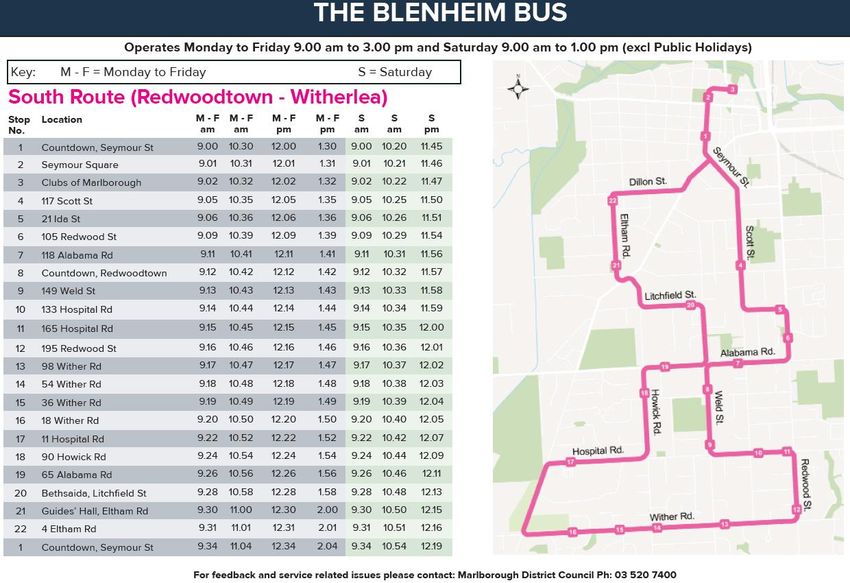
likely to be available to Council. As a Unitary Authority the relationship with transport
operators is a simple one-on-one partnership to ensure passengers’ needs are met.
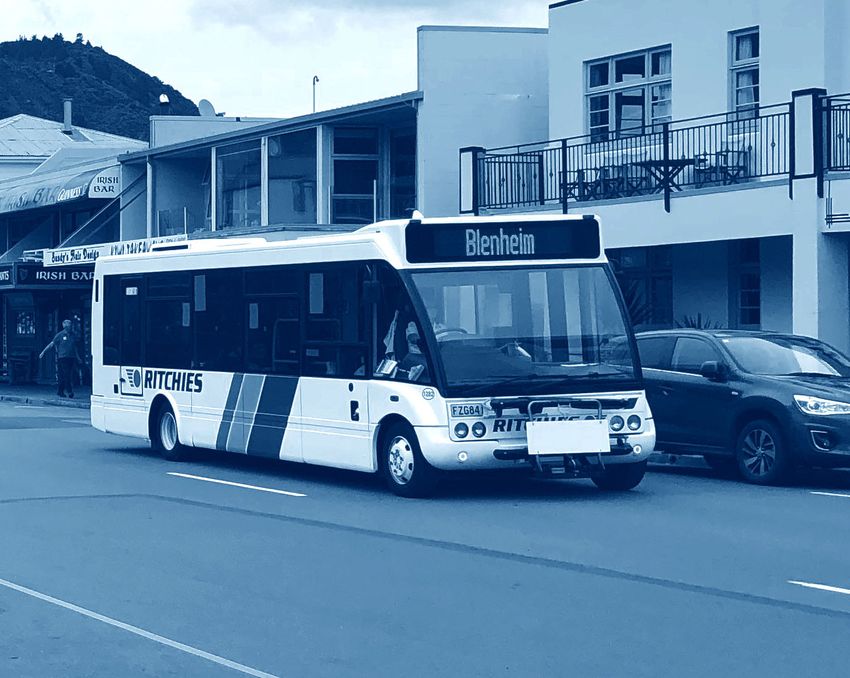
The bus service in Marlborough is integrated with a separate school bus contracted
service and is able to deliver a reliable and sufficiently frequent service.
The Blenheim Bus has attracted some commercial support which reduces reliance
on public subsidies. Council does have an intention to continue providing public
transport services.

Background and Context
Currently, Council provides, by way of a subsidised contract, bus services in the
vicinity of Blenheim. Council also subsidises the Total Mobility scheme for people
with disabilities. Inter-regional services are provided by other providers.
The demand for public transport is led by the increasing elderly population in
Marlborough. The following graph shows census age demographics, where it is
evident the working age (15-64 years old) is generally decreasing over time, at a rate
similar to the increase in people aged 65 and over. Apart from 2001, the percentage

                                            2
of children (0-14 years old) has remained stable.
The bus service is designed to support public transport for the elderly by efficiently
operating after school runs are complete in the mornings and generally before school
runs commence in the afternoons. This timing is ideal for older people to go
shopping, visit healthcare providers, or engage in social activities.
This Marlborough RPTP sets out Council’s intentions with respect to the current and
any future ratepayer funded public transport services in the District. The focus of this
RPTP is to ensure the community have an appropriate transport choice, specifically
to include Public Transport.
Council is preparing this plan as an update to the previous RPTP document, and
note that this will replace the 2015 Marlborough RPTP.
The Blenheim Bus Service
The Blenheim Bus Service is the only publicly funded ‘public transport service’
(within the definition of the Public Transport Management Act) operating in the
district. It is contracted by the Council and currently operated by Ritchies Transport
Holdings Ltd. The contract was retendered in 2016, and will expire in February 2027.
The contract uses the Public Transport Operating Model (PTOM) which includes a
sharing of financial risk and reward between the operator and Council. The
Council’s share, in turn, is sourced from rates on residential properties in the city, a
Waka Kotahi NZ Transport Agency subsidy, and with partnership with a corporate
sponsor, currently Bayleys Marlborough Ltd.
In addition to the two existing Blenheim Bus routes (North and South), the following
18 month trial services were initiated to provide additional bus routes, with an intent
of making these permanent if trials are successful:
Blenheim West Commuter (started 17 Feb 2020),
Blenheim East Commuter (started 17 Feb 2020),
Blenheim to Renwick return (started 17 Feb 2020), and
Picton to Blenheim return (started 6 Aug 2019).
In the 2019/20 financial year, 17,312 public transport trips were made on the Council
subsidised bus service. This is 22% less than the 22,220 average trips over the three
previous financial years. However, it must be noted that March to June 2020 were
adversely impacted by the COVID-19 lock-downs and subsequent impacts.
In December 2020, the Blenheim East Commuter trial service was cancelled due to
low patronage. The Blenheim West Commuter trial service will continue until June
2021.
Low patronage has been evident on all routes during the COVID-19 global
pandemic, most notably during the lock-downs imposed throughout New Zealand:
Alert Level 2 or above (21 Mar – 8 June 2020, and 11 Aug – 21 Sept 2020)
Alert Level 3 or above (23 March – 13 May 2020)
3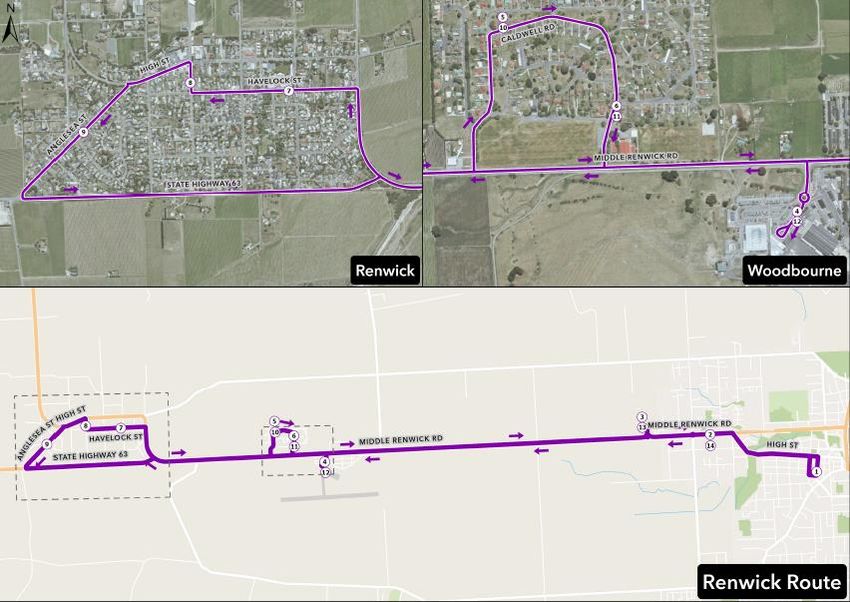
Alert Level 4 (25 March – 27 April 2020)
As the COVID-19 global pandemic continues, the nature or extent of any future lock-
downs within New Zealand is unknown. Any lock-down will have a negative impact
on public transport patronage.
School Bus Service
Ministry of Education is the second largest provider of passenger services in New
Zealand. This includes:
managing approximately 7,000 vehicle journeys each school day
carrying 40 million passenger journeys each year
assisting over 100,000 students safely to and from school every day
managing contracts for around 70 transport providers for bus services,
specialised transport, and ferry services.
The current daily bus and technology bus contracts expire on 31 December 2021.
These contracts service approximately 1,500 Daily Bus routes and 700 Technology
routes. For the first time in 12 years, school bus services will be procured for the
Ministry of Education’s daily and technology bus services. The procurement will be
conducted via two tenders between July 2020 and May 2021. The Ministry will award
routes based on best public value, which means considering quality, price and
broader outcomes, rather than solely on cost. Broader outcomes take into account
economic, cultural, environmental and social benefits that can be achieved through
this procurement.
Total Mobility
The Total Mobility Scheme assists eligible people with a permanent disability or
impairment to access appropriate transport to enhance their community participation.
This assistance is provided in the form of subsidised door-to-door transport services
wherever scheme transport providers operate.
Eligible customers present their Total Mobility swipecard to access a 50% discount
on eligible door-to-door transport, up to a maximum of $15 per trip.
To qualify for the Total Mobility Scheme, applicants are referred to an appropriate
Total Mobility agency to undergo an eligibility assessment based on nationally
established criteria.
Voluntary participation in a nationally developed administration system known as
‘Ridewise’ is open to regions, and has been adopted in Marlborough. Ridewise
utilises swipe card technology to electronically record trips and replaces the time
consuming manual voucher system. It is expected that the swipe cards will be
accepted through New Zealand under a nationally agreed reciprocal arrangement,
and become the standard.
In the 2019/20 financial year, 18,962 trips were made on the subsidised Total
Mobility scheme.
4
Council manages and operates the scheme, with subsidy funding from Waka Kotahi
NZ Transport Agency. The annual cost of the Total Mobility scheme in Marlborough
is about $194,000 for the following:
New taxi hoist grants,
Regular Total Mobility trips,
Hoist Total Mobility trips, and
Administration costs
However, the Council expects to budget for increased mobility trips over time,
reflecting an increasing aging population.
Health Mobility Services
The Marlborough Sounds Community Vehicle Trust provides health mobility services
between Marlborough and Nelson hospital. This is an on-demand service, subject to
availability.
St John Health Shuttle is a free community service that transports people to
essential medical and health-related appointments, and then brings them home
again. There’s no charge for shuttle transport, however a donation is appreciated to
cover costs. This is an on-demand service, subject to availability.
The Red Cross community transport service takes people from their homes to
community appointments - for instance, to their doctor, hospital outpatient clinic,
medical specialist or medical centre. Red Cross drivers are trained in first aid and
provide assistance to and from the vehicle. This is an on-demand service, subject to
availability, and requires booking at least 24 hours in advance.
Inter-regional and inter-community services
The Intercity Bus runs a network throughout New Zealand, including long-distance
commercial public transport services within the Marlborough District. Blenheim and
Picton are part of the network with connections to Nelson to the west and Kaikoura
and Christchurch to the South.
Prior to COVID-19, Atomic Shuttles also had a South Island network which
connected Blenheim to Picton, Nelson, Kaikoura and Christchurch. It is unknown if,
or when, these services will resume. However, it is expected that service may return
when demand increases, possibly in conjunction with the resumption of international
tourism to New Zealand.
Other Blenheim based companies reportedly provide ferry transfers to/from Picton
(and other locations), however these services are on-demand, and are not regularly
scheduled services.
5
Policies
The LTMA states that a regional council must adopt a RPTP if it intends to enter into
a contract to pay for the supply of public transport services, impose controls on
commercial public transport services, or provide financial assistance to operators or
users of taxi/shuttle services. As Council contracts for the supply of the Blenheim
Bus Service and provides Total Mobility financial assistance, an RPTP is required.
All commercial public transport services operating in a region must be registered with
the Council. They must also give notice to the Council of fares, routes etc. The
Council can decline to register a service on certain grounds, for example, it is likely
to increase the net cost to the council of any contracted public transport service.
The Act also provides regional councils with a range of other controls over
commercial public transport services (units) and describes the process for
developing and implementing those controls.
The national and regional statutes, strategies and policies establish a number of
principles or objectives to guide the planning and funding of Public Transport, as well
as transport more generally. The relevance of these principles and objectives and
their implementation in the Marlborough RPTP is summarised in the table below.

     1. Provide a Blenheim Bus Service

     Bus Service Policies                              Implementation of policy

 1.1 Continue to provide a         Continue to tender contract for the provision of the bus service to
 quality bus service in Blenheim   provide a modern low floor bus.

 1.2 Provide convenient bus stop Endeavour to minimise walk distance to bus stops with 90% of
 locations.                      passengers walking less than 500m.

 1.3 Improve the Blenheim bus       Improve the bus network.
 service, within the constraints of
                                    Routes should allow for a ‘clock face’ timetable at each stop
 current budgets and contracts
                                    (i.e. bus arrives/departs at the same time each day), to the
                                    extent possible
                                   New stops should be located and designed with consideration of
                                   safety, and accessibility issues. Audits of existing bus stops
                                   should be undertaken to guide the design and location of new
                                   stops
                                   Provide two styles of timetables: one with stops specific to
                                   each bus stop and one for the entire network
                                   Investigate fare options to provide a more attractive fare
                                   structure while maintaining and/or improving revenue
                                   Seek to implement with the service operator;
                                   Expansion of concessions tickets for bulk ticket purchases,
                                   monthly passes, community service cards, students etc.

                                                   6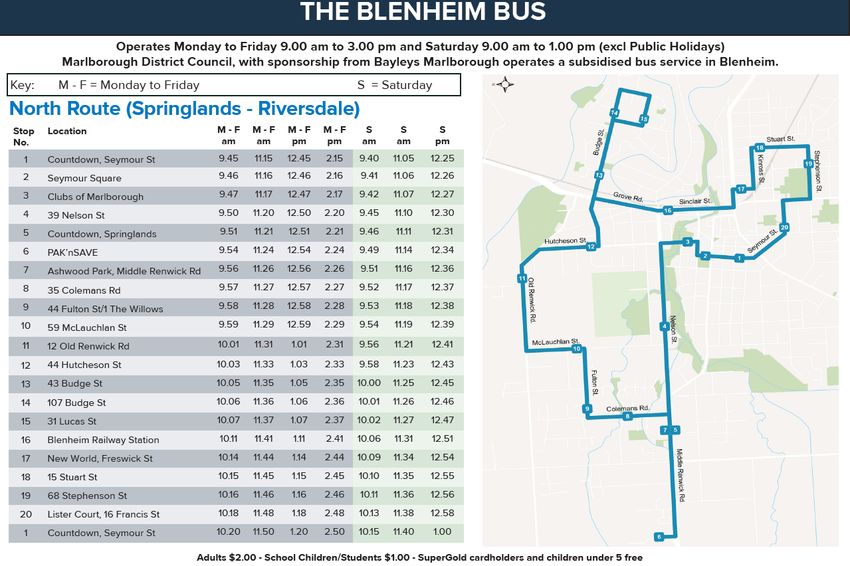
(Concession tickets are currently only available for purchase
                                   by adults at council reception, 10 adult trips for $20).
                                   Carry out an accessibility audit of the existing and proposed bus
                                   stops in 2021
1.4 Consider further               Consider programming the following further improvements to the
improvements to the Blenheim       service:
bus service and seek additional
                                   Extension of weekend services
resources necessary to
implement                          Additional buses to improve frequency and/or increase the
                                   number of routes
                                   Further improvements to frequency or timing of the bus(s) to
                                   complete a ‘clock face’ timetable, additional shelters, bus
                                   timetable information facilities etc.
                                   Extension of the hours of service
                                   Development and implementation of an advertising plan in 2021,
                                   including launch of real time tracking services.
1.5 Investigate alternative        Investigate opportunities to fund bus timetable facilities and
funding opportunities              new shelters through provision of advertising space
                                   Recognise that the Financial Assistance Rate will be at base rate

    2. Provide a Total Mobility Scheme

   Total Mobility Policies                             Implementation of policy

2.1 Continue to support the        Maintain agreements with Total Mobility providers and
Total Mobility Scheme in the       continue to administer total mobility subsidies
Marlborough District, subject to
continued funding from the NZ
Transport Agency
2.2 Allow new operators to join    Enter into total mobility agreements with new operators that
the Total Mobility Scheme          meet the requirements of the scheme

   3. Provide a Supergold Card Scheme

   Total Mobility Policies                             Implementation of policy

3.1 Continue to support the        Continue to administer Supergold Card subsidies for free
Supergold Card initiative          travel during off peak hours

3.2 Provide convenient bus stop Endeavour to minimise walk distance to bus stops with 90%
locations.                      of passengers walking less than 500m.

                                                   7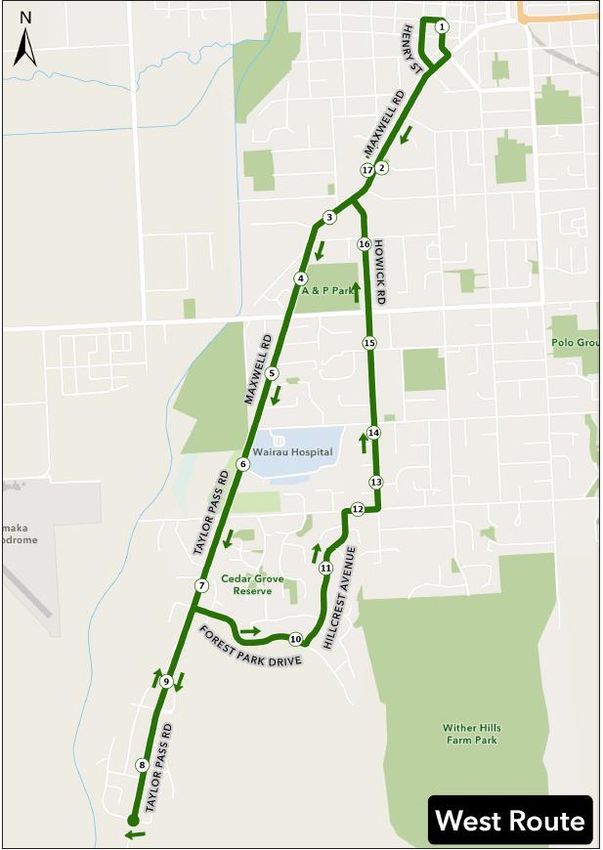
Proposed Services
Units
The LTMA requires every public transport network in NZ to be divided into “units”.
Each unit must then be the subject of a separate contract. The MRPTP is required to
set out the units that the Council intends be provided, and the date that the units are
expected to start operating. Current contracts are able to continue until they end, and
the new model introduced by the LTMA is for future contracts.
Because of the nature and relatively small size of the Blenheim bus service it
currently has only two Units / bus contracts for the network of services:
Blenheim and Renwick Bus Services
Picton Bus Service
This is a logical arrangement in a town the size of Blenheim and has worked well,
and enables close cooperation between Council and the bus operator. This single
unit approach has been adopted in most similar sized towns to Blenheim.
This RPTP, therefore, proposes that the single unit/single contract system will
continue for the Blenheim bus service.
The Blenheim Bus Service
This RPTP supports maintaining a bus service in Blenheim.
Customers are charged a standard fare for each trip ($2 for adults and $1 for school
children/students), while under 5’s and Supergold cardholders are able to travel for
free (except on Commuter services that only run during peak hours).
Patronage of the present service is
modest. The service does not cater for
commuters but rather promotes mobility
for the growing number of older people
and other community members with
limited access to motor vehicles within
Blenheim.
The timetable for the original Blenheim
bus services were altered from 1 July
2019, largely to comply with the new rest
and meal break requirements introduced
through amendments to the Employment
Relations Act, but also to improve service
reliability. The effect of these changes
was to reduce the number of daily circuits
around the North and South routes from
six(6) one hourly services to four(4) one
and a half hourly services. As anticipated,
this has adversely impacted on patronage
8
of these services, as can be seen in the graph below. Average monthly patronage
has fallen from 1,890 passengers in 2018/19 to 1,440 passengers in 2019/20
financial year.
COVID-19 lockdowns have also made a notable impact on patronage, with
decreased utilisation of public transport for every month since February 2020. While
patronage has rebounded some, it has not reached pre-COVID-19 levels as of the
date of this RPTP. Council is continuing to monitor passenger numbers.
Another unintended consequence of the Blenheim service changes has been the
loss of connectivity between the two Blenheim routes and the Picton service. There
is no south route connection for the bus which returns from Picton mid-afternoon.
The south connection would require an additional Blenheim service after 3pm, which
is not budgeted.
Further consideration of a range of options is required. Progressive changes may
enhance the service:
Provision of bus timetables at bus stops
Reconfigured bus timetables
Installation of more shelters at bus stops, particularly at busier stops
Better advertising and branding of the services, including provision of real
time tracking for general public use.
Provision of concessions e.g. for bulk ticket purchases
Longer hours of operation, especially in the evenings
Possible extension of weekend service
However, funding levels are proposed to remain constant in the short to medium
term, therefore the Council will seek to implement changes that are consistent with
the current contract and that can be implemented with current budgets.
Review of the bus routes and stops can be undertaken at little cost. Other
improvements that will be sought in the short term include redesigning the bus
9timetable information; and working with the contractor to improve advertising of the
service.
Introduction of concession tickets could be investigated. A review of ticket pricing
and the implication of cost escalation will need to be considered as time progresses.
Further improvements will be considered in the longer term. Of greatest priority will
be continuing to improve the timing of the bus so that the bus departs and leaves
each stop at the same time each hour with no periods of lower frequency during the
middle of the day, providing timetables at bus stops and installing more shelters.
These changes may require some additional public funding, which will be subject to
Council and government approval through the Ten Year Plan and National Land
Transport Programme.
Fares have been left at a low level to encourage patronage and an increase in fares
during the next two years are anticipated, with an expectation that the increase is
reasonable and affordable, and will not affect patronage. The majority of users are
supergold card holders so fare prices will have little influence on the viability of the
service.
The North and South service offers a modern super low floor kneeling bus which
accommodates 42 passengers and two wheelchairs. Accessibility will continue to be
an important consideration for public transport alternatives in Marlborough, to better
support the transport disadvantaged and an aging resident population.
10Routes are designed for wide coverage and extend through much of Blenheim. The
present North and South routes and timetables are shown below.
In addition, there are trial bus routes which are in operation to determine if the
demand is sufficient to warrant permanent routes. The trial routes are shown below,
and generally are scheduled to run during peak hours:
11Picton to Blenheim Return:
The trial Picton Service commenced in August 2019, operating 2 return trips on
Tuesdays and Thursdays only, during off peak hours, which enables free travel for
SuperGold card holders. Over the 6 completed months of operation, to January
2020, the service has averaged 279 passengers per month (slightly above our
estimated patronage). Around 70% of passengers are SuperGold card holders.
The adult fare is $4 and school children $2, with under 5’s travelling for free. Some
intermediary fees apply for partial journeys.
The following website provides additional information, and may include updated
information from that which is shown above:
https://www.marlborough.govt.nz/services/blenheim-bus-services/bus-service-picton-
to-blenheim
12Blenheim to Renwick Return:
The Renwick service operates from Monday to Saturday delivering four daily
services on weekdays (1 early morning, 1 mid-morning, 1 mid-afternoon and 1 early
evening circuit) and two services on Saturday (1 mid-morning and 1 mid-afternoon
circuit)
The Renwick service also starts and finishes at the Countdown Seymour Street bus
stop.
The route is Countdown Seymour St, High St, Boyce St, Middle Renwick Rd, SH6,
Havelock St, Uxbridge St, High St, Anglesea St, SH63, Middle Renwick Road, Boyce
St, High St, Henry St, George St, Countdown Seymour St.
There are stops in both directions at Springlands Countdown, Pak’N Save,
Marlborough Airport and Woodbourne township.
The adult fare is $3 and school children $1.50, with under 5’s travelling for free.
Some intermediary fees apply for partial journeys.
Note: SuperGold card holders can only travel for free on the mid-morning and mid-
afternoon (off peak) services.
The following website provides additional information, and may include updated
information from that which is shown above:
https://www.marlborough.govt.nz/services/blenheim-bus-services/renwick-trial-bus-
service
13Blenheim West Commuter:
Blenheim West Commuter:
The Blenheim commuter service operates from Monday to Friday, departing from
and returning to the central Seymour Street bus stop (outside Countdown).
The West route travels along Maxwell Road, Taylor Pass Road, Forest Park Drive,
Hillcrest Avenue, Wither Road, Howick Road, Maxwell Road and Seymour Street.
The discontinued East route travelled along Seymour Street, Scott Street,
Stephenson Street, Houldsworth Street, Muller Road, Redwood Street, Wither Road,
Weld St, Stephenson Street, Maxwell Road and Seymour Street.
There are two morning services departing 7:30 and 8:00am and two evening
services departing 5:15 and 5:45pm. Both routes are around 22-23 minutes in
duration.
The adult fare is $2 and school children $1, with under 5’s travelling for free.
Note: there is no free travel for SuperGold card holders on these commuter services,
which are operated during peak hours.
The following website provides additional information, and may include updated
information from that which is shown above:
https://www.marlborough.govt.nz/services/blenheim-bus-services/blenheim-west-
bus-trial-service
14Infrastructure
Road marking and signage is being installed at all stops and was largely in place at
the service commencement date. Some sites still require road marking.
Council is also investigating the installation of timetable holders to be fixed at all bus
shelters that will better inform the public on bus routes and times.
A bus stop and shelter have been recently installed in Uxbridge St, Renwick, outside
Council’s senior housing complex. This will serve as the central Renwick pause stop.
No Smoking in Bus Shelters
The Smokefree legislation is generally concerned with internal smoking, which
prevents application to bus shelters, as they typically have at least one unenclosed
area allowing free exit.
Council has issued a Smokefree Position Statement which
contains policy dealing with smokefree venues. The Statement
endorses certain smokefree areas including Council controlled
venues and locations. Bus shelters are owned by the Council
and thus are considered smokefree venues under this
statement.
It is intended that signage displaying the smokefree logo be
installed on all bus shelters.
There are no enforcement options available under the
Statement.
15Graffiti
Like many other streetscape features, bus shelters are prone to occasional graffiti
and vandalism. The bus shelter in Budge Street has been badly graffiti’d over a
sustained period of time through etching onto the glass window panels. This
particular shelter was one of two donated by Jean Wilson, QSM.
Arrangements have been made to replace the 4 upper glass panels in this shelter
and to trial a graffiti film overlay, which essentially provides a sacrificial barrier
against vandals and the surfaces they deface. The cost of each pane replacement is
approximately $600 while the film is around $175 per pane.
Bike Racks
In mid-2020 Council installed bike racks on all buses to enable people to utilise both
active transport and public transportation on their journey – providing additional
transport choice. It is expected that under normal circumstances this would result in
an increased patronage due to an increased catchment.
16Website Content
Staff are currently scoping a project to review and improve the website presentation
for the growing number of bus services that we provide, including timetables, route
maps and fare schedules etc.
We are also exploring bus tracking apps for general public use.
School Bus Service
The Ministry of Education will continue to provide and administer this service
independently of Council.
Total Mobility
Council will continue to provide and administer this service, utilising the Ridewise
system, and subsidised by Waka Kotahi NZ Transport Agency.
Funding will be adjusted to reflect the demand and utilisation of these services.
Health Mobility Services
Other organisations will continue to provide and administer these services
independently of Council.
Inter-regional and inter-community services
The Intercity Bus will continue to provide this service independently of Council. Other
companies may also provide these services when demand increases.
Alternatives
Council has determined that it is not acceptable to ‘Do Nothing’, and consequentially
is committed to providing a base level of service.
The trial services described above, are demonstration of Council’s initiative to
consider the demand for an expanded public transport network of additional bus
routes. While one route has been cancelled early, the remaining trial routes will be
continued until the end of the planned trial period. Patronage on the trial routes will
be an important consideration regarding a more permanent service expansion.
Services for Transport Disadvantaged
The LTMA requires this RPTP to describe how the public transport services and
financial assistance Council intends to provide will assist the transport
disadvantaged. ‘Transport disadvantaged’ is defined as meaning people whom the
regional council has reasonable grounds to believe are the least able to get to basic
17community activities and services (for example, work, education, health care, welfare
and food shopping).
The first step is to determine who the council believes are transport disadvantaged.
For this the Council is guided by three factors identified in the New Zealand
Transport Strategy: lack of modal choice, affordability and disability.
In addition, the Council considers isolation from services an important factor in the
Marlborough District. The table below describes groups the Council considers are
transport disadvantaged and how the services Council intends to provide will assist
their needs.
Transport Disadvantaged Services
Transport Groups Affected How public transport services will assist
Disadvantage
Factor
Lake of modal Households with limited This plan aims to improve the Blenheim bus
choice access to motor service, providing a more attractive service
vehicles. that will better meet the needs of those with a
lack of modal choice.
Households located
more than 700m from a Actions include reviewing the bus routes in
bus stop. Blenheim. The review will look to balance
coverage with other issues such as
Youth
frequency of service and travel times.
Affordability Households with lower This plan aims to improve the Blenheim bus
incomes. service, providing service that better meets
the needs of people that use the bus.
People in lower paying
jobs. Actions include introducing concessions:
- Family passes and discounts for monthly
Youth and older people.
passes, community service cards etc. will be
considered.
Disability People with disabilities Total Mobility Services will continue to be
that affect their ability to provided, subject to continued financial
drive and mobility. support from Government. Council will
investigate extending total mobility subsidies.
Council will continue to specify that
Older people
contractors use a low floor base for the
Blenheim bus service.
Council plans to develop a bus facility
improvement plan which will take into
account accessibility/mobility issues and will
consider seeking additional funding to
implement the plan.
Isolation People and communities Consideration of access issues outside
living away from most Blenheim will occur.
services.
18Public Transport Plans and Priorities
The Public Transport plans for 2021-2024 include:
Decision on Blenheim West Commuter trial service (June 2021),
Decision on Blenheim to Renwick trial return service (June 2021),
Decision on Picton to Blenheim trial return service (June 2021). and
Implement Ridewise version 2 once development is complete (2021-2022).
Fare review (2023)
Exploration of real time tracking apps for general public use (2021-2023).
Actions identified within the ‘Transport Disadvantaged Services’ table.
The Public Transport priorities for 2021-2024 include:
Public Transport Priorities
Priorities Explanation Marlborough RPTP
Economic The government’s main priority, Implementing this plan will
Growth and as expressed in the GPS, is contribute to better access to
Productivity national economic development employment for Blenheim
and productivity residents. Due to timetable
constraints the bus service is
The GPS recognises several used little for commuting to and
priority areas to promote from work. A range of actions are
economic development and needed to better meet the needs
productivity. This includes of workers, such as changing
initiatives that provide better arrival and departure times in the
access to markets, employment CBD
and areas that contribute to
economic development
Value for The GPS stresses the need to Value for money is a key
money generate better value for money principle to this MRPTP. The
from the government’s plan recognises that local and
investment in land transport and central government funding is
enhance the economic efficiency limited and there is a need to get
of individual projects. This is also more value from investment in
important for Council’s public transport
investment. Three concepts are
In particular, the plan identifies a
related to value for money;
need to review the Blenheim bus
effectiveness (contribution to the
service so that it better meets the
government’s priorities),
needs of Blenheim residents,
efficiency (maximizing value with
while limiting expenditure on the
the lowest resources possible)
service. While some of the
and economy (inputs purchased
changes may require a small
at lowest price over whole life of
increase in public funding, this is
intervention)
likely to be more efficient than
Council to take into account the continuing to invest in a less
need to obtain the best value for effective service. Actions have
money, having regard to the also been prioritised to ensure
desirability of encouraging fair investment is directed at the
competition and a competitive most important actions.
and efficient market for public
No issues relating to fair
transport services
competition are identified
19Public Transport Priorities
Priorities Explanation Marlborough RPTP
Affordability The New Zealand Transport The MRPTP recognizes that the
Strategy promotes maintaining government and the communities
an acceptable financial demand of the Marlborough District have
on central and local government, limited ability to fund public
households, businesses and transport initiatives. The
individuals; taking into account Blenheim bus service must be
available funding sources; reviewed to achieve better value
considering all costs including for money. No new services are
those on other sectors planned at this stage
The Strategy encourages
consideration of less traditional
forms of shared transport outside
of large urban areas such as
community buses or demand-
responsive transport
Making best The GPS seeks better use of The MRPTP recognises the need
use of existing existing transport capacity, to review and get more value out
networks and networks and infrastructure. of existing services, especially
infrastructure According to the GPS, this the Blenheim bus service. It
means improving the efficiency of identifies a staged action plan of
existing networks as well as improvements, which can be
investment in new infrastructure. progressed overtime to build on
It also means sequencing earlier improvements
development so that small
iterative investments in existing
infrastructure do not take place
when more significant investment
in redevelopment the same
infrastructure is shortly planned
to commence
Environmental Environmental sustainability is a Consistent with the GPS, the
sustainability key concept throughout the primary focus for public transport
legislation, strategies and in this MTPTP is improving
policies transport options and
accessibility, rather than shifting
people out of cars and into public
transport. Nonetheless, it is
hoped that providing a more
attractive Blenheim bus service
will help to encourage a modal
shift and reduce greenhouse gas
emissions from motor vehicles
Access and Improving access and mobility is Access and mobility is a key
mobility another key objective in the focus of this MRPTP. This plan
LTMA and increasing the supports retaining the total
availability and use of public mobility service and Blenheim
transport is identified as bus service and continuing to
important to this objective support the Supergold Card
initiative. These services provide
improved access choices for the
community, especially the
20Public Transport Priorities
Priorities Explanation Marlborough RPTP
transport disadvantaged
The GPS also seeks more The MRPTP also seeks to
transport choices, particularly for improve the bus service so that it
those with limited access to a car can better meet the needs of
where appropriate. Better access people in Blenheim
to markets, employment and
areas that contribute to economic
development is another goal in
which public transport could have
a role
Integration The GPS also encourages a The MRPTP intends a
and co- coordinated approach to collaborative approach to
ordination transport problems, whereby improving access and mobility
various agencies work together
in a collaborative way
Safety, National legislation, policies and Safety and personal security
personal strategies promote a safe have not been the most critical
security and transport system, which assists issues for public transport in the
public health personal security and protects Marlborough District. However
and promotes public health these issues will be considered
e.g. in the planning of new bus
stops, design of facilities and
agreements with service
providers (bus and taxi
companies)
The LTMA requiring the Council The benefits in terms of personal
to be satisfied that the RPTP security should also be taken into
contributes to assisting safety account for future decisions
and personal security and to about whether to extend the
protecting and promoting public hours of operation of the bus
health service. Public health is
promoted through this plan by
retaining and improving services
that improve accessibility,
particularly for the transport
disadvantaged
Consideration The GPS encourages land The MRPTP includes a policy to
of the impact transport planning to take into retain the Blenheim bus service,
of higher fuel account the impact of volatile fuel which could help to buffer the
prices prices. It notes that in times of impact of higher fuel prices in
high oil prices, the availability of Blenheim
transport choice, such as public
transport, helps to mitigate the
effects on households, and public
transport use tends to increase
21Significance Policy
A significant policy is required, in accordance with section 120(4) of the Land
Transport Management Act 2003, to set out how to determine the significance of
proposed variations to this RPTP. The level of significance determines the
consultation regarding the proposed variation that must be undertaken.
Application
This RPTP can be varied at any time. However in accordance with section 126(4) of
the Land Transport Management Act 2003, the usual consultation will not be
required if the proposed variation is considered not significant under this policy.
The approach to consultation will reflect the level of significance of any proposed
variation. Consideration will be given to the costs and benefits of any consultative
process or procedure and the extent to which consultation has already taken place.
The implication of not meeting the significance threshold is that the full consultation
requirements of the LTMA will not need to be followed. However, Council may
undertake targeted consultation on matters affecting specific communities and
stakeholders, even if the significance threshold outlined in this policy is not invoked.
General determination of significance
The significance of variations to this RPTP will be determined by Council on a case
by case basis. When determining the significance of a variation, consideration must
be given to the extent to which the variation:
Signals a material change to the planned level of investment in the public
transport network
Impacts on the purpose of the LTMA
Affects residents (variations with a moderate impact on a large number of
residents, or variations with a major impact on a small number of residents will
have greater significance than those with a minor impact)
Affects the integrity of this MRPTP, including its overall affordability
Has already been the subject of consultation with affected parties.
Significant and non-significant matters
Matters that will always be considered ‘significant’ are:
Any variation that amends this policy on significance
Major changes to existing services, or the introduction of new services, (other
than changes to or the introduction of trial services), for which no consultation
regarding the change or introduction has occurred.
Matters that will usually be considered ‘significant’ are:
Changes to units that significantly affect the financial viability of the contractor
of that unit.
22Matters that will always be considered ‘not significant’ are:
Minor editorial and typographical amendments to this MRPTP
Minor changes to fare levels in accordance with current policy and funding
levels
Matters that will usually be considered ‘not significant’ are:
A matter that has already been consulted on, including the addition, removal
or amendment of any matter or service
Minor changes to the description of services following a review of that service e.g.
changes to the frequency, route or hours of a service which result in the same, or
better, level of service
Changes to the description of services or grouping of services as a result of
an areawide service review, provided that there is no significant increase in
cost
Minor changes of routes and/or timetables to existing services
The introduction, alteration or deletion of trial services
The introduction of a new unit provided the contractors of existing units are
not affected.
Targeted consultation on non-significant variations
Where Council determines that a proposed variation is not significant, it may still
undertake targeted consultation as follows:
a. Consultation for minor changes in the delivery of existing public
transport services
For minor changes in service delivery which are required to improve the
efficiency of existing services, such as the addition or deletion of trips and
minor route changes, and which have only a local impact, consultation will
generally be undertaken at a low level with the operator/s involved, the relevant
territorial authority, and passengers who use the services. If consultation has
already occurred as part of a service investigation or review, no additional
consultation need occur.
b. Addition of new services
Where a new service is proposed and the new service has been the subject of
community consultation, no additional consultation need occur.
c. Other non-significant variations
Any proposals for changes that affect only a sector of the community or the
industry (e.g. a change in Total Mobility provision, or a change to specific
vehicle quality standards) may be worked through with those most likely to be
affected, as well as other relevant stakeholders.
23Fare-Box Recovery
In brief
In accordance with Transport Agency requirements, Council has adopted a fare-box
recovery policy. Fare-box recovery measures the percentage of the gross costs of
providing bus services that is covered by passenger fares (the balance of the costs
is met in equal proportions by local ratepayers and The Transport Agency).
The national fare-box recovery rate is currently about 46%. The most recent target
rate set by the Transport Agency is 50% or higher.
The fare-box recovery ratio for the Blenheim bus services (2019/20) is currently
36%, including supergold reimbursements and sponsorship. Council has set a target
of achieving between 35 - 45%.
Background
The Transport Agency requirements
The Transport Agency requires that all regional Councils/unitary authorities prepare
a “fare-box recovery policy”, and include that policy in the Regional Public Transport
Plan.
The Transport Agency require the fare-box recovery policy to:
Set a target fare-box recovery rate for the public transport system as a whole
Set out how the target was chosen
Set out a strategy as to how the target will be achieved
Set out how the policy complies with various relevant national and regional
planning documents, and with legislation
Provide for an annual review of fare levels, and a review of fare structures at
least every six years.
The Transport Agency prescribe the formula for establishing the fare-box recovery
rate.
Services included
The public transport services to be included in the calculation of the fare recovery
are any contracted bus services operating in the region.
Long-distance (e.g. inter-city services) services, privately funded school services,
Ministry of Education funded school services, tourist and charter services are not
included.
In accordance with The Transport Agency policy, Council has measured fare-box
recovery of the service as a whole rather than measuring individual routes or trips.
Individual services, routes or trips, particularly those that might be regarded as
“social” services, are not necessarily expected to achieve the target set out in this
policy.
24How the targets were chosen
Council has chosen the 35–45% target fare-box recovery range based on the current
recovery level and The Transport Agency targets.
Council recognises that its’ bus service is very much a social service, with limited
hours of operation and all during off peak hours, contributing towards a high
proportion of supergold users.
A higher target was not considered appropriate given that the range 35-45% is close
to the NZ average and centred around The Transport Agency target. It must be
noted that other service improvements and fare/zone structure changes will,
however, impact on the future fare recovery rate.
Sponsorship remains a critical component in maintaining the current level of fare-box
recovery.
A lower target was also not considered appropriate – Council believes that it is
appropriate that passengers pay a reasonable share of the costs, and Blenheim has
traditionally had a low passenger contribution. Council considers that a 35-45%
target is a suitable balance between the contributions of ratepayers/taxpayers and
passengers.
Method of calculation
The formula used to calculate fare-box recovery is prescribed by The Transport
Agency and is set out in detail on its website. In essence the formula is total fare
revenue divided by the total cost (including subsidies) of providing the service.
Strategies to maintain the target
While the current fare-box recovery level meets the current target, in the event that it
should fall below the target, some form of intervention will be needed to achieve a
35-45% share from users. Intervention strategies are set out below.
These strategies will require Council to work with transport providers to achieve the
targets. The needs of the transport disadvantaged will be considered in any
intervention.
Strategy 1: Increase patronage
Increasing patronage will increase revenues, and thus improve fare-box recovery.
Council will look to increase patronage by undertaking general and targeted publicity
as well as improving service quality through improving infrastructure, maintaining
high vehicle quality standards, and optimizing routes and service levels to increase
accessibility.
Strategy 2: Improve operating efficiencies
Improvements to operating efficiencies will reduce costs and therefore improve fare-
box recovery.
25The Council, in association with the transport provider, is constantly monitoring the
costs and revenues of services, and investigating how to improve efficiency such as
bus sponsorship/advertising.
Strategy 3: Reduce poor performing services
Reducing poorly performing services will have the effect of reducing costs and thus
increasing fare-box recovery.
Poor performing services (i.e. those services with high costs and/or low patronage)
can be improved by reductions to frequencies and routes, and assessing vehicle
size/suitability. The Council will also consider alternative ways of providing services,
such as on-demand and dial-a-ride options.
Strategy 4: Review of fare products and fare levels
Increasing fares will lead to increases in revenue and thus improve fare-box
recovery. However when considering possible fare increases, the impact on
patronage needs to be considered.
Other options may include reviewing the availability and eligibility criteria for
concession fares and reviewing the levels of discount available.
How the policy will be applied
The current contract payment system allows fare-box recovery to be calculated on a
6 monthly basis, and thus any changes in fare-box recovery can be quickly identified.
If the recovery rate is changing, Council will then decide which of the intervention
strategies will be applied.
Implementation date
This policy will apply immediately.
Fare level review
An annual fare level review will be undertaken, in conjunction with the contractor, at
the conclusion of each financial year. This review will take into consideration the
fare-box recovery levels but may also include any other factors considered to be
relevant. The review will also address the level of discounts and concessions within
the existing fare structure.
Fare structure review
Council will review fare structures at least every six years. The fare structure review
will address all aspects of the fare system, including the appropriateness of zones as
the base for the system, and the availability of (and discount to be applied to)
concession fares.
A review of the fare structure was undertaken in 2017. The next review of the fare
structure is therefore not planned before 2023.
26Plan and Policy Review
This plan and associated policies (including the targets) will be reviewed at least
every three years, or when the Regional Land Transport Plan is reviewed (which is
likely to be every three years).
It may also be reviewed immediately if any Waka Kotahi NZ Transport Agency policy
or practices change, which will affect fare-box recovery.
The review should consider the following statutory guidance documents
Policy Documents
Policy Comment
Government Policy Statement This policy contributes to the GPS by maintaining the
on Land Transport Funding relatively high level of user contribution towards the
(GPS) funding of public transport. It recognises the need for
efficiencies and “value for money” and the restrictions
on the availability of national funding
Regional Land Transport Plan This policy contributes to the RLTP by at least
(RLTP) maintaining the level of local contribution towards the
funding of public transport, and thus helping to
achieve patronage targets
Land Transport Management This policy contributes to the LTMA by aiming to
Act 2003 (LTMA) as amended. improve efficiencies and effectiveness, and by
maintaining the level of local contribution towards the
funding of public transport
27Appendices
While the Marlborough Regional Public Transport Plan can be read in isolation, it
has intentionally been included with the Regional Land Transport Plan (RLTP). For
the purpose of the Marlborough RPTP, the RLTP should be considered an
attachment to this document.
28You can also read


