"Technical Achievements" exhibition - Discover the watchmaking genius of the Maison and its mastery of mechanical - Vacheron Constantin
←
→
Page content transcription
If your browser does not render page correctly, please read the page content below
“Technical Achievements”
          exhibition
  Discover the watchmaking genius of
the Maison and its mastery of mechanical
    complications in the 20th century
       Taipei, 23rd Aug to 20th Sep 2021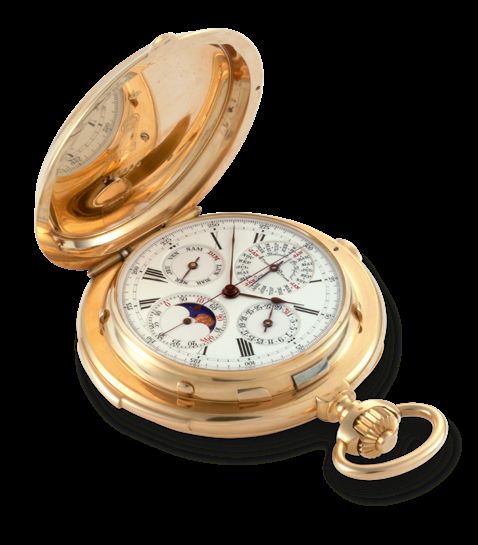
“Technical Achievements” exhibition
                                       Discover the watchmaking genius of the Maison and its mastery
                                       of mechanical complications in the 20th century

Introduction
Retrograde displays                    • The "Technical Achievements" exhibition highlights the inner workings of Vacheron Constantin's watchmaking genius.

Chronographs and split-seconds         • Retrograde displays, split-seconds chronographs, perpetual calendar, minute repeaters models: a selection of eight
chronographs                             masterpieces of mechanical complications from the heritage of the Maison.
The perpetual calendar                 • Exhibition will be held in Vacheron Constantin Taipei 101 Boutique from 23 August to 20 September 2021.
Minute repeaters and Grande Sonnerie   Aug, 2021, Taipei - Since its founding in 1755, Vacheron Constantin has perpetuated watchmaking expertise drawing upon
models
                                       the mastery of the most advanced knowledge and technology. This demanding know-how, which the Manufacture has
Grand Complication combinations        continually enriched throughout its history and continues to explore, is illustrated through a wide range of horological
                                       complications. From the split-seconds chronograph to the perpetual calendar, from the minute repeater to Grand
Watches exhibited
                                       Complication combinations, the "Technical Achievements" exhibition brings together a selection of eight 20th century
Sum-up                                 masterpieces.

                                       “To do better if possible, and that is always possible”: these words written by François Constantin in 1819 sum up the visionary                                                                              2
                                       spirit and quest for excellence of the Vacheron Constantin artisans. From the first watches made in 1755 to the present day,
                                       the Manufacture's heritage is replete with creations testifying to consistent daring and a taste for innovation. A journey
                                       through the archives of the Maison demonstrates the true scope of the skills passed down through several generations of                    1
                                       passionate and curious master-watchmakers, as well as the progress of science and watchmaking genius.

                                       Through a selection of eight historical models, "Technical Achievements" pays tribute to the mechanical feats achieved
                                       in Vacheron Constantin’s workshops during the 20th century. Retrograde displays, split-second chronographs, perpetual
                                       calendar, minute repeaters, and watch with multiple complications are brought together in this exhibition. From pocket
                                       watches to the art of wearing time on the wrist, they reflect the wealth of Vacheron Constantin's technical repertoire and the
                                       desire to continually nurture the expertise accumulated over the centuries. The exhibition is also a reminder of the extent to
                                       which the Manufacture has always endeavoured to place technique at the service of style. Thanks to the miniaturisation of
                                       calibres and their constant technical evolution, Vacheron Constantin has demonstrated tremendous artistic creativity. The
                                       result is a signature touch in which a taste for innovation meets a keen sense of elegance.

                                                                                                                                                                                 3                                                               4

                                                                                                                                                                              1 - Round chronograph watch, Ref. Inv. 11490 (Ref. 4072) - 1930s
                                                                                                                                                                          2   2 - Triple complication pocket watch, Ref. Inv. 10536 - 1901
                                                                                                                                                                              3 - First Grande Sonnerie pocket watch, Ref. Inv. 10715 - 1827
                                                                                                                                                                              4 - "Mercator" wristwatch, Ref. Inv. 11992 - 1995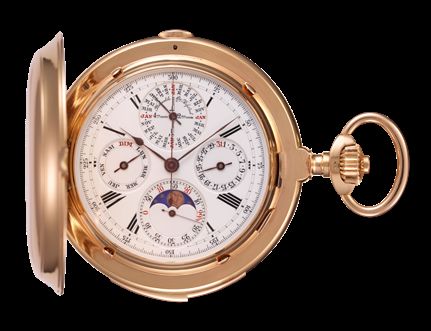
“Technical Achievements” exhibition
                                       Discover the watchmaking genius of the Maison and its mastery
                                       of mechanical complications in the 20th century

Introduction
Retrograde displays                    Retrograde displays
Chronographs and split-seconds
chronographs                           The design and adjustment of a movement with retrograde indications requires great technical virtuosity. First and foremost,
                                       the development of such a mechanism implies mastery of the considerable forces brought into play by the instantaneous
The perpetual calendar
                                       return of the hands over an almost 180° arc in a mere fraction of a second. It also implies perfect energy management in order
Minute repeaters and Grande Sonnerie   to enable the sudden movement of the hand. This technical tour de force enables time to be displayed in an original way while
models                                 maintaining the inherent precision requirements of Haute Horlogerie timepieces.
Grand Complication combinations
                                       Watchmaking history reveals that retrograde displays already appeared in pocket watches during the late 17th century. These
Watches exhibited                                                                                                                                                                                                                                                             2
                                       featured an hour hand that travelled across an arc for half the day before returning to its starting point to begin all over again.
Sum-up                                 Vacheron Constantin has been incorporating retrograde displays into its creations since the end of the 18 th century. The
                                       originality of this complication enabled it to give free rein to its technical creativity.

                                       Among the most famous models is a ‘bras en l’air’ (‘arms in the air’) movement presented in 1930 in a pocket watch case
                                       bearing the signature of Verger Frères. Subsequently, Vacheron Constantin produced other original interpretations
                                       depicting a fakir or a Chinese magician whose arms replaced the retrograde hands to indicate the hours and minutes. Over
                                       the following decades, these ‘arms in the air’ models inspired multiple contemporary variations of the retrograde display,
                                       such as the Mercator and Saltarello wristwatches created in the 1990s. These are among the most striking examples of                        1
                                       Vacheron Constantin's technical and aesthetic daring – a heritage that the Manufacture continues to enrich through highly
                                       sophisticated models added to its current collections, such as the Patrimony moon phase retrograde date watch - Collection
                                       Excellence Platine unveiled in 2020. The one-of-a-kind Les Cabinotiers Armillary tourbillon perpetual calendar - Planeteria
                                       presented in 2021 also presents an innovative interpretation of this complication by integrating a triple retrograde indication
                                       for the date, months and days.

                                                                                                                                                                                                                                                                                  4

                                                                                                                                                                                                           3

                                                                                                                                                                                 1 - "Saltarello" men's watch, Ref. Inv. 11000 - 1998
                                                                                                                                                                             3   2 - Round "arms in the air" pocket watch, Ref. Inv. 11060 - 1930
                                                                                                                                                                                 3 - "Mercator" wristwatch, Ref. Inv. 11992 - 1995
                                                                                                                                                                                 4 - Les Cabinotiers Tourbillon Armillary Tourbillon perpetual calendar - Planetaria - 2021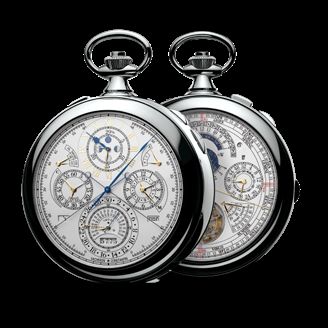
“Technical Achievements” exhibition
                                       Discover the watchmaking genius of the Maison and its mastery
                                       of mechanical complications in the 20th century

Introduction
Retrograde displays                    Chronographs and split-seconds chronographs
Chronographs and split-seconds
chronographs                           The chronograph is one of the most recent horological complications: it was not until the early 19th century that watchmakers
                                       achieved a sufficient level of precision to develop a system for measuring short times by means of a mechanism enabling a
The perpetual calendar
                                       hand to be stopped and restarted without hindering the movement. This invention was quickly followed by another equally
Minute repeaters and Grande Sonnerie   brilliant one designed to measure several events simultaneously by means of a double hand system. Invented in 1838, the
models                                 split-seconds chronograph remains one of the most sophisticated mechanical developments and is greatly appreciated by
Grand Complication combinations
                                       watch enthusiasts.

Watches exhibited                      As functional as it is technically ingenious, this mechanism serves to time actions starting at the same time but of different
Sum-up                                 durations. When the watch is activated, the chronograph hand and the split-second hand are superimposed. When the pusher
                                       is pressed, the split-second hand stops while the chronograph hand continues its progression. After memorising an initial
                                       time, a further press releases the split-seconds hand, which then synchronises instantly with the chronograph seconds
                                       hand that is still running. This operation can be repeated as many times as necessary to carry out several successive timing
                                       operations.

                                       Vacheron Constantin joined the fray at an early stage by incorporating the chronograph complication into elegant pocket
                                       watches that were particularly sought after at turn of the 20th century, in an era when the world was becoming fascinated by             1
                                       sports competitions and horse races. Thanks to the progress made in the miniaturisation of its movements, the Manufacture
                                       was also quick to adopt the complex column-wheel chronograph mechanism in elegant watches from 1917 onwards.

                                       A number of historical models well-known to collectors for their bold design and unfailing reliability testify to this tendency.
                                       Among them is a 1942 chronograph, Reference 4083, which stands out both for its legibility and for the design of its double-                                                                                                            2
                                       cylinder lugs. Another example is the prestigious Reference 4072, a chronograph produced by Vacheron Constantin between
                                       the 1930s and the early 1970s, which owes its exceptional longevity to its timeless design and the exceptional quality of its
                                       movements.

                                       Faithfully cultivated throughout the last century, the expertise of the Manufacture's artisans in the field of chronographs is
                                       alive and well, as demonstrated by ingenious interpretations such as the Traditionnelle split-seconds chronograph ultra-thin -
                                       Collection Excellence Platine. Introduced in April 2021, this timepiece is powered by the prestigious self-winding Calibre 3500,
                                       one of the finest to date for this type of complication.

                                                                                                                                                                                                             3

                                                                                                                                                                          4   1 - Chronograph watch, Ref. Inv. 11017 (Ref. 4083) - 1942
                                                                                                                                                                              2 - Round chronograph watch, Ref. Inv. 11490 (Ref. 4072) - 1938
                                                                                                                                                                              3 - Traditionnelle split-seconds chronograph ultra-thin - Collection Excellence Platine - 2021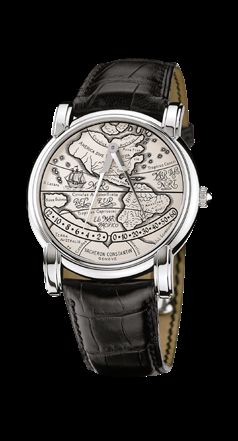
“Technical Achievements” exhibition
                                       Discover the watchmaking genius of the Maison and its mastery
                                       of mechanical complications in the 20th century

Introduction
Retrograde displays                    The perpetual calendar
Chronographs and split-seconds
chronographs                           The perpetual calendar is one of the trickiest horological complications to develop. Considered a masterpiece of horological
                                       genius, this mechanism takes into account the variations of the Gregorian calendar so as to automatically adjust to months
The perpetual calendar
                                       of 30 and 31 days or 28 and 29 days in February, without requiring any correction until 2100. To do this, the movement must
Minute repeaters and Grande Sonnerie   have a mechanical memory whose sequences are repeated every 48 months. The solution is a cam, a component consisting
models                                 of notches of varying depths. The deeper the notch, the shorter the month. This information from the cam is transmitted via
Grand Complication combinations
                                       a feeler spindle to a large lever that operates the various displays. It represents a technical solution to an astronomical and
                                       mathematical problem that Vacheron Constantin addressed by presenting its first perpetual calendar watch in 1884.                                   1
Watches exhibited                                                                                                                                                                                                                                3
Sum-up                                 For almost a century, the Manufacture used this technical prowess exclusively in pocket watches. Thanks to progress in
                                       movement miniaturisation and the trend towards increasingly large wristwatch diameters, the 1980s marked a turning
                                       point with the 1983 creation of the first perpetual calendar to be fitted in an ultra-thin wristwatch (Reference 43031).
                                       Its movement, the prestigious Calibre 1120 QP, constitutes a technical challenge and is still majestically enthroned in the
                                       most demanding creations of the Manufacture, such as the Overseas perpetual calendar ultra-thin. Its latest skeletonised
                                       variation, presented in 2021 in a white gold case, enables viewers to admire – both on the dial side and through the sapphire
                                       crystal caseback – the components of Calibre 1120 QPSQ/1, delicately hollowed out, finished and decorated in the finest
                                       traditions so as to enhance the functional beauty of the mechanism.

                                       Engaged in a continuous quest for innovation, Vacheron Constantin also expanded its technical repertoire with the
                                       Traditionnelle Twin Beat perpetual calendar watch presented in 2019. The 3610 QP calibre powering this timepiece is endowed
                                       with a dual frequency, enabling its owner to reduce the watch's energy consumption when it is not on the wrist. This action
                                       serves to extend the power reserve to at least 65 days – a technical advance that gives real meaning to the term "perpetual"
                                       and opens up new perspectives for traditional watchmaking.

                                                                                                                                                                                       2                                                   4

                                                                                                                                                                             1 - First perpetual calendar pocket watch, Ref. Inv. 10155 - 1884
                                                                                                                                                                             2 - Overseas perpetual calendar ultra-thin skeleton - 2021
                                                                                                                                                                         5   3 - Traditionnelle Twin Beat perpetual calendar - 2019
                                                                                                                                                                             4 - First perpetual calendar offered in an ultra-thin wristwatch,
                                                                                                                                                                                 Ref. Inv. 11344 (Ref. 43031) - 1983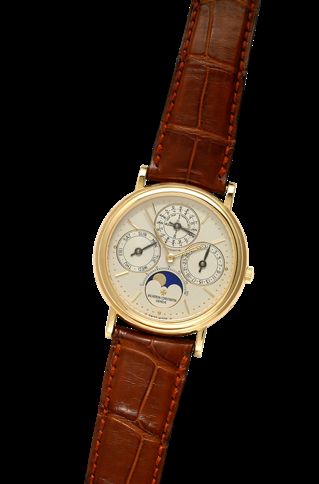
“Technical Achievements” exhibition
                                       Discover the watchmaking genius of the Maison and its mastery
                                       of mechanical complications in the 20th century

Introduction
Retrograde displays                    Minute repeaters and Grande Sonnerie models
Chronographs and split-seconds
chronographs                           Born of the need to tell the time in the dark at a time when people were still reliant on candlelight, chiming watches have
                                       been one of Vacheron Constantin's great specialities for more than two centuries and are available in various forms. The
The perpetual calendar
                                       Manufacture's watchmakers have repeatedly distinguished themselves through strike-on-demand, minute repeater
Minute repeaters and Grande Sonnerie   (striking the hours, quarters and minutes on demand, Petite Sonnerie (striking the hours and quarters without repeating the
models                                 hours at each quarter) and Grande Sonnerie (striking the hours and quarters with a repetition of the hours at each quarter)
Grand Complication combinations
                                       complications. Among these, the sophisticated Grande Sonnerie mechanism is considered by connoisseurs as the pinnacle
                                       of musical watches. Few watchmakers are capable of mastering the demands involved in its design and construction: the
Watches exhibited                      synchronisation of the components must not only be perfect in order to set the time to music, but also to ensure the reliable
Sum-up                                 operation of the movement, as any interference between the different functions is likely to damage the mechanism. The
                                       issue of energy management is also crucial, given that the movement orchestrates 912 hammer strikes on the gongs every
                                       24 hours. Not to mention the harmonic tone and acoustic power that make the creation of such a model an exercise reserved
                                       for the most experienced watchmakers.
                                                                                                                                                                               1

                                       The Manufacture's archives attest to the first chiming timepiece created in 1806 by the founder's grandson,
                                       Jacques Barthélemi Vacheron. The first watch with a Grande Sonnerie mechanism signed Vacheron Constantin dates back
                                       to 1827. Since then, the Manufacture has consistently cultivated and enriched this heritage, to the point of becoming a
                                       benchmark for the most illustrious collectors such as the Maharajah of Patiala, who commissioned a pocket watch with
                                       chronograph, alarm, date and moon phases in 1909; as well as American car manufacturer James Ward Packard, for whom
                                       Vacheron Constantin created a pocket watch equipped with a chronograph, a quarter and half-quarter repeater, and a Grande
                                       Sonnerie in 1918 . Over the course of the century, orders poured in from all over the world for Vacheron Constantin's repeater
                                       watches and Grande and Petite Sonnerie complications, combining virtuoso mechanics with impeccable acoustic resonance.
                                       The Manufacture continues to perpetuate this expertise today, notably through one-off models such as the Les Cabinotiers                                                                                               2
                                       minute repeater tourbillon sky chart – Leo constellation Jewellery watch, whose Calibre 2755 TMRCC combines a minute
                                       repeater with a tourbillon and drives a rotating map of the celestial vault.

                                                                                                                                                                                                                               3

                                                                                                                                                                            1 - First Grande Sonnerie pocket watch, Ref. Inv. 10715 - 1827
                                                                                                                                                                        6   2 - Pocket watch equipped with a chronograph, a quarter and half-quarter repeater, a Petite Sonnerie and
                                                                                                                                                                                a Grande. Sonnerie, Inv. Ref. 11527 - 1918
                                                                                                                                                                            3 - Les Cabinotiers Minute Repeater Tourbillon sky chart - Leo constellation jewellery watch - 2021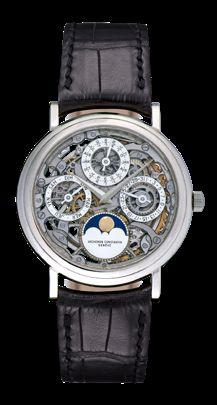
“Technical Achievements” exhibition
                                       Discover the watchmaking genius of the Maison and its mastery
                                       of mechanical complications in the 20th century

Introduction
Retrograde displays                    Grand Complication combinations
Chronographs and split-seconds
chronographs                           As early as 1900, Vacheron Constantin set up a workshop exclusively dedicated to watches with complications. It is here,
                                       where the most seasoned watchmakers rub shoulders, that high-flying watches are born.
The perpetual calendar
Minute repeaters and Grande Sonnerie   Housed in elegantly sculpted gold cases, several extremely complex mechanisms are combined. Two examples reflect the
models                                 technical mastery of Vacheron Constantin's artisans in the creation of Grand Complications, whose golden age reached
Grand Complication combinations
                                       its peak between the 1920s and 1930s: a triple complication from 1901 combining a minute repeater, a chronograph with a
                                       tachymeter scale and an astronomical perpetual calendar; as well as a 1910 hunter-type watch featuring a perpetual calendar,
Watches exhibited                      a quarter repeater and a moon-phase indication.
Sum-up
                                       Nearly a century later, the Manufacture is continuing its epic technical saga by combining the traditional principles of
                                       watchmaking with the latest mechanical advances. In 2015, after eight years of research, Vacheron Constantin unveiled
                                       Reference 57260, the most complicated timepiece ever made. This double-dial pocket watch features 57 complications,                                                                                                     2
                                       including multiple calendars and a split-seconds chronograph with double retrograde display.

                                       This unique expertise in the field of Grand Complications is also illustrated through wristwatches showcasing a resolutely
                                       21st century style. Presented in 2020, the one-of-a-kind Les Cabinotiers split-seconds chronograph - Tempo is the most                  1
                                       complicated wristwatch ever made by Vacheron Constantin. On its two sides, it displays a split-seconds chronograph, a
                                       perpetual calendar, several astronomical functions, a tourbillon and a minute repeater. This mechanical tour de force is
                                       orchestrated by an exceptional calibre featuring 24 complications and 1,163 components.

                                                                                                                                                                                        3

                                                                                                                                                                      7   1 - Hunter-type watch with astronomical perpetual calendar, Ref. Inv. 10722 - 1910
                                                                                                                                                                          2 - Triple complication pocket watch, Ref. Inv. 10536 - 1901
                                                                                                                                                                          3 - Reference 57260 - 2015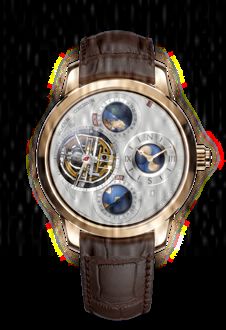
“Technical Achievements” exhibition
                                       Discover the watchmaking genius of the Maison and its mastery
                                       of mechanical complications in the 20th century

Introduction
Retrograde displays                    Watches exhibited
Chronographs and split-seconds
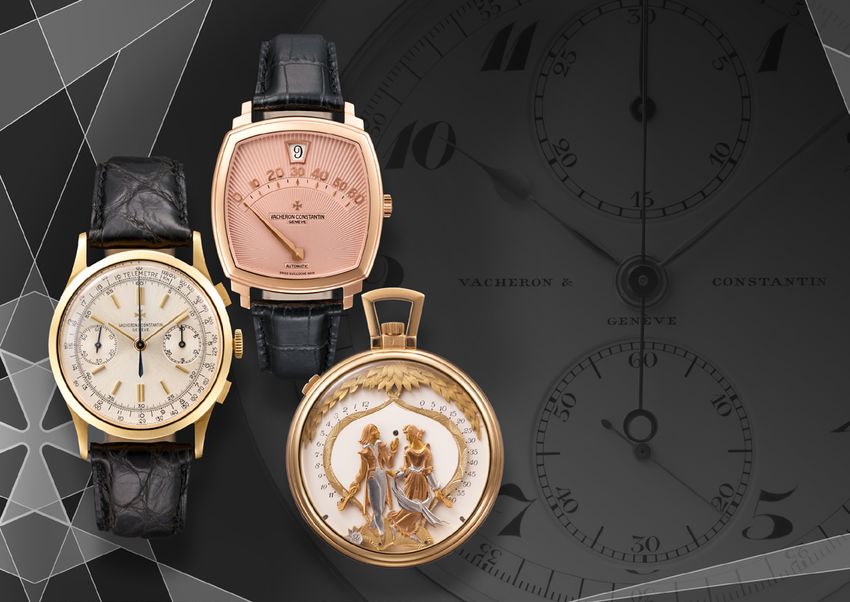
chronographs                           1 - Round "Joueurs de volants" (shuttlecock players) pocket watch, Ref. Inv. 10667 - 1960
                                       Between the 1920s and the 1930s, Vacheron Constantin unrestrainedly displayed its creative daring in the form of pocket
The perpetual calendar
                                       watches with retrograde ‘arms in the air” displays. This 18K yellow gold "Joueurs de volants" model is directly inspired by this
Minute repeaters and Grande Sonnerie   trend. Engraved in yellow, white and pink gold, the young man points to the hours with his right arm, while his partner indicates
models                                 the minutes.
Grand Complication combinations
                                       2 - “Mercator" wristwatch, map of the Americas, Ref. Inv. 12055 - 1996
Watches exhibited                      Created on the occasion of the 400thanniversary of the death of the father of cartography, Gérard Mercator, this 18K yellow
Sum-up                                 gold wristwatch is distinguished not only by the refinement of its hand-engraved dial representing Mercator's map of the
                                       Americas, but also by the originality of its retrograde display. The compass-shaped hands indicate respectively the retrograde
                                       hours and minutes on two sectors placed on the lower part of the dial.

                                       3 - “Saltarello” wristwatch, Ref. Inv. 10740 - 2000
                                       Over successive eras, Vacheron Constantin has developed the retrograde display complication in numerous stylistic
                                       variations. At the heart of the cushion-shaped 18K pink gold case of the Saltarello model, Vacheron Constantin opted for
                                       simplicity: the jumping hours are indicated in an aperture, while the retrograde minutes hand sweeps majestically across the
                                       centre of the pink gold dial.
                                                                                                                                                                                      2

                                                                                                                                                                                                                                                                       3

                                                                                                                                                                                                                                                                   1

                                                                                                                                                                           8   1 - Round "arms in the air" Chinese magician pocket watch, Ref. Inv. 11060 - 1930
                                                                                                                                                                               2 - "Mercator" wristwatch, map of Europe, Asia & Africa, Ref. Inv. 12130 - 1996
                                                                                                                                                                               3 - Saltarello wristwatch, Ref. Inv. 11000 - 1998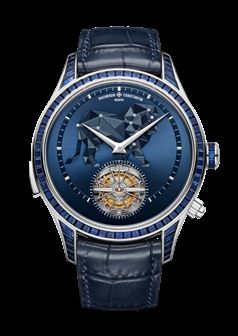
“Technical Achievements” exhibition
                                       Discover the watchmaking genius of the Maison and its mastery
                                       of mechanical complications in the 20th century

Introduction
Retrograde displays                    Watches exhibited
Chronographs and split-seconds
chronographs                           1 - Round pocket chronograph and stopwatch, Ref. Inv. 11091 - 1914
                                       The split-seconds chronograph is certainly one of the most sophisticated mechanical developments in terms of its design
The perpetual calendar
                                       and the sophistication of its settings. In 1914, Vacheron Constantin incorporated it into this yellow gold "Lépine" type pocket
Minute repeaters and Grande Sonnerie   stopwatch. Its sleek and beautifully balanced white enamel dial features a 30-minute counter at 12 o'clock and a small
models                                 seconds hand at 6 o'clock.
Grand Complication combinations
                                       2 - Wrist chronograph, Ref. Inv. 12049 - 1967
Watches exhibited                      This 18K yellow gold wristwatch is one of the most popular chronographs among collectors and watch connoisseurs.
Sum-up                                 Vacheron Constantin produced this model between the late 1930s and the early 1970s. Powered by a chronograph calibre
                                       incorporating a column-wheel system, it features a satin-brushed silver-toned dial on which the 30-minute and small
                                       seconds counters are harmoniously arranged, complemented by telemeter and tachymeter scales.

                                       3 -Perpetual calendar wristwatch, Ref. Inv. 12122 - 1994
                                       In 1984, Vacheron Constantin fitted a wristwatch with a perpetual calendar movement for the very first time. Hailed for
                                       its precision and reliability, this prestigious calibre, which can still be found in the Manufacture's contemporary collections,
                                       equips this 1994 platinum watch. Skeletonised and engraved by hand, all its components have been hollowed out and carefully
                                       decorated to highlight the beauty of this mechanism with its moon phase.
                                                                                                                                                                                  2

                                                                                                                                                                                                                                                   3

                                                                                                                                                                                                   1

                                                                                                                                                                          9   1 - Round pocket chronograph and stopwatch, Ref. Inv. 11091 - 1914
                                                                                                                                                                              2 - Wrist chronograph, Ref. Inv. 12049 - 1967
                                                                                                                                                                              3 - Perpetual calendar wristwatch, Ref. Inv. 12122 - 1994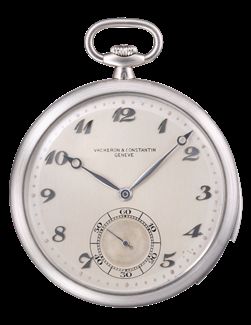
“Technical Achievements” exhibition
                                       Discover the watchmaking genius of the Maison and its mastery
                                       of mechanical complications in the 20th century

Introduction
Retrograde displays                    Watches exhibited
Chronographs and split-seconds
chronographs                           1 - Minute repeater pocket watch, Ref. Inv. 10652 - 1938
                                       A true feat of miniaturisation and acoustic quality, this round pocket watch produced in 1938 houses a minute repeater
The perpetual calendar
                                       mechanism within its platinum case. Its silver-toned dial is punctuated by a small seconds counter at 6 o'clock, while the
Minute repeaters and Grande Sonnerie   caseback is soberly engraved with the monogram "E.G.R.".
models
Grand Complication combinations
                                       2 - Minute repeater pocket chronograph with tachymeter scale and astronomical perpetual calendar, Ref. Inv. 10536 - 1901
                                       As early as 1900, Vacheron Constantin set up a workshop specially dedicated to the assembly of Grand Complication
Watches exhibited                      watches, such as this 18K red gold hunter-type pocket watch combining a minute repeater, a single-pusher chronograph
Sum-up                                 with a tachymeter scale and an astronomical perpetual calendar. From an aesthetic standpoint, this prestigious model is
                                       distinguished by the perfect legibility of the indications harmoniously arranged on its white enamel dial.

                                                                                                                                                                                                                                                                         1

                                                                                                                                                                                                                                        2

                                                                                                                                                                10   1 - Minute repeater pocket watch, Ref. Inv. 10652 - 1938
                                                                                                                                                                     2 - Minute repeater pocket chronograph with tachymeter scale and astronomical perpetual calendar,
                                                                                                                                                                         Ref. Inv. 10536 - 1901
“Technical Achievements” exhibition
Discover the watchmaking genius of the Maison and its mastery
of mechanical complications in the 20th century
Introduction
Retrograde displays Sum-up
Chronographs and split-seconds
chronographs True to François Constantin's motto, "Do better if possible, and that is always possible", Vacheron Constantin has always
been committed to transmitting and enriching its mechanical and aesthetic expertise. Paying tribute to the horological feats
The perpetual calendar
of its artisans throughout the 20th century, the "Technical Achievements" exhibition brings together eight masterpieces
Minute repeaters and Grande Sonnerie of technical sophistication from its heritage. Retrograde display, split-seconds chronograph, perpetual calendar, minute
models repeater and Grand Complications watch bear witness to the full scope of the skills passed on across several generations of
Grand Complication combinations
passionate and curious master watchmakers, as well as to the advancement of science and to the evolution of watchmaking
engineering. The exhibition also paints a picture of an innovative and daring Manufacture, firmly rooted in the progress of its
Watches exhibited time.
Sum-up
Triple complication pocket watch,
Ref. Inv. 10536 - 1901
11Founded in 1755, Vacheron Constantin is the world’s oldest watch Manufacture in continuous production for over 265 years, faithfully perpetuating a proud heritage of watchmaking excellence and stylistic sophistication through generations of master craftsmen. At the pinnacle of Haute Horlogerie and understated elegance, the Maison creates timepieces with unique technical and aesthetic signatures, and an extremely high level of finishing touches. Vacheron Constantin brings to life unparalleled heritage and a spirit of innovation through its collections: Patrimony, Traditionnelle, Métiers d’Art, Overseas, Fiftysix, Historiques and Égérie. It also offers its discerning clientele of connoisseurs the rare opportunity to acquire unique and bespoke timepieces by means of its “Les Cabinotiers“ department. #VacheronConstantin #OneOfNotMany
You can also read


