Telkom University Visayas State University - INDONESIA PHILIPPINES
←
→
Page content transcription
If your browser does not render page correctly, please read the page content below

Telkom University
INDONESIA

Visayas State University
PHILIPPINES

GREETINGS!

The Regional Rating System - UNIVERSITY PERFORMANCE METRICS - UPM has been developed
to assess the responsiveness of universities in the Fourth Industrial Revolution era through the five
core indicators: Entrepreneurial Spirit, Innovative Approaches, Digital Transformation, Student
Mobility, and Ethical Values.
UPM includes a set of 54 indicators across 8 categories following two distinctive orientations:
research and application. Evaluation results are presented in the form of an overall score for the
whole institution and a score for each category and each indicator, corresponding to a number of
Stars ranging from 1 – 5 and 5 Stars ELITE.
This rating system could bring significant benefits to different stakeholders. Higher-education
institutions can use it as a benchmark tool for strategic development, as well as evidence-based
branding for attracting students and potential partners.
Benchmarking results can be used as useful indicators for students to select study destinations and
for employers to recruit qualified human resources. They can also be a reliable source of reference
for national governments to make future policies or decisions on education.
UPM is extremely pleased to inform you the benchmarking results of your institution. This assessment
report presents the detailed rating results and the data that has been used as the basis for the rating
score. Hopefully, this would provide you with useful information for your institution’s self-
benchmarking and strategic governance. In addition, you can use it for your media communication.
Thank you for taking part in UPM. If you need any further information about the results, please feel free to
contact us at upm@vnu.edu.vn.

Audit and assessment start date: 10 Dec 2020
Delivery date: 10 Feb 2021
Validity date: 10 Feb 2021 – 10 Feb 2024

Project Manager
Prof. Nguyen Huu Duc
upm@vnu.edu.vn

                             Innovate to Transcend
OVERALL RATING

Achieved score                    Maximum score
714.5                                      1000

CATEGORY RATING

STRATEGIC GOVERNANCE

                                                                             Minimum
                                                                                       Real
No.                  Criterion & Indicators                         Weight    rating          Score   Awarded stars
                                                                                       data
                                                                               level

1.    Strategic Governance                                           60                        49

      Strategy
      The university’s strategy reflects vision, mission and
      culture as well as strategic goals of education, research
1.1   and community service; innovation & entrepreneurship           15        1-7      6      13
      orientation and development of the smart, digitalized
      university in response to the demands of fourth
      industrial revolution
      Plan
      Mid-term and short-term plans of the institution and
1.2   units in the institution are aligned, assuring the             10        1-7      6      8.5
      implementation of the contents and in the development
      strategy
      Organizational structure and management
      Related units/divisions are established and have specific
1.3   functions to perform strategic tasks (in particular for the    10        1-7      5      7
      functions of innovation, entrepreneurship, digital
      transformation), with reasonable size and performance
      Implementation
      Documents, policies and resource allocation to carry out
1.4   missions and achieve goals are established and                 15        1-7      5     10.5
      implemented, especially resource investment for
      achieving the goals of innovation, starts-up and building
      a smart university
      Accreditation and ranking
1.5   Having got the results of institutional accreditation          10       5-10     10      10
      or/and national/international ranking for the institution
      or related field.
EDUCATION

                                                                             Minimum
                                                                                       Real
No.                  Criterion & Indicators                         Weight    rating          Score   Awarded stars
                                                                                       data
                                                                               level

2.     Education                                                     350                      195.5

       Quality of incoming students
2.1    The average score (the admission percentage) of               40       12-25    25      40
       incoming freshmen in national university entrance exams
       of all disciplines in the last 3 consecutive years

       Size of academic faculty
2.2    The proportion of academic staff in the total number of       35       2-8%     4.3     9
       undergraduate and postgraduate students

       Academic faculty quality
2.3    The proportion of academic faculty staff with a Ph.D.         40       3-70%    23      11
       degree in the total number of academic staff

       Faculty reputation
2.4    The proportion of lecturers bearing titles of professor or    35       1-20%    3.6     3
       associate professor to the total number of faculty staff

       Size of graduate education
2.5    The proportion of graduate education (MSc. and Ph.D.          30        20%     1.75    2.5
       students) to the overall scale of the institution’s
       education
       Size of doctoral education
2.6    The average number of Ph.D. degrees awarded in the last       20         5       -       -           -
       3consecutive years

       Program’s expected learning outcomes
2.7    The program’s ELOs are stated approaching the                 15        1-7      5     10.5
       requirements of 4IR

       Updating and adjusting conventional
       curriculum structure
2.8    The conventional curriculum structure is updated to be        15        1-7      5     10.5
       open, flexible with broad foundation knowledge and
       highly responsive to the requirements of 4IR.
       Developing new training programs directly
       related to 4IR
       The new programs are related to basic 4.0 technologies
2.9    such as IoT, AI, Big Data, Robotics, 3D printing              20        1-5      6      20
       technology, Material and Sensor technology, Energy,
       Biotechnology, or integration of all the above
       technologies, Digital Economy, Creative and Culture
       Industries…
       Personalized learning
       Bring into full play of the advantages of credit-based
       training, reaching the goal of individualization and/or
2.10                                                                 10        1-7      5      7
       personalization in training; encouraging cooperation
       among the faculties in the institution, with other
       universities and industries
Students’ research and start-up projects
2.11   Student research and start-up projects are organized         15   1-7     5    10.5
       effectively. International, national and ministerial-level
       or equivalent prizes are attained
       Student’s satisfaction with the teaching
2.12   90% of student satisfaction with scaled scores down to       20   90%    83    16.5
       50% of student satisfaction. Results conducted by the
       institution applied to all the education programs

       Employers’ satisfaction with the teaching
2.13   90% of employers satisfaction with scaled scores down to     20   90%    100   20
       50%

       Student employability
2.14                                                                20   90%    100   20
       The percentage of graduates have jobs within 12 months

       Student academic awards
       The percentage of awards for research, innovation, start-
2.15   up, Olympic competition… at ministerial, national,           15   1.0%   1.5   15
       international and equivalents related to the training
       fields of the institution in the last 3 years
RESEARCH

                                                                             Minimum
                                                                                       Real
No.                  Criterion & Indicators                         Weight    rating          Score   Awarded stars
                                                                                       data
                                                                               level

3.    Research                                                       200                      155

      International publications
3.1   The average number of ISI and/or Scopus research               100       1.5     2.64   100
      papers per academic staff in the last 5 years

      Research quality
3.2   The average number of citations per ISI-Scopus research        60        10      2.5     15
      paper per academic staff in the last 5 years

      Academic/scholarly books publication
3.3   The average number of academic/scholarly books with            20         2       5      20
      respect to a post-graduate discipline and field in the last
      3 years
      Prolific researches
3.4   The percentage of faculty staff getting ministerial,           20       0.5%     0.5     20
      national or international academic awards in the last 5
      years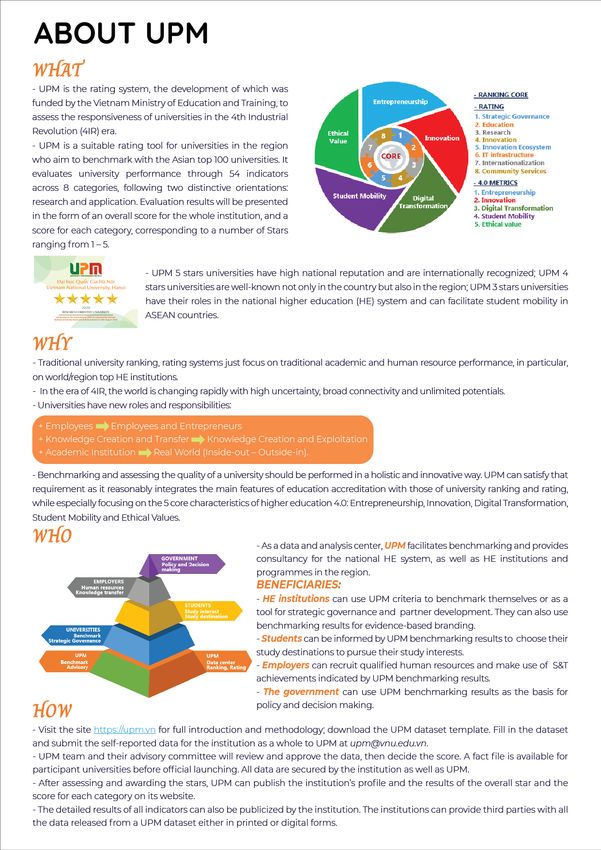
INNOVATION

                                                                              Minimum
                                                                                        Real
No.                   Criterion & Indicators                         Weight    rating          Score   Awarded stars
                                                                                        data
                                                                                level

4.     Innovation                                                     110                      85.5

       Nationally recognized intellectual property
4.1    The number of copyrights, utility solutions, patents           30        20      622     30
       registered with national IP offices during the last 5 years

       Globally recognized intellectual property
4.2    The number/proportion of patents registered with               10         5       -       -           -
       international IP offices during the last 5 years

       Revenue for research and innovation
4.3    The average proportion of sponsorship revenue for              50        15%     10.6   35.5
       research, R&D, innovation and start-up to the total
       revenue during the last 3 years
       Start-up businesses and spin-off
       companies
4.4.   Start-up businesses and spin-off companies developed           20         5      38      20
       from faculty staff’s and students’ research outcomes
       during the past 5 years
INNOVATION ECOSYSTEM

                                                                          Minimum
                                                                                    Real
No.                Criterion & Indicators                        Weight    rating          Score   Awarded stars
                                                                                    data
                                                                            level

5.    Innovation Ecosystem                                        60                        46

      Research, R&D and innovation facilities
5.1   Education programs have adequate laboratories and           20        1-7      5     14.5
      equipment for practice, research, R&D and innovation

      Creative co-working space and start-up
      supports
5.2   Space for innovation and start-up support is where          20        1-7      5     14.5
      faculty staff, students and start-up community share
      ideas, design, construct and develop new products
      Business incubator
5.3   A business incubator is a unit/section that provides        10        1-7      5      7
      services, office space, management training… to nurture
      start-ups to develop into independent businesses
      Business/industry partners
      A number of businesses, industries and organizations
5.4   that have collaboration in students’ research, start-up     10         2      10      10
      projects; provide funding/grants for customized research
      or/and collaboration in R&D resulting in co-publications
      and shared IP license/industry co-patents
INFORMATION TECHNOLOGY INFRASTRUCTURE
Minimum
Real
No. Criterion & Indicators Weight rating Minimum Score Awarded stars
data Real
No. Criterion & Indicators level
Weight rating Score Awarded stars
data
6. IT Infrastructure 100 level 53.5
Network infrastructure and information
connection capacity
Equipped
6.with information sharing/connection system to
IT Infrastructure 100 83.5
ensure the following administrative procedures can be
6.1 carried out online: staff and students attendance 10 1-7 5 7
checking/roll-call; monitoring the use of classrooms and
security condition; electronic library; tuition fees
submission; course Network infrastructure
register; library book borrowingandandinformation
returning; use of online learning materials
connection capacity by the staff
6.1
and students. 10 1-7 5 7
Equipped with information connection system to ensure
Competence in thequality analysis
administrative and can be carried out online
procedures
managementCompetence in quality analysis and
6.2 Database and statistics software for 7 key fields: 10 1-7 5 7
management
6.2research,
education, staff, finance, infrastructure &
Database and statistics software for key fields: education, 10 1-7 5 7
facilities, learners and quality assurance database.
research, staff, finance, infrastructure & facilities,
Digital scholarly resources
learners and quality assurance database
6.3 The number of digitized learning
Digital scholarly materials and
resources 10 20 8 4
copyrighted digital documents on the institution's
6.3 The number of digitized learning materials and 10 20 122 10
website/repository per faculty member.
copyrighted digital documents on the institution's
Learning resource access per faculty member
website/repository
6.4 Statistics of access frequency to digitalized learning 10 5 1 2
resources Learning resource access
6.4 Statistics of access frequency to digitalized learning 10 5 7 10
Degree of online academic interaction
resources
6.5 Frequency of average connection, interaction among 10 2 0.5 2.5
faculty staff and students
Degreein of theonline
course group
academic interaction
(twice/student/week), counted by specialized tools).
6.5 Frequency of average connection, interaction among 10 2 - - -
MOOC and digital faculty lessons (e-Learning)
staff and students in the course group
The average number (twice/student/week),
of online or/and MOOC counted by specialized
courses of tools)
6.6 10 5 0.3 0.5
the total number ofMOOC and
education digitalwith
programs lessons (e-Learning)
necessary
links demonstrated in the institution’s portal.
6.6 The average number of online or/and MOOC courses of 10 5 10 10
Application oftheCyber Physical
total number Systemprograms
of education (CPS) with necessary
links demonstrated
Several virtual practice in the manufacture
laboratories and/or institution’s portal
6.7 Application
factories related to the applicationof
ofCyber
IoT, AI...Physical
having System 10(CPS) 3 1 5
copyright are being in use for the total number of tertiary
Several virtual practice laboratories and/or manufacture
programmes.
6.7 10 3 6 10
factories related to the application of IoT, AI... having
Wifi access copyright are being in use for the total number of tertiary
6.8 WIFI access acrossprogrammes
75% of campus area (excluding 10 75% 100 10
classrooms, lecture halls,access
Wifi administration and library
places).
6.8 WIFI access across 75% of campus area (excluding 10 75% 90 10
Duplication check and lecture
classrooms, researchhalls,ethics
administration and library
6.9 places) software for duplication-
Use at least 01 copyrighted 10 1 1 10
checking and research ethics.
Duplication check and research ethics
Webometrics
6.9 index
Use at least 01 copyrighted software for duplication- 10 1 1 10
6.10 Webometrics Ranking assess
checking andthe visibilityethics
research and 10 1-100 45 5.5
accessibility of the institution’s web learning materials
and academic publications.
Webometrics index
Webometrics Ranking assess the visibility and
6.10
INFORMATION TECHNOLOGY
10
INFRASTRUCTURE
1-100 5 9.5
accessibility of the institution’s web learning materials
and academic publications.INTERNATIONALIZATION
INTERNATIONALIZATION
Minimum
Real
No. Criterion & Indicators Weight rating Score Awarded stars
data
level
7. Internationalization 60 40
Using a foreign language as the medium of
7.1 instruction
The number of active programs using mainly a foreign 10 1-3 5 10
language as the medium of instruction whose degrees
are granted by the institution
International joint training programs
The number of active international joint training
7.2 programs, the degrees of which are granted by a foreign 5 1-3 5 5
university or co-granted by the institution and a foreign
university
International students
7.3 2% of students with foreign nationalities studying in 10 2% 3.75 10
formal degree programs (to the total number of the
students in the institution)
International faculty
5% of academic staffs with foreign nationalities (to the
7.4 total number of faculty), who touch at least one 5 5% 3.4 3.5
subject/course or spent at least 3 consecutive months
teaching or doing research at the institution
Inbound exchange students
7.5 3% of students holding foreign citizenship to study or do 5 3% 0.01 - -
internship the credits of which can be transferred.
Outbound exchange faculty
5% of academic staffs (to the total number of faculty),
7.6 who touch at least one subject/course or spent at least 3 5 5% - - -
consecutive months teaching or doing research at the
institution abroad
Outbound exchange students
7.7 2% of students studying or doing do internship the 5 2% 1.5 4
credits of which can be transferred
International conferences or symposiums
7.8 The number of international conferences or symposiums 5 1 2 5
hosted by department or institution per discipline in the
last three years
International research collaboration
7.9 The proportion of ISI-Scopus publications affiliated with 10 0-90% 25 2.5
international scientistsCOMMUNITY SERVICES
COMMUNITY SERVICES
Minimum
Real
No. Criterion & Indicators Weight rating Score Awarded stars
data
level
8. Community Services 60 60
Life-long learning capacity enhancement
8.1 The average number of short-term courses is designed to 20 1 2.3 20
efforts to tailor education to meet the life-long learning
requirements
Sustainable development
Activities promoting and/or implementing the
university’s impact on the community sustainable
8.2 development, such as climate change, energy 20 1 1.25 20
conservation program, water conservative program,
recycle program, transportation policies and the
realization of the UN’s 17 sustainable development goals
Social norm promotion
Community engagement activities (between the
8.3 university and sociopolitical organizations) to support 20 1-5 25 20
and foster harmoniously social norms on a large scale
and effectively
OVERALL 1000 635BASIC FACTS AND FIGURES
BASIC FACTS AND FIGURES
Total student size: 23346
Undergraduate students: 22952
Master students: 394
Doctoral students: 0
Total number of academics: 1001
Full-time faculty staff: 1001
Part-time lecturers/professors: 0
Full-time faculty staff with doctorate degree: 230
Full-time faculty staff bearing titles of Professor or
36
Assoc. Professor:
Total number of education programs: 40
Undergraduate programs: 35
Master programs: 5
Doctoral programs: 0
Data period 2016 – 2020
GENERAL ANALYSIS
Strategic
Governance
GENERAL
1.0 ANALYSIS
0.9
0.8
Community Services 0.7 Education
0.6
0.5
0.4
0.3
0.2
0.1
Internationalization 0.0 Research
IT Infrastructure Innovation
Innovation
EcosystemYou can also read


