Tennessee Blue Book - Tre Hargett Secretar y of State
←
→
Page content transcription
If your browser does not render page correctly, please read the page content below
Tennessee
Blue Book
2019-2020

 Tre Hargett
 Se cretar y of Stat e
State of Tennessee

                                   The Secretary of State
                                            State Capitol
                                  Nashville, Tennessee 37243-1102

 Tre Hargett                                                                       615-741-2819
Secretary of State                                                              Tre.Hargett@tn.gov
                                          January 2020

My Fellow Tennesseans,

  On behalf of the State of Tennessee, it is my privilege to dedicate this year’s edition of the
2019-2020 Tennessee Blue Book to the ratification of the 19th Amendment to the United States
Constitution. Tennessee’s role is of particular significance in the women’s suffrage movement.
Thirty-five states had already ratified the amendment, and all others except Tennessee had voted
against ratification or refused to call a special session for consideration of the amendment.
When Tennessee became the 36th state to ratify, supporters of women’s suffrage finally gained the
necessary number of states required to pass the 19th Amendment.

      With 2020 marking the centennial of Tennessee’s passage of the 19th Amendment, the cover
for this biennial book is yellow, which represents the color of the roses worn by the supporters of
women’s suffrage. The yellow cover will be a great way to commemorate Tennessee’s celebration
for generations to come.

       On the following pages, you will read more about the events that led up to the 19th
Amendment’s passage in Tennessee and therefore nationally. I hope you will take time to read
these pages, and perhaps be inspired to do more research in other sources. It will help you better
appreciate the difficult path to winning this victory for women.

        I encourage you to reflect not only on the women’s suffrage movement but also to think
about your own participation in elections. The most fundamental manner in which we can par-
ticipate in our form of government is by voting for our local, state, and federal leaders. Our vote
is a significant method of making our hopes, dreams, and desires known to those in leadership.
It is how we hold our government accountable.

      Honor not only these women, but all Tennesseans by being an engaged citizen and using
your right to vote to make a positive difference in the future of our great state and nation.

                                          Sincerely,

                                          Tre Hargett
Tennessee Blue Book
100 YEARS OF WOMAN SUFFRAGE
In the summer of 1920, Tennessee became the epicenter for the movement to grant
women the right to vote. In June 1919, Congress sent the 19th Amendment, which
granted full suffrage to American women, to the states for ratification. The long fight
for a constitutional amendment on woman suffrage had achieved an important vic-
tory, but was not over yet. To become law, the amendment would have to be ratified
by thirty-six of the forty-eight states. Thirty-five states had ratified the amendment by
June 1920, and with most of the remaining states having already taken hard stances
against it, suffragists turned their attention to the Volunteer State. In order to complete
ratification in time for the November presidential elections, they would have to con-
vince Governor Albert H. Roberts to call a special session of the legislature. Suffrage
supporters from all over the country began a letter-writing campaign to the gover-
nor, which included telegrams from national suffrage leaders as well as President
Woodrow Wilson. Roberts finally acquiesced on August 7, 1920, formally calling for
a special session of
the Tennessee General
Assembly to convene
on August 9.
Both suffragists and
anti-suffragists estab-
lished headquarters in
the Hermitage Hotel
in Nashville, the for-
mer led by National
A m e r i c a n Wo m a n
Suffrage Association
president Carrie
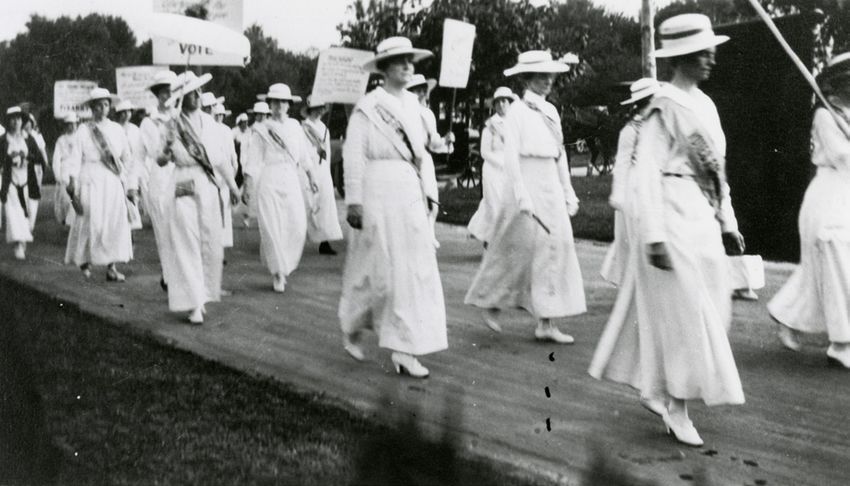
Women march for the right to vote in a Nashville parade for women’s suffrage.
Chapman Catt and the Courtesy of the Tennessee State Library and Archives.
latter led by Josephine
Pearson, the president of the Tennessee State Association Opposed to Woman
Suffrage. Opponents of the 19th Amendment argued that it would violate states’
rights, threaten traditional roles for women, and upset existing race relations by
enfranchising black women. Meanwhile, members of the liquor and manufactur-
ing industries feared the effect women-backed legislation (such as prohibition and
child labor regulations) would have on their profits. Both sides accused the other of
impropriety and bribery as they furiously lobbied legislators.
When the legislature met on August 9, it took only a few days for the Senate to pass
the amendment. The true trial lay ahead. The House, led by Speaker Seth Walker (an
opponent of woman suffrage), delayed consideration of the amendment until August
17, but ended the debate with a motion to adjourn the next day, carried by a vote
of 52-44. Suffragists felt their grip slipping, but the vote was still too close to call.
The next day, the House continued its debate. Legislators, lobbyists, and activists
flooded the State Capitol to answer one question: should women have the right to
vote? Controversy over women’s voting rights had brewed steadily since 1848 but
reached its boiling point that sweltering day in August with advocates for woman suf-
frage donning yellow roses and their opponents wearing red roses. As the legislators
took their places on the House floor, the audience tallied the yellow and red roses
iv Tennessee Blue Book
on their lapels in an attempt to predict the outcome
of the vote. A sea of red seemed to spell doom for
the suffragists. They could only count on 47 votes
in their favor, leaving 49 votes for the opposition.
Harry T. Burn, a freshman legislator from Niota,
arrived with a red rose pinned to his lapel and a let-
ter tucked into his pocket. He had previously shown
support for woman suffrage, but voted to table the
amendment in an attempt to delay its consideration
until after the November elections. The motion to
table, however, failed when Representative Banks
Turner, of Yorkville, voted against it. Confident that
the amendment itself would fail, Speaker Walker
called for a vote on the original motion to ratify.
The vote again came around to Harry Burn. The Harry T. Burn, Republican member of
twenty-four-year-old legislator shocked the entire the Tennessee House of Representatives
from Niota, in McMinn County, provided
House chamber when he voted “Aye.” With his and the 49th vote in favor of ratification.
Turner’s votes, the resolution carried 49-47. In an Courtesy of the Tennessee State Library
and Archives.
attempt at political maneuvering, Speaker Seth
Walker changed his vote to “Aye,” to force recon-
sideration of the resolution, but his strategy failed, and the resolution passed with a
final vote of 50-46. With the vote so close, why did Representative Burn decide to
vote in favor of suffrage? The letter tucked into his pocket had weighed heavily on
his mind. Written by his mother, Febb Ensminger Burn, the letter urged him: “Hurrah
and vote for suffrage and don’t keep them in doubt.” Her support gave him the last
bit of courage needed to take a stand and turn the tide. Despite attempts by the
opposition to challenge the constitutionality of the 19th Amendment on a technical-
ity, the ratification stood and woman suffrage became the law of the land on August
26, 1920. As the thirty-sixth state needed to ratify, Tennessee earned itself the nick-
name “The Perfect 36,” and that democratic legacy lives on through the participation
and service of Tennessee women at all levels of government. — Patricia Mitchell,
Tennessee State Library and Archives
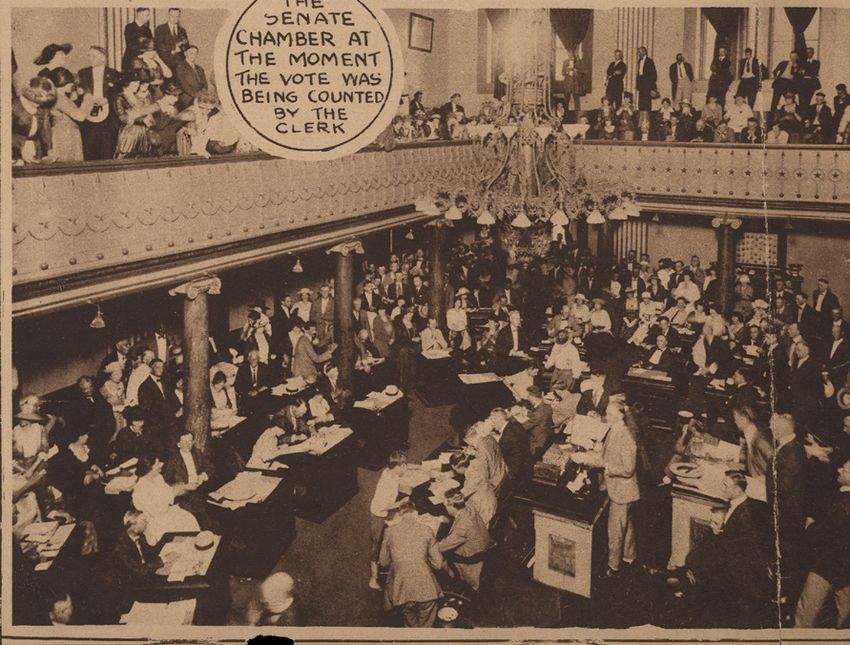
This photograph from the “Ratification
Issue” of the Nashville Tennessean,
Sunday morning, August 29, 1920,
depicts the Senate chamber at the
moment that the clerk counted the his-
toric vote on woman suffrage. Courtesy
of the Tennessee State Library and
Archives.
vTennessee Blue Book
Tennessee Blue Book
2019–2020
Copyright 2019 by the Tennessee Secretary of
State
All rights reserved. Written permission must be
secured from the Tennessee Secretary of State to
use or reproduce any part of this book for commercial
purposes.
The Tennessee Blue Book is produced by the Department
of State’s Publications Division with assistance from individuals in the legislative,
executive, and judicial branches of state government. Publications staff during the
production of this edition were: Jenn Brady, Gabby Cook, Robert A. Greene, Ashley
Hickman, Emily Hollowell, Mary Rachel Leach, Elijah Clemens Smith, Katelyn Smith,
Kate Smitheal, and Cody Ryan York.
I would like to extend special credit to the following: Jed DeKalb, Dawn Majors, and
Theresa Montgomery of the Department of General Services’s office of photographic
services; Dr. Wayne C. Moore, assistant state archivist, Dr. Kevin Cason, archivist, and
Jenn Brady, Gabby Cook, Robert A. Greene, Ashley Hickman, Emily Hollowell, Mary
Rachel Leach, Elijah Clemens Smith, Katelyn Smith, Kate Smitheal, and Cody Ryan
York for their efforts in compiling the 2019–2020 Tennessee Blue Book.
Tre Hargett
Secretary of State
First Floor
State Capitol
Nashville, Tennessee 37243
(615) 741-2819
vi Tennessee Blue Book
Preface
The Tennessee Blue Book serves as a manual of useful information on our state
and government, both past and present. It contains information on the makeup of
Tennessee state government, state history, national and state constitutions, most
recent election results, and census data.
The Blue Book is divided into eight sections. The first three sections are devoted
to the legislative, executive, and judicial branches of government, also referred to
as departments in the Tennessee Constitution. They appear in the order set forth by
the state constitution. The book’s organization is based on the organizational chart
of state government, which appears on the following pages.
Section I focuses on the 111th General Assembly, listing the membership of the
Senate and House of Representatives and their committees. The General Assembly
examines issues affecting Tennesseans and gives guidance necessary for the smooth
operation of state government. The General Assembly elects three constitutional
officers: the secretary of state, the comptroller of the treasury, and the treasurer.
These officials and their departments are featured in this section.
Section II is devoted to the executive branch of government and explains the
function of the departments administered by the governor through his appointed
commissioners. This section also describes the governor’s responsibilities and
explores the history and duties of the agencies under his authority.
Section III examines the judicial branch of state government and provides informa-
tion on the judicial system, courts, and those involved in interpreting state law. The
attorney general and reporter is a constitutional officer appointed by the Tennessee
Supreme Court.
Section IV features the Tennessee Public Utility Commission and explains its role
in advancing the public interest through telecommunications and utilities throughout
the state.
Section V presents the Tennessee congressional delegation in the federal govern-
ment and the United States Constitution.
Section VI contains a cumulative state history, biographies of Tennessee’s for-
mer governors, state historic sites, state symbols and honors, and the Tennessee
Constitution.
Section VII details the results of elections held across the state in 2018 and pro-
vides statistical information regarding Tennessee cities and counties.
Section VIII consists of a topical index and a listing of key illustrations, along with
credit and/or source.
The term “blue book” dates from the 15th century, when the English Parliament
began keeping its records in large volumes covered with blue velvet. Since that time,
the name “Blue Book” has been used to describe many forms of government manu-
als. The Tennessee Blue Book and Official Directory was first published in 1929. Its
predecessor, The Official and Political Manual of the State of Tennessee, was first
published by the Office of the Secretary of State in 1890.
viiTennessee
Electorate
Legislative Executive
Judicial Branch
Branch Branch
Supreme Court
General Assembly Governor
viii
Administrative Attorney
Speaker of Speaker
Office of the General and
the Senate of the House
Courts Reporter
Court of
Secretary of Comptroller of Court of
State Treasurer Criminal
State the Treasury Appeals
Appeals
Boards, Tennessee
Chancery
Commissions, Public Utility Probate Courts Criminal Courts Circuit Courts
Courts
and Councils Commission
Tennessee Blue Book
                                                           Joint                                                                             District
                               Special Joint                                                                       District Public
         Fiscal Review                                   Legislative                                                                        Attorneys
                                Legislative                                                                         Defenders
          Committee                                       Services                                                                           General
                               Committees
                                                         Committee

                                                                                                                                 General
                                 Boards,                                                                                                                Municipal
                                                                                                        Juvenile Courts          Sessions
                               Commissions,                                                                                                              Courts
                                                                                                                                  Courts
                               and Councils

ix
                                                                                       Department of                                 Department of
                         Department            Department of                                                                                                Department of
     Department of                                                     Department of   Economic and          Department of            Environment
                         of Children’s         Commerce and                                                                                                  Finance and
      Agriculture                                                       Correction      Community              Education                  and
                           Services              Insurance                                                                                                  Administration
                                                                                       Development                                   Conservation

                                                                                                              Department of          Department             Department of
      Department          Department                                    Department      Department
                                               Department of                                                 Intellectual and        of Labor and           Mental Health
      of Financial        of General                                     of Human        of Human
                                                  Health                                                     Developmental            Workforce             and Substance
      Institutions         Services                                      Resources        Services
                                                                                                               Disabilities          Development            Abuse Services

                                                Department                                                                            Agencies,
                                                                       Department                             Department
     Department of       Department of         of Safety and                           Department of                                   Boards,
                                                                        of Tourist                            of Veterans
        Military           Revenue               Homeland                              Transportation                                Commissions,
                                                                       Development                             Services
                                                  Security                                                                           and Councils
                                                                                                                                                                             Tennessee Blue Book
Table of Contents
Section I. — Legislative Branch ������������������������������������������������������������������������������������������� 1
Chapter 1: Introduction����������������������������������������������������������������������������������������������������������������������3
Chapter 2: Senate����������������������������������������������������������������������������������������������������������������������������������7
Chapter 3: House of Representatives������������������������������������������������������������������������������������������� 65
Chapter 4: Joint Staff�����������������������������������������������������������������������������������������������������������������������187
Chapter 5: Department of State �������������������������������������������������������������������������������������������������193
Chapter 6: Comptroller of the Treasury�����������������������������������������������������������������������������������203
Chapter 7: Treasury Department�����������������������������������������������������������������������������������������������213
Section II. — Executive Branch �������������������������������������������������������������������������������������� 223
Chapter 8: Introduction�����������������������������������������������������������������������������������������������������������������225
Chapter 9: Office of the Governor�����������������������������������������������������������������������������������������������227
Chapter 10: Department of Agriculture�����������������������������������������������������������������������������������253
Chapter 11: Department of Children’s Services���������������������������������������������������������������������263
Chapter 12: Department of Commerce and Insurance�������������������������������������������������������269
Chapter 13: Department of Correction�������������������������������������������������������������������������������������277
Chapter 14: Department of Economic and Community Development�������������������������285
Chapter 15: Department of Education�������������������������������������������������������������������������������������291
Chapter 16: Higher Education�����������������������������������������������������������������������������������������������������299
Chapter 17: Department of Environment and Conservation�������������������������������������������333
Chapter 18: Department of Finance and Administration �������������������������������������������������343
Chapter 19: Department of Financial Institutions���������������������������������������������������������������349
Chapter 20: Department of General Services�������������������������������������������������������������������������355
Chapter 21: Department of Health���������������������������������������������������������������������������������������������359
Chapter 22: Department of Human Resources���������������������������������������������������������������������367
Chapter 23: Department of Human Services�������������������������������������������������������������������������373
Chapter 24: Department of Intellectual and Developmental Disabilities �������������������381
Chapter 25: Department of Labor and Workforce Development �����������������������������������385
Chapter 26: Department of Mental Health and Substance Abuse Services ���������������393
Chapter 27: Department of Military �����������������������������������������������������������������������������������������399
Chapter 28: Department of Revenue�����������������������������������������������������������������������������������������413
Chapter 29: Department of Safety and Homeland Security����������������������������������������������419
Chapter 30: Department of Tourist Development ���������������������������������������������������������������425
Chapter 31: Department of Transportation���������������������������������������������������������������������������435
Chapter 32: Department of Veterans Services�����������������������������������������������������������������������441
Fallen Heroes of Tennessee�������������������������������������������������������������������������������������������������������446
Chapter 33: Agencies, Boards, and Commissions�����������������������������������������������������������������457
List of Boards and Commissions���������������������������������������������������������������������������������������������468
xiSection III. — Judicial Branch������������������������������������������������������������������������������������������� 477
Chapter 34: Introduction���������������������������������������������������������������������������������������������������������������479
Chapter 35: Tennessee Courts�����������������������������������������������������������������������������������������������������481
Chapter 36: Office of the Attorney General and Reporter�������������������������������������������������511
Chapter 37: District Attorneys General Conference�������������������������������������������������������������521
Chapter 38: District Public Defenders Conference���������������������������������������������������������������525
Section IV. — Tennessee Public Utility Commission ������������������������������������������������ 529
Chapter 39: Tennessee Public Utility Commission���������������������������������������������������������������531
Section V. — National Government ������������������������������������������������������������������������������ 537
Chapter 40: Tennesseans in National Government �������������������������������������������������������������539
Chapter 41: United States Founding Documents�����������������������������������������������������������������555
Section VI. — State of Tennessee ������������������������������������������������������������������������������������ 573
Chapter 42: A History of Tennessee�������������������������������������������������������������������������������������������575
The Land and Native People�����������������������������������������������������������������������������������������������������575
Struggle for the Frontier�������������������������������������������������������������������������������������������������������������579
From Territory to Statehood�����������������������������������������������������������������������������������������������������583
Tennessee’s Coming of Age�������������������������������������������������������������������������������������������������������588
The Age of Jackson�����������������������������������������������������������������������������������������������������������������������595
The Time of Troubles �����������������������������������������������������������������������������������������������������������������601
Reconstruction and Rebuilding�����������������������������������������������������������������������������������������������608
Early Twentieth Century �����������������������������������������������������������������������������������������������������������615
Modern Tennessee�����������������������������������������������������������������������������������������������������������������������623
Chapter 43: Historic Sites �������������������������������������������������������������������������������������������������������������637
Chapter 44: Past Governors and Constitutional Officers of Tennessee�������������������������655
Past Governors �����������������������������������������������������������������������������������������������������������������������������655
Historical Listings of Constitutional Officers���������������������������������������������������������������������674
Chapter 45: About Tennessee�������������������������������������������������������������������������������������������������������681
Tennessee Symbols and Honors ���������������������������������������������������������������������������������������������681
Legal Holidays of Tennessee �������������������������������������������������������������������������������������������������� 688
Observed Days of Tennessee �������������������������������������������������������������������������������������������������� 688
State Flora and Fauna�����������������������������������������������������������������������������������������������������������������690
State Arts and Crafts�������������������������������������������������������������������������������������������������������������������698
Other State Facts���������������������������������������������������������������������������������������������������������������������������711
Origins of Tennessee County Names�������������������������������������������������������������������������������������716
Chapter 46: Tennessee Founding Documents�����������������������������������������������������������������������729
Section VII. — Statistics����������������������������������������������������������������������������������������������������� 755
Chapter 47: Election Returns�������������������������������������������������������������������������������������������������������757
United States Senate Primary Elections�������������������������������������������������������������������������������758
United States Senate General Election���������������������������������������������������������������������������������760
United States House Primary Elections�������������������������������������������������������������������������������763
United States House General Election����������������������������������������������������������������������������������767
Gubernatorial Elections�������������������������������������������������������������������������������������������������������������770
Tennessee Senate Primary Elections�������������������������������������������������������������������������������������779
Tennessee Senate General Elections�������������������������������������������������������������������������������������785
Tennessee House Primary Elections �������������������������������������������������������������������������������������788
xiiTennessee House General Elections���������������������������������������������������������������������������������������817
Tennessee State Special Elections �����������������������������������������������������������������������������������������831
Chapter 48: Geographical Data���������������������������������������������������������������������������������������������������835
State, County, and Municipal Data�����������������������������������������������������������������������������������������835
Section VIII. — Index and Illustrations ���������������������������������������������������������������������� 845
Chapter 49: Index�����������������������������������������������������������������������������������������������������������������������������847
Chapter 50: Illustrations ���������������������������������������������������������������������������������������������������������������875
xiiiYou can also read


