The Daniel K. Inouye Solar Telescope - National Academies
←
→
Page content transcription
If your browser does not render page correctly, please read the page content below

The Daniel K. Inouye Solar Telescope
The DKIST Science Case
!   Magnetic fields control the inconstant Sun.
!   Changes in the solar magnetic field produce: solar flares, coronal mass
    ejections, and variations in the solar wind, and space weather
!   Space weather has potentially profound impacts on human society by:
    ◦ driving terrestrial climate;
    ◦ hazards to humans and commercial aviation;
    ◦ endangering satellites, communication networks, and the power grid.
!   Magnetic fields are the “dark energy” problem of solar
    physics.
!   DKIST will probe the magnetic fields at all levels of the solar atmosphere
    down to length scales (20-30 km). No other facility, existing or planned,
    ground- or space-based, can do this.
!   DKIST’s relevance re-affirmed by recent NRC Astronomy & Astrophysics
    (2010) and Solar and Space Physics (2012) Decadal Surveys.
                                   4/1/15         CSSP Meeting                   2
Simulation vs. Observation
       MHD Simulation!                                      0.76m DST!
       Grid size = 16 km = 0.02”                            Res = 132 km

•   Current understanding is, to a large extent, driven by simulations
•   Data are accepted/dismissed based on whether or not they fit the model
•   Spatial resolution and polarimetric sensitivity are key

       Courtesy M. Rempel, HAO

                                   4/1/15    CSSP Meeting                  3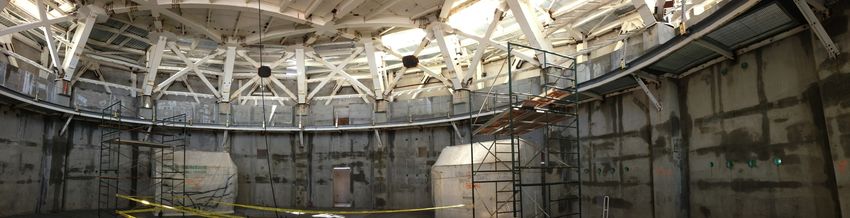
DKIST Overview
!   Technical Specifications:
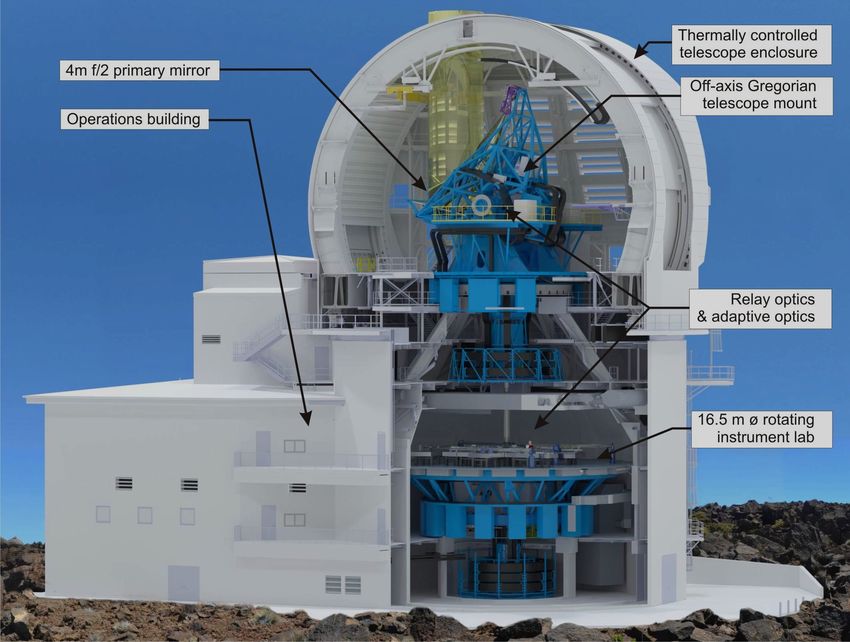
    ◦ 4-m, off-axis Gregorian (all
      reflective), alt-az mount
    ◦ Integrated adaptive optics
    ◦ Enclosure with thermal control and
      dust mitigation
    ◦ Wavelength sensitivity from 0.3 - 28
      microns (near-UV to infrared)
    ◦ Field of view: 3 arcmin
    ◦ Angular resolution: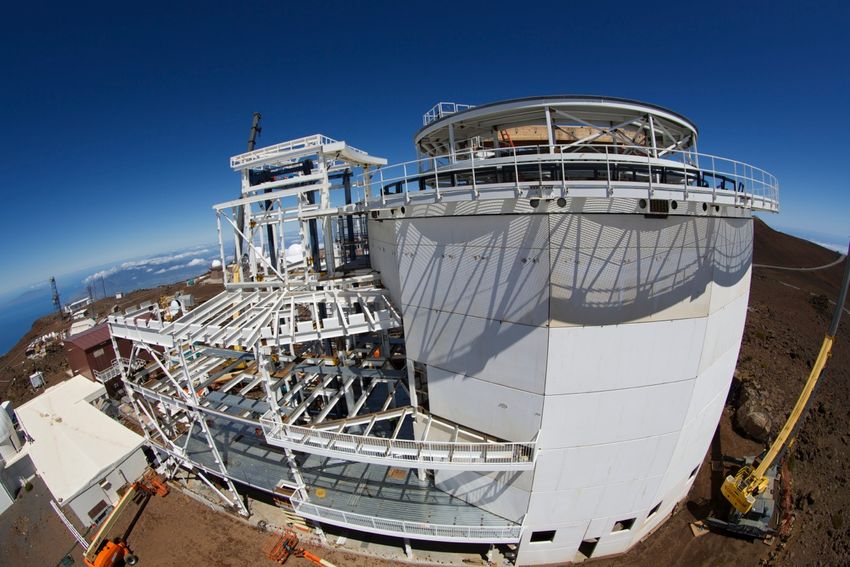
DKIST Site Atop Haleakala, Maui, HI

                           DKIST 2019

                 4/1/15   CSSP Meeting   5
DKIST Chronology
!   Final Design Review established the project baseline          May 2009
!   Awards totaling $298M authorized (NSB-09-57)                  Aug. 6, 2009
!   Federal environmental compliance completed                    Dec. 2, 2009
!   Construction funding (ARRA &MREFC) awarded                    Jan. 2010
!   Anticipated access to Haleakala site pending
    Conservation District Use Permit (CDUP) issued
    by Hawaii Board of Land and Natural Resources (BLNR)          June 2010
!   CDUP Issued by BLNR                                           Dec. 2, 2010
!   CDUP challenged by Kilakila o Haleakala                       Dec. 3, 2010
!   Contested case hearing                                        July 2011
!   Final arguments presented to BLNR                             Sept. 14, 2012
!   BLNR issues final decision affirming the CDUP                 Nov. 9, 2012
!   Final access to site granted                                  Nov. 30, 2012
!   Groundbreaking on site                                        Dec. 1, 2012

           Total delay of 30 months relative to original baseline –
                        June 2010 to December 2012
                                    4/1/15         CSSP Meeting                    6
Ramifications of Delay
!   2009 project baseline was no longer valid. Progress measured
    against the original schedule shows large negative variances.
!   The delay and other “unknown unknowns” result in cost growth.
!   Additional budgetary complexity due to the expiration of ARRA
    funds at the end of FY 2015.

                                              Total cost: $40.6M

                                        Total: $40.6M

                               4/1/15        CSSP Meeting           7
DKIST Revised Baseline
!   Approved by the NSB Aug. 2013 (NSB-13-42)
!   Total Project Cost = $344,128,808 ($47.4M contingency)
    ◦ This is a $46.2M (16%) increase from original baseline
    ◦ Additional funding all in fiscal years 2017 through 2019

                                         MREFC Funding Profile For DKIST
         $45.00
         $40.00                                                                  FY15 Budget = $25.12M
         $35.00
         $30.00
         $25.00
    $M

         $20.00
         $15.00
         $10.00
          $5.00
          $0.00
                      FY 2010   FY 2011   FY 2012   FY 2013   FY 2014   FY 2015   FY 2016   FY 2017   FY 2018   FY 2019
         Original     $20.00    $17.00    $20.00    $25.00    $20.00    $20.00    $20.00     $9.93     $0.00     $0.00
         Rebaseline   $20.00     $5.00    $10.00    $25.00    $42.00    $20.00    $20.00    $20.00    $20.00    $16.13
         Updated      $20.00     $5.00    $10.00    $25.00    $36.88    $25.12    $20.00    $20.00    $20.00    $16.13

                                                     4/1/15                  CSSP Meeting                                 8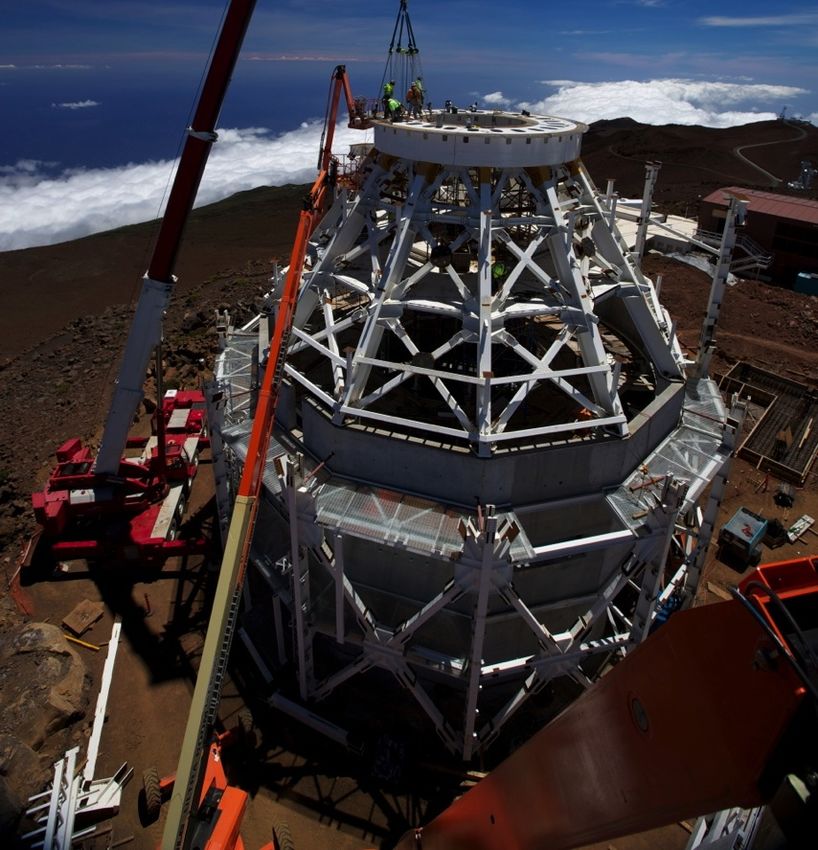
Technologies and knowledge required to
build DKIST are drawn from the global
scientific and engineering communities

                  4/1/15   CSSP Meeting   9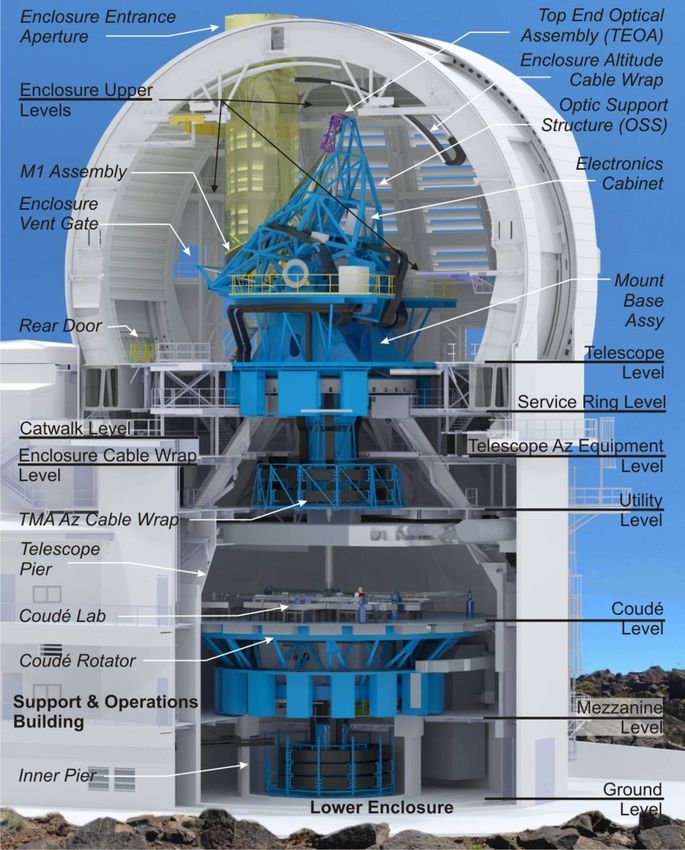
Telescope enclosure, Bilbao, Spain

                                                                           M1 Polishing, Tucson, AZ

Telescope mount, Rockford, IL

Coude rotator, Rockford, IL                                                M1 Cell Assembly, Liege Belgium

                                Telescope Pier, Haleakala, HI
                                                       4/1/15         CSSP Meeting                           10
Telescope
Structures
Alt-Az Telescope Mount
Coudé Rotator Platform
4/1/15DKIST Instrumentation
! Visible Broadband Imager (VBI)
! Visible Spectropolarimeter (ViSP)
! Visible Tunable Filter (VTF)
! Diffraction-Limited Near-Infrared Spectropolarimeter (DL-NIRSP)
! Cryogenic Near-Infrared Spectropolarimeter (Cryo-NIRSP)
4/1/15 CSSP Meeting 12Instrument Development Status
! VBI
◦ Integration in NSO Boulder
lab continues DKIST VBI on the DST
! CRYO-NIRSP
◦ CDR & Fabrication Contract
! DL-NIRSP
◦ CDR & Fabrication Contract
in progress
! ViSP
◦ CDR scheduled for May 2015
! VTF
◦ PDR scheduled for June 2015
4/1/15 CSSP Meeting 13Recent Partnership Development
! UK Proposal for development and delivery of visible
cameras 4k x 4k, 30 Hz (~ $6.5M)
◦ "Queen’s University Belfast plays leading role in
construction of the world’s biggest solar telescope"
QUB Press Release, undated
http://www.eurekalert.org/pub_releases/2015-02/qub-
qub020915.php
◦ "World's biggest solar telescope set for 2019
completion in Hawaii"
Gizmag Space, February 14, 2015
http://www.gizmag.com/dkist-worlds-biggest-solar-
telescope-2019/36088/
4/1/15 CSSP Meeting 14Poor Weather at the Site (Jan. – Feb. 2015)
! Result: some DKIST schedule slip
• Support & Operations building foundation completed
! Current completion date: Sept. 19, 2019
4/1/15 CSSP Meeting 15Construction Status as of Last Week
First Ring Girder Section
of Upper Enclosure
Platform Lift
4/1/15 CSSP Meeting 16Construction Status as of Last Week
4/1/15 CSSP Meeting 17DKIST Will Replace Current National
Solar O/IR Facilities
Dunn Solar Telescope McMath-Pierce, Kitt Peak, AZ
Evans Solar Facility
Sacramento Peak, NM
4/1/15 CSSP Meeting 18DKIST in the AST Portfolio
300
LSST With Max.
Assuming No Divestment enters
Divestment
250
here
200
Individual Investigator+ Mid-scale
AST
$M
150
DKIST
ALMA
100
Facility Budget Existing Facilities
Reductions,
50
Assumes 2.5%
FY10-FY13
inflation/yr for
existing facilities
0
Fiscal
Year
FY10 FY13 FY16 FY19 FY17 FY19
AST budget assumption: FY15=Request, 1%/yr growth thereafter
4/1/15 CSSP Meeting 19Proposed DKIST Operations Ramp
Projected NSO Funding Profile
$30.0
$25.0
FY15 Budget = $13M
$20.0
$M
$15.0
$10.0
$5.0
$0.0
FY 2014 FY 2015 FY 2016 FY 2017 FY 2018 FY 2019 FY 2020 FY 2021 FY 2022 FY 2023 FY 2024
NSO Base $8.0 $8.0 $7.0 $6.0 $5.0 $4.0 $4.12 $4.24 $4.37 $4.50 $4.64
DKIST Ops. $0.0 $5.0 $9.0 $11.5 $14.5 $17.0 $17.51 $18.04 $18.58 $19.13 $19.71
Total, NSO $8.0 $13.0 $16.0 $17.5 $19.5 $21.0 $21.63 $22.28 $22.95 $23.64 $24.34
4/1/15 CSSP Meeting 20A Time of Transition for the NSO
4/1/15 CSSP Meeting 21Transforming the Ground-based Solar Community
! Support of the NSO move to the campus of the University of Colorado,
Boulder (CU) co-located with CU-LASP
◦ Places NSO squarely in the center of the Solar and Space Physics Community
◦ Boulder Solar Alliance: NSO, CU-LASP, NCAR-HAO, NOAA-SWPC, SwRI
! AST Program Officers have been increasing contact with AGS Program
Officers to find synergies and potential projects for co-funding
! AST Program Officers have been presenting at the SPD Agency Town
Halls to raise awareness of DIKIST science within the solar community.
! The ground-based solar community is mobilizing
◦ Special DKIST Science Town Hall at TESS/SPD meeting Apr. 28-May 1, 2015
◦ Efforts will be led by NSO and the DKIST Science Working Group (SWG)
◦ Dr. Mark Rast (CU) to lead efforts to gain community involvement in DKIST
! AST Program Officers and Management: increasing involvement in
Space Weather on a Federal level (Executive priority)
◦ National Space Weather Strategy – OSTP, NSF, NASA, FEMA, NOAA,
DOE, DOJ, NRC, DOD, USGS, DHS…
4/1/15 CSSP Meeting 224/1/15 CSSP Meeting 23
You can also read


