The economic and social impacts of the 2015-2016 El Niño event - National Weather ...
←
→
Page content transcription
If your browser does not render page correctly, please read the page content below
The economic and social impacts of
          the 2015-2016 El Niño event
                                    Sep 23 2016

                          PREPARED BY THE PEAC CENTER

Principal Scientist:
Dr. Rashed Chowdhury

Pacific Region Climate Officer:
LTJG Joseph Brinkley

Tropical Cyclone Specialist:
Mark Lander

Graduate Assistant:
Alejandro Ludert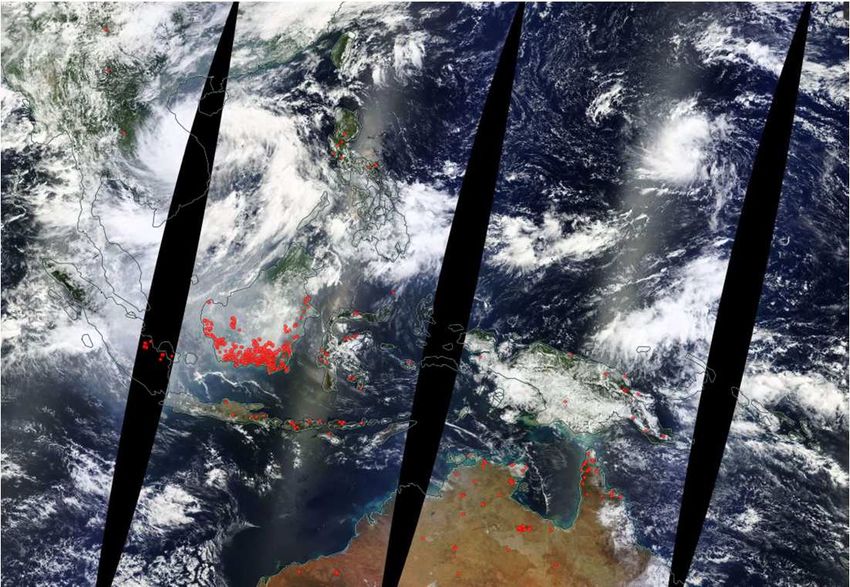
2

                               El Niño and
                               Rainfall

                 La Niña and
                 Rainfall

http://www.climate.gov/news-
features/department/8443/all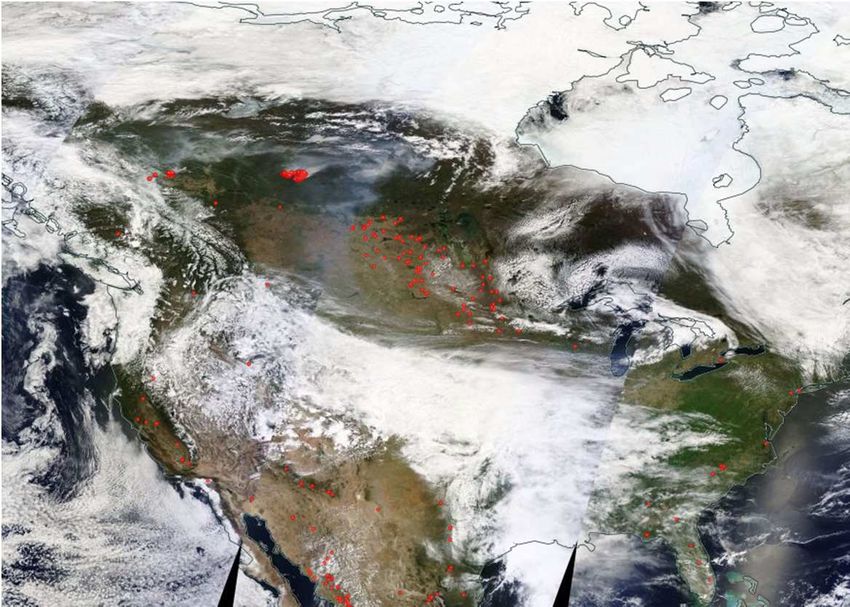
3

Impacts
Rainfall, Tropical Cyclones and Societal
Impacts

4

    Summary of the 2015-2016 El Niño impacts
    (WFP/FAO 13 July 2016)

Retrieved from:
http://reliefweb.int/sites/reliefweb.int/files/resources
/wfp_fao_el_nino_overview_by_fsc_1.pdf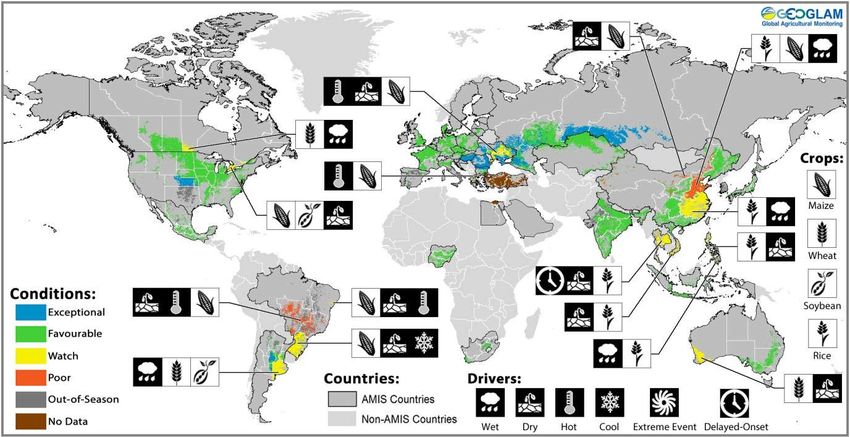
Oceanic Niño Index (Deg C)

     -2.5
                 -1.5
                               -0.5

            -2
                        -1
                                         0
                                             0.5
                                                   1
                                                          1.5
                                                                     2
                                                                                             2.5
                                                                                                                 3
                                   DJF
                                  JFM
                                  FMA
                                  MAM
                                  AMJ
                                   MJJ
                                   JJA
                                   JAS
                                  ASO
                                  SON
                                  OND
                                  NDJ
                                   DJF
                                  JFM
                                  FMA
                                  MAM
                                  AMJ
                                   MJJ
                                   JJA
                                   JAS
                                  ASO
                                  SON
                                  OND
                                  NDJ
                                   DJF

Season
                                  JFM
                                  FMA
                                  MAM
                                  AMJ
                                   MJJ
                                   JJA
                                   JAS
                                  ASO
                                  SON
                                  OND
                                  NDJ
                                   DJF
                                  JFM
                                  FMA
                                  MAM
                                  AMJ
                                   MJJ
                                   JJA
                                                                2015/16
                                                                                                                                                             5

                                   JAS
                                                                          1997/98/99
                                                                                       1982/83/84
                                                                                                    1972/73/74

                                  ASO
                                  SON
                                                                                                                     El Niño “like” conditions during 2014

                                  OND
                                  NDJ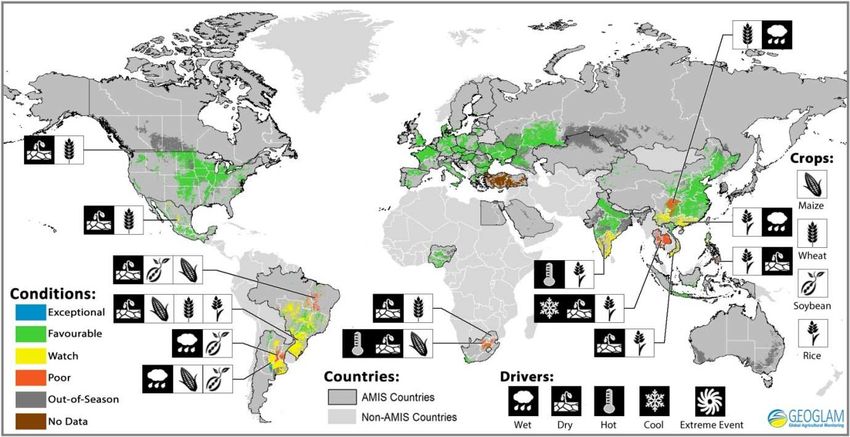
6

   Rainfall impacts:
   Drought

• The impacts of the
  2015/2016 El Niño where
  compounded with those
  from El Niño “like
  conditions during the year
  before
• Extremely dry conditions
  over two years (two
  growing seasons) where
  present in many areas of
  the globe
     • Northern South
         America
     • Africa
     • South East Asia
     • Pacific Islands
     • Australia
                               Figures made using the IRI Map Room
                               https://iridl.ldeo.columbia.edu/maproom/
7

  Drought impacts to
  the USAPIs
• State of Emergency due to drought declared
 for
  • Republic of Palau
  • Federated States of Micronesia
       • Federal and State levels
  • Republic of the Marshall Islands

• Water Rationing Implemented on bigger
  islands
• Drinking water became a serious issues for
  smaller islands
• Damage to food crops in smaller islands
• Drought conditions have eased in the last
  month
   • Water supply is less of a concern
   • Food security will take more time to
      recuperate
                             Special acknowledgement to
                               Richard Heim NOAA/NCEI
                            Chip Guard NWS WFO Guam
                      WSO personnel throughout the USAPI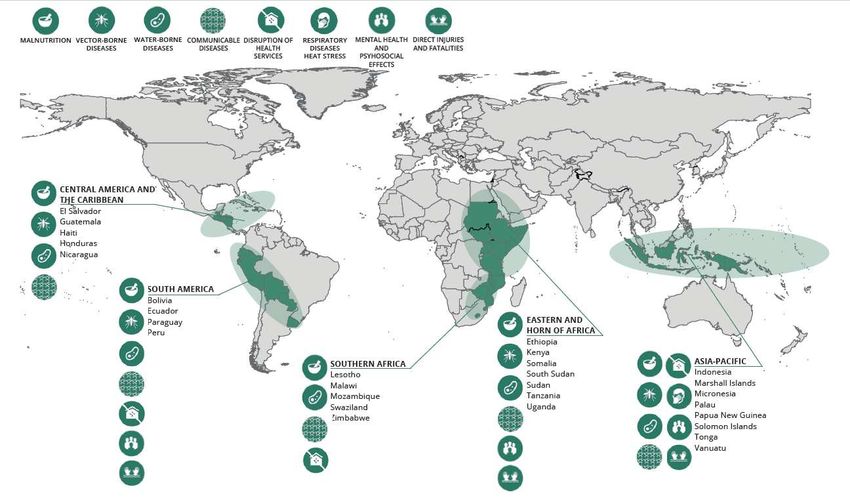
8

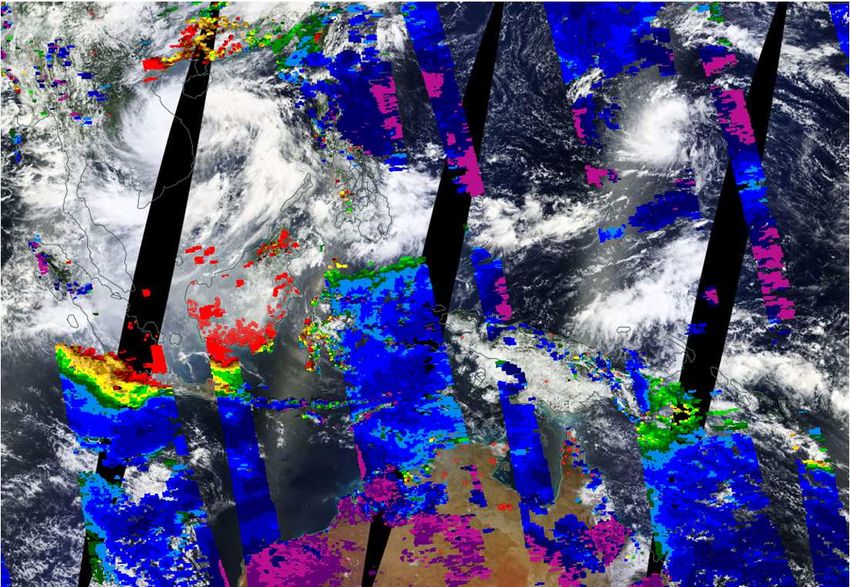
 Borneo fires
• Sep 14 2015
• Top MODIS Terra true
  color and thermal
  anomalies
• Bottom MODIS Terra
  Aerosol Optical Depth
• This type of widespread
  fires was also seen
  during 1997
9

    Borneo fires
• Costliest singular event of 2015
   • Estimated 16 billion in economic
     cost
   • 1.9% of Indonesia’s GDP
• Estimated 100000 excess deaths
  across Indonesia, Malaysia and
  Singapore (Koplitz et al. ERL 19 Sep 2016)

Source:
AON Benfield
2015 Annual Global Climate
and Catastrophe Report
10

  Fort McMurray
  Fires
• El Nino in the Pacific disrupted
  weather patterns to bring
  northern Alberta a dry fall and
  very little snow throughout the
  winter
• Similar conditions where
  observed in 1998
According to Daniel Thompson from
Natural Resources Canada in Edmonton
to Bloomberg News
                                       MODIS True Color Image from May 16th 2016

Source:
AON Benfield
2016 Global Catastrophe
Recap: First Half of 2016
11
Latest information up to April 28th 2016.
Global crops
• Conditions have
improved for many
places across the
globe
• Europe
• South
America
Latest information up to July 28th 2016.
• Australia
• Deteriorated over
Western China
From GEOGLAM Early Warning Crop Monitor
http://www.geoglam-crop-monitor.org/12
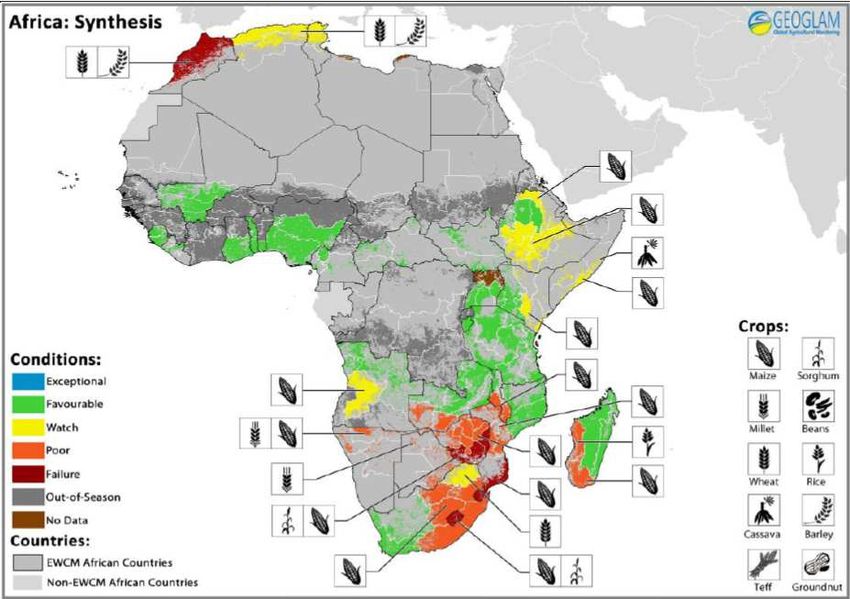
Crops in Africa
Latest information up to April 28th 2016. Latest information up to July 28th 2016.
From GEOGLAM Early Warning Crop Monitor
http://www.geoglam-crop-monitor.org/
• Severe drought over the southern portion of the continent has been
ameliorated
• Watch conditions over Ethiopia have improved13 How ENSO affects global health
14

      Observed Health impacts during 2015-16
•   Tanzania
      • Cholera epidemic of more than 12 000
        reported is likely to spread to other
        countries
      • This Tanzanian cholera outbreak is the
        largest since 1997-1998, which had
        over 40 000 reported cases
•   In Ethiopia
      • Number of people in need of emergency
        health interventions nearly doubled in
        three months
•   In southern Africa
      • Increasing malnutrition and disease
        risks
      • Growing concerns about the interruption
        to anti-retroviral therapy
•   South America                                 http://www.who.int/hac/crises/el-nino/who_el_nino_and_health_global_report_21jan2016.pdf
      • Above-average rainfall                  • Papua New Guinea
      • Floods and increased diseases spread        • Drought
        by mosquitoes                               • Major immediate public health threats include the interruption of critical
•   In Guatemala and Honduras,                          infrastructure
      • 2 years of drought and El Niño          • Vanuatu, Fiji, Solomon Islands
      • 2.8 million people in need of               • Water shortages
        humanitarian assistance                     • Increased incidence of diarrheal diseases
      • 1-5 households will face critical food  • Indonesia
        consumption gaps and acute
                                                    • Fires
        malnutrition
                                                    • Likely cause respiratory disease, food insecurity
15
From the United Nations Office for the
Coordination of Humanitarian Affairs (OCHA)
http://www.unocha.org/el-nino Apr 26 2016
• It is expected that there will be
• 52 million food-insecure people in Southern and
Eastern Africa
• 4.7 million people at risk from adverse weather in
the South Pacific
• 4.2 million people affected by drought in Central
America and
• Millions affected by drought and extreme weather
conditions across Asia
• Governments and the international community did
prepare for this El Niño event and employed
preparedness and response actions, but funding has
been limited.
• Islands across the Pacific have been coping with the
impacts of changed El Niño weather patterns. Many
countries were able to mitigate the most serious
impacts before most situations reached crisis point.
• The current funding gap stands at over $2.2 billion,
of which approximately one third is for Ethiopia.16
Global
Response
• The 2015–16 El Niño has
now dissipated, but its
devastating impacts will
be felt well into 2017
• As a result of droughts
caused or exacerbated by
El Niño, 60 million people
across four continents,
require immediate
assistance
• This was a well forecast
event.
• Both governments and
international stakeholders
have responded, but not
at the scale and speed to
preserve livelihoods, hope
and dignity.
• This El Niño was a
broadly preventable crisis,
and as such, is a modern
day tragedy.17
Even with El Niño ending, the challenges
remain:
• Effects on food security and nutrition from this El Niño event are time
delayed
• Harvest and national stocks will supply populations for a period of
time, food insecurity tends to happen later
• Levels of humanitarian assistance are expected to peak by late
2016 early 2017
Figure and information from the WFP, VAM Food Security Analysis report “ENSO: Humanitarian Implications and Scenarios”18
Global impacts
of La Niña
La Niña years have clearly
shown greater average
annual losses in
comparison to El Niño and
Neutral phases.
• La Niña USD77 billion
• El Niño USD45 billion
Much of the increase in
losses during a La Niña
year surrounds
• Increased frequency of
costly landfalling
tropical cyclone events
in the Atlantic Ocean
basin
• Increased flooding
events across Asia
Pacific
Source: Aon Benfield 2015 Annual Climate and Catastrophe report.19
Web Resources
• Humanitarian Relief
• http://reliefweb.int/ . Archive of White Papers, Infographics and reports from various aid organizations
• USAID. https://www.usaid.gov
• UN Office for the Coordination of humanitarian affairs http://www.unocha.org/
• UN Food and Agriculture Organization
• Global Information and Early Warning System http://www.fao.org/giews/english/index.htm
• Market Monitor Reports https://www.wfp.org/content/market-monitor
• OXFAM https://www.oxfam.org/
• Insurance White Papers
• http://www.insurancehound.co.uk/
• Crop Conditions
• http://www.geoglam-crop-monitor.org/
• USDA Foreign Agricultural Service
• http://www.fas.usda.gov/
• http://www.pecad.fas.usda.gov/
• Global Disaster Monitoring
• http://www.gdacs.org/ Global Disaster Alert and Coordination System
• http://www.pdc.org/ Pacific Disaster Center
• ERL Paper
• http://iopscience.iop.org/article/10.1088/1748-9326/11/9/094023The PEAC Center
The Pacific ENSO Applications Climate
Center
Photo courtesy of
Lt. Charlene FelkleyYou can also read


