THE EDUCATION SYSTEM IN IRELAND: A guide for people seeking asylum, those with refugee status, subsidiary protection or permission to remain ...
←
→
Page content transcription
If your browser does not render page correctly, please read the page content below
Information Booklet
                                                             2019/2020

THE EDUCATION SYSTEM IN IRELAND:
A guide for people seeking asylum, those with refugee
status, subsidiary protection or permission to remain.

Supported by

                                      Issue date: 11 July 2019
Contents                                                                                        Page No.

A guide to the Irish education system …………………………………………….                                             3

Quality and Qualification Ireland (QQI) …………………………………………                                             3

National Framework of Qualification in Ireland (NFQ) ………………….                                        4

Post Leaving Cert (PLC) Education (often called Further Education) ..                                5

Third Level Education (often called Higher Education) ……………………                                       6

How do you apply to go to University in Ireland? …………………………….                                        7

How much does it cost to go to University in Ireland? …………………….                                      8

Student Grants (provided by the Department of Education) …………..                                      10

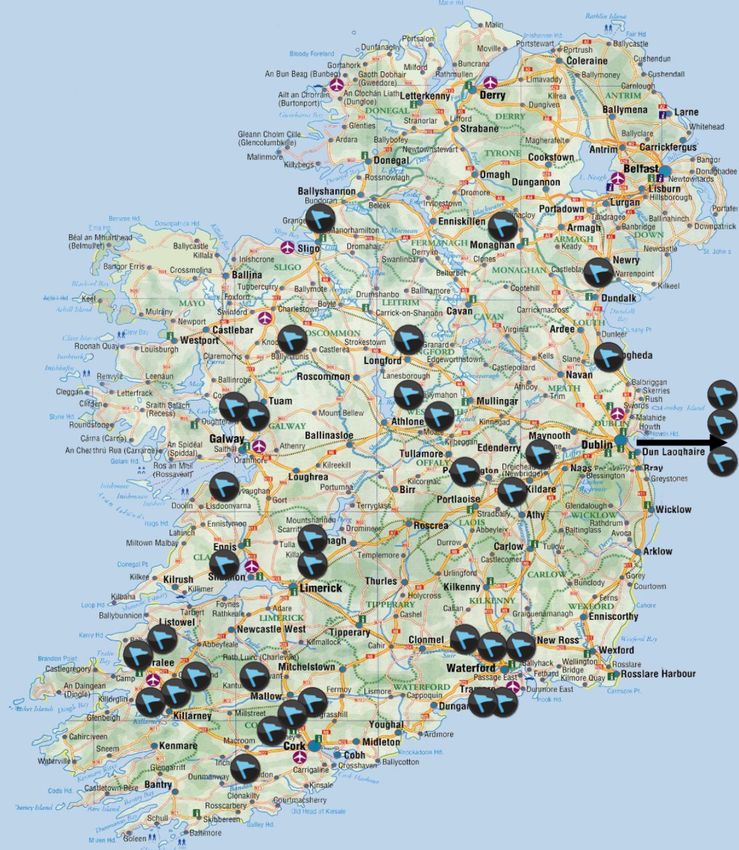
Map of Ireland showing locations of scholarships …………………………..                                        11

Scholarships (provided by Universities) ………………. …………………………                                           12

Scholarships (provided by Institutes of Technology) ………………………                                        19

IRC Education Fund …………………………………………………………………………                                                      22

Other useful information ………………………………………………………………..                                                  23

Useful Websites ……………………………………………………………………………..                                                      26

Online Courses ……………………………………………………………………………….                                                       27

2       All information is for guidance only, it is not complete and any errors are unintentional.
                     Please consult the relevant websites for accurate information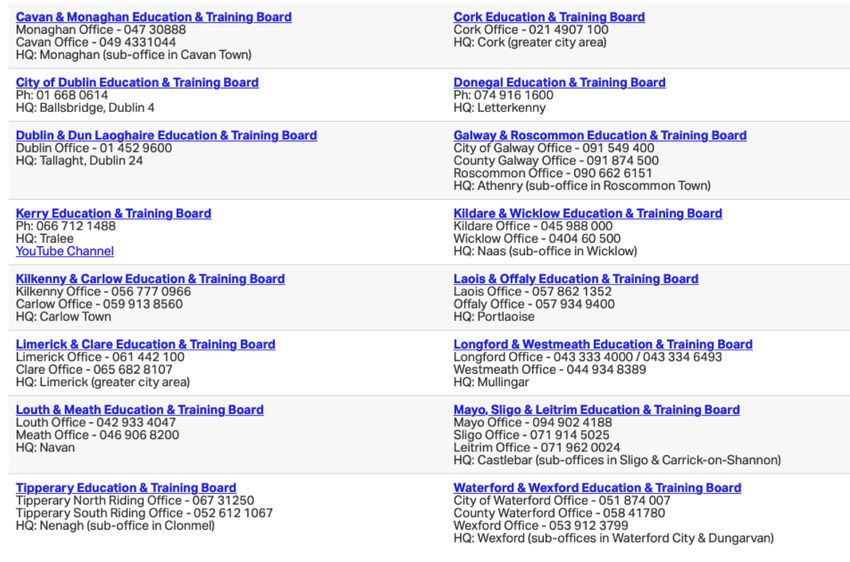
A guide to the Irish education system

     This booklet primarily focuses on education for people over the age of 18 – generally called
     further education, higher education or third level education.
     See the links here below if you are looking for information regarding primary education
     (children age 4-12) or secondary education (children age 12-18).
     One guide can be found here
      https://www.education.ie/en/parents/information/a-guide-to-the-irish-education-
     system.pdf (Page 33-39 refers to Higher Education and Further Education – usually people
     age over 18).
     This website may also be useful https://www.education.ie/en/The-Education-System/

Quality and Qualification Ireland (www.qqi.ie )

     QQI is an independent State agency responsible for promoting quality and accountability in
     education and training services in Ireland.
     They also facilitate the recognition of foreign qualifications through NARIC.
     NARIC Ireland provides advice on the academic recognition of a foreign qualification by
     comparing it, where possible, to a major award type and level on the Irish National
     Framework of Qualifications (NFQ).
     Generally NARIC can only provide comparability statements for wholly completed
     qualifications. www.naric.ie
     QQI are also responsible for developing and maintaining the Irish National Framework of
     Qualifications (NFQ).
     QQI was established in 2012 and is an amalgamation of several previous State bodies
     including the Further Education and Training Awards Council (FETAC). Although FETAC has
     not been in existence for seven years now you will frequently hear people refer to courses
     as FETAC Level 5 or 6 etc. They really mean QQI Level 5 or 6, it’s the same thing.
     So let’s take a look at these levels with NFQ.

       All information is for guidance only, it is not complete and any errors are unintentional.   3
                    Please consult the relevant websites for accurate information
National Framework of Qualification in Ireland (www.nfq.ie )

     Since 2003 the Irish NFQ have established a framework through which all learning
     achievements may be measured and related to each other in a coherent way.
     Most education courses in Ireland are identified as Level 1 – 10 (see diagram below)
     At the end of secondary school students ( typically age 18) complete their Leaving Certificate
     (level 5)
     An Undergraduate Degree is level 7 or 8 (and lasts 3 or 4 years)
     A Postgraduate (Masters) Degree is level 9 (and lasts 1 or 2 years)
     A Doctorate (PhD) is level 10 (and generally takes 3 or 4 years to complete)
     Between the Leaving Cert (level 5) and Undergraduate Degree (level 8) there are many
     courses at levels 5, 6 and 7. These can be very useful particularly if English is not your first
     language but you have previous education in a specific area. They will help you to learn the
     vocabulary of your chosen study area before progressing to a degree. These one-year
     courses will also help you to integrate and understand the Irish education system.
     Levels 5 and 6 are also a great way to prepare for an Undergraduate Degree (level 7 or 8)
     Levels 5 and 6 are an alternative entry path to University instead of the Leaving Certificate

4      All information is for guidance only, it is not complete and any errors are unintentional.
                    Please consult the relevant websites for accurate information
Post Leaving Cert (PLC) Education (often called Further Education)

     There are many courses all around the country at level 5 and 6 which are generally full-time
     and last for one academic year (September – May).
     These PLC courses offer an alternative entry to Third Level Education (often called Higher
     Education) instead of having to complete the Leaving Certificate.
     If you have obtained a work permit you can apply to do a post leaving cert course (PLC)
     (level 5 and 6). If you don’t have a work permit apply anyway you may be accepted.
     PLC courses are generally provided by the Education & Training Board (www.etbi.ie ). There
     are 16 ETBs covering the whole country. You can find them here
     https://www.etbi.ie/etbs/directory-of-etbs/
     Within each ETB you will find a list of local Colleges of Further Education or Community
     Colleges. Often your local secondary school will provide adult and further education courses
     too.

       All information is for guidance only, it is not complete and any errors are unintentional.   5
                    Please consult the relevant websites for accurate information
Third Level Education (often called Higher Education)

     Most Third Level Universities/Colleges (HEIs or Higher Education Institutes) are publicly
     funded, but there are private colleges too. It is very important to only apply to the approved
     publicly funded HEIs if you want to apply for a Student Grant. These HEIs include:-

     8 Universities
        o DCU         Dublin City University
        o MU          Maynooth University
        o NUIG        National University of Ireland, Galway
        o TUD         Technological University Dublin
        o TCD         Trinity College Dublin
        o UCC         University College Cork
        o UCD         University College Dublin
        o UL          University of Limerick

     11 Institutes of Technology (ITs)

         o   AIT     Athlone Institute of Technology
         o   DkIT    Dundalk Institute of Technology
         o   GMIT Galway-Mayo Institute of Technology
         o   IADT Dun Laoghaire Institute of Art, Design & Technology
         o   ITC     Institute of Technology Carlow
         o   CIT     Cork Institute of Technology
         o   ITSligo Institute of Technology Sligo
         o   ITTralee Institute of Technology Tralee
         o   LyIT    Letterkenny Institute of Technology
         o   LIT     Limerick Institute of Technology
         o   WIT     Waterford Institute of Technology

     8 Other HEIs
         o Marino Institute of Education, Dublin
         o Mary Immaculate College, Limerick
         o National College of Art and Design, Dublin
         o National College of Ireland, Dublin
         o Pontifical University, St. Patrick’s College, Maynooth
         o Royal College of Surgeons Ireland, Dublin
         o St. Angela’s College, Sligo
         o St. Nicholas Montessori College Ireland, Dun Laoghaire

6      All information is for guidance only, it is not complete and any errors are unintentional.
                    Please consult the relevant websites for accurate information
HOW DO YOU APPLY TO GO TO
UNIVERSITY IN IRELAND?
(1) You should apply for the course of your choice (Levels 7 & 8) through the Central Applications
Office (CAO) – see below

(2) You should apply for a scholarship (to the University/College of your choice) – see page 12 - 21

The Citizens Information website is an excellent source of information regarding Education and how
to apply, see here for further details.

https://www.citizensinformation.ie/en/education/third_level_education/applying_to_college/applic
ation_procedures_and_entry_requirements.html

Central Applications Office (CAO) - for Higher Education only (Levels 7 & 8)

       The HEIs (Higher Education Institutions) in Ireland have delegated to the CAO the task of
       processing centrally applications to their undergraduate courses.
       Online application opens in November each year for courses starting the following
       September.
       If you apply before 20th January the application fee is €30
       If you apply before 1st February the application fee is €45 (normal closing date)
       If you apply before 1st May the application fee is €60 (this is the late applications date)
       You really should apply before 1st February because not all HEIs will accept late applications
       There are several entry paths to an Undergraduate Degree, these include the Leaving
       Certificate, QQI/Fetac Qualifications, Mature Students, Students with Disabilities (DARE) and
       Higher Education Access Route (HEAR).
       If you have missed the normal closing date of 01 February, it is a good idea to contact the
       admissions office of your chosen university/college to ask if they would accept a late
       application.

Post Leaving Cert (PLC) Education (often called Further Education – Levels 5 & 6)

       Apply directly to your local College of Further Education or Community College if you are
       interested in Further Education or Adult Education courses (further details on page 5).

          All information is for guidance only, it is not complete and any errors are unintentional.   7
                       Please consult the relevant websites for accurate information
HOW MUCH DOES IT COST TO GO
TO UNIVERSITY IN IRELAND?
International (non-EU) or EU Fees

     Each University/College decides the rate of fee to be paid
     If you do not qualify for ‘Free’ Fees (see below) typically the University/College will seek to
     charge you the International (non-EU) rate which could be €10,000-€15,000 per year
     Being autonomous, some Universities and Institutes of Technology will quote the EU rate to
     people in the international protection system provided they have been in Ireland for at least
     three years.

Free Fees

     Free Fees does not actually mean ‘free’ fees (even for Irish Citizens)
     It means the state pays a portion of the ‘tuition fee’ while the student pays the ‘student
     contribution’ charge
     Typically the EU fee can be €6,000 per year – if you are entitled to ‘free’ fees the state pays
     €3,000 and the student pays €3,000 per year (there will be small variations but for a typical
     degree this is about correct)
     Some students are also entitled to State-funded Student Grants, these grants will also pay
     the student contribution of €3,000 and a maintenance grant currently €1,215 per annum
     (further details on page 20 – SUSI grant and Student Support Scheme)

     To qualify for ‘Free’ Fees the student must be one of the following:
          o A first-time undergraduate holding EU/EEA/Swiss Nationality
          o Those with official refugee status (under the Refugee Act 1996)
          o A family member of a refugee who has been granted permission to live in the state
          o A family member of an EU National with permission to live in the state and with a
               stamp ‘4EUFAM’ on their residence card
          o Those with Humanitarian Leave to Remain (prior to Immigration Act 1999)
          o Those with Permission to Remain (under section 3 of the Immigration Act 1999)
          o Those granted Subsidiary Protection by the Minister for Justice and Equality
     From 2013 students who acquire EU citizenship during their studies may be eligible for Free
     Fees for the remainder of their course.
     Free Fees do not apply to courses in private colleges
     Full criteria regarding Free Fees and the Universities/Colleges to which it applies can be
     found here

8      All information is for guidance only, it is not complete and any errors are unintentional.
                    Please consult the relevant websites for accurate information
Student Grants (provided by the Department of Education)

     SUSI Grant (Student Universal Support Ireland) - This is the student grant scheme available
     to Irish students as well as international asylum applicants who have received their refugee
     status, subsidiary protection or permission to remain (see page 10 for further details)
     Typically this grant has two parts, tuition grant and maintenance grant

     Student Support Scheme - This is a student grant similar to the SUSI grant except it is for
     people who are still in the asylum application process (see page 10 for further details)
     Typically this grant has two parts, tuition grant and maintenance grant

Scholarships (provided by Universities & Colleges)

     Since 2015 the Universities and Colleges listed below have introduced their own scholarships
     specifically for people currently or previously in the protection process
     See pages 12-21 for further details

         o   NUIG     National University of Ireland, Galway
         o   DCU      Dublin City University
         o   UL       University of Limerick
         o   UCD      University College Dublin
         o   UCC      University College Cork
         o   AIT      Athlone Institute of Technology
         o   LIT      Limerick Institute of Technology
         o   TCD      Trinity College Dublin
         o   ITC      Carlow Institute of Technology
         o   IADT     Institute of Art, Design & Technology, Dun Laoghaire
         o   CIT      Cork Institute of Technology

       All information is for guidance only, it is not complete and any errors are unintentional.   9
                    Please consult the relevant websites for accurate information
STATE-FUNDED STUDENT GRANTS

SUSI (Student Universal Support Ireland)

     This is the student grant scheme available to Irish students as well as international asylum
     applicants who have received their refugee status, subsidiary protection or permission to
     remain.
     You must have stamp 4 (please consult the SUSI website for details of precisely which stamp
     4 is acceptable)
     You must reside in Ireland for 3 of the last 5 years
     You must apply to an approved course at an approved college
     https://susi.ie/eligibility/undergraduate-student/approved-institutionscourses-for-
     undergraduate-students/
     You must be progressing in your education (see NFQ on page 4)
      https://susi.ie/previous-education-and-progression-undergraduate/
     Your Income must fall below specified thresholds
     Provides for PLC maintenance but not fees
     Provides for Undergraduate maintenance and fees
     Provides for Postgraduate maintenance and fees in some cases
     Will provide for full-time study only
     Full details available here https://susi.ie

Student Support Scheme 2019/2020

     This is a student grant similar to the SUSI grant except it is for people who are still in the
     asylum application process
     You must have spent at least 3 years in secondary school in Ireland
     You must be at least 3 years in the asylum process
     You cannot be on a deportation order
     Application for entry to your course through CAO before 01 Feb 2019 for all students (in
     some cases a Late Application will be accepted before 01 May 2019 but you need to contact
     the college to ask if they will accept it)
     You must be progressing in your education (see NFQ on page 4)
     Full details and application form here https://www.education.ie/en/Learners/Services/Pilot-
     Support-Scheme/

10     All information is for guidance only, it is not complete and any errors are unintentional.
                    Please consult the relevant websites for accurate information
Map showing location of scholarships
Direct Provision Centre
Institute of Technology Areas of the country where
we need more scholarships
University
Scholarships available
All information is for guidance only, it is not complete and any errors are unintentional. 11
Please consult the relevant websites for accurate informationUNIVERSITY SCHOLARSHIPS
DCU (Dublin City University)
Campus-Based Undergraduate Scholarships
DCU is a University of Sanctuary
5 places available
These are three or four-year full-time Level 8 Undergraduate degrees
Available to asylum applicants and Refugees ineligible for state supports
Priority for places will be given to students under 23 and any remaining places will be
allocated to mature students over 23
If you are under 23 you must have completed the Irish Leaving Certificate or have completed
a fulltime QQI/FETAC Level 5 qualification
Scholarship includes Full Tuition Fee Waiver &
Transport and on-campus Meal Plan
Applicants must live in 9 specified Direct Provision Centres, see here for details
https://www.dcu.ie/sanctuary/scholarships.shtml
Application for entry to the course through CAO before 01 Feb 2019 for all students (in some
cases a Late Application will be accepted before 01 May but you need to contact the college
to ask if they will accept it)
Application for Scholarship directly to DCU, see here
https://www.dcu.ie/sanctuary/scholarships.shtml
Queries regarding these 5 scholarships to philip.mckinley@dcu.ie
Closing Date is 5.00pm, Monday 1st July 2019
DCU (Dublin City University)
DCU Connected Online Undergraduate &
Post-graduate Scholarship
DCU is a University of Sanctuary
5 places available
The DCU Connected Scholarships cover the costs of a 60 credit online undergraduate or
postgraduate programme of study which can be shown to clearly benefit recipients in
advancing their personal goals and future career ambitions.
The Scholarship also provides funding to support Internet access where required and the
purchase of relevant textbooks and related study costs including travel to the DCU
Connected Welcome Day in Dublin.
Application form and details can be found here https://www.dcu.ie/connected/university-
sanctuary.shtml
Queries regarding these online scholarships to colum.foley@dcu.ie
Closing Date is Monday 12th August 2019
12 All information is for guidance only, it is not complete and any errors are unintentional.
Please consult the relevant websites for accurate informationDCU (Dublin City University)
Online FutureLearn short courses
DCU is a University of Sanctuary
10 places available
The joint DCU FutureLearn scholarship initiative will enable refugees and asylum seekers
living in Ireland to undertake unlimited study from a wide range of courses offered on
FutureLearn’s online platform though to Certificates of Achievement.
Applicants can apply for a one-year subscription to study an unlimited number
of FutureLearn online short courses.
For detailed information and application form, please see
www.dcu.ie/connected/university-sanctuary.shtml
Queries regarding these FutureLearn scholarships to colum.foley@dcu.ie
Closing Date is Monday 12th August 2019
NUIG (National University of Ireland, Galway)
Full-time Undergraduate & Postgraduate Scholarships
6 undergraduate places available (level 8)
3 postgraduate places available (level 9)
Scholarship includes Full Tuition Fee Waiver &
Annual subsistence payment
Application for entry to the course through CAO before 01 Feb 2019 for all students (in some
cases a Late Application will be accepted before 01 May but you need to contact the college
to ask if they will accept it)
Application for scholarship directly to NUIG
Further details available at www.nuigalway.ie/sanctuary when applications open on the 19th
July 2019
All queries to uni.sanctuary@nuigalway.ie
Closing Date is 5pm Friday 23rd August 2019
All information is for guidance only, it is not complete and any errors are unintentional. 13
Please consult the relevant websites for accurate informationNUIG (National University of Ireland, Galway)
Access Programmes (age 22 and under)
Mature Access Programmes (age 23 and over)
(Under 22) The Access Course for School Leavers is a course specifically designed for
students who are aged 22 or under and have a real desire to study at third level but are
unable due to financial or social reasons. Students should be highly motivated and
interested in studying at an undergraduate level in their chosen area.
(Over 23) This Access Course is a 1 year full-time/part-time daytime/evening course that
aims to provide mature students, aged 23 or over, with the opportunity to prepare,
personally and academically, for an undergraduate course of full-time study of at least three
years duration at NUI, Galway.
NUI Galway Courses:
Full-Time: DFS2 School Leavers 22 years and under, Applications open August 1st and close
23rd of August.
Full- Time DFS5 Mature 23 years and over, Applications opened April 1st and closed 23rd April
(this course is now full).
Part-Time DFS1 Science, Technology and Engineering, Applications open July 16th and close
August 30th– Fee applies €60
Part-Time DFS8 Business, Law & Arts, Applications open July 16th and close August 30th – fee
applies €60
GMIT Castlebar:
Part-Time DFS9 Business, Law & Arts, Applications open July 16th and close August 30th - fee
applies €60
Sligo St Angela’s:
Part-Time: DFS7 School Leavers 22 years and under, Applications open August 1st and close
31st of August.
Part- Time DFS11 Mature 23 years and over, Applications opened April 1st and closed
23rd April (this course is now full).
Ballinasloe:
Part-Time: DFS3 School Leavers 22 years and under, Applications currently open and close
30st of August.
Part- Time DFS6 Mature 23 years and over, Applications currently open and close 30st of
August.
Further details available here
www.nuigalway.ie/access/school-leavers/ (age 22 or under)
http://www.nuigalway.ie/access/mature-students/ (age 23 or over)
https://www.nuigalway.ie/mature/part-time/ (part-time mature courses)
All queries to access@nuigalway.ie or maturestudents@nuigalway.ie
Closing dates vary – see above for each course
14 All information is for guidance only, it is not complete and any errors are unintentional.
Please consult the relevant websites for accurate informationTrinity College Dublin
Full-time Undergraduate Scholarship
4 places available
These are four-year full-time Level 8 Undergraduate degrees
See list of eligible courses at https://www.tcd.ie/trinityaccess/students/current/
Open to people seeking asylum (from 6 DP centres – see list in link above) or refugees who
are ineligible for state support
Applicants must have a Further Education Qualification (QQI) or Leaving Certificate
completed within the last two years
Applicants must be attending University for the first time
Scholarship includes coverage of Full Tuition Fees &
Annual Stipend €1500
A Laptop, provision of meals, and public transport
Application for entry to the course through CAO before 01 Feb 2019 for all students (in some
cases a Late Application will be accepted before 01 May but you need to contact the college
to ask if they will accept it)
Application for scholarship, see here https://www.tcd.ie/trinityaccess/students/current/
Closing Date is Friday 5th July 2019
TUD (Technological University Dublin)
Access Foundation Programme
The Access Foundation Programme is a one-year full-time preparation for higher education
programme at TU Dublin City Campus. The programme prepares students personally and
academically to pursue undergraduate programmes at TU Dublin City Campus.
It is a multi-disciplinary programme preparing students for entry into undergraduate
programmes in Science & Health, Engineering & Built Environment, Business and Arts &
Tourism. Students who successfully complete the programme will be offered a place on an
appropriate undergraduate course at TU Dublin.
The Access Foundation Programme is free for participants.
Applications directly to TUD, see here
https://www.dit.ie/studyatdit/undergraduate/programmescourses/allcourses/accessfounda
tionprogrammedt6522.html
Queries to accessadmissions2018@dit.ie
Queries to johanna.king@dit.ie
Closing Date is Friday 16th August 2019
All information is for guidance only, it is not complete and any errors are unintentional. 15
Please consult the relevant websites for accurate informationUCC (University College Cork)
Full-time Undergraduate Scholarship
UCC is a University of Sanctuary
5 places available
These are three or four-year full-time Level 8 Undergraduate degrees
Available to asylum applicants or those with status but ineligible for state support
Applicants must be living within a commutable distance to UCC
The scheme is targeted at people who have not had the opportunity to study or complete
undergraduate education
Applicants will be assigned an academic mentor to help them understand their preferred
course and to support their application where possible
Scholarship includes Full Tuition Fee Waiver & Bursary
Applicants must apply through the CAO for their choice of course using the Leaving
Certificate/QQI-FE and/or Mature Student route. Note that the deadline for Mature CAO
applications is February 1st 2019, and the late deadline for all other CAO applications is May
1st 2019.
Application for scholarship directly to UCC
For information on other options available to asylum seekers and refugees at UCC see
www.ucc.ie/en/edi/universityofsanctuary
All enquiries to ediunit@ucc.ie
Closing Date is 1st July 2019
UCD (University College Dublin)
Open Learning Scholarship
UCD is a University of Sanctuary
Open Learning Scholarships are currently only available to people with Refugee Status and
Permission to Remain
Scholarship covers the cost of any six Open Learning modules during the year
This a part-time programme with three modules per semester
It can then be used as an entry path to full-time undergraduate degrees at UCD
Further information can be found at www.ucd.ie/openlearning
Applications for 2019/2020 will open in late July 2019
All queries to all@ucd.ie
16 All information is for guidance only, it is not complete and any errors are unintentional.
Please consult the relevant websites for accurate informationUCD (University College Dublin)
University Access Programme (Age 22+)
UCD is a University of Sanctuary
10 places available
These one-year part-time Access courses are designed to prepare adults, who may not have
formal qualifications, for successful study at university. These are Special Purpose Awards
(Level 6) which equip mature students with the skills and confidence required to take the
next step to selected degree courses in UCD
Available to asylum applicants or those with status but ineligible for state supports
You must have been age 22 or over on 1st January 2019
Support includes Full Tuition Fee Waiver &
A Scholarship
Priority is given to students who have been in the International Protection System for more
than one year
Application for entry to the course is made directly to UCD http://www.ucd.ie/access
Application for scholarship available at
http://www.ucd.ie/all/cometoucd/financialsupport/scholarships/pilotschemeforrefugeesan
dasylumseekers/
Mature students can contact mature.student@ucd.ie for further information and help
Closing Date is Friday 5th July 2019
UCD (University College Dublin)
Full-time Undergraduate & Postgraduate Scholarship
UCD is a University of Sanctuary
20 places available
These are three or four-year full-time Level 8 undergraduate degrees and one or
two-year Level 9 postgraduate degrees
Available to asylum applicants or those with status but ineligible for state supports
Priority given to those who came through the UCD Access Programme
Support includes Full Tuition Fee Waiver &
A Scholarship
Priority is given to students who have been in the International Protection System for more
than one year
Application for entry to undergraduate courses is through CAO before 01 Feb 2019.
Application for graduate entry courses is directly to the relevant school at UCD.
Application for scholarship directly to UCD, see here
http://www.ucd.ie/all/cometoucd/financialsupport/scholarships/cnf-
refugeesasylumseekerspilot/
All student queries to all@ucd.ie
Closing Date is Friday 5th July 2019
All information is for guidance only, it is not complete and any errors are unintentional. 17
Please consult the relevant websites for accurate informationUL (University of Limerick)
Mature Student Access Programme (Age 22+)
UL is a University of Sanctuary
10 places available
The Mature Student Access Certificate (MSAC) is a one-year full-time pre-
degree course designed for mature students who wish to develop or refresh key learning
skills, and to undertake some foundation level academic studies, before applying directly for
a degree programme
Available to international protection applicants
You must have been age 22 or over on 1st January 2019
Scholarship includes Full Tuition Fee Waiver
Annual subsistence may be provided
Application for entry to the course is made directly to UL, see here
http://ulsites.ul.ie/mso/mature-student-access-certificate
Application for financial scholarship available at https://www.ul.ie/courses/university-
sanctuary-bursary
Queries to ULSanctuary@ul.ie
Closing Date is Wednesday 3rd July 2019
UL (University of Limerick)
Full-time Undergraduate Scholarship
UL is a University of Sanctuary
15 places available
These are three or four-year full-time Level 8 undergraduate degrees
Available to international protection applicants or those with status but ineligible for state
supports
Available to most undergraduate programmes
Scholarship includes Full Tuition Fee Waiver &
Annual subsistence may be provided
Application for entry to the course through CAO before 01 Feb 2019 for all students (in some
cases a Late Application will be accepted before 01 May but you need to contact the college
to ask if they will accept it)
Application for financial scholarship to UL, see here - https://www.ul.ie/courses/university-
sanctuary-bursary
Queries to ULSanctuary@ul.ie
Closing Date is Wednesday 3rd July 2019
18 All information is for guidance only, it is not complete and any errors are unintentional.
Please consult the relevant websites for accurate informationINSTITUTE OF TECHNOLOGY
SCHOLARSHIPS
AIT (Athlone Institute of Technology)
Access Scholarship
AIT is a College of Sanctuary
6 places available
The Access Course (Special Purpose Level 6) is intended for adult learners who wish to study
after a break in their formal educational experience and who may not have benefited fully
from, or have access to, previous educational experiences
Scholarship includes Full Tuition Fee Waiver
Open to all mature current and former residents of Lissywollen Direct Provision Centre
Open to mature asylum applicants who were unaccompanied minors in the care of Tusla
Apply directly to AIT for course entry and scholarship, see here for application form
https://www.ait.ie/uploads/downloads/AIT-Application-Form-15-11.pdf
Queries to tryan@ait.ie
Closing Date is 16 Sep 2019
AIT (Athlone Institute of Technology)
Undergraduate Scholarship
AIT is a College of Sanctuary
3 places available
Scholarship includes Full Tuition Fee Waiver &
Maintenance support
Preference is given to those who have completed the AIT Access Programme
Prefernece is given to all current and former residents of Lissywollen Direct Provision Centre
Preference to asylum applicants who are or were unaccompanied minors in the care of Tusla
Application for entry to the course through CAO before 01 Feb 2019 for all students (in some
cases a Late Application will be accepted before 01 May but you need to contact the college
to ask if they will accept it)
Application for scholarship directly to AIT
Queries to tryan@ait.ie
Closing Date is 30 June 2019
All information is for guidance only, it is not complete and any errors are unintentional. 19
Please consult the relevant websites for accurate informationIT Carlow (Institute of Technology, Carlow)
Undergraduate Scholarship
2 places available
Open to asylum applicants or those with status but ineligible for state supports
Scholarships to includes Full Tuition Fee Waiver
Scholarships may include maintenance support
Application for entry to the course through CAO before 01 Feb 2019 for all students
Application for scholarship to Carlow Access Programme by completing and submitting an
application form available to download at https://www.itcarlow.ie/student-life/student-
services/access-itcarlow/carlow-access-programme.htm
Queries to access@itcarlow.ie
Closing Date is 01 March 2019
CIT (Cork Institute of Technology)
Undergraduate Scholarship
3 places available
Open to asylum applicants or those with status but ineligible for state supports
Scholarship includes Full Tuition Fee Waiver
Maintenance support may be available
No accommodation support available, students must be able to commute to CIT
Application for entry to the course through CAO before 01 Feb 2019 for all students (in some
cases a Late Application will be accepted before 01 May but you need to contact the college
to ask if they will accept it)
Application for scholarship directly to CIT www.cit.ie/sanctuary
Queries to sanctuary@cit.ie
Closing Date is 26th July 2019
20 All information is for guidance only, it is not complete and any errors are unintentional.
Please consult the relevant websites for accurate informationLIT (Limerick Institute of Technology)
Undergraduate Scholarship
10 places available
Open to people seeking asylum, those with status and those on family reunification
Scholarship includes Full Tuition Fee Waiver &
A maintenance contribution
Application for entry to the course through CAO before 01 Feb 2019 for all students (in some
cases a Late Application will be accepted before 01 May but you need to contact the college
to ask if they will accept it)
Application for scholarship directly to LIT
Queries to anna.murphy@lit.ie
Closing Date is 30 September 2019
IADT (Institute of Art, Design and Technology)
Undergraduate Scholarship
2 places available
Open to people seeking asylum, and those with status but ineligible for state support
Applicants must be living within a commutable distance to IADT
Scholarship includes Full Tuition Fee Waiver
Supports provided
Application for entry to the course through CAO before 01 Feb 2019 for all students (in some
cases a Late Application will be accepted before 01 May but you need to contact the college
to ask if they will accept it)
Application for scholarship directly to IADT
Queries to Caoimhe.omalley@iadt.ie
Closing Date is Friday 9th August 2019
IT Sligo (Institute of Technology, Sligo)
IT Sligo is in discussion with Diversity Sligo on the development of a scholarship scheme for
refugees and asylum seekers. This will provide a number of scholarships which will pay for
the fee for a range of both undergraduate and postgraduate programmes.
All information is for guidance only, it is not complete and any errors are unintentional. 21
Please consult the relevant websites for accurate informationIRISH REFUGEE COUNCIL
EDUCATION FUND
The IRC Education Fund was established in 2015 with the help of the Community Foundation
for Ireland. Since 2016 the Fund has continued through the generosity of private and
corporate donations.
In order to help as many people as possible we generally fund level 5 and 6 courses,
however each year we also try to help two people with level 7 or 8 courses.
Application forms available from 01 July 2019 – email info@irishrefugeecouncil.ie
Forms must be fully complete and returned by 31 July 2019
We will advise all applicants if you are successful by 31 Aug 2019
We do no fund private courses/colleges
We recommend you attend colleges approved by SUSI because if you receive your papers
mid-course the SUSI grant will not fund private colleges. See here for approved
courses/colleges https://susi.ie/eligibility/undergraduate-student/approved-
institutionscourses-for-undergraduate-students/
Tips and advice when applying for funding with the IRC
(1) No private colleges - we do not fund private colleges - because if you receive your papers mid-way
through a course at a private college you will not be able to apply for the government SUSI grant and you
will be stuck to pay the expensive fees to the end of your degree.
(2) We do not supply laptops generally from our education fund - we ask you if you need one on the
application form in case we receive funding for laptops.
(3) We can never fund post-graduate (level 9) or PhD (level 10) programmes. Each year we try to fund
two Level 8 students and we can only commit to funding for two years because our funds come from
donations each year.
(4) If you tell us that you have received an offer of a place on a course, please attach the confirmation
from the college. It puts you ahead of those who don't supply confirmation, and it saves me the trouble
of having to chase you for it :-)
(5) Transport costs are a big problem. RIA rarely transfer anybody from one centre to another because of
an education course. For some of you I know this is very restrictive. If you ask for transport help, please
please do some research and find out exactly how much it will cost you to get to college for the full year
and explain that on the application form.
(6) Make sure your e-mail address is typed or written very clearly on our application form, it is the best
way for us to communicate. It is a very busy time of the year and so it is impossible for me to return
phone calls.
(7) When you make an application to a college don't be afraid to follow up with a visit / email / phone call
to check that they have received your application and to ask when you will be advised if you have a place
or not.
22 All information is for guidance only, it is not complete and any errors are unintentional.
Please consult the relevant websites for accurate informationOTHER USEFUL INFORMATION
Education Guidance Counsellors
Information and Guidance Services in the Further Education and Training (FET)
sector provide impartial careers and education information, one-to-one guidance and group
guidance, which help people to make informed educational, career and life choices.
FET Information and Guidance Services are provided to adults aged 18 years and over, and
those over 16 who have left school early who are interested in or participating
in programmes on the National Framework of Qualifications Levels 1 – 6.
Guidance is provided in the FET sector through various services, including FET / Adult
Education Guidance Services, Colleges of Further Education / PLC Programmes, Youthreach /
Training Centres, Adult and Community Education, Youth Information, BTEI and Prison
Services.
The delivery of Further Education and Training is the responsibility of the 16 Education and
Training Boards (ETBs), funded by SOLAS (the further education and training authority).
For details of your nearest Adult Education Guidance Initiative (AEGI) see here
https://www.ncge.ie/ncge/aegi-contact-details
Alternatively you can find the phone numbers of Adult Education Guidance and Information
Service on page 52 of this guide https://www.onestepup.ie/download/pdf/one-step-up-
january-2019.pdf
Remember too that children in secondary schools have access to the school guidance
counsellor to help them plan their education after the Leaving Certificate
SOLAS
Solas is an agency of the Department of Education and Skills (DES)
Their role is to fund, co-ordinate and monitor Further Education & Training (FET) in response
to the needs of learners and employers.
Solas funds the 16 Education and Training Boards
The Apprenticeships system is also administered by Solas
Aontas
Aontas is Ireland’s National Adult Learning Organisation
Although they don’t address the needs of people seeking international protection in Ireland
their website and information booklet might be useful to you
www.aontas.com
https://www.onestepup.ie/download/pdf/one-step-up-january-2019.pdf
For ideas about learning English – see page 25
For ideas about Apprenticeships – see page 26
All information is for guidance only, it is not complete and any errors are unintentional. 23
Please consult the relevant websites for accurate informationBack to Education Allowance (BTEA)
Only applicable to people with status
BTEA provides funding for second and third level education
You must be over age 21 (over 24 for post-graduate support)
You must secure a full-time course place before applying for BTEA
To receive the allowance for 2nd level education you need to have been in receipt of
qualifying social welfare payments for 3 months (78 days)
To receive the allowance for 3rd level education you need to have been in receipt of
qualifying social welfare payments for 9 months (234 days)
At the moment social welfare payments received while in Direct Provision are not
considered eligible as a qualifying payment.
See here for further information
https://www.citizensinformation.ie/en/social_welfare/social_welfare_payments/back_to_e
ducation/back_to_education_allowance.html
Back to Education Initiative (BTEI)
Only applicable to people with status
BTEI are usually level 3 & 4, but it is possible to obtain level 5 & 6
They are part-time courses for people who have not completed a Leaving Cert
You must be in receipt of specified social welfare payments
See here for further information
https://www.citizensinformation.ie/en/education/returning_to_education/back_to_educati
on_initiative.html
Vocational Training Opportunities Scheme (VTOS)
Only applicable to people with status
VTOS is a funding scheme for people over 21 years old
It offers Junior & Leaving Certificate and QQI awards at Levels 3 to 6 (see page 4)
If doing a PLC course on VTOS allowance you are not eligible for the SUSI maintenance grant
You should have been on social welfare benefits for 6 months
Time spent on Further Education & Training / Community Enterprise Scheme / Youthreach /
Jobs Initiative may count towards the qualifying period
The courses are full-time for one or two years
It is operated by the Education & Training Boards (ETBs) (see page 5)
Books, meals, travel and childcare may be paid for
See here for further information
https://www.citizensinformation.ie/en/education/returning_to_education/vocational_traini
ng_opportunities_scheme.html
24 All information is for guidance only, it is not complete and any errors are unintentional.
Please consult the relevant websites for accurate informationApprenticeships
Generally applicable for people with status
Because the right to work is only valid for 6 months it is usually not possible to start an
apprenticeship but if you find an employer willing to support you it could work
An apprenticeship is the recognised way people are trained in a craft trade or profession
and provides on-the-job training with an employer. It usually alternates between off-the-
job training in an education centre and on-the-job training at your employer's workplace.
An apprenticeship can last between 2 – 4 years.
See here for further information
http://www.apprenticeship.ie/en/contact/SitePages/Home.aspx
And also here
https://www.citizensinformation.ie/en/education/vocational_education_and_training/appr
enticeships.html
A Right to Work – Implications for Education
Access to the labour market may allow for access to further education or training (FET) or
third level courses that have an employment, vocational or workplace-training component.
Your letter of permission from the Minister to access the labour market can be used as proof
of your eligibility to work. Information regarding Further Education and Training can be
obtained at your local Education and Training Board (ETB), or your local Intreo Centre or
your Local Employment Service (LES).
While access to the majority of these programmes is free of charge, participation in Post
Leaving Certificate and higher education programmes will continue to be subject to the
payment of fees
All information is for guidance only, it is not complete and any errors are unintentional. 25
Please consult the relevant websites for accurate informationUSEFUL WEBSITES
www.qqi.ie
QQI is an independent State agency responsible for promoting quality and accountability in
education and training services in Ireland (see page 3)
www.naric.ie
NARIC Ireland provides advice on the academic recognition of a foreign qualification by
comparing it, where possible, to a major award type and level on the Irish National
Framework of Qualifications (NFQ) – see page 3
A comparability statement for each qualification listed is available for download.
Generally NARIC can only provide comparability statements for wholly completed
qualifications.
www.ncge.ie
The National Centre for Guidance in Education is an agency of the Department of Education
and Skills, with responsibility to support and develop guidance practice in all areas of
education
The Adult Education Guidance Initiative (AEGI) through local AEGS offices offer a guidance
service to adults which includes impartial adult education information, one-to-one guidance
and group guidance, which help people to make informed educational, career and life
choices.
You can find your local Adult Education Guidance Service at this link
https://www.ncge.ie/ncge/aegi-contact-details
www.qualifax.ie
Click on ‘search all courses’ and you can enter the type of course that interests you and
the county you live in to get a list of relevant courses
www.fetchcourses.ie
Similar to Qualifax
www.svp.ie
Society of Saint Vincent de Paul offer education grants. Click on ‘what we do’ and then
click on ‘education grants’ for further information.
Europass
Europass is an initiative which aims to help you make your skills and qualifications clearly
and easily understood in Europe - whether you are enrolling in an education or training
programme, looking for a job, or getting experience abroad.
26 All information is for guidance only, it is not complete and any errors are unintentional.
Please consult the relevant websites for accurate informationONLINE COURSES
www.ancosanvcc.com
An Cosán Virtual Community College (VCC) offer an innovative entry level model of higher education
aimed at underserved communities which offers a blended model of online learning, including live
online classes, face-to-face workshops, mentoring, and online resources, all at a pace that suits the
learner.
An Cosán VCC offer unaccredited foundation level and QQI accredited qualifications in
collaboration with Institute of Technology Carlow with the option to progress to Certificate/
Higher Certificate / BA Degree.
The following Certificate Programmes start in September 2019:
§ Leadership & Community Development
§ Applied Addiction Studies & Community Development
§ Leadership and Social Enterprise
§ Business Administration and Digital Skills
The Right to Work Education Project is for International Protection Applicants who are
looking to work or to start their own business will run on Fridays from 2nd August - 30th
August 2019.
A limited number of Bursaries and phased payment options are available for individual
learners where finance is a barrier.
For further information on the programmes and supports available contact Maria Flanagan
at info@ancosanvcc.com or phone 01 5341847.
The Irish Refugee Council has no connection with any of the following organisations and is not specifically
recommending any. If you search for free online courses there are many more websites available. Please
check very carefully the credentials and terms and conditions before you sign up to any online course.
www.NALA.ie
The National Adult Literacy Agency is an independent charity committed to making sure
people with literacy and numeracy difficulties can fully take part in society and have access
to learning opportunities that meet their needs.
www.WriteOn.ie
The Irish National Adult Literacy Agency
Level 1 – 4 courses
All information is for guidance only, it is not complete and any errors are unintentional. 27
Please consult the relevant websites for accurate informationEQI Academy
EQI Academy provides free, certified university courses for refugees that enable them to
build career skills quickly and generate income by working online.
You can email larssmith@eqischools.org for further information
Open University
The Open University is the leading university for flexible, innovative and world-leading
research in the United Kingdom and in over 100 countries worldwide.
Kiron Open Higher Education
Kiron’s mission is to enable access to higher education and successful learning for refugees
through digital solutions.
Coursera
Coursera provides universal access to the world’s best universities and educational
institutions. Courses include recorded video lectures, auto-graded and peer-reviewed
assignments, and community discussion forums.
www.Alison.com
Alison is one of the world’s largest free learning platforms for education and skills training. It
is a for-profit social enterprise dedicated to making it possible for anyone, to study anything,
anywhere, at any time, for free online, at any subject level. Through our mission we are a
catalyst for positive social change, creating opportunity, prosperity, and equality for
everyone.
www.Open2Study.com
Open2Study provides free, specialised short courses, entirely online, across the world, in a
range of subject areas.
Backed by Open Universities Australia (OUA), an Australian leader in accredited online
education.
Stanford University
Free online courses from Stanford University by Class Central, a search engine and reviews
site for free online courses popularly known as MOOCs or Massive Open Online Courses.
28 All information is for guidance only, it is not complete and any errors are unintentional.
Please consult the relevant websites for accurate informationTrinity College
Since 2014, Trinity College Dublin have partnered with FutureLearn to provide five Massive
Online Open Courses (MOOCs) in Sustainable Development, Irish History, Successful Ageing,
Exercise Prescription and Intellectual Disability.
www.OpenCulture.com
Get 1,300 free online courses from the world's leading universities -- Stanford, Yale, MIT,
Harvard, Berkeley, Oxford and more. You can download these audio & video courses straight
to your computer or mp3 player.
www.edX.org
Founded by Harvard University and MIT in 2012, edX is an online learning destination and
MOOC provider, offering high-quality courses from the world’s best universities and
institutions to learners everywhere.
All information is for guidance only, it is not complete and any errors are unintentional. 29
Please consult the relevant websites for accurate informationYou can also read


