THE GENERAL ELECTIONS IN POLAND 2019 - Forum MIDEM
←
→
Page content transcription
If your browser does not render page correctly, please read the page content below
2019-6
                                                                                                         MIDEM-Report

                    THE GENERAL
                    ELECTIONS IN
                    POLAND 2019
                    BY MARTA KOZŁOWSKA

MIDEM is a research center of Technische Universität Dresden in cooperation with the University of Duisburg-Essen, funded
                           by Stiftung Mercator. It is led by Prof. Dr. Hans Vorländer, TU Dresden.
Citation: Kozłowska, Marta 2019: The General Elections in Poland 2019, MIDEM-Report 2019-6, Dresden.
CONTENTS

     SUMMARY                             4

1.   THE POLISH POLITICAL SYSTEM         4

2.   IMMIGRATION AS A POLITICAL ISSUE    7

3.   ELECTORAL CAMPAIGN                  9

4.   THE ELECTORAL RESULT               15

5.   OUTLOOK                            17

     BIBLIOGRAPHY                       18

     AUTHOR                             22

     IMPRINT                            23
SUMMARY
• As predicted in the polls, Law and Justice (PiS) secured a second term in government, winning 43.59 % of the
votes and 235 seats (the same amount as 2015), which constitutes an absolute majority.
• Civic Coalition (KO) remains the strongest opposition party, having secured 27.40 % of the votes. The Left returns
to national politics with 12.56 %. The peasants’ party PSL and the far-right Konfederacja also managed to enter
parliament.
• Voter turnout, at 61.16 % was exceptionally high, which continues the turnout trend that started with the last
local elections in October 2018.
• As opposed to the 2015 electoral campaign, migration has played little to no role in mobilisation attempts prior
to the elections. Instead, LBGT issues were made the central axis of political conflict. Nonetheless, immigration
remains an identity marker for the right.
1. THE POLISH POLITICAL SYSTEM tests gathered unprecedented crowds in numerous
cities and towns, not seen in Poland since the mid-
Political system in 1990s. They lasted for several months despite harsh
transformation weather conditions. Both the Supreme Court of Po-
land and the National Council of the Judiciary issued
Poland’s transition to democracy since 1989 was long statements deeming the reforms unconstitutional,
perceived as one of the most successful in the post-com- and so did numerous Polish district courts of appeal,
munist region. The country was considered a consoli- law faculties at universities, and legal and human
dating democracy1 and a role model for the region, in rights organisations.
particular due to its eagerness to join the EU and its
blooming economy in the last decade. However, viola- International reactions were predominantly nega-
tions of the rule of law by those in power have tarnished tive, reaching from the European Parliament, to the
this image in recent years (see INFOBOX). Council of Europe, as well as member countries, in-
cluding Germany. However, the PiS government did
not retreat and continued with further reforms of
INFOBOX – Constitutional Tribunal Crisis of 2015 the judiciary system, effectively paralysing the CT
and the subsequent crisis of the rule of law and de facto waiving independence of all courts. In
January 2016, the European Commission launched
The Constitutional Tribunal (CT) crisis started in a formal rule-of-law assessment, and in September
October 2015, after PO – facing electoral defeat – 2017 the second stage of infringement procedures
appointed five judges to the CT. President Duda on the rule of law was initiated. This could result in
(PiS) refused to swear in these judges claiming their Poland losing its voting rights in the EU. As of au-
appointment was “contravening democratic princi- tumn 2019, the Polish government did not back
ples”. In November the new Sejm, controlled by PiS, away from its controversial reforms, and the EU
passed an amendment to the existing law in order procedure is still ongoing. Poland is backed only by
to appoint five new judges and set new term limits. Hungary and the three Baltic states, who expressed
A petition by PO resulted in the law being challenged solidarity and understanding for Warsaw.
at the Tribunal, which ruled in December that only
the election of two of the five judges was uncon-
stitutional. However, President Duda had already Until 2005, Poland’s party system was dominated by two
sworn in the five newly elected judges and refused blocs: the post-communist one, consisting mainly of the
to take any further action, arguing that installing Social Left Alliance - SLD, the successor to the commu-
more judges would be against the constitution. In nist party - and the post-Solidarność one. The latter was
late December PiS passed further laws reorganising deeply divided into a conservative and a liberal group
the Tribunal and limiting its independence. represented mostly by Porozumienie Centrum, a direct
predecessor to Law and Justice – PiS, and Unia Wolności,
These acts prompted both domestic and internation- indirectly preceding Civic Platform – PO, with each being
al protests, not only due to the contents of these laws further divided into small factions. The post-Solidarność
but also to the manner they were passed – behind bloc was characterised by constant conflict. Every time
closed doors, in unannounced night sessions, with no the camps united, they won power. However, the un-
access for the press and with attempts to limit the op- ion never lasted, and thus, subsequent elections were
position’s influence on the new laws. The street pro- mostly lost. As a result, the two main blocs took turns in
1 Poland still scores higher than Hungary and South-Eastern countries on the Bertelsmann Transformation Index, despite a decrease in recent years, particularly in
the governance aspect (https://www.bti-project.org/fileadmin/files/BTI/Downloads/Reports/2018/pdf_regional/BTI_2018_Regionalartikel_ECSE_Web.pdf, p. 4).
4Glossary: Political Parties with names, abbreviations and profiles
PiS
Prawo i Sprawiedliwość National-conservative, right-wing populist, soft Eurosceptic
(Law and Justice)
PO
Platforma Obywatelska Liberal-conservative, centrist, pro-EU
(Civic Platform)
.N
Nowoczesna (Neo)liberal, pro-EU
(The Modern Party)
PSL
Polskie Stronnictwo Ludowe Conservative, agrarian
(Polish People’s Party)
SLD
Sojusz Lewicy Social democratic, pro-EU
(Democratic Left Alliance)
Razem
Partia Razem New Left, democratic socialist, progressive
(Together)
W
Wiosna Social liberal, social democratic, pro-EU
(Spring )
K’15
Kukiz’15 Right-wing populist, anti-establishment
(Kukiz‘15)
Konfederacja
Konfederacja Wolność i Niepodległość Nationalist, far-right, xenophobic
(Confederation Freedom and Independence)
winning elections and assuming governmental responsi- urban and pro-business positions, while PiS focused on
bility (post-Solidarność: 1989-1993, 1997-2001, SLD with traditional values, fighting crime and corruption, and
PSL (Polish Peasants’ Party): 1993-1997, 2001-2005). was supported by rural and more religious voters. As
such, they were perceived as natural coalition partners,
The early 2000s brought first signs of a paradigm shift with many overlaps in their programmes and with com-
in Polish politics. The uniting goal of EU accession was plementary voter bases.
about to be completed2, and the left-wing government
was weakened to a large degree by two large corruption The current axis of
scandals3. This caused diminishing support for the social political conflict
democrats (further facilitated by a split within the party)
resulting into a landslide defeat in 2005, from which SLD The conflict between the two parties started when PiS
never recovered. The scandals activated the right-wing unexpectedly came first in the elections, ahead of the
camp of the political spectrum. Civic Platform (PO) gained frontrunner PO. To add insult to injury, a month later,
further public support as the biggest opposition party, PO leader Donald Tusk, narrowly lost the presidential
who led the Sejm investigative committee. The scandals elections to Lech Kaczyński4. Mostly due to personal am-
also gave momentum to the Law and Justice party (PiS), bitions and resentments the coalition talks collapsed.
whose defining theme was the fight against crime and Instead, PiS formed a government with two smaller par-
corruption. The parties, both newcomers in 2001 (even ties: the agrarian populist Samoobrona and the ultracon-
though run by seasoned politicians), turned into main servative and nationalistic League of Polish Families (LPR).
political forces within a few years and were preparing The government, which lasted until 2007, was marked
to take over power in 2005. PO occupied more liberal, by conflicts and controversies. From internal disputes
2 Accession negotiations were completed in December 2002, the accession treaty was signed in April 2003, and the membership referendum was held in June
that year.
3 The so-called Rywin and Orlen affairs.
4 The president is elected every five years directly by the people by absolute majority. His role is the state’s official representation, while the prime minister is the
actual head of government.
5to international antagonisms, their most prominent is- went to parties who failed to reach the threshold, PiS se-
sues were with Germany and the EU. During this time PiS cured a narrow majority of 51 % of seats and was able to
shifted further to the right, took over voters from its two build a majority government.
coalition partners, and deepened the conflict with Civic
Platform. In the snap elections of 2007, Law and Justice
won additional votes assuming 32 % in total as opposed INFOBOX – Electoral system in Poland after 1989
to 27 % in 2005. However, due to higher turnout and
increasing polarisation, this was not enough to stay in Bicameral parliament consisting of:
power, as Civic Platform managed to gain 41.5 %. Donald
Tusk became prime minister of a government formed Sejm – the larger, more powerful house with 460
in a coalition with PSL. His first term was characterised deputies, elected by proportional representation
by low-key administrative-style governance and silent every four years, seats allocated via the D’Hondt
obstructionist conflict with Lech Kaczyński’s presidential method (i.e. favouring larger parties); uses a
office, which was still in the hands of PiS. The concilia- 5-%-threshold (8 % for coalitions) since 1993
tory and moderate style of Tusk’s government secured
ongoing support for the party, which in 2011 translated Senat – upper house, 100 deputies elected by first-
into the first re-election of a ruling party in Poland since past-the-post procedure (plurality bloc voting un-
1989. til 2010) every four years, elected simultaneously
with Sejm.
However, the time of moderate politics in Poland did not
last long. After the presidential plane crashed near Smo-
lensk in April 2010, killing the incumbent Lech Kaczyński Law and Justice managed to maintain popular support de-
and several other prominent politicians and state offi- spite weakening the division of powers, along with several
cials, the rift between the two parties and their elector- other highly controversial decisions. Moreover, PiS appears
ates deepened even further. This rift was fuelled by the to be immune to political scandals. The cause of their con-
distrust of PiS and its supporters regarding the way Tusk’s tinuous support remains a puzzle for many political com-
cabinet handled the situation. Lech Kaczyński’s twin mentators. Two reasons are often named: the broad social
brother Jarosław Kaczyński, the leader of PiS, deepened transfers initiated by the party (e.g. child benefits), and
this distrust by spreading conspiracy theories and rais- framing controversial decisions as examples of the govern-
ing suspicions that PO was collaborating with Moscow in ment’s effectiveness (combating the – in Kaczyński’s words
a political assassination plot. After losing the presiden- – ‘legal impossibilism’).
tial election of June 2010 to PO’s Bronisław Komorowski,
Jarosław Kaczyński started a strategy of ‘total opposition’, The long election year
sabotaging and incessantly criticising the government in
all its activities, further polarising the political climate in Since last summer, Polish politics have been in a state of
the country. This antagonistic behaviour solidified the permanent electoral campaign. It began with local elec-
electoral base of the party but alienated moderate vot- tions in late October 2018, and lasted through European
ers. In 2011, PiS secured only 29.9 % of the votes against and general elections in May and October 2019, respec-
PO’s 39.2 % – and continued the ‘total opposition’ line. tively. It will end with the presidential elections in April
or May 2020.
The defeat of PO in 2015 was mostly its own undoing.
Following Tusk’s election as President of the European The dominant position of Law and Justice was confirmed
Council in late 2014, PO lacked charismatic leadership by its victory in the elections to the European Parliament in
and fell victim to internal fights over the party’s program- May 2019, after moderate success in the local elections of
matic direction. Additionally, it began to be perceived as October 2018, in which, despite winning popular support,
elitist and detached from ordinary people’s lives. This the party failed to secure mayorship of any major city. The
was especially true after illegal recordings of private party also managed to continue its strategy to marginal-
conversations of PO politicians in posh restaurants had ise and neutralise parties on its right (such as the populist
been made public (the so-called ‘Waitergate’ affair), as Kukiz’15) and it remained the frontrunner for the general
well as during the presidential campaign of incumbent elections in autumn 2019.“
Bronisław Komorowski in early 2015. Komorowski lost
dramatically against a lesser-known Andrzej Duda from During the four years of PiS rule, PO remained the main
PiS, despite starting with a high level of initial support. opposition party. Led by former general secretary Grze-
Kaczyński repeated this strategy of hiding behind less gorz Schetyna it engaged mostly in political scheming
antagonistic politicians in the parliamentary elections rather than reinventing itself. Instead of reworking the
later that year, designating Beata Szydło for prime min- programme and strategy, Schetyna focused on eliminat-
ister. Promising ‘good change’ and several reforms, PiS ing internal opposition and marginalising or incorporat-
secured 37.6 % of the votes and defeated PO (24 %) by a ing competitors of the political centre: PO managed to
large margin. Since a record of nearly 18 % of the votes win over members from the new, liberal Nowoczesna par-
6ty (.N), contributing to its demise, and recruited Barbara 2. IMMIGRATION AS A POLITICAL ISSUE
Nowacka, the leader of the United Left coalition of 2015
and a prominent centre-left politician. PO gained mostly Traditionally, Poland is a country of emigration causing
symbolic victories in the local elections (e.g. mayorship of political parties’ focus to be limited to Poles leaving the
Warsaw) and moderate gains in the European elections country and suggesting possible strategies for attracting
with an alliance dubbed European Coalition including N., some of them back. Only in recent years has the trend
PSL, SLD and a few other minor actors. PSL, the former shifted. Not only has the emigration of Poles slowed
coalition partner of PO, had faced marginalisation as well, since 2013, but also is the country experiencing an un-
as it had been losing voters to PiS in rural areas and in the precedented surge of immigration since 2014. The last
small towns of Eastern Poland, its former strongholds. couple of years has seen a huge influx of labour immi-
grants, predominantly from Ukraine, estimated at 1.5-2
In 2015, for the first time since 1989, there were no left- million people, followed by much smaller groups from
wing parties represented in the Polish parliament, due to some Central Asian and former Soviet countries. There
electoral defeat of all left-wing parties (on the one hand is no official data for 2018 yet, but the estimation is that
the United Left coalition, which consisted among others of for the first time in history the net migration to Poland
SLD and Your Movement5, and on the other hand the newly was positive, i.e. more people migrated to Poland than
established, Podemos-inspired Razem party). Banned to out of the country.
extra-parliamentary opposition, the left was fragmented
and divided, further antagonised by Grzegorz Schetyna’s Labour and education are the dominant motives for im-
actions but also by conflicts within the left camp itself. After migration, with only a tiny fraction of people immigrat-
a crushing defeat in the 2018 local elections, the remain- ing for humanitarian reasons. There are hardly any im-
ing parties embarked on different paths for the European migrants and asylum seekers from the Middle East and
elections: SLD aligned itself with PO in a grand anti-PiS co- North Africa, as Poland refused to participate in the EU’s
alition whereas Razem cooperated with some minor part- relocation program (the so-called refugee quota). Since
ners. However, the emergence of a new player, Wiosna (W, 2014 there were less than 400 immigrants from Syria
Spring) led by Robert Biedroń, the successful mayor of the and a few dozen from Iraq applying for asylum directly
middle-sized town of Słupsk with a background in both in Poland (Statistical Year Book 2017: 448).
SLD and Your Movement, reshuffled the left bloc. Although
the initial support for W was in a two-digit range, strategic For a long time, immigration has not been considered
mistakes made the party gain only 6 % of the votes in the an important issue (Fig. 1). Poles were far more preoc-
European elections. Some of these mistakes included fo- cupied with economic matters, in particular, high unem-
cusing on old, familiar politicians instead of young, fresh ployment and – in recent years – rising prices and cost of
faces, and unclear campaign finance practices. The other living, as well as social and health issues. The so-called
parties scored even worse. Fearing repeated demise in refugee crisis increased awareness of the issue of im-
the 2019 general elections, the leaders of the three groups migration, which reached its peak as a major concern
started negotiations, and in July they announced that they for Poles at 17 % in November 2015. Simultaneously,
would run as a united front. the number of terrorist attacks in 2015 and 2016 (i.a.
Fig. 1: Main concerns of Polish citizens, 2005-2018
Economic situation Immigration Rising prices/Inflation/cost of living Health and social security
Terrorism Pensions
0,80
0,70
0,60
0,50
0,40
0,30
0,20
0,10
0
Nov 06
May 07
Nov 06
May 07
Nov 06
May 07
Nov 07
May 08
Nov 08
May 09
Nov 09
May 10
Nov 10
May 11
Nov 11
May 12
Nov 12
May 13
Nov 13
May 14
Nov 14
May 15
Nov 15
May 16
Nov 16
May 17
Nov 17
May 18
Nov 18
Source: Standard Eurobarometer (European Commission 2019a) / own representation
5 Your Movement (Twój Ruch, also known as Ruch Palikota, Palikot’s Movement) was a short-lived left-liberal party founded by Janusz Palikot from dissenters from
PO’s left-liberal wing and other left-wing parties. It won 10.2 % in the 2011 elections. For the 2015 elections it formed a coalition with SLD under the name
United Left. The coalition narrowly failed to reach the 8 % threshold. The party disintegrated in 2016. In 2018 many of its former members engaged in the
newly formed Wiosna.
7Manchester, Paris, Berlin) and similar events such as the This fear-driven discourse between 2015 and 2016 on the
2015/16 New Year’s Eve sexual assaults in Cologne, have issue of refugees was reflected in media coverage. Migra-
quickly increased concerns about terrorism. However, tion has been given a lot of attention and it quickly became
both issues remained less important than economic and an object of media polarisation. Right-wing media were
social issues, and subsequently fell back to single-digit able to impose their narrative on moderate and (left) liberal
values in 2018. coverage within a few months (Krotofil and Motak 2018: 63;
Bertram und Jędrzejek 2015). Thus, the narrative of a cul-
The way immigration is framed in the Polish public dis- tural and social threat to (Christian) Europe became dom-
course is somewhat paradoxical. The last couple of years inant in the media (Bertram, Puchejda and Wigura (2017),
has seen a significant amount of labour migrants to Po- and terms such as ‘waves of migrants’, ‘invasion’, ‘clash of
land, and though most have come from the Ukraine, the civilizations’, ‘hybrid war’, ‘breeding grounds of jihadists’,
media has predominantly focused on immigrants and ‘ideology of multiculturalism’, ‘suicide of the (liberal) elites’
asylum seekers from the Middle East. This was clearly and ‘suicide of Europe’ became dominant frames and met-
triggered by the refugee crisis of 2015, which was met aphors for the topic (ibidem, p. 13-36). As a result, the im-
with polarizing reactions (see Kozłowska (2018) for a age of a refugee from the Middle East merged in the Pol-
more detailed account). There was a clear mismatch be- ish media with an image of a ‘Muslim man’, or even ‘Arab
tween the attention on migration issues and the actual man’. Words such as ‘Muslims’, ‘Arabs’, ‘migrants’ and ‘ref-
number of migrants coming to the country. One of the ugees’ were for the most part used as synonyms, and – on
main reasons for such a disparity between actual im- top of that – often associated with topics like terrorism, Isla-
migration and its perception is likely the emotional at- mism, and fundamentalism. Thus, this phenomenon called
titude Polish citizens have towards different groups of “cluster thinking” (Ciecierski 2017), emerged in the Polish
immigrants. While Ukrainians are mostly perceived as media, where all these complex and diverse topics conflat-
culturally similar and non-threatening, people from the ed into a single, overtly simplified idea. Survey data support
Middle East are regarded a threat (Fig. 2). Other stud- the claim that such cluster thinking spread in the general
ies also put Poland firmly among the countries where public as well. This is most clearly visible in the dynamics of
public discourse about migration is clearly dominated anti-refugee resentments in Poland (Fig. 4). The increase in
by matters of security over humanitarianism, identity, rejection of refugees clearly coincides with the emergence
demographics, or economy (Fig. 3). and development of anti-refugee rhetoric in the media.
Fig 2: Attitudes of Poles towards Ukrainians and As there were hardly any Middle Eastern refugees and
Arabs, September 2016. no terrorist attacks in Poland, the amplification of the
issue relied on fear mongering and anxiety induction.
yes rather yes rather no no do not know Once the peak of the so-called refugee crisis and thus,
the immediate threat was over (and further weakened
Arabs by the lack of major terror attacks in Europe since 2017),
dangerous
Fig 3: Main frames for migration in public social
likable media comments in Poland, 2017-2018.
Security Humanitarianism Identity Demographics
trustworthy Economy
1,3 % 0,8 %
culturally 3,1 %
close
0% 50 % 100 %
8,3 %
Ukrainians
dangerous
likable
trustworthy
86,5 %
culturally
close
0% 50 % 100 %
Source: IPSOS for IOM (2016). Representative sample, N=1011 /
own representation Source: Bakamo for FES 2019 / own representation
8Fig. 4: Should Poland accept some of the refugees from the Middle East and Northern Africa? May 2015-April 2017 (in %)
hard to say definitely no rather no rather yes definitely yes
100
90
80
70
60
50
40
30
20
10
0
May 15
Aug 15
Sep 15
Oct 15
Dec 15
Jan 16
Feb 16
Mar 16
Apr 16
May 16
Jun 16
Jul 16
Aug 16
Sep 16
Oct 16
Nov 16
Dec 16
Apr 17
Source: CBOS: Stosunek do przyjmowania uchodźców. Komunikat z badań 44/2017 / own representation
so was the intensity of reactions to the topic. Today, and North Africa. As a result, it is no longer perceived as
the matter is mostly relegated to right-wing media, an urgent matter. The topic ceased to be a central line of
who still try to revive it, but it is no longer of concern conflict for the government with the EU as well – in part
to mainstream media outlets. The infrequent attempts because the crisis is over, and to a large extent, the EU
of expanding the anti-immigration rhetoric to Ukrainian complied with Central European countries’ demands for
immigrants by the far-right – both in the media and by a strict course on border and coastline control. Moreo-
social actors alike – has thus far failed to bear any fruit. ver, the matters concerning the rule of law in Poland be-
came more dominant. The feared ‘Muslim-Arab-funda-
Labour migration and migration from Ukraine (which to a mentalist-migrants’ did not come, at least not to Poland
large degree denote the same group) are approached by – and the power of fear mongering against them weak-
the Polish press very differently. The issue has never been ened over time. Furthermore, for the last two years,
central to the public discourse and rarely made front pages. there have not been any major terrorist attacks in Eu-
It was also largely neglected during the so-called refugee rope, especially none conducted by people from North
crisis. But once the issue of refugees ceased to aggravate Africa or the Middle East. All of this has contributed to
the public, labour migration has become more visible, an increased perception of control and safety, and to
even though still not central. The way this is described in the near elimination of the issue from public discourse.
the media differs strikingly from the coverage of refugees. Since the majority of Poles from across the political spec-
The dominant frame underlines the positive impact of la- trum reject or are at least reluctant to support humani-
bour migration on the Polish economy with recently raising tarian migration from the region (Fig. 4), it seems largely
concerns of losing Ukrainian workers to Germany, due to futile to use this issue for mobilisation purposes. The
the planned opening of the German market to Ukrainian mobilisation potential of labour/Ukrainian migration is
labourers (e.g. Deneka 2019). Additionally, liberal and left- minimal as well, albeit for different reasons. While Mid-
wing media cover instances of mistreatment of migrants – dle Eastern refugees were confronted with deep fears
both in terms of infringements of labour rights (e.g. Nowak and strong opposition leading to strong and aggravated
2019) and in terms of ethnic discrimination (e.g. Zdanowicz negative reactions, labour migration from the Central
2019). Less frequently, the heart of the issue is addressed: and post-Soviet East predominantly encountered neu-
the lack of a coherent immigration policy. Proposals for a tral, indifferent, or affirmative reactions – regardless of
new policy have been scrutinised for an exclusive focus on political leanings. Even if the reasons for such attitudes
short-term migration in the interests of the market (e.g. differed between political camps, the issue is simply not
Dziennik 2019) and criticised for lacking any measures that polarising enough to be used by the parties effectively
help migrants integrate into Polish society (e.g. Puto 2013). to win votes.
At the same time, both ends of the media spectrum alike
praise the Polish employment rates of migrants, which are 3. ELECTORAL CAMPAIGN
one of the highest in the EU (Eurostat 2019).
The campaign before the general elections started officially
The mobilisation potential of immigration as a voting on 9th August 2019 with the formal announcement of the
strategy is rather limited, too. There are numerous rea- election date. Unofficially, the spring campaign for the Eu-
sons contributing to the decline of the topic’s relevance. ropean elections dragged into the summer. The actual start
One important factor is the sharp decline in irregular im- was sluggish. In August, the parties merely compiled and
migration to Europe, in particular from the Middle East presented their electoral lists, and announced plans for co-
9operation (a list of final coalitions is presented in the INFO- ka weekly), she has thus far not been perceived as a leader-
BOX). Neither PiS nor PO officially published their programs ship figure. Nonetheless, her designation has been received
before early or mid-September. Only the newly united Left mostly favourably by the media and the party electorate,
did so in August. As a result, media coverage was mostly although it failed to increase the party’s ratings. Law and
limited to coalition talks and commenting on party lists and Justice designated the incumbent Prime Minister Mateusz
candidates. Despite the high stakes of the elections, the im- Morawiecki as their top candidate. Yet, the party continues
pression was that both the parties and the voters were al- to remain openly in the iron grip of Jarosław Kaczyński.
ready tired of the ongoing campaign. High approval rates of
the Cabinet of Mateusz Morawiecki and of PiS itself (above Key issues of the campaign
40 %) further contributed to the impression that the stage
was already set. Hardly anyone believed that PiS could be Five committees managed to register nationwide ballots:
defeated. Both KO and the Left accepted their position as Law and Justice, Civic Coalition, the Left, Polish Peasant
the second and third largest party and decided to directly Party/Kukiz’15, and Confederation Freedom and Independ-
confront PiS only in the Senat vote. In the upper house elec- ence. By mid-September all main political players published
tions the first-past-the-post method is employed, meaning their manifestos (summarized in the INFOBOX).
that only a single opposition candidate could stand against
PiS in each of the constituencies. KO, the Left and PSL came However, the campaign remained dull for the most part.
to an agreement about a single opposition candidate in This stands in a sharp contrast to the previous elections, in
every Senat constituency. They ran on separate ballots to which the fight was fierce and the last two weeks of the cam-
the Sejm. paign particularly polarising after PiS had decided to mobi-
lise their voters with an anti-refugee agenda. This year the
Some mobilisation began in September. Civic Platform felt competition was mostly over by early October. The parties
the pressure to protect its role as the main opposition party, doubled down on turnout mobilisation of their voter bases
once The Left started a united campaign and proved to se- and engaged in weak trench warfare from their occupied
cure a solid support of 10-14 %, according to opinion polls. positions. Even the electoral debates held the week before
Grzegorz Schetyna, who was generally mistrusted, copied the elections did not change much. Since it seemed unlike-
the 2015 manoeuvre of Jarosław Kaczyński. In order to ly to defeat PiS, the opposition had focused on alternative
win the election, Kaczyński forfeited the opportunity to be goals. KO and the Left aimed at gaining as many votes as
prime minister and picked the more popular Beata Szydło possible having been predicted to become the second and
as the top candidate instead. Similarly, Schetyna announced third forces in parliament respectively, PSL and Konfeder-
Małgorzata Kidawa-Błońska as KO’s top candidate instead acja simply fought for passing the 5 % threshold. PiS, being
of pursuing the position himself. Kidawa-Błońska, MP since safely in the winner’s seat, fought against the demobilising
2005 and current Deputy Marshall of the Sejm, is known effect of their polling advantage, which – given enough of
for her expertise on media policy as well as sponsoring the their voters did not go to the booths - could cost them the
bill on public funding for IVF procedures between 2011 and parliamentary majority. This resulted in a somewhat pecu-
2015. Despite being regarded as a competent and thorough liar campaign, as the parties seem to have mostly fought
politician (e.g. she has been repeatedly listed in the semi-an- against their own electorate’s apathy rather than competing
nual ranking of outstanding parliamentarians by the Polity- with each other.
INFOBOX – Coalitions and cooperations in the 2019 general elections
Abbr. Polish name English name Participating parties and organisations
PiS runs as PiS - Law and Justice, minor partners: Porozumienie
Jarosława Gowina, United Poland
KO Koalicja Obywatelska Civic Coalition Civic Platform, .N, Inicjatywa Polska (Barbara
Nowacka’s organisation), Zieloni (Greens)
Lewica Lewica The Left Democratic Left Alliance, Wiosna and Razem
PSL-K’15 Koalicka Polska Polish Coalition Polish Peasants‘ Party and Kukiz‘15
Konf., Konfederacja Wolność i Confereration KORWiN, National Movement, other nationalist
Konfederacja Niepodległość Freedom and and far-right organisations
Independence
Source: Polish National Electoral Commission / own preparation
10Fig 5: Voting preferences over time, surveys from June, 3rd to Oct, 11th, 2019 (in %)
LEWICA SLD WIOSNA RAZEM KO* PO .N ZIELONI PSL* KUKIZ‘15 PiS* KONF.* KORWIN RN
50
45
40
35
30
25
20
15
10
5
0
Jun 3rd
Jun 10th
Jun 17th
Jun 24th
Jul 1st
Jul 8th
Jul 15th
Jul 22nd
Jul 29th
Aug 5th
Aug 12th
Aug 19th
Aug 26th
Sep 2nd
Sep 9th
Sep 16th
Sep 23rd
Sep 30th
Oct 7th
Source: ewybory.eu / own representation. For the days with multiple surveys conducted, a mean value for the day is calculated.
A closer look at the programmes reveals that the issue
of migration was given little to no attention, despite the INFOBOX – Main issues and themes used in the
fact that they were quite detailed and – in the case of Law campaign (selection)
and Justice and Civic Coalition – lengthy. Neither the Left
nor the Civic Coalition mention the issue even once. The PiS
Peasants’ Party refers to it only by listing unprecedented Slogan: „Polski model państwa dobrobytu“ (“Polish
mass migrations among potential climate change neg- model of a welfare state”)
ative outcomes. It does not, however, propose any mi- Programme:
gration policy as such or provide a general position of Continuation or expansion of programmes start-
the party towards migration. On the other hand, both ed in 2015-2019, listed in the so-called Kaczyński’s
parties on the right, i.e. Law and Justice and Konfederacja, Five:
refer to migration several times in their programmes. It • child benefits (so-called 500+) also for the first child
appears important to them to represent an anti-immi- • another one-time pension bonus in 2020 (1100 zł
gration force. Both parties underline their continued dis- before tax, about 250 €), and two more in 2021
approval of EU migration policies since 2015 and stress • cut of personal income tax for people under 26
their rejection of any future relocation programmes • lowering of personal income tax rate from 18 % to
or border opening plans. They both address a need 17 % and raising the ceiling on deductible expenses
for repatriation programmes and incentives for Poles • restoration of bus route networks in rural areas
abroad, especially those in the UK, for remigration. The New programmes (selection):
differences are mostly in the details: while PiS deals with • significant and rapid increase of minimum wage
migration mostly in a chapter on international and EU (from current 2250 zł to 4000 zł (220 € and 920 €,
politics, Konfederacja lists its stance on migration among respectively) by the end of 2023)
matters of national security. In a way, the issue of migra- • further reforms of the judiciary system, in particu-
tion functions as an identity marker for the right-wing lar abolition of legal immunity of judges and state
parties, their focus being a general philosophy behind prosecutors in criminal cases
their migration attitudes – and reminding their voters • reforms of the press law and regulations on the
that they intend to keep these attitudes in the future. journalist profession
11KO • lowering the retirement age, raising minimum pen-
Slogan: „Twoja Polska”, “Lepsza Polska dla wszyst- sions, widow’s pension
kich“(“Your Poland”, “A better Poland for all”) • improvement of the conditions in schools: smaller
Programme (selection): class sizes, medical and dental care in schools and
• restoring judicial autonomy and effective functioning pre-schools, publicly financed breakfast and lunch
of the courts, initiatives to strengthen the rule of law for children in schools and pre-schools,
for the future and reverse unconstitutional chang- • separation of Church and state, ending religious ed-
es to the law made since 2015 (“The Restoration of ucation in schools
Democracy Act”), separating the Director of Public • taxes: increasing tax progression and collectability,
Prosecutions and the Minister of Justice posts, judici- increasing deductible expenses, simplifying inher-
ary reforms that restore the rule of law and increase itance and donation taxes, lowering VAT to 21 %
efficiency of the courts, introduction of transparent
promotion rules in the judicial professions PSL+ K’15
• restoring full media freedom, including public media Slogan: „Łączymy Polaków“ (“We unite the Poles”)
• restoring the state of the army and diplomatic cor- Programme (selection):
pus, restoring a good image of Poland internationally • family: reducing weekly working hours for parents
• introduction of civil unions (for both homo- and of children under 10, free public transport for chil-
heterosexuals) dren, guaranteeing part-time employment for 2
• reproduction rights: restoring public financing of years after childbirth, increasing number of pre-
IVF procedures, a right to anaesthesia during child- school care institutions
birth, guaranteed access to prenatal screening and • pensions: lowering retirement age by one year per
improvement of the perinatal care standards, sexual child born with four children entitling to minimum
education in schools and reimbursed contraception, pension, freeing pensions from tax and social pay-
restoring non-prescription availability of emergency ments, lowering pension age, restoring preferen-
contraception. No liberalisation of abortion law tial agrarian pension scheme
• equal pay and pension for men and women, gen- • incentives for young people to stay in rural areas
der balancing of managerial positions in public (e.g. by ground donation or preferential renting)
institutions and state-owned enterprises, intro- • employment incentives for young people after all
ducing a two-month paternal leave, expanding types of schools
pre-school care • financial incentives for modernisation of house
• strengthening financial and formal independence of heating systems.
local governments • schools – reducing class sizes, providing warm
meals for all students regardless of income, five
The Left English lessons a week starting in 1st grade
Slogan: „“Łączy nas przyszłość“ (“The future joins us to- • health system: Gradual increase of health premi-
gether”) ums from current 6.5 % GDP to 9 %, linking remu-
Programme (selection): neration of nurses to that of physicians (a stable
• health system reforms – introduction of care insur- ratio of 60 %)
ance, expansion of geriatric care, increase of health • strengthening financial and formal independence
spending to 7 % of GDP, public financing of IVF, ex- of local governments
pansion of fully reimbursed prescription drugs
• tackling climate change (incl. closing coal mines and Konfederacja
increasing renewable energy, anti-smog and an- Slogan: „Polska dla Ciebie“(“Poland for you”)
ti-pollution policies) Programme (selection):
• restoring the rule of law, systemic support for the • Sovereign state with strong army and own currency
independence of the media • Full ban on abortion
• labour rights (increase of minimum wage to 2700 zł • Protection of children form ‘homo-propaganda’
monthly and 15 zł per hour, limits on zero-hour con- • Rejection of ungrounded material claims by (pre-
tracts, equal pay for equal work principle, gender war) Jews
balance in supervisory boards, compulsory labour • Restoration of death penalty
representation in stock companies) • Limiting public bureaucracy
• marriage equality and civil unions for all • A parental right to choose what children are being
• reproduction rights: liberalisation of access to abor- taught at school
tion, science-based and compulsory sexual educa- • Freeing pensions from income tax
tion in schools, full reimbursement of contraception • Social insurance schemes on purely voluntary basis
• family: improvement in alimony collectability, re- • Removal of minimal pension regulations
forms of the child allowance with limits for the rich-
est families, expansion of public and free-of-charge Source: own preparation based on electoral programmes of the pre-
pre-school care sented parties and public claims of the party members in the media.
12It is striking how fast the issue of immigration, Particularly, the concerns expressed by men are worth
non-European in particular, disappeared from the noting. The image of the stereotypical refugee, who in
Polish public discourse. It dominated media and poli- the Polish discourse is predominantly portrayed as a
tics between 2015 and 2016, and was a major subject young and strong man from a Muslim or Arab coun-
in the 2015 electoral campaign. It then slowly disap- try, has lost saliency in the past year. Yet, the fear of
peared from front pages and political speeches alike. the unknown is still present. It was simply transferred
During 2017 and 2018 the issue was given less and to different ‘others’ that may seem threatening to tra-
less attention. PiS last attempted to mobilise voters ditional masculinity, that is homosexuals and eman-
with fear of immigrants before the local elections of cipated women. The right happily picked up sexual
October 2018. However, using an extremely agitating minorities and the ‘gender ideology’ as their new ob-
video spot backfired, as it was widely criticized in the ject for fear mongering, as they were not ready to give
media as ordinary manipulation (e.g. Strzałkowski up on the mobilising power of fear (cf. Wodak 2015).
2018) and reported by the Polish ombudsman to the ‘Gender ideology’, a phrase used widely in Poland, is
public prosecutor for representing a potential hate a flexible term usually associated with such issues as
crime (RPO 2018). Immigration has not even been key abortion rights, sexual education, reproductive tech-
to the European elections earlier this year, despite nologies as well as feminism and LGBT activism (Szulc
being perceived a predominantly European matter 2019). Although Law and Justice has long been associ-
(cf. Chmelar and Kozłowska (2019: 60). Nonetheless, ated with traditional ‘family values,’ and anti-feminist
it may easily resurface, provided the circumstanc- and anti-LGBT rhetoric, this specific targeting of LGBT
es change. There are still two parties that tie their and gender activism is new.Two events in February
identity to the rejection of immigration – one of them triggered this new agenda: the signing of a declara-
being the main political force in the country. Thus, tion to fight LGBT discrimination by Warsaw mayor
it is safe to assume that the issue will arise again if Rafał Trzaskowski, who belongs to PO, and well-known
it becomes politically expedient to bring it back into gay activist Robert Biedroń’s announcement to re-
the spotlight. turn to national politics with his newly founded party
Wiosna. An anti-gender discourse is rather convenient
For the time being, however, the issue of migration for the right, and the populist right in particular, as it
is hardly present in the public discourse, and absent strengthens their claim of the “moral division between
from the electoral campaign. It is not listed among the colonized, marginalized people and corrupt, cunning
issues considered most important for the elections elites” (Korolczuk 2019). With it, they are able to create
by voters, either (Fig. 6). Instead, the results of two the image of a group of liberals, feminists and other
opinion polls - one for the conservative Rzeczpos- ‘genderists’ as ‘them,’ and frame them as an influen-
polita daily and the other for the liberal TV network tial and dangerous elitist group with an internation-
TVN - show that the dire state of the health system is al agenda and opaque connections that needs to be
considered problem No. 1 in the upcoming elections. stopped (ibidem).
Both polls found that similar issues were relevant
to voters, including, climate change, social transfers Furthermore, making the LGBT community the main
and programs, education, and high prices. Migration fear figure of the right has two advantages over mi-
was not considered important. Similarly, migration grants and refugees. First, the issue is much more sa-
did not come up as a major concern in the results lient. For example, pride parades, known in Poland
of a study conducted by OKO.press, a fact-checking as ‘equality parades,’ do not only attract more partic-
portal. Rather, issues such as climate change (38 %), ipants and more media coverage every year (e.g. in
gender and LBGT issues (24 %), EU withdrawal (19 %), Warsaw from a few hundred people in 2001 to esti-
failure of the health system (19 %), strengthening of mated 50-80 thousand in 2019), but they also keep ex-
nationalistic movements (19%), aging society (17 %), panding to new cities, reaching a record of 24 parades
political polarisation (16 %), Russia (15 %), and eco- in 2019, including the conservative bastions of the
nomic crises (14 %) were listed (Pacewicz 2019). This Eastern towns of Lublin, Rzeszów, and Białystok (Ko-
poll also confirmed the divide between men and wom- peć 2019). Fear mongering against sexual minorities
en, especially within younger demographics (Fig. 7). and their allies is therefore much more effective, as
Women are much more concerned about climate they – as opposed to refugees – are actually visible in
change, the health system, relations with the EU, and Poland. Second, the issue is far more polarising than
the rise of nationalism. Men, on the other hand, fear immigration, with the latter attracting predominantly
the ‘gender ideology’ and LGBT activism, the demo- negative attitudes throughout the political spectrum
graphic crisis and Russia, and somewhat less, climate as is established above. According to the recent Spe-
change. This goes hand in hand with earlier findings, cial Eurobarometer, 49 % of Poles believe that LGBT
which show that women tend to position themselves people should have the same rights as everyone else,
at the centre and left of the centre, while men stand while 45 % reject this notion (European Commission
predominantly to the right of it. This contributes to 2019b). Similarly, 45 % accept same-sex marriage in
the already deep lines of conflict in Polish society. Europe, with 50 % opposing it. However, the dynam-
13ics are in favour of tolerance, as the same study found Interestingly, there are numerous parallels in the way
that since 2015 acceptance of LGBT people in Poland refugees and members of the LGBT community are
increased significantly, by 12 % for equal rights and framed as public enemies by the right. Sitnicka (2019)
17 % for same-sex marriage. In this context, the con- mentions four elements that are used equally in the
cern of every fourth Pole about ‘gender and LGBT attacks towards the two groups: they both 1) pose a
activism’ (see the abovementioned OKO.press study) threat (especially towards children), 2) go against na-
becomes explainable. As such, it is a perfect subject tional identity, Polish traditions, or the teachings of
for political mobilisation. the Catholic Church, 3) jeopardize Polish sovereignty
Fig. 6: Opinion polls: which issues should be the main topic of the upcoming electoral campaign? (in %)
health system 78
climate protection 64
high prices 57
education 53
programmes such as 500+ 50
facilitations for entrepreneurs 48
LGBT issues 30
do not know 2
0% 10 % 20 % 30 % 40 % 50 % 60 % 70 % 80 % 90 %
Source: IBRIS for Rzeczpospolita, 9-10. August 2019, representative sample, respondents could pick any number of answers
health system 55
programmes such as 500+, pension bonuses 35
education 34
climate protection 34
rules of law, independance of judiciary 28
taxes 25
affairs related to abuse of polit. power 21
Poland‘s position in the EU 18
do not know 3
0% 10 % 20 % 30 % 40 % 50 % 60 %
Source: Kantar for Fakty TVN, 12-13. August 2019, representative sample, respondents could pick up to three answers
Fig. 7: Opinion polls: which issues should be the main topic of the upcoming electoral campaign? (in %)
women aged 18-39 men aged 18-39
climate crisis, water shortage, increase of temperature
28 38
threat of ‚gender ideology‘ LGBT activism 18 31
withdrawal of Poland from the EU
14 25
failure of the health system 9 27
strenghening of nationalistic movements 16 25
demographic crisis, aging of the society 9 26
threat from Russia 10 19
0% 5% 10 % 15 % 20 % 25 % 30 % 35 % 40 %
Source: IBSOS for OKO.press, 26-29. August 2019, representative sample, respondents could pick up to two answers
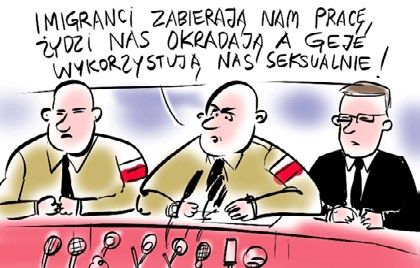
14Fig 8: Political cartoon. Caption reads: “Immigrants take Fig 9: Electoral results 2019: Sejm.
our jobs, Jews rob us, and gays abuse us sexually!” .
43,6
27,4
12,6
8,55
6,81
Source: The drawing circulated on Twitter and Facebook. Despite
PiS KO Lewica PSL+K‘15 Konfederacja
thorough research we were not able to clarify its copyright. We ap-
preciate any relevant indications. Source: National Electoral Commission / own representation
(the EU tries to force both upon Poland), and 4) cost “In the last campaign, the big threat was Muslim migrant.
resources that should rather be spent on other, ‘real’ At other times, the enemy is the Jews. Now it’s our turn”
needs. LGBT rights being portrayed as something for- (ibidem). In a sense, assumptions about the Jew, the
eign, which is imposed on Poland is a particularly re- refugee, and the homosexual cause a triad of xeno-
curring feature, e.g. in this infamous quote by Jarosław phobic fears in the Polish right, as each represents a
Kaczyński during a gathering in Włocławek: “These ide- variant of the ‘other’ – even if today, anti-Semitism is
ologies, philosophies, all of this is imported, these are not unacceptable everywhere except on the most extreme
internal Polish mechanisms. They are a threat to Polish margins of the far-right.
identity, to our nation, to its existence and thus to the
Polish state.” (cf. Davies 2019). However, this tactic has 4. THE ELECTORAL RESULT
been used in the past, as the right once made similar
claims about the Jewish community. This connection PiS, as expected, was the clear winner of the election to the
to anti-Semitism has been emphasized by political car- Sejm, securing 43.59 % of the votes (Fig. 8) and an abso-
toonists (Fig. 8) and social activists. For example, Piotr lute majority of seats (Fig. 9). Despite their victory, PiS had
Godzisz of Lambda, an LGBT organisation, observed: hoped for a higher percentage of votes, as many polls pre-
Fig 10: Seats distribution: Sejm.
PiS KO Lewica PSL+K‘15 KONF. German Minority
134
235
49
30
11
1
Source: National Electoral Commission / own representation
15dicted they would see up to 48 %. Jarosław Kaczyński even 26.2 % of their votes, but the far-right Konfederacja re-
expressed dissatisfaction in his victory speech maintaining ceived 20.2 %, which is almost thrice the result that was
that “we did well, but we deserve more”. KO came second with seen in the general population. The Left gained 17.7 %
27.40 %, followed by the Left (12.56 %), PSL (8.55%), and Kon- within this group, which is 5 % higher than in the general
federacja (6.81 %). Both PSL and Konfederacja passed the 5 population (all data from the exit poll by IPSOS). Young
% electoral threshold. PiS also won the Senat vote with 44 voters clearly reject the PiS-PO duopoly and they are more
%. However, due to the distribution of votes, it failed to se- radical in their political leanings, picking Konfederacja, if
cure a majority in many constituencies. As a result, PiS lost they lean to the right, and the Left, if they are more pro-
control of the upper house by a narrow margin (49 to 51). gressive. Generally, PiS attracted the majority of older
and less educated (elementary and vocational training)
The recent trend of high voter turnout continues, after a voters. Although, PiS clearly monopolised the support of
record-high in local elections in October in 2018 and in the the less educated Poles, no one seems to have a clear
European elections in May 2019. In this election, voter turn- advantage in the higher education segment, which is di-
out reached 61.16 %, which is the highest turnout in gen- vided between PiS, KO, and the Left, who gained the most
eral elections since 1989 (when it reached 62.7 %), and the of their support in this demographic group. Surprisingly,
third highest voter turnout in elections in Poland since 1989 there were only minor gender differences in voting pref-
in general. Thus, Polish democracy, whose rule of law has erences: women tended to vote for KO somewhat more
come under fundamental threat, is improving in terms of often than men, and men chose Konfederacja almost
participation rates. twice as often as women. Moreover, there were only
minor gender disparities in the electoral bases of the re-
There were no surprises in the regional distribution of party maining parties. However, there was a clear difference
support. The geographical differences that were present in in results between cities and the countryside: PiS won
earlier elections resurfaced once again: the North-West and in villages (56.2 %) and small towns (population below
big cities in the East tend to vote along progressive and lib- 50,000: 41.7 %, population between 51,000 and 200,000:
eral lines, the South-East tend to vote conservative (Fig. 10). 38.3 %). Cities, on the other hand, were a domain of KO
However, this time the differences were less pronounced (population between 201,000 and 500,000: 39.3 %, pop-
for the Sejm vote, as PiS won, albeit narrowly, in many con- ulation above 500,000: 41.1 %). Moreover, the larger the
stituencies that thus far had been rather progressive. PiS town, the more people voted for the Left (albeit it always
won in 36 out of 41 constituencies. The North-West/South- remained in 3rd place) as well as for Konfederacja. The
East divide was also visible in the Senat vote (Fig. 11). countryside also remains the stronghold of PSL. PiS man-
aged to keep most of their 2015 voters (90 %), while KO,
The patterns in voting behaviour generally matched past the Left and PSL kept around 70 % of theirs. The former
elections, although the youngest group of voters (ages supporter base of Kukiz’15 disintegrated, picking PiS, PSL,
18-29) showed interesting results: not only did PiS gain and Konfederacja in equal parts instead (ibidem).
Fig 11: Regional distribution of support (Sejm), by Fig 12: Regional distribution of support (Senat), by
constituencies constituencies
PiS won with at least 55 % 40-55 % less than 40 %
PiS KO PSL SLD
KO won with more than 40 % less than 40 %
Source: Source: Visualisation by OKO.press, data from National
Source: PKW. / own representation Electoral Commission / own representation
165. OUTLOOK much state interference in the economy, statism and
excessive social programmes on the one hand, and too
In 2019, Polish citizens decided to keep Law and Justice in little rejection of the EU and other international obliga-
power. The party managed to maintain an absolute ma- tions on the other hand. These considerations will prob-
jority of seats in the Sejm (by a margin of 4). It is unlikely ably make it much harder for PiS to ignore criticism, and
there will be major change in the structure of the future to remain immune to most of it. One more, and less pos-
government, as PiS does not need to seek coalition part- itive, outcome of the increased plurality is possible, too:
ners. A small restructuring of the cabinet is likely, but it is PiS may start to be perceived as a more moderate party
unlikely that there will be huge changes to their existing due to the increased presence of opinions and attitudes
plan of action. This also means a continuation of policies even further to the right than theirs. Alternatively, they
that resulted in conflicts with the EU in recent years, i.e. may further radicalise in order to avoid being outflanked
the continuation of the disputed changes to the judiciary from the right.
system. Moreover, there is also concern that PiS might
target independent media. As long as no new immigration or refugee crisis emerg-
es, it is unlikely that there will be many changes to the
However, losing the upper house to the opposition way Poland handles its migration matters today. The rul-
means that it will become harder for PiS to continue un- ing party will remain opposed to immigration in declara-
challenged with their reforms. Although, the Senat does tions, in particular to that from the Middle East. In prac-
not have full blocking powers over the law proposals tice, it will continue to quietly allow for easy access to
voted in by the Sejm, it can nonetheless stall and delay the labour market for migrants from Ukraine and Cen-
the legislative process and vote in amendments to the tral Asian countries. The electoral results also mean that
proposed laws. It can propose new laws, too, – even if Poland will remain a tough partner for the EU, focused
their passing depends on support in the Sejm, which may on national interests and national sovereignty, and not
prove hard with it being further dominated by PiS. None- at all on European solutions to humanitarian crises or
theless, despite the limited powers of the Senat, winning a common European immigration policy. Another esca-
it over still counts as a major victory for the opposition. lation of the conflict in the Middle East after the recent
Their strategy of coordinating candidacies and mutual withdrawal of the USA from Syria may bring a new wave
support for one another’s candidates proved successful. of asylum seekers or even trigger new terrorist activi-
If they repeat this in the upcoming spring presidential ties by ISIS fighters who escape from increasingly under-
election and agree on a common candidate, they may staffed and erratic Kurdish prisons. As a result, Poland
repeat this victory. With the presidential office in the will be even more inclined to continue or escalate its an-
hands of the opposition, it will gain even more powers, tagonistic politics towards the EU and its Member States.
as the president has the right to veto new bills.
It is not only the Senat that gets a new face. Although
the same party stays in power, the composition of the
new Sejm will differ from the old one. The Left returns
to the Sejm with 48 representatives, many of whom are
first-time parliamentarians. The far-right made it into
parliament as well with 11 MPs. This means that after
Sejm had been dominated by right and centre-right par-
ties for four years, with these elections more plurality
returned to Polish politics. This also holds true within
the opposition itself: the parties of the newly elected
Sejm not only differ from PiS but also – in some cases
significantly – from each other. Therefore, they will likely
criticise the ruling party from different perspectives and
for different activities. KO will probably continue to focus
on criticising social programmes and the weakening of
the constitutional order. The Left, on the contrary, will
likely welcome social redistribution. However, it will fo-
cus on condemning infringements of civil liberties and
minority rights, as well as on protecting the principles
of secularism and separation of church and state. The
presence of Konfederacja in the Sejm means that PiS will
get opposition to the right and will cease to be the only
political force claiming the rejection of sexual minorities,
migrants, or reproductive rights. Since Konfederacja’s
economic ideology is libertarian, it is likely to criticise too
17You can also read


