The leading French agency supporting local investment and export Investor Presentation - September 2016 - www.sfil.fr
←
→
Page content transcription
If your browser does not render page correctly, please read the page content below

The leading French agency supporting local investment and export

Investor Presentation – September 2016

www.sfil.fr

Executive summary
SFIL is a public development Bank created in 2013
The French State has entrusted – with the authorization of the European
Commission - two public policy missions to SFIL:
refinancing of loans to the French local public sector since 2013 and
refinancing of export loans guaranteed by the French State as part of a
new national public export credit scheme since 2015
The French State as reference shareholder is committed to ensure SFIL is
able to pursue its activity in an ongoing manner and honor its
financial commitments
Debt issued by SFIL is classified as Level 1 for LCR purposes:
“The issuer is a credit institution incorporated or established by the central government of a Member State
… [which is] under the legal obligation to protect the economic basis of the credit institution and
maintain its financial viability throughout its life-time…” (Article 10.1.(e)(i), European Parliament LCR
delegated Act, October 2014)
SFIL plans to be a regular capital markets issuer as new French agency
with at least one yearly benchmark
2
Agenda

         1.   A public set up with two public policy missions

         2.   High quality assets, stringent financial policies and funding strategy

         3.   Appendix

                                             3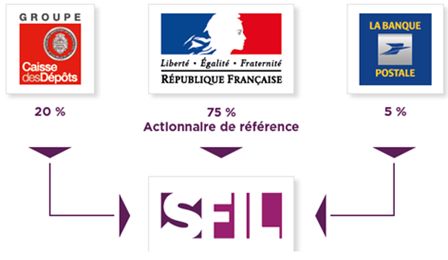
SFIL at the center of a public set up with two public policy missions
First mission: Financing of French Local
authority and hospital investments
Creation of SFIL in 2013 to ensure a stable
access to long dated funding for the local
public sector
Leading loan provider to the French local
public sector in partnership with La Banque
Postale with a market share of 25%
Second mission: provide financing for
large export credits
New public policy mission entrusted by the
French State to SFIL in 2015 to help
enhance the competitiveness of French
exporters
First financing transaction signed in June
2016
4SFIL at the center of a public set up with two public policy missions
Public sphere
Public ownership and close links to the
French State
100% publicly owned
Fully regulated financial institution
supervised by the ECB and ranked 7th 20% 75% 5%
reference shareholder
credit institution in France by assets
Debt issued by SFIL classified Level 1 for
LCR purposes based on the legal
obligation of the French government to
protect the economic basis of SFIL and
maintain its financial viability, Article
10.1.(e)(i), LCR delegated Act, October
2014
5Long run commitment by the French State as reference shareholder
Specific responsibilities including obligation to Strict supervision:
recapitalize a financial institution if needed o CEO and Chairman of SFIL appointed by
Banque de France may ask shareholders to presidential decree
provide necessary support (Art. 511- 42 o French State represented on the
French Monetary and Financial Code) supervisory board
Particular responsibilities in terms of financial o Scope of business strictly limited to the two
support public policy missions
Appointment of
Responsibilities
CEO,
in terms of
representation
financial
on supervisory
support
board
Obligations of the reference shareholder are documented via a letter of comfort to the regulator,
clearly defining support and involvement
The French State is the reference shareholder of SFIL and has the
intention to remain reference shareholder in the long run
6Role of SFIL in a European context
Similar set ups exist in most European countries to Export Credit Activity
finance local government investments and export Local Authority Finance activity
contracts
*
SFIL is a member and Philippe Mills holds the Local Authority Finance Activity
presidency of the European Association of Public *
Banks (EAPB) promoting the specificities of public
development banks Local Authority Finance Activity Local Authority Finance Activity
* *
Local Authority Finance Activity
*
Export Credit Activity Local Authority Finance Activity
*
Local Authority Finance Activity Export Credit Activity
*
Export + Local Authority Finance Activity
Export Credit Activity
*
*
Export + Local Authority Finance Activity
* Member of the EAPB
7First public mission: refinance loans to the French local public sector
December 28th 2012 February 2013 2013 - 2014 2015
• European Commission • Creation of SFIL at the • 2013 and 2014: • 2015: First lender to
confirms need for a public center of a new public set Second lender to the the local public sector
set up to provide a stable up French local public sector with over EUR 5 billion
access to long dated • SFIL takes full ownership • EUR 3.3 billion in new in new loans
funding for the local of DEXMA, now CAFFIL lending in 2013 and EUR • 25% market share
public sector • Loan origination via La 4.2 billion in 2014
Banque Postale,
refinancing via issuance of
covered bonds,
8First public mission: refinance loans to the French local public sector
French local authority debt at a low level in European comparison
Local and Regional Government Debt against GDP 2015 Gen. Govt.
Debt /GDP
Debt to GDP ratio of the French Local Public
Spain 27.5% 99.2%
Sector has only increased slightly from 8.2%
Germany 26.5% 71.2% to 9% of GDP since 2010
Belgium 18.3% 106.0% French local authorities generated a budget
France
95.8% surplus of EUR 700 m in 2015
9.0%
65.1%
Netherlands 8.6%
132.7%
Italy 8.4%
89.2%
United Kingdom 4.7%
0% 5% 10% 15% 20% 25% 30%
Gross Savings amongst the highest in Europe
Local and Regional Government Gross Savings as Percentage of GDP
Gross savings – current government revenues
2.5% minus current expenditures (i.e. excluding
investments) have been stable around 2% of
2.0% GDP over the past 10 years
1.5% Level of gross savings amongst the highest
and least volatile in Europe
1.0%
French Local Public Sector gross savings
0.5% remain at a high level of 1.9% of GDP in 2015
0.0%
2006 2007 2008 2009 2010 2011 2012 2013 2014 2015
Euro area Germany France Italy
Source: Eurostat
9First public mission: refinance loans to the French local public sector
Strict framework under European Commission supervision
Scope of lending business is limited to French local public sector
Pricing at the going market rate, no subsidization – full control of credit risk by SFIL
First lender to the French local public sector in 2015 with a volume of EUR 5 billion in new loans
Commercial banks provide only about a third of French local authority funding needs underlining the need for a public set up
2015-2017 Annual Borrowing Needs: €17-21 billion
minimum: €17 billion max: €21 billion
2015-2017 Estimate of annual public funding available
€5.0 bn €4.0 bn €3.5 bn €4.5 – 8.5 bn
SFIL + LBP CDC EIB Commercial banks & capital markets
Source: Moody’s Research Sector in depth 18-May 2015
10Second public mission: provide financing for large export credits
February 2015 May 2015 Q3 – Q4 2015 June 2016
French State announces European Commission Build-up of the internal Closing of a EUR 550 m
a new public export Approval for the new workforce and financing transaction
credit scheme based on public mission of SFIL and processes, framework for a total contract value
SFIL and CAFFIL CAFFIL received on May agreement with 17 banks of 1.3 billion for two
capabilities 5th 2015 including all major cruise ships build by STX
players in the export France
credit sector
“The execution of this transaction demonstrates the competitiveness of the
mechanisms in support of our exporters put in place by the State”
Michel Sapin, Minister of Finance, 1st of July 2016
11Second public mission: provide financing for large export credits
Exports: GDP growth potential considered as a priority by the French State
Exports represent 21% of France’s GDP, significantly below the EU average (33%)
French know-how is however widely recognized, for both consumer goods (luxury,
pharmaceuticals, agri-sector) and capital goods (10% of exports, mainly in the fields of
energy, transportation, defense).
Competitive sales finance appears to be a significant success factor
SFIL and BPI France are in charge of enhancing the French export credit scheme
Direct Loans by BPI France (from Refinancing by SFIL of large export
2015) contracts whose financing is
arranged by commercial banks (as
BPI acts as sole lender for amounts of 2015)
up to EUR 25 m and as a co-lender for
amounts up to EUR 75 m Loan amounts above EUR 75 m
Export credit guarantee managed by Bpifrance Assurance Export (as of 01.01.2017)
Insurance directly provided by the French State
Current commitment : EUR 65 Bn
12Second public mission: provide financing for large export credit
SFIL’s set up: a refinancing platform open to all commercial banks
The vast majority of OECD countries rely on a public set up for the refinancing of export loans through two different models:
Public refinancing platform: SFIL (France), SEK (Sweden), FEC (Finland), KFW (Germany), CDP (Italy)
Direct public lender: US EXIM (US), JBIC (Japan), KEXIM (Korea), EDC (Canada)
Exposures linked to the export credit activity constitute 100% French government exposures
French Public Export Credit Agency guarantee
covering 95% of the overall loan
SFIL takes 95% of the export loan (fully guaranteed part)
Export Client –
Foreign country
Export Bank as
Export bank will keep an exposure of 5% of the loan agent and originator
(unguaranteed part) of the loan
13Agenda
1. A public set up with two public policy missions
2. High quality assets, stringent financial policies and funding strategy
3. Appendix
14Strong credit ratings
SFIL reached high quality ratings on the basis of:
High strategic importance for the French State as a key source of funding for the local public sector
and French exports
Status as a State owned development bank, French State as reference shareholder with specific
responsibilities in terms of financial support without time limitation
Close supervision by the French State as majority shareholder – all important decisions require
approval by the French State
Strong capital ratios and strong support in terms of liquidity from the shareholders
Issuer Ratings Moody’s S&P Fitch
SFIL – Long Term Aa3 AA AA-
SFIL – Short Term P-1 A-1+ F1+
Moody’s S&P Fitch
French State Aa2 AA AA
Negative outlook by S&P on the ratings of SFIL reflecting the negative outlook on France
15Simple and straightforward balance sheet, strong capitalization
Main balance sheet items of SFIL on a consolidated basis
Consolidated main balance sheet items
June 30th, 2016 - (EUR billion)
Covered Bonds 52.8
Loans and Securities 59.2
Refinancing by Shareholders 7.7
Cash Assets 2.9 Commercial Paper 0.9
Equity 1.4
Cash Collateral Paid 3.0 Cash Collateral Received 2.2
CET1 ratio: 23.4% (Basel III phased in)
Simple and straightforward balance sheet, activity limited to the refinancing of public sector assets,
strong capitalization
Strong asset quality: average risk weighting under Basel III advanced internal rating model of only 6.5%
Long term refinancing mainly via issuance of covered bonds
Additional liquidity needs provided by shareholders via liquidity lines
(all figures including CAFFIL)
16Geographic distribution of the public sector portfolio
Share of French assets - expected evolution Public sector portfolio 30th of June 2016
100%
100%
90%
90% 80.2% 81.2%
80%
80% 11%
SFIL 70%
70%
export
60% credit 60%
50% 50%
91% 31/12/2015
40% 80% 85% 36% 40%
30% LBP 30%
30/06/2016
loan
20% activity 20%
9.8% 9.4%
10% 10% 4.3% 3.9% 2.5% 2.2% 2.5% 2.4%
0.9% 0.9%
0%
0%
31/12/2015 31/12/2016 31/12/2021
France Italy UK Switzerland Allemagne Others
French assets international portfolio figures based on CAFFIL cover pool data
New assets exclusively French:
Local government and public hospital loans,
Export loans benefitting from a French State guarantee
International legacy portfolio managed in runoff
Expected evolution of total public sector portfolio over the coming 5 years :
Share of French assets to increase to 91%
exposures linked to the export credit activity expected to reach 11%
Expected evolution when taking into account undrawn export credit commitments:
the export credit activity is expect to represent 18% of assets in 2021
assets originated since 2013 will represent more than 50% of the balance sheet
17High granularity, low concentration, diversity of borrowers
High granularity, low concentration
Over 17 000 different counterparties
Low concentration risk:
Sum of 20 largest exposures = 13.4% of assets
Largest single borrower exposure represents 1% of assets
20th largest exposure represents 0.4% of assets
Breakdown by type of counterparty for French exposures as of June 30th, 2016
Indirect
exposures
States 7.3%
1%
Public sector
entities
4.8%
Public hospitals
11.1%
Regions Municipalities
8.5% 53.4%
Departments
13.9%
(all figures based on CAFFIL cover pool data) 18SFIL group funding mix
LCR Level 1*
Liquidity lines provided by Issuance of covered
shareholders CDC and LBP to bonds via CAFFIL as main
SFIL funding tool
February 2013 July 2013
Bond issuance by SFIL in 2016 to French CP Program provides a
further diversifiy sources of LCR Level 1*
source of diversification for
LCR Level 1*
funding short dated funding
Last Quarter 2016 August 2015
* European Commission Delegated Act, October 2014
19Sources of funding for SFIL
Increasing flexibility and diversification
New EMTN Program
Planned program size: EUR 5
billion
LCR Level 1 classification*
Focus on benchmark issuance EUR 5
billion CDC and LBP long term
Ratings Aa3 (Moody’s), AA commitment
(S&P), AA- (Fitch)
Liquidity lines
Currently drawn for an amount
of EUR 7.7 billion
French CP Program
Maximum amount: EUR 13.75
Program size: EUR 2 billion Up to EUR 52.8
billion, of which up to EUR
Maximum maturity: 1 year 2 billion 12.5 billion provided by CDC
Launched in 2015 2.5
Growing activity in 2016
Average outstanding amount above
EUR 600 m
Ratings: P1 (Moody’s), A-1+ (S&P),
F1+ (Fitch) Up to EUR 13.75 billion
Labeled STEP under ID 2812
LCR Level 1 classification*
* European Commission Delegated Act, October 2014
20A new regular issuer in the French agency segment
€ Market - Secondary Spreads vs OAT
20
16
SFIL issuance plans
BPI
OAT spreads (bps)
Regular benchmark issuer
12
One or two transactions per year
AFD
CDC EUR and USD issuance
8 Maturities between 3 and 10 years
CADES
4
0 1 2 3 4 5 6 7 8 9 10
Maturity (years)
As of September 29th, 2016
Credit Rating Aa3/AA/AA- Aa2/NR/AA NR/AA/AA Aa2/NR/AA Aa2/AA/AA
1 2
State Ownership 75% 100% 100% 50% 100%
LCR classification Level 1 Level 1 Level 1 Level 1 Level 1
Issue Risk Weight 20% 0% 20% 20% 0%
PSPP Eligibility Requested Yes Yes Yes Yes
(1) 100% ultimate State ownership through CDC and LBP
(2) 100% ultimate State ownership through CDC
21Information about the planned inaugural transaction
Issuer SFIL
Status Senior unsecured
Format RegS bearer, dematerialised
Ratings (Moody’s /S&P /Fitch) Aa3/AA/AA-
Liquidity HQLA Level 1
Issuance out of EMTN programme
Legal framework
French law
Listing Euronext Paris
Expected size EUR Benchmark
Currency EUR
22Key Take-Aways
Two public policy missions:
financing tool for French local public sector investments
Refinancing platform for export credit loans reinforces strategic role for the French State
Strong credit ratings reflect strong support from the French State as reference shareholder
Strong asset quality - French public sector assets to represent over 90% of portfolio by 2021
Status as public development bank reflected by LCR classification as HQLA Level 1 asset
“We regard Société de Financement Local (SFIL) as a government-related
entity, and we believe there is an almost certain likelihood that the French
government would provide SFIL with extraordinary support if needed.”
S&P Rating Report April 29th 2016
23Agenda
1. A public set up with two public policy missions
2. High quality assets, stringent financial policies and funding strategy
3. Appendix
24Appendix – Table of contents
Appendix 1: Further information on SFIL governance
Appendix 2: Further financial information on SFIL
Appendix 3: Further information on French economy and on French local authorities
Appendix 4: Additional information on the export credit activity
25Appendix 1: SFIL board composition reflects its public mission
Board of Directors
Chairman of SFIL, former CEO of Agence France Trésor,
Philippe Mills, Chairman Board Member of EIB, President of the European Association
of Public Banks
French State represented by Jérôme Reboul Deputy Director, Agence des Participations de l’Etat
Jean Pierre Balligand, independent member Former Chairman of CDC Supervisory Board
Head of business and regional development, La Banque
Serge Bayard, representing La Banque Postale
Postale
Delphine de Chaisemartin, representing CDC Head of Financial Institutions, Participations Dept., CDC
Françoise de Panafieu, independent member Former Minister
Cathy Kopp, independent member Former Chairwoman IBM France
Chantal Lory, independent member Former Chairwoman of the Executive Board of LBP AM
Deputy Head of the Banking and Financing of General Interest
Antoine Saintoyant, nominated by the French State
Activities Division, Directorate General of the Treasury
Pierre Sorbets, nominated by the French State Head of Public Sector, HSBC France
5 staff representatives
26Appendix 1: Senior Executives of SFIL
Executive Committee
Chairman and Chief Executive Officer Philippe Mills
Deputy Chief Executive Officer François Laugier
Chief Financial Officer Florent Lecinq
Chief Risk Officer Nathalie Derue
Head of Treasury and Financial Markets Sami Gotrane
Head of CAFFIL Coordination Gilles Gallerne
Head of Loan Portfolio Management Stéphane Costa de Beauregard
Head of Export Credit Pierre-Marie Debreuille
General Secretary Béatrice Gosserez
Head of HR Frédéric Meyer
27Appendix 2: LCR Level 1 Status of SFIL based on strong State support
Article 10.1.(e)(i) LCR delegated Act:
‘The issuer is a credit institution incorporated or established by the central government of a
Member State or the regional government or local authority in a Member State,…
…the government or local authority is under the legal obligation to protect the economic basis
of the credit institution and maintain its financial viability throughout its life-time…
…and any exposure to that regional government or local authority, as applicable, is treated as an
exposure to the central government of the Member State in accordance with Article 115(2) of
Regulation (EU) No 575/2013’
LCR Level 1 Status of SFIL reflects the legal obligation of the French State to
protect the economic basis and maintain the financial viability of SFIL
28Appendix 2: Leverage ratio
EBA report to the European Commission Leverage ratio
Leverage ratio
European Commission Legislative proposal by requirement starting
disclosure starting 2015
published August 1st 2016 end of 2016 January 1st 2018
2015 2016 2017 2018
SFIL reported a Basel III phased-in leverage ratio of 1.9% as of December 31st 2015
The European Commission is scheduled to make a legislative proposal at the end of 2016
The possibility of a specific treatment for public development banks will be investigated in
detail
A specific treatment for public development banks could take different forms:
Exemption from CRR requirements (Article 2(5) CRDIV)
Setting of a leverage ratio requirement below 3% for public development banks
Deduction of promotional loans for the calculation of the leverage ratio requirement
29Appendix 2: Key specialized financial institution
ACTIVITY BALANCE SHEET RATIOS
EUR 5 billion 23.4%
New loans to the French local
EUR 85.8 billion CET1 Ratio
public sector in 2015 (LBP and SFIL consolidated balance sheet
assets 30th June 2016 30th June 2016 (Basel III phased-
SFIL) in)
Over EUR 18 billion Over EUR 50 billion 20th out of 130 banks
Covered bonds issued since the Outstanding covered bonds ECB stress test, equity October
creation of SFIL in 2013 2014
401 Employees EUR 5.2 billion 1.0% NPL
Basel III RWA (SFIL consolidated)
31st December 2015 30th June 2016 (CAFFIL)
30th June 2016
30Appendix 2: SFIL Funding Id-Card
Bloomberg ticker Website Issuer Ratings
SFILFR M-Mkt www.sfil.fr Aa3/AA/AA-
(French CP Program) (Moodys/S&P/Fitch)
SFILFR Govt
LCR Level 1
Label STEP under ID 2812
European Commission
French CP Program Delegated Act, October 2014
31Appendix 3: France among the strongest economies in the world
5th/6th position in terms of GDP while ranked only 21st in terms of population
6th largest exporter of merchandises in the WTO ranking
4th largest exporter of goods and services
4th position for the world’s Quality of the French higher France is ranked 4th worldwide
largest corporations listed by education system widely in terms of internet access and
Fortune 500 recognized throughout the for its road quality
world
France take second place in the 10th position for the quality of
Top 100 of most creative Strong position in managerial its infrastructure
companies published by Forbes education: first position in
European ranking made by 12th place for its scientific
Thomson Reuters placed France Financial Times in masters in research
in third position in the Top 100 management
Global Innovators
Second position in Business
school European ranking and
4th in business school ranking
made by Eduninversal
Source pictures: www.freeimages.com
32Appendix 3: Outlook for the French economy: Structural reforms on track
Labour Market, pensions Competitivity Goods and services
• Growth and Activity Act: • Corporate Tax Credit for • Energy: elimination of
reform of labour courts, easing competitiveness and regulated rate for gas to
of restrictions on Sunday employment: EUR 10bn in business, opening to
opening 2014, EUR 20bn from 2015 competition of hydroelectric
concessions
• Employment Security Act: • Responsibility and Solidarity
"Flexisecurity" agreements, Pact: EUR 20bn additional • Rail transportation: opening
easing of restructurings, decrease in employers' social of passenger transport to
reduction of legal contributions and corporate competition by 2019
uncertainty in collective taxation by 2017
layoff procedures
• Growth and Activity act: wide
• Increase in the contribution range of measures fostering
period for a full-rate competition and liberalizing
pension, objective to balance regulated sectors
the pension system by 2020
and 2040
3
2
1 Measure implemented
33Appendix 3: Budget consolidation: EUR 50 billion spending cuts over three years
Measures for growth under CICE and the Responsibility and Solidarity Pact on track
Latest budget statistics show a significant reduction of the budget deficit from 4% in 2014
to 3.5% of GDP in 2015
This reduction has been achieved via a reduction in expenditures without any increases
in revenues
Objective to achieve a budget deficit below 3% in 2017
2015 Spending cuts by sector
EUR 21 billion EUR 50 billion 2015 - 2017
spending 2016
reductions
EUR 14.5billion 2017
additional
spending EUR 14.5 billion
reductions additional 20%
spending
reductions 38%
20%
22%
Central government Local authorities
Health insurance expenditures Social security
34Appendix 3: Organization of the French Territory
13 Régions (from 1st of January 2016 onwards)
• Construction and upkeep of secondary schools (“Lycées”)
• Regional rail transport system
• Economic development
101 Départements
• Construction and upkeep of secondary schools (“Collèges”)
• Departmental road network
• Fire fighting and emergency services
36,681 Municipalities and ‘Intercommunales’
• Construction and upkeep of: pre-elementary and primary
schools
• Urban public transport and municipal road network
• Drinking water supply, household waste collection and
treatment
Overall, French Local Authorities are in charge of
close to 60% of French public sector investments
35Appendix 3: Control Framework and Budget Rules
The Golden Rule as fundamental principle : local authorities may only raise debt to
finance new investments
Strict state supervision over all French Local
Authorities through:
Controls of the legality of all decisions taken 15 Regional 101 Prefects
by the executive, including the budget Audit chambers
Controls by the Regional Audit Chambers
Intervention in
Regular case of breach of
Prefect, as the representative of the French controls of budget rules
State, has the right to: local and
authority control of legality
Force a decrease in current expenditures finances of local authority
budgets
Impose an increase in discretionary taxes
in cases of financial difficulty or breach of
budget rules
French local public sector: Régions,
Départements, Municipalities
36Appendix 3: French Local Authorities in a European Comparison
Local government deficit one of the lowest in Europe
Gen. Govt.
Local and regional government deficit 2015
Deficit / GDP
French local public sector budget surplus of
Surplus Deficit
EUR 700 m after a deficit of 0.2% in 2014
Belgium 1.4% 2.6%
Increased tax revenues and reduced
Spain 1.3% 5.1% investment more than compensated
Netherlands 0.3% 1.8% reductions in government transfers
United Kingdom 0.2% 4.4%
France 0.0% 3.5%
Italy -0.1% 2.6%
Germany -0.7%
-0.2% Source: Eurostat
-0.3% 0.0% 0.3% 0.6% 0.9% 1.2% 1.5%
Highest share of investment expenditures amongst European peers
Investment share of Local and Regional Government Expenditures 2015
Investment represent higher share of Local
France 16.7% government expenditures in France than
elsewhere in Europe
Netherlands 12.6%
Investment represent close to 17% of
United Kingdom 9.3% French Local government expenditures
compared to Euro below 10%
Italy 8.9%
Spain 8.3%
Belgium 7.5%
Germany 7.2%
Sources: Eurostat
0% 2% 4% 6% 8% 10% 12% 14% 16% 18%
37Appendix 3: Institutional framework fosters prudent management
Municipalities Départements Regions
Investment decision taking Municipal Council District Council Regional Council
through assemblies
('Conseil Municipal') ('Conseil Général') ('Conseil régional')
elected for 6 years terms
One law code Code Général des Collectivités Territoriales (General Local Government Code)
Fundamental principle: Long term debt may be raised only for the purpose of financing investments
the Golden rule
Central government Regional Audit Chamber
(‘Chambre Régionale des Comptes’)
control performs frequent reviews to audit local government finances
Remedy in case of the A Prefect is empowered, inter alia :
exceptional occurrence of
To force a decrease in current expenditures
breach of rules or financial
difficulty To force an increase in discretionary taxes levied by a local authority
38Appendix 3: Set up is authorized and fully operational
Approval by European Commission
Approval dated May 5th, 2015
Main guidelines:
Scope not limited in terms of sectors or countries, as long as the export credit complies
with the OECD arrangement for Export Credit
Authorization granted for 5 years, may be renewed, with a grandfathering of all deals
submitted during that period
Bank competition:
Number of banks invited to quote by the exporter and/or borrower must be superior to
the number of banks refinanced by SFIL - guideline is smoothened for the defense and
nuclear sector and for projects above EUR 500 m
French state will have to report to EC on this point
No further approval is needed
Activity operational
« Protocole d’Accord » with 17 banks
Planned volumes of EUR 1.5 to 2.5 billion p.a. (after the ramp-up period)
Open for all sectors and regions
SFIL analyzes and approves the transactions on a case by case basis, following a process
aligned with market practices (E&S issues, compliance etc.)
39Appendix 4: Public intervention as a bank in the export finance can follow two
alternative routes
Export credit insurance is available for all private lenders.
In addition, national authorities have developed lending capacity in order to insure
affordability and efficiency for the financing of export transactions. Two models are
possible – as displayed in the table below.
1) Public direct lender 2) Public refinancing platform
Shared between credit insurer and
Credit risk Borne
commercial banks
Liquidity risk Borne Borne
Commercial relationship Borne Borne by commercial banks
US EXIM (US), JBIC (Japan), SFIL (France), SEK (Sweden), FEC
Existing set-ups
KEXIM (Korea), EDC (Canada) (Finland), KFW (Germany), CDP (Italy)
As an example, US Exim direct lending usually represents 50% of total US export credits, except
during liquidity crisis phases (peak at 76% in 2011)
40Appendix 4: Export credit insurance: a financially sustainable activity with a
worldwide impact
Volume:
Export credit insurance is an alternative for some importers (high risk countries or corporates),
projects (new technologies, multi-billion tickets) and time periods (financial crisis).
The total exposure is at 700 EUR bn and is geographically diversified in terms of end borrowers (see
graph).
Public Policy objectives and regulation:
Most exporting countries are equipped with an Export Credit Agency to support the export sector
Public export credit insurance is regulated from a trade-related angle (WTO, OECD) with a view to
ensure a level playing field among exporters
Economics:
The insurance premium rates are fixed at a sustainable level : premium collection exceed
indemnifications for most ECAs (including France)
41Appendix 4: Links for further information for French local authorities finances
and infrastructure investments
French local authorities
http://www.collectivites-locales.gouv.fr/
Information on French budget French central government debt
http://www.performance-publique.budget.gouv.fr/ http://www.aft.gouv.fr/
Banque Postale research on French Local authorities
https://www.labanquepostale.fr/collectivites.html
European statistics French economic statistics
http://epp.eurostat.ec.europa.eu http://www.insee.fr/
42Contacts
Investor Relations
Ralf Berninger, CFA Bouchra Rhajbal investorrelations@sfil.fr
Head of Investor Relations Investor Relations
Tel : + 33(0)1 7328 8807 Tel : + 33(0)1 7328 8414
ralf.berninger@sfil.fr bouchra.rhajbal@sfil.fr
Market Activities, Treasury and Funding
Olivier Eudes
Head of Market Activities
+33(0)1 3013 3908
olivier.eudes@sfil.fr
Gonzague Veillas Guillaume Levesque Prisca Sabarros
Head of Treasury and Funding Treasury and Funding Treasury and Funding
Tel : +33(0)1 3013 3909 Tel : +33(0)1 3013 3910 Tel : +33(0)1 3013 39 13
gonzague.veillas@sfil.fr guillaume.levesque@sfil.fr prisca.sabarros@sfil.fr
Cyrille Berseille Djamel Outahar Anne-Sophie Perfetta
Treasury and Funding Treasury and Funding Treasury and Funding
Tel : +33(0)1 3013 39 14 Tel : +33(0)1 3013 3912 Tel : +33(0)1 3013 39 11
cyril.berseille@sfil.fr djamel.outahar@sfil.fr anne-sophie.perfetta@sfil.fr
43Disclaimer
This document does not constitute or form part of any offer or solicitation to purchase or subscribe for securities
and should not be considered as a recommendation by SFIL that any recipient of this document should subscribe for
or purchase any securities. The distribution of this document may be restricted by law or regulation in certain
countries. Accordingly, persons who come into possession of this document should inform themselves of and
observe these restrictions.
This document is not intended for distribution to, or use by, any person or entity in any jurisdiction or country
where such distribution or use would be contrary to law or regulation. This document is not for distribution,
directly or indirectly, in or into the United States of America or to any "US Person" as defined in the U.S. Securities
Act of 1933, as amended (the "Securities Act").
In addition, this document is being distributed to and is directed only at persons in member states of the European
Economic Area ("EEA") who are "qualified investors" within the meaning of article 2(1)(e) of the Prospectus
Directive (directive 2003/71/EC), as amended, to the extent implemented in the relevant member state ("Qualified
Investors"). Any person in the EEA who receives this document will be deemed to have represented and agreed that
it is a Qualified Investor. Any such recipient will also be deemed to have represented and agreed that it has not
received this document on behalf of persons in the EEA other than Qualified Investors. SFIL will rely upon the truth
and accuracy of the foregoing representations and agreements.
Some information or opinions contained in this document (i) have been compiled or arrived at by SFIL from sources
believed to be reliable, but SFIL do not make any representation as to their accuracy or completeness and (ii) are
given at the date mentioned in the presentation and are subject to change without notice.
This document is not to be relied upon as such or used in substitution for the exercise of any independent judgment
and each recipient must make its own investigation as to the opportunity of any investment in SFIL.
44You can also read


