The MCAT Essentials for Testing Year 2020 - Fastly
←
→
Page content transcription
If your browser does not render page correctly, please read the page content below

The MCAT® Essentials
for Testing Year 2020
ADDENDUM: MAY 29, 2020, THROUGH THE REMAINDER OF THE 2020 TESTING YEAR

Required Reading                                                         MCAT® is a program of the
This guide is required reading and contains important information        Association of American Medical Colleges
and resources about the examinee agreement, registration instructions,
and test-day policies.                                                   aamc.org/mcat
The MCAT® Essentials for Testing Year 2020
              Addendum: May 29, 2020, through the remainder of the 2020 testing year
              Effective Date: May 5, 2020

              Coronavirus (COVID-19) and The MCAT Exam
              We know how greatly your life has been disrupted by the coronavirus (COVID-19) pandemic. Preparing
              for the MCAT exam and applying to medical school takes sustained effort and careful planning over
              several years, and we know this time has been challenging. To address the impact of COVID-19 on
              examinees, the AAMC has adjusted the MCAT testing program to follow safe social distancing practices
              to test as many examinees who want to test this year. We’ve added three new test dates and are offering
              three test appointment times on all dates. To administer the exam three times a day, we’ve temporarily
              shortened the appointment time to approximately 5 hours and 45 minutes.

              This addendum to the MCAT Essentials for Testing Year 2020 provides important information on these
              changes and the updated policies that cover the remainder of the 2020 testing year. Please read them
              carefully! You are still responsible for reading the complete version of the Essentials as it includes
              important information about responsibilities on test day and the requirements of the exam. For updates
              and more information on the MCAT testing program’s response to COVID-19 and FAQs, please visit our
              webpage.

              Shortened Exam
              A shortened exam will be administered to accommodate three test appointment times per test date at test
              centers. The exam time will be reduced from a total “seated” time of 7 hours and 30 minutes to 5 hours
              and 45 minutes. The number of scored questions remains the same. Other elements of the exam have
              been reduced or removed to shorten the seated time.

              Content on the Shortened MCAT Exam
              Students will still be tested on all four sections of the exam and will be responsible for demonstrating the
              same knowledge and skills at the same levels of difficulty as on the full-length exam.

              Below is an overview of the MCAT exam as administered beginning May 29 through the remainder of
              2020.

© 2020 Association of American Medical Colleges                     1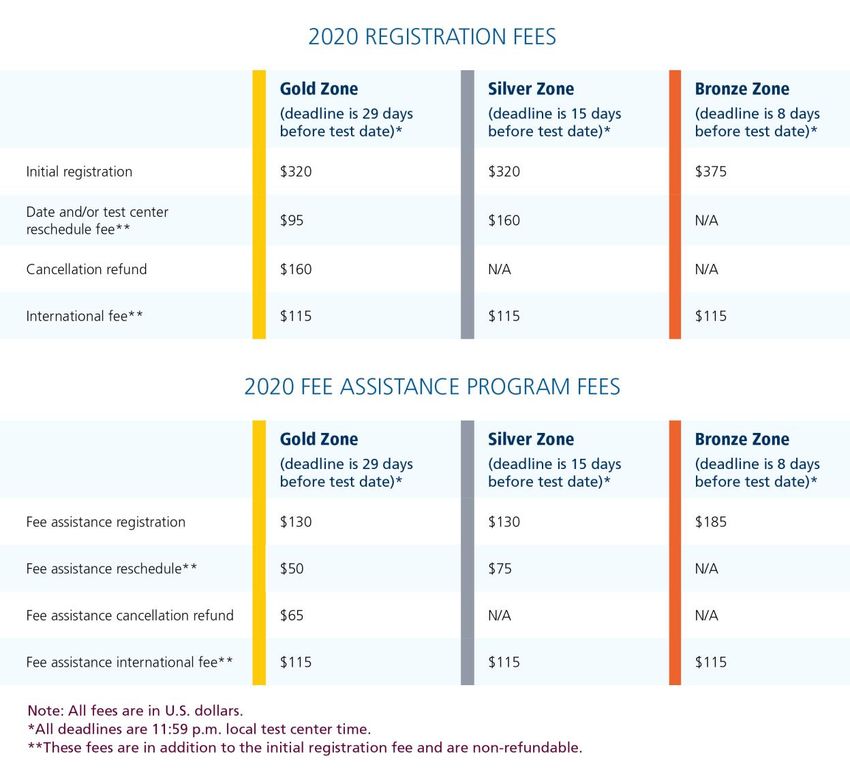
Test Day Schedule for Exams Held May 29–September 28, 2020

              Scheduling Fees, Cancellations, Refunds, and Deadlines
              For the most up-to-date information regarding fees, check the website.

              Testing with Accommodations
              For the most up-to-date information regarding accommodations, check the website.

              Identification Requirements
              We understand that renewal of expired government identification documents may be challenging due to
              the limited availability of services in some states. Please refer to the MCAT Registration ID requirements
              or the COVID-19 page for the most current information about accepted IDs on test day.
              If you know you may require an ID exception or if you have concerns that your identification may not be
              accepted on test day, please contact AAMC Services. You must include your test date and the reason
              for your request in the submission.
              All ID exception requests must be received at least five days before your scheduled exam date.

              Test Day Certification Statement

              The Test Day Certification Statement has been temporarily removed from the seated portion of the exam.
              The Test Day Certification Statement will be provided in the Candidate Rules Agreement, which you will
              receive for review upon arrival at the test center.

              All examinees must read the document and certify before taking the exam that they have not and will not
              engage in any conduct that compromises the integrity, validity, or security of the MCAT exam. You will

© 2020 Association of American Medical Colleges                    2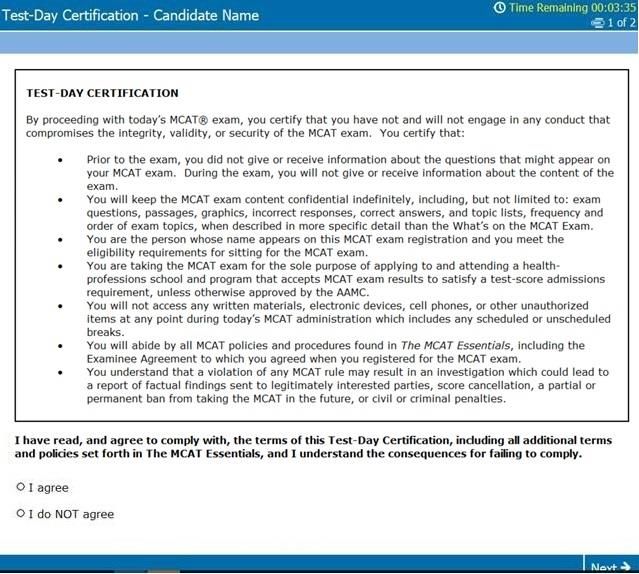
give your consent by signing the digital signature pad. If you decline to provide your digital signature you
will not be permitted to sit for the exam.
Report Suspected Violations
If you receive, or have access to, information or material in any form from any source that you reasonably
believe contains confidential exam content, or has been represented to contain confidential exam content,
it is your responsibility to immediately report its existence to the AAMC by sending an email to
mcatsecurity@aamc.org or by submitting a report via web. Reports of Examinee Agreement violations,
cheating, disclosure of confidential MCAT exam content, wrongdoing, or other alleged actions that
undermine the integrity of the MCAT exam will be treated in a confidential manner. If you report such
activity, the AAMC will not disclose your identity except on a need-to-know basis, including responses to
subpoenas, court orders, or other legal processes.
What Should I Report?
Before, during, or after test day, please report to the AAMC and/or the test administrator any questionable
behavior you observe or reasonably believe to have occurred or that may occur, including but not limited
to examinees:
Receiving assistance or copying from another test-taker.
Taking a test for someone else.
Having access to secure test questions before or after the exam.
© 2020 Association of American Medical Colleges 3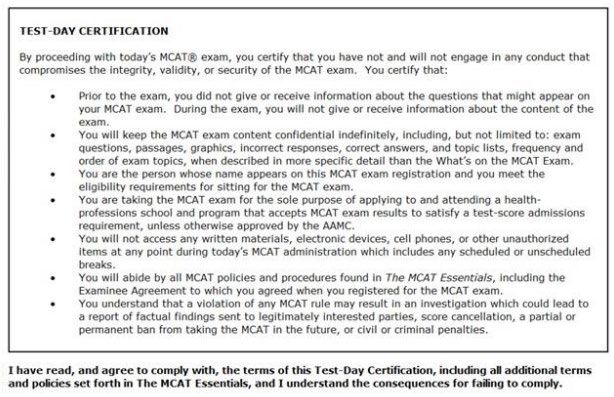
Presenting false, altered, or tampered identification to attempt to gain admission to the test
center.
Attempting to record or otherwise capture test questions during the exam.
Using notes or unauthorized aids.
It is in the interest of all examinees to report the questionable behavior of others. Engaging in any of the
above-listed actions could provide an unfair advantage to an unethical and potentially unqualified
examinee not only on the test, but also as a medical school applicant.
Arriving at the Test Center
Examinees should arrive 30 minutes prior to the exam start time. Standard start times for exams will be at
6:30 a.m., 12:15 p.m., and 6:00 p.m. There may be some variations in start time by test center. Please
view our website for more details.
Check-In Rules and Procedures – Health and Safety
The AAMC continues to monitor guidance about the coronavirus from the Centers for Disease Control
and Prevention (CDC), the World Health Organization (WHO), and state and local health authorities, and
there are processes in place to modify operations during this rapidly changing situation. Your health and
safety are our priority during the COVID-19 pandemic, and robust health and safety measures will be in
place at the test centers when testing resumes
Please visit Pearson VUE’s website for a comprehensive list of health and safety measures in place at all
test centers.
• Social distancing: examinees will be seated six feet (2 meters) apart in the test center.
• Examinees will be allowed to wear masks and gloves in the test centers (subject to inspection).
• Hand sanitizer will be available.
• Enhanced disinfecting practices will occur at all test centers.
Please visit the CDC or WHO for more information on COVID-19 and the most current health and safety
guidance.
Breaks
Examinees will now have a 10-minute break instead of a 30-minute break between Critical Analysis and
Reasoning Skills and Biological and Biochemical Foundations of Living Systems. As a reminder: All three
breaks offered are optional. Taking breaks longer than the allotted time can lead to repercussions,
including the loss of exam time and ability to void the exam. If your break exceeds the time allotted for the
break, any overage may be subtracted from the time you have to take the following test section. You will
need to allow time for check-in procedures when you return from your break.
© 2020 Association of American Medical Colleges 4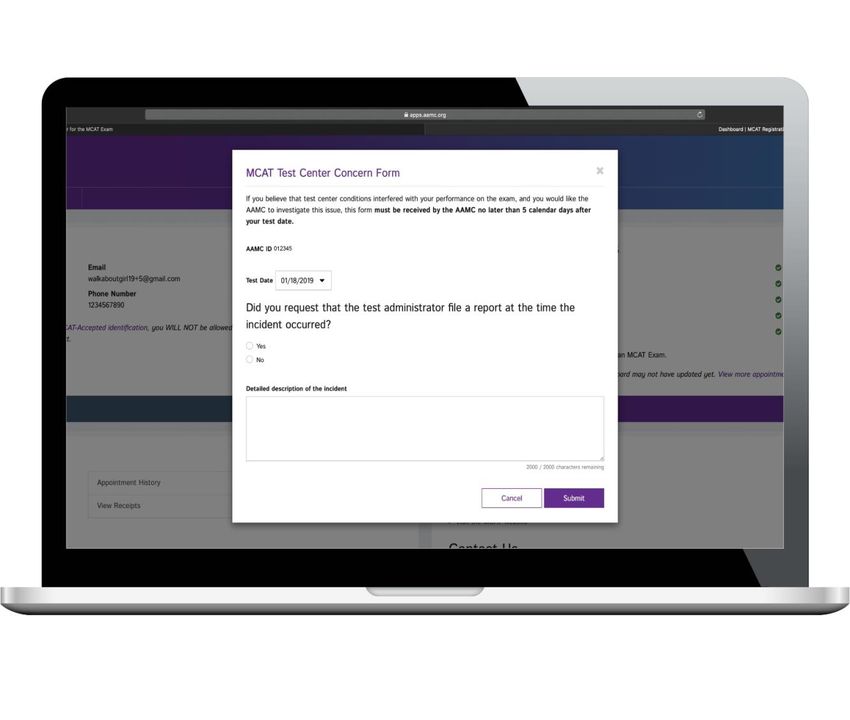
Exam Scoring
              Scoring and Voiding your Exam
              At the end of the exam, examinees will have two minutes to decide between scoring and voiding their
              exam.
              Expedited Score Reporting
              Examinees testing on certain dates will receive score reporting within approximately two weeks as
              opposed to approximately four weeks. Please view our website for the specific test dates in the United
              States and Canada that will have expedited score reporting.
              Scores
              Students will receive the same scores on the shortened exam as they do on the full-length exam.
              Examinees will receive five scores from the shortened version of the exam: one from each of the four
              sections and one combined total score. These scores will have the same precision and confidence bands
              as scores on the full-length exam. Please see our webpage on how the exam is scored for more
              information.

              Testing Irregularities
              Test Center Concerns
              If you believe that test center conditions interfered with your performance on the exam, and you wish to
              have the AAMC research what occurred, you must do both of the following:
                   •     Ask the Test Administrator to file a case report at the time the incident occurs.
                   •     Although the test center is not responsible for researching or resolving any problem(s) you
                         experienced, asking them to file a case report the day of the exam is necessary for the AAMC to
                         take action regarding your Test Center Concern.
                             • If you do not ask the test administrator to witness and document your concern at the time
                                  the problem occurs, the AAMC may not be able to confirm the problem. You may obtain
                                  the case report number from the test administrator to note in your Test Center Concern.
                   •     Submit the MCAT Test Center Concern form through the MCAT Registration System no later
                         than five (5) calendar days following your exam. Concerns received after five calendar days will
                         not be investigated. An MCAT Test Center Concern submitted in the timeframe noted above will
                         receive a written response via email documenting the findings of the investigation.

              If you complete the exam and submit it for scoring, despite the occurrence of a testing irregularity, you are
              not eligible for a refund or a free retest.
              If it is determined that a testing irregularity occurred that deems a score to be invalid, the AAMC reserves
              the right to cancel your score. You will receive verbal and written communication if such an instance
              occurs.
              This process could take up to 30 days after your exam date to be finalized.
              For examinees testing on exam dates with expedited scores: your score will be “held” until the
              investigation is fully concluded. A score on “hold” means you will not be able to view or release your score
              until the investigation is complete. The MCAT Program will not report your score over the phone or in
              email.

© 2020 Association of American Medical Colleges                     5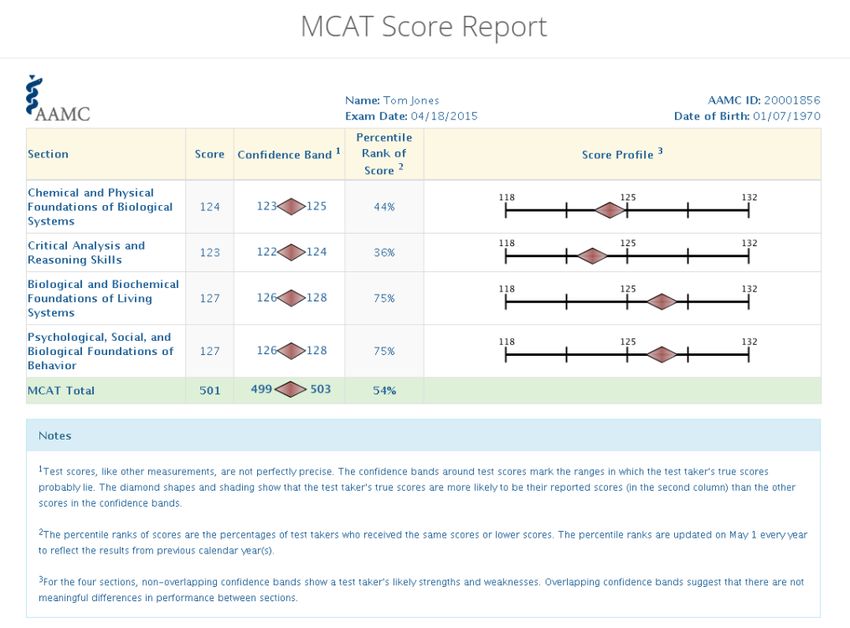
Test Question Challenges
              For the remainder of the 2020 testing year, item challenges will be accepted and reviewed for
              consideration in future examination development. Submissions may not receive a response.

              Discussion of the MCAT Exam
              Examinees taking the MCAT exam beginning May 29 through the remainder of the 2020 testing year are
              to adhere to the same set of expectations around discussion of the exam. Please review these guidelines
              to help you understand the terms under which you may sit for the MCAT exam, the prohibition on
              disclosure of exam content, and how you may share your exam experience.
              While you may read or hear other guidelines inconsistent with these statements, keep in mind that the
              information contained herein, and in the binding MCAT Examinee Agreement is directly from the AAMC.
              By following these guidelines, it is possible to share your MCAT experience without committing a
              violation.
              Please do not hesitate to contact us with any questions. As the next generation of physicians, you are
              needed now more than ever, and the AAMC is proud to support you at every step throughout your
              medical school journey.

              How to Contact with Questions
              MCAT Program
              Association of American Medical Colleges
              655 K St., NW Suite 100
              Washington, DC 20001-2399
              Telephone: 202-828-0600 Contact Form: https://www.aamc.org/contactmcat

              Hours:
              Monday-Friday, 9:00 a.m.-7:00 p.m. ET
              Closed Wednesday, 3:00-5:00 p.m. ET

© 2020 Association of American Medical Colleges                   6
19-070A (08/19)

The MCAT® Essentials
         for Testing Year 2020

Required Reading                                                         MCAT® is a program of the
This guide is required reading and contains important information        Association of American Medical Colleges
and resources about the examinee agreement, registration instructions,
and test-day policies.                                                   aamc.org/mcat
Prepare for the MCAT® Exam Using
AAMC MCAT Official Prep Resources
There isn’t a right or wrong way to prepare for the MCAT® exam, but knowing how and where
to start can be a challenge. The AAMC has developed resources to help you understand the
exam, study, and practice for it!
How to Create a Study Plan
Get a six-step guide to help you create your own study plan. Learn more at aamc.org/mcatprep.
Understand Study
Understand what the MCAT exam is and what Study with a full complement of materials.
it tests.
Khan Academy MCAT Collection
Interactive Content Tool: The Khan Academy MCAT
What’s on the MCAT Exam? Collection contains sample content
Read the content lists and from all four sections of the exam
watch videos to explore and includes 1,100 videos and 3,000
what’s tested in the four review questions to help you study.
exam sections. The collection was created by Khan
Academy with support and funding
from the AAMC and the Robert
Wood Johnson Foundation.
The only guide by the creators of the MCAT exam! The Official Guide Road Maps to MCAT Content
to the MCAT® Exam A Road Map to MCAT® Content in
The AAMC reached out to
Medical College Admission Test
The Official Guide provides
Sociology and Psychology Textbooks
publishers of biochemistry,
The a comprehensive overview psychology, and sociology
Official Guide textbooks for detailed
of the exam, including
to the
MCAT® Exam Association of
American Medical Colleges
information on where to find
information about
registration, what to expect the concepts you’ll need to
on test day, the score scale, know for the MCAT exam.
•
•
The only official comprehensive overview
of the MCAT exam
Everything you need to know about
and how MCAT scores are A Road Map to MCAT® Content
in Biochemistry Textbooks
used in the admissions
the exam sections
• 120 practice questions written by
the test developers at the AAMC
• Tips on how to prepare
process. It also includes
MCAT® is a program of the
Association of American Medical Colleges
Fifth Edition aamc.org/mcat
120 practice questions Association of
American Medical Colleges
and solutions.
continued >>
Learn more about AAMC MCAT Official
Prep resources and practice materials at Association of
aamc.org/mcatprep. American Medical CollegesPractice
Practice with print and online resources written by the test developers. Unless noted otherwise, all resources
include both discrete and passage-based questions, as well as solutions to the questions.
Sample Test Complete Bundle
AAMC This 230-question online AAMC The complete bundle includes
MCAT® practice exam has the same MCAT® all MCAT Official Prep products
Official features and functionality as Official Prep at a discount over ordering each
Prep the MCAT exam, but it does Complete product separately.
Sample not provide a scaled score.
Bundle
Test
Full-Length Practice Exams Online-Only Bundle
AAMC The 230-question online
AAMC The online-only bundle includes
MCAT® practice exams have the same MCAT® all online MCAT Official Prep
Official Prep features and functionality as the Official Prep products.
Practice MCAT exam — with the added Online-Only
benefit of a scaled score and Bundle
Exams
percentile rank.
AAMC MCAT® Official AAMC MCAT®
Question Packs Section Bank
AAMC
Prep Biology Question Official Prep Chemistry
Pack, Vol. 1 & 2 Question Pack
Each question pack offers The online MCAT Section Bank
120 practice questions. MCAT® consists of 300 practice questions
Buy the packs individually Official Prep in the natural, behavioral, and
or as a bundle of six: Section social sciences, with an emphasis
AAMC MCAT® AAMC MCAT® Official biology (two packs), Bank on biochemistry, psychology,
Official Prep Physics
Question Pack
Prep Critical Analysis and
Reasoning Skills chemistry, physics, and and sociology.
critical reasoning (two packs).
Question Pack, Vol. 1 & 2
Practice With the MCAT Print and Online Flashcards
Exam Features Both the print and online MCAT
Practice using the features of
OFFICIAL flashcards contain the same 150
the real MCAT exam, including MCAT® discrete practice questions. You
highlight, strikethrough, and Flashcards get 25 questions in each of these
flag for review. Access this free six disciplines: biochemistry,
resource by logging in to the biology, chemistry, physics,
MCAT Official Prep Hub with psychology, and sociology.
your AAMC credentials.
Learn more about AAMC MCAT Official
Prep resources and practice materials at
aamc.org/mcatprep.
@AAMC_MCAT
19-070Q (10/19)The MCAT® Essentials for Testing Year 2020
Congratulations! Reading The MCAT Essentials is the first step in preparing to take the MCAT exam and
toward a rewarding and fulfilling career in medicine.
The MCAT Essentials is your guide to the official policies and procedures for taking the MCAT exam. The
MCAT Essentials provides you with information about registration, scheduling your exam, test-day
policies, post-test-day procedures, and the rules in place to protect the integrity of the exam. It also
includes information about AAMC MCAT preparation resources as well as other helpful resources.
The information in this guide is necessary for a smooth registration, scheduling, and testing
experience. At the time of registration and on test day, you will be asked to certify that you have
read and agree to comply with the policies and procedures contained within The MCAT
Essentials.
The MCAT Essentials is subject to change from year to year. If you are a returning examinee, you must
read the current version of this guide. The version applicable to you is the version in effect at the time of
your registration.
The Association of American Medical Colleges (AAMC) provides the MCAT exam with the assistance of
its test delivery administrator, Pearson VUE.
You will find contact information throughout this guide if you have questions.
All of us at the AAMC wish you the best and much success as you move forward to a career in medicine!
© 2020 Association of American Medical Colleges 1What Is on the MCAT Exam?
The Medical College Admission Test® (MCAT®) has been part of the medical school admissions process
for over 90 years. Almost all medical schools in the United States, and many in Canada, require
applicants to submit recent MCAT scores, and many health professions and graduate programs accept
MCAT scores in lieu of other standardized tests.
In conjunction with its member medical schools, the AAMC develops and administers the MCAT exam
multiple times each year at hundreds of test sites throughout the United States and Canada, as well as
select locations throughout the world.
The MCAT exam tests concepts that medical school faculty, residents, and medical students rate as
important to entering students’ success. The MCAT is a standardized, computer-based exam with content
divided into four multiple-choice sections. The exam is administered at Pearson VUE test centers.
Content on the MCAT Exam
The MCAT exam has four multiple-choice test sections:
▪ Chemical and Physical Foundations of Biological Systems
▪ Biological and Biochemical Foundations of Living Systems
▪ Psychological, Social, and Biological Foundations of Behavior
▪ Critical Analysis and Reasoning Skills
The first three sections above are organized around 10 foundational concepts or “big ideas” in the
sciences. They draw from disciplines in academic-year-long courses in general chemistry, organic
chemistry, introductory physics, and introductory biology, and from introductory courses in biochemistry,
psychology, and sociology. Multiple choice questions in these sections will ask you to combine your
scientific knowledge from multiple disciplines with your scientific inquiry and reasoning skills.
The Critical Analysis and Reasoning Skills section includes questions that test your ability to comprehend
and analyze information you read in passages taken from a wide range of disciplines in the social
sciences and humanities. This section requires no specific outside content knowledge.
Each section of the exam includes some “field-test” or experimental questions (i.e., questions being
considered for future use that do not count toward your total score).
© 2020 Association of American Medical Colleges 2An overview of the entire MCAT exam as administered on test day:
Exam Overview
Section Number of Time Allotted
Questions
Test-Day Certification 4 minutes
Tutorial (optional) 10 minutes
Chemical and Physical
Foundations of Biological 59 95 minutes
Systems
Break (optional) 10 minutes
Critical Analysis and
53 90 minutes
Reasoning Skills
Mid-Exam Break
30 minutes
(optional)
Biological and Biochemical
Foundations of Living 59 95 minutes
Systems
Break (optional) 10 minutes
Psychological, Social, and
Biological Foundations of 59 95 minutes
Behavior
Void Question 3 minutes
Satisfaction Survey
5 minutes
(optional)
Total Content Time 6 hours and 15 minutes
Total “Seated” Time* Approx. 7 hours and 30
minutes
*Total seated time does not include check-in time upon arrival at the test
center.
© 2020 Association of American Medical Colleges 3Before You Register for the MCAT Exam
AAMC ID
You will need an AAMC ID and an associated username and password to register for the MCAT exam.
If you have previously created an AAMC ID at any time or for any reason — which includes creating an
AAMC ID to purchase or access other AAMC products and services, such as AAMC MCAT Official Prep
Products, the Medical School Admission RequirementsTM (MSAR®) database, the AAMC Fee Assistance
Program, or the American Medical College Application Service® (AMCAS®) application — you must use
the same username and password when registering for your MCAT exam.
If you do not have an existing AAMC ID, you will be directed to create an account and establish a
username and password when logging in to the MCAT Registration System.
If you cannot remember your username or password, DO NOT create a new AAMC ID.
The login page provides options to reset your password or request your username if you cannot remember
your log in credentials. If you encounter problems resetting your password or with your security questions,
please contact AAMC Services. To protect exam security and integrity, you may not create multiple AAMC
IDs for any reason.
If you believe you have multiple accounts or created a duplicate account in error, please
contact the AAMC Account Help Team to resolve the situation. Please allow up to two
business days for a response.
Registration Name and MCAT-Accepted ID
Registration Name
Enter the spelling of your first and last names in the MCAT Registration System exactly the way they
appear on the MCAT-Accepted ID you will use on test day. Do not register using a nickname, partial
names, or initials, and be sure to double check for misspellings. If you do not provide an MCAT-Accepted
ID that exactly matches your registered first and last names at the exam, you will not be allowed to test;
you will be considered a “no-show,” you will not receive a refund, and the appointment will count toward
your testing limits. Even if an ID is valid for flight travel, it may not meet all of the requirements to take
your MCAT exam.
To ensure your ID matches MCAT’s requirements, please review the list below.
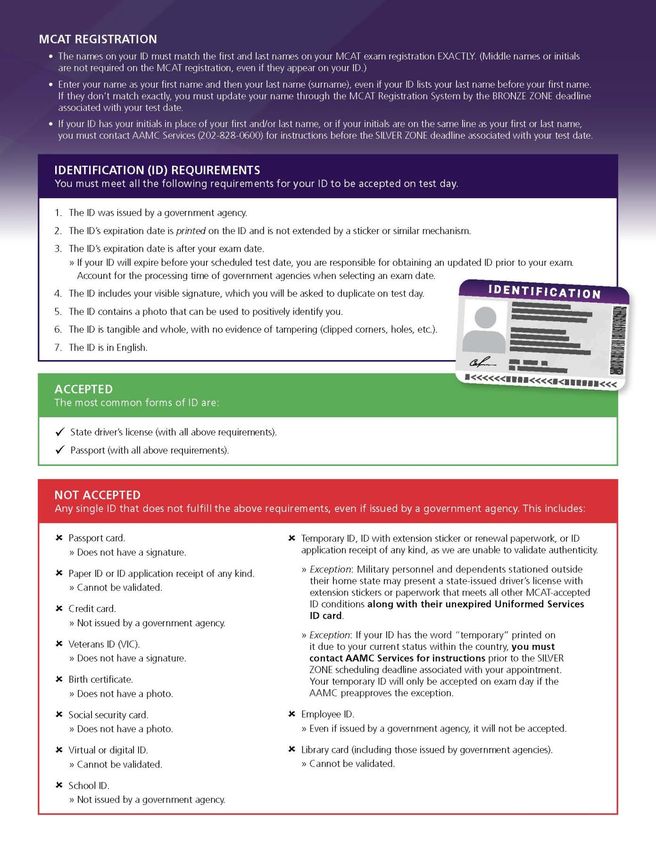
© 2020 Association of American Medical Colleges 4© 2020 Association of American Medical Colleges 5
Resolving Registration Name Requirements

                             If you are unable to provide the required identification, or if you have any concern that
                             your identification may not be acceptable, you MUST contact AAMC Services no later
                             than the Silver Zone scheduling deadline to discuss your options.

              Below are potential issues you may encounter regarding your identification, as well as steps to correct
              them:

               Issue                                   Resolution                                  Deadline to Make Changes
               The first and/or last name(s) you       You MUST change your name in                Bronze Zone Deadline
               entered do not exactly match            the MCAT Registration System to
               the qualifying ID you will use on       match your MCAT-Accepted ID.
               test day.
               Two last names appear on your           Both names MUST be entered into             Bronze Zone Deadline
               ID                                      the MCAT Registration System in
                                                       the “Last Name/Surname” field.
               Initials on your ID                     If your MCAT-Accepted ID has                Silver Zone Deadline
                                                       your initials in place of your full first
                                                       and/or last name(s), you must
                                                       contact AAMC Services for
                                                       instructions.
               Mononymous name                         If you only have a single name              Silver Zone Deadline
                                                       (e.g., Madonna), you must contact
                                                       AAMC Services.

              For information on Registration Zones and Deadlines, see Fees and Deadlines.

              Registration and Scheduling Violations

              The following are violations of the MCAT registration rules that may result in a cancellation of an
              appointment or cancellation of scores, a ban from taking the MCAT exam for a designated period of time
              or permanently, or other consequences (see Investigation Procedures):

                         ▪     Obtaining more than one AAMC ID.
                         ▪     Registering for the MCAT exam under another individual’s AAMC ID.
                         ▪     Allowing someone else to register under your AAMC ID.
                         ▪     Allowing someone else to use your AAMC ID to take the MCAT exam.
                         ▪     Holding multiple reservations at the same time under different AAMC IDs.
                         ▪     Improperly exceeding the testing limits for the exam, including having or using multiple AAMC
                               IDs.
                         ▪     Providing false or inaccurate information when creating an AAMC ID or registering to take the
                               MCAT exam.
                         ▪     Selling or giving away your reservation to someone.
                         ▪     Switching registrations with another examinee.

© 2020 Association of American Medical Colleges                          6
Failure to follow MCAT registration rules may create identity validation and verification issues, the
potential for mistakes in the assignment of score results, and other system disruptions.
If the AAMC suspects that you may have committed a registration/scheduling violation that, if true, would
threaten the validity, integrity, and/or security of the MCAT exam and there is not sufficient time to fully
investigate and resolve the issue prior to your scheduled exam date, the AAMC may, in its sole discretion,
cancel or reschedule your exam to allow time to conclude the investigation.
Eligibility
Eligible Health Professions Programs
You may sit for the exam if you are preparing to apply to and attend a health professions program that
accepts MCAT scores for admissions and you are not currently enrolled in a health professions program.
These programs include:
▪ MD programs.
▪ DO programs.
▪ Podiatric Medicine (DPM) programs.
▪ Veterinary Medicine (DVM) programs.
▪ Any other health-related programs that accept MCAT scores to satisfy a test score
admissions requirement.
At the time of registration, you will be required to agree to a statement verifying that you are taking the
exam solely for the purpose of applying to and attending a health professions program.
Requesting Special Permission
Individuals who do not meet the eligibility requirement above must apply for special permission to take
the MCAT exam. You must apply for special permission if any of the following statements are true:
▪ You wish to take the test for any reason other than solely applying to and attending an eligible
health professions program.
▪ You are currently enrolled in an eligible health-professions program and are looking to change
schools.
▪ You are unable to comply with all AAMC testing procedures for reasons other than a medical
condition or disability. To request adjustments to the standard testing conditions due to medical
conditions or disabilities, please refer to the Testing with Accommodations section.
If you are currently accepted into a health professions program, but have not yet
enrolled in classes, you are not required to obtain special permission.
To apply for special permission, ensure you have an AAMC ID and have completed the information in the
“Personal Information” tab within the MCAT Registration System. You will need to submit a service
request form found on the MCAT Registration System dashboard.
To submit a service request, click the “Submit another service request” link. Complete the form and
include as much detail in your request as possible. We will attempt to review and respond to your request
within five business days.
© 2020 Association of American Medical Colleges 7Failure to obtain special permission may result in, among other consequences, an investigation by the
AAMC, appointment cancellation, cancellation of scores, and/or a ban from taking the MCAT exam for a
designated period or permanently. See the Registration and Scheduling Violations section to learn more
about the AAMC’s investigation process.
International Examinees
There are no additional eligibility requirements for international examinees. If you are in a Bachelor of
Medicine/Bachelor of Surgery (MBBS) degree program or hold the MBBS degree, you may register for
the MCAT exam without seeking special permission if all other eligibility requirements are met.
The AAMC Fee Assistance Program
The AAMC Fee Assistance Program assists those who, without financial assistance, would not be able to
take the exam or apply to medical schools that use the AMCAS application. Approved recipients receive
discounted MCAT exam registration fees, all online AAMC MCAT Official Prep products, and
complimentary access to the Medical School Admission RequirementsTM database.
The AAMC and the Association of Faculties of Medicine of Canada (AFMC) are piloting a fee assistance
program for Canadian examinees who register for the MCAT exam during the 2020 testing year.
Canadian examinees who are eligible and qualify in AFMC’s first application period will receive reduced
scheduling, rescheduling, and cancellation rates and the MCAT® Official Prep Online-Only Bundle
beginning Feb. 3, 2020. Examinees who qualify in AFMC’s second application period will receive reduced
registration rates and the MCAT® Official Prep Online-Only Bundle beginning on April 1, 2020. For more
information regarding the application, evaluation, or qualification process, visit AFMC.
For complete information regarding the Fee Assistance Program, including eligibility requirements,
benefits, and application deadlines, visit the Fee Assistance Program page on the AAMC website to learn
more.
To contact the Fee Assistance Program, email fap@aamc.org or call 202-828-0600.
If you have received Fee Assistance Program approval, but you do not see the reduced
scheduling fees within the MCAT Registration System, contact us immediately. Do not
proceed with scheduling or rescheduling an appointment.
Testing Limits
Examinees who opt to test more than once must adhere to the following restrictions:
▪ You may only hold one (1) MCAT exam appointment at a time.
▪ You may attempt the exam no more than three (3) times in a testing year.
▪ You may attempt the exam no more than four (4) times over two consecutive testing years.
▪ You may attempt the exam no more than seven (7) times in your lifetime (beginning with the
April 2015 test dates and beyond).
© 2020 Association of American Medical Colleges 8Once you begin the exam, you are considered to have used one of your testing attempts even if you void
or do not complete the test. (See Voiding Your Exam.) A voided exam counts as one of your attempts,
regardless of the reason.
A “no show” counts as one of your attempts, regardless of the reason.
Additionally, if you refuse the Test-Day Certification displayed on your monitor before you begin testing,
you will not be able to continue with the exam and your appointment will count as one of your attempts.
Testing With Accommodations
If you have a disability or medical condition that you believe requires an adjustment to standard testing
conditions, we encourage you to apply for testing accommodations. A decision on most requests will be
made within 60 days of receipt of a complete initial application. All initial applications for
accommodations must be submitted electronically via the MCAT Accommodations Online system on the
AAMC website.
You should submit your complete application far enough in advance to allow time to review your request
and confirm any approved accommodations on your test day. Visit our website for more information on
application types and suggested submission time frames. You must be approved for accommodations no
later than the Silver Zone deadline associated with your test date (see Scheduling Zones and Fee
Structure) to allow us time to prepare and implement any approved accommodations. If you have not
received a decision by the Silver Zone deadline or your accommodations are not approved, you may test
under standard conditions or reschedule to a later test date. Applicable rescheduling fees apply.
To increase the likelihood of testing in a convenient location on your preferred test date, we encourage
you to schedule an appointment for your preferred test date as soon as possible. You will be notified via
email when we have made a decision on your request. If your accommodations are approved, be sure to
follow the instructions provided with your approval letter to avoid delays in confirming your
accommodations. While the AAMC will do its best to keep your original appointment or schedule you into
the closest possible date or test site, please understand that some changes to your appointment may be
necessary to support delivery of any approved accommodations.
For detailed information about the accommodations application and registration processes, visit the
MCAT Exam with Accommodations page of the MCAT website or email us at:
accommodations@aamc.org.
The accommodations page of the MCAT website is required reading for all examinees
seeking testing accommodations.
Registering for an MCAT Exam
The MCAT Registration System (MRS)
© 2020 Association of American Medical Colleges 9To begin the registration and scheduling process, log in to the MCAT Registration System (MRS) with
your username and password credentials associated with your AAMC ID. Before selecting a test date and
location, you must complete required registration questions that ask for your contact, background, and
education information along with agreement to various consents and policies. See Registration Name and
MCAT-Accepted ID for associated requirements.
Examinee Agreement
You will be presented with the MCAT Examinee Agreement when you register for your MCAT exam. You
must accept all terms of the Examinee Agreement and The MCAT Essentials in order to complete your
registration and to sit for the MCAT exam. The full text of what you will see at registration is found below.
Introduction
The Examinee Agreement is a legally binding contract between you and the AAMC that sets forth
the terms and conditions under which the AAMC will permit you to register for and take the MCAT
exam. In addition to the prohibitions and terms explained below, all of the policies and procedures
contained in the current version of The MCAT Essentials are expressly incorporated herein as
additional terms of the Examinee Agreement, as well as the AAMC Website Terms and
Conditions, the AAMC Privacy Statement, and any policy statements made on the MCAT
website. Adherence to the Examinee Agreement is necessary to enable the AAMC to maintain for
you and other examinees a fair and secure testing process.
Because the Examinee Agreement is a legally binding contract, you should read it carefully. If you
do not indicate that you understand and agree to abide by the terms of the Examinee Agreement,
you will not be able to register for or take the MCAT exam. By selecting “I Agree” at the end of the
Examinee Agreement, you acknowledge that you have read and understand these rules. On test
day, you will be presented with a Certification Statement that reminds you of your obligations
under the Examinee Agreement. By accepting the Certification Statement on test day and taking
the MCAT exam, you will be certifying that you understand and agree to comply with these
obligations.
Prohibited Items and Behaviors
The following items and behaviors are strictly prohibited during the MCAT exam and during any
scheduled or unscheduled break:
● Possessing, accessing, or using electronic devices, including cellular phones, at any time
after check-in and prior to completing the exam.
● Possessing, accessing, or using cameras or recording equipment of any kind.
● Giving or receiving aid on the MCAT exam.
● Possessing, accessing or using books, notes, or any other written materials (other than
noteboards or test center rules provided for your use and review by test center staff).
● Looking at the content of another examinee’s monitor or noteboard.
● Possessing weapons, including but not limited to, firearms, knives, or any object that
could be used as a weapon, in the test center, including the testing room and waiting
areas.
● Leaving the test center floor or building at any point after check-in and prior to completing
the exam.
© 2020 Association of American Medical Colleges 10● Exhibiting disruptive or abusive behavior, talking in the testing room with anyone other
than a Test Administrator, or talking about or discussing the exam during any scheduled
or unscheduled break.
Possessing, accessing, using, or attempting to possess, access, or use any prohibited item or
engaging or attempting to engage in any prohibited behavior will be considered an intentional and
willful breach of the Examinee Agreement. The AAMC will launch an investigation and may
subject you to one or more of the consequences provided herein for violations of the Examinee
Agreement.
Terms Governing Access to the MCAT Exam
When you accept the following agreement, you are attesting to the following:
I am aware that the MCAT exam is a confidential exam and that its contents will be disclosed to
me on my scheduled test day in a limited context to permit me to test and for no other purpose. I
understand that the AAMC is the exclusive owner of all rights in the MCAT exam, for which it
holds a series of registered copyrights and trade secrets under U.S. and international laws. I
understand that I have no license or permission to copy, adapt, or use any part of the MCAT
exam. I understand that I am bound to keep the MCAT exam content confidential indefinitely,
including, but not limited to: exam questions, passages, graphics, incorrect responses, correct
answers, and topic lists, frequency and order of exam topics, when described in more specific
detail than the What’s on the MCAT Exam? I agree that disclosure, reconstruction, capturing
and/or disseminating of the confidential contents of the MCAT exam would destroy the value and
defeat the purpose of the MCAT exam and irreparably harm the AAMC.
I understand that I may comment on my general exam experience; however, I understand that
discussing or disclosing MCAT content in greater or more specific detail than in the What’s on the
MCAT Exam?, by any means, is a violation of this Examinee Agreement.
Just as I am not permitted to share information about exam content with anyone, I understand
that I also am not permitted to possess, solicit, read, study from, or otherwise use confidential
information about the MCAT exam during my own exam preparation. I certify that I have not
engaged in such conduct prior to taking the exam and that I will not engage in such conduct
during or after the exam. I also agree not to ask any other individual to disclose exam content to
me or to seek out actual live, confidential exam content from any other source. I agree that if I
receive or have access to information or material in any form and from any source, including but
not limited to email, instant messages, text messages, website content, social media posts,
electronic bulletin boards, Internet-based groups, shared or collaborative digital files, electronic
files, and/or paper documents, that I reasonably believe contains confidential MCAT exam
content, or has been represented to contain confidential MCAT exam content, I will immediately
report its existence to the AAMC by sending an email to mcatsecurity@aamc.org. I agree that I
will fully cooperate with any investigation initiated by the AAMC related to my receipt or access to
information believed or represented to contain confidential MCAT exam content.
I certify that all information that I have provided to the AAMC is complete and accurate at the time
of registration for the MCAT exam and if that information has changed, I submitted complete and
accurate updated information. I understand that providing false, misleading, or incomplete
information to the AAMC shall be considered an intentional and willful breach of the Examinee
Agreement and may subject me to one or more of the consequences provided herein for
violations of the Examinee Agreement.
© 2020 Association of American Medical Colleges 11I certify that I am the person whose name and address appear on the MCAT exam registration. I
further certify that I am the person whose name appears on the identification I will present for
admission to the testing room. Unless I have applied for and received special permission to take
the MCAT exam as set out in The MCAT Essentials, I am taking the MCAT exam solely for the
purpose of applying to and attending an eligible health-professions school or program. I
understand that the only eligible programs for which I am permitted to take the MCAT exam are
allopathic, osteopathic, podiatric, and veterinary medicine, or another health-related program that
will accept MCAT exam results to satisfy a test-score admissions requirement.
I certify that, if I am a test preparation company agent or representative, MCAT tutor, or health-
professions or academic advisor, I accurately reported my status as such when I registered for
the exam and, if applicable, I will update any change in such status that takes place after
registration. If I am a test preparation company agent or representative, MCAT tutor, or health-
professions or academic advisor and am taking the MCAT exam for the purpose of applying to
and attending an eligible health-professions school or program, I understand and reaffirm my duty
not to disclose any MCAT content to any person or entity, including my employer, students, or
advisees. If I am not a test preparation company agent or representative, MCAT tutor, or health-
professions or academic advisor, I certify that I am not taking the MCAT exam for the purpose of
obtaining such employment or status.
I understand and agree that any alleged violation of this Examinee Agreement or any alleged
activity that may compromise the validity, integrity, or security of the MCAT exam may be
investigated. Information about the AAMC investigation process may be found in The MCAT
Essentials. If I violate the terms of this Examinee Agreement, including the additional terms or
conditions stated in The MCAT Essentials or any test center rules and regulations, or if I engage
in any activity that may compromise the validity, integrity, or security of the MCAT exam, or fail to
fully cooperate in any investigation of a violation of the Examinee Agreement, I may face the
following consequences:
● The AAMC may issue a report of the factual findings of the investigation to legitimately
interested parties;
● I may be subject to a civil lawsuit and/or criminal charges;
● My MCAT exam may be terminated, and I will not be eligible for a refund or any other
compensation;
● My scores may be canceled, before or after the scores are reported, without a refund;
and
● I may be banned from taking the MCAT exam for a limited time or permanently.
I agree that my personal information will be collected, used, shared, transferred, and stored by
the AAMC subject to this Examinee Agreement.
AAMC Policies Regarding MCAT Examinee Data
The AAMC recognizes our responsibility to treat with care the information it collects about individuals and
to respect their privacy relative to sensitive data concerning them. The AAMC Privacy Statement explains
what kinds of information the AAMC collects and how the AAMC uses this information.
© 2020 Association of American Medical Colleges 12The MCAT program collects personal information in order to administer the MCAT exam, to help prevent
fraud, and to protect the integrity of the exam and the medical school admissions and matriculation
processes. The personal data collected may include demographic, contact, and education information;
health or other sensitive information related to an application for an accommodated exam; a digital
(biometric) palm vein scan, a test day photo, test day audio or video recordings, a digitized ID document,
and your signature(s).
In brief, the AAMC may share your personal information, including your MCAT score, with:
▪ Peer not-for-profit organizations, certifying boards, licensing bodies, and other organizations
involved in medical education for research, eligibility determination, verification, and credentialing
purposes.
▪ Third parties for scholarship opportunities as directed by you during registration or use of another
AAMC service or program.
▪ Service providers who assist the AAMC with technology, test administration, or communications
management activities.
▪ As needed to (i) respond to information requests by law enforcement or other governmental
authorities; (ii) comply with any law, regulation, subpoena or other legal process, or court order;
(iii) investigate and help prevent security threats, fraud, malicious activity, or inappropriate,
unauthorized, or illegal activity involving the AAMC’s services or networks; or (iv) enforce or
protect the AAMC’s rights and property. In such circumstances, personal information may be
disclosed without notice to the individual.
Any information published by the AAMC related to MCAT testing is done so with aggregate data.
Individual test scores are not published or released to third parties unless permitted by the AAMC Privacy
Statement or otherwise authorized by you. Unless otherwise noted, once your personal information is
transferred to third parties, it will be treated in accordance with the third party’s privacy policies. Your
personal information will be transferred to, processed, and stored in the United States and, and if you test
outside the United States, any country necessary to administer the MCAT exam to you from your selected
location.
Release of Personal Information
During the registration process for the MCAT exam, you will be asked to consider the options below.
MCAT Recruiting Service
If you choose to participate in the MCAT Recruiting Service, you authorize the AAMC to release your
name, address, age, sex, state of residence, undergraduate major, email address, and MCAT scores to
those U.S., Canadian, and Caribbean schools of medicine, osteopathy, podiatry, and veterinary medicine;
other health professions programs (as defined in the Eligible Health Professions Programs section of this
document); and U.S. government scholarship programs that participate in the MCAT Recruiting Service.
The AAMC will release your information only to the above-mentioned programs and their related joint
degree programs so long as they are accredited by nationally recognized accrediting bodies, e.g., Liaison
Committee on Medical Education. They may send you information about their programs if you participate
in the MCAT Recruiting Service. The AAMC may charge a reasonable fee for schools and scholarship
programs to participate in the MCAT Recruiting Service.
Participation in the MCAT Recruiting Service is voluntary and may only be elected during
the MCAT registration process. Your decision cannot be changed once the Bronze Zone
Deadline associated with your appointment has passed. The MCAT Program does not
© 2020 Association of American Medical Colleges 13instruct eligible institutions on their method or frequency of contact or of any
distribution of their recruiting materials.
Health Professions Advisor Release
Selecting “Yes” to the Health Professions Advisor Release during the registration process authorizes the
AAMC to release a record of your MCAT scores to your school’s designated, AAMC-approved health-
professions advisor who has met the AAMC-established requirements and confidentiality protocols.
Furthermore, if you applied for fee assistance through the AAMC Fee Assistance Program, and in your
fee assistance application you agreed to release award information to your health professions advisor,
that information will be made available along with your test scores. If you indicated in your American
Medical College Application Service® (AMCAS®) application that you would like your application released
to your health professions advisor, the released AMCAS information will include your MCAT scores
regardless of your answer to this question.
If an undergraduate institution does not have a designated health professions advisor or has not identified
the advisor to the AAMC, we cannot release your scores to the institution.
The Health Professions Advisor Release is voluntary and may be elected during the
MCAT registration process.
Medical Minority Applicant Registry (Med-MAR)
The Medical Minority Applicant Registry (Med-MAR) is an AAMC service designed for medical school
applicants who self-identify as economically disadvantaged or from racial and ethnic groups that are
underrepresented in medicine. If you agree to participate during the registration process, your name,
address, age, sex, state of residence, undergraduate institution, undergraduate major, racial and ethnic
group identification, email address, and MCAT scores will be circulated to U.S. medical schools and
certain health-related agencies as part of an effort to increase opportunities for minorities in medicine.
You are eligible if (a) you are a U.S. citizen, U.S. national, lawful permanent resident (LPR) of the United
States (“Green Card” holder), or have been granted refugee/asylum or Deferred Action for Childhood
Arrivals (DACA) status by the U.S. government; and (b) you are economically disadvantaged or of low
socio-economic status (SES) or you self-identify as a member of a racial or ethnic group historically
underrepresented in medicine — African-American/Black, Hispanic/Latino, American Indian/Alaska
Native, or Native Hawaiian/Pacific Islander.
Participation in the Med-MAR is voluntary and may only be elected during the MCAT
registration process. Your decision cannot be changed once the Bronze Zone Deadline
associated with your appointment has passed. The MCAT Program does not instruct eligible
institutions on the method or frequency of outreach to participants or assist in the development
or distribution of recruiting materials.
Release to Alternate Contact
You may designate an alternate contact who is authorized to contact the AAMC on your behalf to obtain
information about your MCAT registration and exams for which you are scheduled. To protect your private
information, the AAMC does not share your MCAT total or section scores or other sensitive personal
information with your alternate contact.
© 2020 Association of American Medical Colleges 14By completing this authorization, you release the AAMC from any liability resulting from release of
information to the person you designate. This release does not in any way obligate the AAMC to provide
any information to the designated parties.
A separate release is required if you are applying for testing accommodations and would like the
MCAT Office of Accommodated Testing to correspond with medical professionals or others on
your behalf. You may submit this release through the MCAT Registration System “Service
Request” function.
Report Suspected Violations
Fair testing for all MCAT examinees is a priority for the AAMC. The MCAT exam is administered under
strict supervision and security measures.
If you receive, or have access to, information or material in any form from any source that you reasonably
believe contains confidential exam content, or has been represented to contain confidential exam content,
it is your responsibility to immediately report its existence to the AAMC by sending an email to
mcatsecurity@aamc.org.
Reports of Examinee Agreement violations, cheating, disclosure of confidential MCAT exam content,
wrongdoing, or other alleged actions that undermine the integrity of the MCAT exam will be treated in a
confidential manner. If you report such activity, the AAMC will not disclose your identity except on a need-
to-know basis, including responses to subpoenas, court orders, or other legal processes.
What Should I Report?
Before, during, or after test day, please report to the AAMC and/or the test administrator any questionable
behavior you observe or reasonably believe to have occurred or that may occur, including but not limited
to examinees:
▪ Receiving assistance or copying from another test-taker.
▪ Taking a test for someone else.
▪ Having access to secure test questions before or after the exam.
▪ Presenting false, altered, or tampered identification to attempt to gain admission to the test
center.
▪ Attempting to record or otherwise capture test questions during the exam.
▪ Using notes or unauthorized aids.
It is in the interest of all examinees to report the questionable behavior of others. Engaging in any of the
above-listed actions could provide an unfair advantage to an unethical and potentially unqualified
examinee not only on the test, but also as a medical school applicant.
Please report all potential testing violations to 202-903-0840 and/or
mcatsecurity@aamc.org.
© 2020 Association of American Medical Colleges 15Scheduling an MCAT Exam
Once you have answered the necessary registration questions regarding your contact, background, and
education information, as well as agreed to various terms and policies, you will be able to schedule a test
date and location.
Scheduling Details
The MCAT exam is administered at hundreds of locations throughout the United States, Canada, as well
as select locations internationally. The most current list of test centers is available in the MCAT
Registration System. Test centers have limited capacity, and seats are reserved on a first-come, first-
served basis.
You must complete your registration online via the MCAT Registration System prior to scheduling your
MCAT appointment. Once scheduled, you will receive an email confirming your appointment. If you do
not receive an email confirmation within 24 hours of scheduling (be sure to check your spam
folder first) then please contact us immediately.
After scheduling your appointment, you will receive an email confirmation with the details of your
appointment, including the name that you used to register. Be sure to compare this name to the name on
your MCAT-Accepted ID you will use on test day.
The name you registered with must exactly match the spelling of the name on your
MCAT-Accepted ID in order to be admitted to the exam. If you need to change your name,
you must do so by the Bronze Zone deadline of your exam. (See Registration Name and
MCAT-Accepted ID.)
Scheduling Fees and Deadlines
There are three scheduling zones for each exam date: Gold, Silver, and Bronze. For each exam date,
Gold Zone scheduling fees are lower and flexibility is higher. Conversely, fees are higher, and flexibility is
limited in the Bronze Zone.
If you are scheduling, rescheduling, or canceling on the deadline day and experience technical
problems, we may not be able to assist you in time to meet the deadline to secure your
appointment.
All deadlines for the Gold, Silver, and Bronze Zones occur a set number of days prior to the exam. All
deadlines take effect at 11:59 p.m. local, test center time. For example, if your MCAT exam is
scheduled for Aug. 9, 2019, in Los Angeles, California, your Bronze Zone Scheduling deadline is 11:59
p.m. PT on Aug. 1, 2019. See Scheduling Zones and Fee Structure to view the applicable registration
fees and restrictions for this testing year’s MCAT exam. Refer to Scheduling Deadlines for details about
specific deadline dates.
© 2020 Association of American Medical Colleges 16The AAMC does not grant deadline extensions.
Applicable Taxes
Examinees may be required to pay applicable sales tax, value-added tax, Goods and Services Tax, or
similar tax required by law in the country or locality in which they are testing. If taxes are applicable, they
will be collected at the time of scheduling.
© 2020 Association of American Medical Colleges 17“To Be Determined” Test Centers
“To Be Determined” sites — shortened as “TBD sites” — are generalized locations in metropolitan areas
as decided by Pearson VUE. These sites do not have determined addresses at the time of scheduling.
“To Be Determined” sites exist for the sole purpose of offering as many seats as possible on each test
date. “To Be Determined” sites should only be chosen if you have the flexibility to travel within a
metropolitan area. This area may have up to a 40-mile radius from the central location. Examinees who
register for a “To Be Determined” site will not be eligible for a free reschedule based on the final location
of the site.
After you schedule an appointment at a “TBD site” site, you will be sent the test center address no less
than 30 days prior to your exam date via email. The address information will also appear in the MCAT
Registration System at that time.
Changing Your Appointment
Requests to reschedule your appointment may be made online via the MCAT Registration System or by
calling 202-828-0600. You will receive an email confirming your rescheduled appointment. If you do not
receive an email within 24 hours of rescheduling, please check your spam filter first and then contact us
immediately.
Please note additional fees will apply regardless of how quickly a change is requested
after your initial scheduling. No exceptions will be made. (Refer to Scheduling Zones and
Fee Structure.)
Making all your changes at one time will save you money. For example, if you make a simultaneous
change to both test date and test center, you will only be charged one rescheduling fee; however, if you
make the changes separately, a fee will be assessed for each change.
You may change your test date and/or test center, provided:
▪ Scheduling has opened for the desired exam date.
▪ Space is available. Current availability can be found online via the MCAT Registration System.
▪ Changes are made prior to the Silver Zone scheduling deadline for the exam that you are
currently scheduled to take.
▪ Changes are made prior to the Bronze Zone scheduling deadline for the exam that you wish to
reschedule into. Once that exam date is past the Bronze Zone deadline, scheduling is no longer
allowed.
When rescheduling an exam to or from an area where taxes are collected, you may be prevented from
completing your transaction on the web. If this is the case, contact us by phone as soon as possible for
assistance rescheduling your appointment. The base fee to reschedule will be the same, however, the
amount of tax on that fee may change depending on the location of the new test center.
You cannot reschedule into a future testing year.
© 2020 Association of American Medical Colleges 18You can also read


