The Michoacán Centipede Snake, Tantilla cascadae Wilson and Meyer, 1981 (Squamata: Colubridae): New record for Jalisco, with notes on ...
←
→
Page content transcription
If your browser does not render page correctly, please read the page content below

Herpetology Notes, volume 14: 263-268 (2021) (published online on 01 February 2021)

    The Michoacán Centipede Snake, Tantilla cascadae Wilson and
    Meyer, 1981 (Squamata: Colubridae): New record for Jalisco,
      with notes on conservation, biogeography, and a key to the
                species of the genus in western Mexico

    Aldo Dávalos-Martínez1,*, Víctor Fernando Záizar-Gutiérrez1, Daniel Cruz-Sáenz2, Eduardo Daniel Roldán-
                                        Olvera1, and Larry David Wilson3

Abstract. Tantilla cascadae is a rare centipede snake that inhabits western Mexico and is only known from two localities and
three specimens. In this work we report two new specimens from a new locality in the municipality of Tamazula de Gordiano,
Jalisco, Mexico. We assess the biogeographical and physiographical component of the species’ distribution, and discuss the
conservation status of the species proposing a new IUCN conservation assessment of Endangered. We additionally present a
dichotomous key for the genus Tantilla in western Mexico.

Keywords. Southern Jalisco, western Michoacán, IUCN, land-use change, mining, avocado, new locality

Introduction                                                       This species is a member of the Tantilla calamarina
                                                                 species group, which consists of seven species
  The Michoacán Centipede Snake, Tantilla cascadae
                                                                 distributed along the Pacific versant from northwestern
Wilson and Meyer, 1981, is a centipede snake of the
                                                                 Mexico to Costa Rica (Canseco-Márquez et al., 2007b):
family Colubridae, endemic to western Mexico. It
                                                                 Tantilla calamarina Cope, 1866; T. cascadae Wilson
inhabits oak and pine-oak forest (Duellman, 1961; Cruz-
                                                                 and Meyer, 1981; T. ceboruca Canseco-Márquez,
Sáenz et al., 2015) in south-central Jalisco and central
                                                                 Smith, Ponce-Campos, Flores-Villela and Campbell,
Michoacán at elevations of 1430–1858 m (Wilson and
                                                                 2007b; T. coronadoi Hartweg, 1944; T. deppei (Bocourt,
Mata-Silva, 2015). The species is classified by the
                                                                 1883); T. sertula Wilson and Campbell, 2000; and T.
Mexican law as Threatened (SEMARNAT, 2010), as
                                                                 vermiformis (Hallowell, 1861) (Wilson and Mata-Silva
Data Deficient (DD) by the IUCN Red List (Canseco-
                                                                 2015). Wilson and Meyer (1981) defined the group by
Márquez et al., 2007a), and has an Environmental
                                                                 the presence of a middorsal dark stripe and a dark lateral
Vulnerability Score (EVS) of 16 (Johnson et al., 2017).
                                                                 stripe on rows three and four, except in T. deppei, which
                                                                 can have two stripes (one on rows two and three and
                                                                 another in row five) and in T. cascadae, in which the
1
  Universidad de Guadalajara, Centro Universitario de Ciencias   lateral stripe on rows three and four disappears on the
   Biológicas y Agropecuarias, km 15.5 Carretera Guadalajara-    forepart of the body. Some species of the group also
   Nogales, Predio Las Agujas, A.P. 1-1919, Zapopan 44101,       have the central portion of the parietals covered with a
   Jalisco, México.                                              spatulate anterior extension of the middorsal dark stripe,
2
  Universidad de Guadalajara, Centro Universitario de Ciencias   which continues anteriorly to cover the remainder of
   Biológicas y Agropecuarias, Centro de Estudios en Zoología,   the head. On either side of this central head mark a
   km 15.5 Carretera Guadalajara-Nogales, Predio Las Agujas,
                                                                 postparietal pale spot usually grades posteriorly into
   A.P. 1-1919, Zapopan 44101, Jalisco, México.
3
  Centro Zamorano de Biodiversidad, Escuela Agrícola
                                                                 the ground colour of the dorsolateral area between the
   Panamericana Zamorano, Departamento de Francisco              lateral and median dark stripes and connects anteriorly
   Morazán, Honduras; 1350 Pelican Court, Homestead, Florida     with a narrow extension that proceeds along the side of
   33035-1031, USA.                                              the parietal, over the supraocular and onto the side of the
*
  Corresponding author. E-mail:                                  prefrontals and internasals.
   aldodavalosmartinez@gmail.com                                   Virtually nothing is known on the natural history of
© 2021 by Herpetology Notes. Open Access by CC BY-NC-ND 4.0.     Tantilla cascadae except for the note on the specimen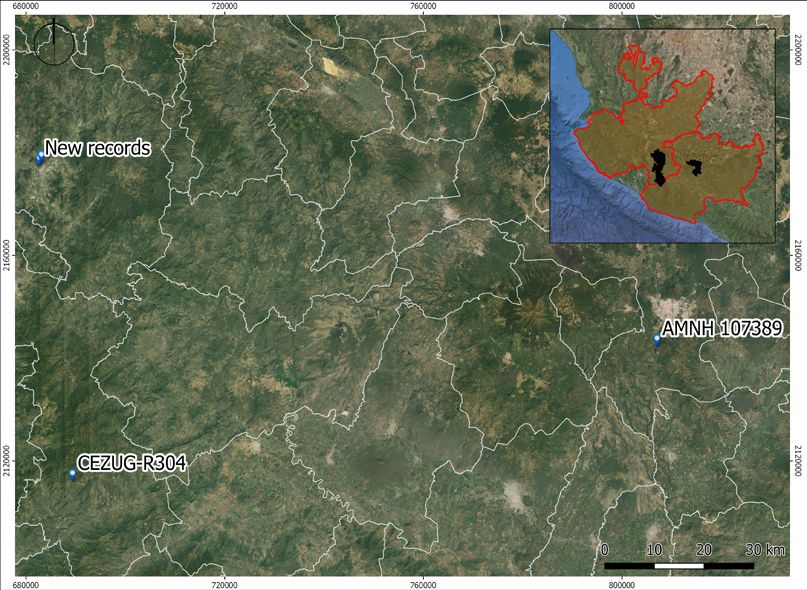
264                                                                                     Aldo Dávalos-Martínez�������

found in 2000 by Heimes (2016) at the type locality:         Comisión Nacional de Áreas Naturales Protegidas
“after being exposed from its hiding-place under a small     (CONANP).
rock the snake tried to retreat quickly into a deeper          For the dichotomous key, we defined “western Mexico”
subterranean passage”.                                       as the region including the states of Aguascalientes,
  Tantilla cascadae is a rare species only known from        Colima, Jalisco, Michoacán, Nayarit, and Zacatecas.
three records: the holotype specimen (AMNH 107389)           We obtained morphological and geographic distribution
from “Tzaráracua Falls (=Cascada la Tzaráracua), S of        data from Reyes-Velasco et al. (2012), Wilson and
Uruapán [10.5 km south, according to Duellman, 1961],        Mata-Silva (2014) and Heimes (2016).
Michoacán, México.” (Wilson and Meyer, 1981), one
photographed individual collected by Heimes (2016)           Results
also from the type locality, and one individual collected      New records. Herein we present two new specimens
in the municipality of Pihuamo, ca. 20 km southeast          of Tantilla cascadae from a new locality in the
from the urban area of Pihuamo, Jalisco, Mexico              municipality of Tamazula de Gordiano, Jalisco, Mexico
(CEZUG-R304; Cruz-Sáenz et al., 2015).                       (Fig. 1). On 1 July 2019 in Cerro La Mesa, 1.14 km NW
  In this work we assess the species’ conservation status,   of Tamazula de Gordiano (19.6849°N, -103.2572°W;
its biogeographic and physiographic regionalisation,         WGS 84; elevation 1447 m) we found a female T.
and provide to its distribution a new locality with two      cascadae (CEZUG-R436); the snake measured 188.03
new specimens. We also provide a dichotomous key for         mm in total length with a tail/total length ratio of 0.198.
the species of Tantilla in western Mexico.                   The specimen has 145 ventrals, 42 subcaudals, six
                                                             supralabials, six infralabials, two postoculars, and a
Materials and Methods                                        lateral dark stripe that is barely perceptible on the first
                                                             third of the body, but is more noticeable towards the
  We undertook diurnal fieldwork in the municipality
                                                             posterior end of the body. We kept the snake in captivity
of Tamazula de Gordiano in Jalisco, Mexico. We
                                                             for a few months before euthanising it and we feed it
collected the specimens under collection permit SGPA/
                                                             with larvae of the mealworm beetle (Tenebrio molitor
DGVS/01205/17, granted to Fausto R. Méndez de la
                                                             Linnaeus, 1758). To our knowledge, this is the first data
Cruz by the Secretaria de Medio Ambiente y Recursos
                                                             on the diet in captivity, and in general, for the species.
Naturales. We confirmed the identification of the new
                                                               On 14 March 2020 in Cerro La Mesa, 1.7 km N of
specimens reported (CEZUG-R436-R445) using the
                                                             Tamazula de Gordiano (19.6907°N, -103.2534°W;
keys and descriptions provided by Wilson and Mata-
                                                             WGS 84; elevation 1358 m), we found another female
Silva (2014).
                                                             Tantilla cascadae (CEZUG-R445). The snake measured
  We discuss the species’ conservation assessment
                                                             192.6 mm in total length with a tail/total length ratio of
based on observations in the field made at the three         0.175. The specimen has 141 ventrals, 38 subcaudals, six
known localities. We assess the Extent of Occurrence         supralabials, six-five infralabials, and two postoculars.
(EOO) and Area of Occupancy (AOO) with Geospatial            We could not obtain data on the lateral stripe of this
Conservation Assessment Tool (GeoCAT; Bachman et             specimen.
al., 2011) using the auto-value cell width of 13 km and        We found both specimens (vouchers CEZUG-R436
we made the IUCN categorisations using the Guidelines        and CEZUG-R445) under rocks while conducting
for Using the IUCN Red List Categories and Criteria          diurnal fieldwork. The habitat of the site is tropical
(IUCN Standards and Petitions Committee, 2019).              deciduous forest. We deposited the specimens in the
  We obtained biogeographical data with QGIS                 vertebrate collection of the Centro de Estudios en
Geographic Information System and Google Earth.              Zoología of the Universidad de Guadalajara.
For assessing the physiographic and biogeographic              These records represent third and fourth vouchered
provinces of the species, we used the regionalisation        specimens of T. cascadae, the second record for the
as proposed by Cruz-Sáenz et al. (2017), INEGI               state of Jalisco, and the third known locality for the
(INEGI, 2020; Biblioteca digital de Mapas. Available         species (Fig. 2). These records extend its known
from: https://www.inegi.org.mx/app/biblioteca/ficha.         distribution 62.3 km north from the Pihuamo locality
html?upc=702825267575 [Accessed 20 May 2020)])               (CEZUG-R304) and 129 km northwest from the type
and Morrone et al. (2016). We obtained the Natural           locality (AMNH 107389). The new locality represents
protected areas data from the shape files provided by        the lowest elevation recorded for the species (1358 m
The Michoacán Centipede Snake: New record for Jalisco, western Mexico 265 Figure 1. (A) Tantilla cascadae (CEZUG R-436) in life. (B) Tantilla cascadae (CEZUG R 445) in life and (C) after euthanasia. Photographs by Eduardo D. Roldán-Olvera (A), Víctor F. Záizar-Gutiérrez (B) and Aldo Dávalos-Martínez (C). for CEZUG-R445), the northernmost locality, and the local tourist activities that take place there, including first record in tropical deciduous forest. littering and the use of horses for recreational purposes. Conservation. Tantilla cascadae is only known from three localities. We estimated an EOO of 2977.385 km2 and an AOO of 500.460 km2. The EOO of the species lies in southeastern Jalisco and western Michoacán. This is one of the areas with the highest rate of illegal land-use change in western Mexico, principally due to the recent and current increase of avocado plantings. Although all the EOO is at risk, each locality has its own environmental problems. Uruapan and its surroundings are attacked constantly by human caused-forest fires and illegal logging for land-use change, whether for developing new urban areas or for preparing new sites for avocado tree planting. The pesticides and herbicides used in agricultural activities also cause environmental damage in the area. The type locality, the Tzaráracua Falls, is at constant risk in due to the contamination of Figure 2. Known distribution of Tantilla cascadae in western the Cupatitzio River, the presence of loose livestock, and Mexico. Map by Víctor F. Záizar-Gutiérrez.
266                                                                                                        Aldo Dávalos-Martínez�������

Table 1. 1.
  Table  Physiographic
            Physiographicand
                          and biogeographic  regionalisation
                              biogeographic regionalization of of Tantilla
                                                               Tantilla    cascadae.
                                                                        cascadae.

 Voucher          Mexican biogeographic provinces   INEGI Physiographic       INEGI Physiographic             Physiographic regions of Jalisco
                  (Morrone et al., 2016)            Provinces                 Subprovinces                    (Cruz-Sáenz et al., 2017)
 AMNH 107389      Transmexican Volcanic Belt        Eje Neovolcánico          Escarpa Limítrofe del Sur       No data available
 CEZUG-R304       Sierra Madre del Sur              Sierra Madre del Sur      Cordillera Costera del Sur      Sierra de Coalcomán
 CEZUG-R436       Pacific Lowlands                  Sierra Madre del Sur      Cordillera Costera del Sur      Trans-Mexican Volcanic Belt
 CEZUG-R445       Pacific Lowlands                  Sierra Madre del Sur      Cordillera Costera del Sur      Trans-Mexican Volcanic Belt

Also, the municipal garbage dump of Uruapan is nearby,                   Recursos Naturales Las Huertas (60 km from both
potentially causing contamination and presence of rats,                  localities).
feral cats, and feral dogs in the area.                                    When Tantilla cascadae was first assessed in terms of
  The new locality reported here for CEZUG-R436                          the IUCN Red List (Canseco-Márquez et al., 2007a) the
and CEZUG-R445, although very close to the town                          species was only known from the type locality; since
of Tamazula de Gordiano and with loose livestock and                     then, two new localities have been reported (including
local tourist activities, remains relatively well conserved              the one herein presented) providing new information
because the people of the town see it as a natural reserve.              regarding its known distribution. Due to the EOO and
A few little opencast mines were started many years                      AOO results, the potential of habitat loss potential to
ago and now are abandoned. The surroundings of the                       the southeastern Jalisco and eastern Michoacán area,
town, however, are highly at risk due to the agricultural                and the conservation problems as discussed above, we
activities of the planting of sugar cane and berries,                    recommend a conservation assessment of Endangered
which includes herbicide and pesticide contamination,                    (EN) [B1a (i, ii, iii)] for this species.
water loss, and land-use change.                                           Biogeography. We followed four physiographic and
  The locality reported in Pihuamo for CEZUG-R304                        biogeographic regionalisation proposals to describe the
                                                                       1
is the most threatened one. Until recently the primary                   biogeographic component of the distribution of Tantilla
vegetation of the area was well conserved, mainly due                    cascadae (Table 1), only the type locality could not be
to drug related activities in the site. Although it has                  assessed with the proposal made by Cruz-Sáenz et al.
been lately at a high risk for the increasing opencast                   (2017). With the three known localities of the species,
mining in the area, where at least two big mines, one                    we estimated an EOO of 2977.385 km2.
of manganese and one of iron, have been operating for                      Dichotomous key. Six species of Tantilla occur in
the last several years. As is known, opencast mining is a                western Mexico; Tantilla bocourti (Günther, 1895)
very invasive activity and the habitat at that site is close             (T. rubra species group), T. calamarina, T. cascadae,
potentially to being lost.                                               T. ceboruca (T. calamarina species group), T. wilcoxi
  Another conservation concern is that none of the                       Stejneger, 1902 and T. yaquia Smith, 1942 (T. planiceps
localities are within any natural protected areas (NPA).                 species group) (Wilson and Mata-Silva, 2014).
Natural protected areas are listed in order of nearest to                  Dichotomous key of the species of the genus Tantilla
farthest and with its approximately distance from each                   from western Mexico:
locality. The Uruapan locality (AMNH 107389) has                           1 Dorsum uniform in colour or nearly so, without
three NPAs around it, the Parque Nacional Barranca                            stripes or bands … 2
del Cupatitzio (9 km), Área de Protección de Flora y                       - Dorsum with definite stripes or bands … 5
Fauna Pico de Tancítaro (20 km), and Reserva de la
                                                                           2 Pale nuchal band crosses posterior portion of
Biósfera Zicuirán-Infiernillo (45 km). Both the Pihuamo
                                                                              parietals … 3
(CEZUG R-304) and the Tamazula de Gordiano
                                                                           - Pale nuchal band borders parietals or present 1–3
localities (CEZUG R-436 and CEZUG R-445) have
                                                                              scales posterior to parietals … 4
the same three NPAs around them, the Parque Nacional
Nevado de Colima (40 km from Tamazula de Gordiano                          3 Secondary temporal elongate; ventrals 135–164;
and 60 km from Pihuamo), Área de Protección de Flora                         black head cap extends to or below corner
y Fauna El Jabalí (50 km from Tamazula de Gordiano                           of mouth, including parts of 6th and 7th
and 60 km from Pihuamo) and Área de Protección de                            infralabials. In the study area, this species is
The Michoacán Centipede Snake: New record for Jalisco, western Mexico 267
present in Aguascalientes, northern Jalisco, and biogeographical patterns within the Tantilla calamarina
southern Zacatecas … T. wilcoxi species group.
- Secondary temporal about same size as dorsal Conservation of narrowly-distributed endemic
body scales; ventrals 160–195; black head species is of vital importance, especially in areas with
cap does not extend to corner of mouth, or high degrees of environmental impact. With the data
below it onto 6th and 7th infralabials. The presented herein, we support the importance of tropical
species is widely distributed in western Mexico and temperate forests from southern Jalisco and western
… T. bocourti (part) Michoacán for the conservation of Tantilla cascadae
and as a reservoir of endemic taxa.
4 Pale nuchal band distinct, bordered behind by
Further research and conservation actions should
dark nape band; ventrals 160–195; varying pale
be taken in place to help the conservation of Tantilla
markings usually present on the internasals
cascadae, such as the discovery of new localities, and
and prefrontals and sometimes on the anterior
in-situ conservation programs in the known distribution
portion of the supraoculars and parietals. This
areas.
species is widely distributed in western Mexico
… T. bocourti (part)
Acknowledgments. We thank Dante S. Figueroa-Martínez,
- Pale nuchal band sometimes distinct, not Sabina Ascencio-Ramírez, Oassis F. Huerta-Galván, and Jairo D.
bordered posteriorly by dark pigment, if so, Uribe-Mendoza for providing valuable comments and information
pigment reduced to series of spots; ventrals that improved the manuscript’s first draft. We also thank Fausto
134–165; a pale preocular spot is present on the R. Méndez de la Cruz for providing the collection permit SGPA/
1st supralabial, and a prominent pale postocular DGVS/01205/17 issued by the Secretaría de Medio Ambiente y
spot on the lower 1/3 – ½ of the anterior Recursos Naturales.
temporal and the majority of the 4th, 5th, and
6th supralabials. In the study area the species is References
present in northern Nayarit … T. yaquia Bachman, S., Moat, J., Hill, A.W., de la Torre, J., Scott, B.
(2011): Supporting Red List threat assessments with GeoCAT:
5 A single postocular; ventrals 106–140. In the geospatial conservation assessment tool. In e-Infrastructures
study area is present on the pacific versant for data publishing in biodiversity science. Smith, V. and L.
of Nayarit, Jalisco, Colima, and Michoacán Penev (Eds.). ZooKeys 150: 117–126. https://doi.org/10.3897/
… T. calamarina zookeys.150.2109.
- Two postoculars; ventrals 136–153 … 6 Bocourt, M.F. (1883): Etudes sur les reptiles. Pp. 1–1012 In
Recherches Zoologiques pour servir a l’Histoire de Ia Faune
6 Supralabials 6. This species is present in south- de l’Amérique Centrale et du Mexique. Mission Scientifique
eastern Jalisco and west-central Michoacán au Mexique et dans l’Amér Imprimerie Impériale. Duméril, A.,
… T. cascadae M.F. Bocourt, and F. Mocquard. Paris, France.
- Supralabials 7 This species is known only Canseco-Márquez, L., Campbell, J.A., Ponce-Campos, P.,
Muñoz-Alonso, A., García-Aguayo, A. (2007a): Tantilla
from three localities in south-central Nayarit,
cascadae. The IUCN Red List of Threatened Species 2007:
west-central Jalisco, and northern Colima
e.T63939A12730009. Accessed on 28 May 2020. https://dx.doi.
… T. ceboruca org/10.2305/IUCN.UK.2007.RLTS.T63939A12730009.en.
Canseco-Márquez, L., Smith, E.N., Ponce-Campos, P., Flores-
Discussion Villela, O., Campbell, J.A. (2007b): A new species of Tantilla
(Squamata: Colubridae) of the calamarina group from Volcán
Regional dichotomous keys can be of valuable help Ceboruco, Nayarit, Mexico. Journal of Herpetology 41:
when dealing with genera with high numbers of species, 220–224. https://doi.org/10.1670/0022-1511(2007)41[220:
such as Tantilla. Our key can be a tool for students, ANSOTS]2.0.CO;2.
naturalists, and environmental consultants that sample Cope, E.D. (1866): Fifth contribution to the herpetology of tropical
and conduct research in western Mexico and can help America. Proceedings of the Academy of Natural Sciences of
them to identify correctly this and other species, which Philadelphia 18: 317–323.
Cruz-Sáenz, D., Muñoz-Nolasco, F.J., Lazcano, D., Flores-
can result in the generation of more knowledge about
Covarrubias, E. (2015): Noteworthy records for Tantilla cascadae
this still poorly-known species.
and T. ceboruca (Squamata: Colubridae) from Jalisco, Mexico.
The biogeographical and physiographical data Check List 11: 1–5. http://dx.doi.org/10.15560/11.4.1708.
provided in this work, in addition to molecular data, can Cruz-Sáenz, D., Muñoz-Nolasco, F.J., Mata-Silva, V., Johnson,
be used in the future to hypothesise the evolutionary and J.D., García-Padilla, E., Wilson, L.D. (2017): The herpetofauna268 Aldo Dávalos-Martínez�������
of Jalisco, Mexico: composition, distribution, and conservation. Reyes-Velasco, J., Grünwald, C.I., Jones, J.M., Price, M.S.,
Mesoamerican Herpetology 4: 23–118. Fisher, J.T. (2012): Geographic distribution. New Distributional
Duellman, W.E. (1961): The amphibians and reptiles of Michoacán, Records for the Herpetofauna of Mexico. Herpetological Review
México. University of Kansas Publications, Museum of Natural 43: 455–457.
History 15: 1–148. https://doi.org/10.5962/bhl.part.7287. SEMARNAT. (2010): Norma Oficial Mexicana, NOM-059-
Günther, A.C.L.G. (1895): Reptilia and Batrachia. Biologia SEMARNAT-2010, Protección ambiental– Especies nativas
Centrali-Américana. UK, Taylor and Francis. [published in parts de México de flora y fauna silvestres– Categorías de riesgo y
from 1885-1902; reprint by the SSAR 1987]. especificaciones para su inclusión, exclusión o cambio– Lista de
Hallowell, E. (1861): Report upon the Reptilia of the North Pacific especies en riesgo. Ciudad de México, México, Diario Oficial
Exploring Expedition, under command of Capt. John Rogers, de la Federación.
U. S. N. Proceedings of the Academy of Natural Sciences of Smith, H.M. (1942): A resume of Mexican snakes of the genus
Philadelphia 12: 480–510. Tantilla. Zoologica 27: 33–42.
Hartweg, N. (1944): Remarks on some Mexican snakes of the Stejneger, L. (1902): The reptiles of the Huachuca Mountains,
genus Tantilla. Occasional Papers of the Museum of Zoology, Arizona. Proceedings of the United States National Museum 25:
University of Michigan 486: 1–9. 149–158. https://doi.org/10.5479/si.00963801.1282.149.
Heimes, P. (2016): Snakes of Mexico. Frankfurt, Germany, Wilson, L.D., Campbell, J.A. (2000): A new species of the
Chimaira. calamarina group of the colubrid snake genus Tantilla (Reptilia:
IUCN Standards and Petitions Committee. (2019): Guidelines Squamata) from Guerrero, Mexico, with a review of and key to
for Using the IUCN Red List Categories and Criteria. Version members of the group. Proceedings of the Biological Society of
14. Prepared by the Standards and Petitions Committee. Washington 113: 820–827.
Downloadable from http://www.iucnredlist.org/documents/ Wilson, L.D., Mata-Silva, V. (2014): Snakes of the genus Tantilla
RedListGuidelines.pdf. (Squamata: Colubridae) in Mexico: taxonomy, distribution, and
Johnson, J. D., Wilson, L.D., Mata-Silva, V., García-Padilla, E., conservation. Mesoamerican Herpetology 1: 5–95.
DeSantis, D.L. (2017): The endemic herpetofauna of Mexico: Wilson, L.D., Mata-Silva, V. (2015): A checklist and key to the
organisms of global significance in severe peril. Mesoamerican snakes of the Tantilla clade (Squamata: Colubridae), with
Herpetology 4: 544–620. comments on distribution and conservation. Mesoamerican
Linnaeus, C. (1758): Systema Naturae, per Regna Tria Herpetology 2: 418–498.
Naturae, secundum Classes, Ordines, Genera, Species, cum Wilson, L.D., Meyer, J.R. (1981): Systematics of the calamarina
Characteribus, Differentiis, Synonymis, Locis. Tomus I. Tenth group of the colubrid snake genus Tantilla. Milwaukee Public
Edition. Stockholm, Sweden, Laurentii Salvii. https://doi. Museum Contributions in Biology and Geology 42: 1–25.
org/10.5962/bhl.title.542.
Morrone, J.J., T. Escalante, T., Rodríguez-Tapia, G. (2016):
Mexican biogeographic provinces: Map and shapefiles. Zootaxa
4277: 277–279. https://doi.org/10.11646/zootaxa.4277.2.8.
Accepted by Robson ÁvilaYou can also read


